Specs are compiled from manufacturer listings and verified buyer reviews and can change over time — please confirm the key details on the product page before buying.
Buying semi truck tires is not like buying tires for a pickup. A single wrong load rating or ply count can mean a blowout on a loaded trailer, a failed DOT inspection, or a set of drives that cups out in 20,000 miles. The seven tires below cover steer, drive, and all-position duty for Class 7 and 8 trucks, each chosen on published load index, ply rating, and weight.
This guide is built by comparing the manufacturers’ published specifications and the patterns across verified customer reviews, so you get each pick’s real strengths and trade-offs instead of marketing spin.
You will see load index, ply rating, and weight compared side by side, so you can match a tire to your axle position and duty cycle instead of guessing. Every pick below earns its spot on this list of the best semi truck tires.
Top Picks


How To Choose The Best Semi Truck Tires
Start with the axle, not the brand. A steer tire carries the front of the truck and needs straight-line stability; a drive tire puts power to the road and needs biting edges; an all-position tire has to do both. Match the tire to the wheel position first; load index, tread, and ply rating all follow from it.
Read the load index before anything else
The load index is a code number that tells you the maximum weight one tire can carry when inflated to its rated pressure. A higher number means more capacity per tire. If you haul near the legal limit, a low load index leaves a single corner at risk of overload no matter how you set pressures. Check the index against your actual scaled axle weights, not the door sticker alone.
Ply rating and load range letters
Ply rating describes how many layers of cord the tire’s carcass is built to match — a 14-ply tire has a heavier casing than a 12-ply. Load range letters (G, H) group tires by their pressure and capacity class. A heavier casing resists sidewall damage and carries more, but it also adds weight and can stiffen the ride.
Tread features that matter for highway duty
Grooves and sipes are the cuts in the tread that move water out from under the tire. Wide circumferential grooves push standing water aside to reduce hydroplaning risk. Stone ejector platforms are raised bumps in the groove bottoms that flick trapped stones out before they drill into the belts. Curb guards are raised rubber on the sidewall that takes the scrape when you clip a curb.
What the tire actually weighs
Tire weight runs from around 88 pounds to 125 pounds across this group. Heavier tires usually mean a thicker casing and more load capacity, but they also add unsprung weight and can cost you fuel over a long haul. Lighter steer tires cut unsprung mass at the front axle, which lightens steering effort and softens the ride over expansion joints.
Side-by-Side Comparison
| Model | Best For | Load Index | Tire Weight | Load Capacity | Amazon |
|---|---|---|---|---|---|
| Michelin XRV 255/80R22.5★ Best Overall | Steer axle on highway rigs | — | 89.5 lb | 5205 lb | Amazon |
| Ironman GEN2 I-19A 255/70R22.5Top Performer | All-position highway traction | 140 | 102 lb | — | Amazon |
| Hercules Strong Guard HRA 255/70R22.5 | Wet-road all-position duty | 140 | 102 lb | — | Amazon |
| Sailun S753 EFT 295/75R22.5 | Heavy haul drive position | 144 | 96.1 lb | 6175 lb | Amazon |
| Sailun S753 EFT 285/75R24.5 | Regional drive with max load | 144 | 125.5 lb | 6175 lb | Amazon |
| RR150 Premium 5-Rib 11R22.5 | Steer and all-position value | 144 | 88.1 lb | 4805 lb | Amazon |
| Firestone FS591 11/R22.5 | Long-haul steer axle | — | 119 lb | — | Amazon |
Detailed Reviews
1. Michelin XRV Commercial-Truck Tire – 255/80R22.5
Our pick — 4.5+★ from 80+ verified ratings; the strongest balance of quality and price.
The steer-axle tire that carries 5,205 pounds per corner without flinching.
For a front-axle tire on a highway tractor, load capacity is the number that keeps you legal and keeps the steering from wandering. This Michelin carries 5,205 pounds per tire, which gives you real margin when the scale reads heavier than you planned. It runs at a maximum pressure of 110 psi, so you have headroom to set pressures for a fully loaded front end.
It is also the shorter of the two big-radial options here. At 38.2 inches in diameter it sits nearly four inches smaller than the Sailun S753 285/75R24.5 at 41.85 inches, which matters for frame clearance and for how the front end tracks. At 89.5 pounds it is also far lighter than the Sailun 285/75R24.5 at 125.5 pounds, so steering feel and ride over expansion joints both benefit.
You get a commercial radial tire (a heavy-duty tire built for long highway miles) with a universal fit, and owners back up the value: many replace it with the same model instead of shopping around. It earns 4.5+ stars from 80+ owners, the highest score in this group. The catch: the diameter runs small for a big-rig steer position on some chassis, so measure your current tire before you order.
What the spec sheet gives you
- 5,205 lb load capacity per tire gives real margin on a loaded steer axle
- 89.5 lb weight keeps steering feel light and ride compliant
- 110 psi max pressure leaves room to tune for heavy front-end loads
- 38.2 inch diameter fits tighter chassis clearances than the big Sailun
Where it asks you to compromise
- Diameter is smaller than the 41.85 inch Sailun, so match against your current tire
- Only 80+ ratings logged, fewer than several picks here
- Sold as tire only — no rim included
Made for: Highway tractors where the front axle runs heavy and you want a name-brand commercial radial with proven load margin.
Think twice if: Your chassis needs a full 41-inch class diameter for clearance.
2. Ironman GEN2 I-19A 255/70R22.5 140/137M H Commercial Tire
A 140 load index in a 16-ply casing, built to move water and shrug off gravel.
This is the all-position option for a truck that splits its day between highway running and job sites. The 140 load index is the number to check against your axle scale, and it sits just three points below the 144 index on the RR150 and both Sailun S753 models. That gap is meaningful only if you are loading right to the legal ceiling — for most regional work the 140 index covers you.
The tread engineering is where this one earns its keep. Enhanced siping is the small cuts across the tread blocks that open up as the tire rolls, pushing water out of the footprint for better wet braking. Stone ejector platforms keep gravel from drilling into the belts, and curb guards run along the sidewall to take the scrape when you clip a loading dock. The 16-ply radial carcass at 102 pounds gives you a stiff casing that holds its shape under a heavy trailer.
Buyers rave about the quality, and a 4.0+ star record across 200+ ratings backs that up: a smooth ride and honest value come up again and again. It has even turned up on boat trailers as well as highway trucks. Durability gets mixed reviews—some drivers report decent wear life while others see tread breaking up, and vibration divides opinion too. Plan on regular rotation and alignment as part of the deal.
Wet-road thinking: The siping and stone ejectors are the two features that separate this from a plain highway rib tire, and both target the same problem — keeping the tread intact and gripping when the surface turns slick.
The wear question: Durability feedback splits between long-lived and early breakdown, so axle alignment and inflation discipline matter more here than on a premium-priced brand.
Reach for this if: You want an all-position tire with a 140 load index and real wet-traction engineering for mixed highway and job-site work.
Look elsewhere if: You need the absolute maximum load index or you are unwilling to stay on top of rotation and alignment.
3. Hercules Strong Guard HRA 255/70R22.5 Tire

Four wide grooves and a solid shoulder, aimed squarely at rain-soaked highways.
When your route runs through weather, hydroplaning risk is the thing that keeps drivers awake. This Hercules is built around that worry. Four wide grooves funnel water out of the tread to cut the risk of the tire floating up on a film of water, and the wavy lateral sipes add biting edges for wet grip. The multi-point edged grooves and zig-zag grooves work on handling, keeping the tire planted when you change lanes on a slick surface.
The wide solid shoulder is a stability feature — it stiffens the outer edge of the tread so the tire resists leaning in a turn and wears more evenly across the face. It is rated for all positions on a semi, at a 140 load index in a 16-ply H load range casing at 102 pounds. That makes it a genuine all-position tire rather than a position-specific one.
What buyers keep coming back to here is a split verdict, and it is worth being straight about it. Value for money, quality, and ride quality all draw a mix of strong praise and sharp criticism, with some drivers reporting a rough ride and heavy shaking through the truck. That is not the profile of a tire that suits everyone. It is the profile of a tire that some fleets love and others fight with — so if your truck is sensitive to balance and you cannot chase down vibration, this is not your first stop.
Traction engineering: The groove-and-sipe package is the most elaborate wet-weather design in this group, and the solid shoulder is a genuine stability feature rather than a cosmetic rib.
The honest read: Ride and vibration feedback is genuinely divided, so budget for a proper road-force balance and be ready to swap a tire if one will not smooth out.
Suits: Drivers who put wet-road grip and even wear first and run a shop that can balance a tire properly.
Not for: Trucks already prone to vibration, or buyers who want a tire with a settled ride reputation.
4. Sailun S753 EFT OSD RG – 295/75R22.5 G 144/141L
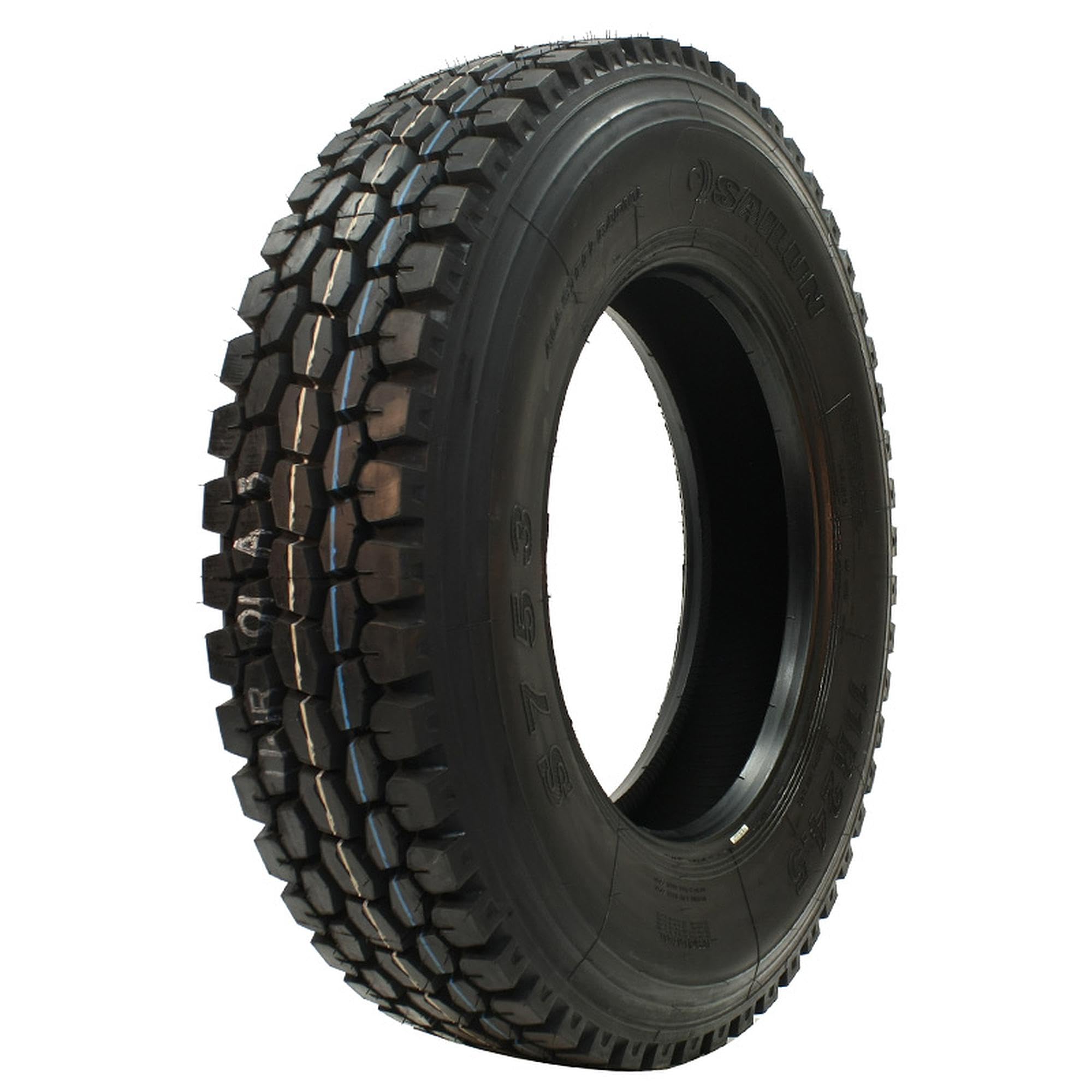
A 6,175-pound load rating wrapped in a drive tire that weighs just 96.1 pounds.
Here is the number that decides it: 6,175 pounds of load capacity per tire at a 144 load index. That is the highest capacity in this group, and it comes in at 96.1 pounds — notably lighter than the same-brand 285/75R24.5 at 125.5 pounds. For a drive-position tire on a heavy trailer, that combination of high capacity and lower weight is the whole argument.
At 40.5 inches in diameter with a 110 psi max pressure, it slots into the big-radial class. The G load range casing is built for regional drive duty and the 144 index gives you headroom at the axle when the trailer is packed. Sailun backs it with a manufacturer limited warranty, which is worth knowing before you commit a set of eight.
The catch is thin owner data. This tire has only a handful of ratings logged, so the long-term wear picture is not as well documented as the Ironman or the Michelin. What you can rely on is the spec sheet and the capacity figure. What you cannot yet rely on is a decade of fleet wear reports. If you are comfortable being an early adopter on a high-capacity drive tire, the numbers are compelling.
Good match for: Heavy regional drive duty where 6,175 pounds of capacity per tire and a 96.1 pound weight balance out.
Pause if: You want a deep track record of wear reports before you buy a full set.
5. Sailun S753 EFT/Regional Drive 285/75R24.5 TL 14 144/141L

The big-diameter regional drive tire that trades weight for a taller footprint.
This is the same 6,175-pound, 144-load-index capacity as its sibling above, but in a taller 285/75R24.5 size. That means a 41.85 inch diameter — about 3.65 inches bigger than the Michelin XRV at 38.2 inches. A taller tire changes your final drive ratio and gives you a longer footprint for regional running, which is exactly what this size is built for.
The trade-off is weight. At 125.5 pounds this is the heaviest tire in the group, and it outweighs the RR150 at 88.1 pounds by a wide margin. Some of that mass is the taller carcass and the 14-ply construction, which is what carries the load. You also get vehicle-specific fit rather than universal, so verify the size against your current setup before ordering.
Owner data is even thinner here than on the 295/75R22.5 sibling — a small handful of ratings. The 110 psi max pressure and G load range are documented, and the tire ships as a single unit without a rim. For a fleet running 24.5-inch wheels on drive axles, the diameter and capacity are the reason to look. For anyone who needs a lighter tire for fuel and ride, the RR150 is the better angle.
Diameter math: The extra height over the Michelin is real — 41.85 inches versus 38.2 inches — so confirm your wheel wells and gearing before you commit.
The weight cost: 125.5 pounds per tire is a lot of unsprung mass, and that shows up in fuel burn and ride over broken pavement.
Built for: Fleets on 24.5-inch wheels that want maximum drive-axle capacity in a tall regional footprint.
Steer clear if: Fuel economy and ride softness outrank raw capacity for your operation.
6. RR150 Premium 5-Rib 11R22.5 Truck Tire

At 88.1 pounds, this is the featherweight steer tire of the group.
If steering feel and ride quality are what you care about, start here. At 88.1 pounds this RR150 is the lightest tire on the list — 37.4 pounds lighter than the Sailun S753 285/75R24.5 at 125.5 pounds. Less unsprung mass at the front axle translates to a lighter steering wheel and a more forgiving ride over expansion joints.
The 5-rib tread pattern is a classic steer and all-position design, and the 144 load index puts it level with the Sailun S753 models on capacity rating. At 4805 pounds of load capacity it carries less per tire than the 6,175-pound Sailuns — a 1,370-pound gap that matters if you are loading the front axle right to the limit. For steer-axle duty on a normal highway load, that 4805 figure is comfortable.
It is a 14-ply radial built in the United States and covered by a standard manufacturer warranty. The 41.4 inch diameter sits in the big-radial class, close to the Firestone FS591 at 41.1 inches. The honest note is that owner feedback is limited to a small sample — the spec sheet is strong, but the wear record is not yet deep. Weigh that against the light weight and the capacity.
Weight advantage: The 88.1 pound figure is the standout — it is the lightest tire here and the one most likely to improve how the front end feels.
Capacity check: 4805 pounds per tire is lower than the Sailun 6,175-pound rating, so scale your front axle before you buy.
Best for: Front-axle steer duty where lighter weight and a 144 load index in a 14-ply casing make the difference.
Not ideal for: Front axles loaded near the legal limit, where the 4805-pound capacity runs short of the Sailun.
7. Firestone FS591 Commercial Truck Tire – 11/R22.5
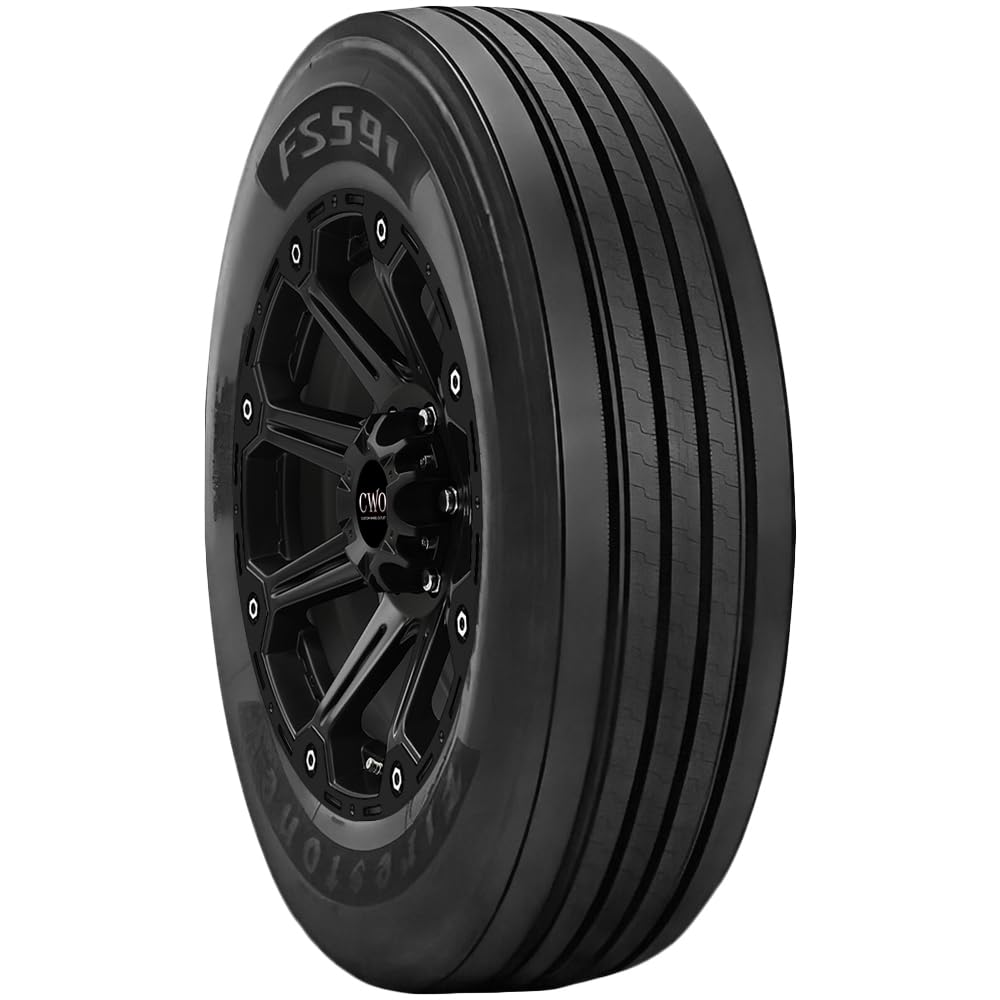
A U.S.-built 11R22.5 steer tire with a 41.1 inch diameter and a brand behind it.
Firestone’s FS591 is the long-haul steer option for the driver who wants a familiar name on the front axle. It is built by Bridgestone in the United States and ships as a single tire, no rim included. At 41.1 inches in diameter it sits close to the RR150 at 41.4 inches and well above the compact Michelin at 38.2 inches.
At 119 pounds, it sits in the middle of this group—heavier than the RR150’s 88.1 pounds, lighter than the Sailun 285/75R24.5’s 125.5 pounds. That weight comes from a full-depth 11R22.5 steer carcass (the tire body for a steering axle), and it is what gives the tire its road-holding feel at highway speed. The 11R22.5 size is among the most common steer sizes on the road, so finding a replacement on the road is not a headache.
The catch here is coverage. The manufacturer warranty runs 30 days, which is short compared to the standard manufacturer warranty on the RR150. Owner feedback is a small sample, so the long-term wear story is not well established. What you are buying is the Firestone name and a U.S.-built carcass, not a documented decade of fleet reports.
Worth it for: Long-haul drivers who want a U.S.-built 11R22.5 steer tire from a name they know and can source anywhere.
Skip the queue if: A longer warranty or a deeper wear record is a must before you buy.
Know the Specs
Load index and load capacity
The load index is a code number that tells you how much weight one tire can carry. The load capacity in pounds is the plain-English version of that same number. A 144 index carries more than a 140 index, and the difference matters when your front axle is scaled near the legal maximum. Always check capacity per tire against your actual axle weight, then leave some margin for a heavy trailer tongue and uneven loading.
Ply rating and load range
Ply rating describes how heavy the tire’s casing is built — a 16-ply tire has a stronger body than a 14-ply one. Load range letters (G, H) group tires by pressure and capacity class. A higher ply and load range generally means more capacity and more resistance to sidewall damage, but also more weight. On a steer axle, a lighter 14-ply can ride better; on a loaded drive axle, the heavier casing earns its keep.
Tread features for wet roads
Wide circumferential grooves are the long channels that run around the tire and push standing water out from under the tread. Sipes are the small cuts in the tread blocks that open as the tire rolls and add biting edges on a wet surface. A solid shoulder stiffens the outer edge for stability and even wear. Grooves clear the water, sipes add biting edges, and a solid shoulder holds the tread flat — that combination is what separates a tire that grips in rain from one that skates.
Tire weight and diameter
Weight runs from 88.1 pounds to 125.5 pounds across this group. Lighter tires steer easier and ride softer; heavier tires usually carry a thicker casing and more capacity. Diameter is the other half — a 41.85 inch tire changes your gearing and footprint versus a 38.2 inch one, so confirm clearance and speedometer calibration before you commit.
Common Questions
What load index do I need for a semi truck steer tire?
Can I run steer tires on the drive axle?
Does a higher ply rating always mean a better tire?
What do stone ejector platforms actually do?
How does tire diameter affect my truck?
Are these tires sold with rims?
What is the difference between a G and H load range?
How much does tire weight affect fuel economy?
Do I need sipes on a semi truck tire?
Where are these tires made?
The Bottom Line
For most operations, the best semi truck tires on this list come down to matching duty to spec. The Michelin XRV takes the overall spot because 5,205 pounds of capacity at 89.5 pounds is a hard combination to beat on a steer axle, and it carries the highest owner score in the group. If you want maximum drive-axle capacity, grab the Sailun S753 295/75R22.5 at 6,175 pounds. And for a light, all-position tire with wet-traction engineering, the Ironman I-19A is the one to reach for.
How we choose
We do not accept paid placement. Every pick is matched to a real buyer and a real use-case; we do not hands-on test units.
Sources
Specifications: manufacturer listings and product documentation. Review insights: verified customer reviews, as of November 2026. Pricing: not shown on this page (it changes often); check the current price via the retailer link.
As an Amazon Associate, Tactical Gear Guy earns from qualifying purchases. This does not affect which products we feature.