Specs are compiled from manufacturer listings and verified buyer reviews and can change over time — please confirm the key details on the product page before buying.
You want a smoke alarm that still works when the power goes out, and you do not want to think about it again for years. Every pick below pairs a real backup power source with smoke detection, so a tripped breaker or a storm does not leave a hallway blind. The hard part is not finding one — it is wading through listings that look identical and finding the one that fits your wiring, your ceiling and your tolerance for late-night chirping.
This guide is built by comparing the manufacturers’ published specifications and the patterns across verified customer reviews, so you get each pick’s real strengths and trade-offs instead of marketing spin.
Some run on a sealed lithium cell that outlives the alarm itself; others take a standard 9-volt or AA you can swap at the kitchen drawer. A few wire into your home’s existing circuit and stay live through an outage. The trick is matching that power design to your home before you buy, and this smoke detector with battery backup list keeps that choice front and center.
Top Picks
How To Choose The Best Smoke Detector with Battery Backup
The word “backup” means two very different things in this category, and mixing them up is the most common buying mistake. One kind is hardwired: it runs off your home’s 120V wiring and carries a battery inside so it keeps watching during a blackout. The other kind runs on batteries alone, with no wiring at all — the battery is not a backup, it is the whole power supply. Decide which one your ceiling is set up for first, then shop.
Hardwired with backup versus battery-only
An existing hardwired ceiling box with a live 120V feed points you straight at the hardwired units. They draw normal power from the house and switch to the internal battery when the line drops. If you are replacing an old alarm that already has wires poking out of the ceiling, a hardwired model saves you from capping them off. If there is no wire there, a battery-only alarm installs in minutes with screws or an adhesive pad and needs no electrician.
Sealed 10-year cell or a battery you can change
A sealed lithium battery is built in and powers the alarm for its whole service life, so there is nothing to swap and no low-battery chirp to chase at 3 a.m. A replaceable 9V or AA design costs less up front but asks you to keep spares and remember the change. Both are legitimate. Pick the sealed cell if you want the alarm to be someone else’s problem for a decade; pick the replaceable design if you would rather not replace the whole unit when the battery finally goes.
Photoelectric versus ionization sensing
Photoelectric sensors are tuned to slow, smouldering fires that throw off light smoke before flames appear — the kind that starts in a sofa or a pile of laundry. Ionization sensors respond faster to fast, flaming fires. Neither is “better” outright; they catch different fire types. For a hallway outside a kitchen or a bedroom, a photoelectric unit tends to produce fewer nuisance alarms from cooking steam.
Interconnection: does one alarm wake the whole house
An interconnected system links the alarms so that when one detects smoke, every linked unit sounds. That matters on a two-storey home where a basement fire would otherwise stay silent upstairs. Wired interconnection uses the same circuit; wireless interconnection links them over radio. Check the maximum number of linked units the system supports before you buy a multi-pack, since you want room to add one later.
Side-by-Side Comparison
| Model | Best For | Power Design | Sensor Type | Pack Size | Amazon |
|---|---|---|---|---|---|
| First Alert BRK Hardwired 3-Pack★ Best Overall | Replacing old wired alarms | Hardwired 120V + battery backup | Ionization | 3 | Amazon |
| Kidde 20SDR AA BatteryBest for No-Wiring Swap | No-wiring quick swap | Two AA batteries (included) | — | 1 | Amazon |
| Siterlink GS562A Hardwired 2-PackBest Interconnected System | Linked whole-home coverage | Hardwired 120V + 9V backup | Photoelectric | 2 | Amazon |
| Kidde 20SD10-V Voice | Voice alerts in bedrooms | Built-in 10-year battery | — | 1 | Amazon |
| SITERLINK GS509A 4-Pack | Compact multi-room coverage | 9V replaceable battery | Photoelectric | 4 | Amazon |
| Kidde P3010L Living Area | Living-room nuisance control | Sealed 10-year lithium | Photoelectric | 1 | Amazon |
| X-Sense SD19-W 3-Pack | Wireless whole-home linking | Sealed 10-year battery | Photoelectric | 3 | Amazon |
| SITERWELL GS509A 6-Pack | Rental and multi-unit value | 9V replaceable battery | Photoelectric | 6 | Amazon |
| Heiman S1-R 5-Pack | Long-range wireless linkage | Lithium battery (included) | Dual-beam photoelectric | 5 | Amazon |
Detailed Reviews
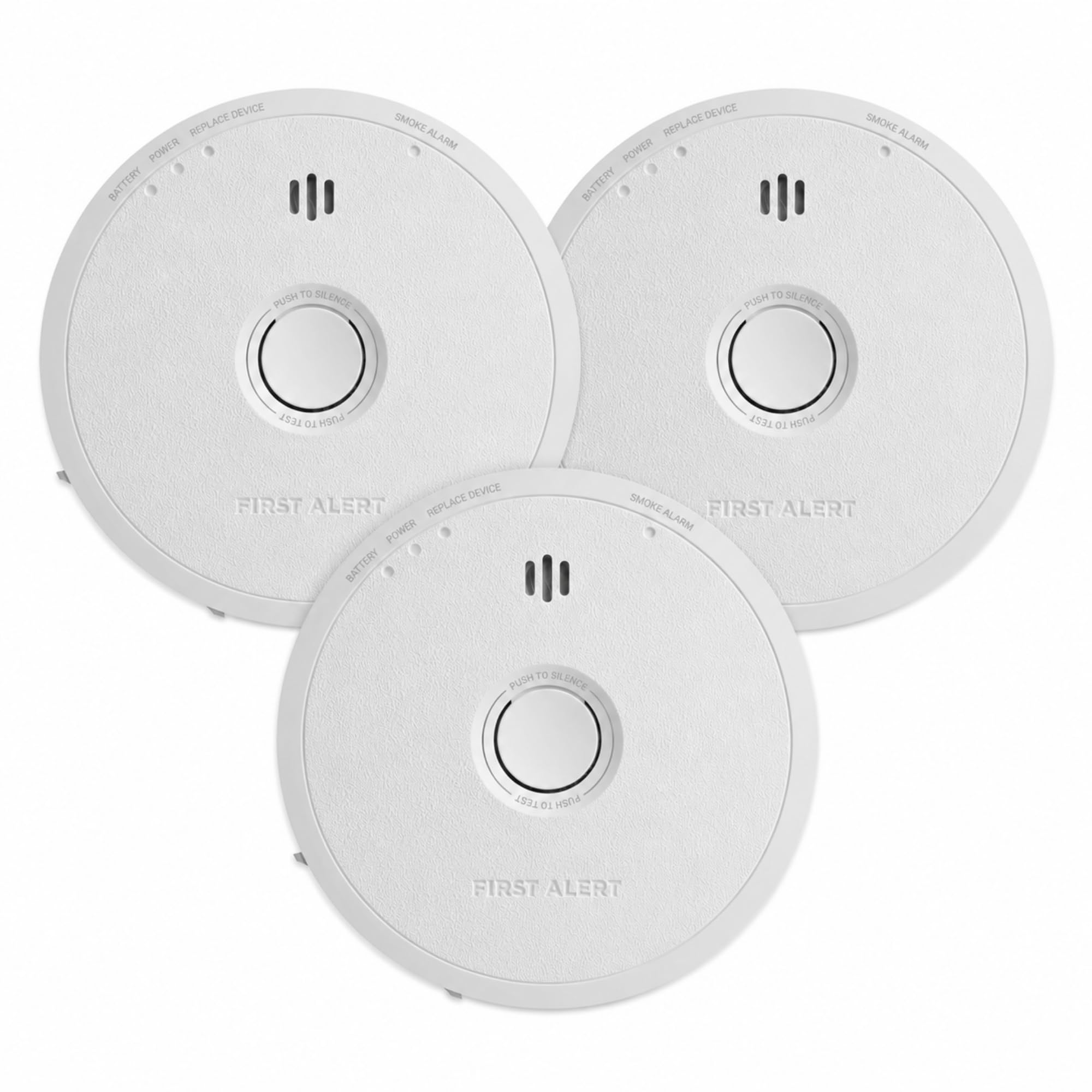
1. First Alert BRK Smoke Detector 3 Pack
Our pick — 4.5+★ from 400+ verified ratings; the strongest balance of quality and price.
Three hardwired alarms that keep watching when the breaker trips.
If your ceiling already has a live 120V box and a pair of wires hanging out, this is the straight swap. The pack gives you three units, and each one draws normal power from the house wiring while carrying a battery inside for the moment the line goes dead. That is the backup you came for: a storm knocks out the block, and the alarm in the hallway is still armed. Three units covers a hallway plus two bedrooms, or a landing and a pair of living spaces.
What wins people over is the swap itself. Functionality is the thing owners praise most, and the recurring theme is that these simply work where an older alarm gave up. Installation draws the second-biggest share of praise, and the pattern is that anyone swapping an existing hardwired unit gets there without tools — the mounting plate matches and the plug-in connector lines up. If you are matching an old BRK ceiling plate, the fit is described as an accurate match, which saves you from patching drywall.
The honest catch is the sensor. It is also a wired unit — no ceiling feed, no install. And at 6″D x 2″W x 6″H per alarm, it is a chunkier ceiling disc than the compact battery units further down this list, so it suits a standard hallway ceiling rather than a tight corner.
Why this earns the top spot
- Hardwired 120V power with an internal battery that keeps the alarm live through an outage
- Three units in one box — enough for a hallway and two bedrooms
- Designed as a straight replacement for existing hardwired BRK ceiling plates
- Installation needs no tools when you are swapping an existing wired alarm
Where it asks something of you
- Requires a live 120V ceiling feed — it will not run as a standalone battery alarm
- Ionization sensing is quicker to react to cooking steam than a photoelectric alarm
- At 6″D x 2″W x 6″H, a visibly larger ceiling disc than the compact units here
Made for: anyone replacing an existing hardwired alarm and wanting three units covered in one order.
Think twice if: your ceiling has no wiring — go battery-only instead.
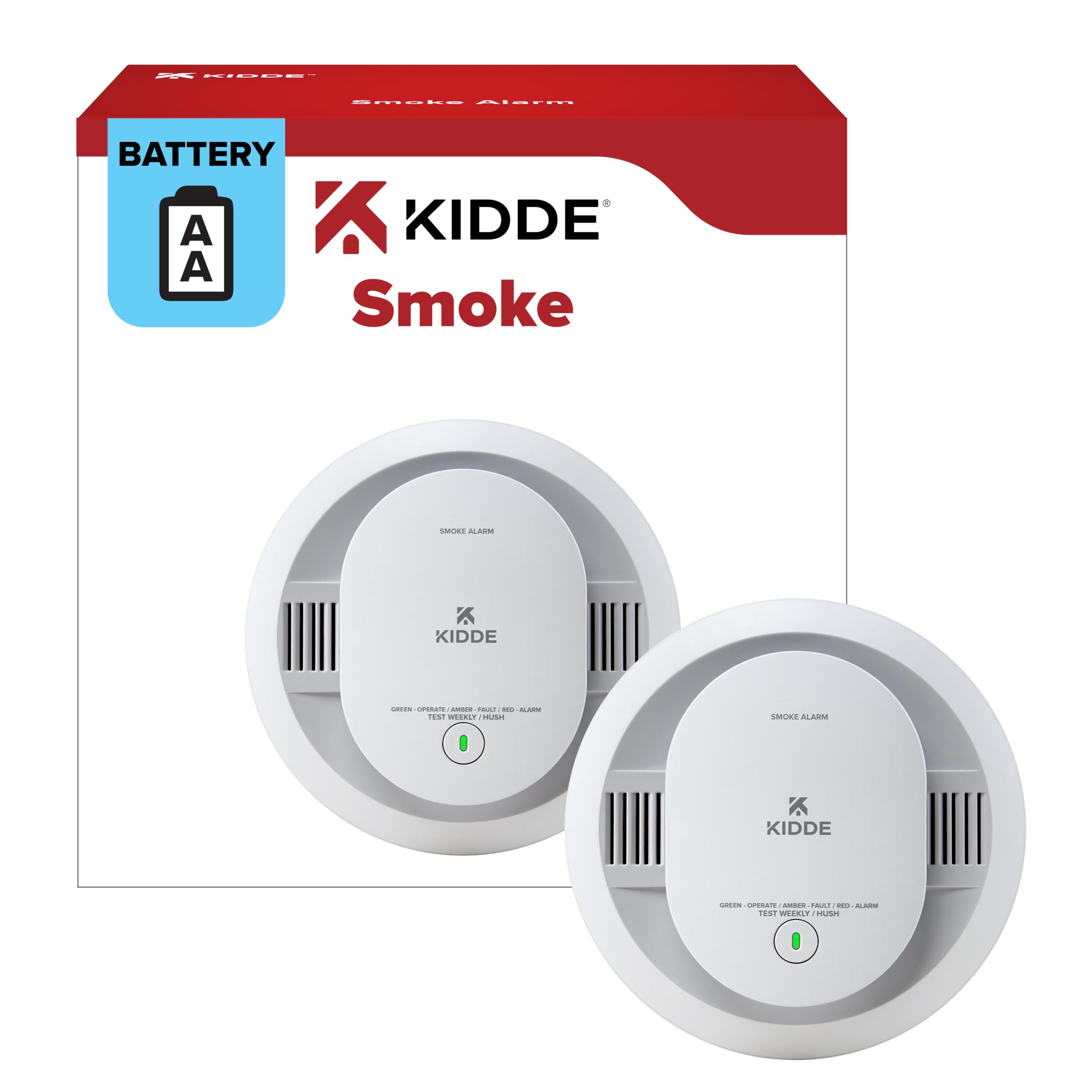
2. Kidde Smoke Detector, AA Battery-Powered, 20SDR, 1 Pack
Two AA batteries, no wires, and a hush button for the toast.
The 20SDR runs on two AA batteries that come in the box, so there is no wiring step at all — you screw the bracket to the ceiling and twist the alarm on. Kidde claims the 20SDR detects smoke over 25% faster than its comparison benchmark, and it sounds an 85-decibel alarm with a red LED for a visual warning. In plain terms, 85 dB is roughly the volume of a loud truck passing close by — enough to pull you out of sleep in the next room. The included AA pair means the alarm is armed the day it arrives.
The everyday win here is nuisance control. Kidde built in advanced sensing that it says helps separate real smoke from cooking or steam, and there is a Test/Hush button on the face. That button does two jobs: it runs a functional test, and it temporarily silences a false alarm without switching the detector off. The unit carries a 10-year limited warranty from the purchase date, and it is tested to the UL 217 10th Edition standard plus FCC rules.
Longevity is where this one asks for patience. Buyers report mixed feedback on durability and reliability — plenty of units run smoothly, but the occasional alarm gives out inside a couple of months. The AA cells (standard replaceable batteries) will also want changing far sooner than a sealed 10-year design would. It is the plainest unit here too: no interconnection (no linking to other alarms), no voice alert, no sealed cell. You get a competent, honest detector at the entry end of the mid-range, sold as one alarm rather than a pack.
The value read: two included AA batteries, an 85 dB alarm, a combined test-and-hush button and a 10-year limited warranty make this the least fussy single-alarm install in the guide.
What you trade away: replaceable AA cells mean a routine battery change may come around in a year or so, and this one stands alone rather than linking to other alarms.
Reach for this if: you want one alarm fitted in five minutes with the batteries already inside.
Look elsewhere if: you would rather not touch a battery again for a decade.
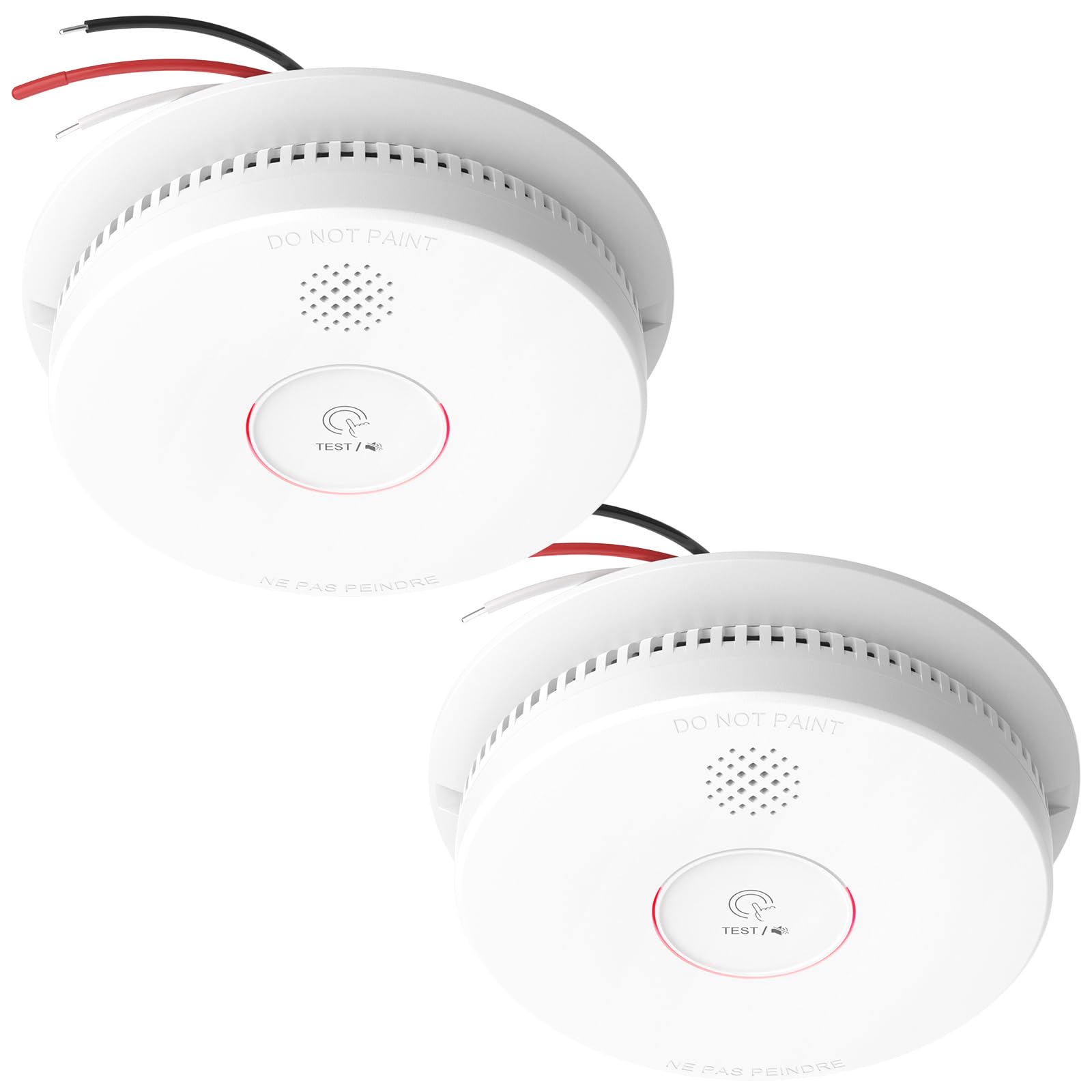
3. Siterlink GS562A Smoke Detectors 2-Pack
When one alarm smells smoke, every linked alarm joins in.
This is the pick for a two-storey home where a basement alarm needs to wake someone upstairs. The GS562A pair wires into 120V AC and links together, so a trigger on one unit sets off both at once. Siterlink’s pitch is faster evacuation — everyone hears the warning regardless of which floor they are on. Each alarm also carries a 9V battery backup, so an outage does not break the link or silence the pair.
The photoelectric sensor inside is the patient kind: it is tuned to the slow, smouldering fire that puts out light smoke before flame, and Siterlink built in sensing that it says cuts false alarms from cooking. Then there is the silence button — one touch mutes the alarm for up to 10 hours, which is long enough to sleep through a low-battery warning and deal with it in daylight. The indicator LED is recessed rather than a bright dot on the face, which suits a child’s room ceiling where you do not want a glowing light at bedtime.
Owners talk about replacement most, and the pattern is that these drop in where an older pair came out. A decade-old unit finally chirping its end-of-life warning is exactly the scenario this pair is bought for. Installation reads easy too. The realistic limit is that this is a wired system: the interconnection (the link that makes both alarms sound together) and the AC feed both need wiring at the ceiling. Confirm both boxes are on the same circuit before you buy the pair. You also get two alarms, not a full house — a third room needs another unit.
Where it earns its place: wired interconnection plus a 9V backup battery is the combination that keeps a whole home alerted during a power cut. The 10-hour silence mode is a genuinely practical touch for a night-time low-battery warning — you can mute the chirp and still sleep.
The practical limit: both the AC feed and the link wiring have to exist at the ceiling, so this is a job for someone comfortable with a hardwired install.
Built for: a wired home that wants the alarm upstairs to hear a fire downstairs.
Not the one if: you have no ceiling wiring to link them through.
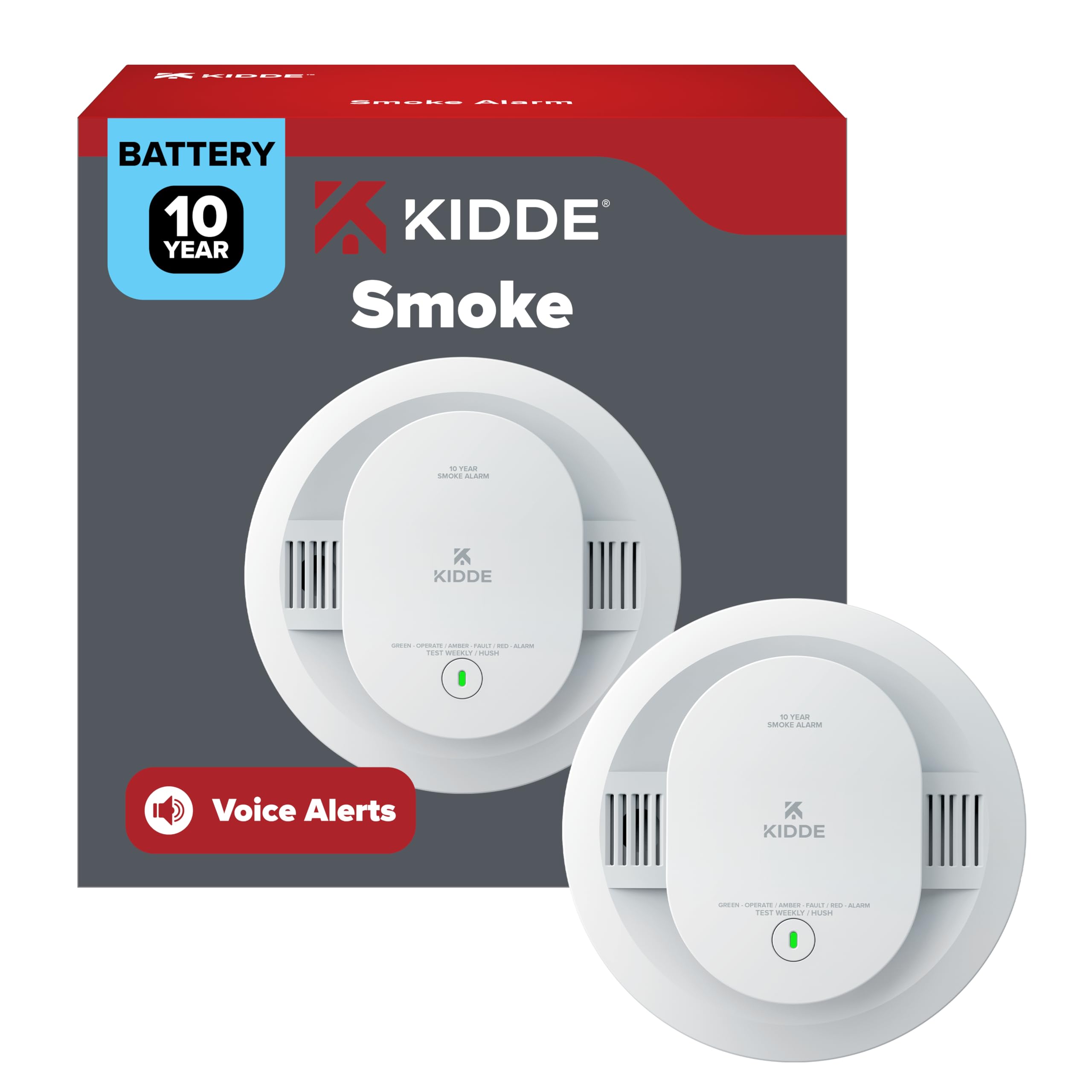
4. Kidde 20SD10-V Smoke Detector 1 Pack
A voice tells you what is wrong, not just a beep.
Most alarms give you one sound and leave you to work out what it means. The 20SD10-V adds spoken alerts that name the hazard out loud, alongside the 85-decibel tone and red LED — so a child or a heavy sleeper gets words, not just noise. Kidde rates the 20SD10-V’s detection at over 25% faster on smoke, and its sensing is built to separate real smoke from cooking or steam. For a bedroom ceiling, that spoken warning is the feature you are paying for.
The power side is the other half of the case. The sealed lithium cell runs the 20SD10-V for a full 10 years — the life of the unit — so there is no low-battery chirp and no cell to swap. Kidde includes a 10-year limited warranty from the purchase date to match. Testing covers the UL 217 10th Edition standard and FCC rules, and there is a test-and-hush button for quick checks and quieting a nuisance alarm.
Weigh the trade-offs before you commit. Reliability, quality and value all read mixed in owner feedback — the voice alert is a real draw, but a vocal minority run into a unit that malfunctions during its service life, and some question whether the price is matched by the lifespan. There is also no interconnection: this alarm speaks for itself and does not trigger the others. If you want linked coverage, this is not the unit. If you want one bedroom ceiling that talks, it is.
What you’re really buying: spoken alerts and a sealed 10-year battery in one unit, so a sleeping household gets words plus a loud tone and you never chase a chirp.
Size the risk properly: it stands alone rather than linking, and the sealed-cell design means the whole alarm retires when the battery does.
Suits you if: a spoken warning matters in a bedroom or a child’s room, and you want zero battery maintenance.
Look past it if: you need alarms that all sound together.
5. SITERLINK GS509A Smoke Detectors 4 Pack
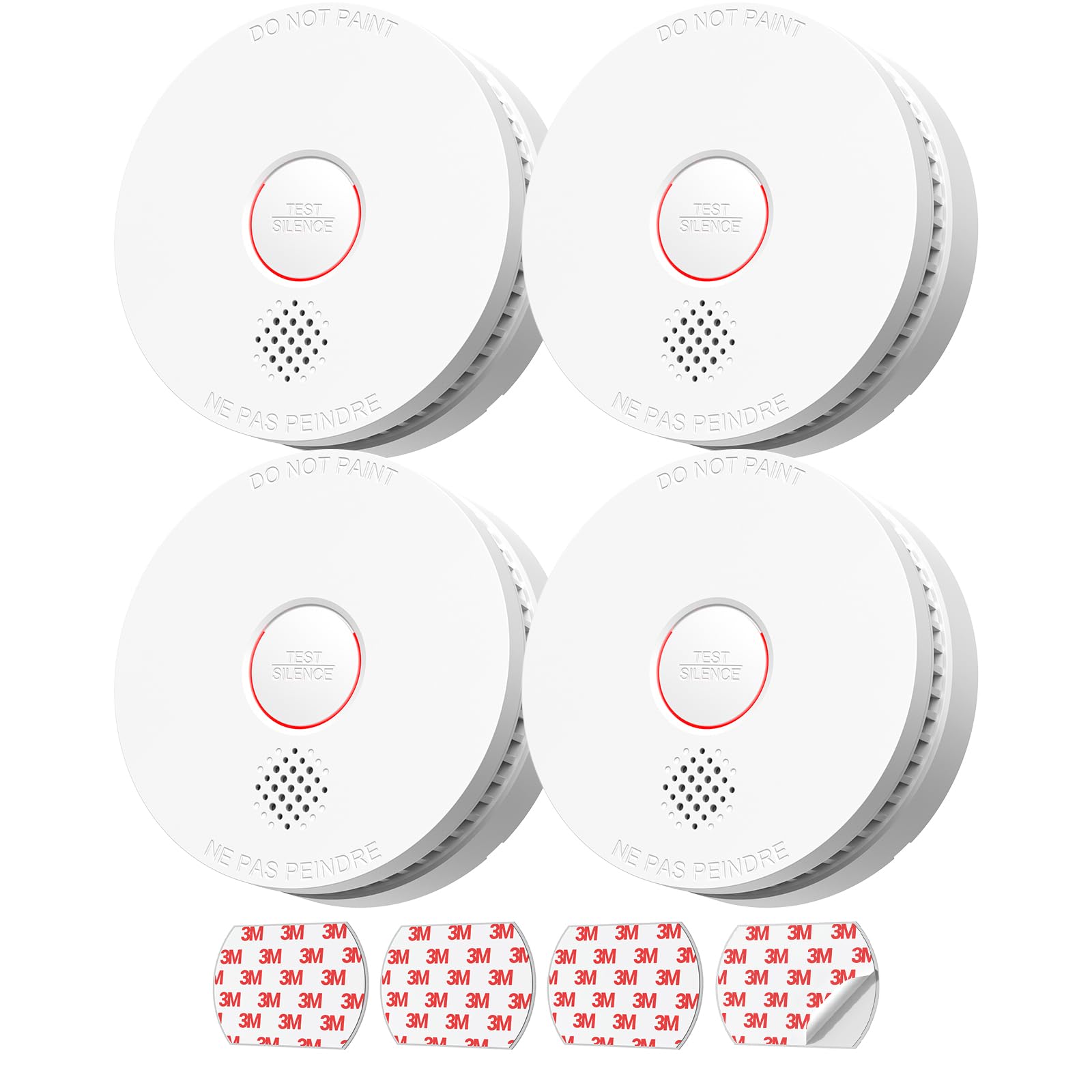
Four low-profile alarms that sit quietly on the ceiling.
Cover four rooms in a flat without four ceiling discs shouting for attention, and this pack is the practical answer. Each unit measures 1.4″D x 3.92″W x 3.92″H and weighs 9.6 ounces — a notably smaller footprint than the hardwired First Alert’s 3 6″D x 2″W x 6″H frame. That compact size is what keeps them from dominating a bedroom ceiling. The package comes with magnetic pads, screws and anchor plugs, plus the mounting brackets, so you can stick them up or screw them in.
The sensing is photoelectric, and Siterlink pairs it with dual light wave detection and a self-learning routine that compensates for temperature, humidity and dust so sensitivity stays steady. What that buys you in real terms is fewer false alarms from a steamy bathroom door. There is also a one-button mute that silences the alarm for up to 10 hours — long enough to sleep off a false alarm or a low-voltage warning and change the 9V cell in daylight. Reliability comes through clearly in the owner feedback, with install close behind, and the compact size draws a steady share of praise from people who did not want a bulky alarm.
The loudness is where opinions split. Several owners find it extremely loud, which is fine for a warning but jarring if the alarm is near a headboard. The 9V cell is also replaceable rather than sealed, so the alarm outlives the battery and you will be swapping cells when the low-voltage signal sounds. And while the manufacturer lists UL217, this pack is not interconnected — each alarm works on its own.
What makes it a smart four-room buy
- Four alarms from one order, each 1.4″D x 3.92″W x 3.92″H and 9.6 ounces
- Photoelectric sensing with dual light wave detection to cut cooking false alarms
- One-button mute for up to 10 hours on a low-voltage or false warning
- Installs with magnetic pads or screws and anchors, no rewiring
What to plan around
- Replaceable 9V cell means a battery change somewhere down the line
- Loudness draws mixed reactions — very loud up close
- No interconnection between the four units
Right for you if: you want four unobtrusive alarms covering separate rooms without wiring.
Worth skipping if: you need them to trigger one another.
6. Kidde P3010L Smoke Alarm

Built for the room where the toaster and the sofa live.
The P3010L is designed as a living-area alarm, which tells you the sensing choice was made deliberately. Photoelectric detection is slower to panic over steam and better at catching the smouldering fire that starts in upholstery, and Kidde adds a Hush feature to silence a nuisance alarm without tearing the unit off the ceiling. The sealed lithium battery powers the P3010L for 10 years — the life of the alarm — so you never swap a cell.
At 8.96 ounces it is one of the lighter single alarms here, though the feature set is the point. The sealed cell means no late-night low-battery chirp during its operating life, and Kidde backs the P3010L with a 10-year limited warranty. There is an end-of-life warning that chirps every 30 seconds when the unit needs replacing — annoying by design, since it is the alarm telling you it has done its run. The Hush button handles the odd cooking false alarm until it clears.
The caveat worth naming is reliability across the fleet. Quality and reliability come up mixed in the owner feedback, with reports of a unit sounding for no reason at night or failing soon after install, and the battery life drawing mixed views too. That is not a reason to rule it out — the design and Hush feature are genuinely good — but it is a reason to test the unit monthly and check the install date. There is no interconnection, so treat this as a single-room alarm rather than the backbone of a house.
The design logic: photoelectric sensing plus a Hush button plus a sealed 10-year lithium cell is exactly the trio you want in a living area where steam and dust are constants.
The honest limit: a single unit, and the fleet reliability is mixed enough that monthly testing is worth the habit.
Pick it for: a living room or hallway where cooking and steam are a daily nuisance.
Not for: a house that needs alarms linked across floors.
7. X-Sense SD19-W Smoke Detector 3-Pack

Link three alarms with no wiring, no app, no fuss.
This is the answer for a home with no ceiling wiring that still wants one alarm to wake the whole house. The SD19-W trio links wirelessly, so a trigger on one sounds the others across bedrooms, hallways and floors. Each SD19-W carries a sealed lithium battery rated for 10 years of power with no replacements during its operating life, which removes the low-battery chirp entirely. And the system scales: X-Sense says you can pair up to 18 compatible Link+ alarms, including SC07-W, SC01-W and SC06-W, with an optional remote for testing and silencing.
Photoelectric sensing (a light-beam sensor that spots smoke) is the right choice for cutting nuisance alarms from cooking fumes and steam. Each unit is ETL listed to meet the UL 217 safety standard — an independent lab checked it against the recognized smoke alarm standard. Installation takes minutes with no wiring, and there is a self-test plus a one-button test/silence control for routine checks. Put these in three high-traffic rooms and you have a linked alert without calling an electrician.
The catch is coverage math. Three alarms cover three rooms, and each is a 4.8″D x 1.7″W x 4.8″H disc, so plan which rooms get them before you order. There is no phone app and no Wi-Fi — the word “interconnected” here means the alarms talk to each other, not to your phone. If you want remote monitoring, this is not the system; if you want alarms that alert each other, it is.
What stands out: sealed 10-year batteries plus wireless linking means no wiring job and no battery swaps, and the 18-alarm ceiling leaves room to grow.
Plan for this: the system lives on the alarms themselves — no app, no Wi-Fi — so growth means more units, not a phone screen.
Fits you if: you have no ceiling wiring but want every linked alarm to sound together.
Skip the fit if: you specifically want a smartphone app.
8. SITERWELL Smoke Detector, 10 Year Product Life Fire Alarm
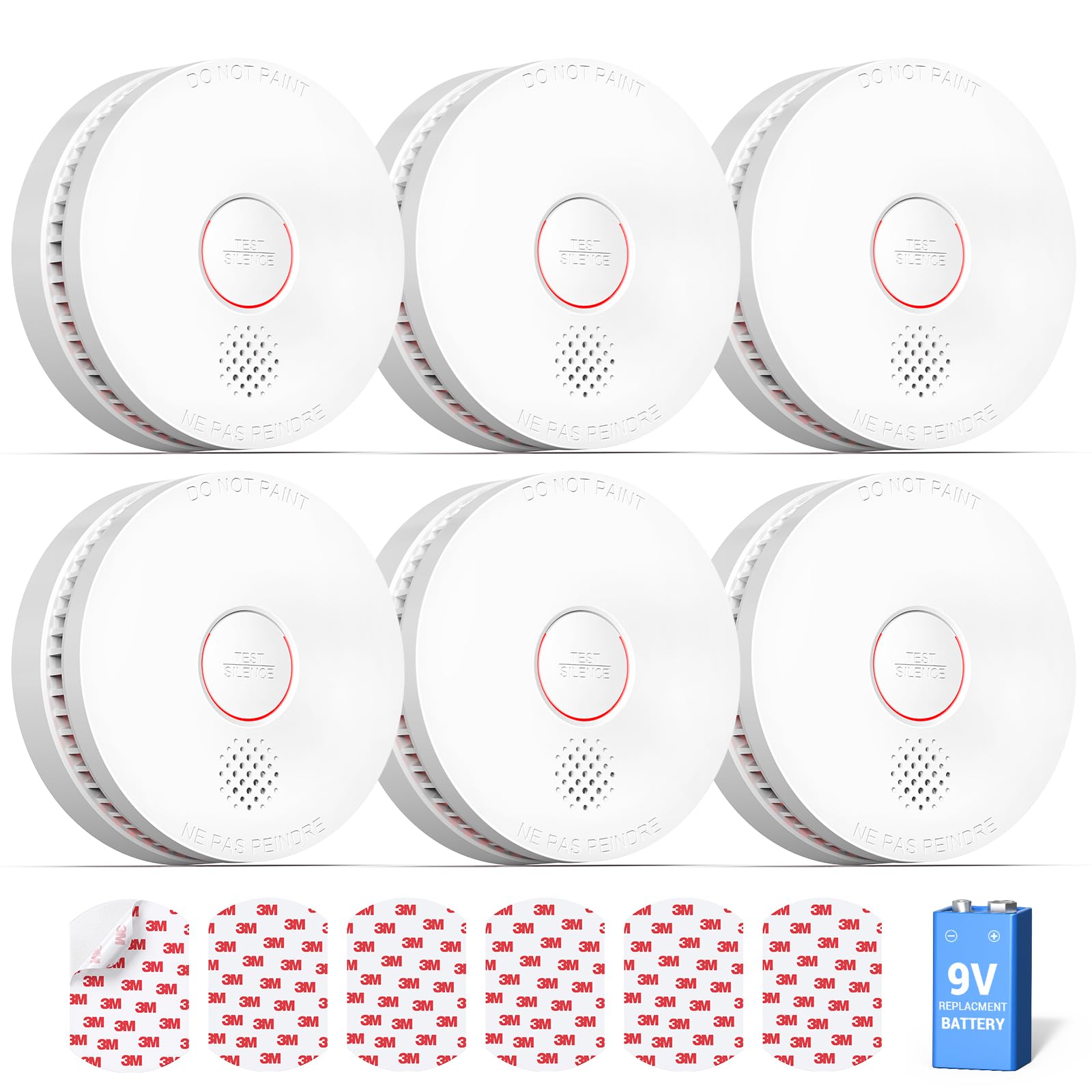
Six alarms in one box for a whole rental unit.
For a landlord, a multi-unit flat, or a home with a lot of rooms, this is the simplest way to cover everything at once. You get six GS509A alarms, each running on a 9V battery you replace as it drains — Siterwell frames it as a 10-year product life that outlasts individual batteries. That replaceable design is deliberate: the unit stays and you swap the cell, rather than retiring the whole alarm when the cell dies. The package includes a UL 217 smoke alarm, a 9V carbon-zinc battery per unit, mounting hardware and a magnetic fastening kit.
The sensing is photoelectric, which the maker pitches as more sensitive to the slow, smouldering fire that throws light smoke and little heat — the kind that can smoulder for hours before it bursts into flame. There is a test/mute button for weekly checks and silencing, an alarm above 85 dB, and a low-battery signal that tells you when a cell needs changing. The housing is polycarbonate, and the units are rated for 10-95% RH non-condensing humidity, so they suit normal indoor rooms rather than a steamy bathroom. Quality and installation are the two things owners rate highest here, and the value of six units in one purchase comes through clearly.
Set your expectations on consistency. Functionality reads mixed — some units work great and others sound for no reason or stop after three months. Battery life and noise level also split opinion. This is the “cover a lot of rooms economically” pick, not the “buy one and never think about it again” pick, so budget a quick monthly test across all six.
The case for the six-pack
- Six photoelectric alarms cover a whole flat or rental in one order
- Replaceable 9V cells keep the units in service while you swap batteries
- Includes mounting hardware and a magnetic fastening kit for quick installs
- Rated for 10-95% RH non-condensing humidity
Keep in mind
- Functionality is mixed across the batch — test all six on arrival
- Replaceable 9V cells mean periodic battery changes
- Not interconnected — each alarm works alone
The smart buy for: a landlord or multi-room home that needs six alarms without a premium per-unit tag.
Think again if: you want one alarm with a sealed cell and a decade of zero maintenance.
9. Heiman Smoke Detector 5 Pack
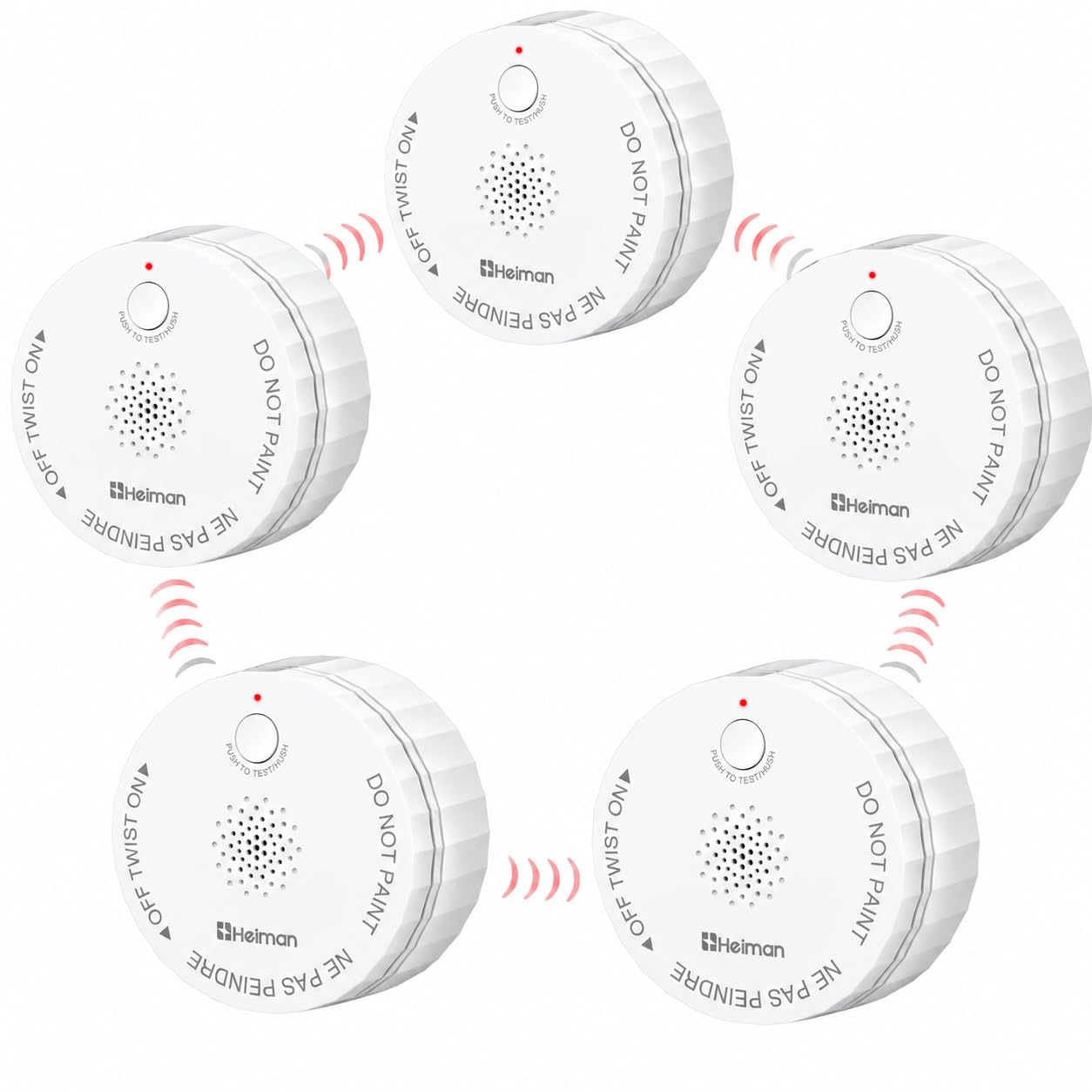
Five linked alarms with a radio range that crosses a big house.
Reach is the headline: the wireless interconnection covers up to 656 ft (200 m) in open areas, so a detached garage, a far extension or a wide two-storey home can all join the same alarm network. You get five units in the box, each 4.9″D x 1.5″W x 4.9″H and 6.4 ounces — the smallest per-unit profile of the linked systems in this guide. A trigger on any alarm sounds all connected units. This is genuinely for the person whose problem is “my garage alarm cannot hear my kitchen alarm.”
The sensing backs up the reach. Dual-beam photoelectric sensors separate smoke by particle size and density, which the maker says makes them more precise than traditional ionization alarms on faint smoke and slow, smouldering fires while cutting false alarms from steam or cooking. Each unit runs on an included lithium battery, so it keeps watching through an outage with no wiring. The housing is UL94 V-0 rated flame-retardant ABS+PC, the alarm is 85 dB at 10 ft, and the test/silence button hushes nuisance alarms for 10 minutes. It is certified to the UL 217 10th Edition standard and won a Red Dot design award.
The one thing not to misread: “wireless interconnected” means the alarms talk to each other, not to your phone. There is no app and no Wi-Fi connection, and Heiman flags this plainly — if you assumed you could check alerts from your phone, you cannot. Reliability and noise also draw mixed reactions, with some units randomly going off and some owners finding the sound weaker than expected. Test each of the five on arrival and you are set.
Where it wins: 656 ft (200 m) of wireless linking plus dual-beam photoelectric sensing and a flame-retardant UL94 V-0 housing is a lot of coverage for five alarms.
Know before you buy: that wireless link does not include a phone app, and the sound on some units is quieter than a big-house alarm really wants.
Go here if: your home is spread wide and the alarms need to reach across it.
Look past it if: you want app control on your phone.
Know the Specs
Power source and battery backup
A hardwired alarm runs on your home’s 120V circuit and carries a battery inside — that battery is what keeps it watching during an outage. A battery-only alarm uses the battery as the primary supply; there is no wiring step. A sealed lithium cell powers the alarm for its full service life with no change, while a replaceable 9V or AA design lets you swap the cell and keep the unit. Pick based on your ceiling, not just the spec sheet.
Sensor type: ionization vs photoelectric
Ionization sensors react quickly to fast, flaming fires but are more prone to nuisance alarms from cooking steam. Photoelectric sensors are tuned to slow, smouldering fires that throw off light smoke before flame, and they tend to be calmer around steam. For a hallway outside the kitchen or a bedroom, photoelectric is often the friendlier choice; that is why most picks here use it.
Decibel rating and interconnection
Most alarms here are rated around 85 dB, which is loud enough to wake a household. Interconnection is the feature that turns one alarm into a whole-home alert — one sounds, the rest follow. Wired interconnection uses the building circuit; wireless uses radio, with the Heiman reaching up to 656 ft (200 m) in open areas and the X-Sense linking up to 18 alarms. Check the linked-unit limit before you choose a pack size.
Common Questions
Will a hardwired smoke detector work if the power goes out?
What is the difference between photoelectric and ionization smoke detectors?
How long does a sealed 10-year battery smoke detector actually last?
Can I link smoke alarms from different brands together?
Do I need a smoke detector with voice alerts in a bedroom?
How do I stop my smoke alarm chirping at night from a low battery?
What does UL 217 certification mean on a smoke detector?
Can a wireless interconnected alarm connect to my phone or Wi-Fi?
Where should I install a smoke detector with battery backup in my home?
The Bottom Line
For most homes, the smoke detector with battery backup winner is the First Alert BRK 3-Pack. It gives you three hardwired units with a working battery backup in one box — the cleanest swap for a home that already has ceiling wiring. If you have no wires and want linked coverage, grab the X-Sense SD19-W 3-Pack, whose sealed 10-year cells link without a single screw into your circuit. And for covering a whole flat or a rental unit without a premium tag, the SITERWELL GS509A 6-Pack is the one to reach for. The First Alert is the crowd favorite here, holding 4.5+ stars across 400+ owners.
How we choose
We do not accept paid placement. Every pick is matched to a real buyer and a real use-case; we do not hands-on test units.
Sources
Specifications: manufacturer listings and product documentation. Review insights: verified customer reviews, as of November 2026. Pricing: not shown on this page (it changes often); check the current price via the retailer link.
As an Amazon Associate, Tactical Gear Guy earns from qualifying purchases. This does not affect which products we feature.