Specs are compiled from manufacturer listings and verified buyer reviews and can change over time — please confirm the key details on the product page before buying.
If your graphics card is longer than your current case is deep, or your 420 mm radiator will not fit anywhere, the fix is a full tower with real interior volume. This guide covers the cases that actually swallow oversized parts — the ones with enough radiator support, GPU clearance, and drive bays to finish a build without a dremel.
This guide is built by comparing the manufacturers’ published specifications and the patterns across verified customer reviews, so you get each pick’s real strengths and trade-offs instead of marketing spin.
You will see which cases ship with fans and which do not, how much clearance you gain over a standard mid-tower, and where the honest trade-offs sit. Every pick below is a genuine full or super tower, so the shortlist for a super tower pc case stays focused on parts that fit the biggest builds.
Top Picks


How To Choose The Best Super Tower PC Case
A full tower is not about looking big on the desk. It is about fitting parts that will not go anywhere else — the longest graphics cards, the thickest radiators, and the drive stack you already own. Start with the three numbers that decide everything: GPU clearance, radiator support, and motherboard size.
GPU clearance decides what you can actually install
Graphics cards have grown long, so measure the card you own or plan to buy, then match it against the case’s stated clearance. A case rated for 480 mm of GPU room leaves space for a flagship card plus a front-mounted fan. A case capped at 413 mm still handles most cards, but a thick front radiator eats into that headroom.
Radiator support is the real super-tower test
An all-in-one or custom loop cooler is rated in millimeters — a 360 mm or 420 mm radiator is the length of the cooling block. A true super tower supports at least a 420 mm up front. A case that also accepts radiators on top, bottom, and side can run multiple loops at once, which is the whole reason people move up from a mid-tower.
Motherboard form factor narrows the list fast
E-ATX boards are wider than the common ATX size, so a case that lists E-ATX support is the safe pick if you own a big workstation board. If you run an SSI-EEB board, check the listing carefully — only some full towers call it out. Measure your board’s width against the case’s stated support before you buy.
Fans included or fans extra
Some cases ship with three or four fans already mounted, which saves you a purchase and installation step. Others arrive with none, so budget for cooling on top of the case itself. Neither is wrong — just know which one you are buying before it arrives.
Side-by-Side Comparison
| Model | Best For | Max GPU Clearance | Radiator Support | Fans Included | Amazon |
|---|---|---|---|---|---|
| Fractal Design North XL Chalk White Mesh★ Best Overall | Living-room builds that still breathe | 413 mm | 420 mm front / 360 mm top | Three 140mm Aspect PWM | Amazon |
| Antec C8 Full-Tower E-ATXBest Value | Triple-radiator showcase builds | — | 360 mm top, bottom, and side | None | Amazon |
| Antec Performance 1 FT Full TowerTemperature Display | Glanceable temps without software | 370 mm | — | Three PWM | Amazon |
| Thermaltake View 600 TG | Showing off a vertical GPU | 480 mm | 420 mm | None | Amazon |
| ASUS ProArt PA602 | Silent workstation airflow | 440 mm | 420 mm | Two 200mm + one 140mm | Amazon |
| Fractal Design Define 7 XL | Drive-heavy storage servers | 530 mm | 480 mm | — | Amazon |
| LIAN LI O11D EVO XL | Pillarless dual-chamber display | 460 mm | Three 420 mm | None | Amazon |
| Lian Li O11 Dynamic EVO XL RGB | ARGB-lit full-tower builds | — | Three 420 mm | None | Amazon |
| Cooler Master HAF 700 | Maximum airflow, period | — | 480 mm | Two 200mm Sickleflow ARGB | Amazon |
| ASUS ROG Hyperion GR701 | Premium build with carry handles | 460 mm | Two 420 mm | Four 140mm | Amazon |
| CORSAIR 9000D RGB Airflow | Magnum-opus custom loops | — | 480 mm front and roof, 360 mm side, 240 mm rear | None | Amazon |
Detailed Reviews
1. Fractal Design North XL Chalk White Mesh
Our pick — 4.5+★ from 3,500+ verified ratings; the strongest balance of quality and price.
The full tower that looks like furniture and still swallows an E-ATX board.
You get a chalk white chassis with wood and alloy detailing that does not scream “gaming rig” at guests — and underneath it is real full-tower volume. It takes E-ATX, ATX, mATX, and mITX boards, so you are not locked out of a big workstation motherboard. The three included 140 mm Aspect PWM fans (pulse-width modulation, meaning the motherboard can slow them down or speed them up as heat changes) mean your cooling budget starts already spent.
Clearance is the number that matters here: a GPU up to 413 mm, or up to 380 mm if you mount a 420 mm front radiator. Compared with the ASUS ProArt PA602’s 440 mm trim, the North XL falls a touch short on card length. It also gives up ground to the Thermaltake View 600 TG, which allows 480 mm. For most builds a 380 mm card plus a front radiator is plenty, but a triple-fan flagship card with a thick radiator up front is the case where you measure first.
On radiator support it holds its own: a 420 mm up front and a 360 mm on top covers an all-in-one loop plus headroom. The interior fits up to six storage drives, which is generous for a case that stays polite on a shelf. What wins people over is the look — this is the case buyers pick when the tower lives in the living room, not a back office. Drive hardware and standoff assembly are straightforward, with thumb screws that make card swaps quick.
What earns the top spot
- Three 140 mm PWM fans already mounted, so no extra cooling spend.
- Takes E-ATX boards and a 420 mm front radiator together.
- Fits up to six drives and stays quiet enough for a shared room.
- Wood-and-alloy front that blends into a living space.
Worth knowing up front
- 413 mm GPU room drops to 380 mm once a 420 mm front radiator goes in.
- Not the cheapest full tower, so you are paying partly for the finish.
- A few buyers see the cost as high against plainer airflow cases.
Reach for this if: you want a full tower that lives in plain sight and still fits an E-ATX board with a 420 mm radiator.
Measure first if: your card runs past 380 mm and you plan a front-mounted 420 mm rad — you will need the extra length.
2. Antec C8 Full-Tower E-ATX
A dual-chamber full tower that runs three thick 360 mm radiators at once.
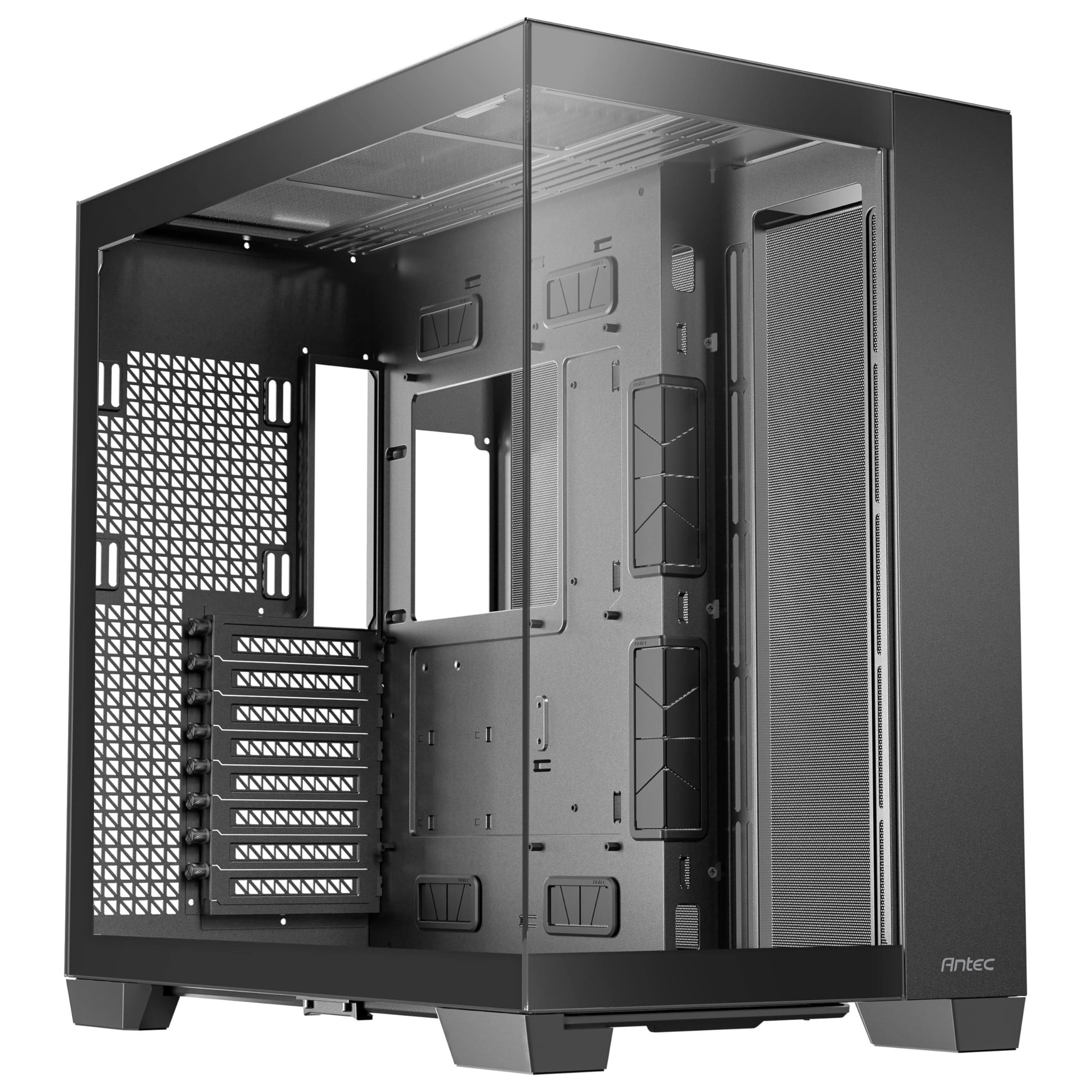
This is the case for a builder who wants maximum radiator real estate and does not mind buying fans separately. The dual-chamber layout splits the power supply and cable side away from the main board, so air flows through the component side without a PSU jungle in the way. Thick 360 mm radiators fit on the top, bottom, and side at the same time — that is a lot of cooling capacity for a mid-range chassis.
The weight difference versus the ASUS ProArt PA602 is worth calling out: this Antec rides at 23.1 pounds against the ProArt’s 35.5. That makes it easier to lift onto a desk solo. It is also shorter on radiator length than the ProArt, which takes a 420 mm — here you are capped at 360 mm per position. Three 360s across three positions is a different strategy than one big 420, and for a multi-loop custom build it often wins.
You get an uninterrupted view of your build, because the full-view front and side panels use a smooth edge where glass meets frame with no visible border. Buyers report the video card fans barely spin up, since the chamber breathes so well. Storage covers two 3.5″ drives (the wide hard drives) and four 2.5″ SSDs (the slim solid-state drives) — modest next to drive-heavy servers, but fine for a gaming rig. Size gets mixed feedback: it is a genuinely big box, so check the depth against your desk before ordering.
The fan decision: none are included, which is the one thing to plan around. Budget for at least three 140 mm or two 160 mm fans top and bottom, and the airflow advantage only shows up once you populate it.
The storage read: two large drives and four small ones is enough for a game library, less so for a home server that hoards footage.
It beats the pack on: radiator count for the money — three simultaneous 360 mm positions at a mid-range tier.
Think twice if: you want fans in the box or a smaller footprint; this one needs both a fan purchase and desk space.
3. Antec Performance 1 FT Full Tower
The full tower that reads out your temps without you opening an app.
Antec built a temperature display right into the chassis, so a glance tells you how hot the system is running — no second monitor, no software window. Antec iUnity adds a readout of your PC specs on top of that. It is a small convenience that turns out to be genuinely useful during a long render or a gaming session, because you notice a climbing number before it becomes a problem.
You get three PWM fans included, plus two cable covers that tidy the routing, and a Type-C port rated at 10Gbps (10 gigabits per second, fast enough for a modern external SSD). It supports graphics cards up to 370 mm in length. That is the shortest card clearance on this list, so a triple-fan flagship card needs measuring. Dual 4 mm tempered glass side panels put the build on show from both faces.
The internal layout has four drive bays and room for a large power supply. Assembly is easy to take apart and rebuild, which matters if you upgrade often. Cable management gets clean results once the covers go on. This is not the biggest case here — it is the one that gives you a readable dashboard and a clean interior for a normal-size high-end build.
Reasons it earns a slot
- Built-in temperature display and Antec iUnity spec readout.
- Three PWM fans and two cable covers in the box.
- Type-C 10Gbps port for fast external drives.
- Twin 4 mm tempered glass panels on both sides.
The honest caveats
- 370 mm GPU clearance is the tightest pick here — flagship cards need a tape measure.
- No radiator support figures listed, so a big custom loop means checking the manual.
- Cooling method is listed as air only.
Best for: a builder who wants to see temps at a glance and keep a clean, viewable interior.
Look elsewhere if: your card is near 370 mm or you plan a large custom water loop.
4. Thermaltake View 600 TG
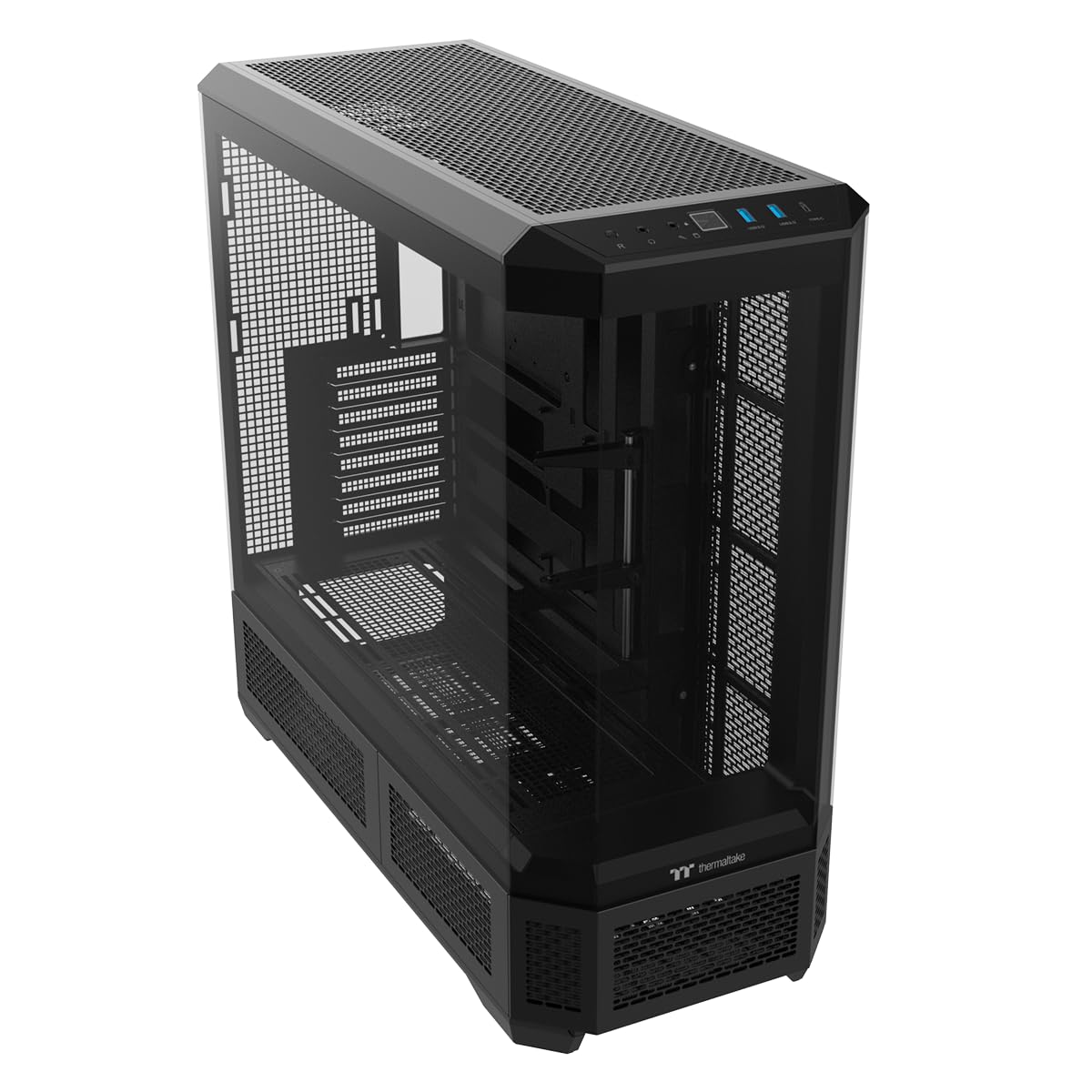
A bay-window tower that flips your graphics card vertical on demand.
480 mm of GPU clearance is the headline, and it is the longest here alongside nothing else in this lineup — the Fractal North XL sits at 413 mm. That means the biggest flagship graphics cards go in without a squeeze. Three tempered glass panels wrap the front like a large bay window, so the build is meant to be looked at. A rotatable PCIe slot tray switches your card from horizontal to vertical, though the 90-degree riser cable is sold separately.
Cooling potential runs to ten fans in either 120 mm or 140 mm sizes, spread across three removable fan trays, two of which carry vibration dampening. A 420 mm radiator fits, air coolers go up to 175 mm tall, and the power supply gets 220 mm of room. None of this comes with fans installed, so the ten-fan figure is a ceiling, not a gift. For a builder who wants to show a vertical card through glass, it is hard to argue with the view.
Hidden-connector support is a real differentiator: cutouts line up with mATX and ATX boards built for rear cable routing, like ASUS BTF, MSI PROJECT ZERO, and GIGABYTE PROJECT STEALTH. Route your cables behind the board and the front stays clean. The interior is spacious enough that routing channels are simple to follow.
The look, plainly: triple glass makes this a display case first — the build is the point, not a plain black box under a desk.
The catch: no fans and no riser cable in the box. Add both to your plan, or the vertical-GPU feature stays unused.
Pick this one when: a 480 mm card and a vertical showcase are both on your wish list.
Less ideal if: you run a rear-connector-free board and want fans supplied — this one makes you buy them.
5. ASUS ProArt PA602

Two oversized 200 mm fans push air straight through a 15.5 mm grill.
The ProArt’s defining spec is a 15.5 mm front grill with 45% porosity, backed by two 200 x 38 mm front fans and a 140 mm rear exhaust. In plain terms, the front of the case is mostly holes, and two big slow-spinning fans shove a wall of air through it. Two internal deflectors then angle that incoming air toward the motherboard and components. A built-in fan hub lets you manage the whole set from one place.
Its 9 internal bays are a big jump over the Thermaltake View 600 TG, which lists a single bay — this is a storage-capable workstation case, not a display-first box. It supports a 420 mm radiator for an all-in-one or custom loop and gives flagship cards room for horizontal or vertical mounting. Compared with the Antec C8’s 360 mm ceiling, the ProArt’s 420 mm radiator support gives you one longer position instead of three shorter ones.
Heft is the trade-off: 35.5 pounds against the Antec C8’s 23.1, so you will want a hand to lift it onto the desk. The front panel carries an IR dust indicator that nudges you to clean the filter when airflow drops — a small thing that keeps the big fans working. I/O includes a Power Lock Latch, a two-section PWM control, and a USB Type-C 20Gbps port for fast external drives.
Where the ProArt leads
- Two 200 x 38 mm front fans plus one 140 mm exhaust included.
- 9 internal bays — the most storage room on this list.
- 420 mm radiator and 440 mm GPU clearance.
- USB Type-C 20Gbps port and a built-in fan hub.
Where it asks something of you
- 35.5 pounds is heavy — plan a two-person lift.
- One large radiator position rather than three simultaneous ones.
- Workstation styling rather than a glass showcase.
It suits: a workstation builder who wants quiet airflow, big storage, and one 420 mm loop.
Not the pick for: anyone who wants a glass-and-lights display case or cannot lift 35.5 pounds.
6. Fractal Design Define 7 XL
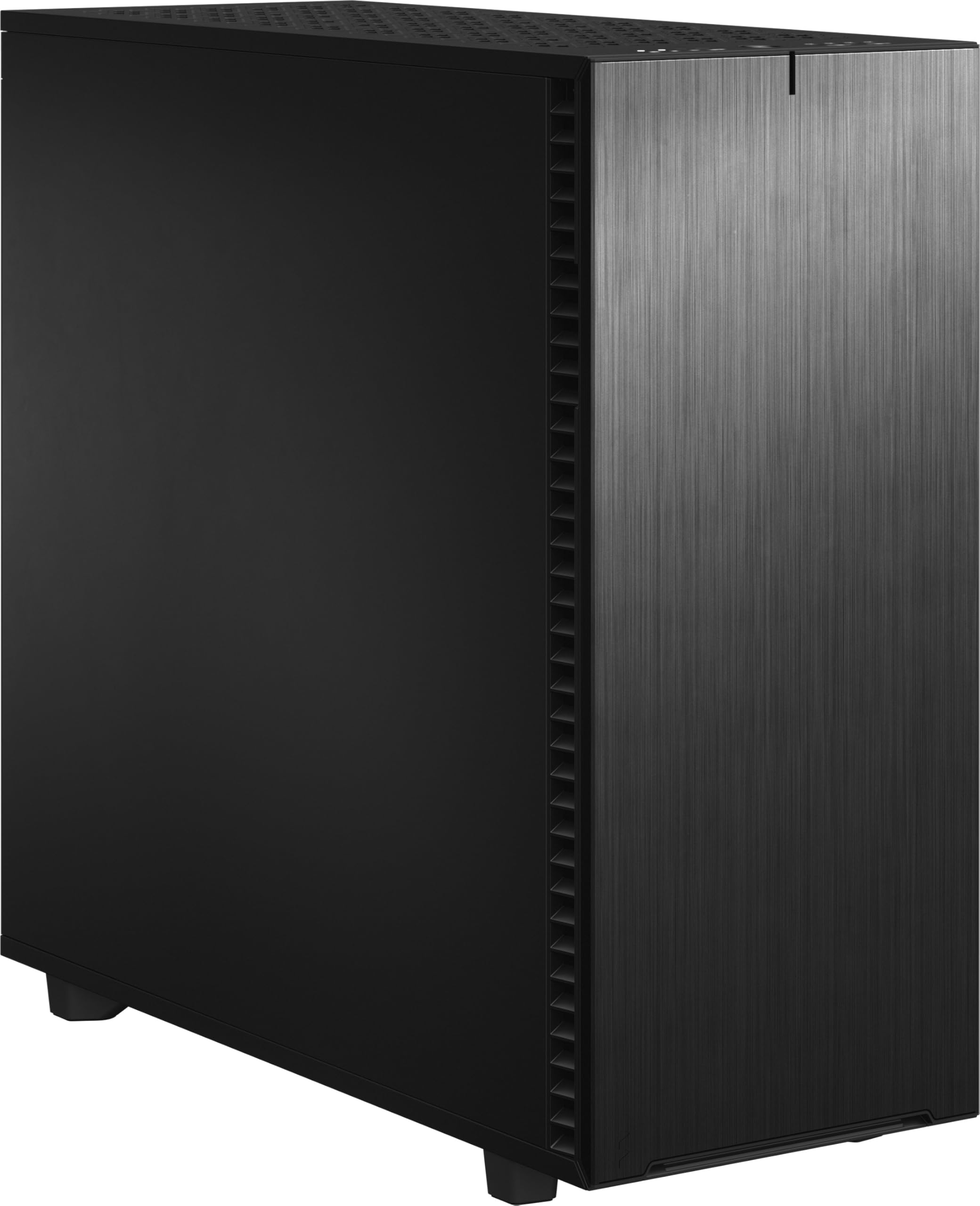
Eighteen hard drives and a 480 mm radiator in one brushed-aluminum box.
Most cases here hold a handful of drives. This one holds up to 18 HDDs and 5 SSDs in its default storage layout — a home server’s worth of spinning disks inside a silent case. A brushed aluminum front door with reversible dual-handed hinges hides everything, and magnetic latching keeps it shut. Multi-brackets turn any unused fan position into an HDD, SSD, or pump mount, so the interior bends to your build instead of the other way around.
Water cooling gets room to breathe: an open layout fits radiators (the finned panels that dump heat from liquid loops) up to 480 mm. Graphics cards can run up to 530 mm — the longest card clearance here, ahead of the Lian Li O11D EVO XL’s 460 mm, so a flagship card drops in without crowding. CPU coolers can stand up to 185 mm tall. It also supports E-ATX and SSI-EEB boards (oversized motherboard formats), which is rare among full towers and the reason large workstation boards end up here.
Silence and storage is the identity: the door, the aluminum panels, and the modular brackets all serve that goal. The trade-off is airflow through a closed front — the vented top helps, but this is not a mesh-front case. It is built like a vault and reads that way, so if you want glass and lighting, look further up the list.
Best fit: a media server or archive machine where drive count and quiet matter more than a window.
Skip consideration if: you are chasing maximum open-air airflow — the closed front is the wrong tool.
Choose it for: 18 drives, a 480 mm radiator, and SSI-EEB support — no other pick here matches that storage run.
Pass if: a glass side panel and big open intakes are the reason you are shopping.
7. LIAN LI O11D EVO XL

Three 420 mm radiators and a front pillar you can take out for an open view.
Radiator capacity is where this case makes its case: support for three 420 mm radiators at once. For a custom-loop builder, that is three big cooling blocks running simultaneously, and it puts the Antec C8’s three 360 mm positions in the rear-view on radiator length. A removable front pillar opens the view across the glass without weakening the structure. An adjustable motherboard tray shifts through three height levels to clear different fan and radiator combinations.
It handles E-ATX, ATX, Micro-ATX, and Mini-ITX boards, up to 11 fans, 7 storage drives, and graphics cards up to 460 mm. That card figure sits behind the Thermaltake View 600 TG’s 480 mm and the Fractal Define 7 XL’s 530 mm, so a very long card plus a thick front radiator needs a check. Cable management uses three dual-layer clips you can move along vertical grommets, so routing stays tidy through any layout.
A 14.5% wider top mesh opening, a 14% wider side mesh opening, a fully open bottom, and three dust filters keep airflow up. Toolless installation and a multi-directional power button with a movable I/O module make the build steps pleasant rather than fiddly. No fans ship with it, so the 11-fan ceiling is yours to fill.
Why it made the shortlist
- Three 420 mm radiator positions — the most here on block length.
- Removable front pillar for an unobstructed glass view.
- Motherboard tray shifts through three height levels.
- 14.5% wider top mesh and 14% wider side mesh openings.
Things to weigh
- No fans included — fill up to 11 yourself.
- 460 mm GPU clearance trails the longest cases here.
- It is a big, heavy tower to position.
Built for: the custom-loop builder who wants three 420 mm radiators and a pillarless view.
Think again if: you need fans supplied or run an extra-long card with a front radiator.
8. Lian Li O11 Dynamic EVO XL RGB
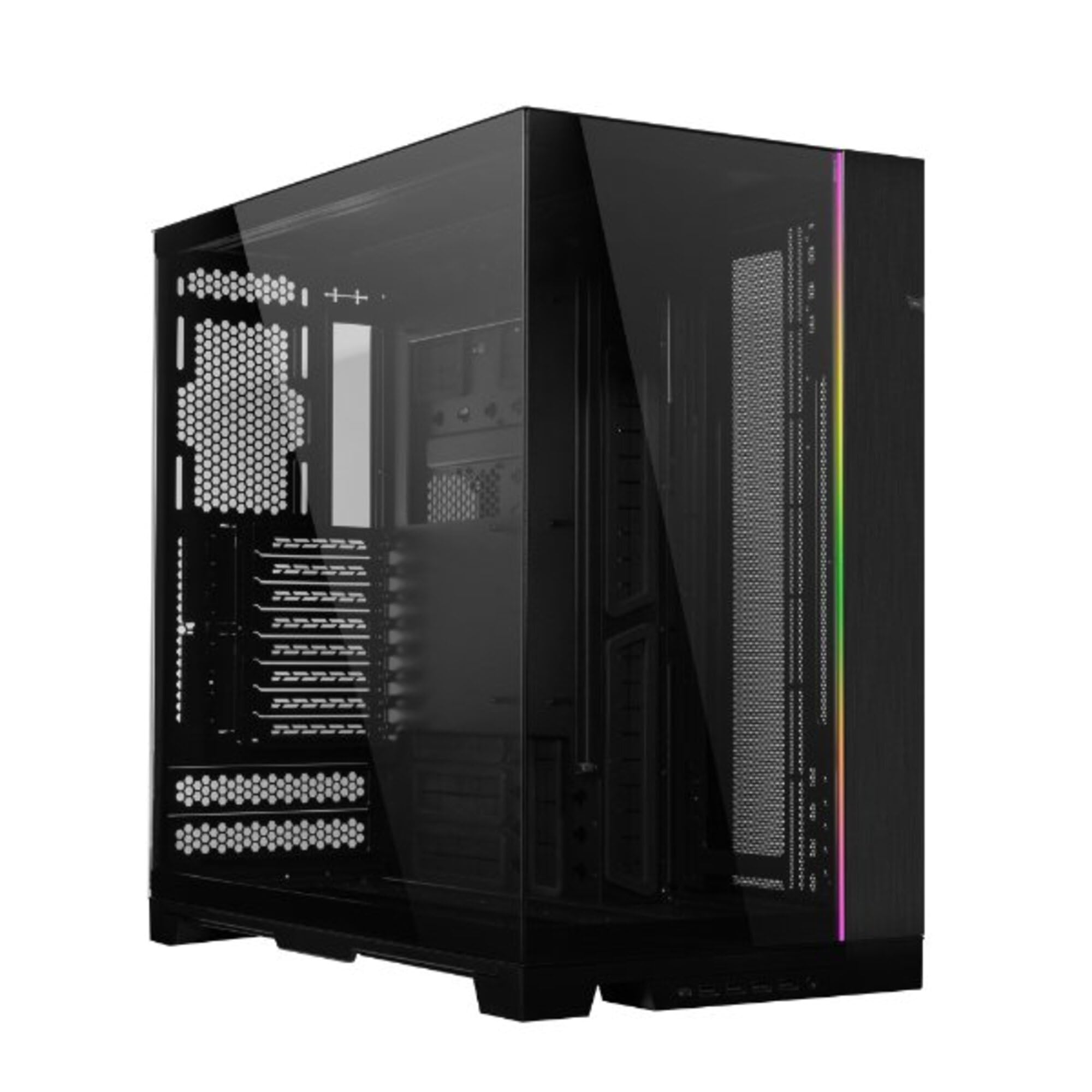
The EVO XL silhouette, now dressed in tempered glass and addressable RGB.
This is a glass-and-light version of the same EVO XL full-tower platform. It supports motherboards up to E-ATX, up to 7 storage drives, and liquid cooling up to three 420 mm radiators or air cooling up to 11 fans. The alloy steel frame keeps the structure rigid while the tempered glass front and sides put the whole build on display. The RGB lighting is the point of this trim level — it is the case you buy when the build is meant to glow.
The shared platform means the numbers track the O11D EVO XL closely: 7 bays, one 12 centimeter fan size, and the same three-420 mm radiator ceiling. If you cannot decide between an RGB-lit box and a plain display case, the difference here is mostly lighting and the glass finish rather than core capacity. Neither ships with fans, so cooling remains a separate purchase either way.
For a builder who wants the EVO XL layout without adding separate lighting, this saves a step. Just know the lighting is baked in, so your theme gets locked to a lit interior. It is the trim to pick if you want a full glass showcase without adding your own lighting.
What sets this trim apart: addressable RGB built in, so you skip buying and wiring a separate light kit.
The one question: fans still are not included — factor a full fan set into the plan.
Best for: a lit glass showcase on the three-radiator EVO XL platform.
Otherwise: if you plan your own lighting, the plain EVO XL covers the same ground.
9. Cooler Master HAF 700

HAF means high airflow, and this case takes the name literally.
Two 200 mm Sickleflow ARGB fans come pre-mounted in a mesh-front chassis, so the case breathes the moment it is built. The fan count ceiling reaches eighteen 120 mm fans, and radiator support goes up to 480 mm — the longest radiator figure here, matching the Lian Li tray layouts for block length. A tool-less design means panels, fan trays, and brackets move without hunting for a screwdriver. The ARGB Gen 2 lighting lets each LED be controlled on its own for fine-tuned lighting effects.
Storage covers 8 internal bays, and the front I/O is generous: one USB 3.2 Gen 2 Type-C port plus four USB 3.2 Gen 1 (3.0) ports, so peripherals and drives plug in without a hub. It is built for extended ATX motherboards.
The honest note is size and weight. The enclosure runs 26.22 inches deep by 11.46 wide by 24.65 tall and weighs 19.6 kg, which is a serious footprint. It will not slide under a compact desk, and moving it takes both hands. If your desk is small, measure the depth before committing.
Why airflow chasers pick it
- Two 200 mm Sickleflow ARGB fans included.
- Support for up to eighteen 120 mm fans or 480 mm radiators.
- One USB-C Gen 2 plus four USB 3.0 front ports.
- Extensive tool-less panels and trays.
The reality check
- 26.22 inches deep — measure your desk first.
- 19.6 kg is heavy to lift and move.
- Bedroom-quiet is not the goal here.
Made for: airflow-first builds that want big fans, a mesh front, and maximum radiator length.
Not for: tight desk spaces or anyone who needs a case to lift easily.
10. ASUS ROG Hyperion GR701

Diecast aluminum-alloy carry handles rated to 80 kg and four pre-mounted 140 mm fans.
The diecast aluminum-alloy frame is the first thing you notice, and its top bars double as carry handles rated to support up to 80 kg. Four 140 mm fans arrive pre-mounted for airflow, with an ARGB fan hub to control them from one place. It takes GPUs up to 460 mm and has 7 internal bays.
The build experience is a step up: a hinged tool-free side panel opens without work, a built-in storage drawer keeps screws and small parts together, and an integrated graphics card holder supports vertical or horizontal installations. Two front Type-C ports support 60W fast charging for a phone or laptop. It is the sort of case designed to make assembly feel considered rather than cramped.
The weight is the honest limit: 24.95 kg means the 80 kg handle rating is about structural strength, not a light lift. It is also big, and buyers split on whether the premium tier is warranted. For a builder who wants the finished object to feel solid and the build process to be pleasant, it earns its place at the top of the range.
The premium payoff: four fans, a hinged panel, a parts drawer, a GPU holder, and 60W Type-C charging — the little conveniences add up during a build.
Size and weight: 24.95 kg and a large footprint mean you position it once and leave it.
For you if: you want a premium-feel build with fans in the box and want a case that shows off hardware.
Wrong pick if: you need to move the case often or want a compact footprint.
11. CORSAIR 9000D RGB Airflow

The super tower that treats a custom loop like a floor plan.
Radiator support here reads like a build sheet: up to 480 mm in the front and roof, 360 mm in the side, and 240 mm in the rear. That is more radiator positions than any other case on this list. Fan capacity runs to eighteen 120 mm, seven 140 mm, or four 200 mm fans. The aluminum InfiniRail mounting system slides along front and roof so you place 120 mm and 140 mm fans wherever you want, instead of being stuck with fixed vertical slots.
An included iCUE LINK System Hub manages up to 13 additional iCUE LINK devices — fans, coolers, and Hydro X Series loop parts — from one controller. The front I/O RGB runs through it too. The steel front panel is removable for cleaning, which keeps the high-airflow path working. It holds 18 internal bays and takes a standard 3.5-inch drive stack.
No fans are included, so the huge capacity is yours to populate — and that adds cost on top. The InfiniRail works well for fan and radiator placement, though buyers split on whether enough mounting clips come in the box, and opinions divide on whether the price is fair for the scale. Size is the triumph and the chore: it fits multiple huge graphics cards with room to spare, and it takes two people to place.
The draw: the most radiator and fan capacity in this lineup, mounted on a sliding rail system, plus an iCUE LINK hub (Corsair’s single-cable controller) ready for your whole lighting-and-fan setup.
Budget note: fans are extra, and the scale means extra fans add real cost — plan the full cooling set before you order.
Sized for: a showpiece custom loop where radiator slots and fan count are the deciding specs.
Only if: you accept no fans in the box and have room for a very large case.
Know the Specs
GPU Clearance
GPU clearance is the longest graphics card your case can hold, measured front to back in millimeters. A case rated at 440 mm or 480 mm fits a flagship card without forcing you to remove a fan tray. A front radiator eats into that space, so real clearance drops — a case rated at 413 mm of GPU room, for example, falls to 380 mm once a 420 mm front radiator goes in.
Radiator Support
Radiators are the cooling blocks used by all-in-one and custom water loops, sized by length in millimeters. A 360 mm or 420 mm radiator needs the case to have matching mounting positions. Some cases fit one big radiator in a single spot; others fit three medium ones across the top, bottom, and side at the same time. Check both the length and the number of positions, because a triple-360 layout and a single-420 layout cool differently.
Motherboard Form Factor
E-ATX boards are wider than standard ATX, so only a case that lists E-ATX support will take one. SSI-EEB is a larger workstation board that only some full towers mention. If you own a big board, match it against the case’s stated support before buying, or the board will not seat.
Fans Included vs Extra
Some cases ship with three or four PWM or ARGB fans already mounted, which saves a purchase and an installation step. Others list a high fan ceiling but ship empty. A PWM fan is one the board can speed up or slow down automatically; ARGB adds per-LED color control. Read the listing for what is in the box, not just how many fans the case can hold.
Common Questions
Will a full-tower case fit under a standard desk?
Do I need a 420 mm radiator to justify a super tower?
Which cases here come with fans and which do not?
What is the difference between a full tower and a mid-tower?
Can these cases hold an E-ATX or SSI-EEB motherboard?
How much GPU clearance do I really need for a flagship card?
Is a dual-chamber layout better than a single-chamber one?
Do any of these cases support hidden-connector motherboards?
How many storage drives can I fit in a full tower?
Are these cases heavy enough to need two people to lift?
The Bottom Line
For most builders, the super tower pc case winner is the Fractal Design North XL: it fits an E-ATX board and a 420 mm front radiator, ships with three 140 mm PWM fans (speed-controlled fans), and still looks at home in a living room. If maximum radiator capacity is your goal, the Antec C8 runs three 360 mm radiators at once, while the CORSAIR 9000D gives the widest range of radiator positions for a custom loop. And for a drive-heavy server or a spot that needs up to 18 HDDs (hard disk drives), the Fractal Design Define 7 XL is the one to reach for.
How we choose
We do not accept paid placement. Every pick is matched to a real buyer and a real use-case; we do not hands-on test units.
Sources
Specifications: manufacturer listings and product documentation. Review insights: verified customer reviews, as of November 2026. Pricing: not shown on this page (it changes often); check the current price via the retailer link.
As an Amazon Associate, Tactical Gear Guy earns from qualifying purchases. This does not affect which products we feature.