Specs are compiled from manufacturer listings and verified buyer reviews and can change over time — please confirm the key details on the product page before buying.
If something is digging up your lawn at night, the fix is a solar stake that fires sound and vibration into the soil on a repeating cycle — not another spray or trap. The catch most buyers miss is that these devices come in two very different types: ground stakes that pulse into the soil for moles and voles, and motion-triggered units that flash and screech at cats, deer, and raccoons above ground. Buying the wrong type for your pest is the number one reason people say a repellent “did nothing.”
This guide is built by comparing the manufacturers’ published specifications and the patterns across verified customer reviews, so you get each pick’s real strengths and trade-offs instead of marketing spin.
Below you’ll find the models that actually match a real pest problem, sorted by what they deter and how they’re powered. Every pick here charges from a solar panel, so there’s no extension cord to run across the yard. My breakdown of the solar ultrasonic animal repellent options separates soil-pulse stakes from motion-sensor units so you buy the right one.
Top Picks
How To Choose The Best Solar Ultrasonic Animal Repellent
The first decision isn’t brand or budget — it’s which animal you’re fighting and where it lives. A mole tunnels underground and never sees a flashing light, so a motion-sensor unit aimed at the lawn surface won’t reach it. A stray cat walks across the surface and ignores a stake buried in the dirt. Match the device type to the pest before you look at anything else.
Soil-pulse stakes versus motion-sensor units
Stakes push sound and vibration directly into the ground, usually on a repeating timer — the 8-pack here pulses roughly every 20 seconds, and the 4-pack model does the same. These are built for moles, gophers, voles, and chipmunks that live under the surface. Motion-sensor units sit above ground, watch for movement with a PIR sensor (a passive infrared detector that spots body heat in motion), then fire sound and light at whatever walks past. Those suit cats, deer, raccoons, skunks, and dogs.
How much ground one unit covers
Coverage is the spec buyers underestimate most. The motion units here list detection angles from 110° up to 360° and ranges from 25 feet to 33 feet, and the stake sets spread across a lawn at roughly 49 feet apart. If your problem area is large, a multi-pack gives you more placement points than one stronger unit ever could. Read the detection angle and range together — a wide angle with a short range covers a broad but shallow band.
Power, waterproofing, and frequency cycling
Every pick here runs on a solar panel, and some add USB charging as a backup for cloudy stretches. Look for an IP65 or IP66 rating (the IP number grades how well a housing keeps out dust and water — 65 and 66 both survive rain and hose spray). Frequency cycling matters too: units that shift between multiple frequencies stop animals from tuning out a single tone, and several models here run five separate modes for exactly that reason.
Side-by-Side Comparison
| Model | Best For | Type | Coverage / Detection | Waterproof Rating | Amazon |
|---|---|---|---|---|---|
| PHIMINNEX Solar Ultrasonic Animal Repeller | Cats, deer, raccoons above ground | Motion-sensor unit | 110° angle, up to 33 ft | IP66 | Amazon |
| Lycxbfjia 8-Pack Mole Repellent Stakes | Moles, voles, chipmunks underground | Soil-pulse stakes | 8 stakes, ~49 ft spacing | IP65 | Amazon |
| Cvtayn Snake & Mole Repellent 4-Pack | Multi-pest lawn defense | Soil-pulse stakes | 50 ft radius | IP65 | Amazon |
| YOOYHHOME 2-Pack Cat Repellent | Cats, dogs, skunks, deer | Motion-sensor unit | 13.5–65.5 kHz output | Waterproof design | Amazon |
| Fretech Mole Repellent 8 Stakes | Large lawns, burrowing pests | Soil-pulse stakes | Up to 7,000 sq ft | Waterproof design | Amazon |
| G-Jyuncyou 2-Pack Animal Repeller | Deer, coyote, raccoon, dog | Motion-sensor unit | Motion-triggered, 5 modes | IP65 | Amazon |
| CKCOEO Solar Animal Repellent 2-Pack | Wide-angle yard coverage | Motion-sensor unit | 150° angle, 25–30 ft | IP65 | Amazon |
Detailed Reviews
1. PHIMINNEX Solar Ultrasonic Animal Repeller Outdoor
Five modes, three frequencies, and a sensor that watches a wide arc — this is the one that adapts when the animals do.
The PHIMINNEX runs three ultrasonic frequencies across a 13.5 kHz to 45.5 kHz band, plus a variable-frequency alarm and a strong flash light. In plain terms, it doesn’t fire one fixed tone that a cat or raccoon eventually ignores — it shuffles the signal. Five working modes let you change the pattern so animals never settle into a routine, and you can dial the volume down without changing the frequency itself, which matters if a neighbor’s window faces your garden.
What wins people over with this unit is the detection setup. A PIR sensor (the heat-and-motion detector) watches a 110° arc out to roughly 33 feet, so it wakes up when something actually enters the zone rather than running all night. The IP66 housing is the stronger of the two waterproof grades in this lineup — it stands up to rain and direct hose spray — and the ABS plastic body is built for a life outdoors. It ships with a rechargeable lithium battery charged by the panel at 90mA in sunlight or through the included USB cable when the sky stays grey.
Setup is the easy part: push it into the soil or hang it on a wall at a sensible height. The honest expectation is timing — the maker tells you to give it 10 to 15 days before you see a drop in visiting animals, so don’t judge it after one night. It’s a single unit, so a large property needs more than one placement point. The flashing lights are reported to work well in the dark, which helps when the visitors come after sunset.
Sharpest edge and real limit: the 110° sensor and 33-foot range give it the widest honest detection window of the motion picks that publish their numbers, and the IP66 rating beats the IP65 units around it on weather exposure. The catch is that it’s aimed at surface animals — cats, dogs, deer, skunks, rabbits, raccoons, foxes, owls — not the moles tunnelling underneath your lawn.
Where it pulls ahead
- Five working modes with three frequencies from 13.5 kHz to 45.5 kHz keep animals from adapting
- Adjustable volume that leaves the ultrasonic frequency untouched
- IP66 waterproofing — the toughest of the motion units here
- Solar panel plus USB backup charging for cloudy stretches
What to weigh first
- One unit per box — wide properties need a second placement
- Maker advises 10–15 days before you notice fewer animals
- Surface deterrent only, so no help against underground moles
Best fit: a yard with cats, deer, raccoons, or skunks crossing the surface, where you want to move the deterrent around and change modes as the pattern shifts.
Look elsewhere: if your actual problem is mole mounds and tunnels — grab a soil-pulse stake set instead, because this one never touches the ground below.
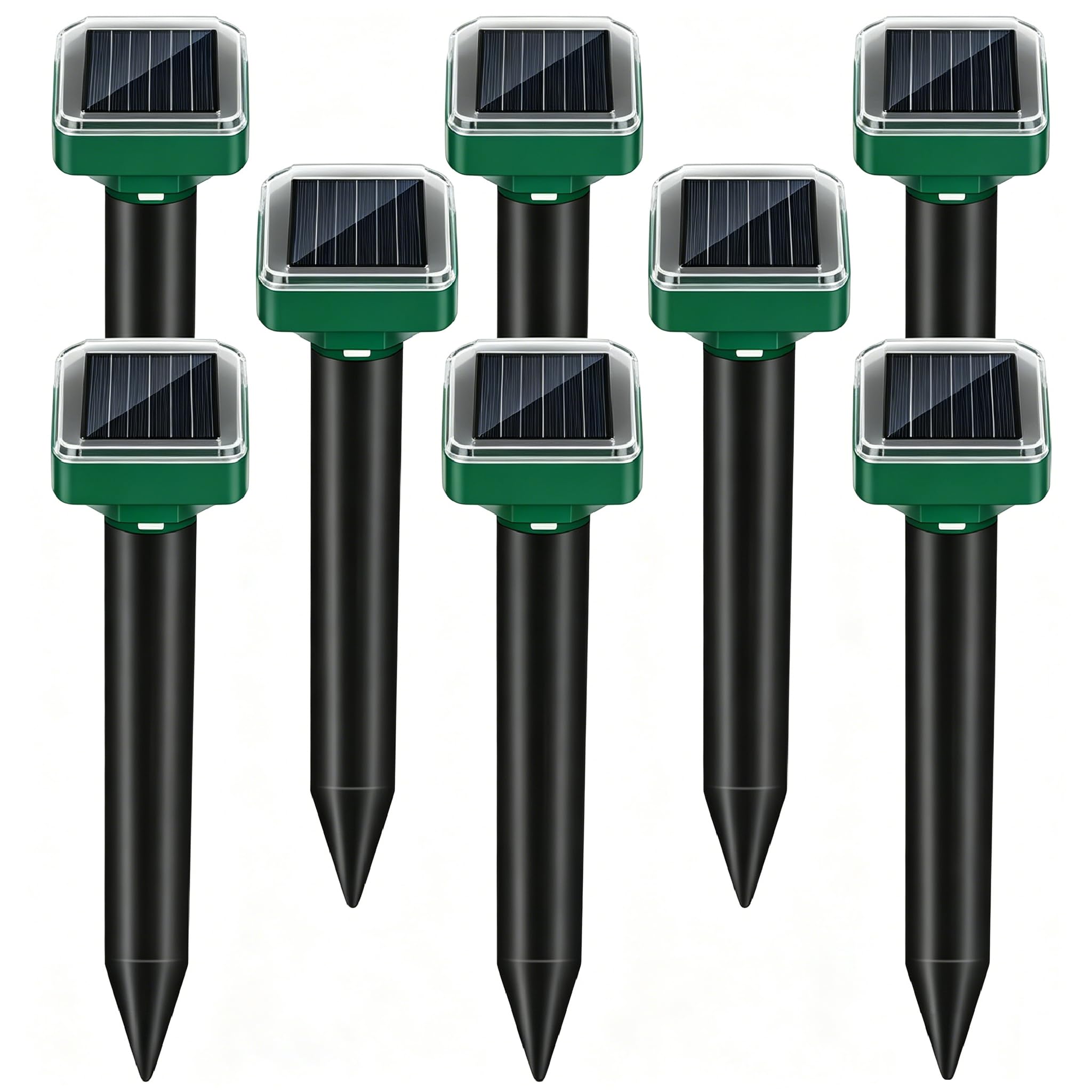
2. Lycxbfjia Ultrasonic Mole Repellent Solar Powered, 8 Pack
Eight stakes for one price, each thumping sound and vibration into the soil every 20 seconds.
Moles and gophers live under the lawn, so no flashing light will ever reach them — the fix is a stake that sends repeated pulses into the soil. This set ships eight of them, and the practical math is that you can stake the front yard, the back lawn, the flower-bed border, and the orchard edge all at once instead of dragging one device around. Space them roughly 49 feet apart near where you see fresh digging.
Each stake runs its cycle automatically, pushing sound and ground vibration out about every 20 seconds with quiet gaps between pulses for everyday operation. There’s no bait to handle and no spring-loaded trap to set or empty — the whole approach works without poison or chemical spray. That’s a real win if you have kids, pets, or just no appetite for dealing with a caught animal.
Solar charging keeps the cycle running without extension cords or disposable batteries. The ABS body carries an IP65 housing rating, which means it survives rain and spray, and the maker backs it with a one-year manufacturer warranty. The one thing to get right is placement: keep the solar panels above ground and uncovered, and firm the soil around each stake so the vibration actually transfers.
Coverage over brute power: unlike any single-unit motion repeller here — the PHIMINNEX covers one 110° zone, while these eight stakes blanket four separate areas. The limitation is simple: these are underground-only tools. A cat walking across your path won’t care about them.
Go this route: when moles, voles, gophers, or chipmunks are tearing up multiple beds and you need coverage in several spots at once.
Not your tool: if the animal you’re fighting walks above the surface, since this set never rises to meet it.
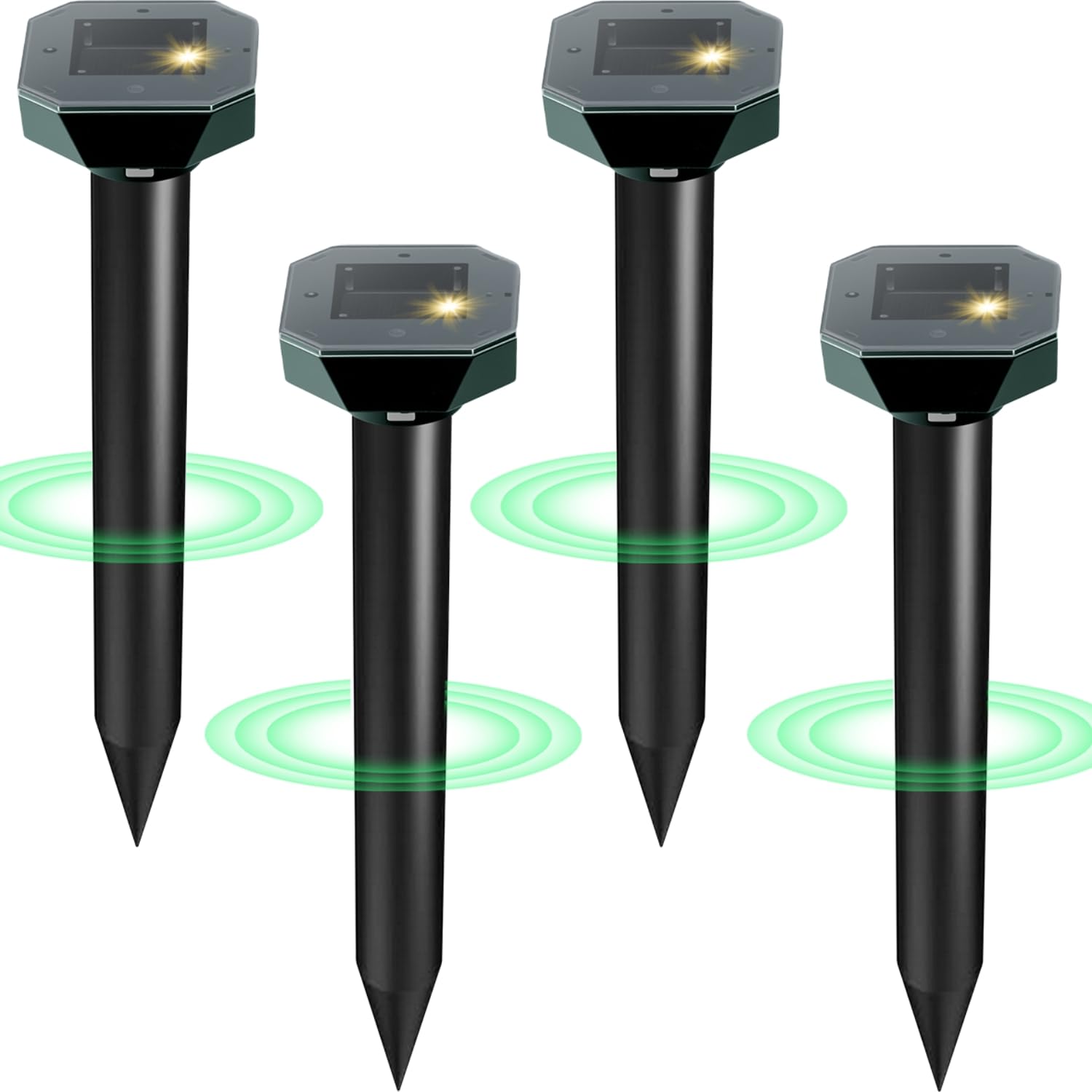
3. Cvtayn Snake & Mole Solar Repellent, 4 Pack
Four stakes that claim a 50-foot radius each — the longest published reach of any stake set here.
The headline here is reach. Cvtayn says each stake covers a 50-foot radius, and pairs that with ultrasonic pulses in the 400–1,000 Hz range plus vibration that fires every 20 seconds. Lower frequencies travel further through soil than a high-pitched tone, which is the logic behind the wide claim. Four stakes at that radius give you a large defensive footprint around flower beds, farms, and yards.
What buyers notice most is that it simply works for garden and lawn care — solar power keeps it running and the water resistance holds up outdoors. Installation is about as simple as it gets: push the stake straight into the soil, no batteries and no outlet. You get a 4-pack, so you have placement points across several beds without buying twice.
Frequency modulation is the quiet engineering detail worth knowing. The unit shifts its pulse pattern to keep pests from adapting to one steady tone. It’s aimed at snakes, moles, gophers, voles, rabbits, skunks, groundhogs, and other burrowers, working without toxic chemicals or traps.
Long reach, small footprint per unit: against the Lycxbfjia 8-pack’s ~49-foot stake spacing, this set wins on claimed radius per stake but ships four units instead of eight. The honest gap is documentation — the water resistance is real, but it isn’t published as a specific IP number the way the PHIMINNEX and TLXLT units list theirs.
Worth it for: larger plots where you want each stake to cover more ground, and multi-pest lawns fighting snakes or gophers alongside moles.
Consider instead: a unit with a published IP rating if you want the waterproofing spelled out in numbers rather than general terms.
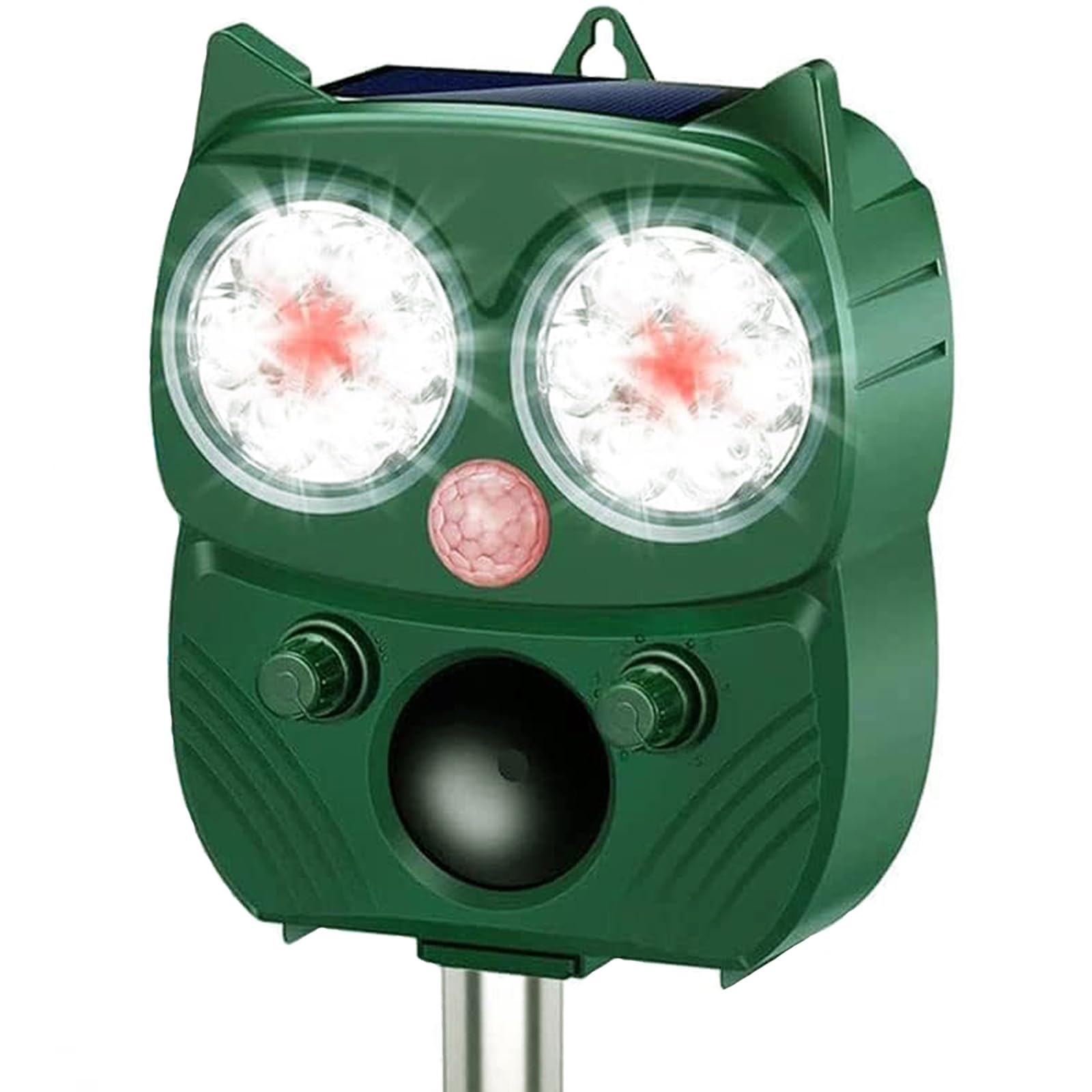
4. YOOYHHOME Cat Repellent Outdoor, 2 Pack
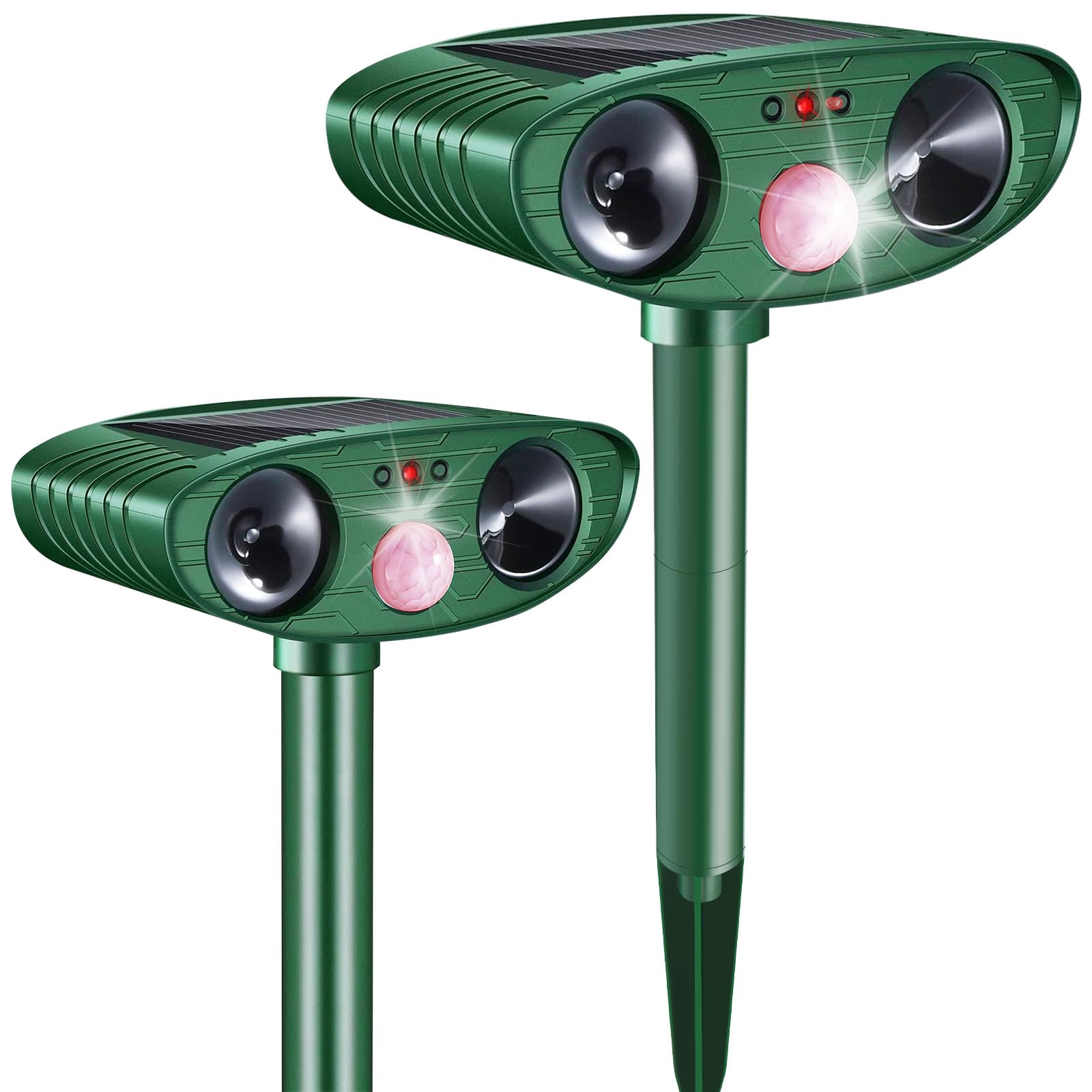
The two-pack that keeps cats, dogs, deer, and skunks off your beds, rain or shine.
Where this unit earns its place is year-round reliability. The waterproof housing is built to keep working through rain, snow, ice, and wind, so you set it out and leave it. It emits ultrasonic output spanning 13.5 kHz to 65.5 kHz — the widest frequency band of the motion units here — aimed at squirrels, stray cats, deer, rabbits, skunks, and dogs.
Effectiveness is what owners talk about most, and the two-pack is why: you get two placement points right from the start. Installation takes minutes, and the device can be stuck in the ground, mounted on a wall, or fixed to a fence, so it fits ponds, flower beds, yards, and orchards alike. The maker states the sound is only audible to animals, and the output is described as harmless to people and to your own pets.
The honest note on sound: feedback on that aspect is mixed, so while the design is meant to be silent to the human ear, some people do pick up on it depending on where the unit sits. Two units cover more ground than one, so spread them across the spots animals actually cross.
The frequency spread: 13.5 kHz to 65.5 kHz is the broadest band among the motion pickups, giving it more tones to work with than the PHIMINNEX’s 13.5–45.5 kHz range.
Year-round angle: the all-weather build is the reason this suits climates with real winters where you can’t be pulling devices in and out.
Right call for: a two-zone yard in a wet or snowy climate where you want the deterrent to simply stay put through the seasons.
Think twice: if the unit will sit right beside a seating area — the mixed feedback on sound makes a tucked-away placement the smarter move.
5. Fretech Mole Repellent for Lawns, 8 Stakes

A stake set rated for 7,000 square feet — the largest single number on any box here.
If your dead patches run across a whole yard, this is the set built for that scale. Fretech rates the eight-stake kit for up to 7,000 square feet, and each stake fires low-frequency sonic pulses every 20 seconds that sink into the soil to reach moles, gophers, and voles. Low frequency is the key word — it’s the tone that carries down through dirt rather than bouncing off the surface.
Effectiveness is the thing that carries this pick, especially for chipmunks that keep finding their way into garages. Setup is straightforward, and the build uses ABS and PC plastics with a waterproof design meant to hold up through rain, snow, and harsh sun. The maker asks you to leave the stakes in direct sunlight for two days before you plant them, which primes the panel for steady charging.
Here’s the honest trade-off: this is the one place the review pages split. Some find the periodic sound annoying, some question long-term durability, and value opinions go both ways. Read that as a device that works but asks you to accept its rhythm — the pulse that drives moles away is also a pulse you’ll hear in a quiet garden. Plan placement away from windows and seating.
Scale you pay for, not silence: against the Lycxbfjia 8-pack, this set publishes a specific 7,000-square-foot rating where the other set specifies only ~49-foot stake spacing. The recurring gripe is the audible pulse — treat it as a placement problem.
Built for: a large lawn where moles and gophers have taken over and you’re willing to trade some quiet for genuine coverage.
Skip if you need silence: a garden that borders a bedroom window or a quiet patio, where the periodic pulse will be something you notice.
6. G-Jyuncyou Solar Ultrasonic Animal Repeller, 2 Pack
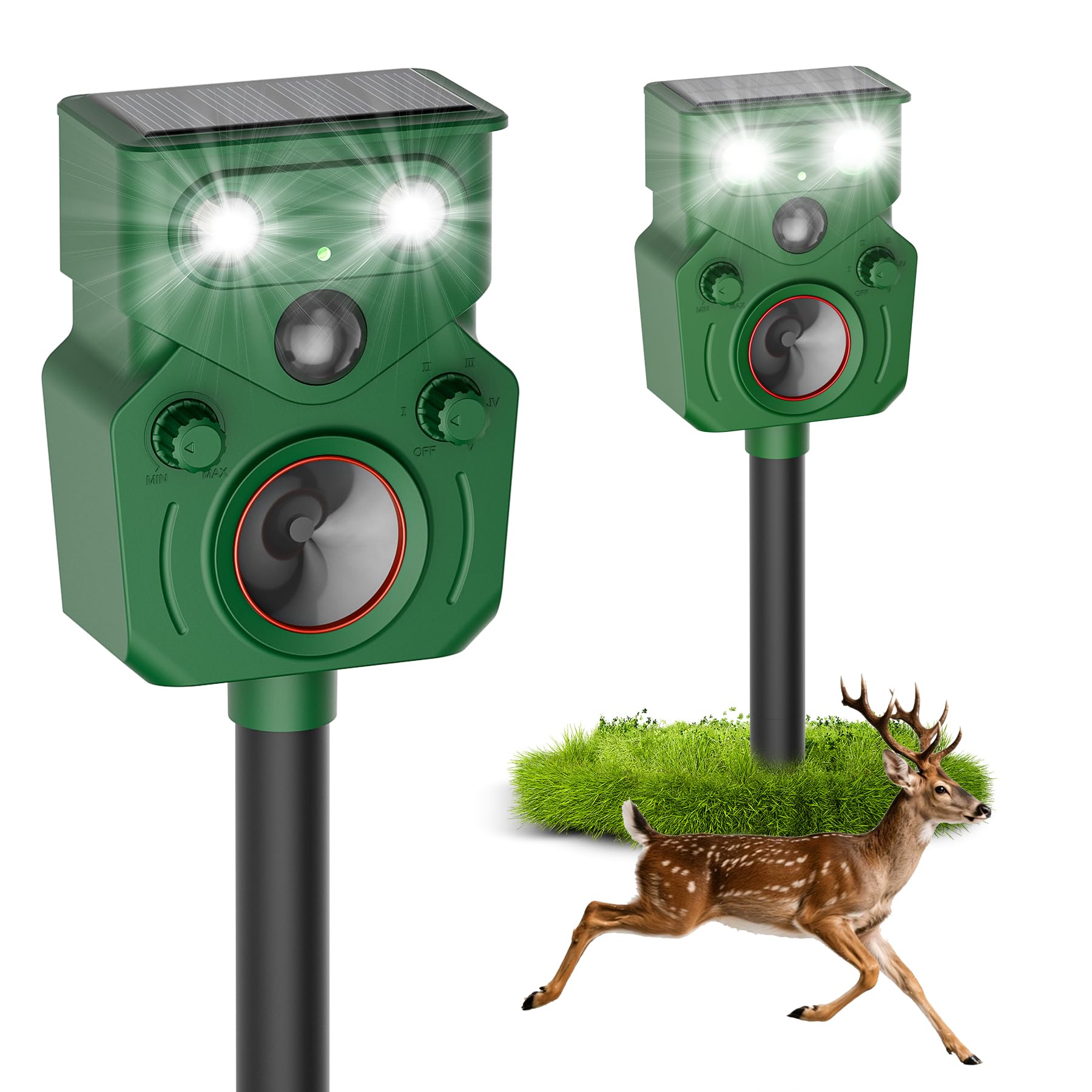
Two chargers in one unit — solar by day, USB backup when the sun never shows.
The dual-charging setup is the reason to pick this one. The panel tops it up in daylight, but when you hit a stretch of grey sky, the included USB fast charging keeps the unit running. That’s the difference between a repeller that sleeps through a rainy week and one that keeps defending your yard. It even alerts you when the battery runs low, so you’re not guessing why it went quiet.
Detection works on motion: when an animal enters the range, the unit fires ultrasonic waves and flashing lights automatically. Adjustment knobs let you dial in sensitivity and frequency, and five working modes cover different scenes. It targets deer, cats, dogs, foxes, coyotes, and raccoons, and the sound is stated to be inaudible to humans so it won’t foul up your quiet morning.
The IP65 housing handles harsh weather, and the ABS build is meant for indoor or outdoor use. Because it’s compact, you can either push it into the ground or hang it on its own — useful for placing it high on a fence line where deer come through. The two-pack lets you cover a couple of approaches rather than one.
Backup power is the headline: the TLXLT unit here charges its panel in 24 hours of sun and leans on USB for cloudy days; this one adds a low-battery reminder so you know when the panel isn’t keeping up. The trade-off is that it’s a smaller-coverage motion unit — for a whole sprawling property, the multi-pack sensor units cover more ground.
Pick this for: a climate with frequent cloudy spells, or a spot where the panel catches only part-day sun and you need a charging fallback.
Consider a larger set: if raw coverage area is your priority over the USB backup feature.
7. TLXLT Solar Ultrasonic Animal Repellent 360°
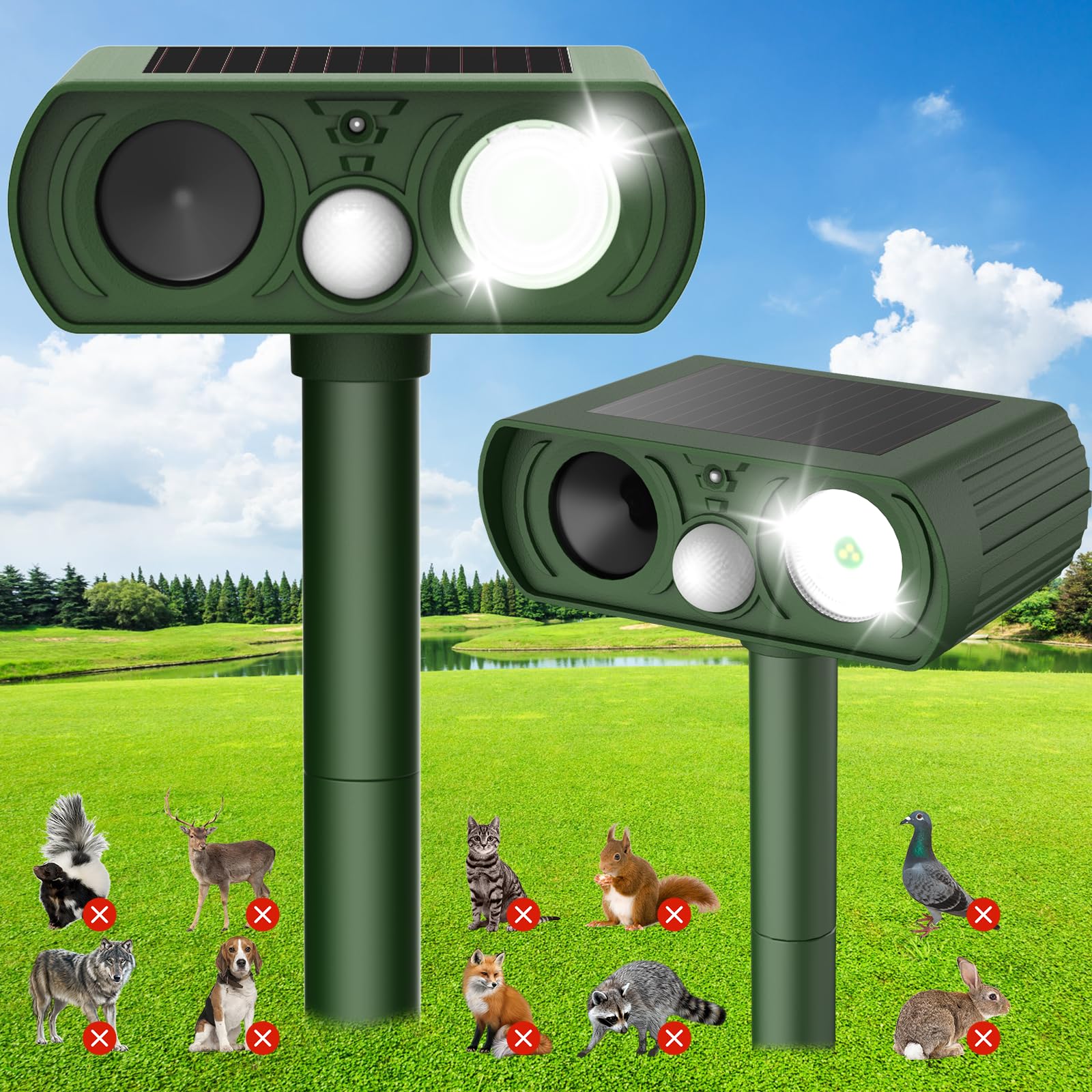
A 150-degree sweep — the widest single-sensor angle here — catches deer and cats cutting across your line.
For a long property edge where animals cross at an angle rather than head-on, the wide sweep is the whole point. This unit’s infrared detection angle reaches 150 degrees with a range of 25 to 30 feet, and when the motion sensor picks something up, it fires ultrasonic sound and flashing LED strobe lights to scare animals off. It handles deer, cats, dogs, squirrels, rabbits, and raccoons.
The reviews back the easy side of it — owners find it simple to set up and like that it doesn’t demand an outlet, which suits yard and balcony use. Placement is flexible: set it roughly 9 to 10 inches above the ground where animals pass, or use the two hanging holes to mount it on a tree or fence. A two-pack gives you a couple of these fixed points.
On the operating detail, the light language tells you what’s happening — blue means charging, red means working. Once it’s on, the red light and ultrasonic signal run for 15 seconds (sound for 2.5 seconds with a light flash at the start), then it drops into standby until the sensor trips again. The IP65 rating and ABS build keep it going in weather.
Angle versus the field: the 150° sweep is the widest single-sensor detection angle in this lineup, edging the PHIMINNEX’s 110° arc. The flip side is its 25–30 foot range is shorter than the PHIMINNEX’s 33 feet — so it’s best positioned where animals pass close, not far.
Best placement: along a fence line or garden edge where animals cross at an angle, so the wide 150° sweep does the work.
Pick differently: if your target zone is long and narrow and you need reach — a tighter angle with more distance serves better.
Know the Specs
PIR Detection Angle and Range
The PIR (passive infrared) sensor spots body heat moving through its field and triggers the device. The angle tells you how wide that field is and the range tells you how far out it reaches. The units here run from 110° up to a full 360°, with ranges from 25 to 33 feet. A wide angle with a short reach suits a broad but shallow approach line like a fence edge; a narrow angle with longer reach suits a single path animals walk straight down. Read both numbers together before you buy.
IP Waterproof Rating
IP stands for Ingress Protection, and the two digits grade how well a housing keeps out solid objects and water. An IP65 rating means the unit is protected against dust and water jets, and IP66 is a step stronger against heavier spray. Every model here that publishes a rating meets IP65 or IP66, which is the level that keeps a yard device running through rain. If a listing doesn’t name a rating, the waterproofing is only described in general terms — worth knowing if your climate is wet.
Ultrasonic Frequency and Cycling
Ultrasonic means a pitch above what human ears register, and the frequency is measured in kHz. The motion units here span roughly 13.5 kHz to 65.5 kHz, and the stake sets pulse in a lower band tuned to travel through soil. Cycling matters because a single steady tone lets animals adapt to it — devices that shift between several frequencies, or offer multiple modes, make the signal harder to tune out. That’s why five-mode adjustment appears across the top picks.
Soil-Pulse Stakes versus Motion Units
These are two different tools, not two strengths of the same one. Soil-pulse stakes push repeated sound and vibration into the ground on a timer, usually around every 20 seconds, and they only reach burrowers like moles, gophers, and voles. Motion units watch the surface with a sensor and fire sound and light at anything that walks through. Choose by where your pest lives: underground for the stakes, above ground for the sensors. Buying the wrong one is the single most common reason a repellent seems to do nothing.
Common Questions
Should I buy a soil-pulse stake or a motion-sensor unit for my lawn?
How long does it take before a solar repellent starts working?
Do these ultrasonic repellents harm my own pets or children?
Will a solar repellent work through cloudy weather or deep shade?
How many stakes or units do I need to cover my yard?
What do the different working modes on a motion repellent actually do?
Can a solar animal repellent keep working in the rain and snow?
Does a motion-sensor repellent cover a wide area or just one spot?
Why does my repellent pulse on a repeating cycle instead of running constantly?
Is a 4-pack or 8-pack better than one larger unit?
The Bottom Line
For most yards, the solar ultrasonic animal repellent to start with is the PHIMINNEX, because its five working modes and IP66 housing make it the most adaptable surface deterrent here, and it’s the crowd favorite at 4.0+ stars across 700+ ratings. If your damage is underground — mole mounds and tunnels — reach for the Lycxbfjia 8-pack stakes, since eight units spread across multiple beds will beat any single sensor for burrowers.
Want one device to watch every direction? The TLXLT and its 360° three-sensor design fits an open garden. And if you simply need to plug the gaps across several animal paths, the CXIENAOY 4-pack gives you four placement points for the money. Pick the type that matches where your pest lives, give it two weeks, and you’ll know whether it’s working.
How we choose
We do not accept paid placement. Every pick is matched to a real buyer and a real use-case; we do not hands-on test units.
Sources
Specifications: manufacturer listings and product documentation. Review insights: verified customer reviews, as of November 2026. Pricing: not shown on this page (it changes often); check the current price via the retailer link.
As an Amazon Associate, Tactical Gear Guy earns from qualifying purchases. This does not affect which products we feature.