Specs are compiled from manufacturer listings and verified buyer reviews and can change over time — please confirm the key details on the product page before buying.
Vertical racks solve one problem brilliantly and create two new ones: you stop lifting bikes onto a roof, but now you have to raise a heavy loaded rack yourself, and your rear hatch is pinned shut until the rack tilts. A hydraulic damper makes that raise feel light, and a single handle makes the tilt quick. The wrong one leaves you wrestling eighty pounds of steel and four bikes in a parking lot. Here is exactly which rack does which.
This guide is built by comparing the manufacturers’ published specifications and the patterns across verified customer reviews, so you get each pick’s real strengths and trade-offs instead of marketing spin.
Every option here hangs your bikes upright on a hitch receiver, so the load stands tall and narrow behind your car. Three specs decide whether a vertical rack works for you: the lift assist, the per-bike weight limit, and where the lock lives.
Top Picks

How To Choose The Best Vertical Hitch Bike Racks
A vertical rack holds your bikes upright with the front wheel hooked in and the rear wheel cradled, so the whole load stands tall and narrow behind your car instead of stretching a metre and a half across the back. Because the bikes stand upright, the specs that matter shift to per-bike weight, lift assist, and wheel fit.
Per-bike weight, not just total capacity
A rack can list a big total load and still refuse your bike. The Thule Range allows 150 lbs total but caps each bike at 37.5 lbs, so one heavy e-bike can use a quarter of the total capacity on its own. Check the per-bike figure first, because that is the number that decides whether your heaviest bike gets on.
The lift is the job
Once bikes are loaded, you raise the whole assembly to a vertical position, and that is the hardest part of owning one of these. A hydraulic damper works like a slow gas strut and takes the load off your arms during both the lower and the raise. If you load alone, the hydraulic damper is the feature worth paying for.
Wheel size and tire width
Vertical racks grip the front wheel, so the wheel has to fit the cradle. The Thule Revert takes 20-29″ wheels with tires as wide as 5″, and its 20-24″ and 4-5″ accessories are sold separately. Fat bikes and kids’ bikes often need those extra parts, so budget for them.
Side-by-Side Comparison
| Model | Best For | Bikes Carried | Per-Bike Weight | Rack Weight | Amazon |
|---|---|---|---|---|---|
| Thule Revert Vertical Hitch Rack★ Best Overall | One-person loading of heavy bikes | 4 | 55 lbs | 32658 g | Amazon |
| Thule Range Hanging Bike Rack | RV and travel trailer hauling | 4 | 37.5 lbs | 36 lbs | Amazon |
| Yakima HangOver Vertical Hanging Rack | Fork-mount mountain bike stability | 4 | 37.5 lbs | 31 kg | Amazon |
| Yakima HangTight 6 | Large groups and families | 6 | 37.5 lbs | 89 lbs | Amazon |
Detailed Reviews
1. Thule Revert Vertical Hitch Rack 4 Bikes
Our pick — 4.5+★ from 50+ verified ratings; the strongest balance of quality and price.
A hydraulic damper that takes the weight, so loaded bikes go up without a fight.
Here is the number that changes this rack from a chore into a tool: 55 lbs per bike, with 220 lbs across all four. That headroom is what lets it carry the heaviest bikes and lighter e-bikes, which is the whole reason people move to vertical racks in the first place. The damper then handles the raise and the lower for you, even with bikes fully loaded.
The loading sequence is the clever part. You tilt the rack down into the load position and it locks itself there, so nothing shifts while you push bikes in. Wheel baskets roll the bikes in and out with almost no lifting. Tilt it back with the push-down handle and the trunk stays reachable with bikes mounted, which is the daily annoyance most racks never solve.
It is not light. The rack weighs 32658 g, and the Thule Range by comparison is listed at 36 lbs — so this is a permanently mounted piece of gear, not something you clip on for a Sunday. Budget also buys fit trouble: the cradle takes 20-29″ wheels, and both the 20-24″ insert and the 4-5″ wheel basket are sold separately. Wide-tire riders should price those in before ordering.
What earns its keep
- Hydraulic damper handles the raise and the lower with bikes loaded
- 55 lbs per bike and 220 lbs total covers heavy bikes and light e-bikes
- Memory function lets you release the handle and push up with both hands
- Padded, no-contact mounting keeps frames and forks untouched
Where you give something up
- The rack itself is heavy and stays on the hitch
- 20-24″ wheel inserts and the wide wheel basket cost extra
- Loading feel and overall weight split opinion among owners
Buy this one if: you load alone and your bikes are heavy, because the damper does the lifting your arms would otherwise do.
Pause first if: your bikes run tires wider than 5″ or wheels under 20″, since both need parts sold separately.
2. Thule Range Hanging Bike Rack

The one built for the back of a travel trailer, with a lock already in the frame.
Most racks assume a car or an SUV. This one is designed as an RV and travel trailer hanging hitch rack for up to 4 bikes, which is a different mounting reality and a smaller list of options. The stability comes from anti-sway cradles that hold each frame still, with 7″ of spacing between bikes so bars and pedals stop knocking against each other on rough road.
You get three practical details that matter on a long trip. Ratcheting straps pull each bike tight in one motion. The integrated cable lock runs through the frames so the whole load stays put at a campsite stop. And the bike arms fold down flat when the rack is empty, so the rear of the trailer is not blocked when you are not hauling anything.
The honest limit is weight. Capacity is 150 lbs total and 37.5 lbs per bike, and the rack itself is 36 lbs. That per-bike figure is well under the Thule Revert’s 55 lbs — the Range allows a bike a little over two-thirds of what the Revert does. E-bikes are out unless they are genuinely light. Some frame styles also need a Thule Frame Adapter to hang securely, so check your frame shape before you commit.
Where it wins: durability is the thing that keeps coming up in owner feedback, and the folding arms plus built-in lock make it a genuine set-and-stay rack for trailer life.
The honest trade-off: hitch-mounted frames can shift a little in the receiver, so a hitch tightener is a sensible add-on for anyone sensitive to movement at speed.
Built for: travel trailer and RV owners who want four bikes locked and settled behind them.
Not for: a household with two heavy e-bikes, given the 37.5 lbs per-bike ceiling.
3. Yakima HangOver Vertical Hanging Rack
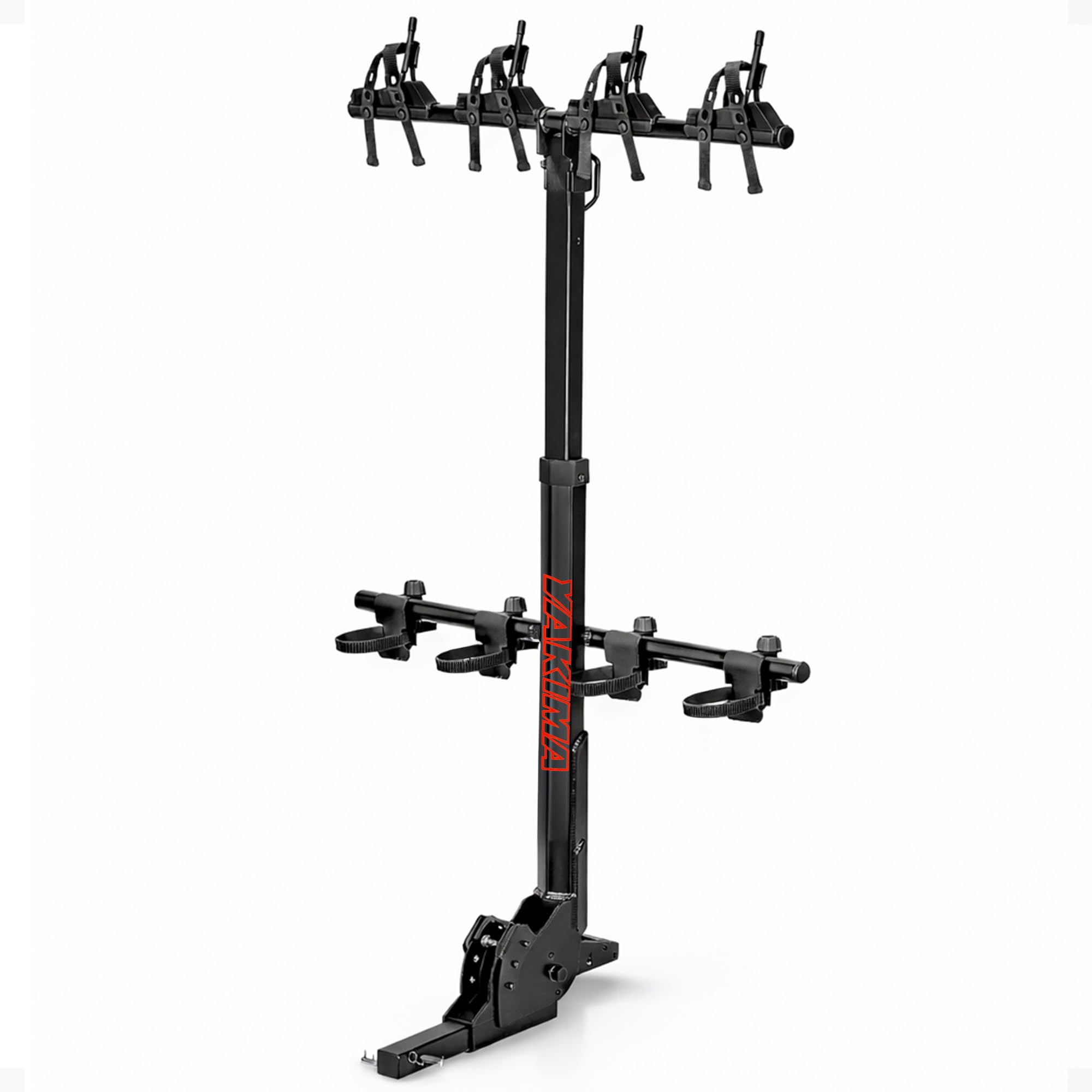
Steel, fork-mounted, and rated to carry more total weight than any other rack here.
Load capacity on this one is 225 lbs, which is a real step above the Thule Range’s 150 lbs. It holds four bikes at up to 37.5 lbs each, on soft padded fork mounts with rotating wheel cups that grip the bike and keep it from shifting during transport. Mountain bikes, fat bikes with suspension forks, and alloy steel construction throughout — this rack is aimed squarely at the trailhead crowd.
The design detail that sets the feel is the fork mount. Your front wheel comes off and the fork drops onto a padded mount, so the bike cannot rock side to side the way a hanging frame can. A tilt mechanism opens up the rear of the vehicle without unloading. There is even a built-in bottle opener on the frame, which tells you who Yakima built this for.
Quality is the split point here, and the straps are the specific concern — they are the part that some riders find lets them down while the frame itself holds up well. Treat the straps as a wear item you inspect before every trip. Also note this rack will not take a bike with the front wheel left on, which rules it out for anyone who does not want to pull a wheel in a wet car park.
The trailhead argument: 225 lbs across four bikes on padded fork mounts makes it the most planted option for heavy mountain builds.
What to watch: strap durability is the recurring weak point, and the front wheel has to come off every time.
Pick it when: your bikes have suspension forks and you want them locked rigid rather than swinging.
Look elsewhere when: you would rather not remove a front wheel or you carry bikes with no fork to mount.
4. Yakima HangTight 6 Vertical Hanging Steel Bike Rack

Six bikes on one hitch, and the only rack here that needs a 2-inch receiver.
If your group is bigger than four, the choice narrows fast. This rack carries 6 bikes at up to 37.5 lbs each, where the Thule Revert tops out at 4 — that is two extra bikes for the family or the shuttle run. It also swallows a broader range of wheels than most: 20 to 32 in. tires up to 5 in. wide and wheelbases up to 50 in.
Rear access comes from a foot-operated tilt rather than a handle, so your hands stay on the bikes while you open the back. A HitchLock is included, plus an integrated lock loop if you want to run your own cable through the frames.
Two things to know before you order. It weighs 89 lbs — the Thule Range by comparison is listed at 36 lbs — so this is a fixed installation rather than something you swap between cars. And it is built for a 2 in. hitch, with a per-bike ceiling of 37.5 lbs that keeps heavy e-bikes out. Dual crown fork setups need the DH Cradle accessory to fit.
The case for six
- Carries 6 bikes where most vertical racks stop at 4
- Takes 20 to 32 in. tires up to 5 in. wide and 50 in. wheelbases
- Padded dual cradles shield even carbon handlebars
- Foot-operated tilt keeps your hands free for the load
What you accept
- 89 lbs means it stays bolted to the vehicle
- 37.5 lbs per bike rules out heavier e-bikes
- Dual crown forks need the separate DH Cradle
Right answer for: families and shuttle riders who regularly move six bikes on a 2-inch hitch.
Wrong answer for: a single-car household swapping racks between vehicles, given the 89 lbs build.
Know the Specs
Load Capacity vs Per-Bike Weight
Total load capacity is the ceiling for everything on the rack combined. Per-bike weight is the ceiling for one bike. Both matter, and the smaller one usually decides. The Thule Range allows 150 lbs overall but just 37.5 lbs per bike, so four mid-weight bikes fit comfortably while a single heavy e-bike can eat a quarter of the total. Read the per-bike number against your heaviest bike, not the total against your average.
Hitch Size and Receiver Fit
Vertical racks are heavy once loaded, so the receiver has to match. The Yakima HangTight 6 is built for a 2 in. hitch specifically, and fitting it to anything else is not an option. The Thule Range is a vehicle-specific fit, which means checking the maker’s compatibility guide against your own hitch before ordering rather than assuming a universal mount. A hitch tightener is a cheap way to settle any movement in the receiver.
Wheel Diameter and Tire Width
Vertical racks hold the front wheel, so the cradle has to match the wheel. The Thule Revert handles 20-29″ wheels with tires up to 5″ wide, with narrower and wider accessories sold separately. The Yakima HangTight 6 goes from 20 to 32 in. and takes wheelbases up to 50 in. Measure your actual tire width at the tread, not the sidewall label, before you trust a spec sheet.
Tilt and Assist Mechanisms
A tilt drops the rack away from the vehicle so you can reach the trunk or tailgate. That tilt is either handle-operated, foot-operated, or hydraulically assisted. The Thule Revert uses a damper plus a memory function that lets you let go of the handle and push up with both hands. Foot-operated tilts keep your hands free while loading. If you load alone, the lift assist matters more than whether the tilt is handle- or foot-operated.
Common Questions
Will a vertical hitch rack block my rear hatch or tailgate?
Can I carry an e-bike on a vertical rack?
Do I need to remove my front wheel with a vertical rack?
What hitch size do these vertical racks need?
Will a fat bike fit on a vertical hanging rack?
Can I lock my bikes to a vertical hitch rack?
How much does a vertical rack weigh and do I leave it on the car?
Will my bike frame fit a hanging rack without an adapter?
How much space do I need between bikes on the rack?
Can I use a vertical rack on a travel trailer or RV?
The Bottom Line
The crowd favourite here is the Thule Revert at 4.5+ stars across 50+ ratings, and the reason is concrete: 55 lbs per bike and a hydraulic damper mean your heaviest bike goes up without a fight. If you are hauling a family of six, the Yakima HangTight 6 is the only rack in this group that fits the whole crew on one hitch. And for a travel trailer with four bikes locked behind it, the Thule Range was built for exactly that receiver.
How we choose
We do not accept paid placement. Every pick is matched to a real buyer and a real use-case; we do not hands-on test units.
Sources
Specifications: manufacturer listings and product documentation. Review insights: verified customer reviews, as of November 2026. Pricing: not shown on this page (it changes often); check the current price via the retailer link.
As an Amazon Associate, Tactical Gear Guy earns from qualifying purchases. This does not affect which products we feature.