Specs are compiled from manufacturer listings and verified buyer reviews and can change over time — please confirm the key details on the product page before buying.
You are standing under the hood with the arc buzzing, and the real question is not which lens goes darkest — it is whether you are breathing welding fume all afternoon. A welding mask respirator has to do both at once: darken the arc in front of your eyes and filter the fume you breathe. Below you get three genuinely respiratory-equipped helmets, explained in plain terms so you can pick the one that matches how and where you weld.
This guide is built by comparing the manufacturers’ published specifications and the patterns across verified customer reviews, so you get each pick’s real strengths and trade-offs instead of marketing spin.
Powered air versus cartridge filtration is the choice that shapes your whole shift, and these three picks cover both routes.
Top Picks

How To Choose The Best Welding Mask Respirator
A welding mask respirator is not a helmet with a filter slapped on. It is a system, and the parts have to work together — the lens that darkens, the filtration that cleans the air, and the harness that holds the whole thing steady while you move. Decide between powered air and cartridges first, because that choice sets the weight, the cost, and how hard you work to breathe.
Powered air versus cartridge filtration
A powered air purifying respirator, or PAPR, uses a blower unit to push filtered air into the helmet. That positive airflow means you are not pulling every breath through a filter yourself, and it keeps a steady stream moving across your face. A cartridge mask works the other way: you breathe through bayonet-style filters mounted on the face piece. It is simpler and lighter, but every inhale goes through the media.
Match the shade to your amperage
The shade number is how dark the lens goes when the arc strikes. Low-amperage work wants a lighter shade so you can see the puddle; heavy amperage wants darker. Look for a lens with a real range of settings rather than a single fixed shade, so one helmet covers tack welds and full-penetration passes alike.
Weight and harness are not a footnote
You wear this on your head for hours. A multi-point harness spreads the load across your skull, and quick-release buckles mean you can get out of the mask fast when a session ends. Weight matters more with a PAPR, because you are carrying the blower assembly too.
What you actually need to do between welds
Grinding, prepping, and inspecting mean you take the dark lens out of the way constantly. A flip-up design lets you do that without pulling the whole mask off your head, which keeps your filtration seal intact through the whole job.
Side-by-Side Comparison
| Model | Best For | Filtration Type | Lens Setup | Stated Weight | Amazon |
|---|---|---|---|---|---|
| 3M Speedglas G5-01 with Adflo PAPR★ Best Overall | All-day heavy fabrication | Adflo powered air purifying respirator (PAPR) | G5-01VC variable color ADF, shades 5, 8-14 | 5.36 kg | Amazon |
| WF-100 Full-Face Welding Respirator | Budget entry to full-face filtration | Dual P3 cartridges | 2 x 4.25″ shade 9 lens, flip-up | 2 pounds | Amazon |
| Parcil Distribution WF-101 | Welding, grinding and cutting in one mask | Bayonet O-A-X P3 cartridges | Auto-darkening, flip-up design | 2 pounds | Amazon |
Detailed Reviews
1. 3M Speedglas G5-01 Welding Helmet
Our pick — 4.5+★ from 20+ verified ratings; the strongest balance of quality and price.
A blower on your belt feeding clean air while three lens colors let you chase the puddle.
The headline is the Adflo system: a powered air purifying respirator that pushes high-efficiency particulate protection into the helmet for you, instead of making you drag every breath through filter media. By hour three, your chest is not working overtime to pull each breath through filter media.
Then there is the G5-01VC filter. Variable Color Technology lets you pick between three color options — clear, cool, or warm — so you can tune the view to see the weld puddle, joint, and arc your own way. Dark shade options run 5 and 8-14, so one helmet covers low-amperage tacks and heavy passes. That range beats the fixed shade 9 lens on the WF-100 below, which locks you to a single darkness setting.
The Connected Equipment app adds a maintenance side you rarely get on a welding mask. You program up to ten memory modes from your phone and the helmet logs hours on, hours in dark state, hours in light state, and on/off cycles. In a shop that tracks equipment, that is a real record instead of a guess. Weighing 5.36 kg, this is not a helmet you forget you are wearing — but the ergonomic, adjustable head suspension is built to carry it.
What earns the top slot
- Powered Adflo filtration does the breathing work for you, all shift long
- Three selectable lens colors plus shades 5 and 8-14 cover light and heavy welding
- Phone app records up to ten memory modes and a full maintenance log
- Adjustable head suspension built for a 5.36 kg assembly
Where it asks more of you
- You are carrying the PAPR assembly as well as the helmet, so it is heavier on the head than the two-pound cartridge masks below
- 3M labels it for industrial and occupational use, not consumer sale — check that fits how you work
Made for: fabricators logging long arcs in poor ventilation who want the air handled for them.
Think twice if: you weld in short bursts and would rather carry a lighter two-pound mask.
2. WF-100 Full-Face Welding Respirator
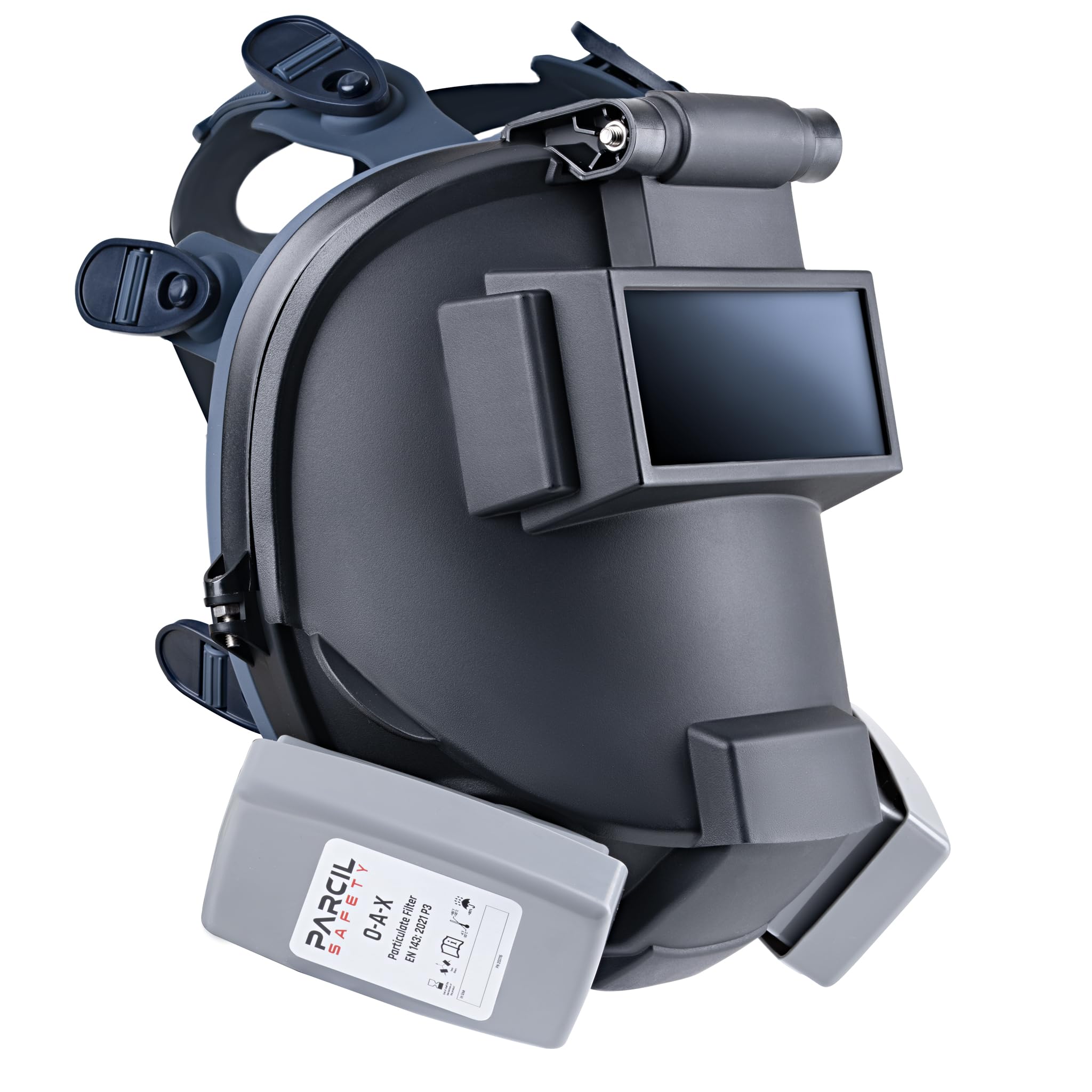
Two lenses, two cartridges, two pounds — the lightest way into full-face fume filtration.
Here is the entry point for anyone who wants respiratory coverage without a blower unit strapped to their waist. The WF-100 runs dual P3 cartridges — P3 being the filter grade that captures fine particulate — mounted on a full-face piece with a flip-up helmet over the top.
Two 4.25-inch lenses sit at shade 9 instead of one big window. That split gives you a pair of viewing panels rather than a single wide field, and shade 9 is a fixed darkness setting rather than an adjustable range. If you mostly run mid-amperage work in one lane, that is a workable setup. If your day jumps between thin tack welds and heavy plate, the 3M above gives you shades 5 and 8-14 to move between, and the WF-100 does not.
The six-point harness and quick-release buckles are what make the two-pound WF-100 comfortable for a full session. The six-point harness spreads the load across your head, and quick-release buckles let you get in and out of the respirator fast — a detail you appreciate every time you stop to reposition a joint. It weighs 2 pounds, and it is built to take 3M and Honeywell cartridges, so you are not locked to one brand of filter when it comes time to swap.
The honest trade-off: a 3.0+ rating tells you this is the least-loved pick of the three, and the fixed shade 9 lens is the likely reason — it simply cannot adapt to the full span of amperage a working welder covers in a day.
Who it still fits: a home shop or occasional fabricator who wants fume protection and light weight, and does not need a lens that shifts darkness on the fly.
Reach for this if: the two-pound carry weight and a fixed shade 9 match the welding you actually do.
Look elsewhere if: you need a lens you can dial from light to dark across different jobs.
3. Parcil WF-101 Welding Respirator Mask
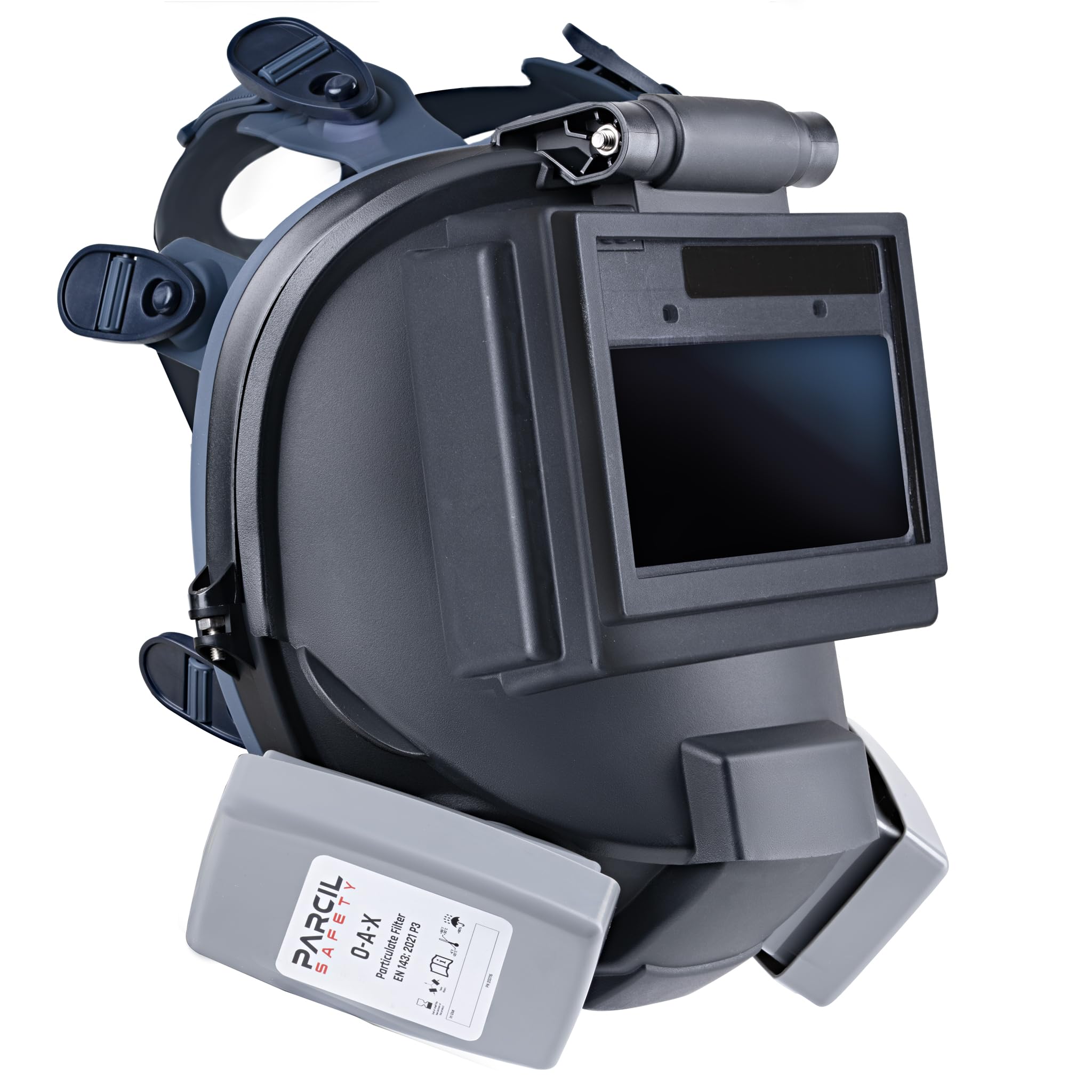
Three jobs, one mask — weld, grind, prep, and never pull the respirator off to switch gear.
The WF-101 is built around doing more with less gear on the bench. It replaces a welding helmet, a grinding face shield, and a respirator in one system, and the flip-up design lets you move between welding, grinding, and prep without changing masks. Every task you do without pulling the mask off is one less time you break the face seal and refit it.
Filtration runs on bayonet O-A-X P3 cartridges, which are aimed at dust, fumes, and organic vapors from welding, grinding, and cutting. That combination matters in a workshop where ventilation is thin. The full-face mask seals across your whole face and the multi-point head harness with quick-release buckles adjusts across head sizes — and at 2 pounds it matches the WF-100 above on weight while adding auto-darkening.
Spectacle inserts, anti-fog design, peel-off lens films, and a carrying bag all come in the box. It takes spectacle inserts if you wear glasses, is designed to help reduce fogging, and ships with peel-off protective films and a carrying bag. It runs on two included lithium metal batteries at 6 volts. A 4.0+ rating reflects a mask that does a lot of jobs competently rather than one job flawlessly.
Where it wins: the auto-darkening lens plus flip-up design means your eyes adapt on their own and your filtration never has to come off between tasks.
What to weigh: bayonet cartridges still mean you breathe through the media yourself, so if lung fatigue over a long shift is your concern, the powered 3M is the more comfortable route.
The crowd for this: fabricators and home-shop welders who grind and cut as much as they weld and want one mask for all of it.
The one caveat: if you want the air pushed for you rather than pulled through cartridges, this is not that system.
Know the Specs
PAPR versus cartridge: how the air gets to you
A powered air purifying respirator — PAPR — uses a blower to push filtered air into the helmet. The 3M G5-01 runs an Adflo high-altitude PAPR for high-efficiency particulate protection. A cartridge mask like the WF-100 or WF-101 has you inhale through P3 filters mounted on the face piece. The PAPR is more comfortable across a long shift because the machine does the work; the cartridge mask is lighter and simpler.
Shade numbers and what they control
Shade is the darkness the lens goes when the arc hits. A fixed shade 9, as on the WF-100, suits one band of work and keeps things simple. The 3M G5-01VC gives you dark shade options of 5, 8-14 plus three variable color choices, so you can adapt the view to the job. The WF-101 handles this with an auto-darkening lens instead of a fixed setting.
P3 and O-A-X cartridge ratings
P3 is the particulate filter grade designed to trap fine particles, which is the core of welding fume protection. The WF-101 steps it up with bayonet O-A-X cartridges aimed at dust, fumes, and organic vapors together. Confirm any cartridge matches the contaminants in your workspace before you rely on it.
Weight and harness on your head
You are wearing this for hours, so carry weight decides comfort. The two cartridge masks list at 2 pounds. The 3M lists at 5.36 kg and relies on an ergonomic, adjustable head suspension to manage that. Six-point and multi-point harnesses spread the load, and quick-release buckles get you out fast.
Common Questions
What is the difference between a welding mask respirator and a plain welding helmet?
Is a PAPR better than a cartridge respirator for welding?
What shade number do I need for my welding amperage?
Can I wear glasses under a full-face welding respirator?
How do I know when to replace the P3 cartridges?
Will a welding respirator mask work for grinding and cutting too?
Are these masks sealed off from welding fume completely?
Are the battery-powered features on these masks hard to maintain?
Can I swap cartridges between welding respirator brands?
The Bottom Line
For most welders, the welding mask respirator winner is the 3M Speedglas G5-01 with Adflo PAPR because the blower does the breathing work while shades 5 and 8-14 plus three lens colors let you chase the puddle your way. If you want the lightest route into full-face filtration, the WF-100 at 2 pounds with dual P3 cartridges is a fair start. And for a shop where you grind and cut as much as you weld, the Parcil WF-101 replaces three pieces of gear with one mask.
One honest note on choosing: the 3M carries a 4.5+ rating from a small batch of industrial buyers, so the confidence behind it is real but narrow — the WF-101 has slightly more voices behind its 4.1 and covers more tasks. Choose based on if you want powered airflow or cartridge-and-flip-up flexibility, not on the brand name.
How we choose
We do not accept paid placement. Every pick is matched to a real buyer and a real use-case; we do not hands-on test units.
Sources
Specifications: manufacturer listings and product documentation. Review insights: verified customer reviews. Pricing: not shown on this page (it changes often); check the current price via the retailer link.
As an Amazon Associate, Tactical Gear Guy earns from qualifying purchases. This does not affect which products we feature.