Specs are compiled from manufacturer listings and verified buyer reviews and can change over time — please confirm the key details on the product page before buying.
Most pull-behind spreaders fail in the same three places. The gate sticks open and dumps a stripe of fertilizer in one pass. The hitch snaps on the first rough corner. Or the hopper is so small you spend more time refilling than driving. The fix isn’t more horsepower from your tractor — it’s matching hopper size to your acreage, spread width to your terrain, and hitch reach to your tow vehicle.
This guide is built by comparing the manufacturers’ published specifications and the patterns across verified customer reviews, so you get each pick’s real strengths and trade-offs instead of marketing spin.
Every pick below tows behind an ATV, UTV, riding mower, or lawn tractor, so the deciding factors are hopper capacity, spread width, and how the flow control reaches back to your seat. These nine cover everything from a small suburban lot to a full acre of pasture, all chosen for Best Pull-Behind Spreader.
Top Picks

How To Choose The Best Pull-Behind Spreader
Buying a tow-behind spreader is really a matching exercise. Get the hopper size, spread width, and hitch right for your property and your tow vehicle, and the rest is details. Get one of them wrong and you’ll be shoveling half a bag of fertilizer back into the sack at the end of every session.
Start with your acreage, then work back to capacity
A bigger hopper means fewer stops to refill, which is the whole point of towing the thing behind a machine in the first place. The Agri-Fab 185 lb model claims roughly 40,000 sq ft on a single fill, while the 110 lb Agri-Fab covers about 17,500 sq ft or a third of an acre. If your lawn is a third of an acre, a 110 lb hopper finishes the job without a mid-run top-up. If you’re managing an acre or more, a 175–185 lb hopper cuts refill stops to one per session.
Match spread width to how you mow
Spread width is how wide a fan of material the spinner throws, and it sets how many passes you make. Models here run from a 10 ft pattern up to about 12 ft. Wider is generally better on open ground because you cover stripes faster. Narrower can actually suit a small, obstacle-heavy yard where a wide fan would throw seed into the flowerbeds.
Check the hitch before you check anything else
A universal hitch is the near-universal standard for these machines and fits most lawn tractors, riding mowers, ATVs, and UTVs. What trips people up is reach — the flow-control handle has to land somewhere you can grab it from the driver’s seat. Look for a model that includes a hitch extender or a handle extension rod if your tow vehicle has a long rear deck.
Think about what you’re spreading, not just how much
Grass seed, pelletized fertilizer, and ice melt all flow differently through the same gate. Adjustable flow control and multiple gate settings let you dial in the drop rate for each. A model with five discharge ports or a dual-impeller spread pattern tends to lay material down more evenly. Chapin is explicit that its TurfPro is not recommended for rock salt, sand, sand mixes, lime, or pelletized lime — so read the material list against your actual plans before you commit.
Side-by-Side Comparison
| Model | Best For | Hopper Capacity | Spread Width | Tire Size | Amazon |
|---|---|---|---|---|---|
| Tow Behind Broadcast Spreader 130 LBS (AugFir)★ Best Overall | Big-lot all-season spreading | 130 lb | 12 ft | 12.5-inch pneumatic | Amazon |
| VEVOR Tow Behind Broadcast SpreaderMost Adjustable | Multi-setting precision on a budget | 130 lb | 10 ft | 13-inch pneumatic | Amazon |
| 125 LB Tow Behind (YTL International)All-Weather Pick | Weatherproof year-round work | 125 lb | 10–12 ft | 12-inch pneumatic | Amazon |
| Agri-Fab 110 lb Tow Behind | Third-acre lawns, seat-of-pants control | 110 lb | 10 ft | 10-inch pneumatic | Amazon |
| EarthWay 2050TP Towable | Compact towing on rough ground | 80 lb | — | Non-skid tires | Amazon |
| Craftsman 110 lb Pull-Behind | Steel-tubing build with a 3-year warranty | 110 lb | 10 ft | 10 x 4-inch pneumatic | Amazon |
| Brinly BS36BH-A | Acre-plus spreading with autoflow | 175 lb (3.5 cu ft) | Pattern controlled by dial | — | Amazon |
| CHAPIN 8622B TurfPro | Auto-stop flow and dual impellers | 2.2 cu ft poly | Dual-impeller pattern | 14-inch wide-tread pneumatic | Amazon |
| Agri-Fab 185 lb ATV/UTV | Full-acre jobs behind an ATV | 185 lb | 12 ft | 15 x 6-inch pneumatic | Amazon |
Detailed Reviews
1. Tow Behind Broadcast Spreader 130 LBS
A 12-foot fan of material and a hopper big enough to skip the mid-run refill.
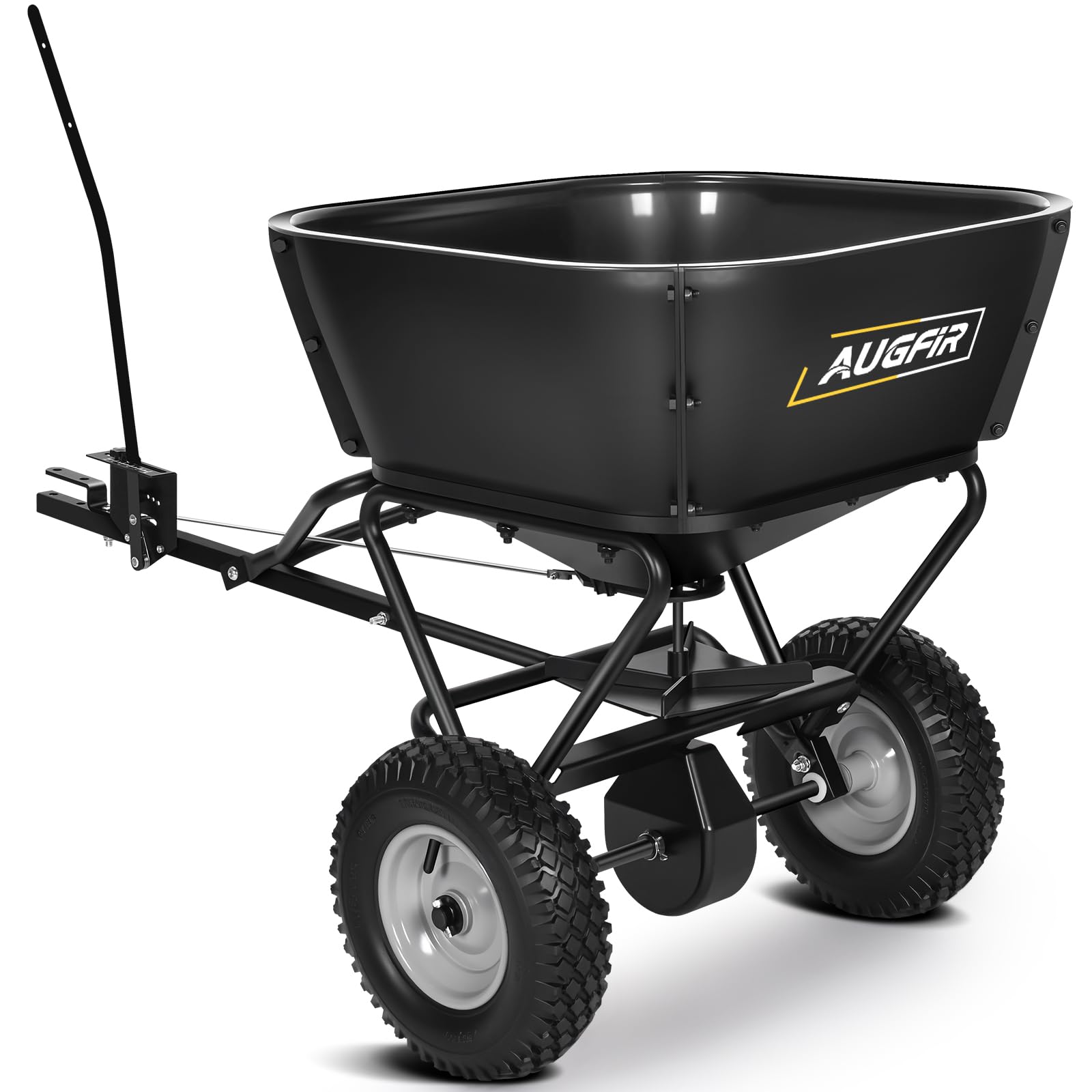
Here’s the number that earns this spreader the top slot: a 12 ft spread width — the widest pattern on this list. That matters because a wider fan means fewer laps across the lawn, and fewer laps means less fuel and less time behind the wheel. It’s built to hang off the back of a riding mower, ATV, UTV, or tractor, and the 130 lb hopper holds a serious load of fertilizer or seed before you have to stop.
The AugFir 130 lb hopper beats the EarthWay 2050TP’s 80 lb hopper on capacity, and its 12 ft spread width beats the VEVOR’s 10 ft pattern. Where it pulls ahead on convenience is the flow control lever — it opens the hopper from your seat, so you’re not climbing down to prime the gate before every pass. The included hitch extender and handle extension rod solve the reach problem that plagues long-decked mowers.
The five adjustable discharge ports work with the hopper’s trapezoidal (slanted-side) shape to keep material feeding evenly instead of clumping at one end. Tires are 12.5-inch pneumatic — air-filled — so they float over soft grass and gravel rather than digging in. The 12.5-inch pneumatic tires float over soft grass and gravel instead of cutting ruts.
What the buying math favors
- 12 ft spread width is the widest pattern on this list — fewer passes per job
- 130 lb hopper takes a full load so refills come less often
- Flow control lever opens the gate from the driver’s seat
- Hitch extender and handle extension rod included, so reach is solved
What to plan around
- The maker’s own instructions steer you away from overfilling the hopper — load it sensibly
- Assembly is involved enough that the included step-by-step guide and video are worth watching first
Made for: large yards and small farms where you want maximum coverage per lap behind a riding mower or ATV.
Plan around: the assembly session — set aside a real block of time and follow the maker’s video before you start bolting.
2. VEVOR Tow Behind Broadcast Spreader 130 LBS
Thirty gate settings and 13-inch tires for dialing in the drop rate.
This VEVOR earns its spot with 30 adjustable settings, so you can spread several different materials across the year without guessing. Thirty positions let you fine-tune how fast seed, fertilizer, or ice melt flows out, rather than picking between “a lot” and “a little.” Its 130 lb hopper matches the widest capacity on this list, so fewer refill stops on a big lawn. The 13-inch pneumatic tires (air-filled, not solid) are the largest on the mid-range picks — taller rubber rolls over gravel and rutted ground more easily.
Where it gives ground is the spread pattern: a 10 ft fan versus the 12 ft pattern on the AugFir above. That’s more passes for the same lawn, which you’ll feel on a big property. The frame is powder-coated steel with aluminum gears, and the hopper is sized to hold full bags of material so you’re not decanting into a smaller bin first.
The honest part is durability. Owners are split on how sturdy it holds up, and the hitch has drawn criticism for failing early on some units. Assembly also draws a mixed reaction — some find it simple, others cumbersome. Treat it as a value-priced homeowner spreader: torque the hitch bolts at assembly and keep loads within the hopper’s rating. Watch the hitch when you first hook up and tighten everything properly.
The setting advantage: 30 gate positions give you real control over application rate — a genuine help when you’re switching between fine grass seed and chunky ice melt on the same machine.
The honest caveat: durability and hitch strength are the areas owners are most divided on, so treat this as a lighter-duty pick that rewards careful setup.
Reach for this if: you spread multiple materials and want fine gate control without stepping up to a heavier machine.
Look elsewhere if: your ground is punishing and you need the hitch to shrug off years of hard towing.
3. 125 LB Tow Behind Broadcast Spreader
The one with a lid — so a light rain doesn’t turn your fertilizer into bricks.
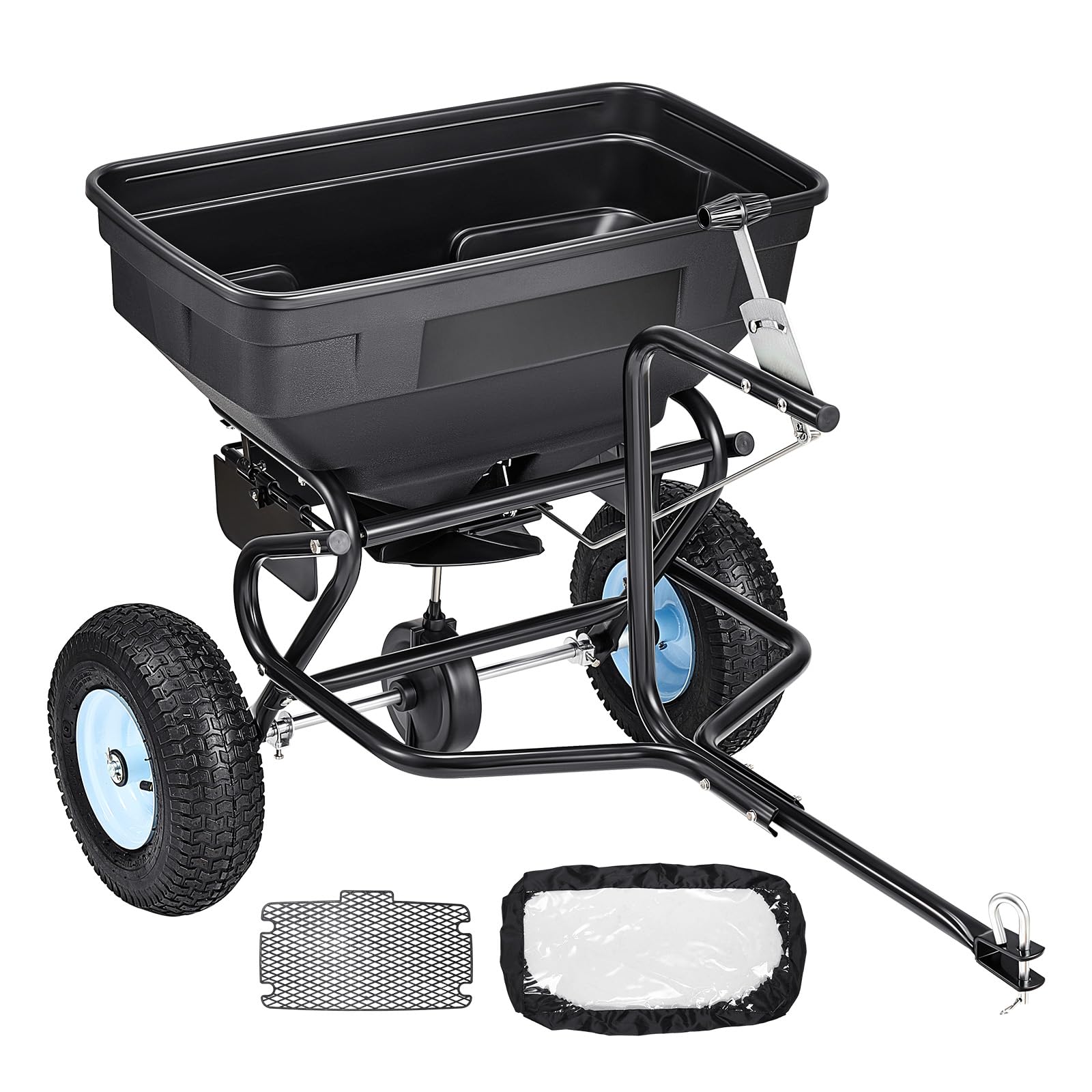
Most spreaders leave the hopper open to the sky. This one ships with a weather-resistant hopper cover, which means you can keep spreading through light rain or snow without the material clumping and clogging the feed. That cover lets you keep spreading through light rain or snow without wet clumps jamming the gate. The 125 lb hopper covers up to 25,000 sq ft on one fill, and the composite hopper is rust-proof so harsh fertilizer won’t eat through it.
The gear drive is cast aluminum rather than plastic, which is the part that usually fails first on a spreader. Cast metal gears mean smoother, more consistent spin across the 10–12 ft broadcast width. The adjustable flow-control lever lets you set the drop rate precisely so you’re not over-applying and burning a stripe into the turf.
Owners consistently report it simply works — functionality and overall quality are the two things that come up most, and both land positive. The mixed notes are around the assembly directions, which some find thin, and one report of a gearbox binding up. A 1-year limited warranty backs it. The frame is powder-coated steel and the 12-inch pneumatic tires handle rough or soft ground without bogging down.
Why the cover matters: spreading in drizzle without a lid means wet clumps and a jammed gate — this model closes that gap, so wet-weather fertilizing stays on schedule.
The one thing to watch: the gearbox is the part to keep an eye on; if it binds, the warranty is your backstop.
Suits you if: you spread in shoulder seasons and want cast-metal gears and a lid doing the hard work.
Second-guess it if: you’d rather have a wider spread pattern than weather protection.
4. Agri-Fab Tow Behind Broadcast Spreader 110 lb

Steel-rod control you work from the mower seat, sized for a third of an acre.
Agri-Fab built this one for the homeowner with a third of an acre and a riding mower. The 110 lb hopper covers up to 17,500 sq ft, or roughly a third of an acre, on a single fill — enough that most suburban lawns finish in one go. The steel rod flow control runs up to your seat, so you set the material rate without climbing down. That’s a small thing that saves a lot of up-and-down over a season.
Its 110 lb hopper is dwarfed by the 185 lb Agri-Fab near the top of this list — 110 lb against 185 lb — so this is the one for a smaller lot, not acreage. The rustproof poly hopper and spreader plate resist corrosion, and the two 10-inch pneumatic tires roll across uneven lawn without getting stuck. It’s built in Sullivan, Illinois with global materials and carries a 3-year limited warranty.
Buyers report a split verdict on build and function. Plenty find it solid and easy to assemble, but some find the assembly instructions hard to follow and report the unit failing early. That spread is wide enough that it depends on setup and material handling — get the assembly right and keep loads reasonable. It’s a mid-range homeowner machine, so keep loads within the 110 lb rating and don’t tow it over rough ground at speed.
Grounds to buy
- 110 lb hopper covers about 17,500 sq ft — a third of an acre on one fill
- Steel rod control adjusts material rate from the mower seat
- Rustproof poly hopper and spreader plate resist fertilizer corrosion
Grounds to pause
- Assembly instructions are the recurring weak point — take your time
- Smaller hopper and 10 ft pattern mean more passes than the wider models
Best for: a third-acre lawn where seat-mounted control is worth more than raw capacity.
Think twice if: you’re spreading over an acre — the hopper here tops out at 110 lb and you’ll be refilling.
5. EarthWay Products 2050TP 80lb Towable Broadcast Spreader

The smallest hopper here, and the one that fits a tight one-acre garden best.
This EarthWay is the compact end of the list, at 80 lb and roughly 24.5 x 20.81 x 18.5 inches. Its 80 lb hopper is the smallest here — the AugFir and VEVOR both carry 130 lb — but the smaller footprint suits a one-acre garden or a yard with lots of edges where a big machine fights you. It comes semi-assembled, so the setup is quicker than a full flat-pack build. The three-hole drop system (seed drops through three openings instead of a spinning disc) spreads seed and manure, and it’s rated for an ATV or riding mower.
The frame is sturdy and the gearbox and side spread control give you a reliable base for lawn care. Owners find it works well, including on steep terrain and over large tree roots, and the size lands right for a one-acre property. Non-skid tires keep traction on slopes that would spin a smoother tire.
On a large open lot, the 12 ft patterns on the AugFir and 185 lb Agri-Fab cut your lap count. If it’s compact with obstacles, the smaller machine here is easier to thread through them.
The fit case: a one-acre garden with slopes and tree roots is where this earns its keep — the compact size and non-skid traction handle terrain a bigger machine finds awkward.
What you sacrifice: 50 lb less hopper capacity than the top-capacity models means more refill stops on bigger jobs.
Pick this one when: a compact, semi-assembled spreader fits your one-acre lot better than a big hopper.
Pass if: you’re spreading over several acres and want fewer refills per session.
6. Craftsman Pull-Behind Broadcast Spreader 110 lb

Built from 1-inch steel tubing and backed by a three-year warranty.
The Craftsman’s chassis is the story: 1-inch steel tubing plus an enclosed gearbox, a poly hopper, and a spreader plate. Steel tubing at that gauge is the sort of thing that survives being dragged over curbs and ruts. The 110 lb hopper covers about 17,500 sq ft or a third of an acre, with a 10 ft spread pattern to match. The universal hitch connects to most riding mowers and lawn tractors, and the steel rod flow control reaches back to your seat.
The pneumatic tires are 10 in x 4 in, smaller than the 12.5-inch rubber on the AugFir, so expect the ride to feel firmer over rough ground. The upside to a narrower 10 ft pattern and lighter 28 lb machine is maneuverability in a yard with beds and trees. It’s built by Agri-Fab in Sullivan, Illinois with global materials and carries a 3-year limited warranty.
Owner experience here leans positive on how it spreads, with durability and reliability the areas that draw mixed reports — some units hold up fine, a few fail early. Value and wheel function are the smaller complaints. Treat it as a homeowner-duty machine: follow the assembly steps carefully and don’t exceed the 110 lb hopper rating.
Reasons it holds up
- 1-inch steel tubing frame with enclosed gearbox for a beefier build
- 3-year limited warranty backs the frame and drive
- 110 lb hopper covers a third of an acre with a 10 ft pattern
Where it asks for care
- 10 x 4-inch tires are smaller than the wider rubber on bigger models
- Durability reports are mixed, so treat it as a homeowner-duty machine
Go here if: steel-tubing build and a 3-year warranty matter more to you than a huge hopper.
Keep looking if: your ground is rough enough that bigger tires are a must.
7. Brinly BS36BH-A Tow Behind Broadcast Spreader 175 lb

175 pounds of seed and a gate that shuts itself when the tractor stops.
The 175 lb hopper — 3.5 cu ft of seed, fertilizer, or ice melt — is the headline. That size is aimed squarely at yards an acre or larger, where the whole point is maximizing spreading time versus refill time. The material side is well thought out: a heavy polyethylene hopper, stainless steel hardware, spinner shaft, and agitator, with glass-filled nylon gears enclosed in a nylon gearbox to keep corrosion out.
The patented autoflow is the feature worth understanding. When your tractor stops, the gate stops feeding, so material doesn’t pile up in one spot and burn a patch of turf. Directional spread pattern control lets you center and even out the distribution for whatever material you’re running. Brinly also pre-calibrates hundreds of settings on a locking rate dial to get you close to accurate without trial and error.
Assembly is called out at 30 minutes, with a pictorial manual that matches each part to a step and a video on Brinly’s YouTube channel. Among owners, quality and function draw mixed reaction, and durability is the recurring weak note — an agitator that doesn’t work right and a gate that won’t hold its setting both come up. For a large-yard machine, it’s a strong design that asks you to check those two parts after assembly.
The design win: autoflow stopping material when the tractor stops is a real safeguard against burned stripes, and the 175 lb hopper keeps acre-plus jobs moving.
The parts to check: verify the agitator and the gate hold before you trust it on a full-acre run.
Made for: an acre or more where a big hopper and waste-stopping autoflow justify the heavier machine.
Look elsewhere if: you want a simpler tool with fewer setting dials to manage.
8. CHAPIN 8622B TurfPro Tow-Behind Spreader

Dual impellers and auto-stop, with one clear material warning to respect.
The 2.2 cu ft poly hopper and dual impellers set this Chapin apart — twin spinning discs are meant to throw material more evenly than a single spinner. Eleven gate settings let you match the flow to the material, and auto-stop technology halts the flow when you stop moving, so seed and fertilizer don’t pile up in a heap. The frame is powder-coated steel with an enclosed gearbox and lubricated bearings, riding on 14-inch wide-tread pneumatic tires for traction on soft ground.
Read the operating guidance before you buy, because it shapes what this machine can do. Chapin rates the top operating speed at 3.5 mph (a brisk walk) and says it isn’t suitable for zero-turn mowers. It also says the TurfPro is not recommended for rock salt, sand, sand mixes, lime, or pelletized lime — so if winter ice melt is your main job, this is a narrower fit than the Agri-Fab models that list salt and ice melt. It connects to a standard hitch with two hitch pins included for ATVs, UTVs, and lawn tractors.
Owner feedback splits on build quality — some find it well constructed, some describe it as cheaply built — and reliability reports run the same way, with working-well comments alongside a few early failures. It’s designed and made in the USA with global materials and backed by a 1-year limited warranty plus US-based support.
Where dual impellers pay off: even, controlled spreading across a large property, with auto-stop preventing pile-ups at every halt.
The material limit: no rock salt, sand, or lime — so this is a seed-and-fertilizer machine, not an all-season salt spreader.
Worth it for: landowners spreading seed and fertilizer who want even coverage and auto-stop flow.
Skip if: winter ice melt is a big part of your plan — this machine isn’t rated for that material.
9. Agri-Fab Tow Behind ATV/UTV Broadcast Spreader 185 lb

185 pounds of capacity and a full acre on one fill behind your ATV.
When your property is measured in acres, capacity stops being a detail and becomes the whole decision. This Agri-Fab’s 185 lb hopper is the largest on the list and covers approximately 40,000 sq ft, or up to a full acre, on one fill. That’s its reason for existing: fewer stops, more ground covered per session. The 12 ft spread width matches the widest pattern on this list, so you cover stripes fast behind an ATV or UTV.
A raised on/off direct rod control reaches your tractor, ATV, or UTV seat so you work the gate without stopping. The 15 in x 6 in pneumatic tires are the largest here, with ball bearings and a gear disengage for smoother transport over rough ground.
Owners mention it performs well and spreads evenly, with durability a positive. Build quality is the area that splits, with some finding it solidly built and some flagging quality. The rustproof poly hopper, spreader plate, and enclosed gearbox resist corrosion. It’s made in Sullivan, Illinois with global materials and carries a 3-year limited warranty.
Why acreage owners lean this way
- 185 lb hopper — the largest here — covers up to a full acre per fill
- 12 ft spread width matches the widest pattern on this list
- 15 x 6-inch tires with ball bearings roll smoothly over rough ground
- 3-year limited warranty backs the build
Where it makes you compromise
- At 54 lb it’s the heaviest machine here, so it’s less nimble in tight spaces
- Build-quality reports are split, so inspect it fully at setup
The pick for: an acre or more towed behind an ATV or UTV, where one fill should finish the job.
Think twice if: your yard is small and tight — the 54 lb weight and wide footprint belong on open ground.
Know the Specs
Hopper capacity (lb and cu ft)
The hopper is the bin that holds your material, and its capacity is quoted in pounds or cubic feet. A bigger hopper means fewer refills, which is the whole reason you tow a spreader instead of carrying a bag. A 110 lb hopper tends to suit a third of an acre, while a 185 lb hopper is aimed at a full acre. Cubic feet is just a volume measure — a 2.2 cu ft hopper and a 175 lb hopper hold different amounts of material because seed and fertilizer pack differently by weight.
Spread width (ft)
Spread width is how wide a fan of material the spinner throws, quoted in feet. A 12 ft pattern covers more ground per pass than a 10 ft one, so it means fewer laps and less fuel over a large lawn. On a small, obstacle-heavy yard, a narrower pattern can actually keep seed out of your flowerbeds. Match the width to your terrain — wide for open acreage, narrower for cluttered lots.
Flow control and gate settings
The flow control is the gate that opens the hopper and lets material drop onto the spinner. Rod controls that reach back to your seat let you adjust the drop rate without stopping. Multiple gate settings — 11 on the Chapin, 30 on the VEVOR — let you fine-tune how fast different materials feed. Auto-stop or autoflow tech closes the gate when you halt, so material doesn’t dump in a pile and burn the turf beneath it.
Pneumatic tires and hitch fit
Pneumatic means air-filled, and larger air-filled tires float over soft grass, gravel, and snow rather than digging ruts. Sizes here run from 10-inch to 15 in x 6 in, with larger rubber generally smoothing rough ground. The universal hitch is the standard mount that fits most lawn tractors, riding mowers, ATVs, and UTVs. Check the reach to your seat too — a hitch extender or handle extension rod solves the long-deck problem where the control ends up out of arm’s length.
Common Questions
Will a pull-behind spreader fit my riding mower?
How big a hopper do I need for a half-acre lawn?
Can these spreaders handle ice melt and rock salt in winter?
Why does my spreader dump fertilizer in one spot when I stop?
How wide a spread pattern is better, 10 ft or 12 ft?
Do I need pneumatic tires or will solid tires work?
How long does assembly take on a tow-behind spreader?
Can I use a tow-behind spreader on a zero-turn mower?
What materials can a broadcast spreader handle besides fertilizer?
How much ground does a full hopper actually cover?
The Bottom Line
For most people buying a pull-behind spreader, the AugFir Tow Behind Broadcast Spreader is the pick to beat — a 130 lb hopper and the widest 12 ft pattern on this list, so each pass covers more ground. Its seat-reachable flow control saves you a climb-down on every pass. If you’d rather have cast-metal gears and a hopper cover for wet-weather spreading, the 125 LB YTL International spreader delivers both. And if you’re managing a full acre behind an ATV, step up to the Agri-Fab 185 lb ATV/UTV spreader, whose hopper holds 75 lb more than its smaller sibling and covers up to an acre on one fill.
How we choose
We do not accept paid placement. Every pick is matched to a real buyer and a real use-case; we do not hands-on test units.
Sources
Specifications: manufacturer listings and product documentation. Review insights: verified customer reviews, as of November 2026. Pricing: not shown on this page (it changes often); check the current price via the retailer link.
As an Amazon Associate, Tactical Gear Guy earns from qualifying purchases. This does not affect which products we feature.