Specs are compiled from manufacturer listings and verified buyer reviews and can change over time — please confirm the key details on the product page before buying.
Cutting trim with a miter saw means dragging out a heavy machine, filling the room with dust, and hoping your angle was right. A trim cutting tool is the hand-held shortcut: you mark the angle, squeeze the handle, and get a clean cut on shoe moulding or quarter round in seconds. The blade steel and the anvil (the flat metal bed that holds your molding steady) decide whether the cut comes out clean.
This guide is built by comparing the manufacturers’ published specifications and the patterns across verified customer reviews, so you get each pick’s real strengths and trade-offs instead of marketing spin.
You will see the blade steel, the angle stops, and the real limit of each tool before you commit. Here is a straight read on the best trim cutting tool.
Top Picks


How To Choose The Best Trim Cutting Tool
The real question: will it cut my molding cleanly at the angle I need without wrecking my hands? Start with the blade, then check the angle stops, then decide how much hand effort you are willing to put in.
Blade steel decides the cut
Japanese SK5 high-carbon steel is the blade material on most of the better shears here, and it holds a sharp edge through repeated cuts on softwood and PVC trim. One tool in this list runs on standard steel razor blades with a blade-to-anvil action instead. Both approaches work; the SK5 shears are purpose-built for angled molding cuts, while the razor-blade cutter is a broader utility tool.
Hardness matters too. A blade heat-treated to 58-60 HRC (a hardness scale number — higher means the edge resists rolling over) keeps its edge through trim jobs. Around HRC52 is a softer, easier-to-resharpen edge that still handles softwood fine.
Angle stops you can lock and trust
Most mitre shears here lock at 45°, 60°, 75°, 90°, 120°, and 135°. The 45° setting is the one you will use most, because it makes the corner joint where two trim pieces meet. A tool that shifts at that angle produces gaps, so a firm spring-ball or click-stop mechanism matters more than the number of stops on the dial.
Hand effort and the ratchet question
A plain shear relies on your grip strength for every cut. A two-stage ratchet gear multiplies that force across several small clicks, which keeps long flooring runs from wearing your forearms out. If you have a weaker grip or a full day of quarter round ahead, the ratchet is worth the extra bulk.
What these tools will not cut
None of these hand shears are for metal, tile, or hard plastic pipe. Dense hardwood like oak and dense MDF also sit outside the intended range. Thin-kerf hand tools are not built to bite those, so plan on a saw for them.
Side-by-Side Comparison
| Model | Best For | Blade Steel | Angle Range | Handle | Amazon |
|---|---|---|---|---|---|
| Ronan Multi-Cut Industrial Cutter★ Best Overall | Mixed jobs and heavy materials | Stainless steel razor blade | — | Molded ergo-grip rubber | Amazon |
| CRAFTSMAN Miter SnipsBest Value | Craft and light trim cuts | High carbon or alloy steel | 45° stop | Bi-material slip-resistant | Amazon |
| GARTOL 45-135° Miter ShearsCompact Pick | Detail trim and craft work | SK5 high-carbon steel | 45° to 135° | Aluminum with PPC anti-skid cover | Amazon |
| LeafLux Miter Shears LFXP3101S | Corner joints on molding and trim | SK5, 58-60 HRC | 45° to 135° | Solid steel | Amazon |
| GARTOL Ratchet Miter Shears | Long runs with less hand strain | SK5 steel | 45° to 135° | Non-slip silicone | Amazon |
| O’Shine Long Handle Miter Shears | Big hands and repetitive jobs | Japan SK5, HRC52 | 45° to 135° | PVC anti-slip long grip | Amazon |
| O’Shine Miter Shears OS003 | Everyday softwood and PVC trim | Japan SK5, HRC52 | 45° to 135° | PVC anti-slip | Amazon |
| GARTOL Ratchet Miter Shears with 5 Anvils | Shapes and materials beyond flat trim | SK5 steel | 45° to 135° | Plastic with soft rubber grip | Amazon |
Detailed Reviews
1. Ronan Multi-Cut Industrial Cutter
Our pick — 4.5+★ from 850+ verified ratings; the strongest balance of quality and price.
The one that bites through vinyl, rubber and branches instead of just trim.
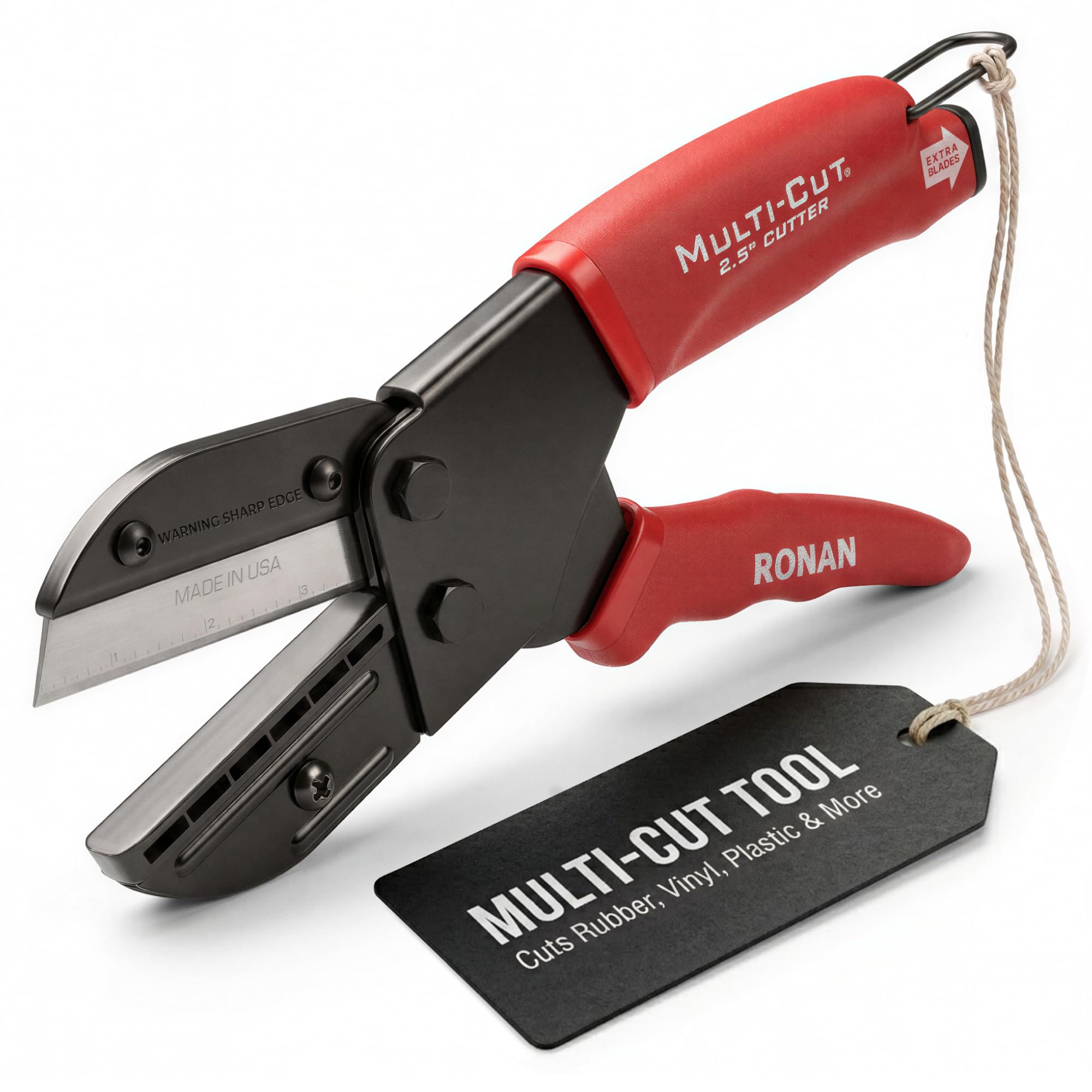
If your cutting happens in a garage rather than a finished hallway, this is the pick. The Ronan Multi-Cut does not squeeze like scissors. It uses a blade-to-anvil action with an offset pivot point, which means the blade presses down onto a high-impact plastic anvil instead of sliding past a second blade. That offset pivot is what gives it leverage on thick, dense material — plastic, vinyl, rubber, leather and light wood.
It ships with a USA-made industrial-grade steel razor blade rated by the maker for up to 18 months, plus 3 spares stored in the handle. Blade changes are the standard pull-and-replace style rather than a dedicated snap-in system. Inch markings along the tool help you line up rough cuts without reaching for a tape.
The honest trade-off is scope. This is not an angle-cutting tool — there are no 45° or 135° stops here, so it will not make the corner joint on quarter round. The data also lists hard PVC and thick metal as out of range. Think of it as the general-purpose cutter you keep in the truck, paired with a proper miter shear for the trim cuts. The crowd reaction backs its sturdiness: it is a favorite among owners, holding 4.5+ stars across 800+ ratings, with buyers comparing the build to craftsman-grade tools.
What earns its keep
- Offset pivot and anvil action give real leverage on thick plastic, vinyl and rubber.
- 3 spare blades live inside the handle, so a dull edge is a 30-second fix.
- Built-in safety lock holds the tool shut in a toolbox or drawer.
- Black oxide coating resists rust in a damp garage.
Where it stops short
- No angle stops — it cannot make a true 45° miter joint.
- Not rated for hard PVC or thick metal.
Reach for this if: your cuts run across hoses, PEX pipe, vinyl trim, rope and light pruning rather than precision molding joints.
Look elsewhere if: you need locked 45° corners on shoe moulding — that is a job for a dedicated miter shear.
2. CRAFTSMAN Miter Snips (CMHT73757)
A simple 45-degree guide and a blade you can sharpen, at entry-level money.
The CRAFTSMAN keeps things basic on purpose. There is one angle stop, at 45 degrees, built into the guide. That is the angle most trim corners need, so a single stop covers a lot of real work on PVC, MDF and pine trim. Nothing to dial, nothing to click into place — you seat the molding and squeeze.
Cutting performance is what wins people over here; it is the aspect owners single out most. The blade is resharpenable high carbon or alloy steel, which stretches its working life compared with a blade you simply replace. The bi-material grip is slip-resistant and ambidextrous, so it works in either hand. At 0.41 kg it sits heavier in the hand than the aluminum-bodied shears further down this list.
Two things to weigh before you buy. The single 45° stop means no 135° or 120° settings for angled molding returns. And sharpness is genuinely mixed in owner feedback — plenty find the edge plenty sharp, while others expected more from the start. The material quality itself draws solid marks. It is worth pairing a light honing pass with the first few cuts if yours arrives on the dull side.
Value read: you get a recognizable brand, a resharpenable blade, and a real 45° guide for a budget-friendly outlay.
The catch: one angle only, and the factory edge varies enough that a quick touch-up is smart.
Pick it when: your trim work lives at 45 degrees and you want the simplest tool that gets there.
Pass if: your projects need 120° or 135° settings.
3. GARTOL 45-135° Adjustable Miter Shears
An engraved scale and six click stops take the guesswork out of corner cuts.
Angles are the whole point here. The slider locks into 45°, 60°, 75°, 90°, 120°, and 135°, and the scale is engraved into the surface rather than printed, so it stays readable after a few months of use. You position the molding against the fence and the cut lands where the marking says it will. For shoe moulding and quarter round corner joints, that is the feature that does the work.
Build is a powder-coated aluminum alloy base with a steel handle wrapped in a PPC anti-skid cover. The base is what keeps the molding from skating during the cut. It measures 9.5″L x 2.5″W — a touch longer and narrower than the LeafLux at 8.78″L x 3″W, which gives you a longer lever arm on the squeeze. The pre-installed Japanese SK5 steel blade handles softwoods like pine and balsa, plastics, rubber gaskets and weatherstripping.
Now the honest part. Blade sharpness is the most-discussed topic in owner feedback and it is genuinely split — plenty report clean, accurate cuts, while others find it does not cut well as delivered. Overall quality reads the same way. If you are cutting dense material or expect weeks of hard use before any tune-up, go up the list. If your trim work is light and occasional, the function side — ease of use and value — draws consistent praise.
Angle-first design: six discrete locks plus engraving means fewer mismeasured corners, and the turn-clasp shuts the blade away safely.
Blade caveat: mixed feedback on the factory edge is a real fit-note — budget for a replacement blade if you cut a lot.
The right buyer: a DIYer cutting shoe moulding and PVC trunking at a handful of angles per project.
The mismatch: anyone counting on a razor edge straight out of the package for heavy daily cuts.
4. LeafLux Miter Shears LFXP3101S
A harder, heat-treated edge aimed squarely at clean corner joints.
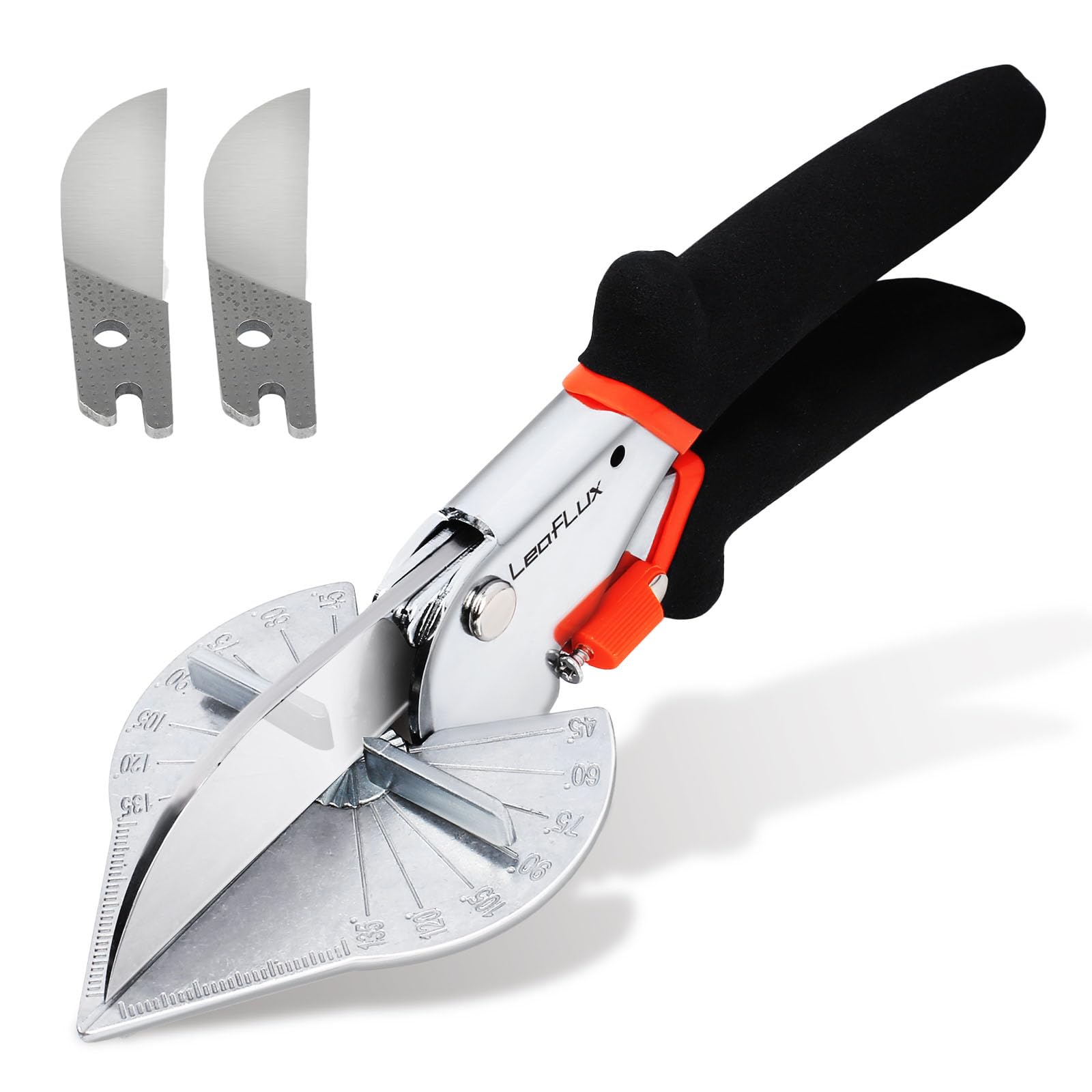
Start with the number that tells you the most: 58-60 HRC. That is the hardness range on the SK5 high-carbon blade, heat-treated to hold a fine edge and resist rolling on trim, molding and light wood. Softer edges sharpen easily but fold more quickly. This one is pitched at the buyer who wants the cut to stay crisp through a whole length of molding rather than degrading cut by cut.
You get the same six angle positions as the GARTOL above — 45°, 60°, 75°, 90°, 120°, 135° — plus a strong safety lock that stops accidental opening. Blade length is 3.9 inches and the handles are solid steel with an anodized finish for corrosion resistance, so a damp basement does not chew the tool. It is ambidextrous and cuts wood, trim, PVC strips, trunking, vinyl and quarter round, with metal openly excluded.
The quality story here is the strongest on this entire list. Build quality is what owners praise most and it is backed by a broad base of feedback. Ease of use and adjustability draw steady approval too. Cutting performance as a whole reads more split, so treat it as a careful trim tool rather than a brute-force cutter. It measures 8.78″L x 3″W, giving a wider fence face than the narrower GARTOL for holding molding flat.
Built for: the trim job where the corner joint has to look sharp, and the blade has to keep that edge.
Think twice if: you expect it to plow through oak or dense MDF — the materials list says otherwise.
5. GARTOL Ratchet Miter Shears

A gear that turns one hard squeeze into a string of easy clicks.
If a full room of quarter round sounds like an arm workout, this is the design that fixes it. The two-stage ratcheting mechanism multiplies your hand force and feeds the blade down in small increments — click, click, click — instead of demanding one full-power squeeze per cut. The maker pitches it for weaker grip strength, where the force multiplication matters most.
The bed is a heavy-duty aluminum alloy anvil, not plastic, with spring-ball locking holes at 45°, 60°, 75°, 90°, 105°, 120°, and 135°. That is one more stop than the six-angle tools here — you get 105° as well. The blade is Japanese SK5 high carbon steel, 4 inches long, and the set includes a spare blade in a protective sheath plus an instruction manual. Handles are contoured non-slip silicone, ambidextrous, with a turn-clasp safety lock.
Build quality is where the tool earns its reputation — it is the standout in owner feedback, with functionality right behind it. Durability and time saved both come up positively, and the blade life stretches across multiple job sites. There is one recurring fit-note worth knowing: the blade can rotate slightly during a cut, which is a real irritant on the hardest material. Securing the piece before you squeeze solves most of it. At 16 ounces it is no featherweight.
Where it wins: the ratchet cuts fatigue on long flooring runs, and the aluminum anvil holds molding steadier than plastic bases.
Set-up tip: clamp or hold your material firm — a rotating blade is the trade-off on the toughest cuts.
Choose this when: you have a lot of molding to cut and want your hands to survive the day.
Choose something else when: you want the lightest tool in the box and do only a few cuts at a time.
6. O’Shine Long Handle Miter Shears

A longer lever for the contractor cutting molding all day long.
Leverage is the design brief here. The elongated grip amplifies torque, and the maker claims it saves up to 30% of the force of its standard model. That is a maker figure, but the leverage math favors a longer handle. For contractors with larger hands running repetitive jobs, that is the pitch.
The blade is Japanese SK5 steel with hard chrome plating, heat-treated to HRC52, cutting quarter round, shoe molding, base shoe, trunking, PVC trim and weather strips up to 3/4″ in size. The multi-angle aluminum fence runs 45 to 135 degrees and holds material firmly without slipping. The full tool measures 9.4″L x 3″W, the longest in this group — which is precisely where the extra leverage comes from. A spare blade with a polypropylene sheath ships in the box.
The tool is made in Taiwan with an all-metal build and an upgraded PVC anti-slip grip. Quality and functionality are the two things that land best with buyers, and the sharpness of the blade gets separate praise. The gap to know about is at the 45-degree setting specifically — angled cuts there draw the criticism while straight and vinyl quarter round cuts come out clean. If your project is wall-to-wall angled returns, test that setting first.
The leverage play: a longer handle and PVC grip mean less hand fatigue on a full day of molding, so big-handed users get the comfort.
Angle caution: 45° performance is the weak spot in feedback — clean straight and vinyl cuts are the safer bet.
Match made for: the pro or large-handed DIYer cutting repetitive shoe molding and PVC trim.
Not for: the occasional trim job that lives entirely on angled corner joints.
7. O’Shine Miter Shears OS003

The all-rounder that earned this list’s most enthusiastic following.
Here is the pick with the strongest overall verdict on the list. Buyers describe the OS003 as very sharp, sturdy and a time saver, and its build quality is the quality owners praise most. It is also the most popular tool on this page, holding 4.5+ stars across 600+ ratings. That combination of sharpness praise and volume is worth weighing if you want the safe bet.
Mechanically it works the way the other O’Shine does. The anvil carries incised markings at 45°, 60°, 75°, 90°, 105°, 120°, and 135°, and spring-and-iron-ball stops hold the fence where you set it with a click. The high-quality aluminum alloy anvil and movable fence are large enough to grip material of different thicknesses but light enough for repeatable cutting. The 4-inch SK5 blade is heat-treated to HRC52 with a hard chrome plate, cutting softwood up to 3/4″, balsa, trunking, PVC strips, chamfer, quarter round and wood trim.
It measures 8.75″L x 3″W at 0.5 kg, comes with a spare blade in a polypropylene sheath, and is made in Taiwan. Functionality draws strong marks alongside ease of use and speed. The honest gap is that cutting performance and angle adjustment both carry mixed feedback — some owners get precise results, others fight it on quarter round molding and angle accuracy. It is not built for metal.
Why it leads the popularity contest: sharp, sturdy and fast is the recurring read, and it handles soft trim up to 3/4″ with the blade the maker ships.
Realistic expectation: on thick quarter round and tight angles, results vary — test your setting on scrap first.
Most buyers should start here: it is the safest balance of sharpness, build and following for general softwood and PVC trim.
skip it if: your job is brutal on angle accuracy at 45° — the feed on that setting is where the split feedback lives.
8. GARTOL Ratchet Miter Shears with 5 Anvils
Five anvils turn one hand cutter into a shapes-and-pipes toolbox.
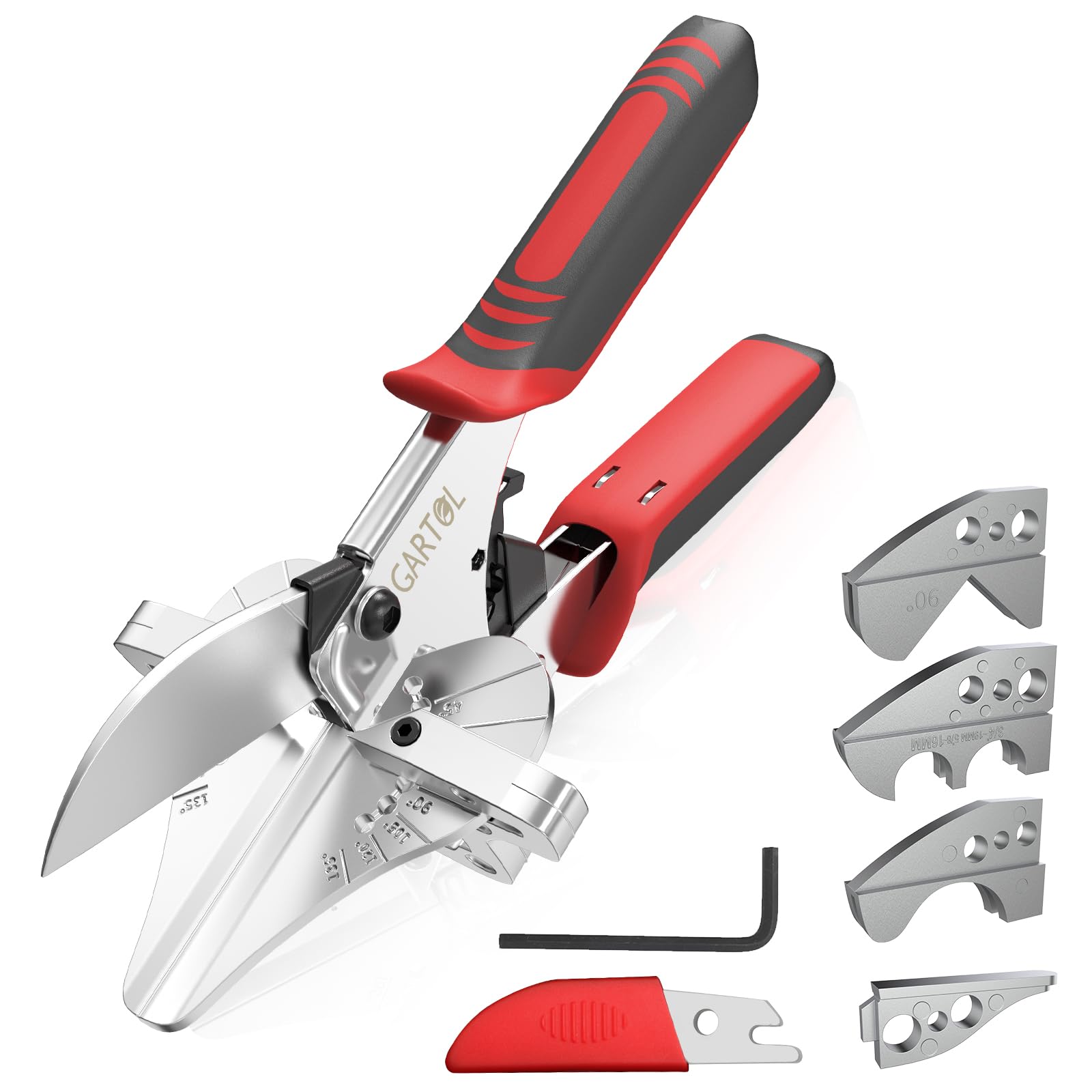
Most trim cutters give you one flat bed. This one swaps anvils. Flat handles straight cuts on flat material, 90° squares up right-angle work, Dowel cradles round stock, PVC takes pipes and flexible plastics, and a Specialty anvil covers the odd shapes. For a mixed job — trim one day, PVC pipe or dowel the next — that is the feature that stretches the tool well past molding work.
The rest of the kit runs on the same ratchet platform the other GARTOL does: a labor-saving ratchet system that reduces wrist stress, plus a Japanese SK5 steel blade that can be resharpened with a sharpener for long life. The aluminum alloy anvil and fence hold material steadily and stay light. It locks at 45°, 60°, 75°, 90°, 105°, 120°, and 135° on click stops. You get the blade in a protective cover, an instruction manual, and the disassembly wrench for swapping anvils.
Here is the honest read. On this kit specifically, owner experiences are genuinely split on both cutting performance and ease of use — some find it does exactly what is described, others find the cuts less clean or the tool harder to operate. That makes it a tool to set up carefully and test on scrap before you commit a full molding run. If you want the five-anvil versatility, budget a little patience for dialing it in.
Worth it for: the buyer who cuts trim, dowel and PVC pipe with one tool and wants the interchangeable anvils.
Weigh the trade-off: this is the most elaborate kit here, and it asks for careful set-up before the cuts come clean.
Know the Specs
Blade steel and hardness
SK5 is a Japanese high-carbon steel commonly used for these blades because it takes a fine edge. Hardness is measured on the HRC scale — a higher number means an edge that resists rolling. The LeafLux runs at 58-60 HRC, while the O’Shine blades heat-treat to HRC52, which is softer but easier to resharpen. Either grade handles softwood and PVC; the difference shows up on how long the edge stays sharp.
Anvil and fence
The anvil is the flat metal bed that backs the blade, and the fence is the movable guide that holds the molding at your chosen angle. An aluminum alloy anvil resists wear better than plastic and keeps material from slipping mid-cut. Spring-ball or click stops lock the fence at set angles. A fence that shifts under pressure is the usual cause of a gappy corner joint.
Angle stops
Miter shears typically lock at 45°, 60°, 75°, 90°, 105°, 120°, and 135° depending on the model. The 45° setting creates the corner joint between two trim pieces. 90° makes square cuts. The wider settings cover molding returns and angled transitions. Some tools here skip 105° entirely, so check your project’s angles against the list before you buy.
Ratchet versus plain squeeze
A plain shear needs one full-power squeeze per cut. A ratchet gear feeds the blade down in small increments, so your hand does less work per cut — helpful on long runs or with a weaker grip. The trade-off is a slightly heavier, more complex tool. For a few cuts at a time, a plain shear is simpler and lighter.
Common Questions
Will a miter shear cut quarter round cleanly?
Can a trim cutting tool cut metal or tile?
What angle do I set for a corner joint?
Is a ratchet miter shear worth choosing over a plain one?
How do I change the blade on a miter shear?
Can I resharpen the SK5 blade?
What size molding will these cutters handle?
Will a miter shear replace my chop saw?
Why does my shear cut leave a gap at the corner?
Are these miter shears comfortable for left-handed use?
The Bottom Line
For most buyers, the trim cutting tool that earns its place on the wall is the Ronan Multi-Cut Industrial Cutter, because the blade-to-anvil action and offset pivot cut through the wide spread of plastic, vinyl, rubber and light wood that a typical garage or renovation job throws at you. If your work is locked to corner joints on molding, the O’Shine Miter Shears OS003 is the safest all-round pick for softwood and PVC trim. And if you have a full room of quarter round to get through, the GARTOL Ratchet Miter Shears cuts down the hand strain with its two-stage ratchet. Match the angle stops and blade steel to the trim you actually cut.
How we choose
We do not accept paid placement. Every pick is matched to a real buyer and a real use-case; we do not hands-on test units.
Sources
Specifications: manufacturer listings and product documentation. Review insights: verified customer reviews, as of November 2026. Pricing: not shown on this page (it changes often); check the current price via the retailer link.
As an Amazon Associate, Tactical Gear Guy earns from qualifying purchases. This does not affect which products we feature.