Specs are compiled from manufacturer listings and verified buyer reviews and can change over time — please confirm the key details on the product page before buying.
If half your yard, barn, or back bedroom gets one flickering bar, the fix is an antenna extender — a device that catches your existing signal and pushes it further. The right one depends on whether you are fighting walls or distance. Indoor units like the TP-Link RE550 cover a house; outdoor units with high-gain antennas like the Mekupc AX3000 reach hundreds of meters across open ground. Below you get seven real options, sorted by what each actually does best.
This guide is built by comparing the manufacturers’ published specifications and the patterns across verified customer reviews, so you get each pick’s real strengths and trade-offs instead of marketing spin.
Every pick here is a coverage tool, not a speed booster — the most misunderstood fact about the best Wi-Fi antenna extender.
Top Picks
How To Choose The Best Wi-Fi Antenna Extender
Start with one question: are you extending through walls or across open ground? That answer narrows the field faster than any spec sheet: indoor repeater for walls, outdoor access point for distance. An indoor repeater with three adjustable antennas handles a house. An outdoor access point with high-gain fiberglass antennas handles a yard, a barn, or a field.
Match the gain and range to your space
Antenna gain, written in dBi, measures how tightly the antenna focuses a signal in one direction. Higher gain pushes further in a straight line — that is why outdoor units carry 5dBi, 7dBi, or 8dBi antennas. A 200–300 meter radius is line-of-sight coverage; trees and buildings shorten it. Indoor units instead quote square footage such as 2,100 or 2,400 sq. ft.
Weather rating is not optional outdoors
An IP67 enclosure is sealed against dust and survives being submerged briefly, while IP65 resists water jets. Either rating beats an indoor unit left on a fence post. Check lightning and static protection too — a 6kV lightning and 15kV ESD rating tells you the unit is built to shrug off a storm.
PoE decides where you can mount it
Power over Ethernet sends electricity and data down one cable, so you can mount the extender at the far end of a run with no outlet nearby. Most outdoor units include a passive PoE injector. Keep the injector indoors — the adapters themselves are not waterproof on these models.
Side-by-Side Comparison
| Model | Best For | Top Speed | Coverage / Range | Weather Rating | Amazon |
|---|---|---|---|---|---|
| Mekupc AX3000 Outdoor★ Best Overall | Long-range outdoor reach | 2402 Mbps | 200–300 m radius | IP67 | Amazon |
| TP-Link RE550Best Value | Whole-home indoor coverage | 1900 Mbps | 2100 sq. ft. | Indoor | Amazon |
| BrosTrend AC1200 Outdoor | Yard and garden on a budget | 1200 Mbps | Up to 656 ft. | IP65 | Amazon |
| TP-Link RE223BE | Wi-Fi 7 homes | 3200 Mbps | 2400 sq. ft. | Indoor | Amazon |
| NETGEAR EXS27 | Wi-Fi 7 with wired port | 5 Gbps | 1500 sq. ft. | Indoor | Amazon |
| WAVLINK AX1800 (WN573HX1) | Large properties and farms | 1800 Mbps | 200–300 m radius | IP67 | Amazon |
Detailed Reviews
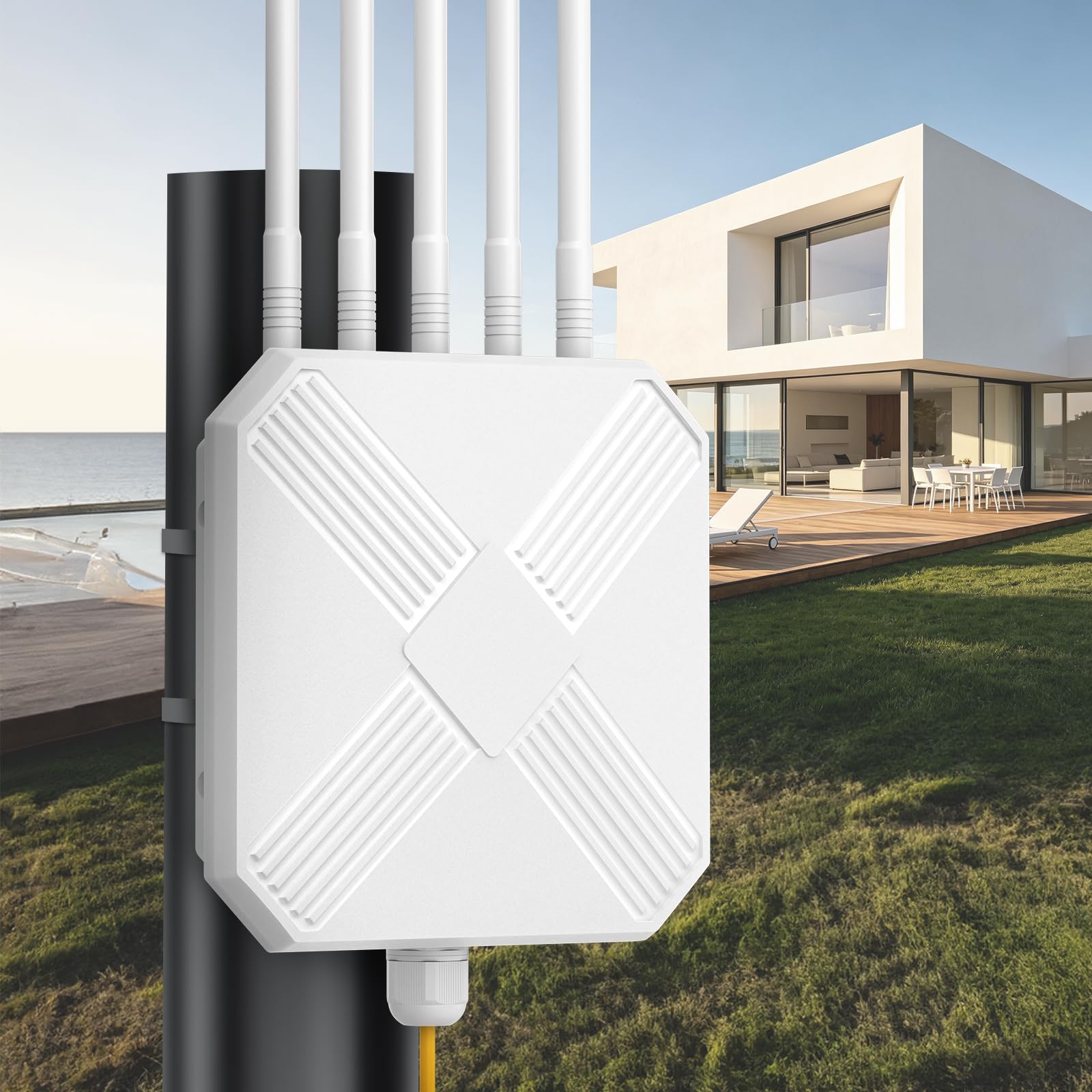
1. Mekupc AX3000 Outdoor Access Point
Our pick — 4.5+★ from 550+ verified ratings; the strongest balance of quality and price.
Five amplifiers and five antennas built for a field, not a hallway.
If your Wi-Fi dies before it reaches the far fence, the Mekupc AX3000 is the pick to beat. It pushes up to 2402 Mbps on the 5 GHz band (the faster, shorter-range Wi-Fi) and 573 Mbps on 2.4 GHz (the slower, longer-range Wi-Fi) across a 200–300 meter radius — enough to cover a large yard, RV pad, or barn with one unit. Five high-gain omnidirectional antennas (they send signal in all directions) plus five built-in power amplifiers do the pushing, so it reaches where a single-antenna repeater gives up.
The build is meant to live outside. An IP67 casing seals against dust and survives rain, snow, and storms, and the spec list adds 15kV ESD protection and 6kV lightning resistance for extreme temperatures from -20°C to 50°C. Power runs over a single Ethernet cable thanks to passive PoE, so you mount it where the coverage is needed, not where an outlet happens to be. Farms, warehouses, and outdoor events are the obvious homes for it, and it can run in AP, Router, Repeater, or Hybrid mode depending on what you already own.
Raw speed is where it separates from the BrosTrend AC1200 below — 2402 Mbps versus 1200 Mbps on the data transfer rate, a clear leap if you are feeding cameras or a Starlink link. It also carries a Gigabit Ethernet port at 1000/100/10 Mbps and connects up to 274 devices at once.
What it brings to the field
- 200–300 meter radius from five high-gain antennas and five power amplifiers
- IP67 body with 15kV ESD and 6kV lightning protection for year-round outdoor mounting
- Passive PoE means one cable carries power and data to a remote spot
- Four modes (AP, Router, Repeater, Hybrid) plus a Gigabit Ethernet port
Watch for this
- The PoE converter itself is not waterproof, so it must sit indoors or in a dry box
- Cable runs need to stay under 100 m with CAT5E or better wire
Reach for this if: you need real outdoor distance and a sealed build, and you want PoE flexibility to place it far from the house.
Look elsewhere if: a single-room dead spot is your only problem — an indoor repeater does that job for far less complexity.
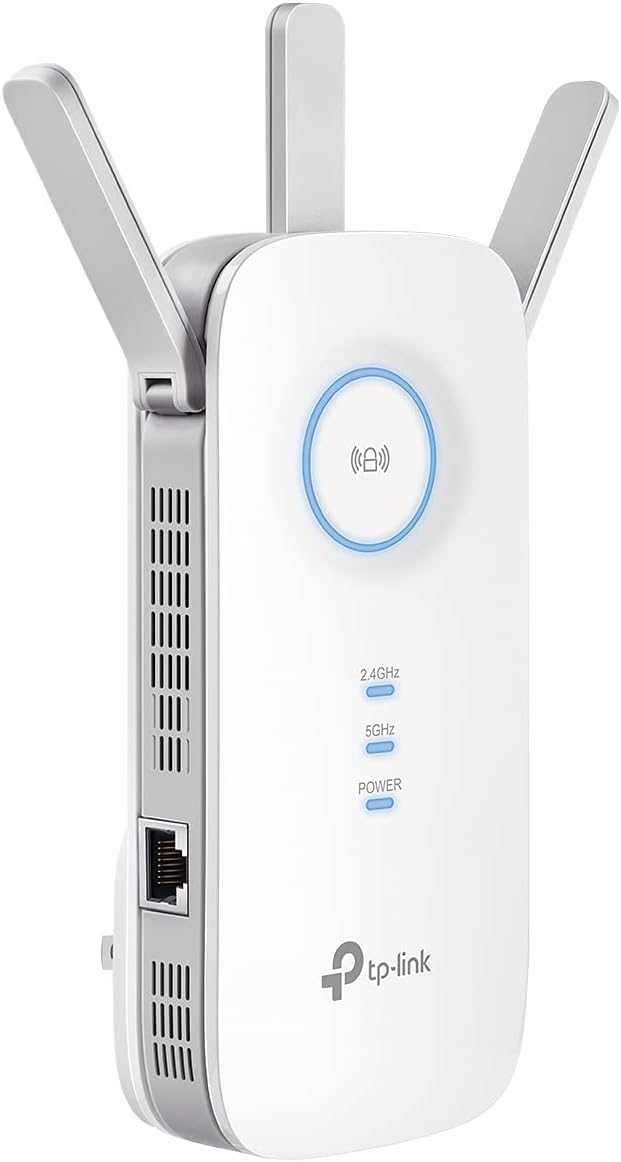
2. TP-Link AC1900 RE550
The indoor workhorse that quietly fills the rooms your router forgot.
Most people with a dead bedroom do not need a rooftop antenna — they need this. The RE550 spreads up to 2,100 sq. ft. of coverage and connects up to 32 devices through three adjustable external antennas, with speeds up to 1300 Mbps on 5 GHz and 600 Mbps on 2.4 GHz. It has become a house-filling standard on the strength of that dependable everyday function, which is what buyers mention before anything else.
Setup is the other reason it wins people over. The Tether app walks you through it, an intelligent signal indicator shows you the best spot to plug it in, and EasyMesh (a standard that lets mesh devices work as one network) joins it to a compatible router as one unified network with smooth roaming. Hook a smart TV or console to the Gigabit Ethernet port (a wired port that runs at up to 1,000 Mbps) and you get a wired-speed link in a room the router never reached. TP-Link is also a signatory of the CISA Secure-by-Design pledge (a voluntary security commitment), so security updates are part of the pitch.
The catch is built into every wireless extender: it improves coverage, not speed, and actual throughput runs at 50% or less of what your router delivers natively. That is a physics limit of the category, not a flaw in this unit. If you want the fast lane, the Wi-Fi 7 TP-Link RE223BE lower down is a bigger jump.
Why it earns its place: 1.9 Gbps total bandwidth, 32-device capacity, and EasyMesh roaming for a fraction of what an outdoor access point costs — paired with an app setup most buyers finish without thinking about it.
The one thing to know: it is indoor-rated, so it will not survive on a fence post in the rain.
Best for: a standard house with one or two stubborn dead zones and a budget that stays modest.
Skip the outdoor dream: if your target is a deck, yard, or detached garage, go weatherproof instead.
3. BrosTrend AC1200 Outdoor WiFi Extender
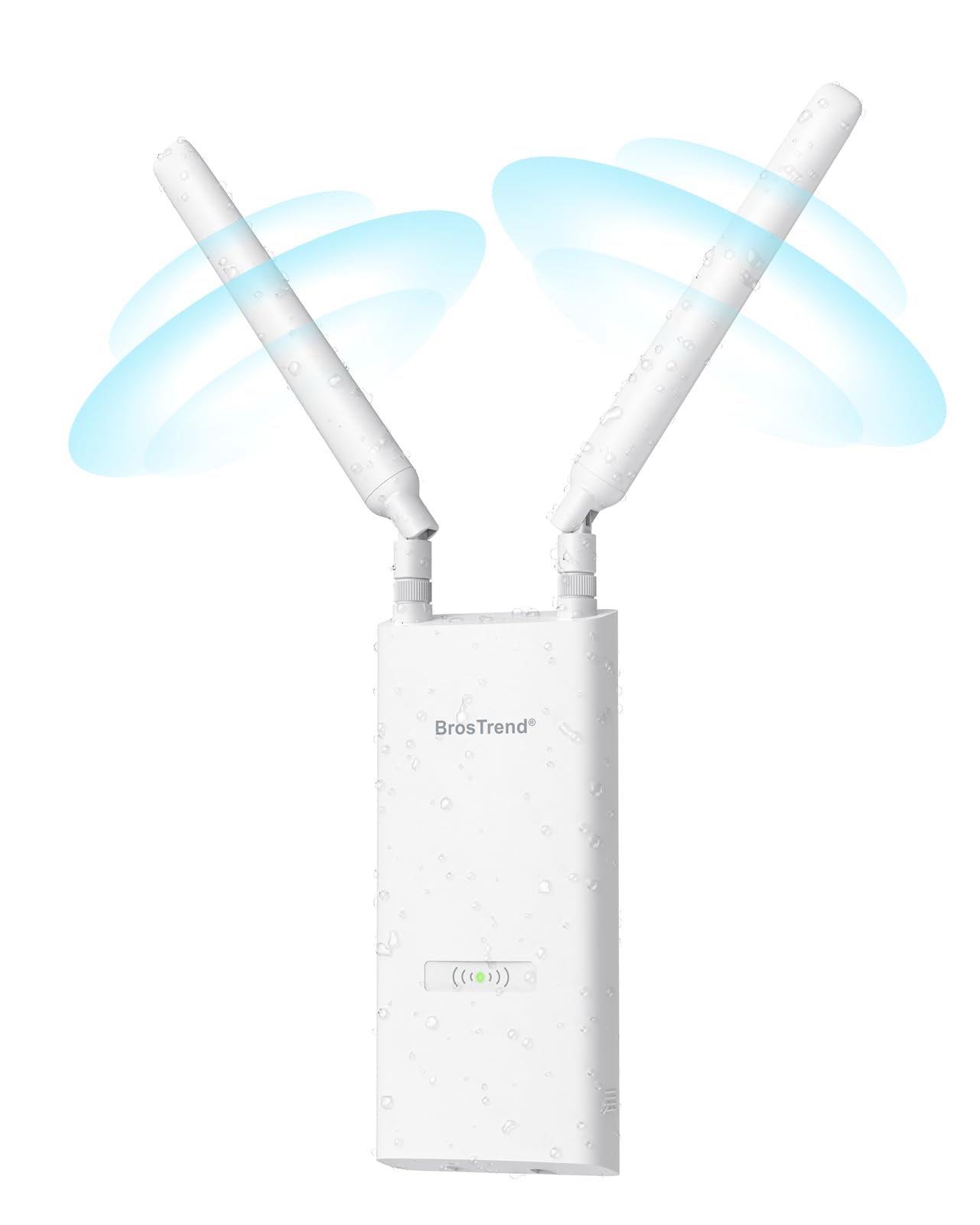
An IP65 shell and two 5dBi antennas that push your garden back online.
The BrosTrend is the sensible first step into outdoor coverage. It relays your existing router’s signal up to 656 feet and carries speeds up to 867 Mbps on 5 GHz and 300 Mbps on 2.4 GHz. Two adjustable 5dBi omni-directional antennas spread the signal in all directions, and Beamforming focuses it toward your devices — a two-part approach that keeps a poolside speaker or security camera connected.
Weather is handled by an IP65-rated waterproof and dustproof housing, backed by 6kV lightning and 8kV ESD protection. Power comes via a single Ethernet cable through the included gigabit PoE injector, so no outlet is needed at the mount point. The injector stays indoors, and BrosTrend recommends qualified Cat5e or higher outdoor cable that is waterproof, shielded, and UV-resistant for the run itself.
Here is the trade-off to weigh: reliability is the most-discussed area and it is split. For many it holds steady for garden, deck, and remote-work duty; a handful hit connection drop-offs that pushed them toward a quicker-returning alternative. Treat it as a light-duty outdoor extender rather than a farm-grade one — the WAVLINK units further down are the heavyweights. The included mounting bracket, grounding screw, and anti-theft screw show it is designed for a permanent spot on a wall.
Where the money goes: an IP65 build, two 5dBi antennas, and a PoE injector in the box — a real outdoor kit rather than an indoor unit with a hopeful claim.
Set your expectations: 656 feet and 867 Mbps on 5 GHz suit a yard, not a 3-acre field.
Matches nicely with: homeowners extending to a deck, patio, or a couple of outdoor cameras who want PoE without a big spend.
Not the fit for: anyone covering open acreage or demanding constant high-bandwidth links — step up to a higher-gain unit.
4. TP-Link BE3200 RE223BE
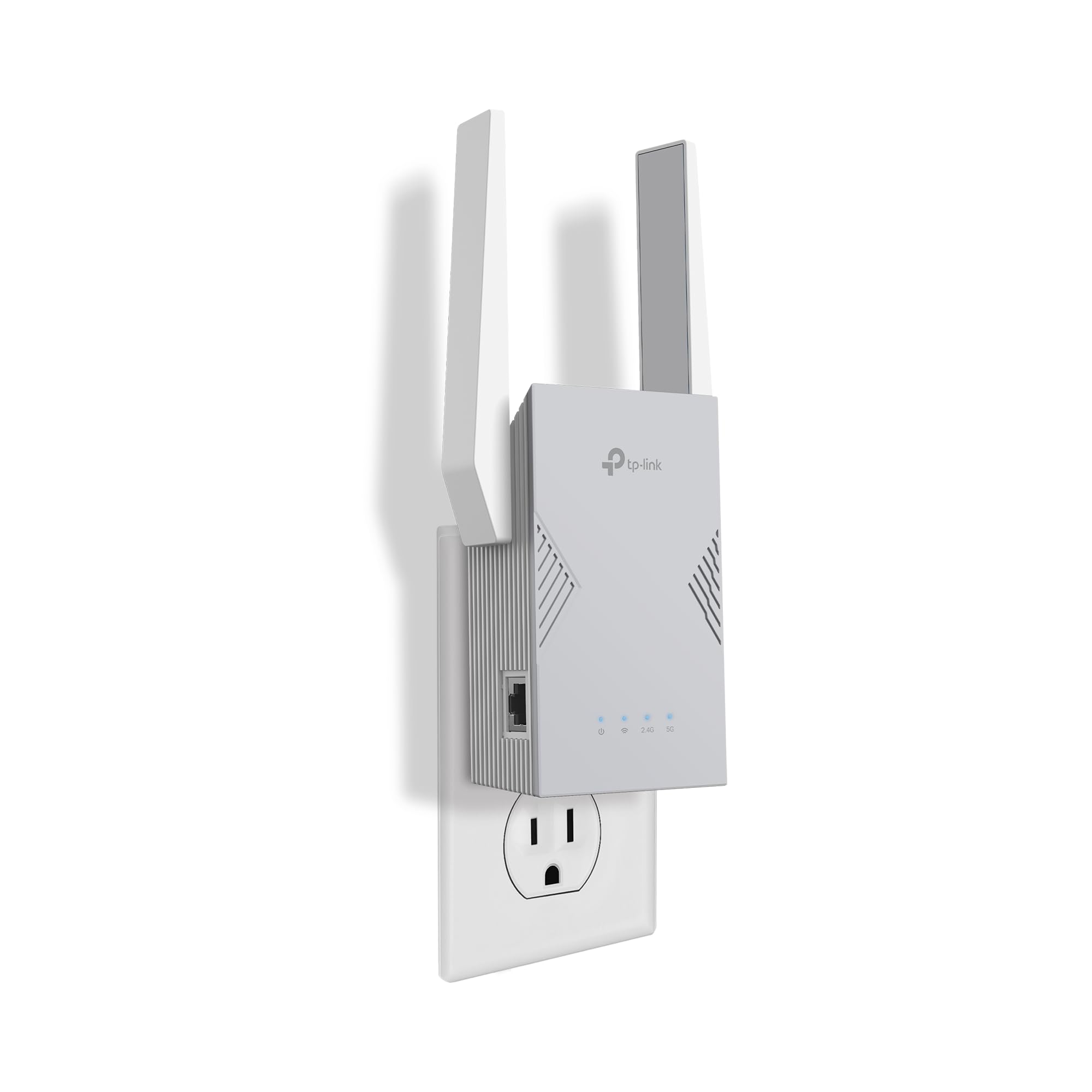
A next-gen extender that keeps more devices happy across 2,400 sq. ft.
Own a Wi-Fi 7 router and this extender pulls its weight. The RE223BE reaches up to 3.2 Gbps of total bandwidth — 2594 Mbps on the 5 GHz band and 688 Mbps on 2.4 GHz — across four optimally positioned antennas with Beamforming. Pair it with a Wi-Fi 7 router and it taps Multi-Link Operation, which combines bands for better throughput, lower latency, and steadier connections. It covers up to 64 devices, which is the difference between a house full of phones and a house full of everything.
Reliability and an easy setup are what make this one a natural fit. Buyers configure it in less than five minutes with the Tether app, and the signal indicator points you to the right spot. The spec list leans that way too — EasyMesh lets it join a compatible router as one network with smart adaptive roaming, and the same CISA Secure-by-Design commitment underlines security updates.
Two limits worth knowing before you commit. It is a dual-band unit that does not support the 6 GHz band, so it stays on 2.4 GHz and 5 GHz. And like every wireless extender here, it improves coverage rather than raw speed. If your router stream is already quick and you simply want more rooms at that level, this one delivers.
The case for the RE223BE
- 3.2 Gbps total bandwidth split as 2594 Mbps (5 GHz) and 688 Mbps (2.4 GHz)
- Multi-Link Operation when paired with a Wi-Fi 7 router for lower latency
- Up to 2,400 sq. ft. and 64 devices across four beamforming antennas
Where it stops short
- No 6 GHz band — it runs 2.4 GHz and 5 GHz only
- Not built for indoor-to-outdoor duty in the rain
The right call for: a modern Wi-Fi 7 home that needs coverage stretched to a garage, basement, or far bedroom.
Think twice if: you already rely on a 6 GHz band for a clean channel — this extender will not mirror it.
5. NETGEAR Nighthawk EXS27
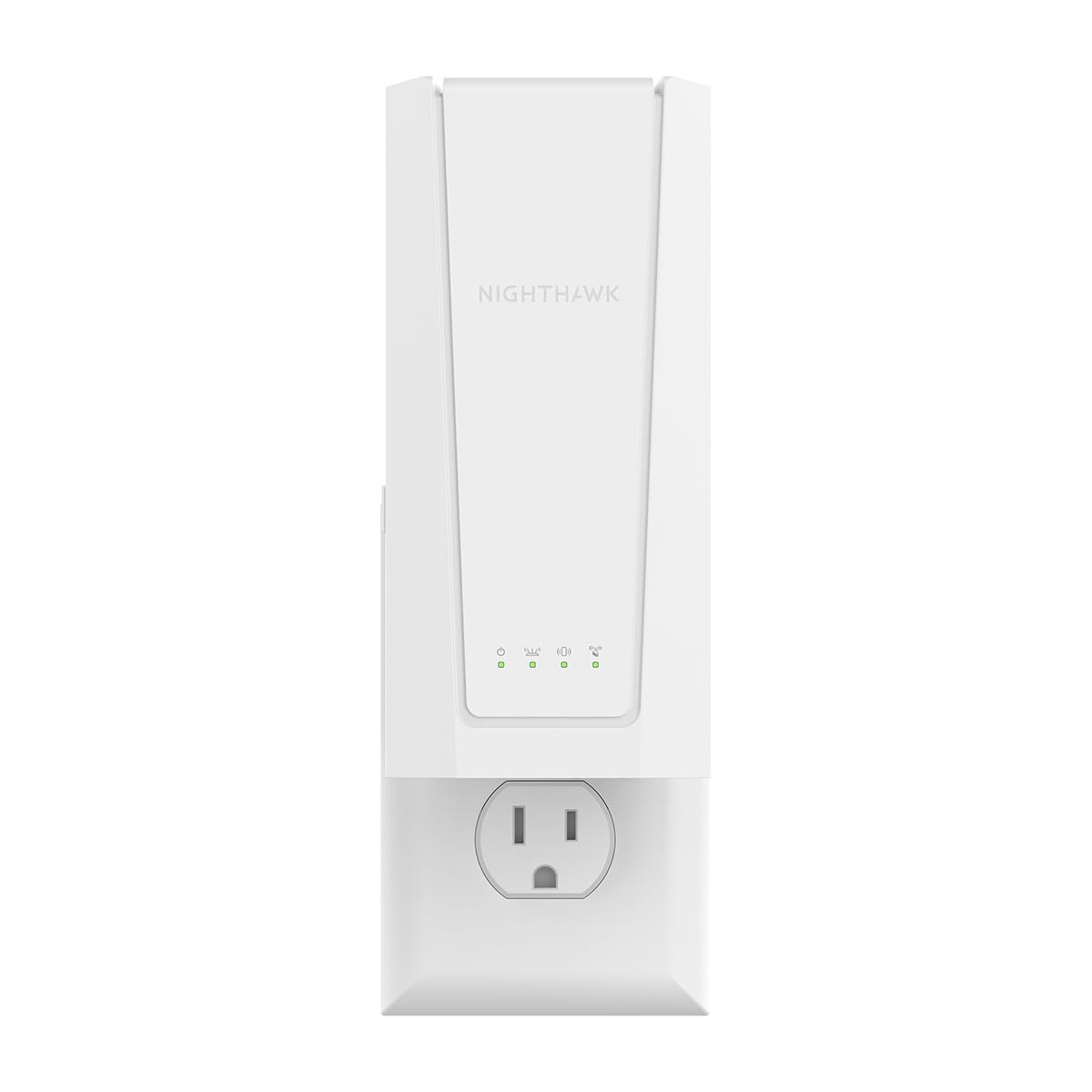
A wall-outlet extender with a 2.5G port for the gear that needs wire speed.
The EXS27 is aimed at the person who wants Wi-Fi 7 reach and a full-speed wired link in one device. It adds up to 1,500 sq. ft. of coverage for up to 45 devices from any wall outlet, and the 2.5 Gigabit Ethernet port lets you run a smart TV or game console directly for the kind of connection Wi-Fi cannot guarantee. Its headline throughput is up to 5 Gbps, which is the biggest number in this whole lineup.
Setup and roaming are the draws. Use the Nighthawk app for guided setup, or press WPS on your router and the extender and you are done. Smart Roaming keeps your existing network name and shifts each device to the strongest signal as you walk room to room, so calls and streams stay intact. The 5-Stream BE5000 design brings Wi-Fi 7 down to bedrooms, the garage, the basement, and the backyard without tearing up your network.
The fair caution is durability over time. Buyers praise the range, and 1,500 sq. ft. holds up for most homes, but performance reports are split — some units work well for months and others stop within about six. If you want the longest-reach indoor option with a wired port, this is strong; if you want a unit built to sit outdoors, the weatherproof Mekupc or WAVLINK models are the correct shape.
Standout number: up to 5 Gbps throughput and a 2.5 Gigabit Ethernet port — the fastest wired hand-off in the lineup and a clear step past the RE550’s 1.9 Gbps.
Weigh the risk: the mixed long-term reports mean it is best bought from a seller with a clean return path.
Who it suits: a Wi-Fi 7 household that needs one more strong room and a wired console or TV hookup at the same spot.
Who passes: if a single dead corner is the whole problem, the RE550 handles it more simply.
6. WAVLINK AX1800 Outdoor WiFi 6 Extender

Four fiberglass antennas and 256-device capacity for properties that sprawl.
On a farm, estate, or wide open yard, this WAVLINK is the workhorse. Four high-gain 8dBi omni-directional detachable fiberglass antennas push a stable signal up to 200–300 meters in line-of-sight conditions and support up to 256 devices at once. Speeds reach 1800 Mbps (1201 Mbps on 5 GHz plus 574 Mbps on 2.4 GHz) for 4K streaming, outdoor cameras, and gaming, with Starlink Gen 2/3 compatibility via a Starlink Ethernet Adapter.
Reliability is what the outdoor market notices first about this unit, and it is backed by a true sealed spec. An IP67 casing survives rain, heat, snow, dust, and UV, with 6kV lightning and 15kV static protection and a working range of -20°C to 50°C. Power can come from 802.3af/at active PoE or passive PoE through the included 54V/0.3A adapter — one cable to a spot with no outlet. It runs Mesh, AP, Router, Repeater, and AP+Repeater modes, though there is no companion app, so setup is done through the web interface.
Setup is the honest split. Many find it straightforward; others find the instructions thin and end up leaning on WAVLINK’s support line, which responds within 8 hours and is paired with a two-year warranty. Plan a little patience for the first hour and the hardware rewards you after.
What sells it outdoors
- Four 8dBi fiberglass antennas covering 200–300 m for up to 256 devices
- IP67 sealing with 6kV lightning and 15kV ESD protection for year-round mounting
- Active and passive PoE, so the mount point needs no power outlet
- Two-year warranty and lifetime technical support
Where it asks for patience
- No app — setup runs through a web interface, and instructions are thin
- The included 1 m Ethernet cable may be too short for a long outdoor run; bring CAT5E or better under 100 m
- The PoE adapter itself is not waterproof, so mount it indoors
Point it at: farms, large yards, RV pads, and anywhere the signal has to cross real distance and stay sealed through the seasons.
Be ready to: spend a bit of setup time and keep the PoE adapter dry.
Know the Specs
Antenna gain (dBi) and beamforming
Gain tells you how tightly an antenna focuses the signal — higher numbers like 7dBi or 8dBi reach further in a straight line. Beamforming then aims that focused signal at your actual devices rather than spraying it in every direction. Together they decide whether a signal survives distance, not just walls.
IP rating and PoE
An IP number pairs dust protection with water protection — IP67 shrugs off dust and brief submersion, while IP65 handles water jets. PoE (Power over Ethernet) sends electricity and data down a single cable, so you can mount the extender at the far end of a run with no outlet in sight. Both matter most for anything mounted outdoors.
Common Questions
Does a Wi-Fi antenna extender actually increase my internet speed?
Will an outdoor extender work with my Starlink setup?
What is the difference between IP65 and IP67 on these units?
Can I mount the extender where there is no power outlet?
Do I need a Wi-Fi 7 router to use the TP-Link RE223BE or NETGEAR EXS27?
How far can an outdoor Wi-Fi antenna extender reach?
Does the WAVLINK outdoor extender work with a mesh system?
Is the TP-Link RE550 compatible with any router?
Can a single extender cover a whole farm or large property?
The Bottom Line
For the majority of shoppers, the wi-fi antenna extender winner is the Mekupc AX3000 because it pairs a sealed IP67 body (dust-tight and protected against water jets) and 6kV lightning protection (it can take a 6,000-volt surge) with a 200–300 meter radius and 2402 Mbps on 5 GHz — the combination most people need when the signal has to cross ground and weather. If you would rather stay indoors and cover a house, grab the TP-Link RE550. And for open land and off-grid Starlink installs, the WAVLINK AX1800 is the one to reach for, with the four-antenna WN573HX1 a close partner when you want the app-free web interface and a two-year warranty.
How we choose
We do not accept paid placement. Every pick is matched to a real buyer and a real use-case; we do not hands-on test units.
Sources
Specifications: manufacturer listings and product documentation. Review insights: verified customer reviews, as of November 2026. Pricing: not shown on this page (it changes often); check the current price via the retailer link.
As an Amazon Associate, Tactical Gear Guy earns from qualifying purchases. This does not affect which products we feature.