Specs are compiled from manufacturer listings and verified buyer reviews and can change over time — please confirm the key details on the product page before buying.
Your desk is white, your monitor is silver, and the last pair of speakers you bought turned out to be black plastic boxes with a blue LED that never switches off. That mismatch is the whole problem with shopping this category. The short answer: buy for the cabinet finish and the input list first, then worry about watts — a white pair with the wrong connections will sit unplugged no matter how good it sounds.
This guide is built by comparing the manufacturers’ published specifications and the patterns across verified customer reviews, so you get each pick’s real strengths and trade-offs instead of marketing spin.
Below you will find white pairs for every desk and budget, from compact gaming sets to studio monitors. Every option here has a genuine white housing, so the finish will not be the thing that ruins your setup — which is exactly what you want from the best white PC speakers.
Top Picks

How To Choose The Best White PC Speakers
The white part is easy to check. The hard part is working out whether a pair will actually fit your desk, your ports and your ears. Start with the three questions below and most of the field narrows itself.
Check the cabinet color, not just the photo lighting
A lot of listings show a white-looking speaker that ships with a black grille or a dark rear panel. Look for “Color: White” in the spec block rather than trusting the hero image. Every pair on this list has a white housing confirmed in its own specification data, so you are choosing on sound and fit instead of gambling on the finish.
Match the inputs to what is already on your desk
Most desktops give you a 3.5mm headphone jack and USB ports. Laptops often drop the analog jack entirely, which makes USB audio or Bluetooth the deciding feature. If you own a turntable you need RCA, and if you record music you want a balanced TRS input. Count your ports before you count watts — a speaker with no matching input sits silent.
Size the drivers and the cabinet to the space you have
A 3-inch driver in a compact cabinet suits a desk where the speakers sit an arm’s length from your ears. A 5-inch woofer in a larger wooden box moves more air and gives you real low end, but it eats desk real estate. Measure the gap either side of your monitor first — a pair that does not fit gets shoved onto the floor, and the sound suffers for it.
Side-by-Side Comparison
| Model | Best For | Power | Driver Size | Inputs | Amazon |
|---|---|---|---|---|---|
| Edifier R1280T★ Best Overall | All-round desk upgrade | 42W RMS | 4-inch + 13mm tweeter | Dual AUX / RCA | Amazon |
| IBALL·BOX USB-C Gaming PairBest Connectivity | Gaming on a budget | 30W (45W peak compatible) | 3-inch full-range | USB-C / Bluetooth 5.3 / 3.5mm AUX | Amazon |
| Ortizan C7Best for Home Studio | Home studio starters | — | 3.5-inch + 0.75-inch tweeter | RCA / Bluetooth 5.3 / AUX / 6.35mm TRS | Amazon |
| MEVOSTO DS19 | Turntables and big desks | 36W RMS | 5-inch + 1-inch tweeter | USB / RCA / AUX / Bluetooth 5.4 | Amazon |
| Sanyun SW206 | Creators who also game | 80W | 4-inch + 25mm tweeter | TRS / Optical / Coaxial / USB / Bluetooth 5.4 / AUX | Amazon |
| Edifier MR3 | Hi-Res listening and editing | 18W x 2 RMS | 3.5-inch + 1-inch tweeter | Balanced TRS / RCA / AUX / Bluetooth | Amazon |
| PreSonus Eris 3.5 BT | Mixing on a small desk | 50W | 3.5-inch + 1-inch tweeter | Balanced TRS / RCA / front AUX / Bluetooth 5.0 | Amazon |
| Audio-Technica AT-SP3XWH | Turntable and phone pairing | — | — | Dual RCA / Bluetooth | Amazon |
Detailed Reviews
1. Edifier R1280T Powered Bookshelf Speakers (White)
Our pick — 4.5+★ from 500+ verified ratings; the strongest balance of quality and price.
A white wood-grain box with 42 watts behind it — the pair most desks should start with.
It is the crowd favorite of the group at 4.5+ stars across 500+ owners, and the reason is a combination almost nothing else here offers: a genuine MDF wood cabinet finished in white wood-effect vinyl. MDF is a dense pressed-wood board that resists the hollow ringing cheap plastic boxes produce. Put your hand on the side of one during a bass-heavy track and it stays quiet, which is why speech and acoustic guitar come through without a cardboard haze around them.
Inside, a 13mm silk dome tweeter (the small dome that handles the top end) sits above a 4-inch full-range driver, so vocals and cymbals stay separated instead of smearing together at volume. Two separate AUX inputs mean your PC and your phone can both stay plugged in at once — no crawling behind the monitor to swap a cable, which is the single most useful detail here for anyone with a work laptop and a personal desktop sharing one screen.
Where this earns its place at the top is the control layout. Volume, bass and treble all adjust from the included remote or the side of the main speaker, so you can pull the low end back for late-night typing without opening an app. The catch is the connection list: it is AUX and RCA only, with no Bluetooth and no USB audio. If your laptop has dropped its headphone jack, budget for a small USB adapter. The other thing to know is the size — these are bookshelf speakers, not tiny satellites, so clear roughly the footprint of two paperback books either side of your monitor.
Where it pulls ahead
- Dense MDF cabinet with a white wood-effect finish that suits a home office rather than a gaming cave
- Two AUX inputs let a PC and a phone stay connected with no cable swapping
- Remote plus side-mounted bass and treble dials, so tuning happens without software
- 4.5+ stars from 500+ owners, with sound quality the most-praised trait in reviews
What to weigh first
- No Bluetooth and no USB audio — analog AUX or RCA only
- Full bookshelf footprint, so it needs real desk space either side of the monitor
- Turntable owners need a deck with a built-in or external phono preamp
Buy this one if: you want a white pair that looks like furniture, plays cleanly at low volume, and gives you a remote for bass and treble.
Hold off if: your only free port is USB-C or you plan to stream from a phone without an adapter.
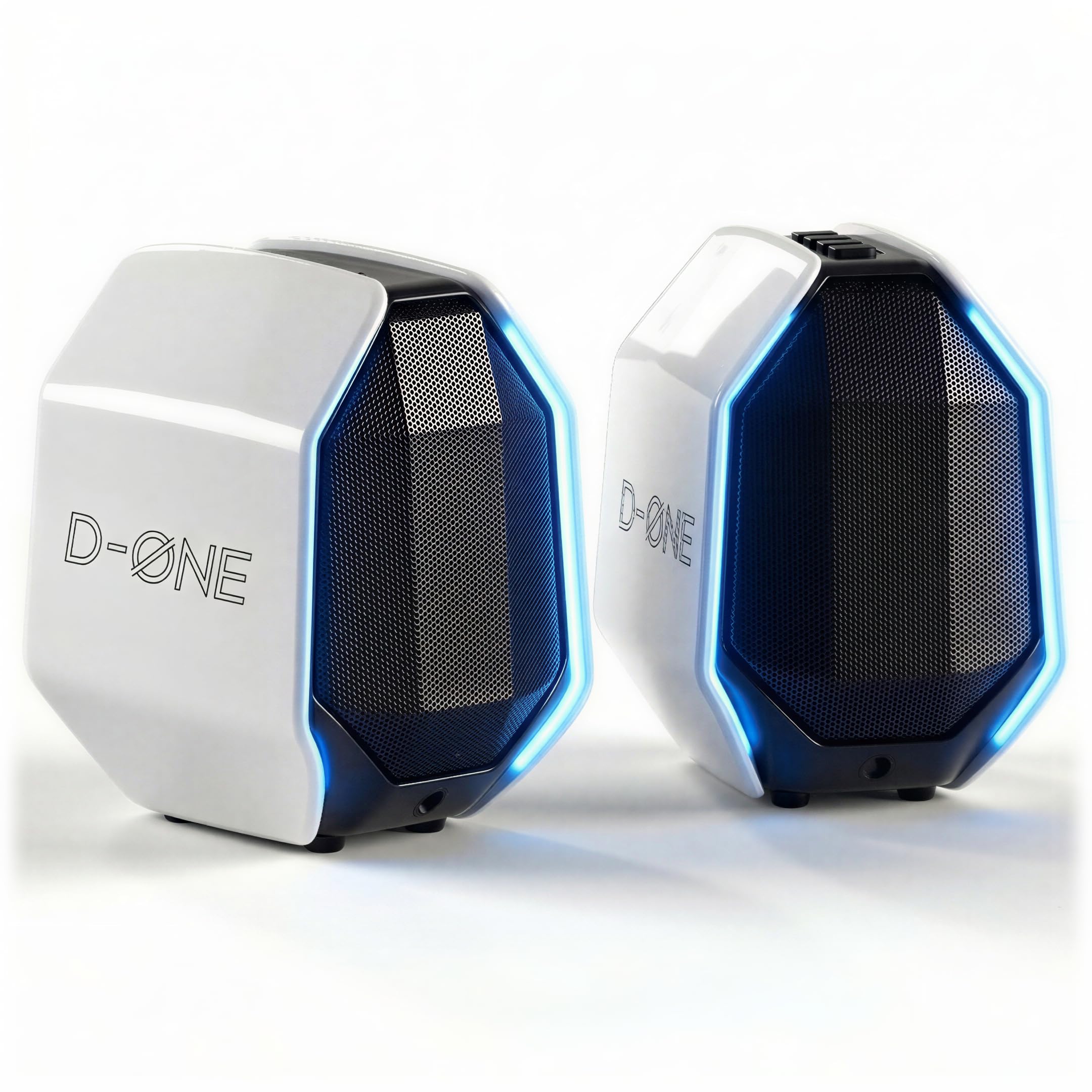
2. IBALL·BOX USB-C Bluetooth PC Speakers (White, 30W)
Three ways in, one white plastic box — the pair for a laptop with no headphone jack.
Bluetooth 5.3 reaches a claimed 10 meters here, against the 18 meters the Ortizan C7 manages two spots down. That gap matters in a big room, but across a desk it is academic — 10 meters is roughly three times the distance from your chair to the far wall of a normal study. What actually earns this pair its place is the input list: USB-C, Bluetooth 5.3 and a 3.5mm AUX cable all in one cabinet, plus a USB sound card built in so the PC treats it as a proper audio device rather than a line-out.
Power comes from the included 15V/2A adapter at 30W of clear output. If you already own a 15V/3A DC adapter you can push it toward 45W peak, though that supply is not in the box. The 3-inch full-range driver works with a rear bass diaphragm to give kick drums and explosions some weight, and the triple EQ — Gaming, Music and Bass Boost — is switchable from the push buttons rather than buried in software. For first-person shooters the Gaming preset sharpens footsteps and reload sounds, which is exactly the use case this pair is built around.
Owners rate the sound and the build well ahead of the price bracket, though connectivity and size come in for mixed notes — a few find the physical footprint bigger than expected for a compact set, so check the width against your monitor gap. The RGB lighting is a breathing effect rather than a per-key pattern, and it stays on, which will delight some desks and irritate others. If you want a white pair that swallows every device you own without an adapter, this is the one.
The real draw: USB-C audio, Bluetooth 5.3 and a 3.5mm cable in a single white cabinet — plug a work laptop, a gaming PC and a phone in on rotation without hunting for a dongle.
The honest catch: the RGB breathing light has no off switch described in the data, so a bedroom desk may want it covered.
Reach for this if: your devices are a mix of USB-C laptop, console and phone, and you want one white pair to serve all three.
Look elsewhere if: you need flat, uncolored sound for editing rather than an EQ preset tuned for games.
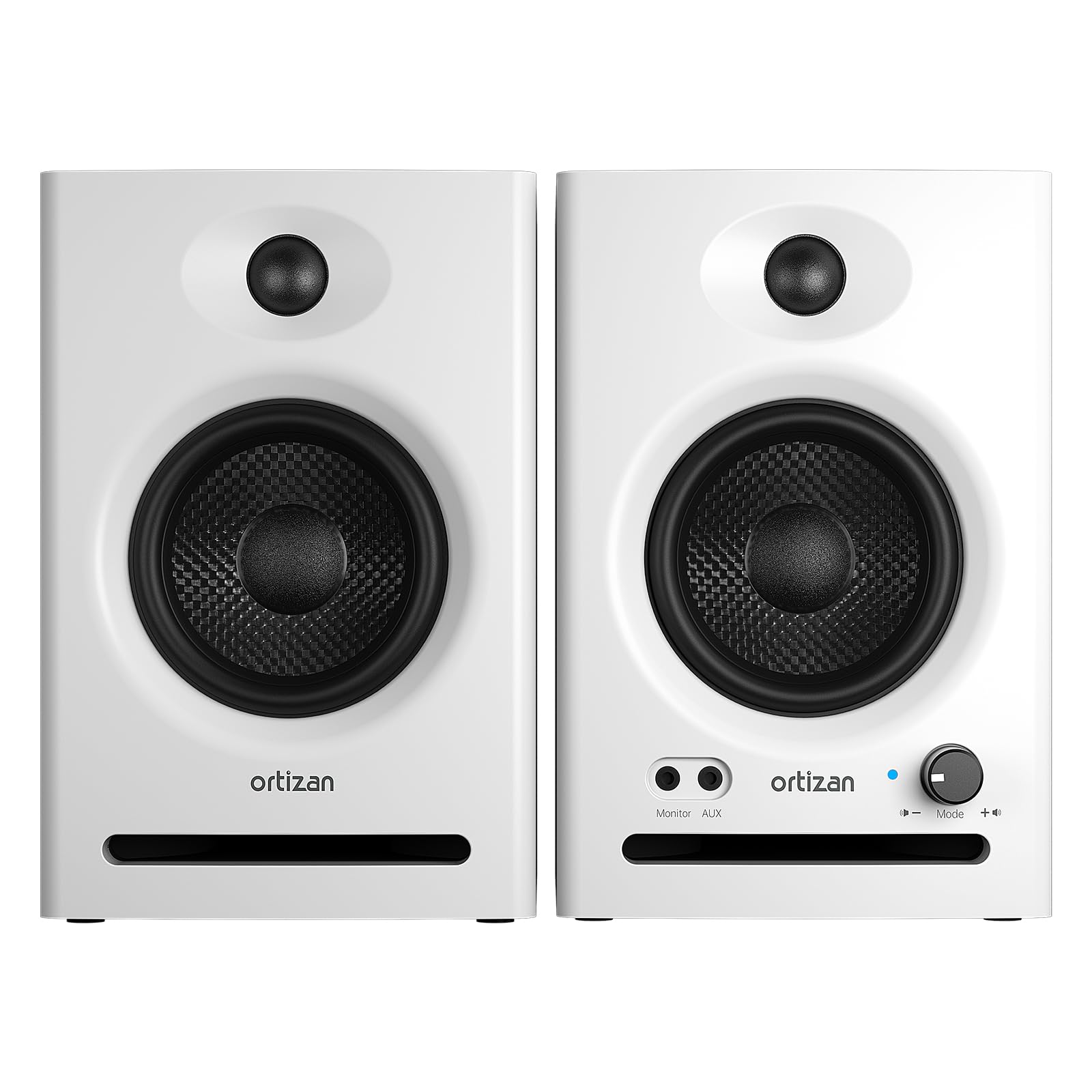
3. Ortizan C7 Powered Studio Monitors Pair (White)
A 0.75-inch silk tweeter over a 3.5-inch carbon cone — and the longest Bluetooth reach here.
Eighteen meters of Bluetooth 5.3 range is the longest reach in this group. That is roughly the length of a small apartment hallway, so you can leave your phone on the kitchen counter and keep streaming while you work at the far end of the flat. Pairing itself is quick — the maker describes it as a two-second handshake — and the connection is the thing owners single out most after the sound itself.
The driver pairing is a 0.75-inch silk dome tweeter (a soft fabric dome that takes the edge off harsh high frequencies) with a 3.5-inch carbon fiber mid-bass unit. A 24-bit DAC handles digital audio over USB, which is the chip that converts your computer’s digital file into an analog signal — a better one loses less detail on the way. There is also an electronic two-way crossover splitting the signal between the two drivers so bass and treble are not fighting over the same cone. The maker describes the tuning as a flat curve reached after lab adjustment, which is the monitor approach: reproduce what is there rather than flatter it.
The input panel is unusually serious for the price. A 6.35mm TRS balanced input takes a mixing console, audio interface, electric guitar or electric piano, and balanced cabling is a connection method that rejects interference over longer cable runs. You also get two AUX inputs, RCA for a TV or turntable, and a front headphone output for switching to private listening. Sound and quality are what buyers praise, though function and volume control draw mixed notes — a few find the control scheme less intuitive than plain dials. If your desk is also a small recording setup, this pair covers both jobs.
Pick this for: a desk that doubles as a recording corner, where a guitar or interface needs a balanced TRS input alongside your PC.
Think twice if: you want dead-simple controls — the input switching asks more of you than a single volume knob.
4. MEVOSTO DS19 White Powered Bookshelf Speakers (5-Inch)
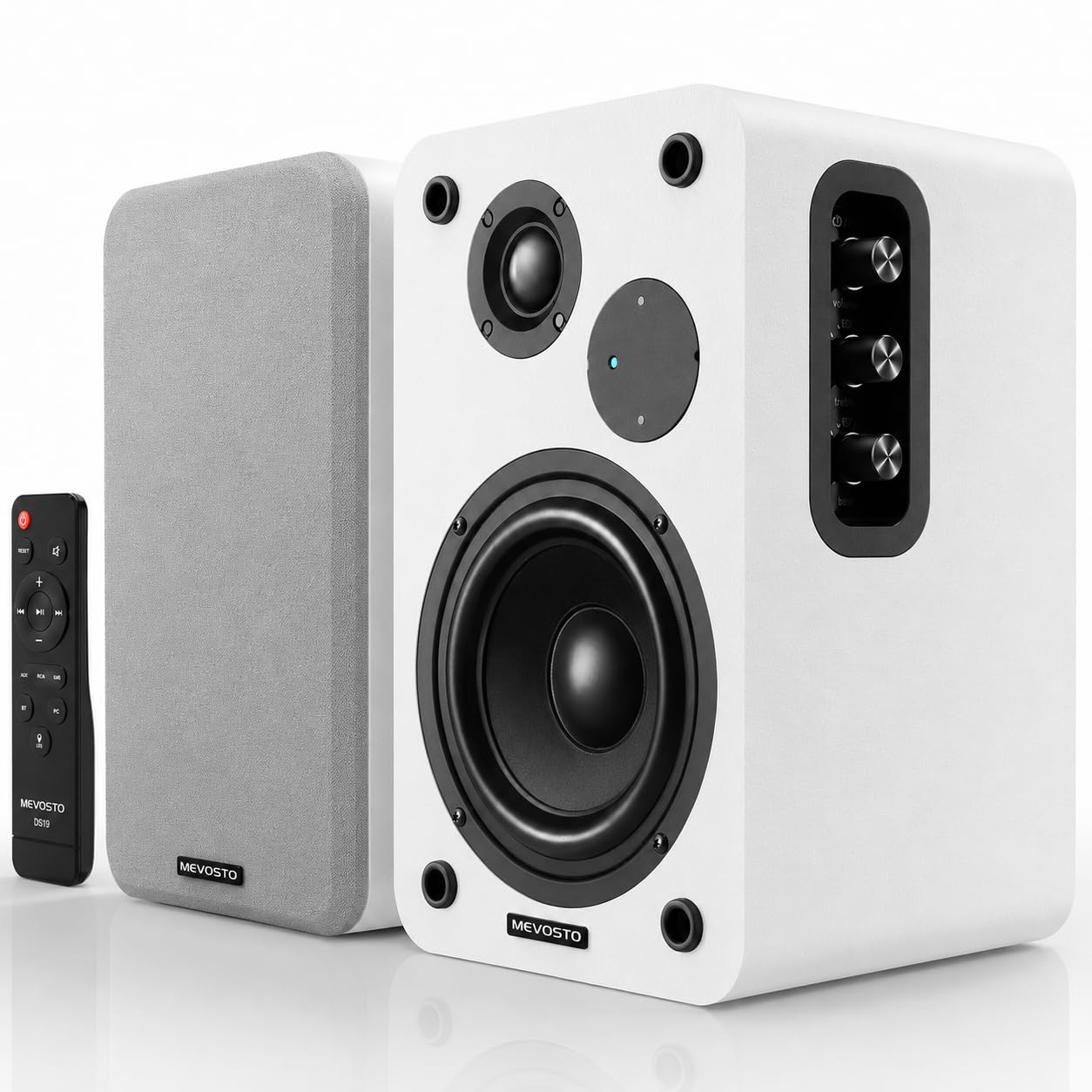
Dual 5-inch woofers in a leather-textured white cabinet — the pair with the most low end here.
No other pair in this roundup runs a 5-inch woofer. A bigger cone moves more air at the same power, so a kick drum has actual weight rather than a tap. Add the matching 1-inch silk-dome tweeter and a 36W RMS built-in amp, and you get a true 2.0 stereo setup with no separate amplifier to buy or find shelf space for. The wood cabinet is finished in a leather-textured white, which reads as a living-room speaker rather than a computer accessory — useful if the desk sits in a shared room.
The input list covers almost everything a desktop throws at it: USB audio for a PC, RCA for a record player with a built-in or external phono preamp, 3.5mm AUX, and Bluetooth 5.4 for wireless at a claimed 15 meters. There are bass and treble knobs on the cabinet plus a remote. Console owners get USB audio with compatible machines including the PS5. The maker also notes the pair can run from compatible 12V/15V/18V DC sources, which is a niche but real advantage for a camper or boat setup.
What buyers consistently praise is the sound for the money and the wood finish, with multiple input options called out as the reason it stays plugged in. The honest note is volume — some find it plenty loud, others call the ceiling uninspiring, so treat this as a near-field pair for a room rather than a party speaker. Also check that your device outputs audio over USB before relying on that cable, and remember there is no Dolby support. For a vinyl desk that also needs PC sound, the input spread here is hard to match.
Best suited to: a turntable and a desktop sharing one room, where RCA, USB and Bluetooth all need a home.
Pair it with: realistic expectations on volume — 36W RMS fills a study, not a living room full of people.
5. Sanyun SW206 80W 2.0 Active Bookshelf Speakers
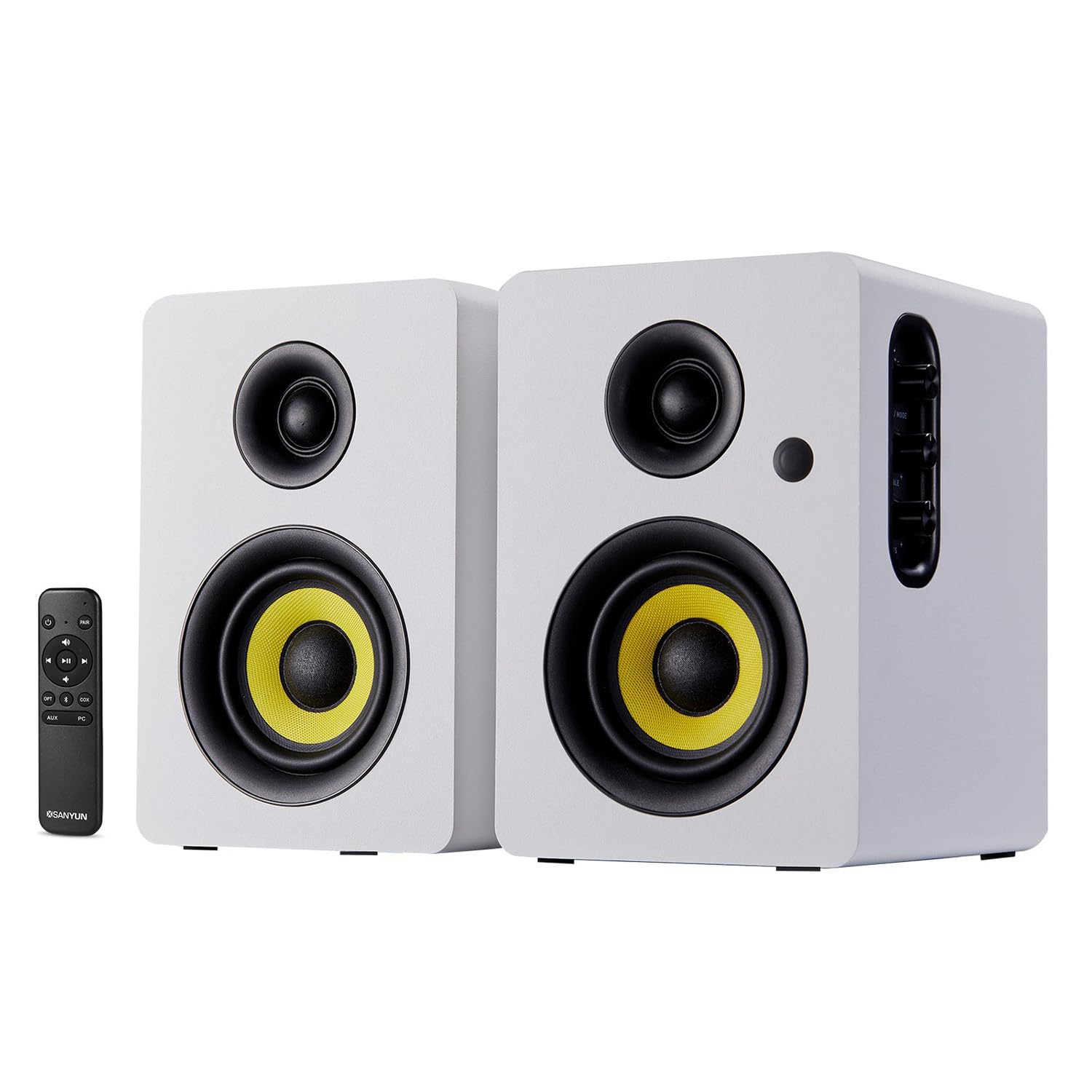
One switch flips this pair from flat studio tool to warm living-room speaker.
Two modes in one cabinet is the idea worth understanding. Creator Mode (labeled Monitor on the knob) aims for clean, uncolored sound for mixing, recording and editing. Music Mode (labeled HiFi) adds warmth, spatial depth and width for films, games and casual listening. If your desk is where you both work on audio and unwind afterwards, you are buying two speakers in one white box — and the 80W rating is the highest sustained figure in this group.
Six inputs is the other reason it sits here: 6.35mm TRS balanced, optical, coaxial, USB with a 24-bit DAC, Bluetooth 5.4 and 3.5mm AUX. The TRS input is dedicated to Creator Mode while AUX is dedicated to Music Mode; the digital inputs work in both. A 4-inch carbon fiber woofer and a 25mm silk dome tweeter handle the output, backed by a high-density MDF cabinet that keeps the box from adding its own ring to the music. Rear knobs give permanent bass and treble calibration, and the remote handles volume, input and mode switching.
Two things to weigh. Reliability and Bluetooth draw mixed notes in the review data, with some buyers reporting good long-term performance and others hitting failures — worth knowing if this pair will run all day, every day. The volume control also draws negative notes, so expect to set levels from the remote rather than a big front dial. Everything else lands well: sound quality and value are the strengths buyers name, and the yellow carbon fiber cones give the white cabinet a deliberate look. For a home creator who wants one system for work and play, the dual-mode switch is the feature nothing else here has.
What the dual-mode brings
- Creator Mode for flat, honest editing and Music Mode for warm, spacious playback from one switch
- Six inputs including optical, coaxial and a 24-bit USB DAC
- 80W of power, the highest figure in this comparison
- MDF cabinet with rear bass and treble knobs plus a full remote
Where it asks patience
- Reliability and Bluetooth show mixed feedback across the review data
- Volume control draws negative notes — plan on the remote
- Mode switching adds a learning step before you can just press play
Choose it if: you mix audio and relax at the same desk and want one white pair to do both jobs.
Skip the upgrade if: you want a set-and-forget speaker — the dual-mode workflow rewards people who will actually use it.
6. Edifier MR3 Powered Studio Monitor Speakers (White)

Hi-Res certified, 52Hz to 40kHz, and a phone app for shaping the sound yourself.
Hi-Res Audio certification with a 52Hz to 40kHz response range is the spec to notice here. The 40kHz ceiling is well beyond what human ears register, but the number signals a tweeter designed to stay clean at the top rather than roll off early — useful when you are editing cymbals or checking sibilance in a voiceover. The bottom of the range, 52Hz, is where a 3.5-inch mid-low driver stops; deep bass is not this pair’s job, and it does not pretend otherwise.
Power is 18W x 2 RMS with a peak SPL of 92.5dB, delivered through a 3.5-inch mid-low driver and 1-inch tweeter, all in an MDF cabinet that keeps resonance down. Three modes — Music, Monitor and Custom — plus the EDIFIER ConneX app let you fine-tune EQ from your phone, which is the differentiator against every analog-only pair on this list. Bluetooth 5.4 supports multipoint, meaning two devices connected at once, so a work laptop and a phone can both stay paired and you just press play on whichever you need.
Balanced TRS, RCA and AUX inputs sit alongside a headphone output, and RCA plus AUX can run at the same time for two wired sources. The honest note is output: performance, controls and volume all draw mixed feedback, with some finding the level modest for a large room. On a desk at close range it is plenty; for filling a space, look at the Sanyun’s 80W instead. Appearance and Bluetooth connectivity are the things buyers like most, so if you want a white studio-style monitor with app control, this is the pick.
Why the certification matters: a 52Hz to 40kHz range means the tweeter holds together at the very top of the register, so vocal edits and cymbal detail stay honest instead of turning glassy.
The trade-off to know: 18W x 2 RMS is a near-field figure — a big open room will want more headroom.
Tailored to: editors and detail listeners who want app-based EQ control and a certified response range on a white desk.
Wrong pick if: you need room-filling volume — this pair is tuned for close listening, not parties.
7. PreSonus Eris 3.5 Bluetooth Powered Desktop Monitors (White)

Fifty watts, 80Hz to 20kHz, and room-tuning knobs on the back — a mixing desk classic in white.
The number to start with is 50W of built-in amplification, the strongest of the 3.5-inch pairs here. That headroom matters when you are mixing at low volume and then need to check a passage loud without the amp straining. A 3.5-inch woven-composite woofer and 1-inch silk-dome tweeter cover an 80Hz to 20kHz range, with a 98dB peak SPL at one meter. The composite cone is stiffer than plain paper, which keeps bass from blurring when a track gets dense.
What separates this from the Edifier MR3 next door is the room tuning. High- and low-frequency acoustic tuning controls let you pull the bass back when the speakers sit against a wall, or tame a bright room, without buying any acoustic treatment. The input panel is generous: balanced ¼-inch TRS for an interface or mixer, RCA, and a front-panel ⅛-inch aux input for a phone, plus a front headphone jack with its own amplifier so private listening does not mean unplugging anything.
Owners describe clear, crisp highs and mids, and Bluetooth that holds a connection across a room. The honest catch is reliability feedback that comes in mixed — nothing alarming, but a reminder that this is a working tool rather than a sealed appliance. These are also relatively small cabinets that sit neatly either side of a laptop, so a tight desk handles them. If you cut audio for a living and want a white pair that will not lie to you, this is the one.
Made for: anyone mixing or editing who needs balanced TRS inputs and room-tuning knobs to correct a boomy corner.
Heads up: the acoustic tuning dials live on the back panel, so you set them once by ear and reach around to adjust.
8. Audio-Technica AT-SP3XWH Powered Bookshelf Speakers (White)
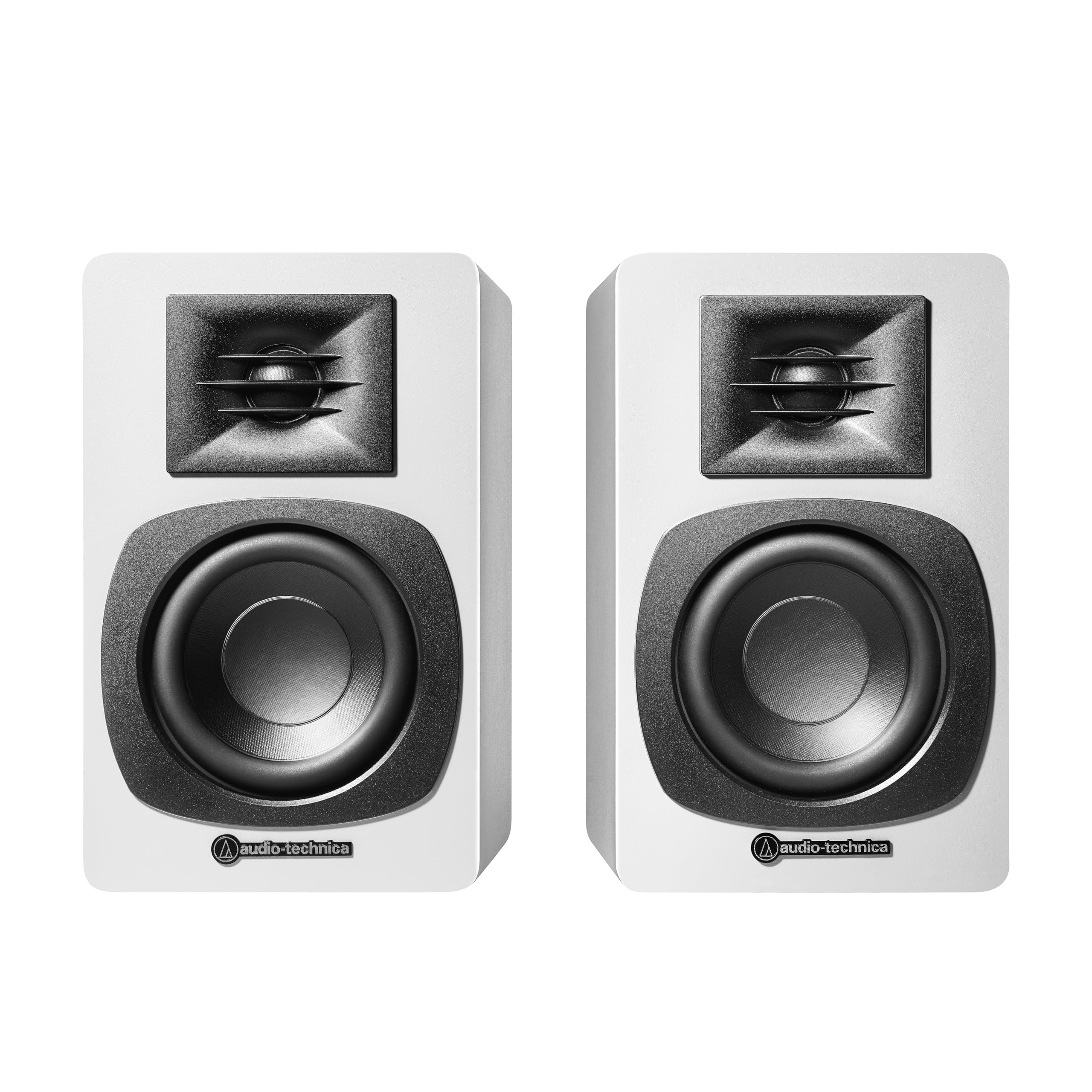
Two Bluetooth devices connected at once, with a volume dial on the front where it belongs.
Multipoint pairing is the feature to understand here: the speaker holds a live connection to two Bluetooth devices at the same time, so your laptop and your phone are both paired and you simply play from whichever one you pick up. No re-pairing menu, no forgetting the other device. Dual RCA jacks handle anything wired, which makes this a natural partner for a turntable — especially an Audio-Technica deck, the pairing buyers mention most.
Setup is deliberately simple. A power button with an LED indicator and a volume dial on the cabinet replace any app or menu system, and the package includes an AC adapter with three international plug adapters plus a 6.6-foot (2.0 m) speaker cable, so the pair can be spaced across a wider desk. The maker describes the cabinets as specially tuned for full-range audio in a compact white housing that suits almost any room. Bluetooth range is a claimed 10 meters.
Buyers report clear, very loud output with easy setup and reliable Bluetooth that also behaves when used with RCA. What you will not find in the data is a stated wattage or driver size — the maker leans on tuning and simplicity rather than spec bragging, so buy this one on the two-device pairing and the front dial rather than on paper numbers. It is the priciest pair here, and it earns that on build simplicity and multipoint rather than raw power. For a clean white desk with a turntable and a phone in rotation, it is a tidy answer.
The multipoint advantage: two Bluetooth sources stay connected simultaneously, so switching from laptop audio to a phone call is a press of play rather than a pairing ritual.
Built for: two-device households — a turntable on RCA and a phone on Bluetooth, both live at once.
Know before buying: the maker publishes no wattage or driver size, so this is a buy on simplicity and pairing, not on power figures.
Know the Specs
RMS watts versus peak watts
RMS is the power a speaker can sustain continuously; peak is a short burst it can survive. A 42W RMS figure is a more honest guide to everyday loudness than a bigger peak number, which is why the Edifier R1280T’s 42W RMS tells you more about desk volume than a peak claim elsewhere. For near-field listening an arm’s length from your ears, sustained watts matter less than a clean driver, so do not chase the biggest number on the box.
Driver size and what it does for bass
A woofer moves air, and a larger cone moves more of it. A 5-inch woofer like the MEVOSTO’s will reach lower than a 2.75-inch full-range driver like the Edifier Hecate’s, because physics sets the floor. Full-range drivers cover the whole frequency band from one cone, which keeps a compact cabinet simple; a separate woofer and tweeter with a crossover split the work and usually give a cleaner top end. Match driver size to your room: a 3-inch cone for an arm’s-length desk, a 5-inch woofer for a larger space.
Input types and what each one needs
3.5mm AUX is the common headphone-jack connection and works with almost any desktop. USB audio sends a digital signal so the speaker’s own DAC does the conversion. RCA suits turntables and TVs, and balanced TRS rejects interference over longer runs for studio gear. Bluetooth frees you from cables but adds pairing. List your devices and their ports first, then buy the pair that connects to all of them without an adapter.
Cabinet material and resonance
MDF is a dense pressed-wood board used in proper speaker cabinets because it resists the hollow ringing thin plastic produces. A wood cabinet will usually sound cleaner at volume than a plastic one of the same size, and it looks better on a white desk. Plastic cabinets are lighter and cheaper, which is fine for a small gaming pair at close range, but a wood box holds its composure when the bass gets busy.
Common Questions
Will white PC speakers yellow over time?
Do I need an amplifier with powered PC speakers?
Can these speakers connect to a turntable?
Is Bluetooth good enough for PC gaming audio?
What is the difference between a studio monitor and a PC speaker?
How much desk space do bookshelf speakers need?
Can I use white PC speakers with a PS5 or gaming console?
Do I need a separate DAC if my speakers have USB audio?
Why do my speakers sound better at low volume than high volume?
Can two devices stay connected to the same speakers at once?
The Bottom Line
For most desks, the white pair worth buying is the Edifier R1280T. The MDF cabinet in a white wood finish, 42W RMS of honest power, two live AUX inputs and a remote for bass and treble make it the easiest recommendation in this group, and it carries the highest rating here alongside the Audio-Technica.
If your laptop has dropped its headphone jack and you need USB-C, Bluetooth and AUX in one white cabinet, the IBALL·BOX pair is the practical choice. For a vinyl desk that also needs PC sound, the MEVOSTO DS19 covers RCA, USB and Bluetooth with the biggest woofer in the roundup.
Pick the pair whose ports match your devices and whose cabinet fits the gap beside your monitor, and the white finish will be the least interesting thing about them.
How we choose
We do not accept paid placement. Every pick is matched to a real buyer and a real use-case; we do not hands-on test units.
Sources
Specifications: manufacturer listings and product documentation. Review insights: verified customer reviews, as of November 2026. Pricing: not shown on this page (it changes often); check the current price via the retailer link.
As an Amazon Associate, Tactical Gear Guy earns from qualifying purchases. This does not affect which products we feature.