Specs are compiled from manufacturer listings and verified buyer reviews and can change over time — please confirm the key details on the product page before buying.
River water looks fine and can still put you on your back for a week. The real job of a backcountry purifier is removing the things you cannot see — bacteria, parasites, and microplastics — from water that is muddy, silty, or otherwise questionable. This guide covers the portable field filters and purifiers that actually make river water drinkable, plus the trade-offs that decide which one suits your trip.
This guide is built by comparing the manufacturers’ published specifications and the patterns across verified customer reviews, so you get each pick’s real strengths and trade-offs instead of marketing spin.
You will see the difference between a fast squeeze filter and a slow gravity system, and why weight and flow rate decide which one earns a spot in your pack on the way to the next clean drink of water. A portable water purifier for river water needs to match your trip, not just the filter rating.
Top Picks


How To Choose The Best Water Purifier for River Water
River water is not the same challenge as a clean tap. It carries silt, sediment, and cloudiness that clog a filter fast, and depending on where you are, it can also carry bacteria and parasites. A purifier for river water has to do two jobs at once: keep a reasonable flow rate when the water is dirty, and physically stop the organisms that make you sick.
Micron rating: the number that decides what gets stopped
The micron rating is the size of the holes in the filter membrane, measured in micrometers. The smaller the number, the more it catches. A 0.1 micron filter is tight enough to stop bacteria and protozoa, while a 0.01 micron hollow fiber ultrafiltration membrane goes finer still. If you are pulling from a river near livestock or beaver activity, that tighter rating matters.
Flow rate and effort
Flow rate is how many liters per minute come through the filter. A faster flow rate means less time pumping, which matters when you are cold, tired, and filling several bottles for a group. A fast filter can still slow down in silty water, so look for one with a backflush option (a way to reverse-flush the membrane and clear debris) to keep it moving.
Filter lifespan and what it costs over time
Filter lifespan tells you how much water one cartridge cleans before you replace it. A short-lived cartridge is a running cost; a huge-capacity membrane lasts the life of the trip and beyond. Match the lifespan to how you plan to use it: a week-long backpacking trip needs far less than a basecamp season or a dedicated emergency kit.
Weight and pack size
Every ounce counts on a thru-hike. A tiny straw filter or squeeze filter disappears into a hip belt pocket, while a gravity system with hanging bags needs more room. Decide which matters more — carrying comfort or pumping a large group’s worth of water without effort.
Side-by-Side Comparison
| Model | Best For | Filter Type | Capacity / Lifespan | Weight | Amazon |
|---|---|---|---|---|---|
| LifeStraw Personal Water Filter★ Best Overall | Ultralight emergency backup | Filter straw | 4000 liters per straw | 1.6 ounces | Amazon |
| Sawyer SP129 SqueezeBest For Solo Trips | Fast solo backpacking | Squeeze / inline | 100,000 gallons | 2 ounces | Amazon |
| SurviMate Purified Water BottleBest Bottle Filter | Grab-and-go bottle filtering | 5-stage bottle filter | 1500L/year | — | Amazon |
| Platypus Quickdraw Ultralight | Thru-hiking speed | Hollow fiber squeeze | 1 liters | 3.3 ounces | Amazon |
| Practical Survival Gravity Kit | Basecamp / group hydration | Gravity hollow fiber | 1800 gallons | 1.5 pounds | Amazon |
| Purewell Hand Pump | Pumping from a lake or river | Hand pump / UF | 793 gallons | 1 pounds | Amazon |
| Sawyer Squeeze + Cnoc 2L | Long trips, big bladder | Squeeze / bladder | 100,000 gallons | 0.27 kg | Amazon |
| LifeStraw Peak Compact Gravity | Flexible group filter | Gravity / squeeze / straw | 3 liters | 228 g | Amazon |
| Survivor Filter PRO X | Electric pump convenience | Electric pump / 3-stage | 360 liters | 13.5 ounces | Amazon |
Detailed Reviews
1. LifeStraw Personal Water Filter, 5 Pack
Our pick — 4.5+★ from 126,000+ verified ratings; the strongest balance of quality and price.
The pocket straw that turns a river sip into clean water without a single moving part.
This is the crowd favorite by a wide margin — 4.5+ stars across 126,000+ owners — and the reason is simple: it is a filter you can drop in a pocket and forget about. Each of the five straws cleans up to 4000 liters (1,000 gallons) of water, so a five-pack covers a household’s emergency stash or a decade of weekend trips. The microfiltration membrane removes 99.999999% of waterborne bacteria like E. coli and Salmonella and 99.999% of parasites like Giardia and Cryptosporidium.
Weighing 1.6 ounces, it vanishes in a day pack or glovebox, and the BPA-free plastic body needs no batteries, pumping, or setup. For river water specifically, it also reduces the smallest microplastics found in the environment down to 1 micron, pulling turbidity (cloudiness from suspended silt) down to 0.2 microns. That is a real advantage when the water in front of you is brown.
The catch: a straw filter only cleans what you personally sip through it. Fill a group of bottles and you will be taking turns; there is no bag or pump to move water fast. It is also a filter, not a chemical purifier, so it does not neutralize dissolved chemicals. For solo backup or an emergency kit, though, it does the core job with no fuss.
What earns it first place
- 4000 liters of clean water per straw — the largest lifespan in this lineup alongside the Sawyer membranes.
- 1.6-ounce body disappears into a pocket or bug-out bag.
- Removes 99.999999% of bacteria and 99.999% of parasites.
- No batteries, pumping, or priming — just sip.
Where it asks patience
- One drinker at a time; no way to fill a bottle for the group quickly.
- Filter-only — dissolved chemicals stay in the water.
Reach for this if: you want a genuine no-fail backup filter in every pack, glovebox, and emergency kit.
Look elsewhere if: your group needs to fill multiple bottles at once — a gravity or pump system does that better.
2. Sawyer Products SP129 Squeeze Filtration System
A palm-sized filter that turns a dirty river pouch into a drinkable bottle, without the pumping.
The Sawyer SP129 leads with a number most hikers care about: 100,000 gallons of water per filter. That is a lifespan you will never exhaust on weekend trips, and it makes the reusable membrane a long-term answer rather than a consumable. The filter itself is a 0.1 micron absolute inline tin that fits in your palm and weighs just 2 ounces.
What it catches is the whole point for river water: harmful bacteria, protozoa, cysts, sediment, and 100% of microplastics. You can drink straight from the pouch, thread the filter onto a standard 28mm water bottle, or hang it in a gravity setup. It comes with two reusable 32-oz BPA-free collapsible pouches that roll up tight for packing, plus a straw, hydration-pack adapters, and a mesh bag. Maximum flow rate is 1.7 liters per minute.
The trade-off is effort. Squeezing a pouch is more labor than a gravity drip when you are filling several bottles, and the durability chatter in reviews suggests treating the pouches and filter housing gently. For a solo backpacker or a two-person trip where speed matters more than hands-free convenience, it pulls its weight well.
Where the value lands: 100,000 gallons of capacity against 2 ounces of carry weight is an excellent ratio, and the included pouches mean you can filter immediately from the start.
One thing to know: the squeeze method works fast at 1.7 liters per minute, but it is your arm doing the work, and the collapsible pouches reward careful handling.
The verdict: a superb choice for a solo hiker or lightweight duo who want bottle-ready water without the bulk.
But keep in mind: the squeeze effort adds up when you are filling for a group or a full day.
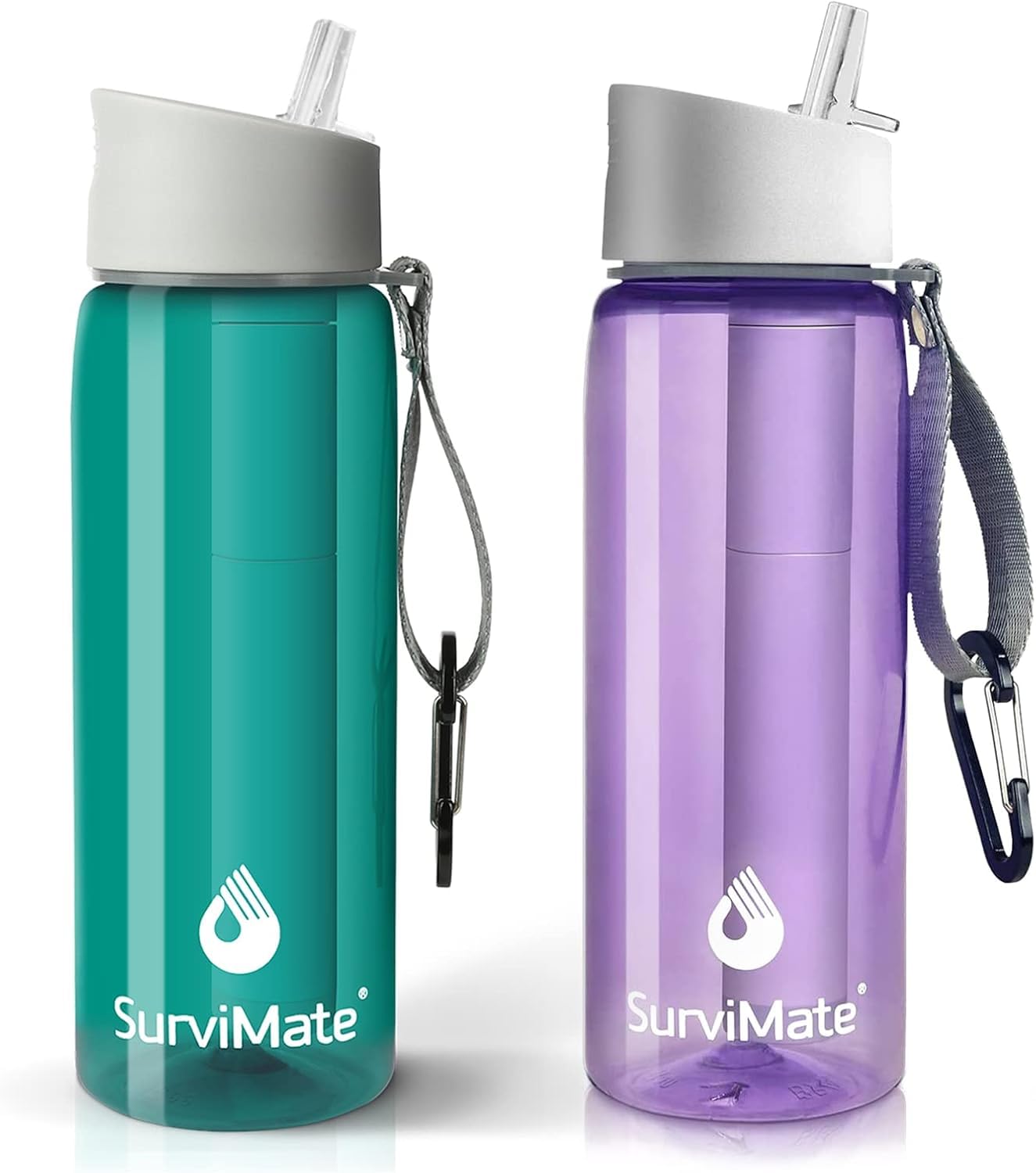
3. SurviMate Purified Water Bottle
Fill it, sip a few times, and drink — the bottle that filters as you go, compass on top.
The SurviMate packs a 5-stage filter straight into a Tritan, BPA-free bottle that stands 9.3 inches tall, which is about the height of a standard water bottle and fits in a side pocket. The stages work together: a coarse filter screen catches the big debris first, then a 0.01μm hollow fiber UF membrane, a sediment PP membrane, purification beads, and an activated carbon fiber to reduce chlorine, odors, and heavy metals.
It is a genuinely simple concept for river water. Fill the bottle, sip 5 to 8 times to draw water through the filter, and drink — no pumps, hoses, squeezing, or batteries. The built-in compass on the top is a nice survival-minded extra. Filter life runs up to 1500L per year of continuous use, and the filter is replaceable while the bottle itself lasts.
The honest downside is in how it drinks. The sip-through-straw action draws some mixed feedback — the water was difficult to drink through for some buyers, and a few report a strange taste and occasional leakage. If your priority is easy, high-volume drinking, a gravity or squeeze system is more pleasant. If you want a single bottle that filters as you walk, this does the job and brings the compass along.
The draw-and-drink appeal: a 5-stage filter with a 0.01μm hollow fiber UF membrane built into a grab-and-go bottle is a neat all-in-one for day hikes.
What to expect: drinking takes deliberate sips through the straw, and a few buyers mention a strange taste or a leak — worth knowing before you commit.
For the hiker who wants it all in one: a self-contained filtered bottle that goes from river bank to sip with no extra gear.
Skip if: you drink fast and in volume — the straw action is not built for gulping.
4. Platypus Quickdraw Ultralight 1 Liter System

Three liters a minute when you squeeze — the filter for hikers who hate waiting at the bank.
For river water, speed is the whole pitch here. The Quickdraw pushes 3 liters per minute when squeezed and 1.75 liters per minute in a gravity setup, which is the fastest stated flow rate in this lineup. The hollow fiber filter is individually tested and meets the NSF & EPA P231 protocol, removing 99.9999% of bacteria and 99.9% of protozoa. That is a rigorous benchmark carried by a filter that weighs just 3.3 ounces.
The 1-liter reservoir has a wide mouth and handle for quick filling at any water source, and it doubles as a dirty bag for custom filter systems. The ConnectCap threads clean-side onto any 28mm bottle — smartwater, select Cnoc bags, soda bottles — so you can filter straight into what you already carry. Easy cleaning is built in: a shake-to-clean or backflush restores flow and clears debris without tools.
Where the straw filter cleans your sip, this one cleans a whole liter. The 1-liter reservoir is the limit, though — for a larger group you will be refilling it more often than a hanging gravity bag. As a thru-hiking or fast-and-light tool for one or two people, it is hard to match the flow.
The speed argument: the Quickdraw flows at 3 liters per minute squeezed, and the Sawyer SP129 flows at 1.7 liters per minute.
The capacity note: the Quickdraw reservoir holds 1 liter and the Sawyer Squeeze is paired with a 2-liter Cnoc bladder, so plan on more refills.
Best fit for: a thru-hiker or fast-and-light soloist who treats water stops as a pit stop, not a chore.
Think twice if: you are filtering for a group — the 1-liter reservoir means frequent refills.
5. Practical Survival Gravity Water Filtration System

Hang it from a tree and let gravity clean up to 6 liters at a time.
When you are filtering river water for a basecamp or a family, hand effort is the enemy. This gravity kit removes over 99.99% of waterborne bacteria like E. coli and Legionella and parasites like Giardia and Cryptosporidium, and filters microplastics down to 0.1 micron. The high-capacity core cleans up to 1800 gallons, and the maker states that works out to nearly 10 years of clean water without pumping.
The setup is the selling point: two oversized hanging bags hold 6 liters each for basecamp or group hydration, and you fill the dirty bag, hang it, connect the filter and clean bag, and let gravity do the rest. The maker claims a 60-second setup. It weighs approximately 1.5 lbs and fits easily in a backpack or hanging bag. The ports join securely to standard screw-top bottles, so you can fill your own bottle straight from the clean bag.
At 1.5 lbs it is the heaviest pick here, and its 0.6 gpm flow rate means it is a slow drip compared with a squeeze filter — but that is the nature of gravity. It is built for patience and volume, not speed. For a group at basecamp, that is exactly the right trade.
Why groups like it: two 6L hanging bags and an 1800-gallon core make this the highest-volume, longest-lived setup in the lineup for camp duty.
The trade-off: 1.5 lbs and a 0.6 gpm drip mean it is not a fast solo tool — it is a camp fixture.
Perfect for: a basecamp, a family, or a hunting party that wants clean water hanging and ready all day.
Not the one for: a solo fast-packer who counts every ounce and wants water in seconds.
6. Purewell Water Hand Purifier Pump
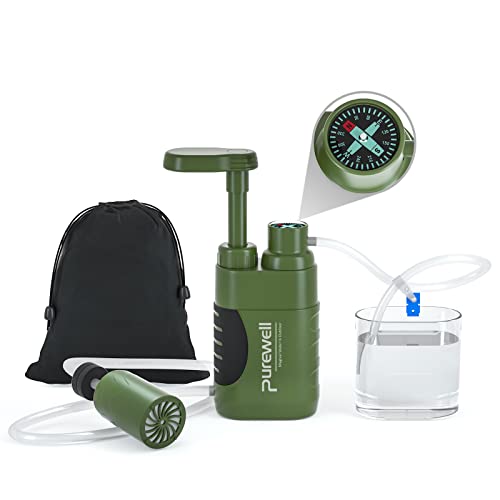
Drop the hose in the river, pump the handle, and watch clean water flow into your bottle.
The Purewell is a hand pump, and that format suits river water well — you can reach into the flow without wading in and pump straight into a bottle. The 0.01 micron hollow fiber ultrafiltration membrane sits at the core of a four-stage filter that also includes an activated carbon fiber, a coconut shell activated carbon rod, and medical-grade PP cotton. The maker states it reduces up to 99.9999% of fluoride, arsenic, chlorine, lead, and most heavy metals, odors, and chemicals, and that it passed SGS and NSF/ANSI laboratory tests.
At 1 pound and sized 8.2 by 5.1 by 2 inches, it fits in a day pack, and the capacity runs 793 gallons before replacement. The sides and bottom have special rubber to keep the pump steady while working, and the handle diameter is 15mm. A transparent lid doubles as a drinking cup, and a top compass is included.
The honest reality is the pumping. Some buyers find the operation difficult, and it is more physical work than a gravity or electric system. There is no electricity needed, which is the point for field use. If you want an all-in-one that turns lake or river water into potable water without a battery, this earns its place.
The do-it-all format: a hose, a pump, and a 0.01-micron UF core that lets you pump straight from a river into a bottle.
The effort factor: pumping is real arm work, and a few buyers find it difficult to operate — plan for it on long water stops.
Worth grabbing if: you want to pump directly from a river bank and prefer no batteries or bags to manage.
Consider another route if: you have limited hand strength or want hands-off filtering for a group.
7. Sawyer Squeeze with Cnoc Premium 2 Liter Bladder
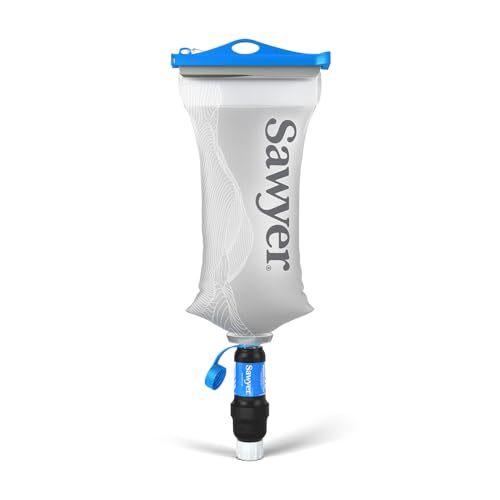
The Squeeze filter you know, paired with a 2-liter bladder that holds more per trip.
This is the same proven Sawyer membrane as the SP129, paired with a bigger Cnoc bladder. The hollow fiber filter removes harmful bacteria, protozoa, cysts, sediment, and 100% of microplastics, and it is reusable and easy to clean with a stated life of up to 100,000 gallons. Sawyer notes the fiber walls are thicker than typical hollow fiber membranes, which allows for more rigorous backwashing — a real advantage in silty river water.
The Cnoc bladder is the standout addition. The kit also includes a cleaning coupling and a syringe. Owners keep coming back to the reinforcement at the top, which makes the bladder easy to fill and seal.
The extra bladder adds some packed volume and weight — the kit lists 0.27 kg (about 9.5 ounces) overall — but the payoff is fewer refills. It is the pick for a trip where you would rather carry a proper reservoir and get the most out of a single fill.
The capacity upgrade: a 2-liter TPU bladder paired with the 100,000-gallon Sawyer membrane; the Quickdraw holds 1 liter and the SP129 uses two 32-oz pouches.
The bulk note: the larger bladder is heavier than a bare squeeze setup — trade a little pack space for fewer trips to the water.
The smart pick for: hikers on longer trips who want a bigger reservoir and a membrane that lasts.
Pass if: you are cutting every ounce and prefer the slimmer 1-liter Quickdraw.
8. LifeStraw Peak Compact Gravity Water Filter, 3 L

One filter, four ways to use it — gravity bag, squeeze bottle, straw, or bottle mount.
Flexibility is the whole idea here. This 3-liter system can hang as a gravity filter, work as a large squeeze bottle, sip as a straw, or mount on a water bottle. That range covers solo trips and group camping from the same filter body. It protects against 99.999999% of bacteria including E. coli and Salmonella, 99.999% of parasites including Giardia and Cryptosporidium, and 99.999% of microplastics, silt, sand, and cloudiness.
For river water, the re-engineered membrane and custom backwash accessory are the details that matter. The enhanced microfilter is built for better performance against sand and silt and to maintain flow over the long haul. At 228 g, it is light enough to pack on a group trip without regret. The filter life is listed at 1 year.
The catch is speed. Filtration speed gets mixed feedback — some find it fast while others describe it as incredibly slow, and taste is similarly divided, with a vinyl note reported. On silty water, expect to use that backwash accessory to keep the flow moving. If you value versatility and are willing to backflush regularly, it is a strong group tool.
Versatility wins: four configurations from one 228 g filter body makes this the most adaptable pick for a mixed group of campers.
The speed question: filtration speed is a split verdict, and the vinyl taste note is one to watch if you are particular about flavor.
Great for: the camper who wants one filter to handle gravity group fills and solo sips in the same trip.
Look at the Quickdraw if: you prioritize raw speed above all else on river water.
9. Survivor Filter PRO X Electric Portable Water Filter

Tap a button and let a motor do the pumping — no arm work required.
If pumping or squeezing river water sounds like a chore, this is the answer. The PRO X is an electric pump with a 3-stage 0.01 micron filter that removes 99.999% of tested virus, bacteria, and parasites, plus 99.5% mercury and 93% lead, according to NSF/ANSI standards. It runs on any plug, mobile charger, or AA batteries, so you are not tied to a wall when you are off grid.
At 13.5 ounces, it is compact and charges by cable. The battery-based system filters up to 360 liters (95 gallons) and flows at 500ml (17oz) per minute — tap the button and let it run. The kit includes the pump, case, clips, backwashing syringe, hoses, and filters.
The honest limit is the 360-liter battery capacity, which is the shortest lifespan figure in this lineup. For a weekend or a bug-out-bag, that is plenty. The maker covers defects with a lifetime warranty. If you want a motorized, three-stage purifier with no pumping, it is the one worth a look.
The no-sweat advantage: an electric 3-stage 0.01 micron pump that removes viruses and heavy metals, with no arm-powered pumping at all.
The capacity check: 360 liters is the shortest battery-run in this lineup — plan for longer trips accordingly.
The one for hands-off filtering: a motorized three-stage purifier for a bug-out bag or a basecamp where no one wants to pump.
Weigh the trade: 360 liters of battery-run capacity is the shortest here, so pair it with a backup filter for extended trips.
Know the Specs
Micron rating and membrane type
Micron rating is the pore size of the filter membrane. A 0.1 micron hollow fiber filter stops bacteria and protozoa, while a 0.01 micron ultrafiltration membrane goes finer still. Hollow fiber means a bundle of tiny tubes — water passes through the tube walls while contaminants are trapped. For river water, a hollow fiber membrane resists clogging and generally offers a backflush path to restore flow.
Capacity, flow rate, and lifespan
Capacity tells you how much water one filter cleans before you replace it, from hundreds of liters to huge gallon figures. Flow rate is how fast it moves water, measured in liters per minute or gallons per minute. A gravity bag is slower but hands-free; a squeeze or pump is faster but adds effort. Match the numbers to your trip length and group size rather than chasing the highest figure.
Common Questions
Will a water filter make river water safe to drink?
Does a water purifier filter out viruses from river water?
Can these filters handle muddy or silty river water?
Is a straw filter or a squeeze filter better for backpacking?
How long does a portable river water filter last?
Do I need to backflush the filter after each trip?
Which is easier to use, a gravity filter or a hand pump?
Can I use a filter with a standard water bottle?
What is the easiest system to use for a family campout?
The Bottom Line
For most people heading into the backcountry, the water purifier for river water winner is the LifeStraw Personal Water Filter 5 Pack because it delivers a 4000-liter membrane at 1.6 ounces with zero setup, and five of them cover a household or an emergency stash. If you want to filter straight into your own bottle at speed, the Platypus Quickdraw Ultralight is the pick with its 3 liters per minute squeezed. For basecamp or group duty, the Practical Survival Gravity Kit hangs, fills, and gets on with it while you set up camp.
How we choose
We do not accept paid placement. Every pick is matched to a real buyer and a real use-case; we do not hands-on test units.
Sources
Specifications: manufacturer listings and product documentation. Review insights: verified customer reviews, as of November 2026. Pricing: not shown on this page (it changes often); check the current price via the retailer link.
As an Amazon Associate, Tactical Gear Guy earns from qualifying purchases. This does not affect which products we feature.