Specs are compiled from manufacturer listings and verified buyer reviews and can change over time — please confirm the key details on the product page before buying.
Buying a UHS-II microSD card is mostly about not wasting money in one of two directions. Buy a card that is too slow and your camera body writes to a buffer instead of the card, so a burst of stills stalls and a long 4K clip cuts out. Buy more card than your device can actually read and you pay for a second row of pins your camera never uses. The fix is simple: check your device’s video speed class requirement first, then buy the cheapest card that clears it.
This guide is built by comparing the manufacturers’ published specifications and the patterns across verified customer reviews, so you get each pick’s real strengths and trade-offs instead of marketing spin.
What follows is a plain-English read of six cards that actually carry the UHS-II interface — the second row of contact pins that separates a genuinely fast card from one that just has a fast-sounding label. Every card below is judged on the same three things: sustained write rating, read speed for offloading, and capacity per shoot day. The short version: uhs-ii microsd card shopping gets much easier once you stop chasing the biggest read number on the box.
Top Picks


How To Choose The Best UHS-II microSD Card
Start with one question: what does my camera or drone actually demand? A card only helps you if your device can use it. A UHS-II card in a UHS-I slot still works, but it drops back to the slower bus and you have paid for speed you never see.
Match the video speed class to your recording mode
The video speed class (the “V” number on the label) is a guaranteed minimum sustained write speed — the slowest the card will ever write while recording. A V60 card promises at least 60 MB/s continuously. A V90 card promises at least 90 MB/s. If your camera shoots high-bitrate 4K or 8K and warns about dropped frames, step up to V90. For 4K at normal bitrates and action-cam footage, V60 is usually enough.
Read speed is your offload clock
Read speed only matters after the shoot, when you dump files to a laptop. A 300 MB/s card empties a full card noticeably faster than a 280 MB/s one — but both need a UHS-II card reader to hit those numbers. Plug either into an old USB reader and you get the reader’s ceiling, not the card’s.
Capacity is a shoot-day decision, not an ego decision
The right capacity is the smallest one that covers your longest shoot day without offloading. A 64GB card suits a short run-and-gun session. A 128GB or 256GB card lets you keep shooting across a full trip. Bigger cards cost more and hurt more if one fails, which is why two mid-size cards often beat one huge one.
Check the second row of pins, not just the headline number
Plenty of cards advertise “high speed” while running the older UHS-I interface. A true UHS-II card has a second row of gold contacts and needs a UHS-II slot or reader to deliver its rated speed. Check the specification line for “UHS-II” before you trust any read-speed claim.
Side-by-Side Comparison
| Model | Best For | Capacity | Read Speed | Video Speed Class | Amazon |
|---|---|---|---|---|---|
| Lexar 128GB Gold★ Best Overall | Drone and action-cam work | 128 GB | 280 MB/s | V60 | Amazon |
| Nextorage Japan NX-M2SEMost Durable | Rough outdoor shooting days | 128 GB | 280 MB/s | V60 | Amazon |
| SABRENT Rocket V60 | 8K recording on a budget | 128 GB | — | V60 | Amazon |
| Delkin Devices Power 64GB | High-bitrate 8K capture | 64 GB | 300 MB/s | V90 | Amazon |
| GIGASTONE Ultimate Pro | Long 4K sessions | 128 GB | 280 MB/s | V60 | Amazon |
| Kodak 256GB UHS-II | Multi-day creator trips | 256 GB | 300 MB/s | V60 | Amazon |
Detailed Reviews
1. Lexar 128GB Gold Micro SD Card
Our pick — 4.5+★ from 850+ verified ratings; the strongest balance of quality and price.
The 128GB V60 card that covers a full drone day of 4K without drama.
The number to start with is 128GB paired with a V60 rating — a guaranteed floor of 60 MB/s sustained writing. That combination is the reason this card sits here: it covers a full day of 4K footage on a drone or action cam without the card being the thing that limits you. Lexar also rates it at 280 MB/s read, so emptying a full card into a laptop is quick work rather than a coffee break.
What wins people over across the review pages is pure performance — it is the trait that dominates owner feedback, and the recurring context is DJI drones and security cameras rather than a spec sheet. 280 MB/s read opens the door to capturing 4K without stutter and moving those files across fast. Lexar also rates the card temperature-proof, which matters when a camera sits in a hot car between takes.
The honest catch is money and long-haul trust. Value for money shows up as a mixed theme in owner feedback — this is not the cheap card in the lineup, and a 128GB UHS-II purchase is a real spend. Reliability also draws mixed reports. The card is rated 4.5+ stars across 800+ ratings, so the vast majority of buyers are content, but treat any card as a single point of failure and keep a second one in your bag.
Where this Lexar earns its place
- V60 rating guarantees the minimum sustained write speed 4K recording needs.
- 280 MB/s read empties a full 128GB card quickly when you are working on a deadline.
- 128GB gives a full shoot day of headroom before you have to offload.
- Rated temperature-proof for cameras left in hot or cold conditions.
- A1 application rating keeps file transfers and app performance smooth.
What you give up
- V60 rather than V90 — not the card for the heaviest 8K bitrate modes.
- Owner feedback flags cost as the sticking point.
- One 128GB card is a single point of failure; a spare is a sensible habit.
Reach for this if: you shoot 4K on a drone, action cam or mirrorless body and want one card that handles the day without drama.
Look elsewhere if: your camera demands V90 sustained writes for the highest-bitrate modes.
2. Nextorage Japan Micro SD Card UHS-II 128GB V60
Nine named durability ratings — IPX7 water, IP6X dust, 1.5m drop — on a 280 MB/s card.
If your card lives somewhere it can get wet or dropped, the Nextorage is the one to look at first. It carries nine separate durability ratings, and they are specific rather than vague: IPX7 for water immersion, IP6X for dust, a 1.5m drop rating, 10N bend resistance, insertion resistance rated past 10,000 cycles, plus X-ray, anti-magnetic, electrostatic and temperature resistance. Compared with the Lexar above it reads at the same 280 MB/s, so you are trading nothing on speed for that hardening.
Speed splits into 280 MB/s read for offloading and 100 MB/s write for capture, both matching the Lexar on their respective lanes. You also get a free download of Memory Card File Rescue software, which is the kind of thing you never think about until a card throws an error mid-trip. Buyers report around two hours of recording time, which lines up with a V60 128GB card in a demanding recording mode.
Reliability is the trait that dominates owner feedback here, closely followed by capacity — which tells you the card is being trusted over repeated outings rather than one test bench. The trade-off is that the hardened build is the selling point and, if your camera never leaves a studio, you are paying for protection you may not need.
The case for it: nine named durability standards and a 280 MB/s read speed on the same card is a strong pairing for anyone shooting outdoors, on water or off a bike.
The fair caveat: it is a V60 card, so the highest-bitrate internal recording modes on a high-end body will want the Delkin below.
Who it beats: anything rated only water-resistant rather than IPX7, if your card rides a drone or an action cam.
Who it does not suit: studio shooters who want maximum sustained write and nothing else.
3. SABRENT Rocket V60 microSDXC 128GB

Sabrent’s 8K claim rests on a guaranteed 60 MB/s sustained write floor.
The Rocket V60 is built around a guaranteed minimum write speed of 60 MB/s. That is the number that decides whether 8K recording actually holds together, because it is the sustained floor rather than a peak. Sabrent also rates the A1 application performance, which controls the small random reads and writes behind smooth file transfers and app loading. It is a smaller, nimbler card than its bigger 8K claim suggests — the physical card measures 0.59″ by 0.43″, so it drops into a phone or a drone tray without fuss.
Where this card differs from the Lexar and Nextorage above is headroom. Both of those publish 280 MB/s read speeds; Sabrent’s listing centers on the 60 MB/s write guarantee and the 8K capability rather than a headline read figure. If you do most of your shooting on the card and offload less often, that matters little. If you empty a card after every session, the faster reads of the two cards above are easier to live with.
Compatibility is broad and stated plainly: UHS-II and microSDXC compliant, with backward compatibility for UHS-I devices. That means it will work in an older phone or camera, just at the older bus speed. Sabrent also asks buyers to register the card for technical support, which is worth doing the day it arrives.
What it does well: 60 MB/s guaranteed write and 8K-rated capture at the value end of this lineup, with A1 performance for everyday file work.
The limit worth knowing: the 60 MB/s write floor is the lowest sustained figure among the UHS-II cards here, so a camera demanding V90 will want more.
Settle here if: you want 8K-rated capture and a 128GB card without paying premium money.
Move on if: you dump cards constantly and want the fastest available offload speed.
4. Delkin Devices 64GB Power MicroSD UHS-II (V90)

The only V90 card here, with a guaranteed 90 MB/s sustained write floor.
The defining figure is V90 — a guaranteed sustained write of at least 90 MB/s. That is the highest sustained write floor in this lineup, 50% higher than the V60 cards such as the Lexar Gold. Delkin pairs it with 300 MB/s read and 250 MB/s write peaks, which is the fastest read figure in this group and just ahead of the Lexar’s 280 MB/s. For 8K, 3D, HDR and 360 video work, this is the card the numbers point to.
Capacity is where it gives ground. This is a 64GB card, half the capacity of the GIGASTONE Ultimate Pro’s 128GB. Professional 8K footage eats space quickly, so plan your offload rhythm around that ceiling rather than expecting to shoot a full day on one card. The build includes waterproof, shockproof and X-ray protection plus built-in error correction and wear-leveling, and the package includes an SD UHS-II adapter for full-size slots.
The reliability record is the thing to weigh honestly. Verified buyer feedback includes reports of the card failing after around three months of use, and reliability shows up as a negative theme in the review data. That is a real signal for anyone who would park a single card in a paid shoot. Delkin counters with a lifetime warranty and a 48-hour replacement guarantee for manufacturer defects, backed by US-based support — worth knowing if something does go wrong.
Why this is the high-bitrate pick
- V90 rating guarantees at least 90 MB/s sustained write for uninterrupted 8K capture.
- 300 MB/s read is the fastest offload figure in this comparison.
- Ships with an SD UHS-II adapter for cameras with full-size slots.
- Lifetime warranty plus a 48-hour replacement guarantee on defects.
What tempers the recommendation
- 64GB is half the capacity of the 128GB cards here — heavy 8K work needs frequent offloads.
- Verified buyer reviews include cards failing after roughly three months.
- Best treated as a card you back up as you go rather than your only one.
Built for: high-bitrate 8K and 360 capture where a sustained 90 MB/s floor is the whole job description.
Think twice if: you need one card to hold an entire shoot day, or you want the lowest risk per card.
5. GIGASTONE 128GB Micro SD Card Ultimate Pro
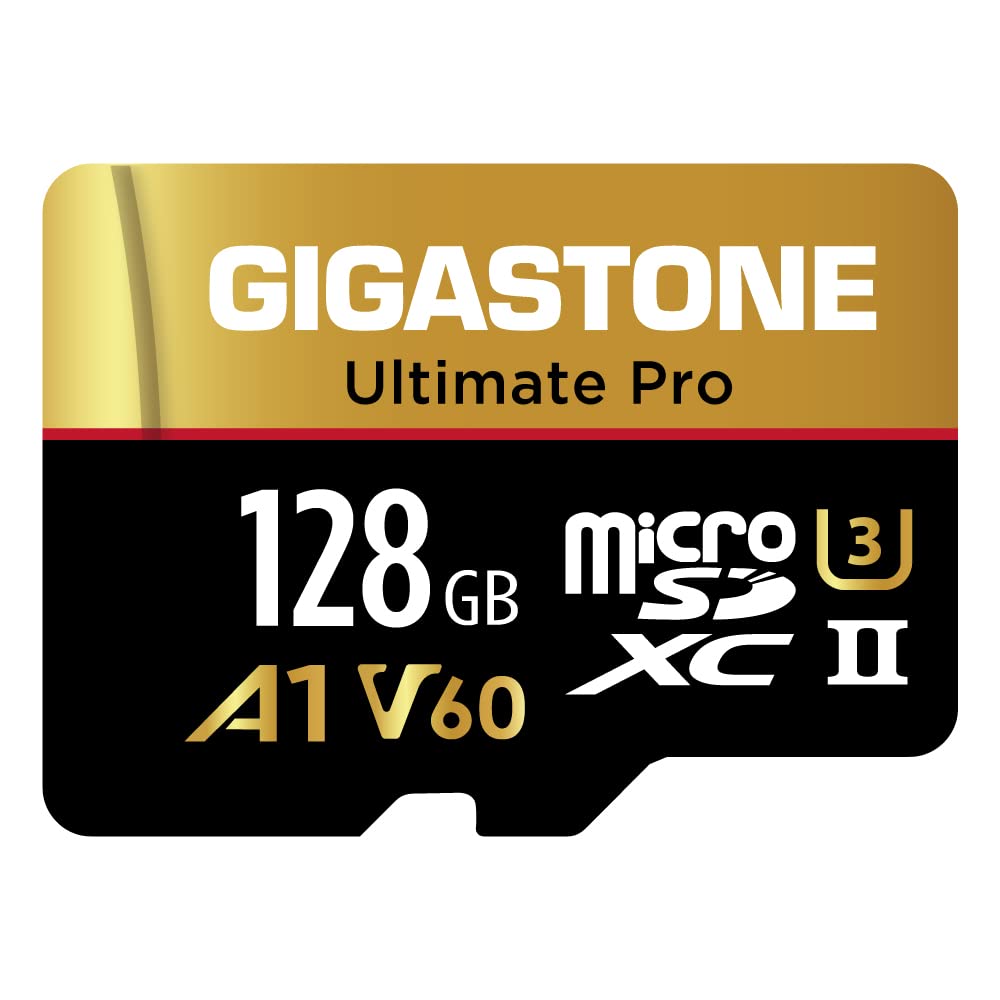
A 128GB V60 card that bundles free data recovery with a five-year warranty.
The headline here is not a speed number — it is the five-year limited warranty bundled with free data recovery. That second part is the unusual piece: if the card corrupts or a file goes missing, recovery help is included rather than an upsell. The card beneath that promise is rated V60 with UHS-II, reading up to 280 MB/s and writing up to 100 MB/s, and it ships with an adapter for full-size slots.
Capacity is 128GB, double the Delkin Power’s 64GB above, which makes it the better fit for shooters who would rather not offload mid-trip. It also carries A1 and U3 ratings alongside the V60 mark, and Gigastone lists it as waterproof, shockproof, temperature-proof and X-ray proof. Across owner reviews, smooth 4K and 8K playback at 60 fps is the recurring theme, with no lag or dropped frames during use standing out as the consistent experience.
Speed and reliability are the two themes that come up most in owner feedback, and both show as positive. The catch is subtler: data recovery software is a rescue service, not a substitute for a backup routine. It also sits at the premium end of this group, which is a fair read given the warranty term compared with the 10-year cover on the Lexar Gold.
The standout: five years of warranty cover with free data recovery included is a meaningful safety net for anyone shooting unrepeatable footage.
The trade-off: V60 sustained writing rather than V90, and a premium price for the peace-of-mind bundle.
Pick it if: you shoot footage you cannot reshoot and want recovery support written into the deal.
Pass if: your body demands V90 sustained writes for its top recording modes.
6. Kodak 256GB MicroSD Card UHS-II V60
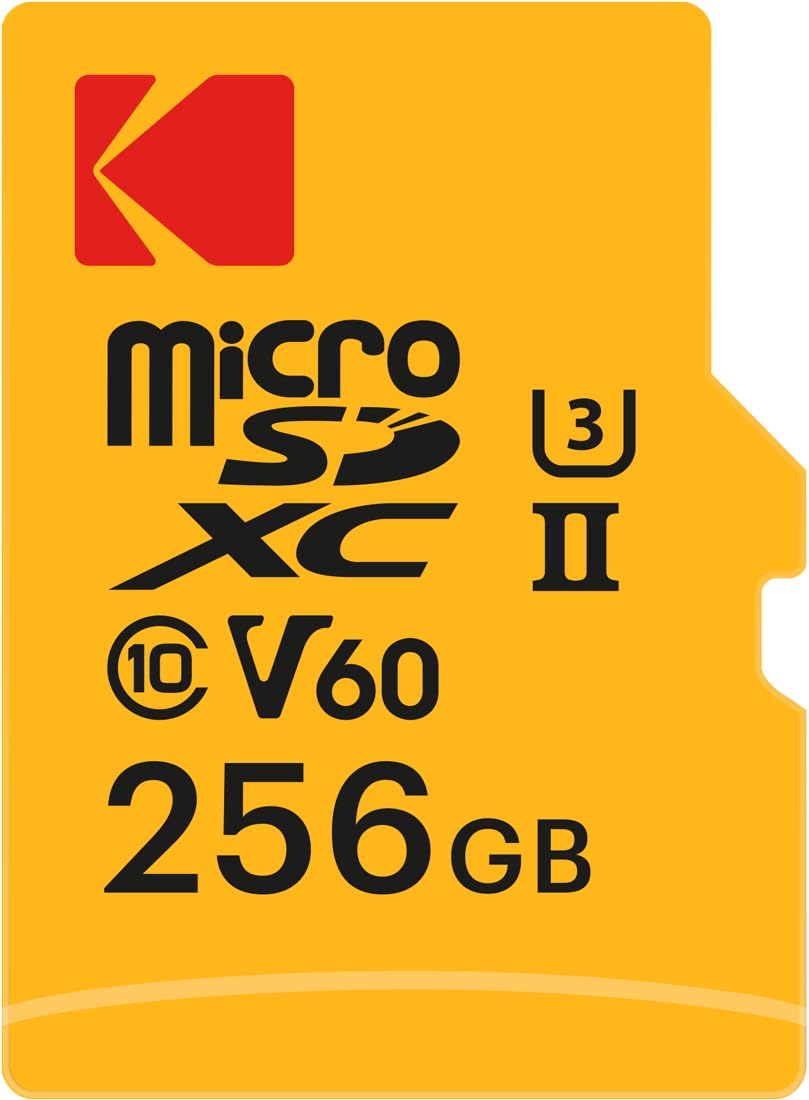
256GB — double the 128GB cards here — with a 300 MB/s read for the trip where you cannot offload.
Most of this list stops at 128GB. The Kodak goes to 256GB, which is the single reason to shortlist it: a multi-day creator trip where you would rather not carry a laptop just to dump cards. Read speed is rated at 300 MB/s — matching the Delkin Power at the top of this group and just ahead of the 280 MB/s Lexar and Nextorage cards. Write speed is rated up to 160 MB/s, the highest write peak in this comparison.
It is a V60 card, so the sustained recording floor is 60 MB/s, the same promise the lower-capacity V60 cards make. Kodak positions it for 4K and 8K shooting without interruption or loss of quality, and includes an SD adapter for cameras and drones that take full-size cards. Backward compatibility with UHS-I devices is stated too, so it will slot into an older phone at the older bus speed.
Two things to weigh. This card has the thinnest review history of the group, so there is less owner experience to lean on than with the Lexar or Nextorage. And the largest capacity in the lineup also concentrates the most footage on a single point of failure — if you go this route, splitting a shoot across two cards or offloading nightly is the sane habit, not a single mega-card and a hope.
Where the Kodak pulls ahead
- 256GB capacity — the largest in this comparison and double the 128GB cards.
- 300 MB/s read, matching the fastest offload figure here.
- 160 MB/s rated write peak, the highest of these six cards.
- SD adapter included for full-size slots.
Points to weigh first
- V60 sustained floor, so the highest-bitrate modes still want a V90 card.
- The thinnest owner track record in this lineup.
- One large card concentrates all your footage in one place.
Worth it when: your priority is capacity and offload speed over the deepest sustained-write rating.
Not for you when: your camera needs V90, or you want a long owner history before you commit.
Know the Specs
Video Speed Class (V30, V60, V90)
This is the guaranteed minimum sustained write speed, expressed in MB/s. A V60 card will not drop below 60 MB/s while recording; a V90 card will not drop below 90 MB/s. It exists so a camera knows, with certainty, that the card can keep up with continuous footage. Higher bitrate modes need a higher class. A V60 card handles most 4K and action-cam recording. A V90 card is the safer bet for the heaviest 8K and 360 capture.
Read Speed vs Write Speed
Write speed is how fast the card takes data in during capture. Read speed is how fast it hands data back when you offload. The two are rarely the same — the Delkin Power, for instance, is rated 300 MB/s read but 250 MB/s write. If your bottleneck is waiting on transfers, read speed is your number. If your bottleneck is dropped frames, write speed and the video class are what matter.
UHS-II vs UHS-I
UHS-II cards carry a second row of gold contacts and a faster bus. The catch is that the extra speed only shows up in a UHS-II slot or a UHS-II card reader. Drop a UHS-II card into an older UHS-I device and it works, but at the older bus speed. Before buying, check both your camera and your card reader — a fast card behind a slow reader is wasted money.
A1, U3 and Durability Ratings
A1 is an application performance rating covering the small random reads and writes that keep file transfers and app loading smooth. U3 is a minimum write speed mark of 30 MB/s. Durability ratings — such as IPX7 water resistance, IP6X dust resistance, X-ray and magnetic resistance, drop and bend limits — tell you how much abuse the card survives before data is at risk. They matter most for drone, action-cam and outdoor use.
Capacity and Card Count
Capacity is on-card storage for a session. For long shoots, two mid-size cards often beat one giant one: you spread risk, and you can swap rather than stop to offload. For a short run-and-gun day, a smaller card is plenty and cheaper. Match capacity to how often you can realistically get files onto a computer.
Compatibility and Adapters
Many UHS-II microSD cards ship with an SD adapter so the same card works in a full-size SD slot. Backward compatibility with UHS-I devices is common. Always confirm the adapter is UHS-II rated as well — a basic adapter can cap the card’s speed coming out of the slot.
Common Questions
Will a UHS-II microSD card work in my UHS-I camera?
Do I need V90 instead of V60 for 4K video?
What is the difference between read speed and write speed on these cards?
Does my card reader need to be UHS-II to get the full speed?
How many 4K recording hours will 128GB hold?
Is one large card or two smaller cards safer for shooting?
Can these cards survive water, drops and X-rays?
What does the A1 rating on these cards actually do?
Why do some cards fail after a few months of use?
Is the bundled data recovery software on the GIGASTONE worth having?
The Bottom Line
For most shooters, the uhs-ii microsd card to buy is the Lexar 128GB Gold — 128GB of capacity at a V60 sustained floor, with 280 MB/s read for offloads and a temperature-proof rating for real-world camera bags. It is the balanced answer for drone, action-cam and mirrorless 4K work. If your body demands a sustained 90 MB/s floor for 8K or 360 capture, the Delkin Devices Power 64GB is the V90 card to pair with it, as long as you accept 64GB and offload often. And if capacity for a multi-day trip is the priority, the Kodak 256GB gives you double the room and a 300 MB/s read speed to match.
How we choose
We do not accept paid placement. Every pick is matched to a real buyer and a real use-case; we do not hands-on test units.
Sources
Specifications: manufacturer listings and product documentation. Review insights: verified customer reviews, as of November 2026. Pricing: not shown on this page (it changes often); check the current price via the retailer link.
As an Amazon Associate, Tactical Gear Guy earns from qualifying purchases. This does not affect which products we feature.