Specs are compiled from manufacturer listings and verified buyer reviews and can change over time — please confirm the key details on the product page before buying.
You want a drive that stays locked even if it falls out of your bag on a train. Every pick below locks itself with a PIN you type on the drive itself or with hardware encryption built into the chip, so a thief gets a brick instead of your files. The one that earns the top spot is the Apricorn Aegis Secure Key 3 NX 32GB — a 32GB stick validated to FIPS 140-2 Level 3, a U.S. government standard for how tamper-resistant a security device is.
This guide is built by comparing the manufacturers’ published specifications and the patterns across verified customer reviews, so you get each pick’s real strengths and trade-offs instead of marketing spin.
Some drives in this group use a keypad you press before plugging in, while others run encryption software the moment they connect. Either way, nobody reads your data without your PIN. Here is how to pick one for the way you actually carry and use it.
Top Picks

How To Choose The Best Encrypted USB Flash Drive
It is who is holding the drive when it is not in your hand. An encrypted USB flash drive is only as good as the lock that stops a stranger reading it, so compare lock types before you compare gigabytes.
Keypad or software — pick your lock style
A keypad drive has the PIN buttons built into the body. You type your numbers before you plug it into anything, so the drive never depends on the host computer. That matters when you plug into a shared desktop, a hotel business centre, or a client’s laptop you do not control. Software-based drives encrypt inside the chip too, but you enter the password from the host machine. Many still need zero installation and run without drivers, which is handy on a Mac or a Linux box, but a compromised computer is one more thing you have to trust.
The FIPS level is not the same as a lock
FIPS 140-2 and FIPS 140-3 are U.S. government validation standards for cryptographic modules — the tamper-resistant hardware that holds the encryption key. Level 3 is a higher tier that adds physical tamper resistance to the mix. Some listings carry a “(Pending)” note, which means certification is in progress rather than complete. Read that wording closely if your employer or a contract requires a finished certification, because pending and validated are not the same thing on paper.
Brute-force behaviour decides what happens on a lost drive
Brute-force protection is the drive’s own rule for stopping someone who guesses at your PIN. On the Integral Crypto-197 the drive erases its data and encryption key after 6 failed access attempts. Other drives reset to factory settings after a set number of wrong tries. Think about what you actually want: a wipe protects your data completely, but it also means you lose it forever if a child or a colleague taps in the wrong numbers.
Ruggedness, PIN length, and speed round it out
A drive that rides in a pocket or a tool bag gets dropped. An IP57 rating means the case is sealed against dust and survives being submerged in water, which is the number to look for if yours lives outdoors. Then check your PIN length options — longer is stronger. Finally, note the USB generation, because USB 3.2 Gen 1 and USB 3.0 both move big files far faster than an old USB 2.0 port.
Side-by-Side Comparison
| Model | Best For | Capacity | Interface | PIN Method | Amazon |
|---|---|---|---|---|---|
| Apricorn Aegis Secure Key 3 NX★ Best Overall | Overall security | 32 GB | USB 3.0 | On-board keypad | Amazon |
| Kingston Ironkey Keypad 200Best for PINs | Alphanumeric PINs | 32 GB | USB 3.2 Gen 1 | On-board keypad | Amazon |
| Kingston IronKey Vault Privacy 50 | High capacity | 256 GB | USB 3.2 Gen 1 | Software password | Amazon |
| iStorage datAshur PRO | Rugged travel | 32 GB | USB 3.0 | On-board keypad | Amazon |
| Apricorn Aegis Secure Key 3Z | Aluminum build | 32 GB | USB 3.0 | On-board keypad | Amazon |
| INNÔPlus Secure Flash Drive | Fast transfers | 32 GB | USB 3.0 | Software password | Amazon |
| Integral Crypto-197 | Budget pick | 16 GB | USB 3.0 | Software password | Amazon |
Detailed Reviews
1. Apricorn Aegis Secure Key 3 NX 32GB
Our pick — 4.5+★ from 700+ verified ratings; the strongest balance of quality and price.
The drive you can hand to anyone, because the keypad never leaves your control.
What puts this one on top is its FIPS 140-2 Level 3 validation. That is a U.S. government validation for encryption modules, and Level 3 adds physical tamper resistance on top of the core cryptography. In plain terms, the chip that holds your key is built to resist someone opening the case and poking at it. You type your PIN on the drive itself before it open up, so nothing about your access depends on the computer you plug into.
Apricorn also builds in separate Admin and User modes, which means you can set up one PIN that manages the drive and a second one for daily use. Two Read-Only modes let you flip the drive into a state where files can be read but never changed or deleted, which is exactly what you want when handing a report to a client’s machine. Data Recovery PINs give you a planned way back in if you forget your own code, and the drive supports Windows, iOS, Linux, Android, and Chrome, so it is not tied to one operating system.
What wins people over is reliability. Owners describe it as a workhorse that just keeps open up cleanly on USB 3.1 ports, and the data protection angle is what they talk about most — client information, business files, the stuff that cannot leak. The honest catch is the button layout. A few find the buttons small and the open up sequence fiddly at first, so budget a little practice time before you rely on it under pressure. At 32GB with a 0.03 kg body, it is pocket-sized without feeling flimsy.
keypad entry build
- FIPS 140-2 Level 3 validation — a higher security tier than the FIPS 197-only drives here.
- On-board keypad means the PIN never touches the host computer.
- Separate Admin and User modes plus two Read-Only modes.
- Data Recovery PINs give you a route back in after a forgotten code.
- Works across Windows, iOS, Linux, Android, and Chrome.
small keypad keys
- The buttons are small, and the open up sequence takes a few tries to learn.
- 32GB is modest if you plan to carry large video or design files.
need PIN access: you want a validated Level 3 lock and you are willing to learn the keypad rhythm.
want touchscreen: you need room for huge files — the 256GB Kingston IronKey Vault Privacy 50 holds far more.
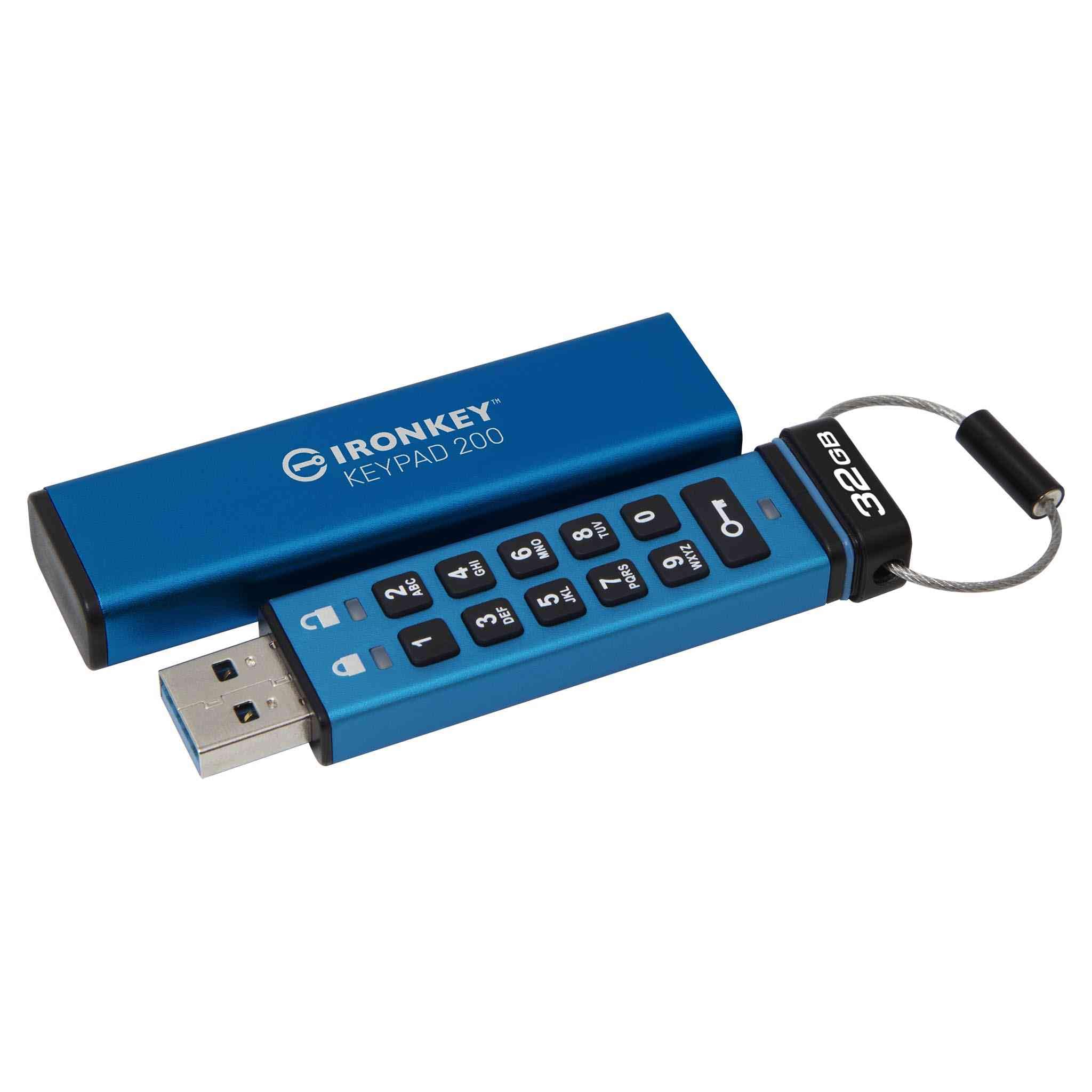
2. Kingston Ironkey Keypad 200 32GB
Type letters and numbers, not just digits — a full alphanumeric PIN on the drive itself.
Most keypad drives limit you to numbers. This one enforces an alphanumeric PIN, so you can build a password out of letters as well as digits, and that wider character set makes guessing far harder. The drive carries FIPS 140-3 Level 3 (Pending) certification, meaning it is built to the newer government standard with validation still in progress. It runs XTS-AES 256-bit hardware encryption, which scrambles your data inside the chip rather than on the computer.
It is OS and device independent, so it does not care whether you plug into Windows, macOS, Linux, Chrome OS, Android, or any system that reads a USB mass storage device. A Multi-PIN option gives you separate Admin and User codes. Weigh it against the Apricorn above: this Kingston is 25 g versus the Integral Crypto-197 at 18.14 g, so it is the heftier of the two in the hand, which is a fair trade for a full keypad.
What people notice is how thoroughly it locks down — the encryption here is described as pretty much unbreakable, and it meets strict security requirements without fuss. BadUSB protection adds a layer against malicious firmware tricks. The catch sits in the “Pending” wording on that certification: if your workplace insists on completed validation, confirm the status before you buy.
battery-free keypad: a full alphanumeric keypad on the drive body is the standout feature, and it pairs with XTS-AES 256-bit encryption and BadUSB protection.
thick body: that Level 3 rating is pending rather than finished, and 32GB will feel tight for media-heavy work.
offline open up: you want letters in your PIN and a drive that ignores the operating system entirely.
need fast transfers: you must show a completed FIPS Level 3 certificate to an employer today.
3. Kingston IronKey Vault Privacy 50 256GB
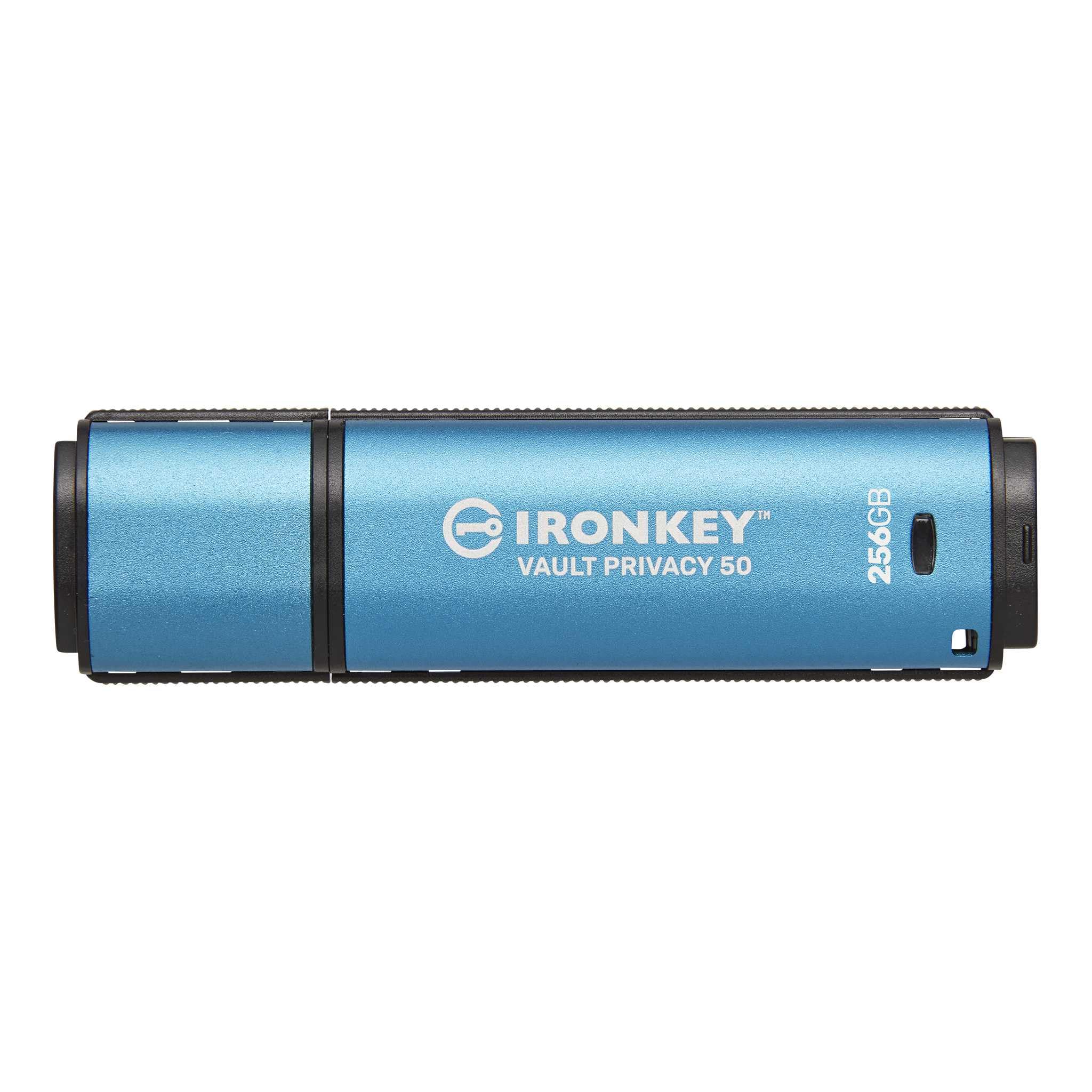
The capacity king: 256GB of encrypted space, versus 16GB on the Integral Crypto-197.
Here is the head-to-head that matters most. This drive holds 256 GB while the Integral Crypto-197 holds 16 GB — that is the difference between a folder of documents and a whole project’s worth of video and design files. If your encrypted drive is meant to replace a backup disk, this is the one to shortlist.
It rides on FIPS 197 with XTS-AES 256-bit encryption, the same business-grade hardware security standard used across this group. Brute Force and BadUSB Attack Protection guard against PIN guessing and malicious USB firmware, and the firmware itself is digitally signed so it cannot be quietly swapped. You get a Multi-Password option with Complex and Passphrase modes, plus a new Passphrase mode that lets you build a longer, memorable phrase instead of a short code. Dual Read-Only settings stop accidental overwrites, and the drive is TAA Compliant, which matters for government and enterprise procurement.
The recurring hesitation is value — some buyers find the price reasonable for the capacity, others less so. Set that against what you get: a 20 g body, USB 3.2 Gen 1 speed, and hardware encryption on a quarter-terabyte. It also works across devices with USB ports, so it travels between machines without drivers.
store big archives: capacity is your first concern and you want the same hardware encryption at 256 GB.
budget limited: you only move a few documents and would rather have a keypad for on-host typing.
4. iStorage datAshur PRO 32GB

Dust-sealed, water-resistant, and built for a bag that gets thrown in the truck.
If your drive lives in a pocket, a toolbox, or a rucksack, the IP57 rating is the spec to watch. That means the case is sealed against dust and survives being submerged in water, so a dropped-in-a-puddle moment does not end your data. Type a 7–15 digit PIN on the keypad to open up, and the drive behaves like any normal USB stick once it is open.
The security credentials are the deepest in this group: FIPS 140-2 Level 3, plus NLNCSA DEP-V and NATO Restricted certification. It also helps you meet data regulations such as GDPR, CCPA, and HIPAA if you handle regulated records. AES-XTS 256-bit hardware encryption runs in real time with no software required, and it works on MS Windows, macOS, Linux, Chrome, Android, thin clients, zero clients, embedded systems, Citrix, and VMware. Transfer speeds reach up to 169MB/s read and up to 135MB/s write on backward-compatible USB 3.2.
The thing people bring up is how much security is packed into a small stick — it is described as jam-packed with additional features, and it suits protecting personal ID and business records alike. The honest note: keypad entry with a long PIN takes a moment each time you open up, so it is not the drive for someone who wants instant access all day.
rugged metal shell: IP57 sealing plus the triple certification stack is what makes this the travel pick.
heavier carry: a 7–15 digit PIN every time you plug in adds a few seconds to each session.
rough handling: field work, site visits, and regulated records where the drive takes knocks.
want slim fit: you open up dozens of times a day and want the shortest possible PIN ritual.
5. Apricorn Aegis Secure Key 3Z 32GB

An aluminum shell that shrugs off water and dust, with a PIN you enroll yourself.
Apricorn’s second entry in this roundup shares the family recipe but leans on the case. It is FIPS 140-2 Level 3 validated with 256-bit AES XTS encryption, and the housing is high-quality rugged aluminum rated IP57 for water and dust resistance. At 1.75 ounces it has real presence in the hand without being a brick, and it survives the kind of drops a plastic drive would not.
The PIN side is an embedded 7–16 digit code with user-forced enrollment, meaning the drive makes you set your own PIN rather than shipping with a default. Two Read-Only modes let you lock files against edits, and the drive is Aegis Configurator compatible if you manage several of them. It is cross-platform compatible, so it does not care which computer you plug into.
What owners describe is a top-quality stick that is straightforward to use, with fast data transfer speeds and AES 256-bit encryption doing the heavy lifting. The trade-off is that it is the same 32GB ceiling as the other keypad drives — if your files are large, the 256GB Vault Privacy 50 above is the better fit. Otherwise, this is a hard-wearing daily driver for confidential material.
basic secure storage: a metal-bodied keypad drive you can drop, dunk, and still trust with confidential files.
need USB-C speed: you want maximum storage rather than maximum shell.
6. INNÔPlus Secure Flash Drive 32GB

The speed pick — up to 480MB/s reads when you need big files moved fast.
When backup time is the pain, the read speed is the number that counts. This drive reads at up to 480MB/s and writes at up to 160MB/s over USB 3.0, so a large folder copies in a fraction of the time a slow stick would take. That speed does not cost you security: it uses full-disk 256-bit AES XTS hardware encryption, the same 256-bit standard as the rest of this group.
The lock is a password rather than a keypad. If the wrong password is entered 10 times, the drive resets to factory settings and wipes entirely, so a lost drive cannot be brute-forced. It needs no software or drivers and works across Windows, Mac, Linux, embedded systems, and various devices. The zinc alloy and ABS shell resists scratches, rust, and damage, and the orange body is easy to spot in a bag.
Two honest notes. Some owners point out files can only be 4GB, which is a limitation if you routinely move huge single files — worth checking against your workflow. And while the security and quality are well regarded, reliability draws more mixed feedback than the locked-down keypad drives here. Ease of use is where it shines, with quick PIN and password setup.
budget secure option: up to 480MB/s reads and 160MB/s writes make it the quickest copier in this group.
mixed speed results: the 4GB file-size limit and more mixed reliability feedback than the keypad picks.
cheap encryption: you move large volumes often and want the fastest transfer you can get.
demand top speed: you need to carry single files larger than 4GB or want keypad-only access.
7. Integral Crypto-197 16GB

The entry point — certified encryption and an auto-wipe that fits a tight budget.
This is the smallest and simplest lock in the group, and it covers the basics well. It is certified to FIPS 197, the U.S. Government-approved information security standard, and uses mandatory AES 256-bit hardware encryption so your files are secured inside the chip, not by software. Data cannot be opened without the correct high-strength 8–16 character alphanumeric password, and you can set a password hint that cannot match the password itself.
The self-defence is the standout: brute-force password attack protection automatically erases the data and encryption key after 6 failed access attempts, then resets the drive. Auto-lock encrypts everything the moment you pull it from a PC or Mac, or when the host’s screen saver or lock kicks in. It is also rugged — a hardened inner case with a rubberised silicone outer layer protects against knocks, drops, break-in, and submerging in water.
It runs SuperSpeed USB 3.0 and works on both PC and Mac with zero footprint, meaning no software install and no licence or subscription fee. Weight is a pocket-friendly 18.14 g. For a second encrypted stick, a travel spare, or a starter drive, it does the job without stretching the budget.
small document sets: you want certified hardware encryption and an auto-wipe on a tight budget.
store media files: 16GB will not hold your archive — size up to the 256GB Kingston.
Know the Specs
Hardware Encryption vs. Software Encryption
Hardware encryption means the scrambling happens on a dedicated chip inside the drive itself, not on the computer you plug into. Software encryption relies on the host machine to do the work. The hardware route means your data is protected even if the computer is compromised, and the drive stays encrypted the moment it is unplugged. A drive running AES-XTS 256-bit hardware encryption, like the keypad models here, keeps the key locked inside the drive’s own silicon.
FIPS Levels — 197, 140-2, and 140-3
FIPS 197 is the standard for the AES encryption algorithm itself. FIPS 140-2 and FIPS 140-3 are broader validation standards for the entire cryptographic module. Level 3 adds physical tamper resistance on top of the core cryptography, so it means the hardware is built to resist someone opening the case. Watch for the word “(Pending)” on a listing — it means validation is still in progress rather than complete.
Brute-Force Protection and Auto-Wipe
Brute-force protection is the drive’s rule for stopping PIN guessing. Some drives, like the Integral, erase their data and encryption key after a set number of failed attempts, then reset. Others restore to factory settings after a run of wrong passwords. This is what makes a lost drive safe: without your PIN, a stranger gets a brick, not your files. The flip side is that too many wrong taps wipes your data permanently.
USB Generations and Transfer Speed
USB 3.0 and USB 3.2 Gen 1 are the same speed tier under different naming, and both move big files far faster than an old USB 2.0 port. On this list, the INNÔPlus quotes up to 480MB/s reads and 160MB/s writes, while the datAshur PRO quotes up to 169MB/s reads and 135MB/s writes. Faster ports shorten backup time; slower drives cost you patience on big transfers.
Common Questions
Will an encrypted USB flash drive work on a Windows laptop and a Mac?
What does FIPS 140-2 Level 3 actually mean?
What happens if I enter the wrong PIN too many times?
Is a keypad drive better than a software password drive?
How many gigabytes do I need for documents versus photos and video?
Are these drives water resistant?
Can I use an encrypted USB drive on a work computer without installing software?
What is BadUSB protection and why does it matter?
Do I lose the encryption if the drive gets physically damaged?
The Bottom Line
For most people, the winning encrypted usb flash drive is the Apricorn Aegis Secure Key 3 NX 32GB, because it pairs FIPS 140-2 Level 3 validation with an on-board keypad that never lets your PIN touch the host computer. If you want letters in your PIN and the newer FIPS 140-3 standard, reach for the Kingston Ironkey Keypad 200. And when capacity is the whole point, the Kingston IronKey Vault Privacy 50 gives you 256 GB under the same hardware encryption.
Whatever you pick, the one nudge worth taking: the top pick carries a strong validated rating on a well-reviewed record, so it is the safest bet for anyone who wants the lock to do the talking. Match the drive to how you carry it — keypad and rugged shell for the field, big capacity for the archive, and a certified budget stick for the second-car glovebox.
How we choose
We do not accept paid placement. Every pick is matched to a real buyer and a real use-case; we do not hands-on test units.
Sources
Specifications: manufacturer listings and product documentation. Review insights: verified customer reviews, as of November 2026. Pricing: not shown on this page (it changes often); check the current price via the retailer link.
As an Amazon Associate, Tactical Gear Guy earns from qualifying purchases. This does not affect which products we feature.