Specs are compiled from manufacturer listings and verified buyer reviews and can change over time — please confirm the key details on the product page before buying.
Replacing a windshield is mostly a cutting job, and the cutting is where most jobs go wrong. The wrong knife binds in the urethane bead, the blade wanders, and suddenly you are looking at a chipped edge on glass you were trying to save. This shortlist covers the lever knives, air-powered cutters, push knives and full kits that make that bead come away cleanly — and the specs that separate a tool you fight with from one that just tracks through.
This guide is built by comparing the manufacturers’ published specifications and the patterns across verified customer reviews, so you get each pick’s real strengths and trade-offs instead of marketing spin.
You will see which handles are aluminum, which blades swap without a second tool, and where the coverage runs out on each kit. The goal is simple: pick once, cut clean, and keep the glass intact — which is exactly what separates good windshield replacement tools from a drawer of bent scrapers.
Top Picks


How To Choose The Best Windshield Replacement Tools
The bead of urethane holding a windshield in place is tough, slightly elastic, and roughly a quarter-inch thick on a bonded install. Every tool on this list exists to get a blade through that bead at the right angle without levering against the glass. Pick the wrong motion and you fight the tool instead of the urethane. Pick the right one and the blade tracks the seam with minimal steering.
Start with how you will power the cut
Hand tools pull, push or strike their way through urethane. A lever knife uses a pull cable to drag the blade along the bead with steady force. A push knife uses a striking plate and a mallet to drive the blade forward. An air-powered cutter swaps muscle for a throttle and a compressor. Decide which of those three motions fits your body and your shop before you look at blade counts.
Check the blade mount before the blade count
A flexible blade mount that can be positioned in several ways lets you approach a dashboard-side seam and a roof-side seam with the same tool. Fixed-mount knives limit you to one cutting angle. If you plan to cut more than one vehicle, an adjustable mount saves you from buying a second knife for the awkward corners.
Handle material and grip decide how long you can work
Aluminum handles keep the tool light and rigid, and a shaped grip keeps your hand from slipping when the urethane fights back. Foam-covered pull cables and non-slip grips matter most on a job that runs past an hour. A tool that is comfortable empty can still cramp your hand once it is loaded against a bonded seam.
Know what the kit actually includes
A knife alone cuts glass out. A kit also scrapes old sealant, threads a cutting wire, or adapts to different glass. Read the accessory list line by line — the scrapers, adapters and threading tools are what turn a single cut into a finished replacement.
Side-by-Side Comparison
| Model | Best For | Power Source | Blades Included | Weight | Amazon |
|---|---|---|---|---|---|
| UltraWiz 3007K Lever Knife★ Best Overall | Steady pull-cable cutting | Hand / pull cable | 1 blade (1″ TLS1222) | — | Amazon |
| Pandairftr Quick Release Cold Knife KitEasiest Blade Swaps | Tool-free blade swaps | Hand / pull handle | 3 cut blades | 1.85 pounds | Amazon |
| Astro Pneumatic WINDKO ONYX | High-volume shop cutting | Air / throttle | 3 blades | 2.3 pounds | Amazon |
| Equalizer Push Knife 24″ | Quarter glass removal | Hand / mallet-driven | 1 Express blade (1.5″ x 10″) | — | Amazon |
| PipeKnife 4-Piece Long Knife Set | Long-reach flat glass | Hand | 4 long knives (9, 14, 18, 24 inch) | — | Amazon |
| Konzition Dual-Cutting Removal Kit | All-in-one first kit | Hand / dual-direction wire | Cutting wire + glass cutter + threader | 11.38 pounds | Amazon |
Detailed Reviews
1. UltraWiz 3007K Lever Knife
Our pick — 4.5+★ from 100+ verified ratings; the strongest balance of quality and price.
A pull-cable lever knife built the way a pro’s daily driver should be — adjustable, aluminum, and made in the USA.
The UltraWiz 3007K earns the top spot on one thing above all: the lever lets you set the blade angle anywhere you want it, with no fixed stops. That matters because a modern bonded windshield is not one continuous seam. The blade has to sit differently along the cowl than it does up the A-pillar, and a knife with unlimited adjustment means you stop fighting the handle and just cut.
The business end is a 1-inch TLS1222 UltraWiz blade riding on an aluminum body with an ergonomically shaped handle. The inline pull cable ends in a heavy-duty eyelet for strength, and the cable handle carries a foam-covered grip so your palm survives a long cut. UltraWiz says the tool follows OSHA’s Ergonomic Guidelines for Selecting Hand Tools — a spec that matters if you cut glass daily rather than once a season.
What wins technicians over is reliability, and the durability and build quality come right behind it. The cutting itself draws the most vivid praise, with the blade passing through urethane with as little resistance as a warm knife through butter. UltraWiz says these are the tools most technicians reach for today, and the lever-and-eyelet design shows it was refined for clearance and blade changes. If you want the best overall starting point for hand cutting, this is it. Note that the color varies by availability — you may receive purple or black.
What earns it the crown
- Unlimited lever adjustment sets the blade angle wherever the seam demands it.
- Aluminum body and shaped handle keep the tool rigid without chewing your palm.
- Heavy-duty eyelet on the inline pull cable adds strength where you pull hardest.
- Ships with a 1-inch TLS1222 UltraWiz blade, made in the USA.
What to weigh first
- One blade in the box means you buy replacements before a busy stretch.
- Color is assigned by availability, so you cannot choose purple or black at checkout.
Go with this one if: you cut urethane by hand and want a lever knife that adapts to every seam on the car.
Think again if: you would rather have three blades and two scrapers bundled in from day one.
2. Windshield Removal Tool Kit
Three blades, a push-button release, and enough scrapers to finish the job — this is the kit that trots rather than sprints.
Here is the whole point of this cold knife: you change blades with your thumb. The push-button release lets you swap among three specialized blades in seconds without hunting for an Allen key, which turns a mid-cut change from a chore into a single motion. If you cut more than one make of vehicle, that matters more than any single blade ever will.
The handle is automotive-grade aluminum alloy with a non-slip grip that stays comfortable through extended use. The package arrives as one straight bar, one pull handle, three cut blades and two sealant scrapers — a genuinely complete working set. At 1.85 pounds it is light enough to hold up a ladder or reach over a dashboard without your arm reminding you later. The maker bills it as fitting most cars and SUVs, and the three blade shapes are designed to take on different urethane seam positions.
Context matters here: a 4.0+ rating from 50+ reviews puts it newer to the market than the UltraWiz above. The blade geometry is good enough to make clean cuts through tough urethane adhesive, which protects the glass edge, but this is a kit you grow with rather than a dedicated pro shop tool. The included scrapers are the real bonus, because prepping the glass edge is half of what drags a replacement job out. For a DIYer or a small shop that wants one box with everything in it, this fits neatly.
Its real secret: the tool-free blade change turns a multi-blade kit into something you actually use all three blades of, instead of defaulting to whichever one was pre-installed.
The honest caveat: the cutting blades do their best work on urethane that is not wildly beyond its normal state — on a bond that has sat for a decade, you will want a powered cutter from higher up this list.
Reach for it when: you are kitting out a home garage and want blade variety plus scrapers in one purchase.
Look elsewhere if: you need a single knife that stays rigged for one specific vehicle all day long.
3. Astro Pneumatic Tool WINDKO ONYX

Twelve blade positions and a teasing throttle: the powered answer when hand cutting over the roof line starts to hurt.
Compare this to the hand tools above and the difference is muscle. The WINDKO ONYX is an air-powered sealant cutter that drives its blade with a compressor instead of your shoulder, and the flexible blade mount can be set in 12 different positions at 30-degree increments. That range means the blade can reach a bonded seam at the bottom of a deep windshield well or along an encapsulated molding without you contorting the whole tool.
It cuts around bonded and encapsulated glass and cleans and smooths moldings once the glass is out, so the tool stays useful past the cut itself. The teasing throttle and regulator give you easy speed control — you can feather the cut rather than lunge through a urethane bead. It arrives with three blades: a 57mm bent, a 52mm bent curved, and a 35mm flat-nose straight. The tool measures 29 inches long and weighs 2.3 pounds, so it reaches across a full windshield width while still being light enough to control one-handed.
Quality is what buyers keep coming back to, with effectiveness close behind, and there is good reason the cutting itself gets compared to a hot knife through butter. It is the most proven tool here at 4.5+ stars across 300+ owners — the track record you want from a powered cutter you will lean on for hundreds of jobs. The catch is the compressor — this is a shop tool, not something you carry in a car boot for a one-off driveway replacement. If you already own air, it is the obvious upgrade.
Why the blade mount carries it: 12 positions at 30-degree steps means the same cutter handles cowl, pillar and molding work without a second purchase.
The trade-off: it needs an air supply and a compressor, so it earns its keep only when you cut glass often.
Built for: technicians and busy garages already plumbed for compressed air.
Pass on it if: you cut one windshield a year in your driveway and would have to buy a compressor to run it.
4. Equalizer Push Knife 24″ with HydroBlade

Twenty-four inches of machined aluminum and a striking plate meant for a mallet, not a handle meant for your hand.
Push knives cut differently from everything above, and that difference is the entire reason this one exists. A rectangular plate at the back takes hammer blows from a rubber mallet, and that power passes through the blade into the urethane. You are not dragging a blade with a cable or feathering a throttle — you are driving it forward in controlled taps. On quarter glass, which sits in a tight frame with little room to swing a lever, that motion often gets you through where a pull knife cannot.
The blade itself is the star. The included Express Blade measures 1.5 inches by 10 inches, is the most widely used size in the range, and is cut from a proprietary grade of stainless steel. It is aimed at slicing through wide bands of urethane, and the maker notes it works wherever you would otherwise plunge-cut or angle-cut. Changing blades is a matter of unscrewing the hinged plate that locks the blade in place. The tool runs 24 by 5 by 3 inches and is made in the USA.
Equalizer develops its Express blades for hundreds of different vehicles, which is why a push knife earns a spot in the box even if you mostly cut bonded windshields. Against the Astro Pneumatic’s 29-inch reach this one is shorter, but it is aimed at a different job entirely — tight quarter glass rather than full windshield sweeps. The honest limit is the mallet. It is a two-handed, deliberate operation that rewards patience with clean cuts and punishes rushing with a jumped blade.
Where it shines
- Mallet-driven strike plate transfers force straight into the blade for tight quarter glass.
- 1.5 x 10-inch Express Blade in proprietary stainless steel handles wide urethane bands.
- Hinged plate lock makes a blade change a single unscrew.
- Made in the USA, with blades developed for hundreds of vehicle applications.
Where you feel the trade-off
- Needs a mallet and two steady hands — not a one-arm job.
- One blade ships with it, so stock extras before a quarter-glass run.
Suits you if: quarter glass and tight frames are the jobs that slow you down, and you would rather strike than pull.
Not your tool if: you cut bonded windshields all day and want a blade you drag along the bead.
5. Auto Glass Windshield Removal Tool
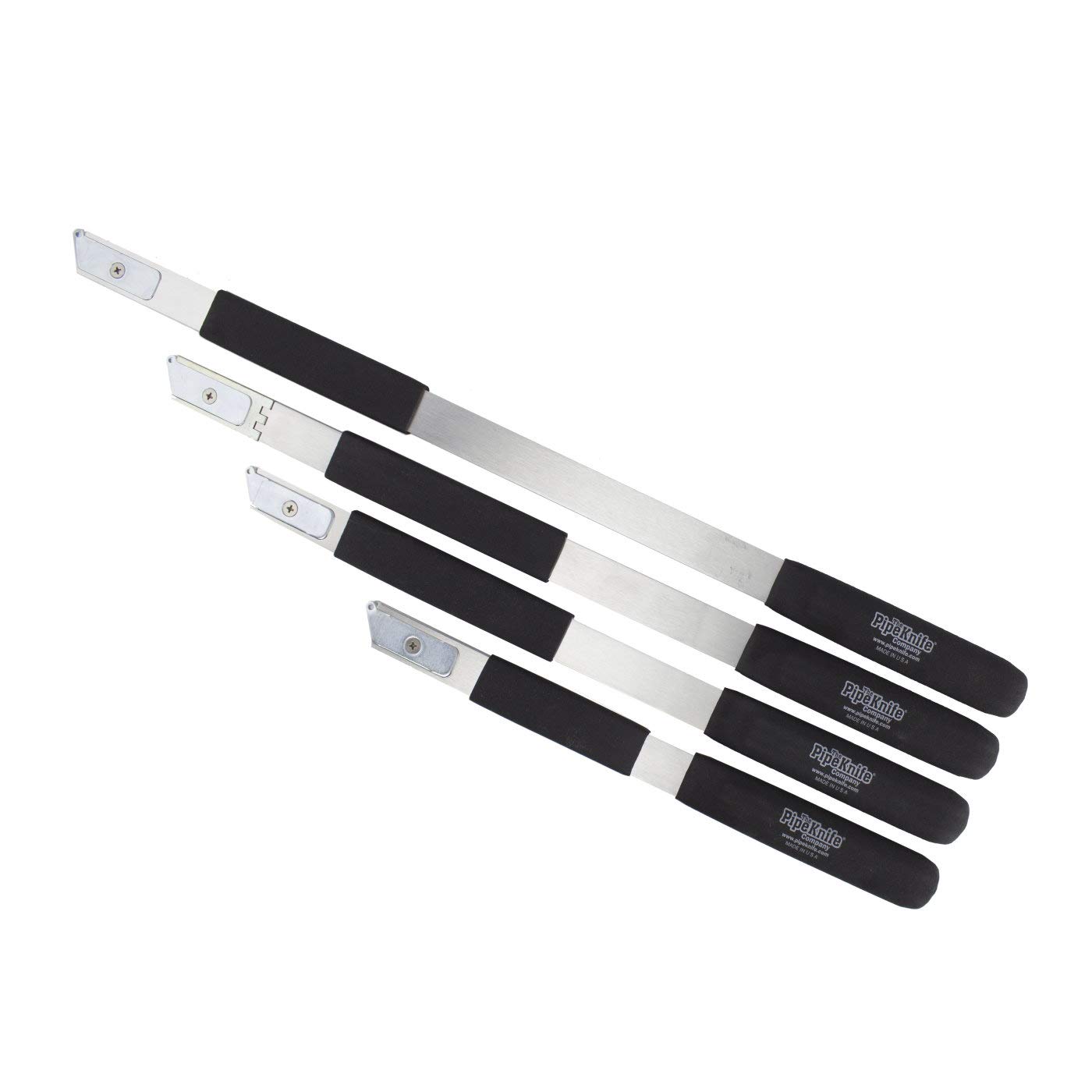
Four knife lengths from 9 to 24 inches, so the depth of the seam stops deciding whether you can reach it.
Let the four tools here do the pitch: 9, 14, 18 and 24 inches. That spread is a deliberate answer to the fact that no single knife length reaches everywhere in a car. A short blade gets into a tight flat-glass window frame and a long one spans a deep dash-to-windshield gap without your knuckles going through the defroster vent. Owning all four means you grab the length the job needs rather than making one compromise tool do everything.
Beyond windshields, the maker lists removing old sealant from expansion joints and cutting out flat glass windows among the uses. It is made in the USA, and it measures 24 by 5 by 1 inches at its longest — a slim profile that slides into places a chunky air tool cannot follow. Quality is what buyers prize most, with functionality right behind it, and the review pages describe the blades working cleanly through thick caulking as readily as through a windshield bead.
This is the set for someone who already knows they cut more than glass. It is a set, not a kit — no scrapers, no cutting wire, no adapters come along. Buy it if reach is your recurring problem and you want four lengths to solve it, and pair it with a scraper if edge prep is part of your process. For flat-glass work and sealant removal, this is more versatile than a single dedicated cutter, even if it lacks the powered convenience of the Astro above.
What the four lengths buy you: you stop improvising. The right blade depth for a quarter panel or a full windshield is already in the roll.
The one gap: there is no scraper or wire in the box, so this set covers the cut and leaves you to sort out edge prep yourself.
Worth it for: anyone who cuts windshields, flat glass and old sealant and wants a depth for every job.
Keep looking if: you need a single powered cutter that races through a bonded seam.
6. Konzition Auto Windshield Removal Tool Kit
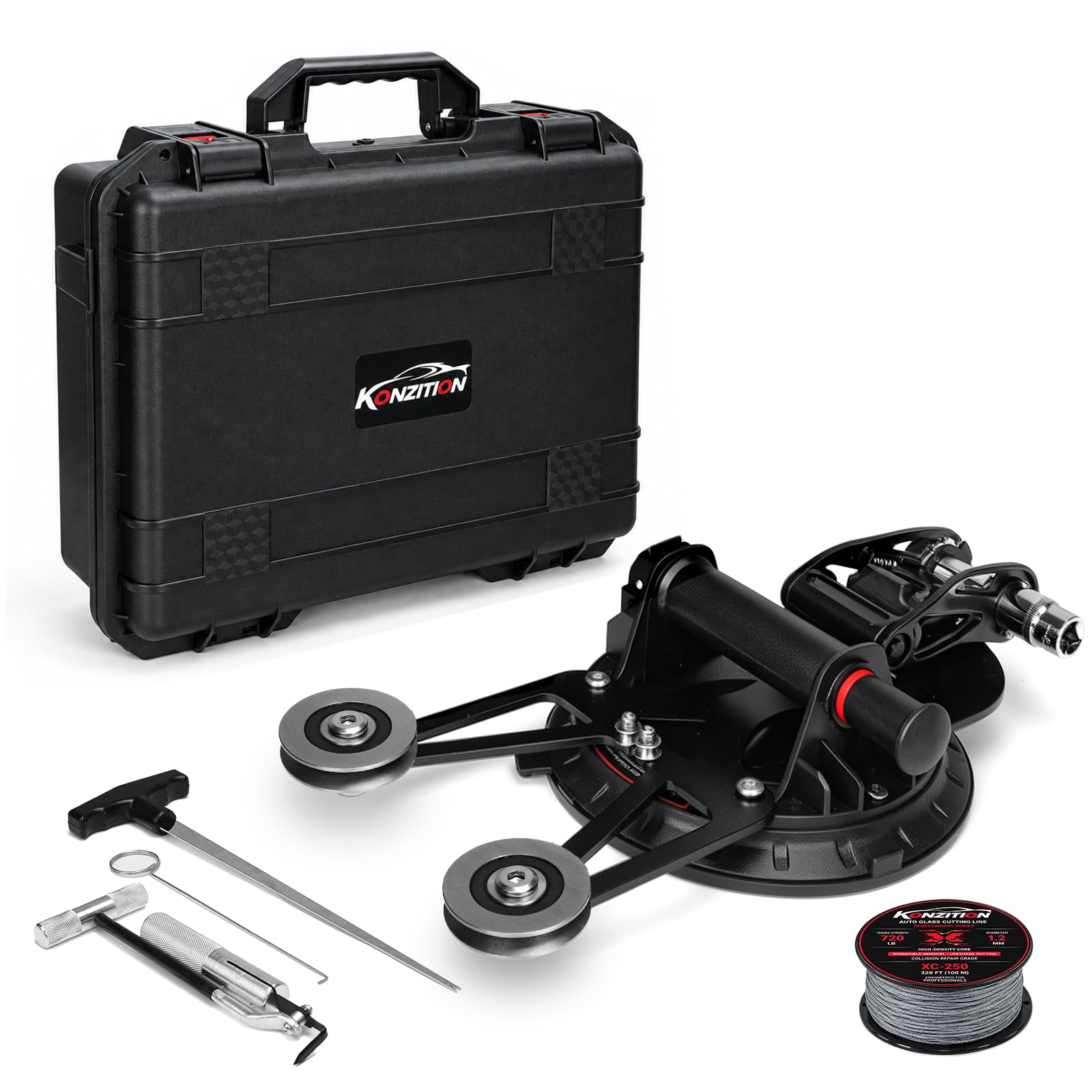
A whole job in one heavy box: wire, cutter, threader and a suction cup rated to hold position while you pull.
The first thing you notice is the mass — 11.38 pounds, in a package measuring 16.9 by 14.4 by 6 inches. That is a full kit, not a single knife, and it is aimed squarely at the person doing their first or second windshield replacement. Its dual-direction cutting system slices through dashboard-side and roof-side adhesives in one setup, so you are not repositioning the tool or adding a second pulley to reach the far edge.
The safety hardware is the part that actually protects your glass. A 7.86-inch heavy-duty vacuum suction cup anchors the tool with industrial-grade adsorption so the cut stays on line, and the red indicator line tells you when to stop pumping — once it disappears, you stop, because over-pumping can crack the glass. The kit also includes a dedicated sealant cutter to prep the glass edge, and a T-handle threader designed to slide through tight gaps with no pro skill required. The handle is shaped to fit your palm and reduce hand fatigue over a long job.
The maker claims fit across cars, trucks, vans and SUVs covering 99 percent of models, and the included cutting wire, knife, threader and adapter are what make it beginner-friendly rather than pro-only. Compared with the Pandairftr light kit at 1.85 pounds, this is a substantially heavier, more complete package. The honest catch is that a kit this complete still has a learning curve; the suction cup and wire want a calm first attempt before they reward you with speed.
Where the value sits: the suction cup, wire, cutter and threader cover the whole job, so a first-time replacement never stalls waiting on a missing adapter.
What to plan for: the cup needs careful pumping to the red line — over-pumping is the one way this kit can cost you the glass.
Pick this if: you want one box that handles the full removal, from wire to edge prep, on your first windshield.
skip it if: you already own a lever knife, a powered cutter, and a suction cup, and just need blades.
Know the Specs
Pull Cable vs Push Knife vs Air
A pull cable drags the blade toward you along the bead, which keeps your arm out of the glass well and gives steady control on a long windshield seam. A push knife transfers mallet strikes to the blade, which is the better motion in a tight quarter-glass frame where a lever has no room to swing. An air-powered cutter uses a throttle and a compressor to drive the blade, trading portability for speed and reduced hand strain. Match the motion to the seam you cut most.
Blade Mount Positions
A flexible mount that can be set at several angles lets one tool reach a roof-side seam and a dashboard-side seam without you tilting the whole body to compensate. The Astro Pneumatic cutter, for example, can be set in 12 positions at 30-degree increments. A fixed mount limits you to one approach angle, which means more crouching, more reaching, and more chance the blade drags at an angle that chips the glass edge.
Handle Material and Grip
Aluminum handles keep a knife light and rigid, which matters when the blade meets a hard urethane bead. A shaped grip and a foam-covered cable handle reduce the slip and cramping that build up over an hour of cutting. If you cut glass all day, the handle matters as much as the blade because fatigue is what makes a steady cut go crooked.
Suction Cups and Cutting Wire
Wire-and-suction-cup systems anchor the cut from outside the glass so the blade stays on line. A larger cup with an indicator line gives you a visual stop so you do not over-pump and crack the glass. Kits that include a threading tool and adapter do the awkward part for you, which is getting the wire through and around the seal without scoring the panel.
Common Questions
Will a hand lever knife cut through a factory-bonded windshield or do I need air power?
How do I change a blade on a cold knife without damaging the tool?
Is a longer knife always better for reaching the windshield seam?
What does a windshield removal kit include that a single knife does not?
Can a push knife be used on a full windshield or just quarter glass?
Do I need a compressor to run an air windshield remover?
How do I avoid cracking the glass while cutting it out?
Will these tools work on my truck, van or SUV as well as a car?
What is the difference between a lever knife and a cold knife?
How often should I replace the blade when removing windshields?
The Bottom Line
For most people buying windshield replacement tools, the winner is the UltraWiz 3007K because its unlimited lever adjustment and aluminum build make it the most adaptable hand knife on the list. If blade variety in one box is what you want, the Pandairftr cold knife kit gives you three blades and two scrapers without adding a compressor. And for anyone cutting often with air already on the wall, the Astro Pneumatic WINDKO ONYX is the one to reach for. Whichever you pick, keep spare blades close by — the tools here only cut as cleanly as the edge you feed them.
How we choose
We do not accept paid placement. Every pick is matched to a real buyer and a real use-case; we do not hands-on test units.
Sources
Specifications: manufacturer listings and product documentation. Review insights: verified customer reviews, as of November 2026. Pricing: not shown on this page (it changes often); check the current price via the retailer link.
As an Amazon Associate, Tactical Gear Guy earns from qualifying purchases. This does not affect which products we feature.