Specs are compiled from manufacturer listings and verified buyer reviews and can change over time — please confirm the key details on the product page before buying.
If your earphones die halfway through a run because sweat got inside the housing, you already know the real question here. It is not whether a pair sounds good on the shelf — it is whether it survives mile six in the rain and still charges the next morning. This list covers nine sport pairs that carry a stated water-resistance rating, from open-ear designs that leave your ear canal clear to fully sealed buds you can rinse off. One note on the picks: the matching here is flexible by design, so not every pair is the exact rating or form you typed into the search bar — the closest same-type option serves the same job, and every pick is named honestly so you are never guessing.
This guide is built by comparing the manufacturers’ published specifications and the patterns across verified customer reviews, so you get each pick’s real strengths and trade-offs instead of marketing spin.
Every pick below states its own water rating and battery figure, so you can match the pair to how much you sweat before you spend anything. What follows is a straight walk through the best waterproof running earphones with the honest catch on each one included.
Top Picks


How To Choose The Best Waterproof Running Earphones
Start with the rating, not the sound. A pair rated IPX5 handles sweat and rain spray but not a dunk. A pair rated IP68 (the highest dust and water protection tier) shrugs off dust and survives being submerged. For most runners, IPX5 is enough for rain and a sweaty training block — only swimmers and people who hose their gear down need the top tier.
Read the IP rating before the spec sheet
The first digit covers dust and solids; the second covers water. A higher second digit means more water protection, so IPX7 outlasts IPX5 in a downpour. Bone conduction and open-ear pairs often sit at IP67 or IP68 for a simple reason: nothing sits inside your ear canal to trap moisture.
Decide open-ear versus sealed
Open-ear designs (the driver sits outside the canal) let you hear cars, cyclists, and trail noise while the music plays. Sealed buds push the driver into your ear and deliver more bass. For road running in traffic, open-ear is the safer daily choice. For treadmill work in a loud gym, sealed buds with noise cancelling win.
Check whether the playtime includes the case
A pair that claims 30 hours usually means earbuds plus charging case added together. Look for the split: the JBL Endurance Peak 3 runs up to 10 hours in the earbuds and 40 more in the case. If you run longer than the earbud-only figure, carry the case.
Pick a fit that survives stride impact
Earhooks, neckbands, and memory-metal clips are the three ways to hold a bud steady through a run. Earhooks loop over the top of the ear. A neckband anchors a cable behind your neck so the buds can never hit the pavement. A clip grips the outer ear with no canal contact at all.
Side-by-Side Comparison
| Model | Best For | Water Rating | Battery (Buds) | Bluetooth | Amazon |
|---|---|---|---|---|---|
| SHOKZ OpenRun★ Best Overall | Awareness-first road running | IP67 | 8 hours | 5.1 | Amazon |
| SoundPEATS Q40 HDHi-Res Pick | Hi-Res music on a neckband | IP67 | 20 hours | 6 | Amazon |
| Raycon Everyday ClipMost Comfortable | All-day clip-on comfort | IPX5 | 30 hours | 6 | Amazon |
| JBL Endurance Peak 3 | Pool and showerproof training | IP68 | 10 hours | 5 | Amazon |
| Soundcore Sport X20 | Loud gym noise cancelling | IP68 | 12 hours | 5.2 | Amazon |
| JBL Endurance Zone | Open-ear calls on the trail | IP68 | 8 hours | 5.3 | Amazon |
| NANK Runner Diver2 Pro | Swim training with built-in MP3 | IP69 | 10 hours | 5.4 | Amazon |
| Cleer ARC 5 | Spatial audio open-ear listening | IPX7 | 60 hours total | 5.4 | Amazon |
| SHOKZ OpenFit 2 | Long-race battery and comfort | IP55 | 11 hours | 5 | Amazon |
Detailed Reviews
1. SHOKZ OpenRun Bone Conduction Headphones
Our pick — 4.5+★ from 27,000+ verified ratings; the strongest balance of quality and price.
The pair that leaves your ears open to traffic and still shrugs off sweat at IP67.
Bone conduction means the driver never enters your ear canal. Instead, a small transducer (a vibrating pad that turns audio into vibration) presses against your cheekbone and sends sound through the bone to your inner ear, so your canal stays open and you hear the road around you. It is the reason you can pace a busy bike lane without pulling a bud out at every junction.
The rating is IP67, which means full dust protection and enough water resistance for heavy sweat and rain. The 8-hour battery covers a marathon build session, and a 10-minute quick charge adds up to 1.5 hours if you forget to plug in. Sound quality is what wins people over, with the open fit and stayed-put security close behind — the run-time, by contrast, is the part that splits opinion, with some finding the charge inconsistent over time. That is the honest trade-off on this pair: the fit and awareness are the draw, and the charge cycle is the thing to watch.
Where this pair earns its keep
- IP67 rating (full dust protection, sweat and rain ready) keeps the housing safe on wet runs.
- Bone conduction leaves the ear canal open, so traffic and your run buddy stay audible.
- 8 hours of playtime plus a 10-minute charge for up to 1.5 hours of listening.
- Featherweight wraparound frame that does not need to go inside your ear.
The part to size up honestly
- Battery charging is the debate point — the run-time draws mixed feedback, not the fit.
- Bone conduction sits outside the canal, so it trades bass depth for awareness.
Reach for this if: you run on roads and want your ears clear at every junction while IP67 keeps the unit safe.
Look elsewhere if: you need a charging routine you never have to think about — the run-time is the weak link here.
2. SoundPEATS Q40 HD Neckband Headphones
A neckband with LDAC inside — more data pushed per second than a standard Bluetooth codec.
An 11mm dual-magnet driver (large for a sport earbud) with a PU+LCP composite diaphragm pushes the kind of bass you feel in your chest during a sprint. LDAC certification means the pair transmits 3 times more data than a standard Bluetooth codec, which is the difference between a flat stream and detail you can pick apart.
The neckband form is the practical bit: a flexible band and adjustable cable clip sit behind your neck, so the buds never take a fall on the trail. Bluetooth 6 gives a 20-meter range — double the 10 meters you get on the SHOKZ OpenRun above — which matters if you leave your phone on a rack across the gym floor. IP67 covers sweat, dust, and a quick rinse, and the 20-hour playtime means you fill it up a couple of times a week. Sound and overall build are what owners prize most; reliability and long-term durability are where the mixed word sits, with some reports of units failing inside a month.
Notable ceiling: 360-degree spatial audio and a Dynamic EQ that reshapes bass or vocals depending on whether you are running or listening to a podcast. You adjust that in the SOUNDPEATS app.
The honest gap: the 20-meter range is the longest in this group, but the reliability question is real — treat the neckband with care and check the return window.
Smart match for: the runner who wants Hi-Res detail and a neckband that cannot be dropped.
Think twice if: you want a pair you never think about again — durability is the reported weak point, not the sound.
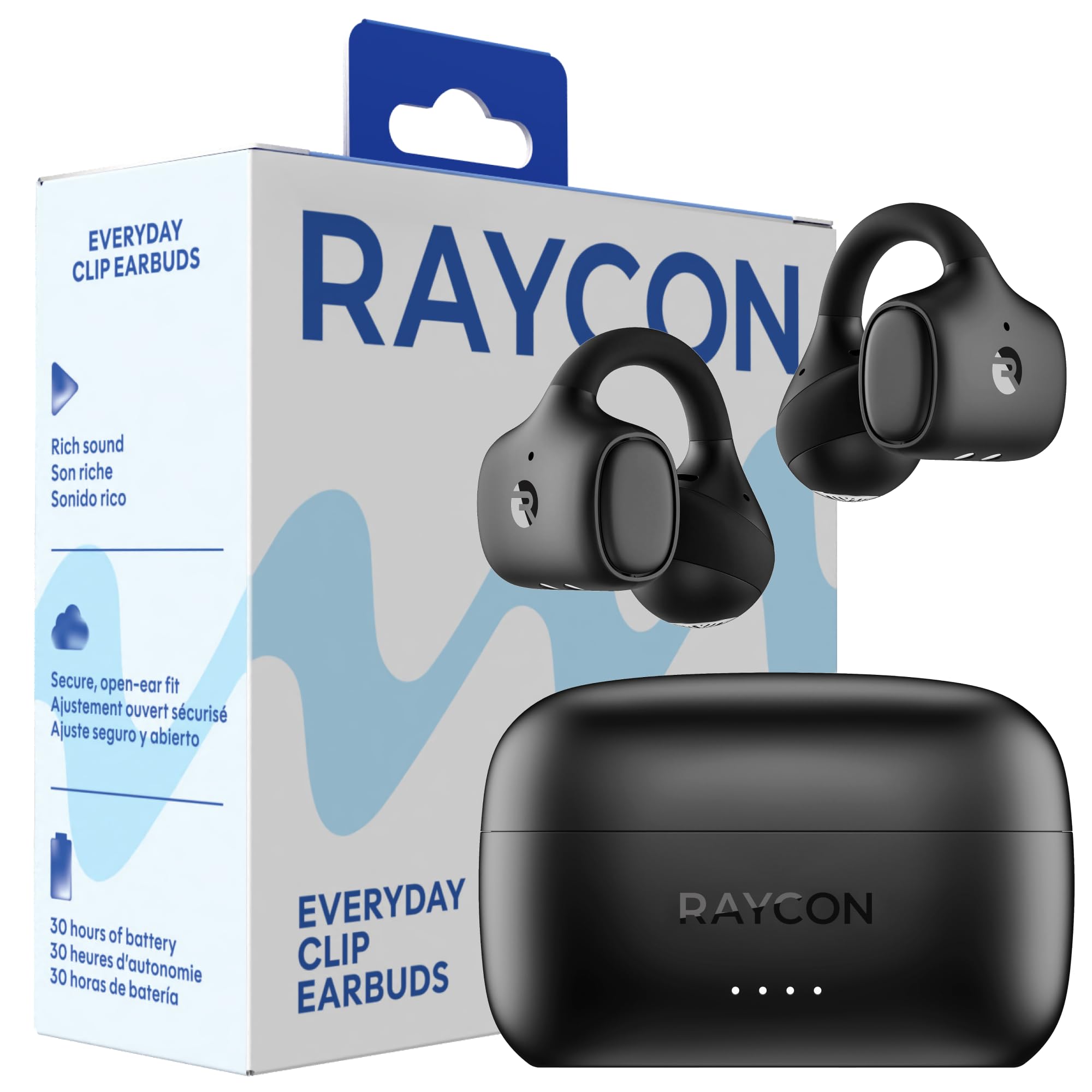
3. Raycon Everyday Clip On Earbuds
At 6.17 grams per side, these clip on and then vanish from your awareness.
Many runners give up on earbuds not because they die but because they hurt after an hour. The Everyday Clip attacks that with weight: at 6.17 grams, the bud is light enough to forget, and the nickel-titanium memory-metal clip flexes to your outer ear without squeezing. No canal contact, so no ear fatigue on a long session. The clip also clears glasses and hats, which most earhook designs struggle with.
On the safety side, the open-ear design keeps you fully aware of surroundings, which is the whole reason to pick a clip form over a sealed bud. The water rating is IPX5 — sweat-proof and rain-ready, not submersible. Battery is the headline: 30 hours of total playtime across the earbuds and case, which is a 3.8x jump over the 8 hours on the SHOKZ OpenRun. Bluetooth 6 here versus 5.1 there is the other gap note if you pair to newer gear.
Quality is what people keep coming back to, with the sound and the comfort filling out the praise. The physical push buttons are a small but real win — no accidental taps when you touch your ear mid-stride, and they work with gloves on. The trade-off is honest: open-ear clips trade bass for awareness, so do not pick this if you want a deep, sealed thump.
All-day math: 30 hours total across buds and case is the longest figure in this group — enough that charging is a weekend chore, not a nightly one.
Fair caveat: IPX5 stops at sweat and spray, so this is not the pair to swim or shower in.
Go this way for: multi-hour comfort and a clip that clears glasses and hats.
Not the one for: pool work — the IPX5 rating caps the water it can take.
4. JBL Endurance Peak 3 Earbuds
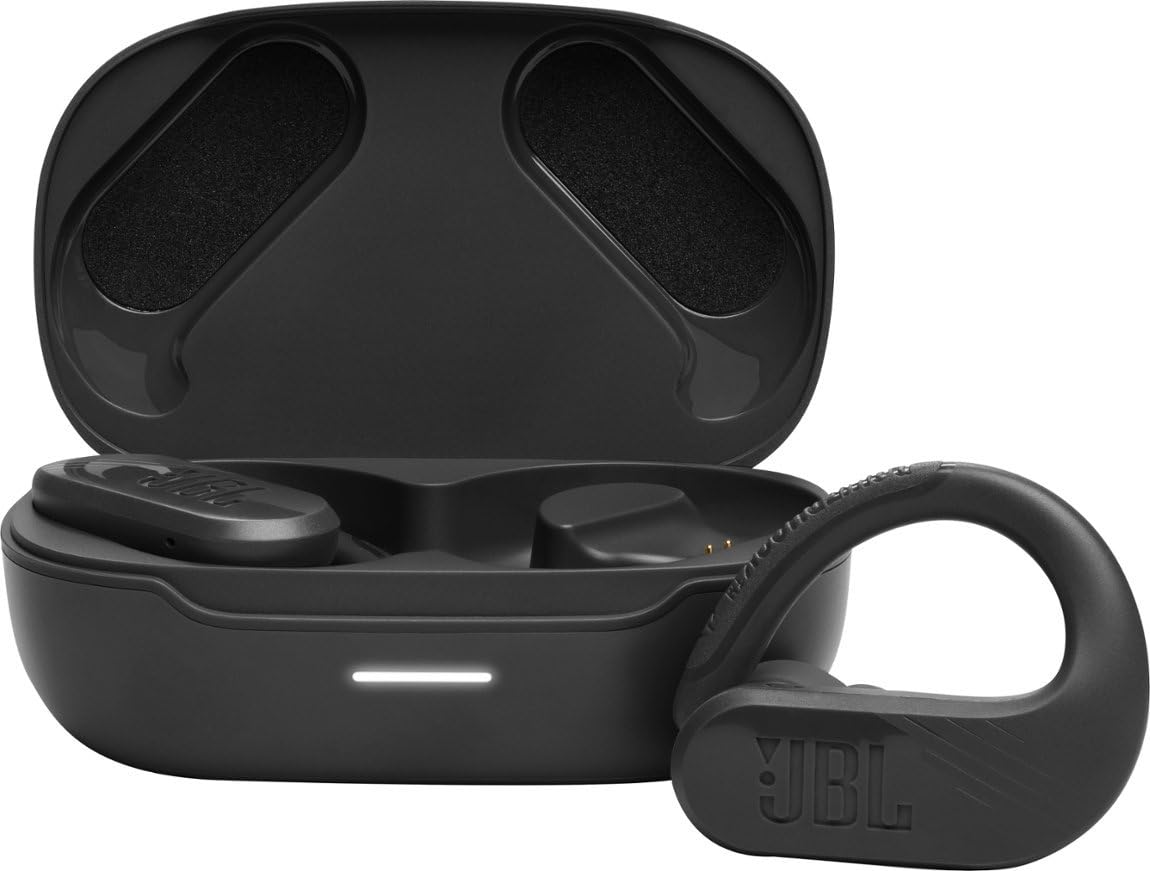
The earbud that survives half an hour at 1.5 meters under salt water or fresh.
IP68 is rare in this group, and JBL spells out what it buys: 30 minutes at depths up to 1.5 meters in salt or fresh water. That is a rating you can rinse under a tap after a muddy trail run without flinching, and it is why this pair is the one to look at if your workout puts you near a pool. A 10mm dynamic driver delivers the brand’s Pure Bass tuning, which is the bass-forward signature you either love or do not.
Playtime is up to 10 hours in the earbuds and 40 more in the case — 50 total — and a 10-minute speed charge gets you up to an hour of listening on the way out the door. The fit is the other strong point, with a secure hold that keeps them in on a hard stride. The recurring friction is Bluetooth pairing: connectivity draws mixed reports, and volume is the one aspect that trends negative. The bargain angle is real too, since this is the Renewed listing.
The physical win: IP68 with a stated 1.5-meter depth for 30 minutes is the most detailed water claim on this list — it is not just a label, it is a tested scenario.
What to expect: pairing can be fussy, so budget a couple of minutes to get it linked before your first run.
This is your pick if: you want a sealed true-wireless bud that handles rain and a rinse.
Skip the pairing headache by: checking the Bluetooth list once before you head out — that is the reported snag here.
5. Soundcore Sport X20 Earbuds

For the lifter who wants clanging weights to disappear, not the road noise.
Adaptive noise cancelling is the whole pitch, and for a gym session it changes the experience. The earbuds read the room and dial the cancellation up, so grunts and dropped plates fade back. The trade is simple: this is the pair to wear inside, where you do not need traffic audible. The 11mm dynamic driver with BassUp tuning backs it with low end that hits on a heavy set.
Fit is where the Sport X20 earns its place on a running list. The adjustable ear hooks rotate up to 30 degrees and extend 4mm, so you can dial the position onto your ear shape. That is a customization most of the fixed-hook pairs here do not offer. The IP68 SweatGuard seal protects against water, sweat, and dust, and the 12-hour earbud battery paired with 48 hours in the case covers a week of training.
The sound and secure fit are what the reviews keep landing on, with the noise and transparency switch getting frequent praise. The honest note: adaptive noise cancelling needs a sealed fit, so this is a warmer, more isolated listen than the open-ear pairs above. If you want to hear the trail, pick one of those. If you want the gym to go quiet, this is it.
Adjustability advantage: 30 degrees of rotation plus 4mm of extension is the tunable fit you want if earhooks usually sit wrong on you.
Where it fits best: indoor training, not road running — the cancellation is the point and the awareness is the sacrifice.
Built for: the gym rat who wants the room to go silent under a heavy weight.
Not ideal for: open-trail running where you need to hear what is behind you.
6. JBL Endurance Zone Headphones
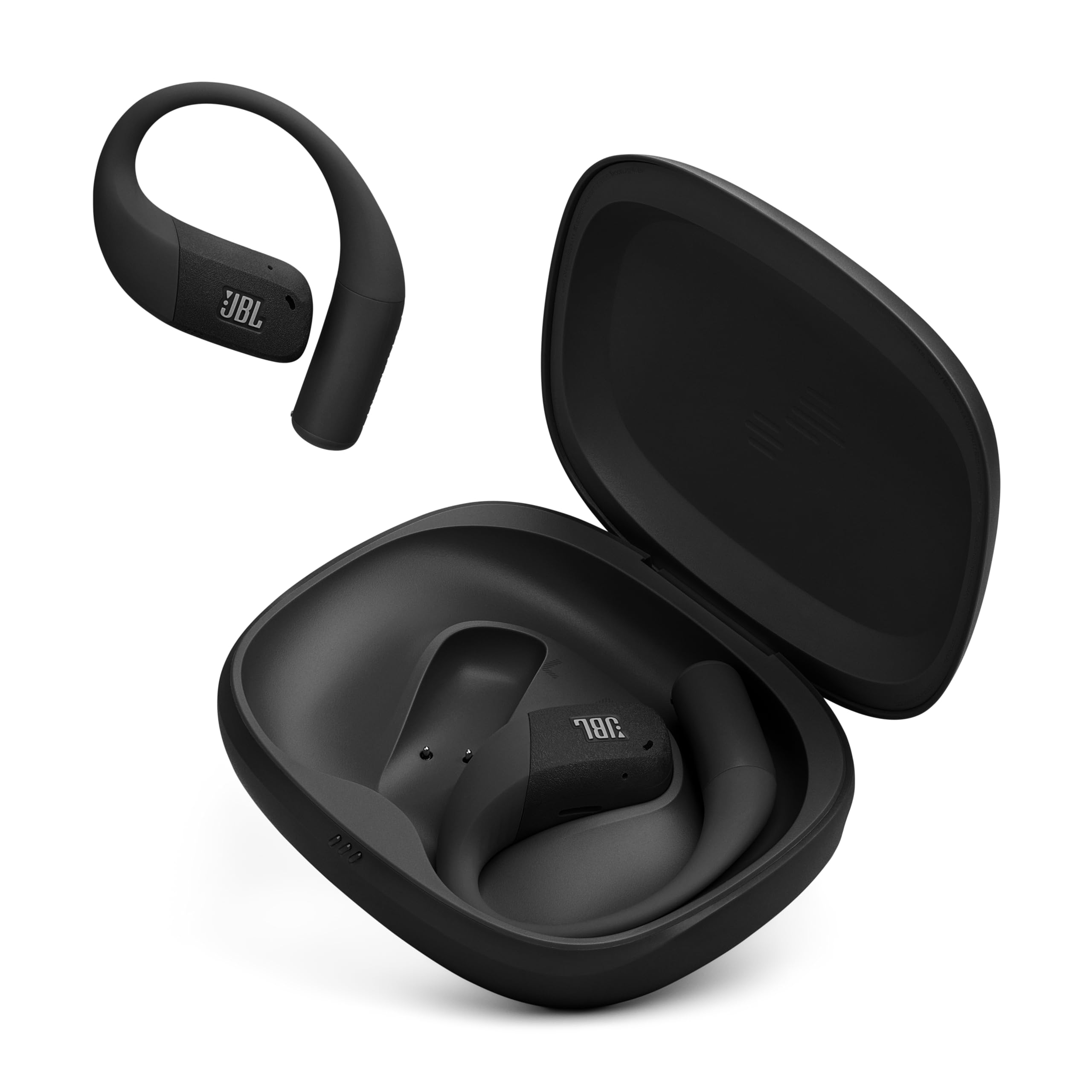
Open-ear sound with four mics built for windy trail calls.
Most open-ear pairs treat the microphone as an afterthought. The Endurance Zone puts four of them — two beamforming per earbud — into a housing that also carries a hydrodynamic windproof design to cut the distortion that wind creates against a mic. If you take work calls on a run or need to answer mid-trail, this is the pair built for that.
The driver is an 18x11mm dynamic unit (large for the open-ear form) with an adaptive bass boost, which is why the sound holds up better than you expect from a bud that keeps your canal open. The liquid silicone earhook with adaptable memory wire holds the fit. IP68 covers sweat, rain, salt water, and sand, and JBL says the rugged case resists scratch and stretch. Playtime is up to 8 hours in the earbuds plus 24 in the case, for 32 total, and a 10-minute charge adds 3 hours.
Sound is the most-praised part, with battery and comfort following close. The rest is mixed: some find the fit spot-on, others find the buds too big for their ears, and value draws both sides. That is an ear-size fit issue, not a defect — check your ear size and the return window. Google Fast Pair handles Android linking, and Google Finder can ping a lost bud.
One-line verdict: pick this if your runs double as call time and you need the mic to carry your voice over wind.
Check the fit: the buds run large on some ears, so try them early while returns are easy.
7. NANK Runner Diver2 Pro Headphones

IP69 and a built-in MP3 player — this one is designed to go underwater when the others stop.
Bluetooth signals do not travel through water, so a pair that works while swimming has to store the music itself. The Diver2 Pro does exactly that with 32GB of built-in MP3 storage, which is the one feature no other pair on this list carries. Triple-tap to switch modes: Bluetooth for the run, MP3 for the lap pool. The IP69 rating is built for submersion at depths up to 10 meters, with up to 5 hours of continuous underwater playback.
Outside the pool it behaves like a good bone conduction pair. Bluetooth 5.4 is the newest version here, the 10-hour battery covers most training days, and a 10-minute charge adds up to 2 hours. The 35-degree adjustable ear hooks fit under swim caps, goggles, and helmets, and there is an included silicone strap to pull the fit tighter. Sound quality is what owners rank first, with functionality right behind — a surprising result for the form factor.
The honest catch is the mode switch: Bluetooth drops out underwater, so load tracks and switch to MP3 before you get in. That is not a flaw so much as a rule of Bluetooth underwater, and the included demo tracks let you test it. There is also a noise-cancelling mode for open-air work, plus earbuds and sound enhancers in the box for pool days.
The swim math: 32GB of storage plus IP69 to 10 meters is the only combination here that works underwater — the others stay on deck.
The operating rule: music must be downloaded to the built-in storage before you swim, so set it up the night before.
Worth the pick if: you swim laps and want music in the water, not just on the way to the pool.
Do not buy it for: phone-free streaming — you load the tracks yourself, so it is not a replacement for a phone on land.
8. Cleer ARC 5 Open Ear Earbuds with Dolby & THX Audio, Black
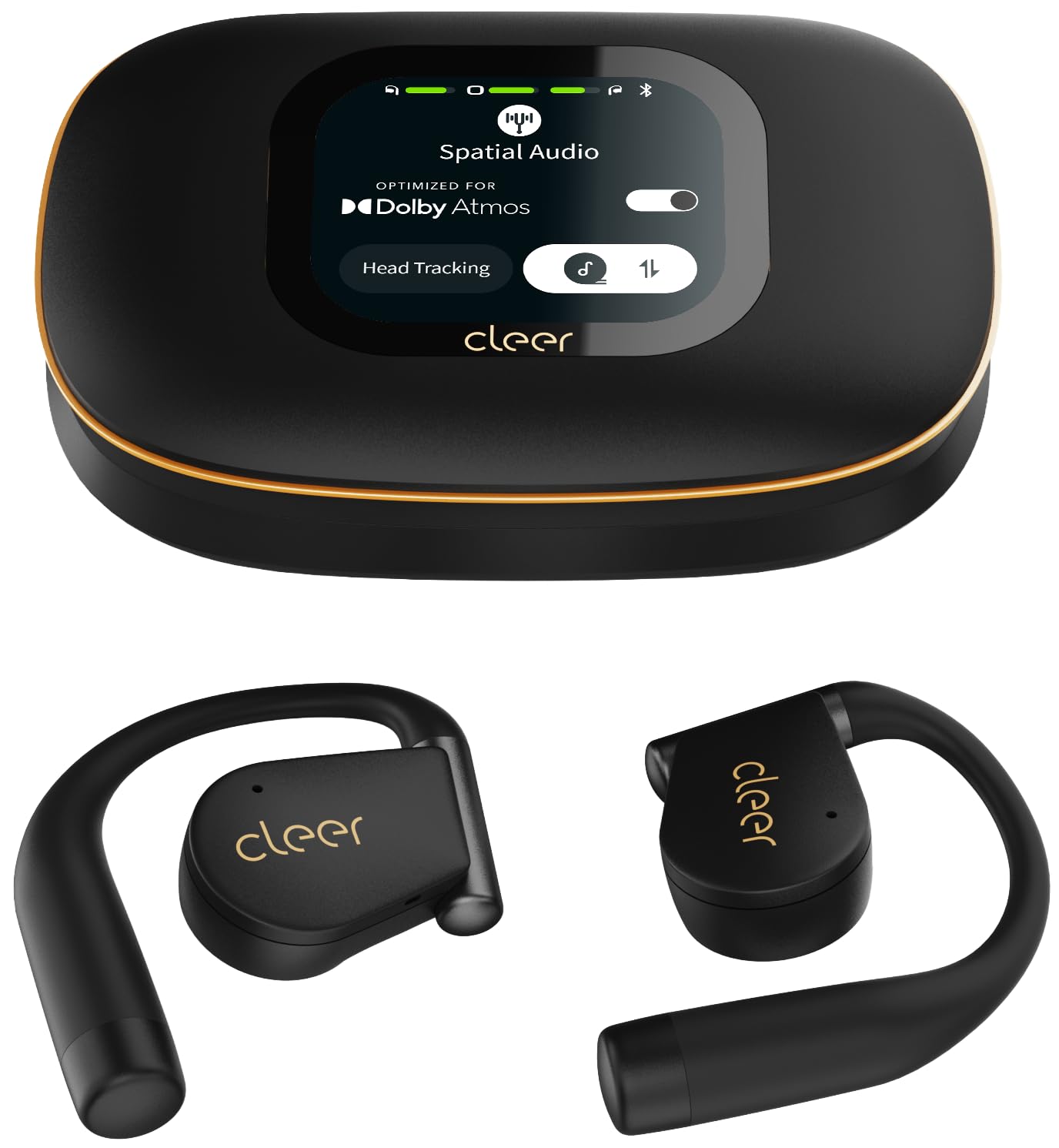
Dolby Atmos and THX spatial audio in an open-ear bud that stays put while you run.
This is the pair for the runner who treats a long run like a listening session. Dolby Atmos and THX Spatial Audio with dynamic head tracking (the audio field moves with your head) turn a trail run into a room-filling mix, while the open-ear form keeps your surroundings audible. Snapdragon Sound, aptX Adaptive, and Lossless support back that up, with DBE 4.0 for a fuller low end. Sound quality is the clear favorite in reviews — the spatial trick is the reason.
Battery is the vertical win: up to 60 hours total with the charging case, and a 5-minute charge gets you up to 2 hours of playback. That is the longest total figure on this list, and it is a lot for an open-ear pair. IPX7 handles sweat and rain (the 7 covers short immersion), and the physical controls keep it simple. Apple MFi certification means it pairs cleanly to iPhone and iPad, and the Cleer+ app handles EQ and firmware.
The honest caveat is fit and comfort, where reviews split — some find the earhooks comfortable, others do not, and connectivity draws both sides too. That is an earhook shape mismatch, not a broken product. The carrying case weighs 97 grams, which is light enough to clip to a belt loop. Sound is where it wins, and the fit is where you should try before committing to a long run.
For the audio-first runner: spatial audio plus 60 hours of case-backed playtime is the strongest listening package here.
Try the fit first: earhook comfort is the split point, so take a short run before a long one.
9. SHOKZ OpenFit 2 Earbuds

11 hours in the buds alone — enough for most marathons with charge left over.
Most of this list tops out at 8 to 10 hours per earbud charge. The OpenFit 2 runs up to 11 hours in the earbuds and 48 hours with the charging case, which is the longest per-bud figure here. A 10-minute quick charge adds 2 hours, so a forgotten plug-in the night before is not a crisis. For an ultra or a long race day, that headroom matters.
The physical bit is the weight: 9.4 grams per earhook, with a Ni-Ti alloy (a springy, shape-memory metal) that conforms to your ear. It flexes and holds rather than clamping. The open-ear air-conduction design keeps you aware, and dual noise-cancelling mics and DirectPitch 2.0 keep your calls private. The rating is IP55 — splash and sweat resistant, but not the pair to swim in.
Sound quality is what leads, with comfort and reliable performance filling out the picture — people wear them all day and pair them to phones and computers without a fight. Bluetooth 5 is the older version here versus the 6 on the Raycon and SoundPEATS above, though the Shokz App lets you remap the buttons and EQ. The honest trade is the IP55 water ceiling: fine for rain and sweat, but it will not survive a dunk.
Race-day headroom: 11 hours in the buds, 48 with the case, and 2 extra hours from a 10-minute charge.
The ceiling: IP55 covers sweat and rain but not submersion, so keep it out of the pool.
Suits you if: you run long and want the charge to outlast your legs.
Look past it if: your training involves water deeper than rain — IP55 is the limit.
Know the Specs
What IPX5, IP67, IP68, IP69 and IPX7 actually mean
The letters stand for ingress protection (how well a case keeps out solids and liquids). IPX5 handles sweat and rain spray. A 6 in the first digit adds full dust protection, so IP67 keeps grit out and survives a splash. IP68 goes a step further and survives submersion — the JBL Endurance Peak 3 states 30 minutes at up to 1.5 meters. IP69 is rated for high-pressure, high-temperature water and depths up to 10 meters on the NANK. A lone IPX7 covers short immersion. For running, IPX5 is enough; for swimming, you need the high digits.
Bone conduction, air conduction and the open-ear trade
Bone conduction uses a vibrating transducer against your cheekbone to send sound straight to the inner ear, so the canal stays open. Air conduction open-ear designs put the driver just outside the canal and aim the sound inward. Both keep you aware of traffic, which is why runners pick them. The trade is bass depth: a sealed bud pushes air into a closed canal and delivers more low end. That is not a flaw — it is a choice between sealed bass and open-ear awareness.
Total playtime versus earbud-only playtime
A 48-hour or 60-hour claim usually counts the charging case along with the buds. Look for the split. The OpenFit 2 runs 11 hours in the buds and 48 with the case. The ARC 5 says 60 hours total with the case. If your run is longer than the earbud-only number, you need the case with you. Quick-charge figures matter too: 10 minutes gets 1.5 hours on the OpenRun, 2 hours on the OpenFit 2 and Diver2 Pro, and 5 hours on the Q40 HD.
Bluetooth version and range for gym and trail
The number after “Bluetooth” is the version — higher generally means newer connection behavior. The Q40 HD and Raycon use Bluetooth 6, the Diver2 Pro and ARC 5 use 5.4, and the OpenRun and Endurance Peak 3 use older versions. Range is stated in meters or feet: the Q40 HD reaches 20 meters, the Endurance Peak 3 and OpenRun reach 10 meters, and the OpenFit 2 and Everyday Clip reach about 33 feet. If you leave your phone on a rack or in a bag, the longer range saves you a walk.
Common Questions
Can I swim with waterproof running earphones?
Is IPX5 enough for running in heavy sweat or rain?
Will open-ear earphones stay on during a hard run?
Do bone conduction earphones have worse sound than regular earbuds?
How long does the battery last on these running earphones?
What is the difference between IP67 and IP68?
Can I take calls on open-ear running earphones?
Do these earphones work with both iPhone and Android?
Is a neckband better than true wireless for running?
How do I know if a bud will fit my ear shape?
The Bottom Line
For most runners, the waterproof running earphones winner is the SHOKZ OpenRun because its IP67 rating and bone conduction design keep your ears open to traffic while the sweat and rain stay out. If you want a neckband that pushes Hi-Res detail and cannot be dropped, grab the SoundPEATS Q40 HD. And for lap-pool training, the NANK Runner Diver2 Pro is the one to reach for, with IP69 and 32GB of onboard MP3 storage. The honest nudge: the OpenRun is the safest daily pick, because open-ear awareness matters more on a wet road than any spec sheet can show.
How we choose
We do not accept paid placement. Every pick is matched to a real buyer and a real use-case; we do not hands-on test units.
Sources
Specifications: manufacturer listings and product documentation. Review insights: verified customer reviews, as of November 2026. Pricing: not shown on this page (it changes often); check the current price via the retailer link.
As an Amazon Associate, Tactical Gear Guy earns from qualifying purchases. This does not affect which products we feature.