Specs are compiled from manufacturer listings and verified buyer reviews and can change over time — please confirm the key details on the product page before buying.
Buying women’s snowboard boots is really three decisions: does the boot lock your heel down, does the flex match how you ride, and can you actually crank it tight in a cold parking lot? Get the heel hold wrong and your heel lifts on every toe-side turn, costing you control. Get the flex wrong and a soft boot washes out at speed while a stiff one fights you in the park. This guide walks through six real women’s-specific boots, from heat-moldable lace-ups to dual-zone dial boots, and names the exact trade-off on each one.
This guide is built by comparing the manufacturers’ published specifications and the patterns across verified customer reviews, so you get each pick’s real strengths and trade-offs instead of marketing spin.
Heel hold, flex rating and liner moldability decide whether a boot works for your foot, so every pick below is judged on those three things first. Read on for the full breakdown of the best women’s snowboard boots.
Top Picks
How To Choose The Best Women’s Snowboard Boots
A women’s snowboard boot has to do two jobs at once: hold your heel in place when you push a turn, and stay warm and comfortable on a lift ride. Most buyers over-focus on looks and under-focus on heel hold.
Start with heel hold, not colorway
If your heel lifts even a few millimetres inside the boot, you lose control on toe-side turns. Look for a women’s-specific fit last and an internal harness or J-bar setup. A boot described as women’s-specific True Fit, or one with Internal J Bars in its liner, is built to wrap a narrower heel and instep rather than just shrink a men’s shell.
Match flex rating to how you actually ride
Flex is how stiff the boot resists bending. A soft boot around 4/10 lets you press and butter with little effort, which suits park laps, beginner turns and playful all-mountain riding. Stiffer boots give more support at speed but ask more of your legs. Two boots here list an explicit 4/10 medium-soft flex, so use that as your anchor point when reading other listings.
Decide between BOA dials and laces before you shop
BOA systems tighten the whole boot with a turning dial and release with a pull, which is far easier with gloves on in a cold lot. Traditional laces let you tension each zone separately by hand. A hybrid setup — a quick-pull inner liner lacing plus traditional outer laces — gives you both the glove-friendly liner lock and hand-tuned outer tension.
Take liner moldability seriously
A heat-moldable liner softens in a shop oven and then takes the shape of your foot as it cools. That is what kills pressure points on a wider forefoot or a high instep. Thermofit or heat-moldable liners appear on several picks here, and they are the single biggest comfort upgrade for a boot that feels tight in the first hour.
Side-by-Side Comparison
| Model | Best For | Closure | Flex Rating | Liner | Amazon |
|---|---|---|---|---|---|
| Burton Women’s Mint BOA★ Best Overall | All-mountain comfort | Single-Zone BOA | Soft flex | Imprint 1+ heat-moldable | Amazon |
| DC Shoes Lotus BOAPrecision Pick | Micro-adjustable precision | Dual Zone BOA (H4 Coiler) | 4/10 medium | Response Liner II | Amazon |
| K2 Belief BOA | Lightweight BOA touring | BOA Focus Fit | — | Intuition Comfort Foam 3D | Amazon |
| DC Phase Boa | Park and freestyle laps | BOA H4 Coiler | 4/10 | Response Liner I | Amazon |
| Siren Lux | Budget heat-mold fit | Traditional lace + Quicklace liner | — | Thermofit heat-moldable | Amazon |
| thirtytwo Womens Shifty Boa | Heel-hold focus | BOA | — | Heat-moldable foam | Amazon |
Detailed Reviews
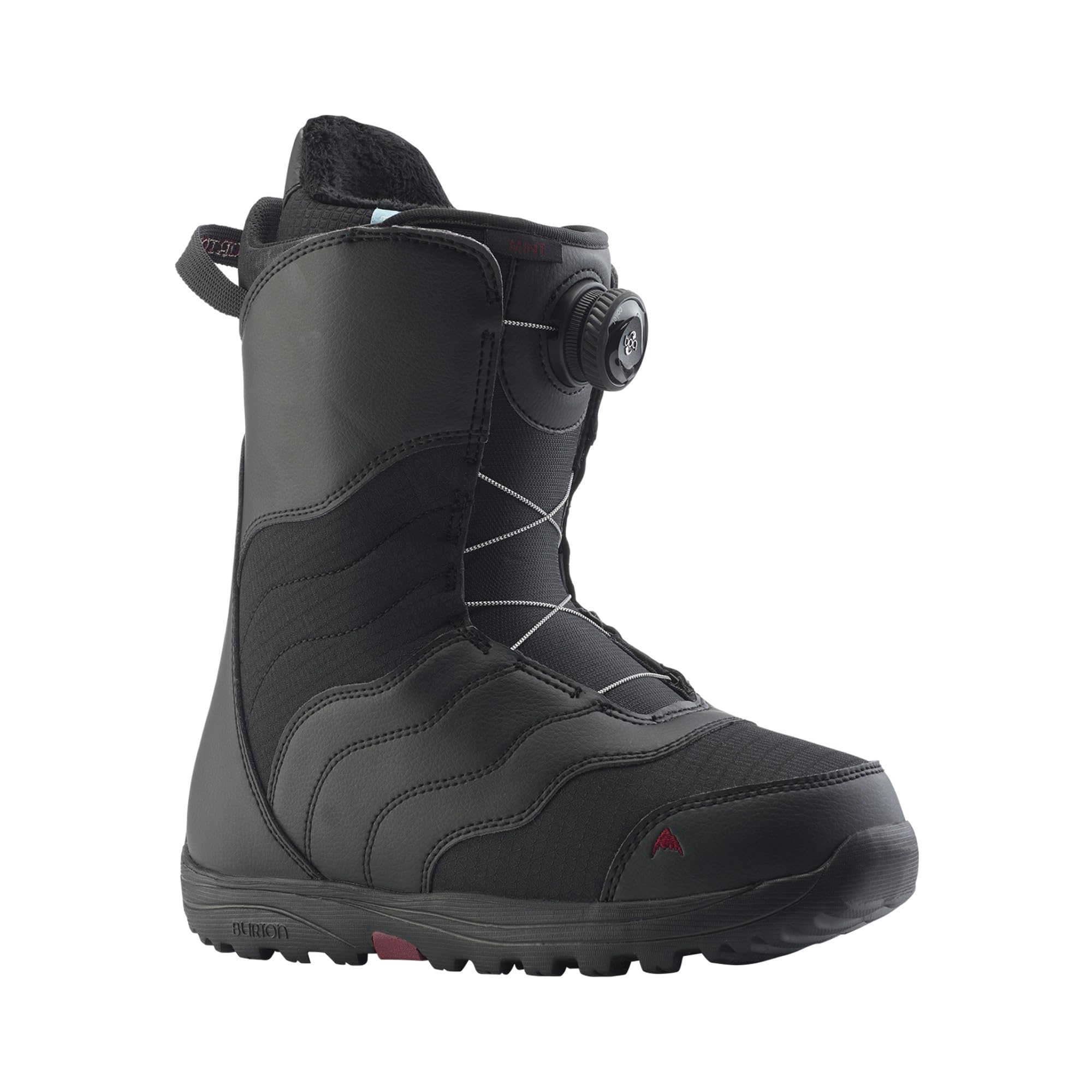
1. Burton Women’s Mint BOA Snowboard Boots
Our pick — 4.0+★ from 90+ verified ratings; the strongest balance of quality and price.
The boot built for the woman who wants a soft, forgiving ride without fighting her laces in the cold.
The Burton Mint starts with a women’s-specific True Fit last, meaning the shell is shaped around a narrower heel and instep instead of a shrunken men’s mold. That is the spec that actually decides heel hold, and it is why this sits at the top of the list. Add an Imprint 1+ heat-moldable liner with integrated lacing, and the boot wraps the foot instead of just sitting over it. On cold mornings, the reflective foil sleeping-bag layer under your foot is what keeps warmth from escaping straight down into the board.
Lacing is a single-zone BOA system, where an inner spool routes the lace so one dial tightens the whole boot. It is the fast, glove-on option — a few clicks and you are locked in, no re-lacing on the lift. The 1:1 soft flex PowerUp tongue adds a snug interface between boot and tongue so the fit feels consistent from the first run. And the DynoLITE outsole is built to cushion and keep board feel, which matters when you want to detect the terrain underfoot rather than ride on a numb platform.
Comfort reviews are mixed: many buyers call these the most comfortable boots they own, but blister complaints also appear. That pattern points to a boot that needs a proper heat mold and the correct size, not straight-out-of-the-box wear. Buyers praise overall quality most, which fits a boot with a durable polyurethane backstay (a stiff plastic panel at the back of the heel) and a snow-proof internal gusset (a sealed flap that keeps snow out of the lower boot). A one-year warranty covers manufacturing defects. Treat the liner mold as mandatory, not optional, and this becomes a very forgiving all-mountain boot.
What earns it the top spot
- Women’s-specific True Fit last built around a narrower heel and instep
- Single-zone BOA dial tightens the whole boot with gloves on
- Imprint 1+ heat-moldable liner plus reflective foil underfoot for warmth
- DynoLITE outsole cushions while keeping board feel
- Snow-proof internal gusset seals the lower boot
Where it needs a nudge
- Comfort feedback is mixed — a few riders get blisters before the liner is molded
- Single-zone BOA tensions the boot as one unit, so you cannot tune upper and lower separately
Reach for this if: you want a soft-flex all-mountain boot with dial lacing and a liner that can be molded to your foot.
Look elsewhere if: you want separate upper and lower tension zones, which needs a dual-dial system.
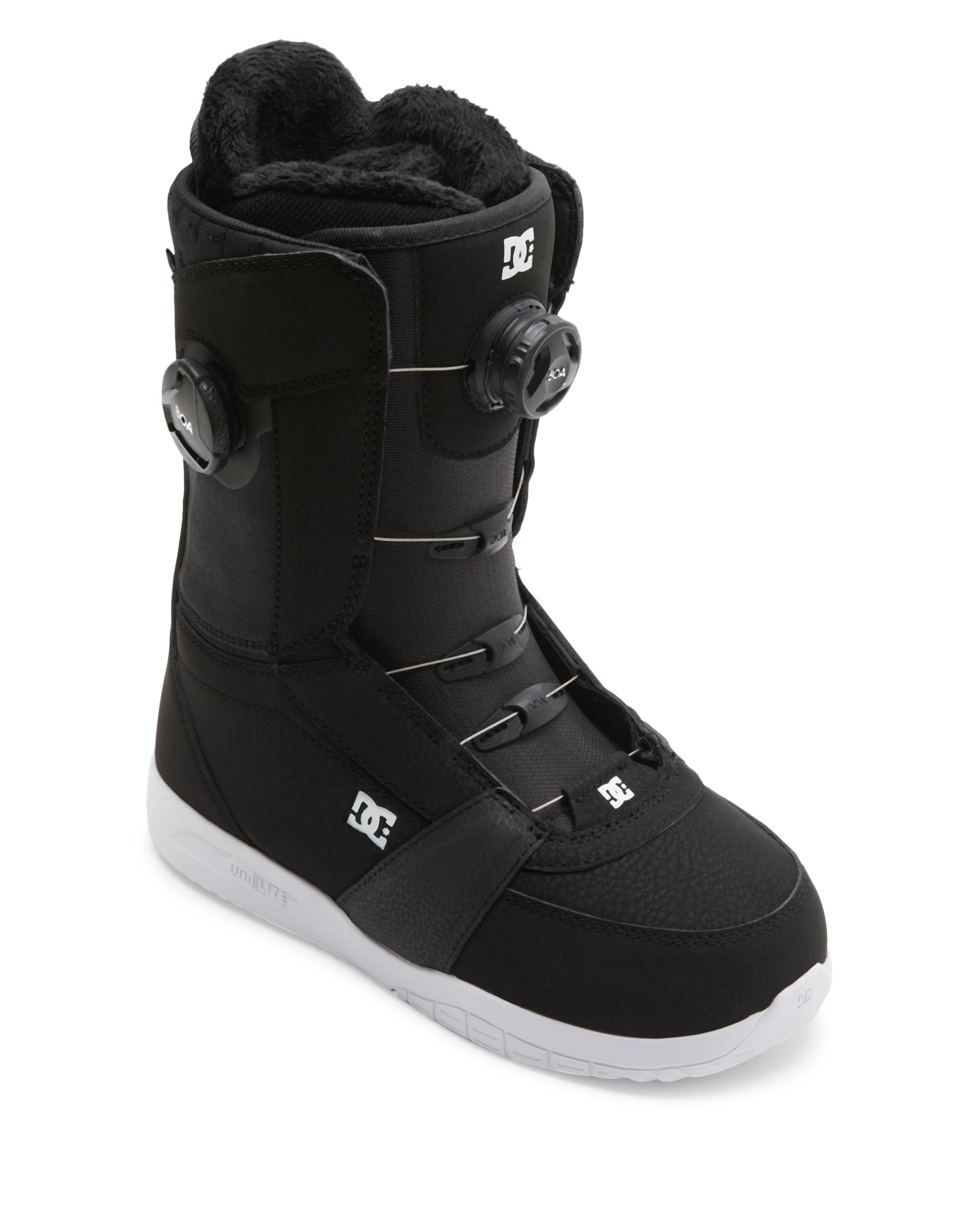
2. DC Shoes Lotus BOA Snowboard Boots
Two dials, one for each zone — the boot that lets you crank the ankle tight and leave the calf loose.
The Lotus is the pick when you have ever wished you could tighten just the lower half of a boot. It uses a Dual Zone BOA Fit System with H4 Coiler dials, so the upper and lower zones tension independently. That is the fix for the single-dial limitation you get on the Burton Mint above — heel lock without strangling your shin. The medium 4/10 flex keeps it playful rather than plank-stiff, and the articulated construction is built to allow a natural range of motion as you press into a turn.
DC’s Response Liner II does the heavy lifting inside. It is a multi-layer liner with a 360-degree power strap and latex J-bars, which are the side inserts that clamp your ankle and stop heel lift. Underfoot, the molded IMPACT-ALG insole adds arch support and a heel cup. Between the J-bars, the power strap and the heel cup, this is a boot engineered around heel hold from three directions at once.
Weight is the trade-off you should know about before you buy. At 5.3 pounds versus the DC Phase Boa at 4 pounds, this is a substantial boot. The Unilite outsole is built to claw some of that back with board feel and grip. If you are counting grams for a long touring day, weigh that against the dual-dial precision. For riders who want maximum ankle lockdown, the extra mass is a fair trade.
Where the value sits: the independent dual-zone dials are the real story — precision fit that single-dial boots simply cannot match, paired with a liner that attacks heel lift from multiple angles.
The catch to weigh: this is a heavier boot at 5.3 pounds, so pair it with the fact that it wants a rider who prioritizes lockdown over feather weight.
Best matched to: riders who want two-zone micro-adjustment and a liner built to kill heel lift.
Think twice if: a light boot on your foot matters more to you than dial precision.
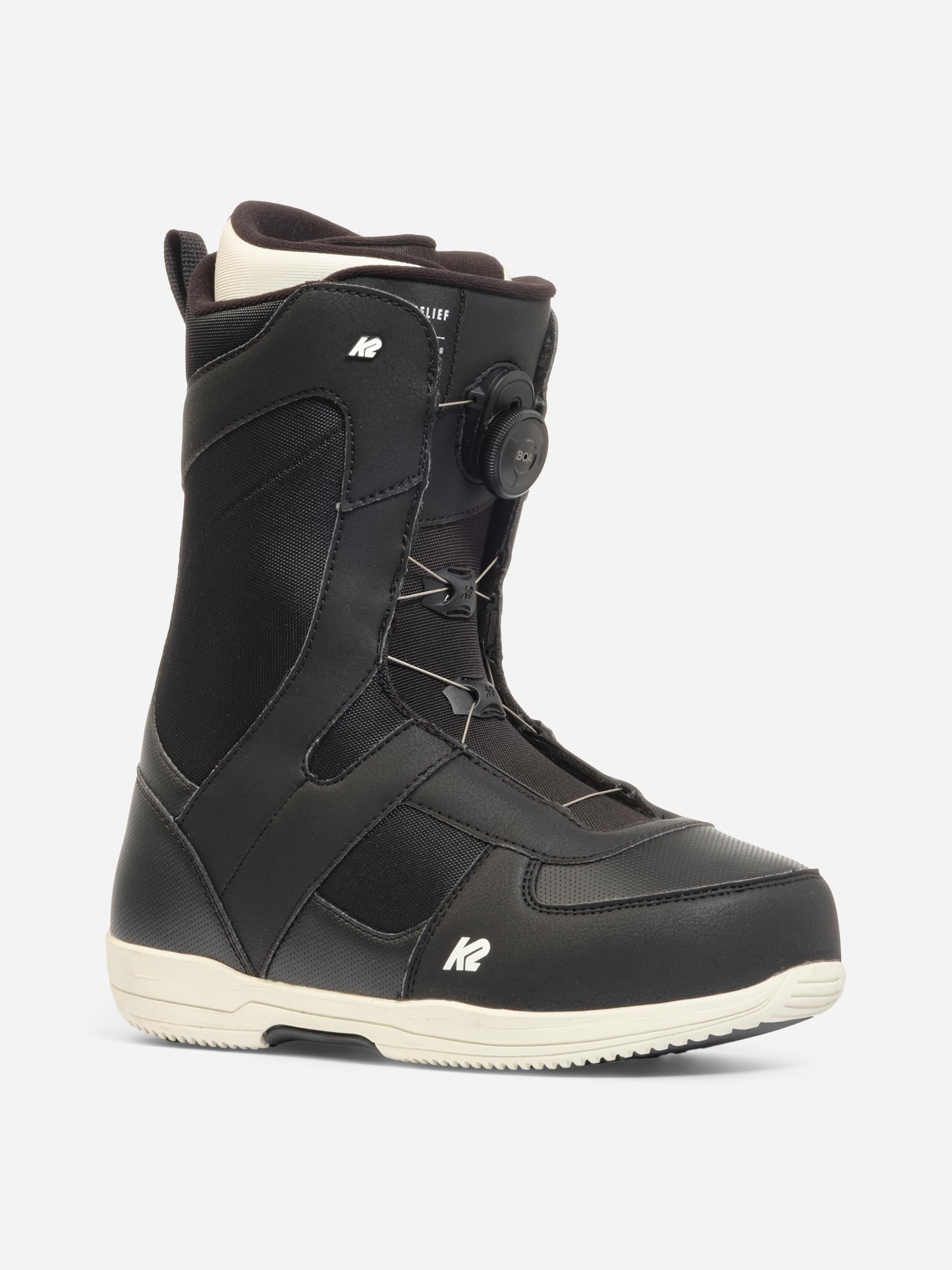
3. K2 Belief BOA Women’s Snowboard Boots
Sixteen ounces of BOA boot — the weight of a full water bottle, not a brick on each foot.
The number worth pausing on is 16 ounces. That is this boot’s listed weight, and it makes it one of the lightest boots on this list by a wide margin. Compare it to the DC Lotus at 5.3 pounds and the difference is dramatic — the Belief is a boot you can wear for a full day without feeling it in your calves on the last run. The H4 BOA Focus Fit System tightens the shell on a dial, which suits cold-fingered lift-line adjustments.
Inside, K2 uses an Intuition Comfort Foam 3D Liner paired with Comfort Foam EVA. Intuition liners are known for molding to the foot, and the fast-in liner lacing lets you lock that liner down before you even touch the outer shell. Internal J Bars sit at the ankle to combat heel lift — the same anti-lift approach the DC Lotus takes, but here it comes at 16 ounces versus the DC Lotus at 5.3 pounds.
The Flex Zone Upper Cuff (a hinged top section that flexes as your leg leans forward) keeps a light boot from feeling flimsy. It gives you ankle support without a rigid wall fighting your shin. Sizing runs to a 5 in the listed spec, so check the manufacturer size chart carefully before you order — a light boot is only light if it actually fits. For a rider who wants a dial boot without a weight penalty, this is the fit-to-purpose choice.
What stands out: 16 ounces of boot with a moldable Intuition liner and internal J-bar heel hold — light enough for long days, supportive enough for real turns.
What to verify first: the sizing runs to size 5 in the spec, so confirm your size against K2’s chart before committing.
Made for: the rider chasing the lightest possible BOA boot with genuine liner moldability.
Worth a pass if: you need a specific size that falls outside what this listing offers.
4. DC Phase Boa Snowboard Boots Women’s 2025-8.5

A 4/10 flex and a BOA dial for riders who want to press, butter and play all over the mountain.
If you spend your day in the park, the Phase Boa’s explicit 4/10 flex rating is exactly the lever you want. Soft enough to press the nose of a board without a fight, stiff enough to hold an edge on a groomer. It matches the Lotus on that flex number and arrives at 4 pounds versus the Lotus at 5.3 — a gap you will notice on air and on the lift.
The BOA Fit System here uses an H4 Coiler dial, so the lacing tightens uniformly with a twist and releases with a pull. The Response Liner I and IMPACT-ALG Insole carry the internal support work, the same insole family DC uses across the line to add arch support and heel cushioning underfoot. The Foundation UniLite outsole keeps the base light and flexible to match the soft flex above it.
One thing to set expectations on: this listing carries a modest review footprint, so you are buying more on the spec sheet than on a deep owner history. That is normal for a newer colorway or model-year SKU. The spec sheet is strong for its purpose — soft flex, dial lacing, insole support, light weight — and for a park-focused rider that combination is what actually matters. If you want years of aggregated feedback before you commit, the Burton and Siren options below have more buyer history behind them.
Where the Phase earns its place
- Explicit 4/10 flex tuned for park and playful all-mountain riding
- BOA H4 Coiler dial for glove-friendly tightening
- 4 pounds versus the DC Lotus at 5.3 pounds
- IMPACT-ALG insole adds arch and heel support
Keep in mind
- A newer listing with a smaller review footprint than the established picks
- Single-dial tensioning, so no separate upper and lower zones
Tailored to: park riders and playful all-mountain riders who want a 4/10 soft flex with dial lacing.
Keep shopping if: you want a deep, long-running review history before you buy.
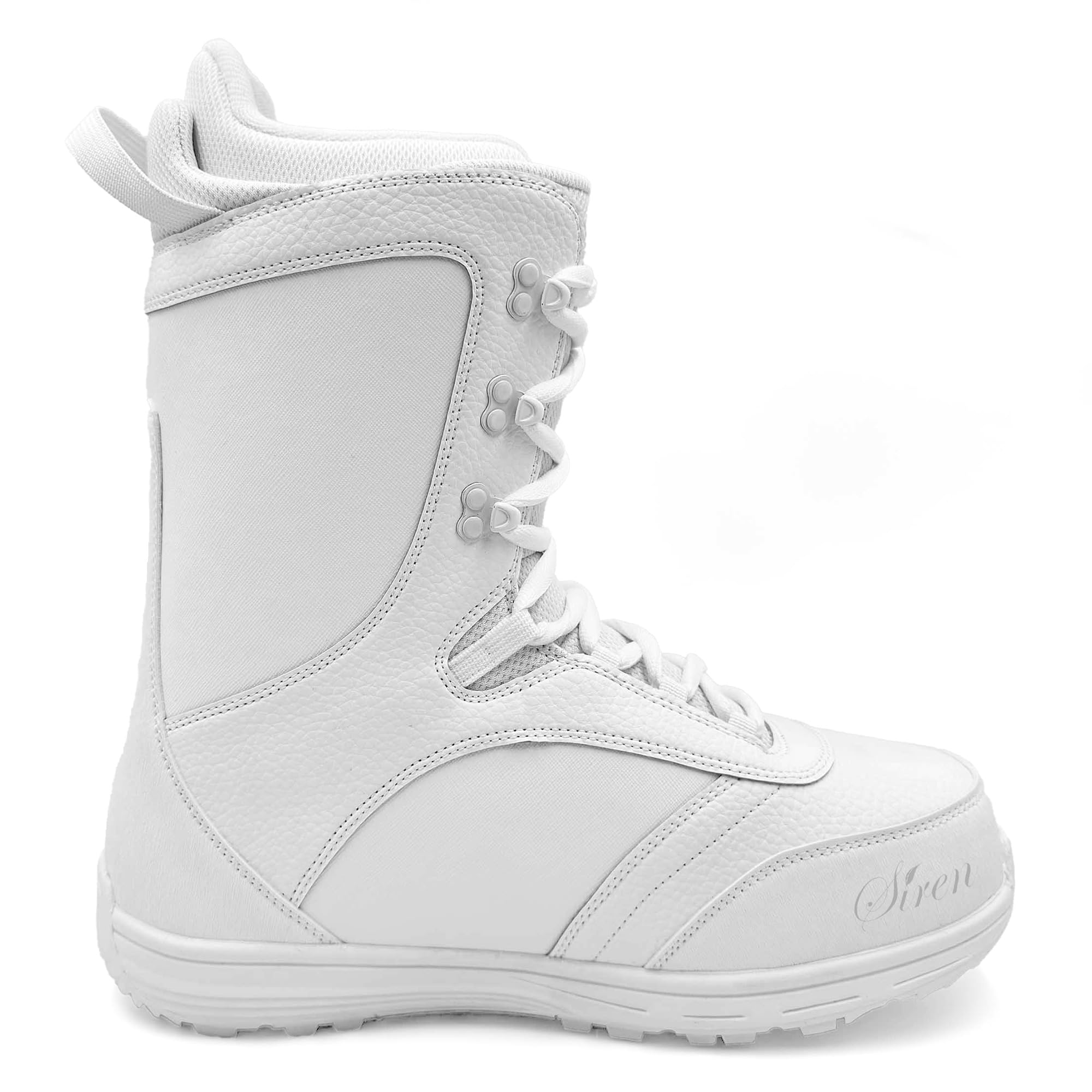
5. Siren Lux Women’s Snowboard Boots
The entry-level boot that still gives you a heat-moldable liner and two-zone lacing.
The Lux proves you do not need a dial to get a moldable fit. It runs a two-part lace setup: a Quicklace inner liner that you pull and lock to pin your foot in place, and a traditional outer lace you tension by hand. That inner Quicklace is the glove-friendly part — pull once, slide the lock down, and the liner holds all day. The outer laces then let you tune each section of the boot exactly how you like it.
The Thermofit heat-moldable liner is the headline for a boot at this end of the range. Heat molding is the single best fix for pressure points, and finding it on an entry-level boot is the reason this one earns a spot. A rubber sole adds grip when you are hiking a catwalk or walking across the base lodge, and metal lace loops make the traditional lacing last season after season.
Know the honest limits. This is a lace-up boot, so no dial, and the heat mold has to be done once at a shop, which adds a step before your first ride. The quality feedback on this model is mixed rather than glowing, so treat it as a value-first boot that rewards careful sizing and the mold step. If your priority is dial speed and a longer track record, the picks above suit you better. If you want moldable comfort for less, this is the sensible entry point.
The entry-level win: Thermofit heat-moldable liner plus a Quicklace inner and traditional outer lace — moldable fit and dual-zone lacing without a dial system.
Know before you buy: it is a lace-up with mixed quality feedback, so budget time for a professional heat mold and get your size right.
Great for: a first pair or a value-focused rider who wants a moldable liner and hand-tuned lacing.
Skip this one if: you would rather twist a dial than pull laces in the cold.
6. thirtytwo Womens Shifty Boa W’s ’24

A BOA boot built around one obsession: locking your heel down so it does not slide inside the shell.
The Shifty puts its cards on the table with a feature called Grip & Rip Heel Hold — a name that tells you exactly what problem it is solving. If your heel has ever lifted mid-turn, look for a boot with an internal harness or J-bars. The BOA Fit System tightens on a dial, and integrated internal lacing adds another layer of hold inside the shell, so the foot stays planted rather than shifting around.
The comfort touches are deliberately low-tech and sensible. A heat-moldable foam liner takes the shape of your foot, a Comfy Tongue cushions the pressure across the top of your foot, and a Cozy Cuff is built to keep the cuff interface soft against the shin. The Evolution Outsole forms the base. It is a straightforward formula — grip at the heel, mold at the liner, cushion at the cuff.
The fair caveat is that this is the most recently introduced boot here, which means the smallest pool of aggregated owner feedback to lean on, and it is not the cheapest dial boot either. Check sizing against thirtytwo’s own woman’s chart — the listed size is 8.5 — before you order.
Where it aims its effort: Grip & Rip Heel Hold plus integrated internal lacing means the whole design circles back to one goal — keeping your heel down for control on toe-side turns.
What to weigh: a newer, smaller-feedback listing, so lean on the spec and get the size right rather than on a long owner history.
Right for you when: heel lift is your main complaint and you want a BOA boot built to fix exactly that.
Look elsewhere when: you want a long, deep review record to backstop the decision.
Know the Specs
Flex Rating
Flex is how stiff the boot resists bending, usually written as a number out of 10. A 4/10 boot, like the DC Lotus and DC Phase Boa, is medium-soft — it lets you press, butter and move your ankles naturally, which suits park riding and forgiving all-mountain turns. A stiffer boot offers more support at speed but asks more effort from your legs. Match the flex number to the terrain you ride most, not the terrain you aspire to.
BOA Versus Traditional Lacing
A BOA system (a dial-and-wire lacing system) tightens the whole boot with a turning dial and releases with a pull, so you can adjust it with gloves on. Single-zone systems tension the boot as one unit; dual-zone systems like the DC Lotus let you tune the ankle and calf separately. Traditional laces, or a hybrid with a Quicklace inner liner like the Siren Lux, let you tension each zone by hand. Neither is better — it depends on if you want dial speed or hand-tuned zones.
Heat-Moldable Liners
The liner is the soft inner boot that touches your foot. A heat-moldable liner softens in a shop oven, then sets to the shape of your foot as it cools. That process smooths pressure points on a wider forefoot or a high instep and is the biggest comfort upgrade you can make. Thermofit, Imprint 1+ and Intuition Comfort Foam are all heat-moldable or mold-to-fit liner families, and every one benefits from being professionally molded before your first serious run.
Heel Hold
Heel hold is whether your heel stays pinned to the bottom of the boot when you push a turn. If it lifts, you lose control on toe-side turns and get blisters. Women’s-specific lasts, internal J-bars (side inserts at the ankle), 360-degree power straps and heel-hold harnesses all target this. When comparing boots, weight heel hold above colorway — a boot that lets your heel swim will frustrate you on the hill.
Common Questions
Do women’s snowboard boots really fit differently from men’s?
Is a BOA dial boot easier to tighten than laces in the cold?
What does a 4/10 flex rating actually feel like on the hill?
Do I need to heat mold a heat-moldable liner?
How tight should snowboard boots be around the heel?
Are BOA boots less durable than lace-up boots?
Can I use men’s boots instead of women’s-specific snowboard boots?
How do I compare boot weight across models?
The Bottom Line
For most riders the winner is the Burton Women’s Mint BOA, because its women’s-specific True Fit last (a shape built around a woman’s foot) and Imprint 1+ heat-moldable liner (a liner that softens to your foot when heated) solve heel hold and comfort at once, with single-zone BOA speed on top. If you want independent upper and lower tensioning, reach for the DC Shoes Lotus BOA and its dual-zone H4 dials. And if a light boot matters most to your legs, the K2 Belief BOA at 16 ounces is the one to grab — the low weight and moldable Intuition liner make it a genuinely smart buy for long days on the hill.
How we choose
We do not accept paid placement. Every pick is matched to a real buyer and a real use-case; we do not hands-on test units.
Sources
Specifications: manufacturer listings and product documentation. Review insights: verified customer reviews, as of November 2026. Pricing: not shown on this page (it changes often); check the current price via the retailer link.
As an Amazon Associate, Tactical Gear Guy earns from qualifying purchases. This does not affect which products we feature.