Specs are compiled from manufacturer listings and verified buyer reviews and can change over time — please confirm the key details on the product page before buying.
A vented LP gas heater is the one heating purchase where the wrong pick costs you heat, money, or a wall you have to patch. Vented propane heaters burn liquid propane and push the exhaust out through an exterior wall, so the fumes leave your room instead of sitting in it. That sealed exhaust is why they work in bedrooms, garages, and cabins where a vent-free unit has no business being installed.
This guide is built by comparing the manufacturers’ published specifications and the patterns across verified customer reviews, so you get each pick’s real strengths and trade-offs instead of marketing spin.
What separates a good unit from a frustrating one is sizing, vent depth, and whether the burner actually holds its rated output — the details below sort that out for you. vented lp gas heaters come in a narrow range of outputs and footprints, and matching one to your room is the whole game.
Top Picks
How To Choose The Best Vented LP Gas Heaters
The mistake almost every first-time buyer makes is shopping by BTU number alone. A 35,000 BTU heater in a 300-square-foot room will short-cycle and cook you out; an 8,000 BTU unit in a 1,500-square-foot garage will run all night and never catch up. Match the output to the room first, then work backwards through venting, fuel supply, and controls.
Size the output to the square footage
Manufacturers publish a heating coverage figure in square feet, and that is your starting filter. Use it as a ceiling, not an average — a poorly insulated space needs more headroom, a tight modern room less. Check the coverage number on the spec sheet against the actual room you plan to heat, then stay at or under it.
Confirm the vent kit fits your wall
Direct-vent means a concentric pipe pair goes through the wall and draws fresh air in while pushing exhaust out. The vent kit is built for a specific wall-thickness range, and if your wall falls outside it you need an extension. Confirm the range before you buy, because a heater sitting in a box while you source parts is the classic mid-winter regret.
Decide if you need electric-free operation
Most vented wall heaters light with a standing pilot or a piezo spark and run with no electricity, which is the reason many people buy them for cabins and outage-prone homes. Some premium units add a programmable thermostat, modulating burners, or Wi-Fi hooks that need power. Pick which side of that line you fall on before you start comparing.
Check the fuel supply and regulator requirement
Each heater lists a minimum propane tank size, and larger output generally demands a bigger tank. A two-stage low-pressure regulator is required for proper operation on the models that specify it. Under-fed propane shows up as a weak flame and poor heat, so the tank and regulator setup is part of the purchase, not an afterthought.
Side-by-Side Comparison
| Model | Best For | Heat Output | Heating Coverage | Item Weight | Amazon |
|---|---|---|---|---|---|
| Modine Hot Dawg HD45AS01-21★ Best Overall | Garage and workshop heat | — | 1500 square feet | 60 pounds | Amazon |
| Comfort Glow Direct Vent Propane Wall Heater DVP08Best For Outages | Small rooms and outage backup | 8000 british thermal units | 280 | 23 pounds | Amazon |
| Comfort Glow 25,000 BTU Direct Vent Wall Heater | Mid-size rooms on a thermostat | 25000 british thermal units | 825 | 60 pounds | Amazon |
| Empire Direct-Vent Wall Furnace D-Vent Lp 15K | Tight bedrooms and studies | — | — | — | Amazon |
| Empire Comfort Systems DV-215-SGLP | Small-space outdoor-wall installs | 15,000 BTU | — | — | Amazon |
| Empire Comfort Systems DV35SGLP | Large rooms needing high output | 35000 british thermal units | — | — | Amazon |
| Rinnai EX22DTWP | Whole-room comfort with controls | — | 1600 square feet | 67 pounds | Amazon |
Detailed Reviews
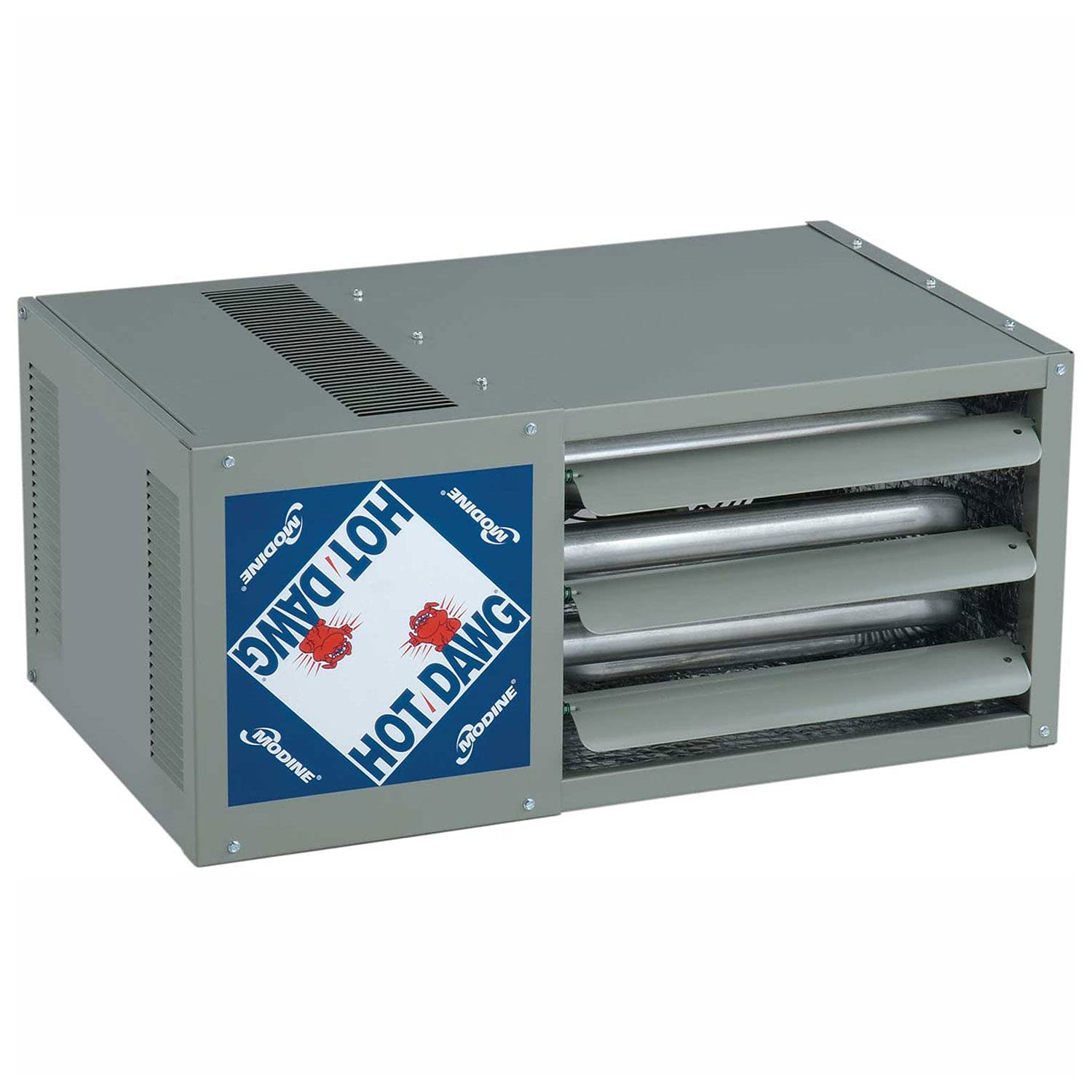
1. Modine Hot Dawg HD45AS01-21
Our pick — 4.5+★ from 20+ verified ratings; the strongest balance of quality and price.
A forced-air garage heater that pushes warm air instead of politely radiating at you.
Garage heat is a different problem from living-room heat. You want warmth thrown across a cold slab fast, and the Hot Dawg is built to do that — it uses forced air, meaning a fan pushes the heated air out into the room instead of waiting for convection (heat drifting naturally through the air) to spread it. The published coverage is 1500 square feet, which is honest garage territory rather than a bedroom figure dressed up as one.
The comparison that matters most is against the Rinnai below. The Modine covers 1500 square feet and the Rinnai covers 1600, so the two sit in the same size class. Where they split is behavior: the Modine is a workhorse built to blast heat into an unconditioned space, and it carries 4.5+ stars from a smaller pool of buyers, which is the highest score on this list. The Rinnai has a slightly bigger following — 20+ ratings to this unit’s 26 — but the Modine holds the top score.
It is direct vent, so the exhaust leaves through the wall and the combustion gases stay out of your breathing air. It is fueled by liquid propane and rated for indoor use. The unit weighs 60 pounds, which is a two-person wall lift, and the grey cabinet is built for a garage aesthetic rather than a living-room one. Nothing in the listing promises a thermostat, so plan on your own control setup.
Why the garage crowd leans this way
- Forced-air heating method moves warm air actively across a cold space
- 1500 square feet of published coverage handles a real two-car garage
- Direct-vent form factor sends exhaust outdoors instead of into the room
- Highest rating on this list at 4.5+ stars
What to weigh before you commit
- 60 pounds means a genuine two-person install on an exterior wall
- No thermostat listed, so temperature control is on you
- Smaller review base than the Rinnai’s, so less owner history to read
Made for: a garage, shop, or barn that needs fast forced-air recovery on cold mornings.
Think twice if: you want programmable temperature control built into the unit — this one expects you to supply it.
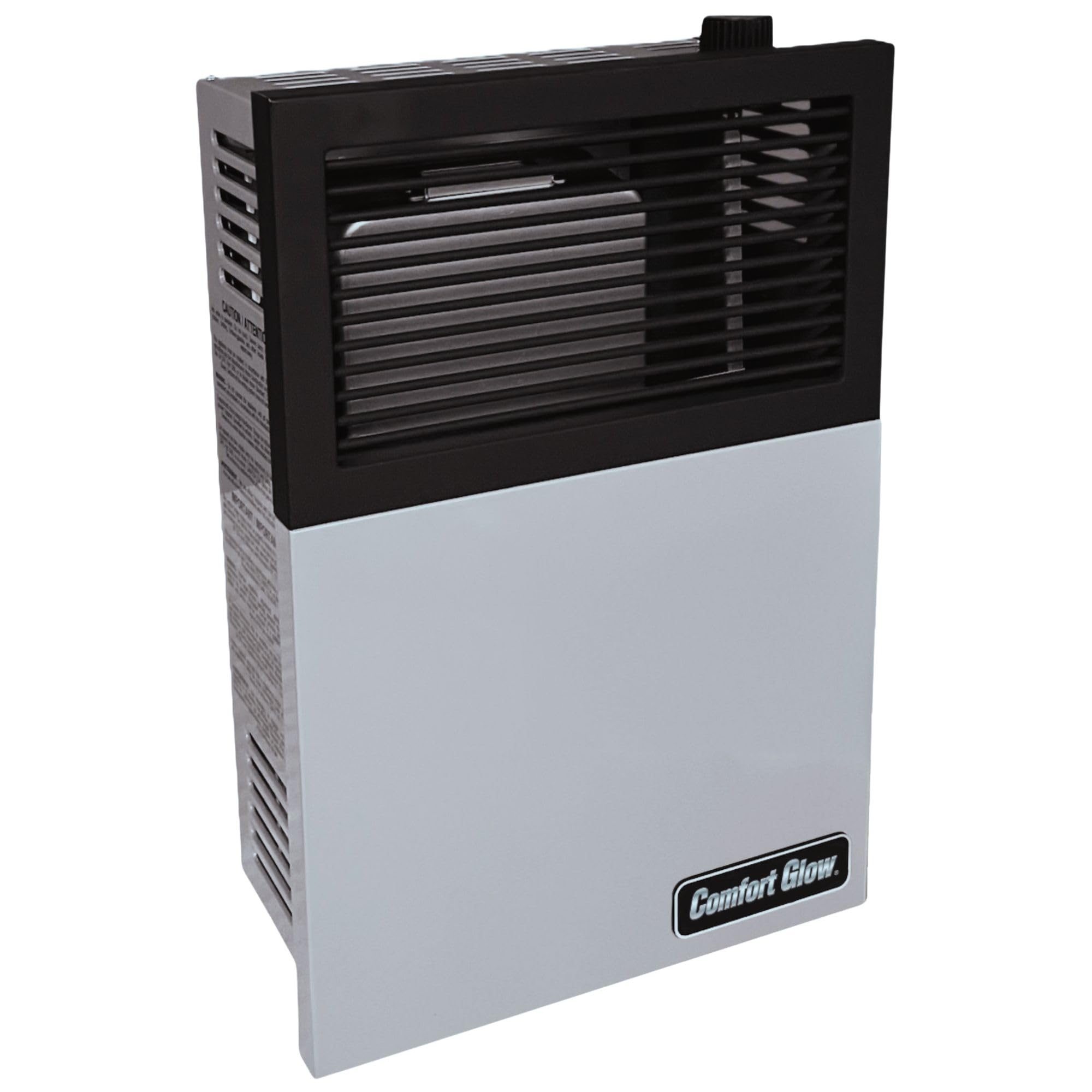
2. Comfort Glow DVP08
The one that keeps heating when the power line does not.
Here is the number that defines this heater: 8,000 BTU. That is the smallest output on this list by a wide margin — the Empire DV35SGLP puts out 35,000 BTU, a 4.4x gap. Small output means a small room, and Comfort Glow rates it at 280 square feet. Put it in a bedroom, a bathroom, or a workshop nook and it makes sense. Put it in an open-plan living area and you will feel the ceiling win.
The real selling point is that it runs with no electricity at all. It vents directly through the wall with no chimney, lights with Matchless Piezo ignition, and keeps a safety pilot with a built-in pressure regulator that stops the gas flow if the flame goes out. It is approved for bedrooms, bathrooms, HUD housing facilities, and mobile or modular homes, and approved for Canada. At 23 pounds it is the lightest unit here, a third of the 67-pound Rinnai below.
Be honest about the heat. The performance and heat-output feedback on this model leans mixed to negative, and the heat output specifically draws poor marks. Some buyers report it works great in a small space; others say it does not work at all. That pattern reads like a sizing and installation mismatch in some cases and a real unit problem in others, so buy it for a genuinely small room and check your regulator setup before you blame the heater. It requires a minimum 20 lb. propane tank and a two-stage low-pressure regulator.
The install detail that saves you: the professional vent kit is in the box — heat shield, vent pipe, air intake pipe, vent cap, flashing, and connection rod — and it fits 4.5″ to 10″ thick walls. That is a real cost you are not chasing separately.
The honest catch: 280 square feet is the whole promise. Expect more from this burner and you will be disappointed, not because it failed but because you asked it to heat a space it was never rated for.
Reach for this one if: power outages are your reason for buying and one small room is your target.
Look elsewhere if: you need to move serious heat — step up to the 25,000 BTU Comfort Glow or the Empire 35,000 BTU unit.
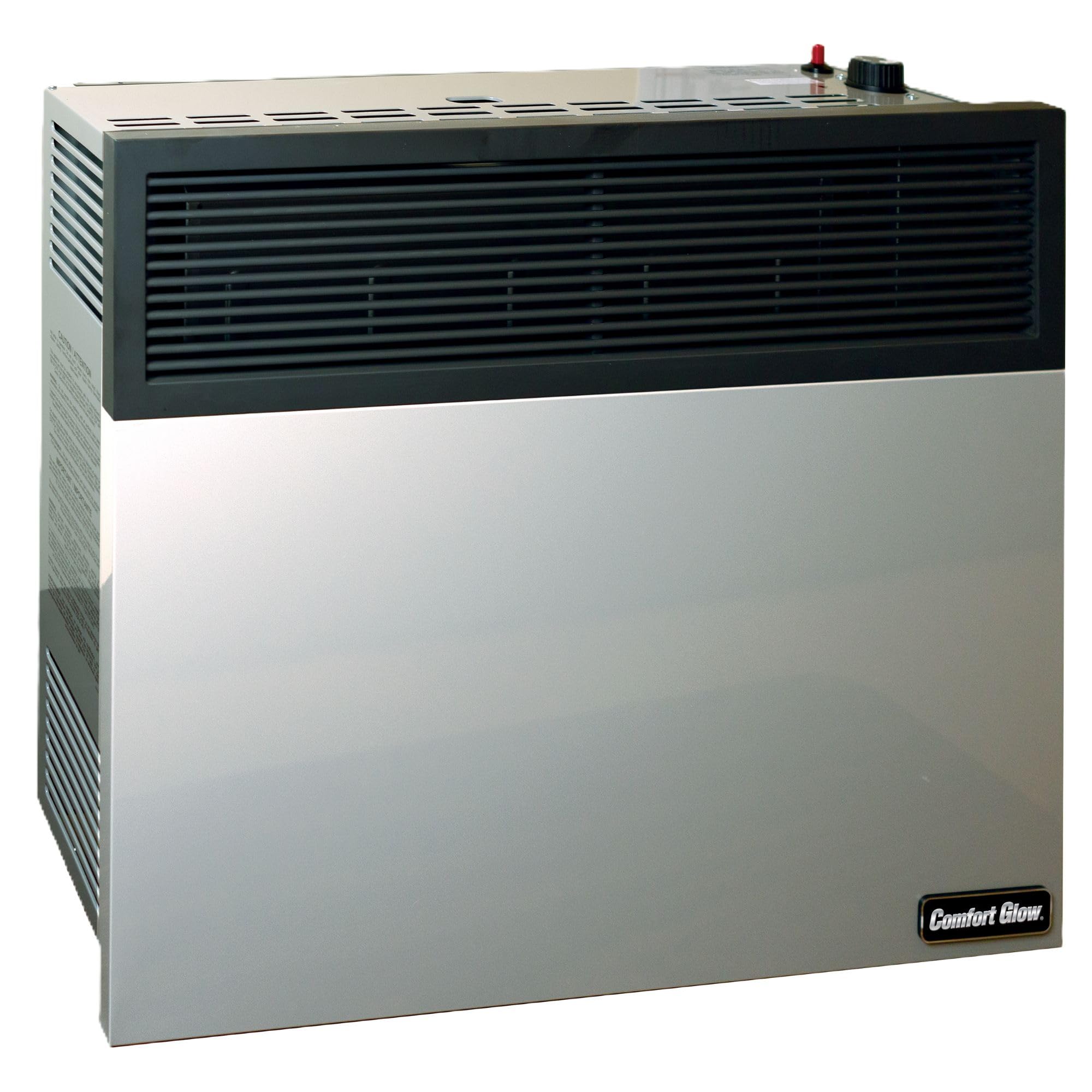
3. Comfort Glow 25,000 BTU Wall Heater
Dial in a temperature and let the burner chase it all evening.
This is the Comfort Glow that sized up properly. It puts out 25,000 BTU and covers 825 square feet — three times the coverage of the 8,000 BTU DVP08 above, which is rated at 280. Add the adjustable thermostatic heat control and you get the thing most wall heaters make you do by hand: set a temperature instead of guessing at a knob.
It still runs with no electricity, which is the point of the whole category. Vents straight through the wall, no chimney. Approved for bedrooms, bathrooms, HUD housing, mobile and modular homes, and Canada. The 430 stainless steel burner is designed for quiet operation, and the vent kit ships in the box for walls 4.5″ to 10″ thick. It steps up to a minimum 100 lb. propane tank, so the fuel side is a bigger commitment than the small unit above.
What people like is the heat itself — the warmth it produces is the most-praised part of this model, and the room-heating reports back that up. What you should hear plainly is the reliability picture, which reads mixed: plenty of units work exactly as promised, and a portion of owners mention problems. Ventilation draws sharp criticism from a slice of owners too. Treat the vent install as the job that decides whether you are happy, and a manufacturer limited 2 year warranty backs the unit either way.
What wins the room: 25,000 BTU across 825 square feet with thermostatic control is the balance point for a large bedroom, a den, or a cabin living area.
Where it asks for care: that 100 lb. tank minimum and a clean vent run are not optional extras — they are the install.
Best fit: a heat-hungry room where you want a set-and-adjust thermostat and no dependence on the grid.
Not the one if: you want a plug-and-play small-space unit — go smaller on output and tank size.
4. Furnace D-Vent Lp 15K-No Tstat – Direct-Vent Wall Furnace

Built to disappear onto the outside wall of a room too small for anything bigger.
Empire designed this one around a tight footprint and it shows. The cabinetry is textured beige and built to tuck out of the way on any outside wall, and the unit vents directly to the outside so the fumes go where fumes belong. It uses no electricity, which makes it a natural fit for a bedroom or a study where you want warmth without a cord.
The install numbers are the ones to write down. Minimum clearance is 12 inches at the top, 1 inch at the sides, and 0 at the bottom. The wall depth range runs 4-1/2 inches minimum to 13 inches maximum, and the vent opening in the wall is 6-1/4 inches in diameter. The LP gas inlet is 1/2 inch NPT. Those figures decide whether the wall you have in mind will accept this heater, so measure twice.
Ignition is piezo, which is a push-button spark rather than a standing pilot you have to relight by hand. The name says it plainly: no thermostat. You get manual control, and that is the trade you accept for the compact cabinet and the no-electric operation. It is the kind of heater that suits a small room with a wall to the outdoors and a homeowner who does not mind adjusting the flame themselves.
Choose this for: a narrow bedroom, study, or cabin room where a slim cabinet on an exterior wall is the only shape that works.
Pass if: you expect a thermostat dial — this model is manual control by design.
5. Empire DV-215-SGLP

Mid-output Empire heat in a wall furnace that never touches your breaker panel.
At 15,000 BTU this sits between the two other Empire furnaces on this list and between the Comfort Glow units as well. It installs on an outside wall, vents directly, and uses no electricity. The cabinet is powder coated beige with a wall-mount form factor, and controls are push-button rather than a dial.
You can add an optional blower to this model, sold separately. That matters if you want to push warmth around a room instead of letting convection do all the work — on a 15,000 BTU unit (BTU is a measure of heat output) in a cold room, air movement is often the difference between warm and warm everywhere. The top of the line is the Empire 35,000 BTU furnace below, and the bottom is the 8,000 BTU Comfort Glow; this one sits in the middle.
Be clear-eyed about what the listing gives you. It is a workmanlike direct-vent furnace with no programmable thermostat, no modulating burner, and no smart hooks. What it offers instead is straightforward propane heat with no power draw, powder-coated cabinetry, and a wall-mount install. Buy it for the simplicity, and accept that the control side is manual.
The case for the simple build: no electricity, no chips, no thermostat board to fail — just pilot-or-button ignition and propane.
The follow-up question: will 15,000 BTU hold your room? If your space trends large or open, the 25,000 BTU Comfort Glow covers more ground.
This one suits: a small-to-mid room where a no-electric furnace with an optional blower is the right tool.
Keep looking if: you want the heat to spread widely from the start — budget for the separate blower.
6. Empire Comfort Systems 35,000 Btu

The big-output brute of the Empire family, for rooms that eat heat.
35,000 BTU is the top of this list, and it is a 4.4x jump from the 8,000 BTU Comfort Glow DVP08. That number is why you pick this furnace: a large open room, a great room, or a shop where the small units never got off the ground. Model DV35SGLP, powder coated beige, wall-mounted, combustion heating method, indoor use.
Its size is the honest trade-off. The cabinet is described as 37 inches wide by 11.5 inches deep by 27.5 inches high in the product write-up, and the spec sheet lists it at 13 inches deep, 40 inches wide, and 32 inches high. Either way you are hanging a substantial box on an exterior wall, so plan the wall real estate before delivery. This is not a slim unit that tucks behind a door.
It is direct vent and runs on liquid propane, which means the exhaust goes outdoors. Set against the Rinnai below, this is the bigger-output side of the premium bracket: 35,000 BTU against the Rinnai’s 20,700 BTU, while the Rinnai adds a modulating burner and programmable control. You choose between raw BTU and smart control here, and an oversized room usually answers that question for you.
The right call for: a large room that a small wall heater never warmed, where maximum propane output is the priority.
Reconsider if: floor and wall space are tight — this cabinet is the bulkiest thing on the list.
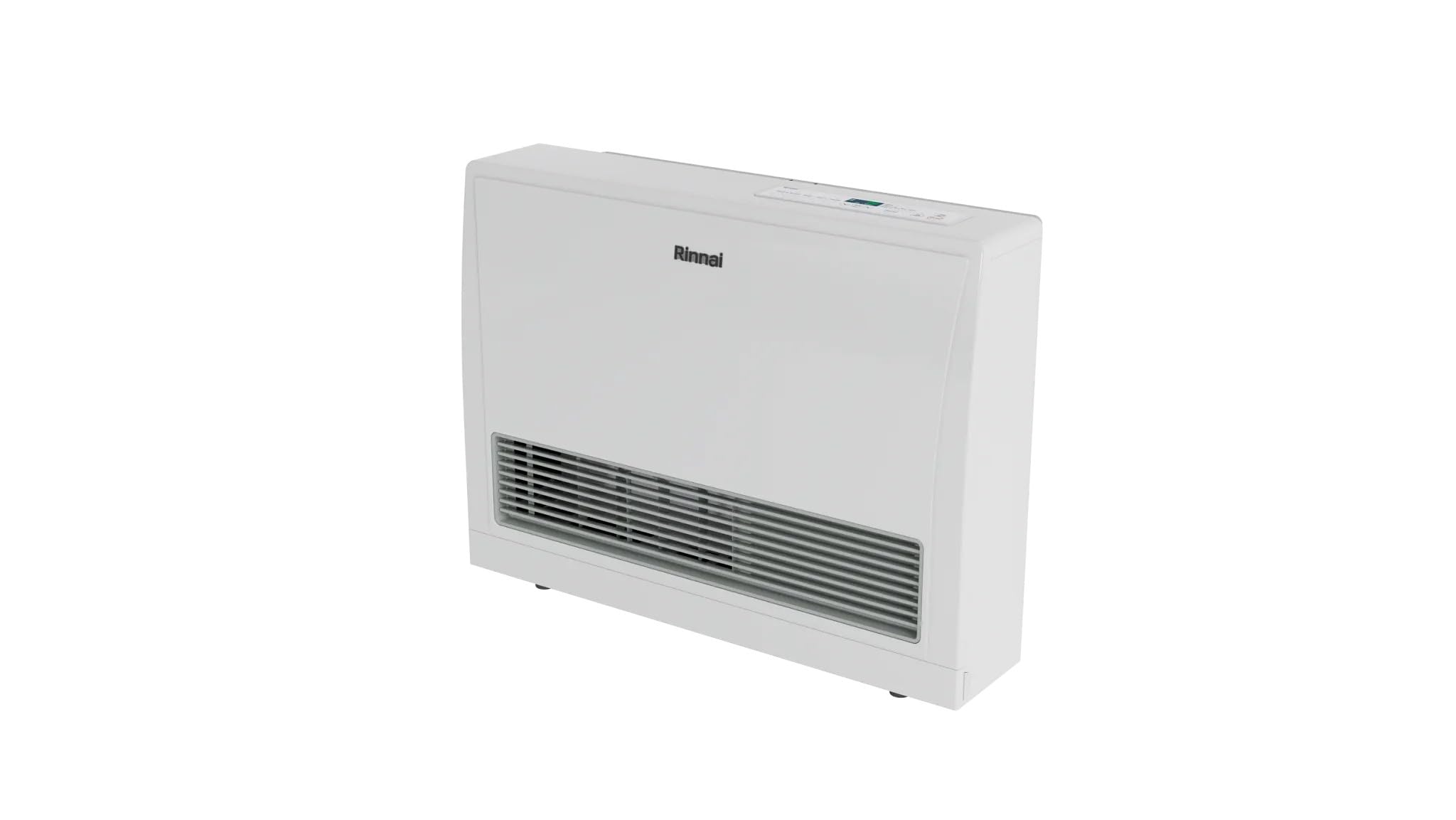
7. Rinnai EX22DTWP
A modulating burner that trims its own flame instead of cycling on and off.
Most wall heaters are on or off. The Rinnai is not — its advanced modulating technology adjusts the burner to hold a temperature and is built to eliminate cold spots, which is a different kind of comfort than a furnace that blasts and rests. Coverage is 1600 square feet, the largest on this list, and it edges the Modine’s 1500 square feet while carrying 20,700 BTU.
The safety and control package is where the engineering shows. The cabinet stays cool-to-the-touch, self-diagnostic electronics flag faults, and a programmable thermostat lets you set specific temperatures. It works with Wi-Fi-enabled systems so you can manage comfort remotely. Families with kids get the most from that cool cabinet; anyone who has ever watched a wall furnace glow gets confidence from the diagnostics.
At 67 pounds it is the heaviest unit here, against the 23-pound Comfort Glow DVP08, so treat the install as a two-person job. Its 10-year heat exchanger, 5-year parts, and 2-year labor coverage are the longest terms on this list. The follow-up question is whether all that control is worth the top-tier outlay — if you want to set a temperature and stop thinking about it, yes; if you want the simplest possible burner, the Empire units deliver that.
The engineering that earns the price tier
- Modulating burner holds temperature instead of cycling on and off
- 1600 square feet of coverage is the largest on this list
- Programmable thermostat with Wi-Fi-enabled system integration
- 10-year heat exchanger, 5-year parts, 2-year labor warranty
What you take on
- 67 pounds is the heaviest unit here — plan a two-person lift
- Programmable electronics mean this heater depends on power
- Top-tier pricing for the smart control package
Go here if: you want the most even, controllable heat in a large room and a warranty that runs a decade on the exchanger.
Think again if: the whole point of your purchase is heat with no electricity at all.
Know the Specs
BTU output and square-foot coverage
BTU stands for British thermal unit, a measure of how much heat a burner produces. Manufacturers pair that number with a coverage figure in square feet, and the pair is your sizing tool. A larger BTU number generally means a larger room, but insulation, ceiling height, and window area all shift the real answer. Use the coverage rating as a ceiling and stay under it.
Direct vent versus vent-free
Direct vent means the heater pulls fresh air from outside and pushes exhaust back out through a concentric pipe in the wall — no chimney required. Vent-free units release combustion byproducts into the room, which is why vented models are the ones installed in bedrooms and enclosed spaces. If your plan involves a sleeping room, vented is the design that fits.
No-electric operation and ignition type
Many vented propane heaters light with a standing pilot or a piezo spark and run without a power connection, which makes them useful for outages and off-grid cabins. Piezo ignition is a push-button spark; Matchless Piezo is the same idea with a different label. Units with programmable thermostats and Wi-Fi integration need electricity, so the two features pull in opposite directions.
Tank size and regulator requirements
Each heater lists a minimum propane tank and often requires a two-stage low-pressure regulator for proper operation. Larger output demands a larger tank — the small Comfort Glow calls for a minimum 20 lb. tank, the 25,000 BTU unit calls for a minimum 100 lb. tank. Under-sized supply shows up as a weak flame and short heat, so size the fuel side as carefully as the heater.
Common Questions
Can a vented LP gas heater be installed in a bedroom?
How thick can my wall be for a direct vent install?
Do these heaters run during a power outage?
What size propane tank does a vented wall heater need?
Is 8,000 BTU enough to heat a garage?
How does a direct vent heater bring in fresh air?
Does a higher BTU number always mean a better heater?
What is the advantage of a modulating burner like the Rinnai’s?
Can a vented LP gas heater use natural gas instead of propane?
What clearances do vented wall heaters need around the cabinet?
The Bottom Line
For most buyers working through the vented LP gas heater decision, the vented lp gas heaters winner is the Modine Hot Dawg HD45AS01-21 because it pairs forced-air heat with 1500 square feet of coverage and the highest rating on this list. If you want a large room with temperature control and no power draw, grab the Comfort Glow 25,000 BTU with its thermostatic dial. And for whole-room comfort with a modulating burner (one that adjusts its flame to hold a steady temperature) and programmable control, the Rinnai EX22DTWP is the one to reach for. Match the BTU to the room, size the tank to the burner, and get the vent kit range right before you order — those three checks decide whether the heater ever warms the space you bought it for.
How we choose
We do not accept paid placement. Every pick is matched to a real buyer and a real use-case; we do not hands-on test units.
Sources
Specifications: manufacturer listings and product documentation. Review insights: verified customer reviews, as of November 2026. Pricing: not shown on this page (it changes often); check the current price via the retailer link.
As an Amazon Associate, Tactical Gear Guy earns from qualifying purchases. This does not affect which products we feature.