Specs are compiled from manufacturer listings and verified buyer reviews and can change over time — please confirm the key details on the product page before buying.
You want a window air conditioner you can get up the stairs and into the frame without calling a neighbor. Here is the short answer: match the BTU rating to your room size first, then check the unit weight and the window width the install kit actually fits. Nail those three and the noise, remote, and filter differences become tiebreakers rather than dealbreakers. This guide covers nine window units across small bedrooms, home offices, and mid-size living rooms, with the real trade-offs spelled out so you can pick the one that fits your window and your back.
This guide is built by comparing the manufacturers’ published specifications and the patterns across verified customer reviews, so you get each pick’s real strengths and trade-offs instead of marketing spin.
Every unit below mounts in a standard double-hung window, so the real differences come down to room coverage, fan speeds, and how loud the compressor runs at night. Read on for the picks that make the most sense for a lightweight window ac.
Quick Picks
- Senville Window Air Conditioner
- Midea 5,000 BTU Window Air Conditioner — Best Value
- Frigidaire 5,000 BTU Window-Mounted Air — Top Performer
- LG 5000 BTU Window Air Conditioners LW5023 — Compact Pick
- GE 5,000 BTU Digital Window Air Conditioner — Scheduling Pick
- Midea 6,000 BTU Window Air Conditioner — Best for Larger Rooms
- Hisense 8,000 BTU Smart Inverter Window Air — Smart Pick
- LG 8,000 BTU Window Air Conditioner LW8024RD — Best for Living Rooms
- Frigidaire 8,000 BTU Window Air Conditioner — Best Airflow Control
How To Choose The Best Lightweight Window AC
Most people buy the wrong window unit for one of two reasons. They pick a BTU rating that is too big for the room and end up with a compressor that short-cycles and never properly pulls humidity out of the air. Or they buy a cooler that technically fits their window on paper but needs a spacer block or a longer bracket to sit safely in the frame. Both problems are avoidable in about five minutes of reading the specs.
Match the BTU Rating to the Room, Not the House
Cooling power is measured in BTU (British thermal units), which is simply how much heat the unit can pull out of a room per hour. A 5,000 BTU unit suits a bedroom or office up to about 150 square feet. A 6,000 BTU unit handles up to 250 square feet. An 8,000 BTU unit covers up to 350 square feet, which is roughly a 14 by 25 foot room. Going bigger than your square footage does not cool the room faster — it just makes the unit cycle on and off more often, which is louder and less comfortable.
Check the Window Fit Before You Check Anything Else
The install kit is the part people forget to read. Units list a window width and height range because the side panels only expand so far. A unit that lists a minimum width of 21 inches will not sit safely in a 19-inch window frame, no matter how well it cools. Measure the inside of your window opening, both width and height, then compare it to the listed fit range — not the box dimensions. A unit that sits loose in the frame rattles louder than its compressor ever runs.
Understand What a dBA Rating Actually Tells You
Noise is listed in dBA, a decibel scale weighted to how human ears hear sound. The box number is measured on low fan with the compressor off, the quietest the unit ever runs. A unit rated at 52 dBA on low fan will be noticeably louder once the compressor starts, and louder still on high fan. The spec is accurate — it just measures the fan, not the compressor. If you plan to sleep next to the unit, buy the quietest low-fan spec you can find and accept that the compressor noise is the real variable.
Weight and Installation Effort Matter More Than You Think
Window AC units are heavy because a compressor, coils, and refrigerant all sit inside a metal box. The listed weight is the number to check if you live alone or install the unit high up. A unit with a lighter build is easier to seat in the frame and hold steady while you attach the side panels. If the unit ships with an install bracket, that bracket takes most of the load once it is placed, but you still need to lift the unit into position on your own.
Features Worth Paying For — and the Ones You Can Skip
A washable filter rinses clean under the tap, so you never buy replacement filters. Eco mode cycles the compressor less aggressively to shave energy use, which matters if the unit runs all summer. Auto-restart is the feature nobody thinks about until a storm knocks the power out and the AC does not come back on by itself. A remote control is genuinely useful when the unit sits high in the window. Wi-Fi control is worth it only if you want to cool the room before you get home.
Side-by-Side Comparison
| Model | Best For | Cooling Power | Room Coverage | Low-Fan Noise | Amazon |
|---|---|---|---|---|---|
| Senville 6,000 BTU Window AC | Small bedrooms and dorms | 6,000 BTU | 250 sq. ft. | — | Amazon |
| Midea 5,000 BTU EasyCool | Tight bedroom installs | 5,000 BTU | 150 sq. ft. | 52 dB | Amazon |
| Frigidaire 5,000 BTU Window-Mounted | Budget-friendly reliability | 5,000 BTU | 150 sq. ft. | 52 dBA | Amazon |
| LG LW5023 5,000 BTU | Narrow double-hung windows | 5,000 BTU | 150 sq. ft. | 50 dB | Amazon |
| GE 5,000 BTU Digital | Timers and schedules | 5,000 BTU | 150 sq. ft. | 52 dBA | Amazon |
| Midea 6,000 BTU EasyCool | Two-room cooling on one unit | 6,000 BTU | 250 sq. ft. | 52 dB | Amazon |
| Hisense 8,000 BTU Smart Inverter | Mid-size rooms with app control | 8,000 BTU | 350 sq. ft. | — | Amazon |
| LG 8,000 BTU LW8024RD | Living room cooling | 8,000 BTU | 350 sq. ft. | 53 dB | Amazon |
| Frigidaire 8,000 BTU with Remote | Deep airflow control | 8,000 BTU | 350 sq. ft. | 54 dBA | Amazon |
Detailed Reviews
1. Senville 6000 BTU Window Air Conditioner
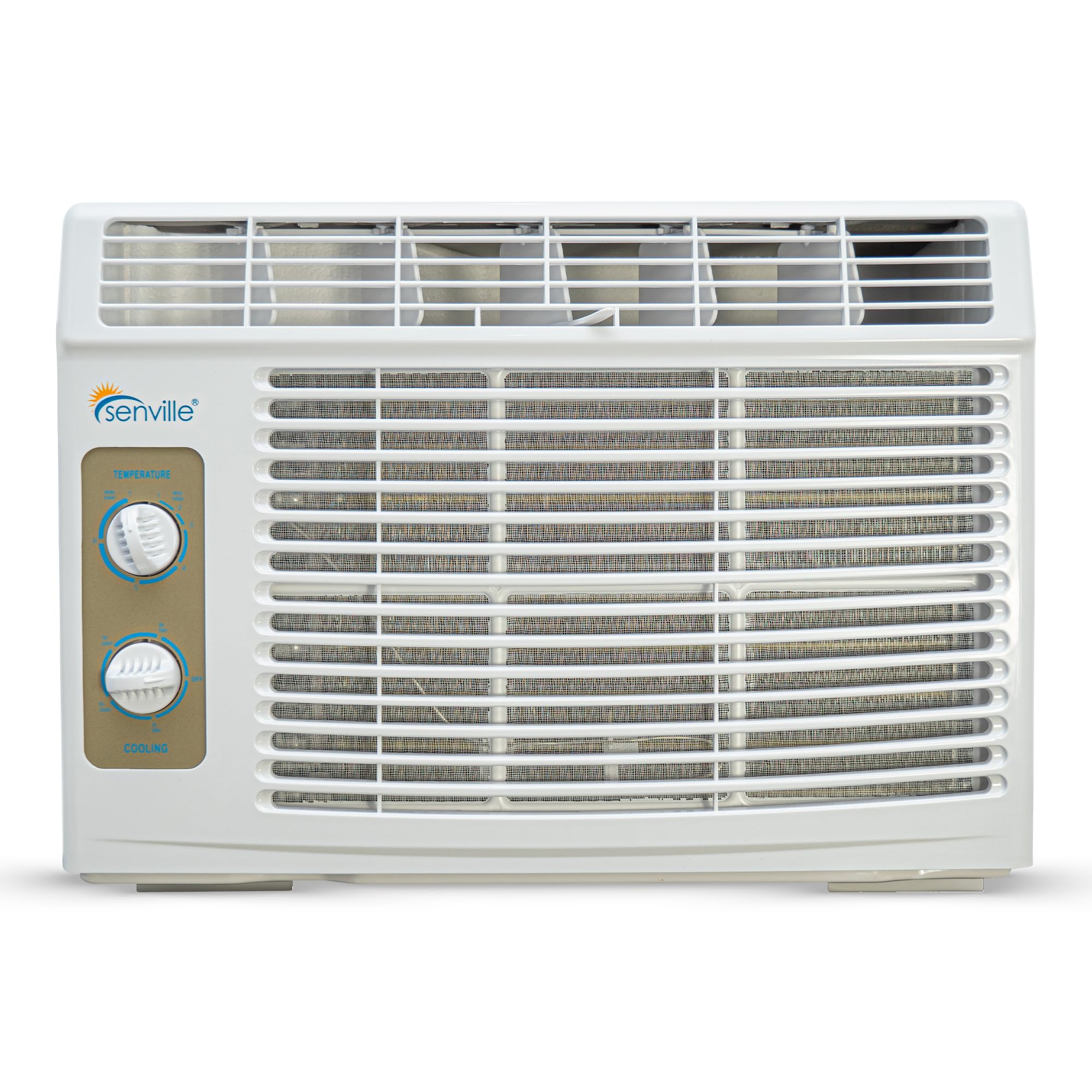
A 6,000 BTU box that cools a 250 square-foot room and ships with its own install kit.
Here is the number that decides this pick: 6,000 BTU across 250 square feet. That is 67% more floor coverage than the LG LW5023, which is a 150 square-foot unit with 5,000 BTU. In plain terms, this cooler handles a small living room or a generously sized bedroom, where the smaller units only manage a single room. It also beats the Midea 5,000 BTU unit on cooling power, 6,000 BTU against 5,000 BTU, so on a hot afternoon it has more headroom before it has to run flat out.
Cool air arrives quickly, the remote mirrors the front-panel display so you never guess which setting you pressed, and the install kit comes in the box. The washable filter pulls out and rinses clean, and Senville lists a dust filter as a standard part of the design. The 0.5-ton capacity matches the 6,000 BTU figure, so the spec sheet is internally consistent.
The catch is noise. A remote and a button panel mean most adjustment happens at the unit or from the bed, but the compressor is the variable you cannot dial down. Some owners find it quiet enough to sleep beside; others find it noticeable. Window fit is the other split — measure your opening before you order, because a 250 square-foot cooler is a broader chassis than a 5,000 BTU box, and the fit range is not printed on this listing. It splits the difference between price and cooling power better than anything else here.
What earns it the top spot
- 6,000 BTU over 250 square feet — the widest coverage in the 5,000–6,000 BTU range here
- Installation kit included, so the box is a complete install
- Remote control matches the front-panel display, no guesswork
- Washable, reusable filter keeps maintenance cost at zero
What to plan around
- Compressor noise is the recurring gripe — expect some at night
- Window fit range is not listed, so measure before ordering
- No inverter, so it cycles on and off rather than modulating
Straight verdict: the pick for a bedroom or small living room up to 250 square feet where you want cooling power without stepping up to an 8,000 BTU unit.
The honest limit: no listed window fit range — measure your opening first, because this chassis is wider than a 5,000 BTU box.
2. Midea 5,000 BTU Window Air Conditioner

Three jobs in one small chassis — cool, fan, and pull humidity out of a 150 square-foot room.
If your window is narrow and your bedroom is small, this is the practical answer. It is a 5,000 BTU unit covering 150 square feet, and Midea rates the low fan at 52 dB — quiet enough that the compressor, not the fan, is what you hear. The 3-in-1 layout means you get cooling, a 3-speed fan for air circulation, and a dehumidifier mode that pulls moisture out without dropping the temperature further, which is genuinely useful on a muggy but mild evening.
The build uses a rotary-scroll compressor and copper core, which is the standard internal layout for this size class. Everything mounts in an existing window frame with the included accessories, though you do need your own screwdriver, and Midea recommends pilot holes on some frames. The removable, reusable filter is a single slide-out piece that protects the coils from dust and pet hair. Eco mode and an EasyTimer let you program a schedule so it is not running full blast all night.
The honest trade-off is cooling headroom. A 5,000 BTU unit is sized for one small room, and the buyers who end up unhappy are the ones who tried to stretch it across a larger space — it does not have the capacity to push cold air to the far wall. For a bedroom or home office up to 150 square feet, that limit never comes up.
Where it fits: a compact bedroom, dorm, or home office where the window is small and you want a single unit that cools, circulates, and dehumidifies without a second appliance.
Reach for this if: you have a tight window frame and a room up to 150 square feet.
Look elsewhere if: you need to cool a room bigger than that — an 8,000 BTU unit is the honest step up.
3. Frigidaire 5,000 BTU Window-Mounted Air Conditioner

The 78-inch power cord alone tells you Frigidaire designed this around real apartments.
Most window AC units come with a cord that barely reaches the nearest outlet, which is why people end up buying an extension cord they should not use. Frigidaire puts a 78-inch three-prong cord on this unit, so it reaches an outlet across the room without a cheater cord. That detail matters more than any spec-sheet number for anyone whose window is on the wrong wall.
The core package is a 5,000 BTU cooler covering 150 square feet, rated at 52 dBA, with two fan speeds and an adjustable thermostat. Auto Restart remembers your settings when the power comes back after an outage, which is the feature nobody notices until a summer storm cycles the breaker. Adjustable side panels extend to meet your window frame, so the fit is tunable rather than fixed. The washable filter captures dust and rinses clean.
Frigidaire has sold this design for years, and the long-running consistency shows in the volume of positive feedback on functionality and build quality. The one honest caveat is that cooling performance divides opinion — this is a 0.42-ton unit built for one small room, and pushing it past 150 square feet is where the complaints start. Treat it as a single-room cooler and it holds up.
Details that earn their keep
- 78-inch power cord eliminates the extension-cord problem entirely
- Auto Restart restores settings after a power cut
- Adjustable side panels extend to fit the frame
- 52 dBA operation keeps a bedroom usable at night
Where it stops short
- Cooling performance is mixed once you exceed 150 square feet
- Two fan speeds is fewer than the 3-speed units here
- Touch controls instead of a full remote
Who it beats: shorter-cord units that force you into an extension cord — and it beats them on years of consistent feedback about build quality.
Who it does not: a long room where you need cold air to reach past the 150 square-foot mark.
4. LG 5000 BTU Window Air Conditioners LW5023

Built for the double-hung window that everything else is too wide to fit.
LG publishes the actual window range on this unit: W 21 to 35 inches by H 12 inches. That is rare in this category, and it is the single most useful spec here — you can measure your window and know before ordering whether it fits. The EZ Mount kit comes in the box. If you have an older apartment with a narrow double-hung window, this is the unit most likely to seat cleanly without a custom bracket.
At 5,000 BTU it covers 150 square feet, right in line with the Midea and Frigidaire 5,000 BTU units. Where it leads is noise: LG rates low mode at 50 dB, which is the quietest listed low-fan figure in this group. That is a meaningful edge if the unit sits beside the head of your bed rather than across the room.
Be realistic about the cooling. There are two cooling modes and two fan speeds, plus an Energy Save function and R32 refrigerant. The frequent gripe is that on low the air feels weak, and the compressor noise is louder than the 50 dB figure suggests once it kicks in. Run it on the higher fan setting during the hottest part of the day and it does the job in a small room.
Why the window spec matters: a listed 21 to 35 inch fit range means you can verify your frame before buying — the rest of this list makes you guess.
Made for: a narrow double-hung window in a bedroom or office up to 150 square feet, where the frame width is the deciding factor.
Worth knowing: low-fan airflow is gentle — plan to use the higher fan speed on peak-heat days.
5. GE 5,000 BTU Digital Window Air Conditioner

A programmable 24-hour timer turns a bedroom cooler into a scheduled appliance.
The feature that sets this GE apart is the 24-hour programmable timer. You set it to cool from 10 p.m. to 7 a.m., and it handles the rest — no reaching for a remote at midnight. Pair that with the auto-restart function that remembers your settings after a power outage, and it is the most set-and-leave-it unit on this list for a fixed schedule.
The hardware is a 5,000 BTU cooler for rooms up to 150 square feet, sized to roughly a 10 by 15 foot space. It runs at 52 dBA on low and 56 dBA on high, with two-way air direction to aim the cold where you want it. The digital thermostat holds a temperature from 64 degrees to 86 degrees Fahrenheit, and the remote controls the full range from across the room. The washable filter includes a clean-filter reminder light so you know when to rinse it.
The install spec is firm and worth reading twice: double-hung windows 27.125 inches to 36 inches wide, with a 13.375 inch minimum height. That is a narrower window band than the LG or Midea units accept, so measure carefully. The unit is not Wi-Fi or smart-home compatible, which is fine for a bedroom but will disappoint anyone who wanted to pre-cool the room from the car.
Standout: the 24-hour timer plus auto-restart is the strongest scheduling package in this group — set it once and forget it.
Room to note: the 27.125 to 36 inch window width band rules out very narrow frames.
Choose this for: a bedroom on a fixed overnight schedule where you want timer control and a wide 64 to 86 degree thermostat range.
Think twice if: you want to control the unit from your phone — there is no Wi-Fi or smart-home link here.
6. Midea 6,000 BTU Window Air Conditioner
The larger Midea stretches the same 3-in-1 layout across a 250 square-foot room.
This is the 5,000 BTU Midea on this list pushed up to 6,000 BTU and 250 square feet of coverage. That is the entire pitch — the same cooling, fan, and dehumidifier modes, the same 52 dB low-fan rating, the same washable filter, now sized for a bedroom that takes more than one window to cool. If you already liked the smaller Midea but needed more coverage, this is the direct upgrade.
Install is the thing buyers talk about here. The kit fits windows 23 to 36 inches wide and 14 inches high, and the general read is that one person can have it running in about 20 minutes with a screwdriver. The 3-speed fan moves air at 168.82 CFM, which is enough to push cold air to the far side of a 250 square-foot room. The LED display shows temperature, time, and mode, and the remote mirrors it from the bed.
Weigh the reliability side honestly. Cooling performance is the strongest suit, and installation is a close second. But a few units reportedly quit within the first couple of weeks, and noise and settings draw split opinions. Midea backs it with a one-year parts and labor warranty, so a dead unit in week two is a warranty claim, not a loss — but it is a hassle you should budget for. The 250 square-foot coverage is real, not marketing padding.
Where it delivers
- 6,000 BTU across 250 square feet with 168.82 CFM airflow
- One-person install, 20 minutes with a screwdriver
- Cool, fan, and dehumidifier modes in one unit
- 52 dB low mode keeps a bedroom workable
What to weigh
- A few reports of units failing inside the first weeks — one-year warranty covers it
- Noise and settings feedback split both ways
- Fits windows 23 to 36 inches wide, so measure first
Top of the short list for: a 250 square-foot room where you want the 3-in-1 Midea layout with more cooling headroom.
Consider the 5,000 BTU instead if: your room is under 150 square feet — the extra capacity buys you nothing there.
7. Hisense 8,000 BTU Smart Inverter Window Air Conditioner
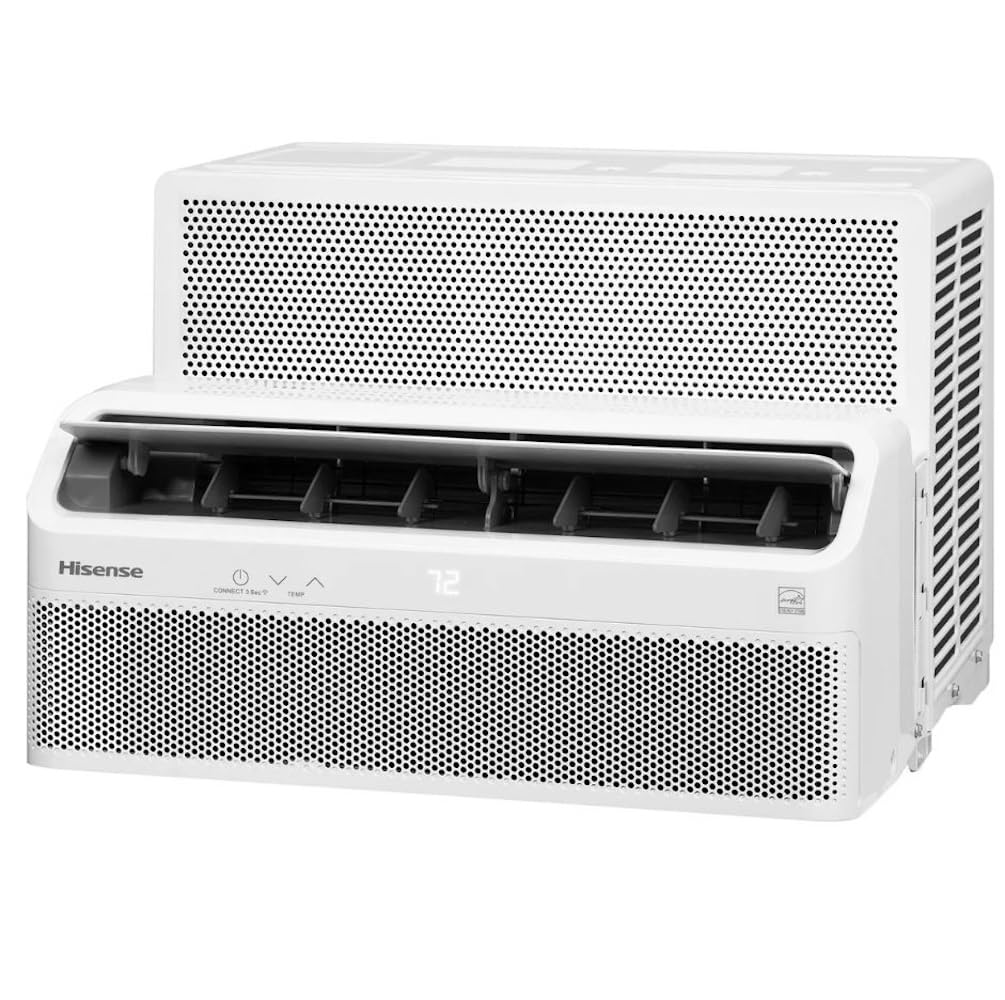
An 8,000 BTU inverter that runs at 700 watts and answers to your phone.
Inverter compressors are the quiet revolution in window ACs. Instead of cycling all the way on and off like the 5,000 BTU units here, an inverter compressor varies its speed to hold the temperature steady. That is why Hisense rates this at 700 watts — the unit modulates its draw rather than spiking to full power. It is also why the listed annual energy use sits at 400 kilowatt hours per year, which is lower than the Frigidaire 8,000 BTU figure of 550 kilowatt hours per year.
Coverage is 350 square feet, which puts it in the same class as the two 8,000 BTU LG and Frigidaire units. Where it differs is smart control: it is Wi-Fi enabled through the ConnectLife app, so you can start cooling before you get home. The ultra-slim profile and dedicated install bracket mean it seats in the window securely without the wobble that frame-mounted units can develop. It runs three fan speeds with 4-way air direction across cool, fan, dry, and eco modes, plus a sleep mode for overnight.
The practical notes: the bracket and the 51.8 pound weight mean installation is not a solo lift-and-slide job — plan for a second set of hands. Window fit covers 25 to 38.6 inches wide by 15.2 inches high, and buyers do disagree about how cleanly it seats in their frames. Value divides opinion too. But efficiency, quiet operation, and steady performance are the strong suits.
What makes it different: the inverter compressor holds a steady temperature at 700 watts instead of cycling hard — the quietest way to run a 350 square-foot room.
The catch: 51.8 pounds plus a bracket install is a two-person job, and window fit is not a sure thing across every frame.
Go with this if: you want app control, an inverter compressor, and 350 square feet of coverage in one package.
Not the pick if: you need to slide the unit in alone — the 51.8 pound weight and bracket demand help.
8. LG 8,000 BTU Window Air Conditioner LW8024RD
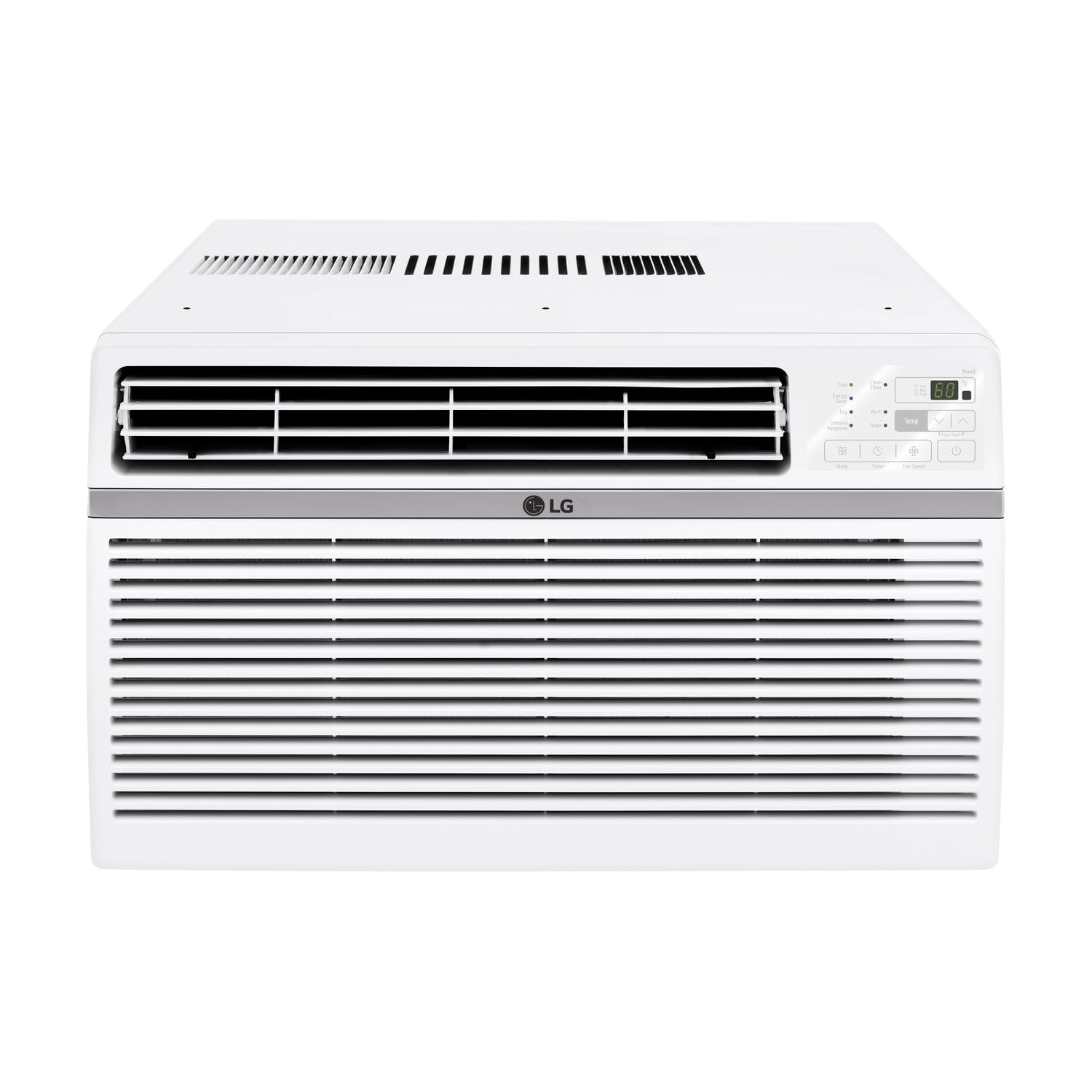
An 8,000 BTU workhorse that drops a 14 by 25 foot room from sweltering to comfortable.
Buyers report it pulling a rated room from 81 down to 73 degrees. At 8,000 BTU across 350 square feet — LG calls that a 14 by 25 foot space — it is sized for a living room, not a bedroom. That is the same coverage as the Hisense and Frigidaire 8,000 BTU units, but this one leans on a quiet 53 dB low-mode rating and a scroll compressor.
You get three cooling speeds and three fan speeds, plus Auto Cool mode that picks a fan speed based on how far the room is from your set temperature. Electronic controls and a remote handle adjustments. Auto Restart brings the unit back on after an outage without reprogramming. The filter-light reminder saves you from guessing when the washable filter needs a rinse, and the moderate efficiency rating keeps the running cost in line with other 8,000 BTU units.
Noise is the honest split. LG rates low mode at 53 dB, which is genuinely quiet, but the readings come in both directions — some rooms feel serene, others feel loud. That usually depends on where the unit sits relative to where you sit. Place it away from the couch and the 53 dB figure is realistic.
Why it earns its spot: 8,000 BTU over 350 square feet is the right math for a living room, and the reported 81 to 73 degree drop shows what that coverage does in practice.
Suits: a medium living room or large bedroom where you need 350 square feet of real coverage and want the quiet low-mode rating.
Question to ask: where the unit will sit relative to your seating — that placement decides whether 53 dB feels quiet.
9. Frigidaire 8,000 BTU Window Air Conditioner
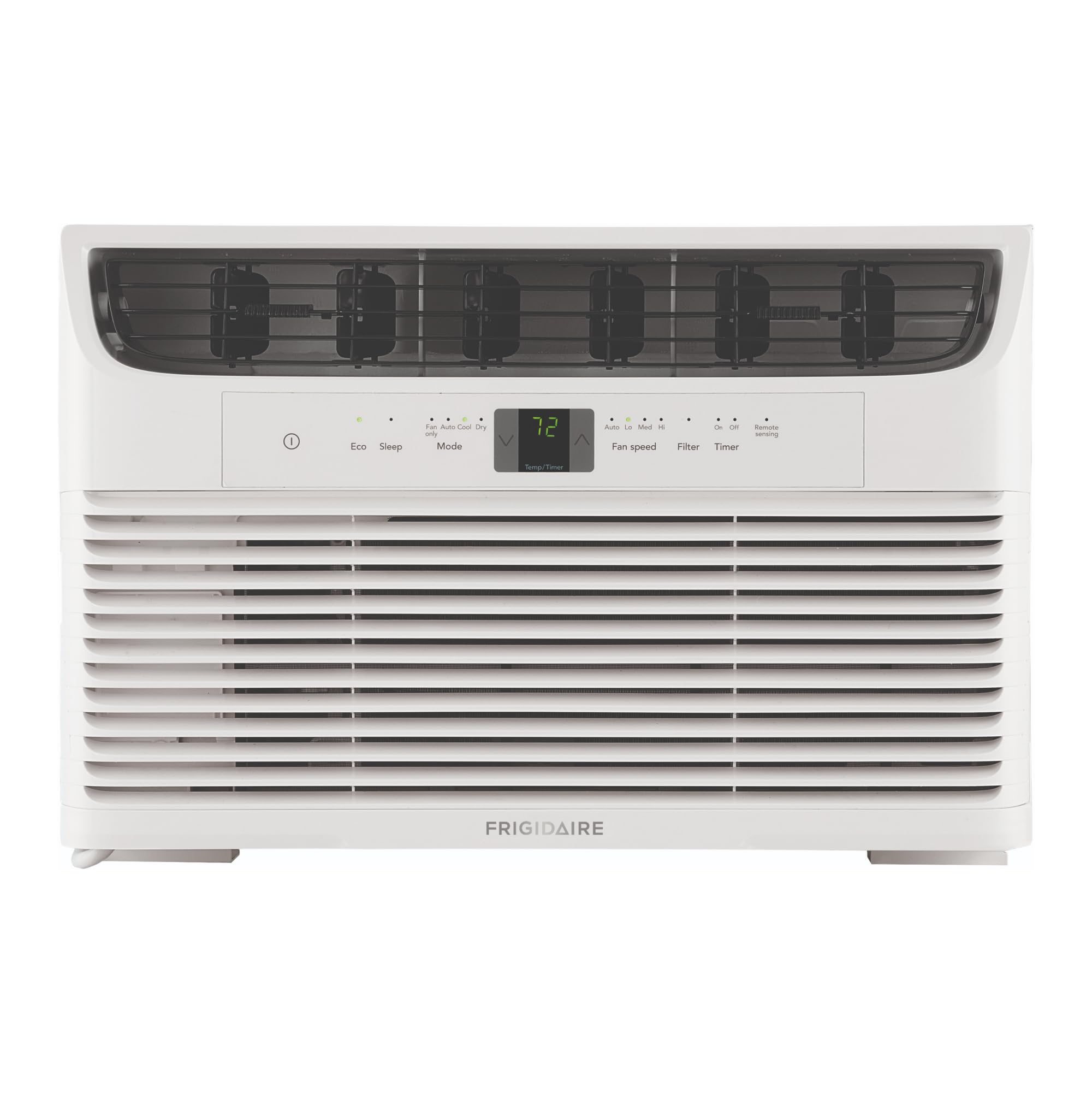
Six-way airflow and a 24-hour timer make this the most directional 8,000 BTU unit here.
Directional airflow is the feature that actually fixes a hot corner. This Frigidaire offers 6-way directional airflow, which means you can aim the cold air toward the sofa, the desk, or the far wall instead of hoping the room evens out on its own. Combined with three fan speeds and a 350 square-foot coverage rating, it is the most adjustable 8,000 BTU cooler in this group for a room with awkward furniture placement.
The energy package is where it sits just behind the Hisense. Rated annual energy use is 550 kilowatt hours per year against the Hisense 400 kilowatt hours per year, and the efficiency figure is 10.9. Eco Mode cycles the compressor to save power, and Sleep Mode gradually raises the temperature overnight so you are not shivering at 4 a.m. A 24-hour on/off timer lets you set the schedule a day in advance. Dry Mode pulls excess moisture out of the air.
The unit runs at 54 dBA, the highest low-mode rating on this list. That is still quiet enough for a small living room, but it is the least quiet of the 8,000 BTU group. One sizing note: feedback puts the chassis around 19 inches wide, wider than the 16 inches some buyers expected, so check your window opening against the actual unit width before you commit.
The case for it
- 6-way directional airflow points cold air where you need it
- Eco Mode and Sleep Mode both cut overnight energy use
- 24-hour timer plus Dry Mode for humid climates
- Remote control handles all settings
What to check first
- 54 dBA low mode is the loudest of the 8,000 BTU units here
- Chassis runs around 19 inches wide per feedback — wider than some expect
- Higher annual energy use than the Hisense 8,000 BTU
Best match for: a room with an awkward layout where you need to point the cold air at one specific spot.
Skip the guesswork on: the 19 inch chassis — verify your window width before this one arrives.
Know the Specs
BTU and Square Footage
BTU stands for British thermal unit, and it measures how much heat the cooler can remove per hour. The coverage rating in square feet is directly tied to it: 5,000 BTU typically covers 150 square feet, 6,000 BTU covers 250, and 8,000 BTU covers 350. A unit that is too big for the room will cycle on and off constantly, which is louder and removes less humidity. Match the BTU to the room, add a little headroom for a sunny kitchen, and stop there.
dBA and What You Actually Hear
dBA is a decibel reading adjusted to human hearing. The number on the box is almost always the low-fan setting with the compressor idle, so it is the quietest the unit ever gets. Once the compressor engages, the real noise level climbs. If the unit sits near your bed, the numbers worth comparing are 50 dB and 52 dB on low fan. Anything above 54 dBA on low will be noticeable at night for most people.
Window Fit Ranges
A window AC is only as good as its fit. The install kit side panels expand to a specific width and height range, and a unit that lists a 21 inch minimum will not seat safely in a 19 inch frame. Units that publish their fit range — like the LG 21 to 35 inch and the GE 27.125 to 36 inch specs — let you verify before buying. Units that do not publish a range are where measurement matters most.
Inverter vs Fixed-Speed Compressors
A fixed-speed compressor runs at full power or off, like a light switch. An inverter compressor varies its speed to hold a temperature, more like a dimmer. Inverters hold the room steadier and usually draw less power over a season, which is why the Hisense inverter is rated at 700 watts. Fixed-speed units are simpler and typically cheaper to buy, and for a single small bedroom they work perfectly well.
Common Questions
Will a 5,000 BTU window AC cool a bedroom on an upper floor?
How do I know if a window AC will fit my window?
Is an inverter window AC quieter than a standard one?
Do window air conditioners need a dedicated circuit?
How often should I clean the washable filter?
Does a 6,000 BTU unit use more electricity than a 5,000 BTU unit?
Can I use a window AC in a sliding window instead of a double-hung one?
What does Eco mode do on a window air conditioner?
Why does my window AC blow air that is not very cold?
The Bottom Line
The lightweight window ac that earns top billing here is the Senville 6,000 BTU, because it delivers 6,000 BTU across 250 square feet with a remote, a washable filter, and the install kit in the box. That combination covers a bedroom or small living room without stepping into the larger 8,000 BTU class. If your room is bigger than that, grab the LG 8,000 BTU LW8024RD for 350 square feet of coverage and a quiet 53 dB low mode. And for a narrow window frame where fit is the deciding factor, the LG LW5023 is the one to reach for — it is the only unit here that publishes its 21 to 35 inch window range up front. Match BTU to your square footage and the fit range to your window opening, and the choice narrows to one.
How we choose
We do not accept paid placement. Every pick is matched to a real buyer and a real use-case; we do not hands-on test units.
Sources
Specifications: manufacturer listings and product documentation. Review insights: verified customer reviews, as of November 2026. Pricing: not shown on this page (it changes often); check the current price via the retailer link.
As an Amazon Associate, Tactical Gear Guy earns from qualifying purchases. This does not affect which products we feature.