Specs are compiled from manufacturer listings and verified buyer reviews and can change over time — please confirm the key details on the product page before buying.
You screw a gauge onto the hose bib, open the valve, and the needle tells you the truth about your home’s water pressure in seconds. That single reading decides if you need a regulator, whether your sprinklers will pop their heads, and whether your pipes are quietly straining every time someone showers. The picks below all do that job — attach to a standard 3/4″ garden hose thread, hold accuracy to a ±3-2-3% band (meaning the needle stays within a few percent of true pressure across the dial), and survive living outside.
This guide is built by comparing the manufacturers’ published specifications and the patterns across verified customer reviews, so you get each pick’s real strengths and trade-offs instead of marketing spin.
The quick answer: a glycerin-filled stainless case is what separates a gauge that lasts from one that fogs over and drifts. Here is the honest breakdown of the best water pressure gauge for your hose bib, RV, or pump line.
Top Picks

How To Choose The Best Water Pressure Gauge
Most people buy the wrong gauge because they buy for the number on the dial and not for the thread. Fit is everything here. If the thread doesn’t match your connection, the reading never happens.
Match the thread before anything else
A 3/4″ female hose thread (FHT) screws straight onto a garden faucet or hose bib — the same thread your garden hose uses. If you’re testing a pump, a water heater line, or a pipe port, you want a 1/4″ NPT connection (a narrower threaded fitting common on plumbing test points) instead. Some kits ship with brass adapters that bridge the two so one gauge covers both jobs.
Liquid filled versus dry dial
A dry gauge has nothing inside the case, so the needle can flutter when water surges or the unit vibrates. A glycerin-filled or oil-filled case damps that movement, which keeps the reading steady and protects the internal parts from wear. All seven picks below are liquid filled.
Range and readability
A 0-100 PSI dial spreads the marks out, so the needle lands between graduations more clearly for the normal 40-80 PSI a house runs. A 0-200 PSI dial covers pump and irrigation systems with more headroom, but each tick covers more ground. Pick the range that brackets your system, not the biggest number.
Side-by-Side Comparison
| Model | Best For | Pressure Range | Thread | Dial Size | Amazon |
|---|---|---|---|---|---|
| MEASUREMAN 2-1/2″ Glycerin Filled Stainless★ Best Overall | House and garden baseline | 0-200 psi/kpa | 3/4″ FHT | 2-1/2″ | Amazon |
| REOTEMP PD25H with Max PointerSpike Catcher | Spotting pressure spikes | 0-160 PSI | 3/4″ GHT | 2.5″ | Amazon |
| senctrl Lead-Free with Lazy Hand | Potable drinking water lines | 0-100 psi / 0-7 bar | 3/4″ FHT | 2.5″ | Amazon |
| MEANLIN MEASURE Liquid Filled | Water, oil and air lines | 0-100 Psi | 3/4″ Female | 2.5″ | Amazon |
| Pronese Stainless Gauge Kit | Multi-system bench testing | 0~200 PSI | 1/4″ NPT | 2-1/2″ | Amazon |
| Boltigen 200 PSI Gauge Kit | Mismatched plumbing hookups | 0-200 psi / 0-14 bar | Multiple (1/4″ NPT, 3/4″ GHT, 1/2″ NPT) | — | Amazon |
| Bernoi Liquid Filled Kit | Pool and irrigation systems | 0-200 Psi / 14 bar | 3/4″ GHT | — | Amazon |
Detailed Reviews
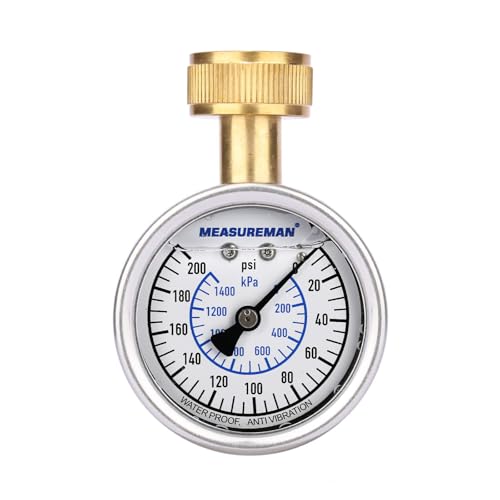
1. MEASUREMAN 2-1/2″ Glycerin Filled Gauge
Our pick — 4.5+★ from 700+ verified ratings; the strongest balance of quality and price.
The house-and-garden workhorse that screws straight onto the faucet and settles the question in one glance.
It holds 4.5+ stars across 700+ ratings, and buyers credit the build: a 304 stainless case that resists rust outdoors, paired with brass wetted parts. Glycerin sits inside the case, which steadies the needle when the water surges and keeps the internal movement from rattling itself loose over years of use.
The connection is the easy part. A 3/4″ female hose thread adapter attaches directly to a faucet or a garden hose, so there’s nothing to assemble and no adapter to hunt down. The dual scale reads 0-200 psi/kpa — both units printed on the same face — and the stated accuracy is ±3-2-3%, meaning the needle tracks true pressure within a few percent across low, middle, and high portions of the dial. At 8.8 ounces it has real heft in the hand, which is exactly what you want from a gauge that lives on a hose bib.
The one thing to know: on a 0-200 dial each graduation spans more PSI than on a 0-100 gauge, so a few PSI difference between two spigots takes a close look. For confirming your whole house sits in a healthy band, that headroom is a benefit, not a compromise.
What earns it first place
- 304 stainless case plus brass wetted parts — built for outdoor hose-bib duty
- Glycerin fill keeps the needle steady under surge and vibration
- 3/4″ male-thread-free install: screws right onto faucet or hose
- Dual psi/kpa scale and ±3-2-3% stated accuracy
Where it asks a little of you
- The 0-200 dial compresses the marks — small differences need a close look
- No max pointer, so it won’t record a spike while you’re away
The right call for: anyone who wants one sturdy gauge on the outdoor faucet to check house and garden pressure season after season.
Think twice if: you specifically need a lazy hand to catch overnight pressure spikes — that’s the REOTEMP below.
2. REOTEMP PD25H 2.5″ Test Gauge
Catches the spike you’d never see — a red pointer that stays put after the surge has passed.
Here’s the scenario this gauge was built for. Your pressure looks fine when you test it at noon, then the utility quietly bumps it overnight and your shower head starts spitting. The red max pointer rides with the black needle and stops at the highest point reached. When you check the next morning, you see the spike even though you weren’t standing there. That single feature is the reason to pick this one over the MEASUREMAN above.
It’s an ASME-compliant 2.5″ dial reading 0 to 160 PSI at 3-2-3% accuracy — enough headroom to test a pressure-reducing valve, not just house pressure. The spec sheet lists it at 1.75 x 4.25 x 2.75 inches, and the small body slips onto a hose bib without a fuss.
One honest note that keeps this at pick two: accuracy is the strongest part of the story here, but the functionality and build quality readings split both ways in owner feedback — some gauges work flawlessly and hold up, a handful of units arrive not working. That’s a fit fact, not a dealbreaker, but it’s why this sits behind the MEASUREMAN for a set-and-forget installation.
The spike advantage: a max pointer is genuinely rare in this price range and turns a one-time reading into a record of the worst your system saw.
Sized for inspection work: 0-160 PSI with a 3/2/3% accuracy band matches what a home inspector would carry to a walkthrough.
Reach for this if: you suspect intermittent pressure spikes and want the dial to remember them for you.
Look elsewhere if: you want a gauge with zero owner variance in build — the MEASUREMAN’s longevity track record is stronger.
3. senctrl 0-100 Psi Gauge
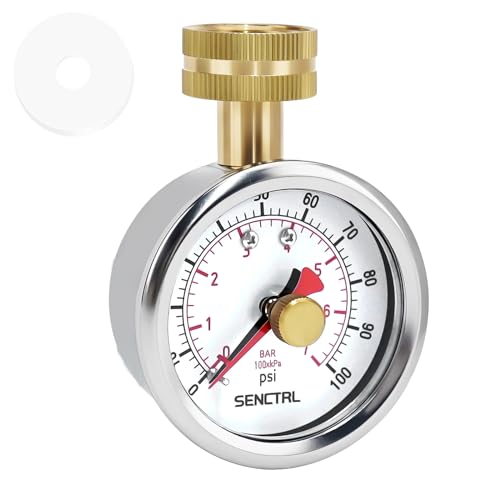
Built for drinking-water lines — lead-free brass inside, and a waterproof case that fights fog.
The thing everyone raves about here is how nicely it’s put together. A 304 stainless steel case houses the dial, the wetted parts are lead-free brass with stainless steel and a food-grade silicone sealing ring, and the whole assembly is rated IP67 (a waterproofing standard meaning it shrugs off rain and brief immersion). That matters if your gauge sits on an outdoor spigot through a wet spring.
A lazy hand works like a max pointer. Set the red hand just above the black one, open the valve, and the black needle drags the red one up to the peak pressure it reached. Reset it by turning it back to zero. The dual scale reads 0-100 psi on one side and 0-7 bar on the other, and the stated accuracy is ±3/2/3% across the full range — the tighter 0-100 dial makes small differences easier to spot than a wide 0-200 range.
The maker rates the movement for 10,000 test cycles, and the PRV-Tex vent keeps the window from fogging when temperature swings. On the compatibility side, the 3/4″ female garden hose thread suits outdoor spigots, RV tank fills, ice makers, RO systems, and washing machine outlets. The one caveat: the lead-free brass is the whole reason to pay attention here, so if your test is on a non-drinking line — a compressor or a hydraulic press — a cheaper oil-filled gauge does the same job.
Why potable water buyers pick it
- Lead-free brass and food-grade silicone ring on the wetted side
- IP67 case with PRV-Tex vent — reads clear in rain and moisture
- Lazy hand records peak pressure, resettable to zero
- Dual psi/bar scale at 0-100 psi, easier to spot small differences
The trade-off to weigh
- Lead-free brass is a premium over a standard brass gauge
- 0-100 tops out below the pump and irrigation range some buyers need
The gauge for drinking water: if you are testing household potable lines, the lead-free wetted path is the reason this sits ahead of generic brass gauges.
A different tool fits better if: your job is a 150 PSI pump test — that needs a 200 PSI range.
4. MEANLIN MEASURE 0~100Psi Gauge
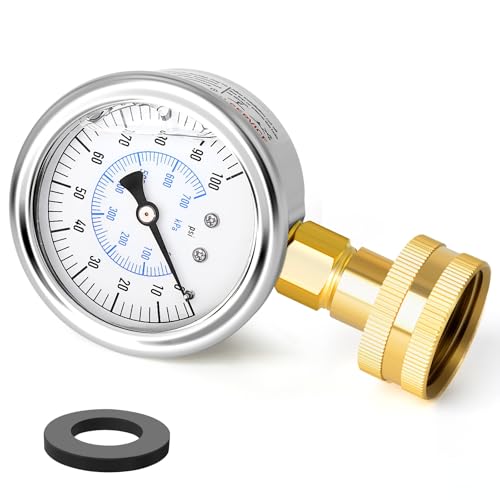
The pocket-sized dial you can drop in a toolbox and forget about until you need it.
Weighing just 3.2 ounces, this is the featherweight of the group — the MEASUREMAN above tips the scale at 8.8 ounces, so this one is noticeably easier to tuck into a small tool bag and carry to a rental property or a job site. It’s a 2.5″ face dial with a 3/4″ female lower-mount connection and a 0-100 Psi range, liquid filled inside a stainless steel frame.
It isn’t just a water gauge. The spec line lists it for water, oil, and air, and the temperature range runs 0-55℃ / 32-131℉ — useful if you’re checking a compressor line or an oil system rather than a hose bib. A 1-year warranty backs the stainless case.
The one honest caveat: a handful of buyers report water weeping from the case under pressure, so check the seals on arrival. That’s the recurring gripe, so inspect the seals and the dial window when it lands. If it holds, the light weight and multi-fluid capability make it a genuinely handy companion piece.
Light and versatile: 3.2 ounces plus a water/oil/air rating makes this the one to sling in a bag for mixed jobs.
Check the seals on arrival: the water-leak reports are the one thing to verify before you trust it on a full-pressure line.
Suits you if: you want a light, multi-fluid 0-100 gauge to keep in a toolbox for water, oil, and air checks.
skip it if: you need a set-and-leave gauge on a high-pressure outdoor line — the leak reports warrant a sturdier pick.
5. Pronese Water Test Pressure Gauge Kit

A whole test rig in one box — gauge, hose, valve, and adapter ready to hook up.
This is the pick for the person who isn’t just checking a hose bib. The 2-1/2″ gauge carries a 1/4″ NPT lower-mount connection — the narrower threaded fitting that suits pumps, compressors, and machinery, not just a garden faucet. The kit throws in a 12″ EPDM rubber hose (a weather-resistant rubber), a 1/4″ valve, and a 1/4-to-3/4 adapter so the same rig bridges a test port and a standard hose thread.
At 0.39 kg it has more heft than the senctrl’s 0.18 kg, which reflects the extras in the box rather than a heavier gauge alone. The dial reads 0~200 PSI with ±3/2/3% accuracy and is liquid filled — the lubricant inside steadies the needle and, per the maker, reduces friction to extend the gauge’s life. The color-coded face lets you spot high vs low pressure fast, and the stainless case with brass internals covers garden, home, pump, and compressor duty.
One honest snag that lands in the reviews: assembly feedback splits. Some buyers find it easy to install, others note it lacks a necessary fitting or arrives without instructions. Budget a little time to figure out the valve-and-hose order before you open the water. When it’s plumbed correctly, the 1/4″ NPT core makes it a genuinely versatile test kit.
What the kit brings
- 1/4″ NPT mount that opens up pump, compressor, and machinery testing
- Hose, valve, and adapter all included — assemble and test in one go
- Liquid filled 0~200 PSI dial at ±3/2/3% with color-coded face
- Stainless case and brass internals for mixed-fluid duty
The catch to plan around
- Assembly feedback splits — some report missing fittings or no instructions
- 1/4″ NPT base means you lean on the adapter to reach a hose bib
Made for the tinkerer: if you’re testing pumps, compressors, or a mix of systems, the 1/4″ NPT core and full kit earn their keep.
Not the simplest hose-bib gauge: for a plain garden-faucet check, a straight 3/4″ FHT gauge screws on faster.
6. Boltigen 200 Psi Water Pressure Gauge Kit

The kit for mismatched plumbing — enough brass adapters to reach whatever thread you’re facing.
If you’ve ever held a gauge to a connection that simply won’t thread, this kit is the answer. Inside the box: a 0-200psi oil-filled gauge with 1/4″ NPT male thread, a 1/4″ NPT female-to-3/4″ GHT female adapter, a 3/4″ GHT male-to-male quick connect, a 1/2″ NPT female-to-3/4″ GHT male adapter, a 1/2″ NPT male-to-3/4″ GHT male adapter, sealing tape, and two sealing washers. Seven pieces, so almost any standard hookup has a path in.
It carries the group’s top rating at 4.5+ out of 5. And it earns it on quality and accuracy, with two things buyers consistently note — the needle reads steady and the numbers are easy to understand. The dial covers 0-200psi (0-14 Bar) to ASME B40 accuracy, and the oil fill damps needle flutter and cushions the movement against vibration. The shell is stainless steel, and the adapter set is solid brass rather than pot metal.
The one thing to keep in mind: all those adapters are a blessing and a small chore. You’ll want to lay the pieces out and identify the right one before you open the water, because the quick-connect and the two 1/2″ pieces have specific jobs. Point it at a quick hose-bib check and it’s more kit than you need — but for a home-plus-industrial setup that shifts between fittings, the adapter count is exactly right.
Fit coverage: five adapters plus sealing tape and washers mean a mismatched thread is rarely a dead end.
Steady readings: the oil fill holds the needle calm against vibration, and the ASME B40 accuracy claim backs up the consistent numbers buyers describe.
Best for the multi-fit job: grab this if your connections vary and you want one box that adapts to all of them.
Overkill if: you only ever test one garden spigot — a single-thread gauge is quicker to use.
7. Bernoi Liquid Filled Gauge Kit

For the irrigation planner and pool owner — glycerin-damped, and set up to reach odd fittings.
The job this one targets is planning an efficient watering system or cleaning a pool, where a steady pressure number decides how many heads a zone can carry. A 3/4″ female hose thread adapter attaches quickly to an outside faucet or hose bib, and the kit adds a 1/4″ adapter, a 1/2″ adapter, and push-to-connect fittings for 1/2-inch and 3/8-inch tube. That’s five parts, enough to reach patio fixtures, pool equipment, and garden systems.
The dial runs to 200 Psi / 14 bar at ASME B40 Grade B accuracy, and the glycerin fill damps needle flutter from vibration and pump surge. The stainless case with brass internals is built to resist rust through year-round exposure, which is why it suits a pool pad that stays damp. At 10 ounces it feels substantial in hand.
What owners mention most is that it simply works — it’s the kind of gauge that helps you troubleshoot a home water supply problem rather than leave you guessing. The included accessories earn their own mentions, especially the handy 1/2″ NPT to 1/4″ tubing adapter for the push-to-connect tube. The one trade-off is that all those fittings reward a quick layout first, so you pick the right one before opening the valve.
Where it shines
- Glycerin fill damps vibration and media noise for a steady dial
- ASME B40 Grade B accuracy to 200 Psi / 14 bar
- Five adapters including push-to-connect for 1/2″ and 3/8″ tube
- Stainless case and brass internals built to resist rust
Worth knowing
- Five fittings reward a setup-first approach before testing
- 200 Psi range compresses marks on a dial that would read easier at 0-100
A planner’s gauge: ideal if you’re mapping irrigation zones or a pool system and want a steady reading plus adapters for odd tube sizes.
Simpler fits better if: you just want a bare hose-bib check — a single-thread gauge gets there faster.
Know the Specs
Accuracy band (±3-2-3%)
The three numbers describe how far the needle can drift from true pressure at the low, middle, and high thirds of the dial — a small measured tolerance. In plain terms it means the reading you trust is close to reality across the whole range, not just at one spot. It’s a real accuracy grade, so any pick printing it is stating a tested tolerance rather than a guess.
Thread type (FHT, GHT, NPT)
FHT and GHT both mean a garden hose thread — the standard thread on an outdoor spigot, so a gauge marked this way screws straight on. NPT is a narrower plumbing thread common on pumps and test ports, and it usually needs an adapter to reach a hose bib. Matching the thread to your connection is the single decision that makes or breaks the whole test.
Liquid fill (glycerin or oil)
A liquid inside the case damps the needle movement and cushions the internal parts from vibration and surge. A dry dial flutters and wears faster. Glycerin and oil both do the same core job — steady the reading and protect the movement — which is why every gauge in this list is filled.
Max pointer / lazy hand
A second hand that rides with the black needle and stays at the highest pressure reached until you reset it. It turns a one-time glance into a record of the worst your system saw, handy for catching spikes that only happen when you’re not watching.
Common Questions
Will a 3/4″ hose thread gauge fit my outdoor faucet?
What does a lazy hand or max pointer actually do?
How do I read the ±3-2-3% accuracy figure?
Is a glycerin-filled gauge better than a dry dial?
Should I pick a 0-100 PSI or a 0-200 PSI range?
Can I use a water pressure gauge on a compressor or oil line?
What pressure should a healthy home water system show?
Do gauge kits really need all those adapters?
How do I stop a gauge leaking at the threads?
Will a pressure gauge read correctly on hot water?
The Bottom Line
For most people, the best water pressure gauge is the MEASUREMAN 2-1/2″ — a 304 stainless case, brass wetted parts, glycerin fill, and 0-200 psi/kpa coverage that stands up to a hose bib season after season. It’s the crowd favorite, and the longevity feedback backs that up. If you suspect intermittent spikes, the REOTEMP’s max pointer records what you’d otherwise miss. For drinking-water lines, the senctrl’s lead-free brass is the pick. And if your connections vary between a hose bib and a pump, the Boltigen kit’s seven-piece adapter set reaches almost any thread. Whichever you choose, match the thread first — that single fit decision decides whether the test even happens.
How we choose
We do not accept paid placement. Every pick is matched to a real buyer and a real use-case; we do not hands-on test units.
Sources
Specifications: manufacturer listings and product documentation. Review insights: verified customer reviews, as of November 2026. Pricing: not shown on this page (it changes often); check the current price via the retailer link.
As an Amazon Associate, Tactical Gear Guy earns from qualifying purchases. This does not affect which products we feature.