Specs are compiled from manufacturer listings and verified buyer reviews and can change over time — please confirm the key details on the product page before buying.
Buying a wide-angle lens for a Nikon is mostly a mount question, not a brand question. Nikon sells two completely different systems — the older F-mount used on DSLRs and the newer Z-mount on mirrorless bodies — and a lens built for one will not physically attach to the other. So before you read a single word about focal length or aperture, check which mount your camera has. Get the mount right and the rest of the shortlist narrows fast. Get it wrong and the lens will not mount at all.
This guide is built by comparing the manufacturers’ published specifications and the patterns across verified customer reviews, so you get each pick’s real strengths and trade-offs instead of marketing spin.
The picks below split cleanly into Z-mount glass for mirrorless bodies and F-mount glass for DSLRs, with a spread of focal lengths from 10mm to 30mm. Every option here accepts a Nikon body, and each entry names the exact mount so you can rule it in or out in seconds. Here is the honest breakdown of the best wide-angle lens for a Nikon.
Top Picks


How To Choose The Best Wide-Angle Lens for a Nikon
A wide-angle lens is what you mount when the scene is too big to back away from. That means landscapes, tight interiors, group shots in a small room, and architecture you cannot step away from. Five decisions settle the choice, and the first one rules out half the market before you even start comparing glass.
Match the mount before anything else
Nikon Z bodies — the Z5, Z6, Z7, Z8, Z9, Z50 and their variants — take Z-mount lenses only. Nikon DSLRs take F-mount lenses only. The mounts are physically different sizes, so there is no adapter-free crossover. If you are on a Z camera, you want a lens whose listing says Nikon Z. If you shoot a DSLR, you want Nikon F or Nikon F (DX). Mount mismatch is the single most common reason these lenses go back.
Full frame or APS-C changes your focal length
An APS-C sensor is smaller than a full-frame sensor, so it captures a narrower slice of the scene at the same focal length. That is why a DX lens like the 10-24mm behaves like a wider range on paper than it delivers in practice. Full-frame glass on a full-frame body gives you the coverage printed on the barrel. Which one you want depends entirely on the sensor in your body.
Fixed aperture versus variable aperture
A fixed aperture lens, marked with a single value like f/4 or f/2.8, holds that same brightness through the whole zoom range. A variable aperture lens dims as you zoom in, which forces a slower shutter or a higher ISO in dim rooms. For handheld interiors and evening cityscapes, the fixed-aperture designs are the ones that keep your shutter speed usable.
How wide is wide enough
The smaller the millimetre number, the more scene you capture. A 14mm prime pulls in an enormous field, a 20mm is a comfortable everyday wide, and a 24-30mm end is close to what your eye sees. If you shoot real estate or tight interiors, lean toward the low numbers. If you want one lens that stays on the camera for street and travel, a zoom starting around 10mm or 14mm covers more situations.
Minimum focus distance for interiors
Minimum focus distance is how close the lens can get to a subject and still lock focus. A short distance lets you push right up against a detail in a cramped room and still get a clean shot. It also open up the near-far composition trick, where something small in the foreground looks huge against a distant background.
Side-by-Side Comparison
| Model | Best For | Mount | Focal Length | Max Aperture | Amazon |
|---|---|---|---|---|---|
| Nikon NIKKOR Z 14-30mm f/4 S★ Best Overall | All-round Z-mount wide zoom | Nikon Z | 14-30mm | f/4 | Amazon |
| VILTROX 20mm F2.8 ZBest Value | Street and travel on Z bodies | Nikon Z | 20mm | f/2.8 | Amazon |
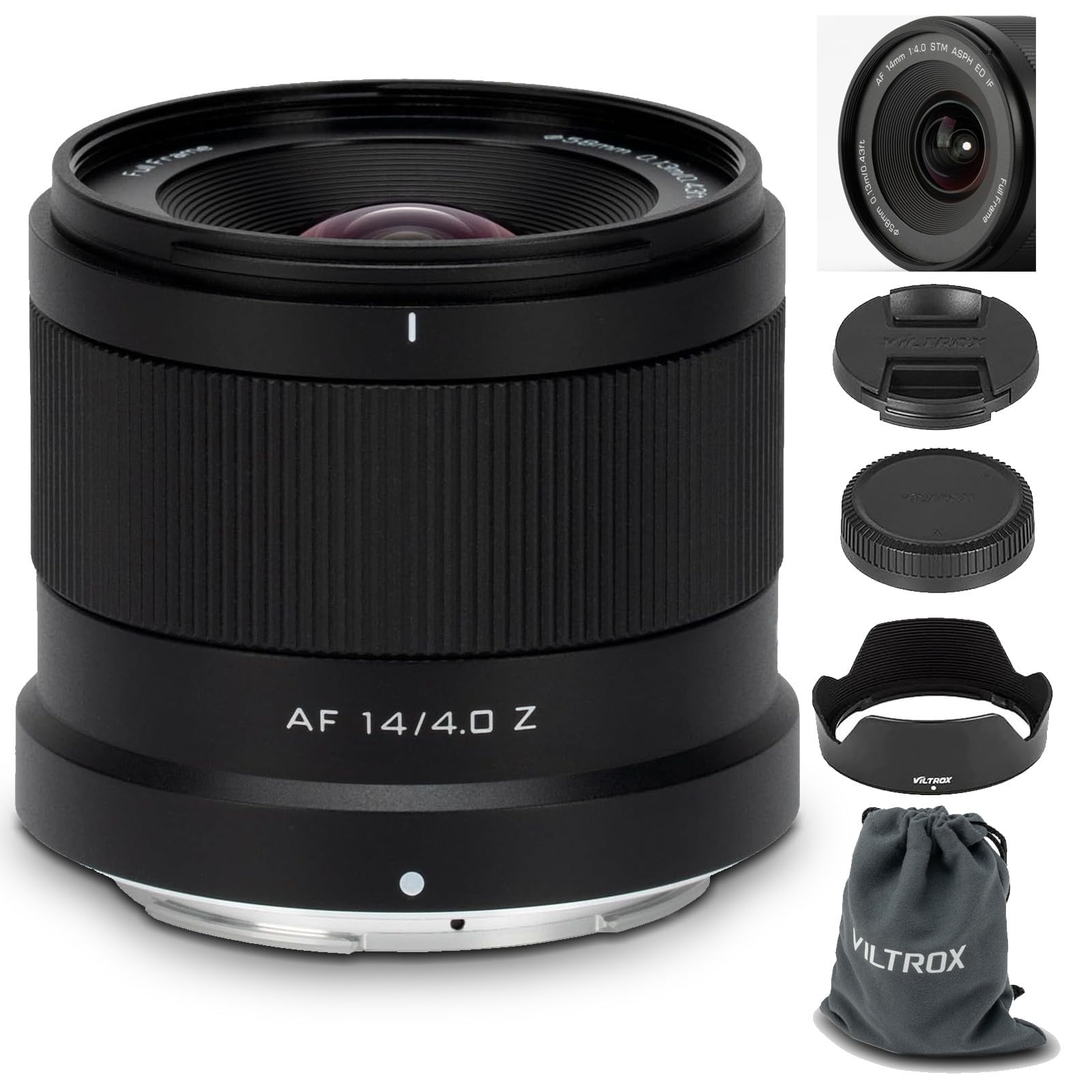
| VILTROX 14mm F4.0 Z-MountBest Ultra-Wide | Ultra-wide landscapes and vlogging | Nikon Z | 14mm | f/4 | Amazon |
| Tokina AT-X PRO DX 11-16mm | Fast DX zoom for DSLRs | Nikon F | 11-16mm | f/2.8 | Amazon |
| Tamron 10-24mm f/3.5-4.5 SP Di II | Budget DX zoom range | Nikon F | 10-24mm | f/3.5-4.5 | Amazon |
| Nikon 10-24mm f/3.5-4.5G ED AF-S DX | Nikon-brand DX landscape glass | Nikon F | 10-24mm | f/3.5-4.5 | Amazon |
| Tamron SP 15-30mm f/2.8 Di VC USD | Stabilised full-frame wide zoom | Nikon F (FX) | 15-30mm | f/2.8 | Amazon |
Detailed Reviews
1. Nikon NIKKOR Z 14-30mm f/4 S
Our pick — 4.5+★ from 500+ verified ratings; the strongest balance of quality and price.
It collapses to 3.5 inches, so the widest lens in your bag is also the easiest to pack.
If you own a Z body and want one wide zoom that handles interiors, landscapes and video without swapping glass, this is the one to beat. The 14-30mm range starts genuinely wide for cramped rooms and stretches to 30mm for a more natural street angle. Across that whole sweep the aperture stays locked at f/4, so your exposure does not shift as you zoom — handy when you are filming and cannot afford a jump in brightness mid-shot.
The retractable mechanism is the detail that sells it. The barrel collapses down to 3.5 inches for transport, which is why this lens rides in a small bag next to a compact Z camera instead of demanding its own compartment. The Stepping Motor (a near-silent focus drive) pulls focus smoothly and quietly, so autofocus noise will not bleed into your video audio. What wins people over most, though, is the pure optical result: corner-to-corner sharpness with very little of the barrel distortion that wide glass often forces you to correct in editing.
The obvious follow-up question is whether f/4 is fast enough. It is a full stop dimmer than the f/2.8 zooms further down this list, so for astrophotography or very dark interiors you will lean on a tripod or a higher ISO. Nikon’s USA-model listing here ships with the 82mm front cap, the HB-86 hood and the CL-C1 case in the box.
What earns it the top slot
- Corner-to-corner sharpness with outstanding low distortion, straight out of camera
- Collapses to 3.5 inches, so it packs like a much smaller lens
- Fixed f/4 across the zoom keeps exposure steady for video
- Takes standard 82mm circular filters — no exotic holder required
Where it asks for patience
- f/4 is a stop slower than the f/2.8 zooms here, so low light needs a tripod or higher ISO
- The retractable barrel means one extra twist before you can shoot
Reach for this if: you shoot a Z camera and want one wide zoom that covers interiors, travel and video without a lens change.
Pass it by if: your work is night skies or dim event halls where every stop of light counts.
2. VILTROX 20mm F2.8 Z Lens
A 173g prime that disappears into a jacket pocket and still opens to f/2.8.
Here is the weight story in plain terms: this lens tips the scale at 173g, while the Tamron 10-24mm further down weighs 406g. If you have ever carried a wide zoom around a city all afternoon, you already know which number your shoulder prefers. The fixed 20mm focal length is a comfortable, natural-looking wide — enough to pull in a street scene or a landscape horizon without the heavy stretch you get at 14mm. The f/2.8 aperture keeps more light coming in than the f/4 zooms, which buys you faster shutter speeds as the light fades.
The internal optics are serious for the outlay: 10 elements in 8 groups, with 2 ED (extra-low dispersion) elements to tame colour fringing, a high-refractive-index element and 2 aspherical elements. In plain words, that is a lot of correction packed into a small barrel, and it shows in crisp results. The STM stepping motor keeps autofocus quiet, and EXIF data passes through to the camera so your files stay properly tagged.
The honest caveat is consistency. Focus is quick when it works, but some buyers report the lens losing autofocus ability over time, and complex distortion shows up in certain frames. Buy it as a light, affordable everyday wide and it delivers; expect prime-lens perfection in every situation and you may be disappointed. Focus can be switched to manual when you want to take control.
Who this is for: the Z shooter who wants a pocketable wide for street and travel at an entry-level outlay, and who does not mind manual focus as a fallback.
The realistic catch: autofocus reliability is a mixed bag over the long haul — worth knowing before you make it your only wide.
The short version: 173g of f/2.8 wide-angle that fits where a zoom will not.
Think twice if: you shoot fast-moving subjects and need autofocus to be flawless every single frame.
3. VILTROX 14mm F4.0 Z-Mount Lens
112 degrees of view and a 0.13m close focus turn small rooms into wide-open spaces.
Two numbers define this lens. The first is the 112° field of view — a genuinely expansive full-frame perspective that swallows whole rooms, sweeping landscapes and group shots that would otherwise need you to back through a wall. The second is the 0.13m minimum focus distance. Put those together and you can shove the lens right up against a foreground detail and still frame the whole scene behind it, which is the classic near-far composition that makes ultra-wides look dramatic.
The glass is dense for the tier: 12 elements in 9 groups, including 2 aspherical elements, 4 ED elements and 2 high-refractive-index elements. In everyday terms, that is a heavy dose of correction aimed at keeping edges crisp and cutting the vignetting (darkened corners) and distortion that ultra-wides often suffer. Autofocus tracks eyes and faces, so spontaneous street moments and moving pets stay sharp. Video shooters get minimal focus breathing, meaning the framing does not visibly swell as you pull focus — a detail that matters if you vlog or focus-stack.
At 0.17 kg it is easy to carry all day, and the construction is full metal rather than plastic. Compare that close-focus figure to the Tamron 10-24mm’s 0.24m and you see the difference in how tight you can get. Landscapes, astrophotography and interiors are its natural habitat. There is no image stabilisation in the barrel, so handheld low-light work leans on your technique or a Z body with stabilisation built in.
Why ultra-wide shooters gravitate here
- 112° view captures entire rooms and wide horizons in one frame
- 0.13m close focus open up dramatic near-far compositions
- 12-element optical design with 4 ED elements controls colour fringing
- Full metal build at 0.17 kg — solid without the heft
What to plan around
- No in-lens stabilisation, so handheld dusk shots need steady hands or body stabilisation
- The 14mm stretch is dramatic — portraits taken too close will distort faces
Go here for: the widest single focal length on this list, ideal for interiors, vlogging and layered landscape compositions.
Not your lens if: you want one zoom to cover both wide scenes and tighter framing.
4. Tokina AT-X PRO DX 11-16mm

A bright f/2.8 zoom built for crop-sensor DSLRs that punches well above its price.
For DX-format DSLR shooters, this is the lens that answers the f/2.8 wish without the premium-tier bill. The 11-16mm range with a constant f/2.8 aperture across the zoom means you hold the same bright exposure from wide to tighter — something the variable f/3.5-4.5 zooms here cannot do. Wide-open at f/2.8, you can shoot interiors and dusk scenes at a shutter speed that stays hand-holdable.
The optical recipe is purposeful: two aspheric lens elements and two super-low dispersion elements, coated in multiple layers to control flare and ghosting. In plain language, that is the correction set that keeps straight lines straight and colours clean, which matters for architecture and any frame with a window or light source in it. The aperture range runs f/2.8 down to f/22, and the 77mm filter thread means standard filters screw straight on.
One fact you need before ordering: this version is originally intended for sale outside the USA and carries no warranty. If you value a manufacturer’s guarantee, factor that in. It is designed for APS-C sensors, so it will not cover a full-frame circle. Autofocus is generally quick, though it can be finicky in some conditions, and there is no in-lens stabilisation.
Straight talk on the value: a constant f/2.8 ultrawide zoom at this tier is rare, and the built quality is praised for feeling far above the price band. For crop-sensor landscape and interior work it earns its place.
Before you click buy: the no-warranty listing is the real trade-off — you are trading US warranty coverage for the price.
Pick it for: DX DSLR owners who need f/2.8 brightness across a wide zoom.
Look on if: a US warranty is non-negotiable for your gear.
5. Tamron 10-24mm f/3.5-4.5 SP Di II

A 2.4x zoom that starts at 10mm — the flexibility of two lenses in one barrel.
Ten to twenty-four millimetres covers a lot of ground. That is a 2.4x zoom, the first 10-24mm zoom of its kind, and the practical effect is one lens for both the sweeping landscape and the tighter architectural detail. On an APS-C body it behaves like a 15-36mm equivalent, so you get real wide coverage without carrying a second lens. It is the widest-reaching zoom on this list.
You get a lens that dims as you zoom: the f/3.5-4.5 maximum aperture (how much light the lens lets in) shrinks toward the long end, so a dim room needs a slower shutter or higher ISO. Close-up work is easy, with a 0.24m minimum focus distance (how near the lens can lock on) and a 1:51 magnification ratio Tamron’s top-tier figure for this zoom. Filters screw onto a 77mm thread, and a flower-shaped lens hood ships in the box. Autofocus runs through a micromotor-type motor (a small built-in focus motor) without full-time manual override — in plain terms, you flip a switch to manual focus rather than just grabbing the ring mid-shot.
Where it earns its keep is image quality for the outlay. Landscapes and architecture come out with strong colour and detail, and owners who compared it to Nikon-branded glass routinely say it holds its own for less. Edge distortion is the mixed note — some frames show minimal side distortion, others show a little at the edges, which is common for a zoom this wide and usually easy to correct. The 406g weight makes it the heavier twin of the VILTROX 20mm’s 173g.
Where it shines: a wide-range DX zoom that covers both 10mm drama and 24mm normality without a swap, with image quality that stands up against pricier Nikon glass.
The one wrinkle: zooming to the long end narrows the aperture, so dim rooms want a slower shutter or a bump in ISO.
Reach for it when: one lens has to handle both landscape and architecture on a crop-sensor DSLR.
Skip the swap if: you shoot wide-open in low light — the variable aperture will cost you a stop.
6. Nikon 10-24mm f/3.5-4.5G ED AF-S DX

Native Nikon glass for DX bodies, with a picture angle that swings from 109 to 61 degrees.
If you want the mount, the metering and the resale all to say Nikon, this is the DX wide zoom designed for that job. The picture angle runs from 109° at the 10mm end down to 61° at 24mm — a range that covers everything from a full room to a tighter, more natural scene. It equates to a 15-36mm equivalent field, putting it in line with the Tamron, but with Nikon’s own glass and branding behind it.
The focusing is handled by Nikon’s Silent Wave Motor, a fast, accurate and quiet autofocus drive that will not hunt loudly mid-shot. Aspherical elements are included to tame coma and other lens aberrations even at the widest aperture, and the design works to control chromatic aberration for clean colour. Close focusing reaches 0.8 feet, which lets you get near a subject for layered compositions. It accepts screw-on filters, so circular polarisers and ND filters are a straightforward add.
Landscape shooters and people photographing interiors or panoramas are the natural buyers here. The mixed note across owner experiences is distortion and, for some, perceived value — the correction is expected for a zoom this wide, but it is worth knowing you may touch it up in editing. It does not stabilise in the barrel, so steady handling helps in low light.
The verdict: the choice for Nikon loyalists on a crop-sensor DSLR who value a native mount and quiet autofocus.
Weigh this first: direct correction and a frank look at value, since distortion is a known quirk of the design.
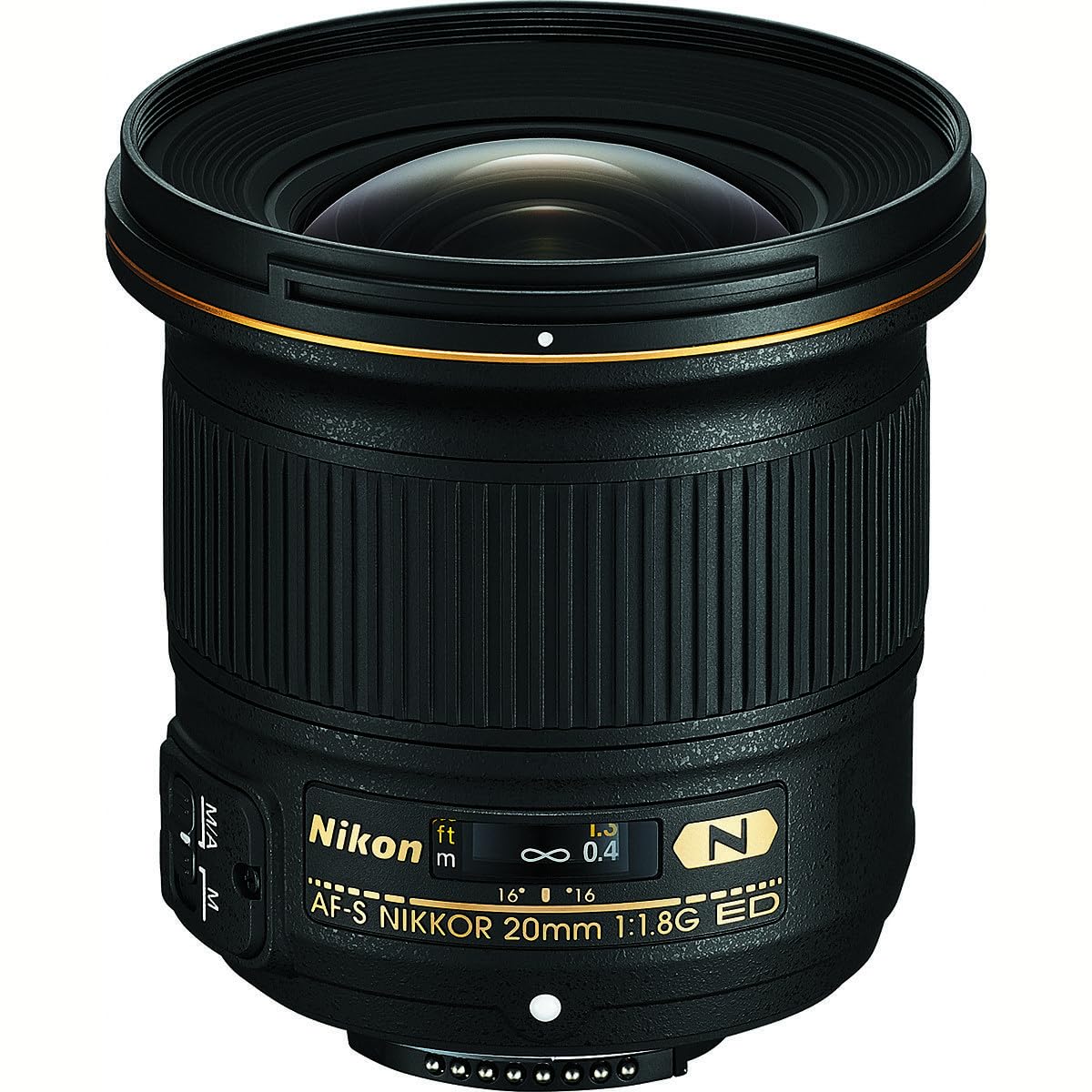
7. Nikon AF-S FX NIKKOR 20mm f/1.8G ED
The real-estate workhorse — a 10-20mm DX zoom that swallows whole rooms in one frame.
If your wide-angle job is shooting interiors, this is the one that earns its keep on a DX-format Nikon DSLR. The 10mm end pulls an entire room into a single frame, and that is exactly why it turns up in real-estate work — no stitching, no backing into a hallway. The 10-20mm sweep then lets you tighten to a more natural 20mm for detail shots without a lens change.
The focusing is handled by a ring-type ultrasonic motor with full-time manual focusing — a quiet, quick autofocus drive that also lets you grab the focus ring and override it any time without flicking a switch. Aspherical and low-dispersion elements handle optical correction, and the minimum focus distance of 0.24m lets you get close for architectural detail. The 77mm filter thread matches the Tamron 10-24mm, so the same filters fit both.
At 470g it is the second-heaviest zoom here behind the full-frame Tamron 15-30mm f/2.8’s 2.5 pounds. The variable f/4-5.6 aperture is the honest trade-off — it dims toward the long end, so dim rooms will ask for a tripod or a higher ISO. For indoor and outdoor work and end-to-end sharpness, though, it is a well-loved tool that holds up across a full day of shooting.
What it does beautifully: captures an entire room in one shot and keeps sharpness strong from edge to edge, which is why interior and landscape shooters keep coming back.
The honest limit: the f/4-5.6 range narrows as you zoom, so low light is where you will feel the compromise.
The right lens for: crop-sensor DSLR shooters who need one frame to hold a whole room or a wide horizon.
Consider another route if: most of your shooting happens in dim rooms without a tripod.
8. Tamron SP 15-30mm f/2.8 Di VC USD

A full-frame f/2.8 wide zoom with built-in stabilisation — rare in this class.
Most fast wide zooms skip stabilisation. This one does not, and that single feature changes how you can shoot handheld. Vibration Compensation steadies the image in the barrel, so dim interiors and evening exteriors hold sharper at slower shutter speeds. Pair that with the constant f/2.8 aperture and you have a full-frame zoom that stays bright from 15mm to 30mm without dimming as you zoom.
The angle of view runs from 110° 32 minutes at the wide end to 71° 35 minutes at 30mm — a broad sweep that covers dramatic wide shots and more natural framing alike. The USD Ultrasonic Silent Motor keeps autofocus quick and quiet, and a 9-blade round aperture produces smooth out-of-focus backgrounds. Fluorine coating on the front element helps shrug off moisture and grease. Build quality is described as professional grade, with images landing close to prime-lens sharpness.
The weight is the part you feel: 2.5 pounds makes this the heaviest lens on this list, and it is a full-frame FX design so it wants a full-frame body. Owners who have shot it against big-name alternatives report it holding its own on sharpness. For landscape and architecture shooters who want stabilisation and f/2.8 in one lens, that heft is the cost of admission.
The case for it: stabilisation plus a constant f/2.8 across a full-frame zoom range is a combination few rivals here offer.
Weigh the heft: at 2.5 pounds it is the heaviest pick, so it suits shooters who set up rather than run and gun.
9. Nikon NIKKOR Z 17-28mm f/2.8
ill only attach to the mount it was built for, so this is the very first spec to check. Z lenses tend to be newer designs with quieter motors; F lenses open up the huge secondhand DSLR market.
Focal length in millimetres
Focal length describes how much scene the lens captures. A smaller number, like 14mm, pulls in a huge field of view. A larger number, like 30mm, is closer to what your eye sees. Primes hold one focal length; zooms cover a range like 10-24mm. Lower numbers suit interiors and dramatic landscapes, higher numbers suit street and travel.
Maximum aperture (the f-number)
The aperture is the opening that lets light in, written as f plus a number. A lower number means a wider opening and more light — f/1.8 gathers far more than f/4. Fixed-aperture lenses hold that value as you zoom; variable ones dim toward the long end. For dim rooms and night skies, lower is better; for bright outdoor work, a higher number keeps the lens smaller and lighter.
Minimum focus distance
This is how close you can get to a subject and still lock focus, measured in metres or feet. A short distance such as 0.13m lets you shoot tight detail in a cramped room and build dramatic near-far compositions. A longer distance like 0.66 feet asks you to step back. For interiors and creative foreground work, the shorter the better.
Full frame versus APS-C coverage
Full-frame lenses cover a bigger sensor, while DX lenses are built for the smaller APS-C sensor. Put a DX lens on a full-frame body and you lose coverage at the edges. Put a full-frame lens on an APS-C body and you simply use the centre. Match the lens to your sensor to get the field of view printed on the barrel.
Filter thread size
The filter thread is the ring of screw-mount grooves at the front of the lens, sized in millimetres. Common sizes here are 52mm, 67mm, 77mm and 82mm. Buying a filter in the right size saves you from stacking adapters. If you already own circular polarisers or ND filters, match the lens thread so they screw straight on.
Image stabilisation
Stabilisation counteracts hand shake so slow shutter speeds stay sharp. Some lenses build it into the barrel, labelled Vibration Compensation or Optical Stabilisation; others leave it to the camera body. When the lens lacks it, your technique or in-body stabilisation carries the load in low light. For handheld interiors and dusk shooting, in-lens stabilisation is a real convenience.
Autofocus motor type
The motor drives focus. Stepping motors and ultrasonic motors are quiet and quick, which helps video and spontaneous shots. Micromotor designs are simpler and often found on budget lenses, sometimes without full-time manual override. Quiet motors matter most for video, where focus noise can be picked up by the microphone.
Common Questions
Will a Nikon Z lens fit my Nikon DSLR?
Is a DX lens okay on a full-frame Nikon body?
What focal length counts as wide-angle for a Nikon?
Do I need a fast f/2.8 aperture for landscapes?
Why do wide-angle lenses distort the edges of a photo?
Can I use standard filters on these wide-angle lenses?
Is in-lens stabilisation important for a wide-angle lens?
Will a wide-angle lens work for video and vlogging?
How close can these lenses focus for tight interior shots?
Should I choose a prime or a zoom for wide-angle work?
The Bottom Line
For most Nikon Z shooters, the wide-angle lens for a nikon winner is the Nikon NIKKOR Z 14-30mm f/4 S because it balances a genuinely wide 14-30mm range, a fixed f/4 aperture and a barrel that collapses to 3.5 inches for easy packing. If night skies and dim rooms are your thing, the Nikon AF-S FX NIKKOR 20mm f/1.8G ED gives you the fastest aperture here at f/1.8. And for the widest single focal length at an entry-level tier, the VILTROX 14mm F4.0 Z-Mount reaches 112° with a 0.13m close focus. Check your mount first, then pick the focal length that matches the scene you shoot most — that ordering gets you the right glass more reliably than any single spec.
How we choose
We do not accept paid placement. Every pick is matched to a real buyer and a real use-case; we do not hands-on test units.
Sources
Specifications: manufacturer listings and product documentation. Review insights: verified customer reviews, as of November 2026. Pricing: not shown on this page (it changes often); check the current price via the retailer link.
As an Amazon Associate, Tactical Gear Guy earns from qualifying purchases. This does not affect which products we feature.