Specs are compiled from manufacturer listings and verified buyer reviews and can change over time — please confirm the key details on the product page before buying.
You want a full cable gym in a garage or spare room, but a floor-standing crossover eats half the space. A wall-mounted unit fixes that — it bolts to your studs, pulls you through lat pulldowns, rows, and flys, and leaves the floor clear. The trick is buying one that stays solid under load instead of shaking itself loose. A quick note before the picks: this list uses flexible, human-like matching for wall-mounted installation, so a few options here are plate-loaded towers or folding racks rather than a pure cable crossover — the nearest same-type machine for the same job.
This guide is built by comparing the manufacturers’ published specifications and the patterns across verified customer reviews, so you get each pick’s real strengths and trade-offs instead of marketing spin.
Some wall units wobble at heavy weight, others max out at 200 pounds, and a few hide a folding frame behind the cable stack. Below you’ll find specs side by side, the weight capacities that actually matter, and honest trade-offs so you pick the one that fits your wall and your lifting — the short version is here in this guide to the wall weight machine.
Top Picks
How To Choose The Best Wall Weight Machine
A wall-mounted weight machine trades floor space for wall space, so the first thing to check is your wall, not the machine. You are bolting a frame that will take hundreds of pounds of pulling force into studs or masonry. Get that wrong and no pulley quality saves you.
Check your wall and your footprint first
Most units here mount to wall studs or concrete and masonry. Some need a specific rack series for mounting, so confirm your wall type and stud spacing before you order. Then measure the footprint — compact wall stations tuck into corners, while folding racks swing out when deployed.
Match the maximum load to your lifting
The maximum weight recommendation is the number that decides how far the machine grows with you. Plate-loaded towers run from 200 pounds up to 400 pounds of rated load. If you train heavy on lat pulldowns or rows, buy headroom rather than the smallest number on the page.
Understand the pulley ratio
A 2:1 ratio halves the resistance you feel at the handle, so a lighter plate feels easier and the pull is faster. A 1:1 ratio delivers full plate resistance and a heavier, slower pull. Some stations let you switch between both, which is useful for drop sets versus heavy work.
Side-by-Side Comparison
| Model | Best For | Max Load | Height Positions | Item Weight | Amazon |
|---|---|---|---|---|---|
| Valor Fitness BD-62★ Best Overall | Best Overall | 200 pounds | 16 | 62 pounds | Amazon |
| Goimu WM1Best Value | Best Value | 300 pounds | 17 | 81.4 pounds | Amazon |
| Mikolo M-G3Most Versatile | Most Versatile | 400 pounds | 19 | 400 pounds | Amazon |
| ER Kang Cable Station | Top Performer | 400 pounds | 18 | 34.93 kg | Amazon |
| Titan Fitness Pulley Tower | Rack Add-On | 350 pounds | 18 | 65 pounds | Amazon |
| GMWD G7 Pro | Compact Pick | 350 pounds | 26 | 165 pounds | Amazon |
| Goimu WM3-V4 | Best Folding Rack | 2000 pounds | 15 | — | Amazon |
| Mikolo WR00 | Best for Heavy Lifting | 1000 pounds | 15 | 150 pounds | Amazon |
| JEEKEE H16 PRO | Premium Pick | 2400 pounds | — | 240 pounds | Amazon |
Detailed Reviews
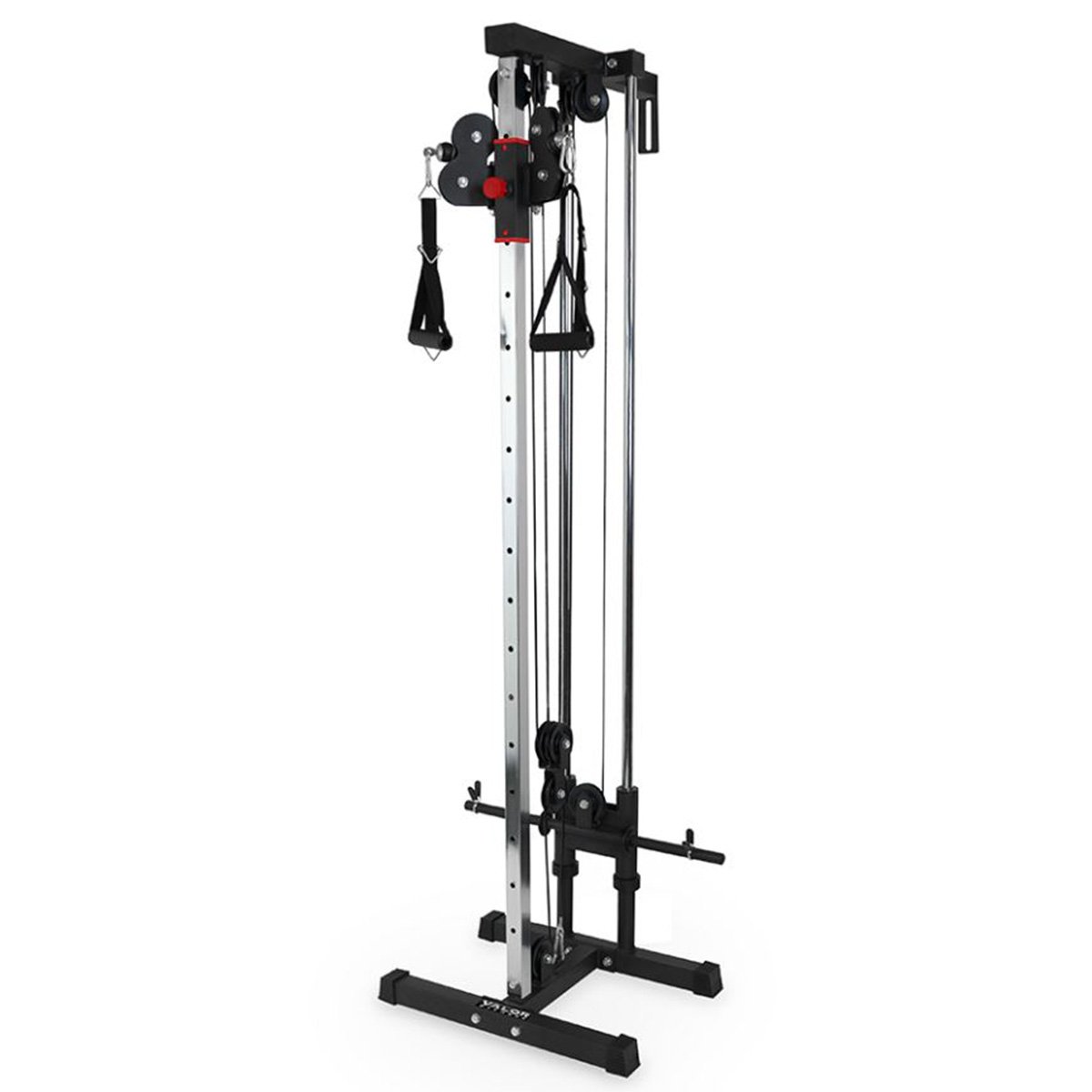
1. Valor Fitness Wall Mounted Cable Machine
Our pick — 4.5+★ from 650+ verified ratings; the strongest balance of quality and price.
The one that turns an unused garage wall into a lat pulldown station.
Sixteen pulley heights is the reason this machine earns the top spot. You slide the pulley up for lat pulldowns, down for seated rows, and anywhere in between for tricep pushdowns and face pulls. All of it runs off standard 1″ weight plates, so your existing plates do the work — an Olympic 2″ adapter is sold separately.
What wins people over is how smooth it feels, especially as the weight climbs. The 14-gauge steel frame and nylon pulleys keep the cable tracking without the jitter that cheaper towers show once you load real plates. It weighs 62 pounds versus the 400 pounds of the Mikolo M-G3 below, so this is the far easier one to hang and to move if you relocate. It also offers 16 height positions against the Mikolo’s 19, and its 25″D x 25″W x 80″H build stands slightly smaller than the 28.11″D x 24.8″W x 78.74″H of the Goimu WM1.
The honest catch is the 200-pound maximum weight recommendation. That ceiling is the lowest among the plate-loaded picks here, so if you already row or pulldown near that number, buy headroom instead. For everyone working in the middle of the range, the compact frame and included mounting hardware make this a straightforward install.
What earns the top spot
- 16 pulley heights cover high pulls through low rows from one wall
- 62-pound frame is light enough to hang without a crew
- Steel cables and nylon pulleys stay smooth under load
- Mounting hardware and instructions come in the box
Where it tops out
- 200-pound max is the lowest load rating among the plate-loaded picks
- Olympic 2″ plates need a separate adapter
Reach for this if: you want a compact, reliable cable station and your working weight fits inside 200 pounds.
Look elsewhere if: you train heavy lat pulldowns — the 400-pound-rated Mikolo or ER Kang gives you the headroom.
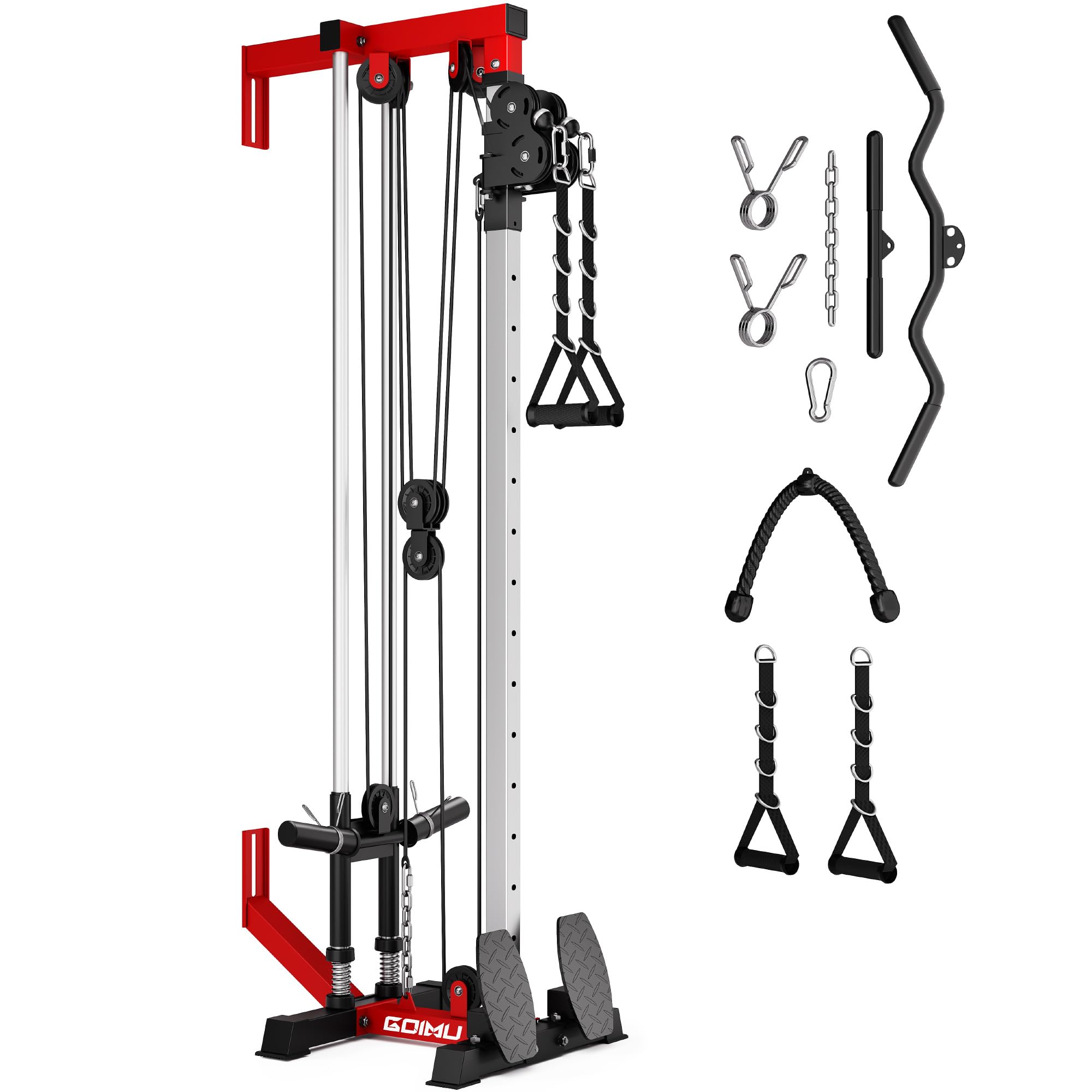
2. Goimu WM1 Wall Mount Cable Station, 17 Positions
Two pulley ratios in one tower, so a light plate can feel heavy and heavy can feel light.
Here is the feature that sets this one apart: a cable adaptor that flips the pulley between a 1:1 ratio and a 2:1 ratio in seconds. Set it at 1:1 for a full-resistance heavy lift, then swap to 2:1 for faster, lighter drop sets. That flexibility sits on a 300-pound maximum weight recommendation, which lands above the 200 pounds of the Valor BD-62 and stays well inside the 400 pounds of the ER Kang.
Seventeen height positions run from high for lat pulldowns down to low for rows, and the kit arrives with a lat pull bar, cable bar, tricep rope, T bar, and dual handles. That means you can start training without buying extra attachments. Owners consistently call it reliable and easy to assemble, praising the solid build and smooth cable glide. The compact profile keeps it tight against the wall in a small garage.
The honest note is the mounting requirement. This station is designed for installation on concrete or masonry walls, and it needs no floor anchors — great for renters, but worth checking against your own wall first. At 81.4 pounds, plan for two people to lift it into place.
Full-kit advantage: lat bar, cable bar, tricep rope, and dual handles come included, so there is no immediate add-on spend.
Wall check first: confirm you have concrete or masonry before you drill — this one is not built for stud-only mounting.
The smart-money call: a switchable ratio plus a full attachment kit for a space-conscious garage setup.
Know before you buy: the concrete or masonry mounting requirement rules out some stud walls.
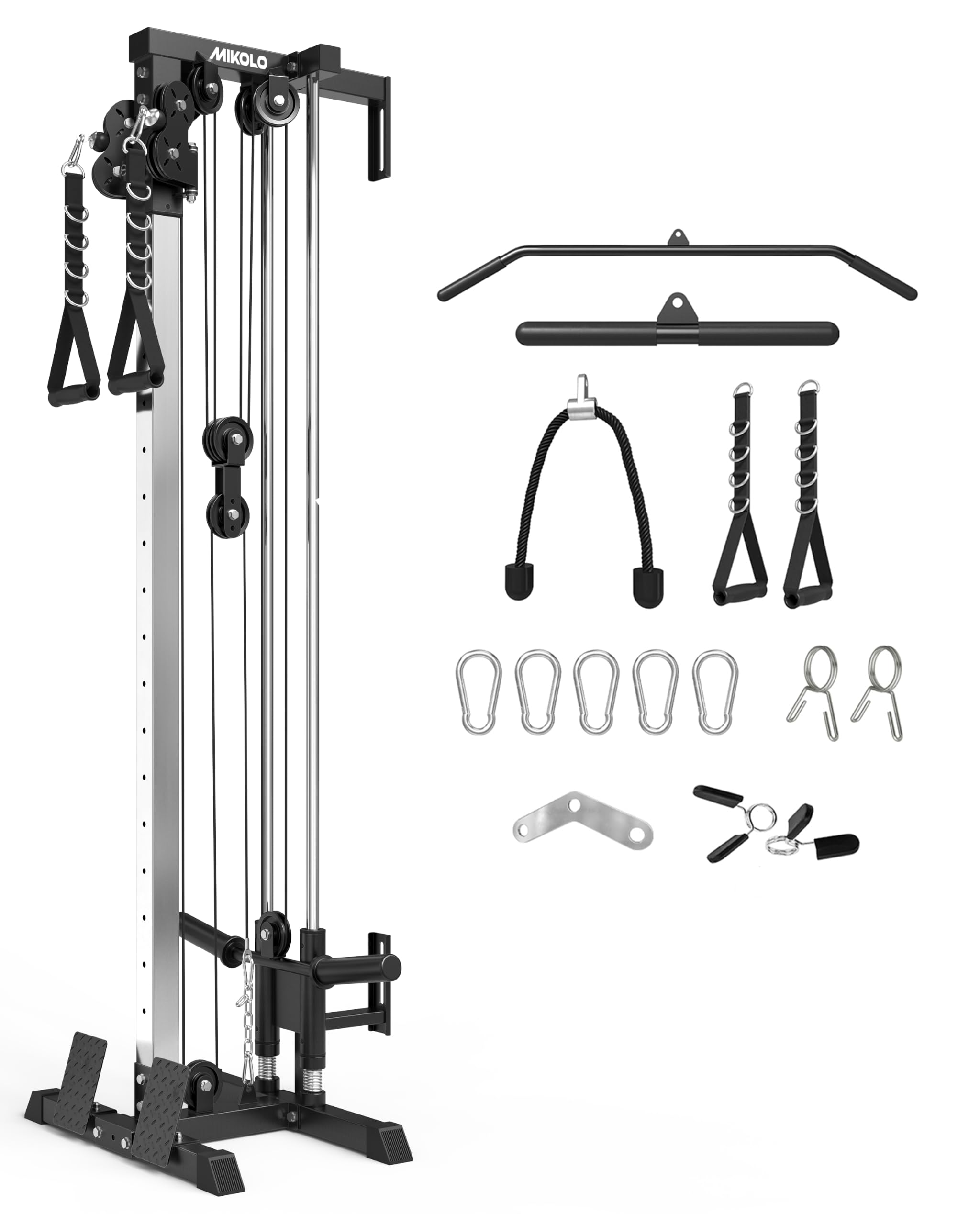
3. Mikolo Wall Mount Cable Station M-G3, 19 Positions
A 400-pound ceiling carried on aircraft-quality cables rated to 2200 pounds.
Start with the strength numbers, because they are the whole argument here. The frame is commercial-grade 14-gauge steel, the cables are nylon-coated with a 2200-pound tensile strength, and the machine carries a 400-pound maximum load capacity. That puts it 200 pounds above the Valor BD-62’s ceiling and level with the ER Kang. If you want one station that grows with your lifts without swapping frames, this is the one.
Then there is the hardware. Nineteen pulley positions, a rotatable pulley bracket that widens your range of motion, and a large footboard for seated cable rows. Upward-angled 10° weight pegs help stop plates slipping off mid-set, and the sleeves take both 1″ and 2″ plates without an adapter. Lat bar, cable bar, and tricep rope all arrive included.
Two things to weigh honestly. First, it is a 400-pound machine — plan a proper install with help. Second, build quality and smoothness draw some mixed comments, so check the cable tracking and pulley glide during the first few sessions. Owners still rate the quality and value highly, and many say it feels like a far pricier commercial unit.
The strength case
- 400-pound load capacity gives real room to progress
- Takes 1″ and 2″ plates without an extra adapter
- 10° angled weight pegs resist plate slipping
- Footboard open up proper seated cable rows
The honest side
- Heavy frame at 400 pounds needs a careful two-person install
- Build quality and smoothness land as mixed in owner feedback
Fits the lifter: anyone who needs 400 pounds of capacity and both plate sizes without extra buys.
Weigh it honestly: heavy to hang, and worth checking the pulleys on arrival.
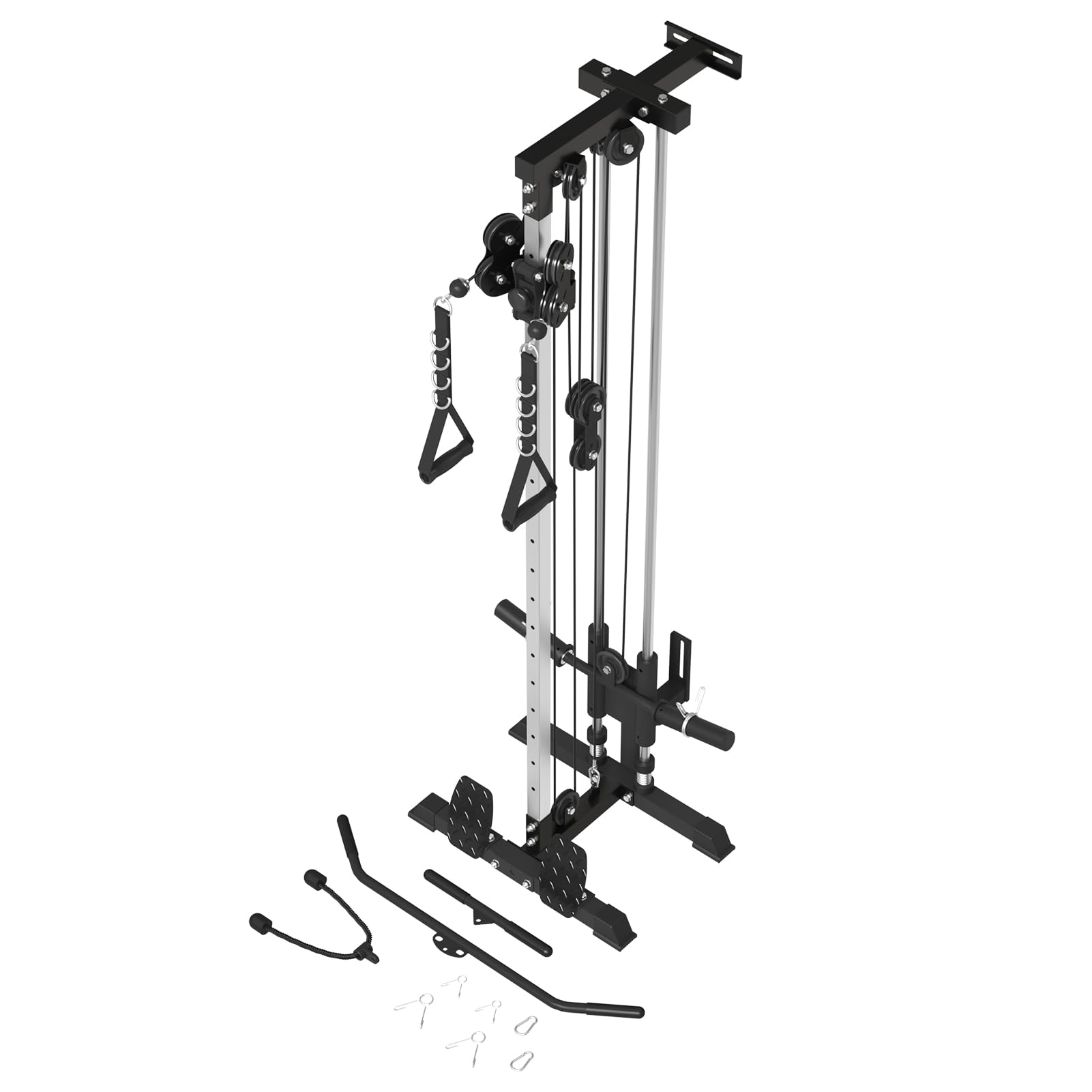
4. ER Kang Wall Mount Cable Station, 18in Pulley Tower
Thicker steel than the rest of the wall towers, and it shows in how the frame sits still.
The frame is the differentiator. It is built from commercial-grade 11-gauge black powder-coated steel — a heavier gauge than the 14-gauge found on several towers here — with nylon-coated aircraft-quality cables rated to a 2200-pound tensile strength. The maximum load recommendation is 400 pounds, and that is double the 200-pound ceiling of the Valor BD-62. It also carries four more height positions than the Valor’s 16, at 18 total.
The H-shaped base is the quiet hero. It spreads the pull across the floor and cuts the shaking that plagues thin wall stations during fast reps. A big footboard handles seated cable rows, the weight pegs sit at an upward 10° so plates stay put, and detachable sleeves accept 1″ or 2″ plates. Lat bar, cable bar, and tricep rope come with it, and the four-buckle strap handles let you dial in handle length.
Buyers talk about value most here, with build quality a close second. The one caveat is durability: it draws some mixed feedback, so a few units show scratches after light use. Treat the powder coat as something to look after rather than indestructible.
Frame-first thinking: 11-gauge steel and a 400-pound rating make this the sturdiest pure cable tower on the list.
The finish caveat: the powder coat can scratch sooner than you would expect — a cosmetic point, not a strength one.
Built for load: pick this when a rock-solid frame at 400 pounds matters more than a few cosmetic scuffs.
Not for you if: a scratch-free finish is something you will inspect closely.
5. Titan Fitness 80.5″ Short Wall Mounted Pulley Tower

A pulley tower that can hang on your wall or bolt straight to your power rack.
This one is for the lifter who already owns a rack. It bolts to your wall, or mounts to a T-3, X-3, or TITAN Series Power Rack, which saves your wall entirely. The 350-pound plate capacity sits between the Valor’s 200 and the Mikolo’s 400, and it supports standard 1″ plates with spring clips — plus a pair of 12.5″ nylon adapter sleeves for Olympic plates.
Check the pulley math before you buy. Used separately, each handle gives a 2:1 ratio for high-rep work. Join both handles with the chrome connector for a 1:1 ratio and full resistance.
The catch is the paperwork. Assembly draws mixed feedback, with some instructions missing steps — budget extra time and watch the trolley alignment. Functionality also splits: several buyers report it runs perfectly, while one notes it does not deliver a full range of motion. At 65 pounds and 28″D x 25″W x 80.5″H it is manageable to hang, and mounting hardware is not included, so grab that separately.
Why rack owners like it
- Mounts to a T-3, X-3, or TITAN Series rack as well as a wall
- 2:1 and 1:1 pulley ratios in one tower
- 350-pound capacity with both standard and Olympic plate support
- 18 trolley height positions for full-range coverage
Plan around these
- Instructions can miss steps; allow more assembly time
- Mounting hardware is not included
Rack owners first: bolt this to your existing power rack and skip the wall entirely.
Bring tools and patience: the install rewards careful trolley alignment.
6. GMWD Wall Mounted Cable Machine with Dual Swivel Arms

Folds flat against the wall so your garage goes back to being a garage.
Adjustability is the headline: 26 height adjustment holes plus 13 arm angle settings that swing through 180 degrees. That combination lets you set the handles for chest flys, shoulder presses, and woodchoppers without moving the whole station. It tops the 19 positions of the Mikolo M-G3 and the 18 on the ER Kang, and the frame carries a 350-pound maximum weight recommendation.
The dual cable bracket switches between a 2:1 and a 1:1 resistance ratio, so you can shift intensity between light drop sets and heavy pulls. The full kit lands in the box too — lat bar, cable bar, dual cable bracket, leg holder, and wall-mount hardware sized for both wood and concrete surfaces. When the session ends, it folds flat, and the 39″L x 25.8″W x 77″H frame uses that footprint only while it is open.
Owners praise the top-notch pulleys first, then the easy assembly and sturdy build. The one thing to know is that the 165-pound weight is the second-heaviest of the pure cable towers here after the 400-pound Mikolo, so line up help for the lift.
Best for tight rooms: 26 height holes, 13 arm angles, and a flat fold make it the most adjustable compact tower here.
Install reality: 165 pounds and hardware for wood or concrete come included, but bring a second pair of hands.
Room-first pick: the flat-fold frame and 180-degree arms suit a garage you share with a car.
Skip the solo install: this one needs two people and a secure mount.
7. Goimu WM3-V4 Folding Squat Rack with Dual Pulley System

A rack, cable crossover, and pull-up bar that collapses to 4.3 square feet.
The fold is the whole point. This rack stores in 4.3 square feet and opens to 12.3 square feet, with five configurable modes — folded, semi-open, half rack, functional trainer, and cable crossover. Patented locking mechanisms switch modes in seconds, so a cramped apartment or basement gets both a power rack and a cable station from one wall. The 2000-pound maximum weight recommendation is by far the highest on this list, 1600 pounds above the Mikolo M-G3.
The cable side is dual independent pulleys at a 1:1 ratio, which means you and a partner can train at the same time and run supersets or drop sets. Fifteen adjustable pulley heights plus a detachable pull-up bar and quick-swap J-hooks and safety arms cover well over 80 exercises. Owners rate the quality and value highly, and the frame has taken heavy squats without complaint.
The catch sits in setup and finish. Assembly draws mixed feedback — some find it very easy, others find the instructions poor. Stability also splits and durability draws some negative feedback, so check the floor feet and wall mounts carefully before loading up. Plan a patient install.
Where it shines
- 2000-pound weight rating buys serious headroom for squat and rack work
- Folds to 4.3 square feet for tiny spaces
- Five modes swap in seconds with patented locks
- Dual pulleys let two people train at once
What to watch
- Assembly instructions split opinion between easy and unclear
- Stability and durability draw some mixed feedback
Fits the space-starved lifter: a full rack plus cables that hides away in a small room.
Give it a careful setup: check feet and wall mounts before you load it heavy.
8. Mikolo Folding Squat Rack

Folds down to 3 square feet, yet rated to hold up to 1000 pounds.
Stability credentials come first here. The frame is 2×2 inch 14-gauge steel with reinforced screw-in wall mounts and four adjustable ground support feet, rated to handle up to 1000 pounds. That is five times the 200-pound ceiling of the Valor BD-62, and it means the frame stays planted through heavy squats and bench work. Owners agree the quality is excellent and the frame stays planted under load.
It opens to 9.5 square feet and folds to just 3 square feet, covering five settings: folded, semi-open, power rack, functional trainer, and cable crossover. The cable side runs a 1:1 pulley ratio with 15 height options and a single-handed adjustment, plus a detachable pull-up bar and J-hooks. Over 80 exercises are on the table from one unit.
Assembly is the mention that matters most after quality and value — and in a good way, since the instructions are clear and the build goes together easily. Folding is fast enough that the rack clears the garage in under a minute. The one trade-off: at 150 pounds, this frame is a solid commitment to hang, so plan it right.
Built to load: 1000-pound capacity on 2×2 inch 14-gauge steel, with feet you can level on an uneven floor.
Consider the weight: a 150-pound frame rewards a carefully planned install over a rushed one.
Lift-heavy selection: the rack to choose when squat and bench load matter as much as the cable work.
Be ready to commit: this is a permanent-feeling frame that deserves a solid wall.
9. JEEKEE Folding Wall Mounted Power Rack
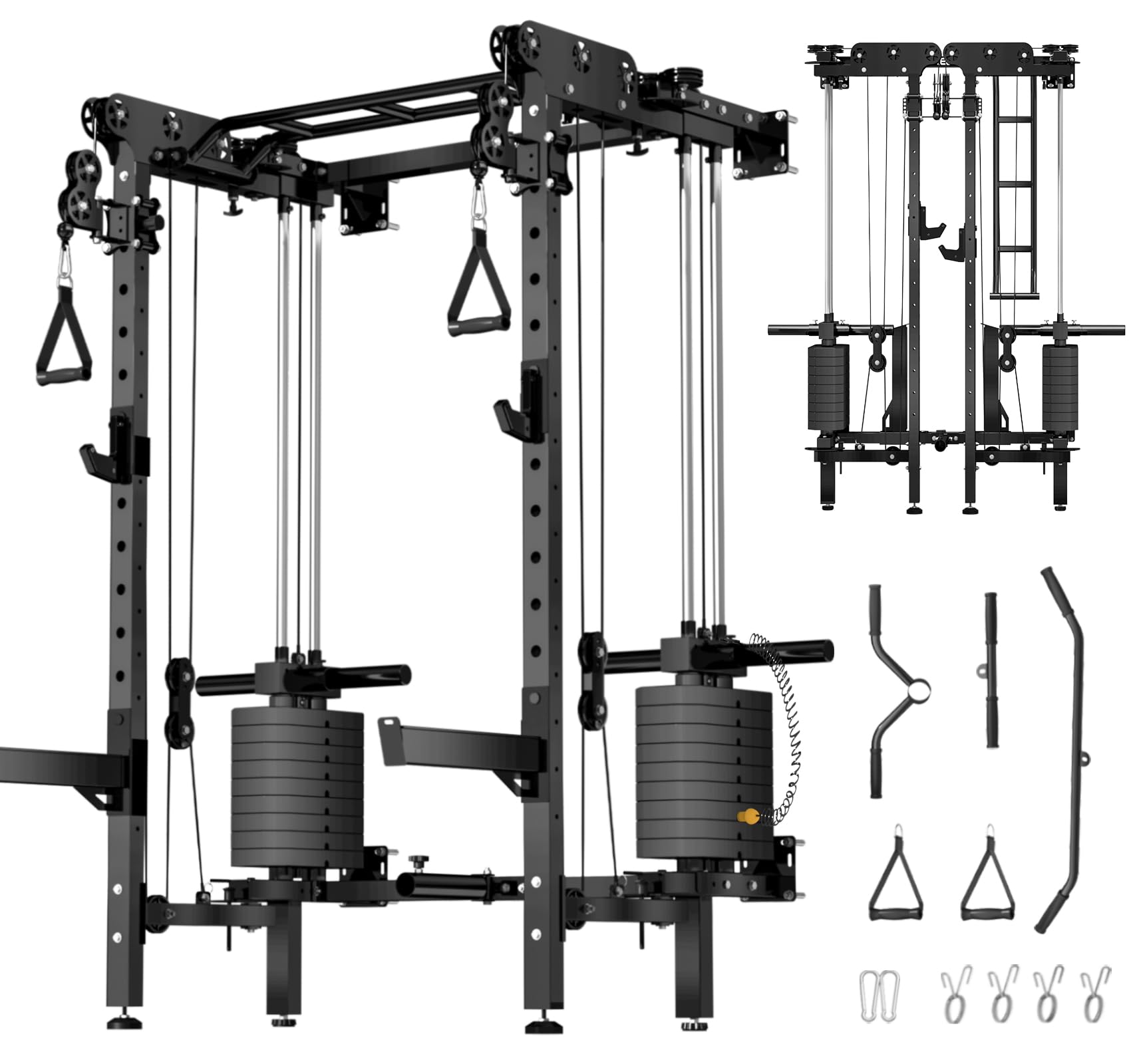
A built-in weight stack means no plates to load before a single cable rep.
This is the only pick with resistance already on board. A 180-pound integrated weight stack — 90 pounds per side — adjusts in 10-pound increments, so you change resistance with a pin instead of hauling plates across the floor.
It is a folding rack too. It expands to 84.7″ x 36.3″ x 49″ and folds to 7 square feet, which keeps a small room usable between sessions. Extra weight plate storage holders, compatible with 2″ plates, let you add load beyond the stack. The kit includes sandwich J-cups, safety arms, dual handles, a lat pulldown bar, cable bar, T-bar, a landmine attachment, and a multi-grip pull-up bar.
The trade-off is setup and smoothness. Assembly draws mixed feedback, with some finding it easy and others hitting difficulty, and some report the equipment does not operate smoothly. Owners still call the quality and value solid. At 240 pounds it is the heaviest single frame here, so treat the install as a two-person job.
Why it earns premium
- 180-pound built-in stack with 10-pound increments, no plate loading
- 2400-pound steel frame rating, the highest capacity on the list
- Folds to 7 square feet for small rooms
- J-cups, safety arms, landmine, and multi-grip bar all included
Where it asks patience
- Some report the cables do not run smoothly
- Assembly feedback splits; the 240-pound frame needs two people
The all-in unit: best when you want a stack, a rack, and a landmine in one folding footprint.
Test it first: check the cable smoothness early and get help hanging the 240-pound frame.
Know the Specs
Maximum weight recommendation (pounds)
This is the load the frame and cables are rated to carry — the figure that tells you how far the machine grows with you. Plate-loaded towers here range from 200 pounds up to 400 pounds, while the folding rack frames are rated far higher for bar work. Pick headroom above your current lifts so you are not buying twice.
Pulley ratio (1:1 versus 2:1)
A ratio describes how the cable trades distance for resistance. At 1:1, the plate load you feel matches the handle pull — heavier and slower. At 2:1, the resistance you feel is roughly half, so the pull is faster and easier. Some stations let you switch, which covers both heavy work and fast drop sets from one tower.
Height positions and arm angles
Adjustable pulleys decide which exercises are possible. More positions let you hit high lat pulldowns, mid rows, and low curls from one frame. Arm angle settings swing the handles through an arc for chest flys and presses. More positions generally means more of your program can be done at one station.
Footprint and fold size
Footprint is how much floor the unit eats while in use; fold size is how little it takes when stored. A compact cable tower hugs the wall and keeps the floor clear. A folding rack swings out when deployed and collapses when done, which matters most in a shared garage or apartment.
Common Questions
Can I mount a cable machine on drywall alone?
What does a 2:1 pulley ratio feel like compared to 1:1?
Will a plate-loaded cable machine work with Olympic 2″ plates?
How much weight capacity do I actually need?
Do these wall-mounted machines need floor anchors?
Can two people share one cable machine at the same time?
Is a folding rack worth it over a simple wall cable tower?
How many pulley height positions should I look for?
What is the heaviest unit here to install?
Do I need extra attachments with these machines?
The Bottom Line
For most home gyms, the wall weight machine winner is the Valor Fitness BD-62 because 16 pulley heights, smooth steel-cable movement, and included mounting hardware turn a bare wall into a full cable station with the least fuss. If you want a switchable 1:1 and 2:1 ratio plus a complete attachment kit, grab the Goimu WM1. And for heavy bar work alongside the cables, the Mikolo WR00 is the one to reach for, with a 1000-pound rating behind it. One honest nudge: nine picks here, but only one carries the lightest hang weight and the smoothest pull of the plate-loaded towers — the BD-62.
How we choose
We do not accept paid placement. Every pick is matched to a real buyer and a real use-case; we do not hands-on test units.
Sources
Specifications: manufacturer listings and product documentation. Review insights: verified customer reviews, as of November 2026. Pricing: not shown on this page (it changes often); check the current price via the retailer link.
As an Amazon Associate, Tactical Gear Guy earns from qualifying purchases. This does not affect which products we feature.