Specs are compiled from manufacturer listings and verified buyer reviews and can change over time — please confirm the key details on the product page before buying.
A slow drip under the kitchen sink can run for weeks before you ever smell it. A Wi-Fi water leak detector with app push alerts catches that drip on day one and pings your phone before the floor is ruined. The pick most people should start with is the YoLink kit: three sensors plus a hub, a 105 dB alarm, and a signal that travels up to 2,034 feet.
This guide is built by comparing the manufacturers’ published specifications and the patterns across verified customer reviews, so you get each pick’s real strengths and trade-offs instead of marketing spin.
What separates a good leak detector from a bad one is whether the alert reaches your phone and whether the battery survives to next winter. Below you will find nine options sorted by where they belong in a real house, plus the plain-English spec notes that matter when you pick one of these Wi-Fi water leak detector kits.
Top Picks

How To Choose The Best Wi-Fi Water Leak Detector
Start with one question: where is the water most likely to appear, and is there power and Wi-Fi near that spot? Everything else — hub or no hub, siren volume, battery life — follows from that answer. A detector in a basement corner behind a furnace is a different job from one under a kitchen sink.
Hub or hubless: pick your architecture first
A hub is a small box that plugs in near your router and relays messages from the sensors to your phone. Hubless sensors talk straight to your 2.4 GHz Wi-Fi. Hubs are worth it when sensors sit far from the router — the YoLink system reaches up to 2,034 feet, and the GoveeLife gateway reaches up to 1,804 feet, both far beyond what a single Wi-Fi sensor manages.
Hubless is simpler and cheaper per sensor, but each unit needs to see your network on its own. If your router lives upstairs and your water heater lives in a basement, expect trouble.
The 2.4 GHz trap
Almost every detector here connects on 2.4 GHz Wi-Fi only — not 5 GHz. If your router runs a single combined network name, the sensor may try to join the wrong band and fail. Splitting the two bands, or setting up a 2.4 GHz guest network, saves a lot of setup headaches.
Waterproofing is not marketing fluff
An IP rating (Ingress Protection) describes how well a housing keeps out dust and water. IP67, the rating on the TECKNET kits and the YoLink sensors, means it can survive short immersion. IP66 on the Stechro and Winees units handles spray and humidity but is not rated for dunking. A detector sitting in the path of a burst pipe benefits from the higher number.
Battery life and the alerts that cost money
Push notifications through the app are free on every pick here. Text messages and phone calls are a different story — several of these systems charge a small subscription for SMS, email, or call alerts, and one YoLink kit bundles a set number of free texts per month. Read that line before you buy.
Side-by-Side Comparison
| Model | Best For | Hub Needed | Alarm Volume | Waterproof Rating | Amazon |
|---|---|---|---|---|---|
| YoLink Sensor 4 3-Pack + SpeakerHub★ Best Overall | Big houses and outbuildings | Yes (included) | 105 dB | IP67 | Amazon |
| TECKNET 5-Sensor Kit + GatewayMost Coverage Per Dollar | Covering a whole house on a budget | Yes (included) | 120 dB | IP67 | Amazon |
| TECKNET Wi-Fi Leak Sensor (2-Pack)Easiest Install | Sink and toilet duty, no hub | No | 120 dB | IP67 | Amazon |
| GoveeLife Smart Leak Detector 1s (3-Pack) | Reaching behind appliances | Yes (included) | 105 dB | IP67 | Amazon |
| Zircon Leak Alert WiFi | Email-based alerts, no hub | No | 105 dB | — | Amazon |
| Shelly Flood Gen4 | Smart-home automation setups | No | — | IP44 | Amazon |
| Stechro 4 Sensors + Gateway | Multi-room coverage with a hub | Yes (included) | 120 dB | IP66 | Amazon |
| Winees 3-Pack with Hub | Long sensor-to-hub range | Yes (included) | 100 dB | IP66 | Amazon |
| Honeywell CHW3610W1001 | Temperature and humidity tracking | No | — | — | Amazon |
Detailed Reviews
1. YoLink Water Leak Sensor 4 3-Pack
Our pick — 4.5+★ from 400+ verified ratings; the strongest balance of quality and price.
Three sensors, one hub, and a signal that reaches the far shed.
If your water heater lives in a basement with one bar of Wi-Fi, this is the kit that solves your problem. The YoLink system runs on LoRa (a low-power radio protocol built for long distance rather than bandwidth), and it claims a receiving range up to 2,034 feet. That is roughly a third of a mile of coverage from one hub, which is why it suits remote outbuildings and thick-walled basements that kill ordinary Wi-Fi sensors.
The hub supports more than 300 YoLink devices, so this is a starting point rather than a dead end. You get three Water Leak Sensor 4 units, each rated IP67 (survives short immersion), each running on replaceable AAA batteries the maker rates for over 5 years, and eight batteries come in the box. There is also a low-temperature sensor on each unit that warns you before a pipe freezes. The alarm is a 105 dB siren — about as loud as a smoke detector going off two rooms away.
Owners praise the YoLink sensors’ reliability first and the quick setup second. Owners describe placing the sensors under equipment and being done. The catch is connectivity — the LoRa link itself is strong, but the hub still needs a stable 2.4 GHz Wi-Fi connection to reach your phone, and that is the weak link when the router sits far away. Also worth reading twice: the “4 Pack” in the listing means four items total (one hub, three sensors), not four sensors. And text alerts come as five free texts per device, with 20 free SMS a month for the kit — beyond that, SMS plans run at a small monthly fee.
What earns the top spot
- Up to 2,034 feet of LoRa range — versus 200 meters on the Winees hub setup, so it reaches places Wi-Fi cannot
- IP67 housings that tolerate a real puddle, not just humidity
- Freeze warnings on every sensor, useful in unheated basements and garages
- Hub expands past 300 devices if you grow the system later
Where it asks for patience
- The hub still depends on 2.4 GHz Wi-Fi to push alerts to your phone
- SMS beyond the bundled free monthly allowance needs a paid plan
- The listing’s item count confuses people — three sensors ship, not four
Reach for this if: your leak risk sits in a basement, crawlspace, garage, or shed where normal Wi-Fi drops out.
Look elsewhere if: you only need one sensor under a sink and want zero hub setup.
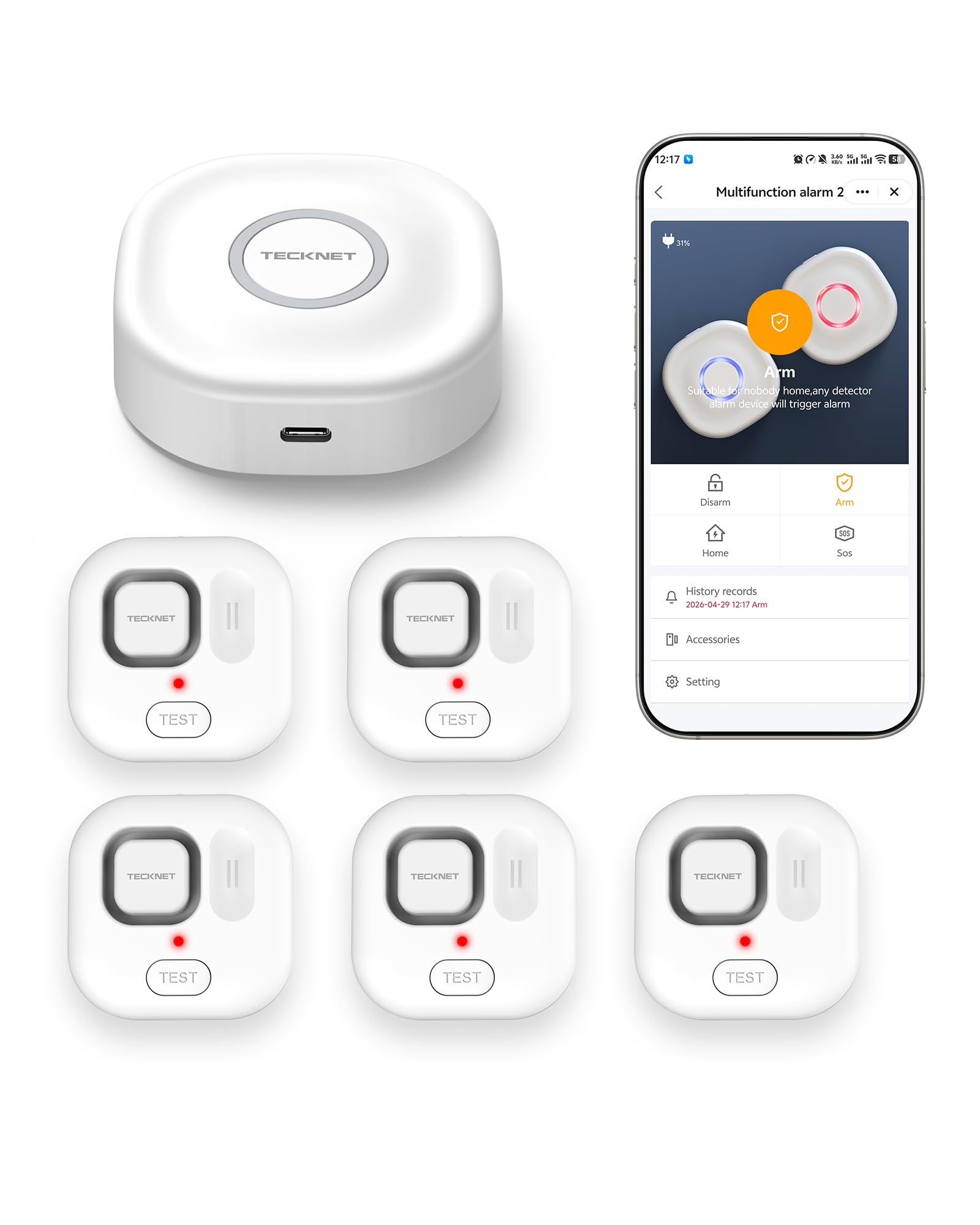
2. TECKNET Wi-Fi Water Leak Detector Kit
Five sensors, ten batteries, one gateway — a whole house in a single box.
Nobody buys one leak detector for a house with a kitchen, two bathrooms, a laundry room and a water heater. This kit covers all of them. You get five sensors and a gateway, plus 10 AAA batteries pre-loaded, so from the start you can park a sensor beside every water source you own. The alarm is a 120 dB siren with four volume levels, adjustable by holding the TEST button for three seconds — loud enough to hear from a basement, quiet enough for a bedroom wall.
Detection is done by six probes per unit: two on top for dripping pipes and four underneath for standing water and damp floors. All six work at once. That is a genuinely useful layout under a dishwasher, where the leak may start as a drip and end as a puddle. The IP67 housing means you can dry a flooded unit off and reuse it.
The trade-off is honest and specific: false alarms. In very humid air, moisture in the air itself can bridge the probes and trip the alarm, so the probes need regular wiping. Expect to tend to them. The other limit is the gateway, which pairs only with the bundled sensors — it is not a hub you can grow into with other brands.
Sound investment: 120 dB of siren with four volume steps and a 3-second TEST-button switch covers both a quiet bedroom and a noisy basement.
Maintenance reality: probes need routine drying in humid rooms, and the gateway locks you to TECKNET sensors only.
The sensible default: a first-time buyer who wants every water source covered in one purchase.
Think twice if: your laundry room stays steamy enough that wet air might trip a probe.
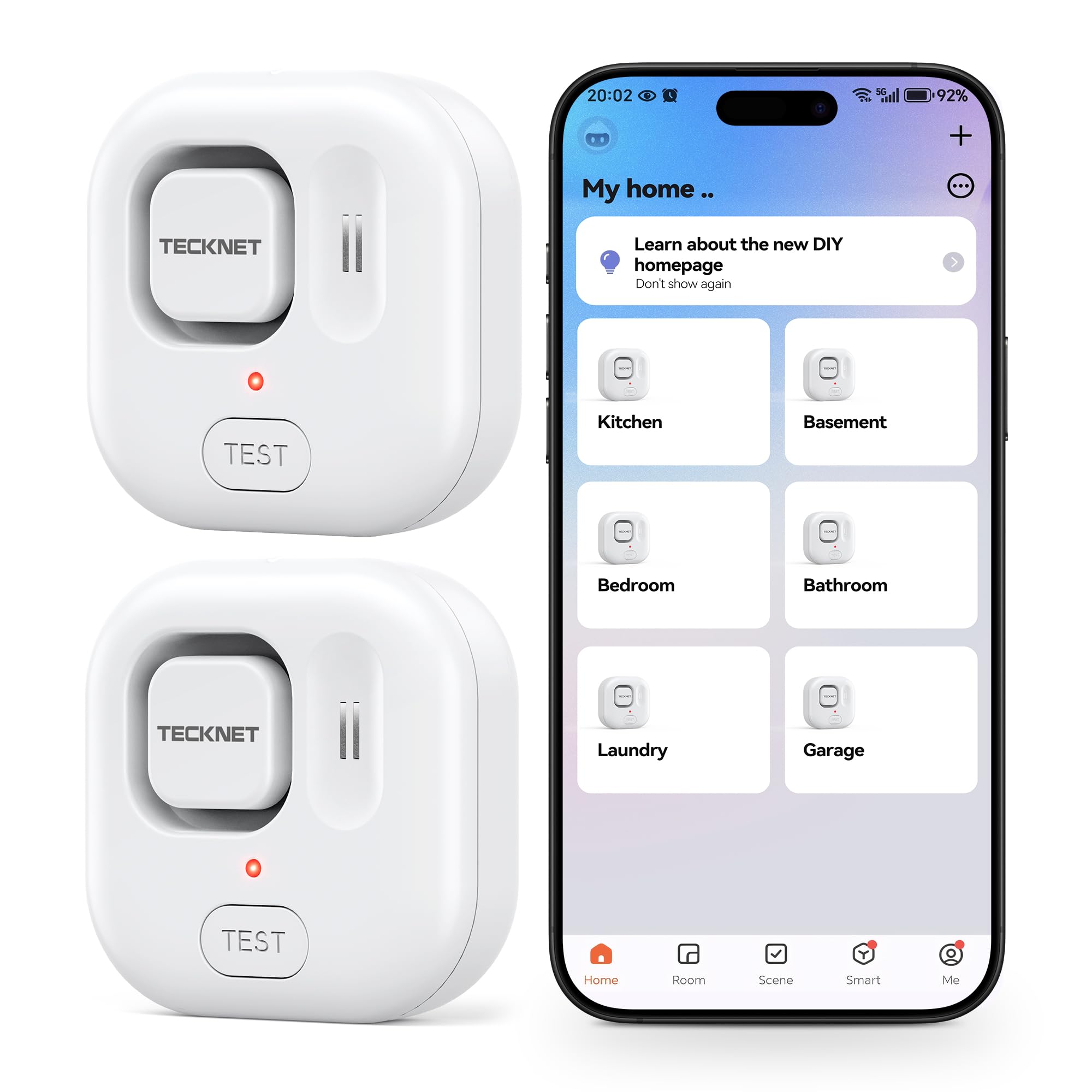
3. TECKNET WiFi Water Leak Detector
Two sensors that talk straight to your router — no box in between.
This is the simplest architecture on the list. Two sensors, four included AAA batteries, and a direct 2.4 GHz Wi-Fi link to the Tuya Smart app. No gateway to plug in, no hub to keep alive. Each unit weighs in around 0.18 kg and runs for up to 2 years on its two AAA cells, with a low-battery reminder in the app so you are not guessing.
Six probes handle detection: two on top for pipe drips, four underneath for floor pooling. When water hits, a 120 dB siren fires with adjustable volume — identical in loudness to the five-sensor TECKNET kit above, just with half the sensors in the box. The IP67 housing means humid laundry rooms and basement corners are fair game.
The thing that trips people up is the app, not the hardware. The Tuya Smart interface has a following but also a learning curve, and connectivity on 2.4 GHz is the other recurring note. If your router broadcasts one combined network name, split it or expect to troubleshoot. Also note the honest limit in the listing: text and call alerts need a third-party subscription — app push notifications are the free path.
Straightforward wiring-free install: two sensors, no hub, up to 2 years per set of AAA batteries, and app push alerts at no cost.
What to plan around: the Tuya Smart app demands patience, and 5 GHz networks are not supported at all.
Best fit for: a renter or small-space owner covering a sink and a toilet with no permanent install.
Not the one if: you want email or SMS alerts without paying for a third-party service.
4. GoveeLife Smart Water Leak Detector 3 Pack
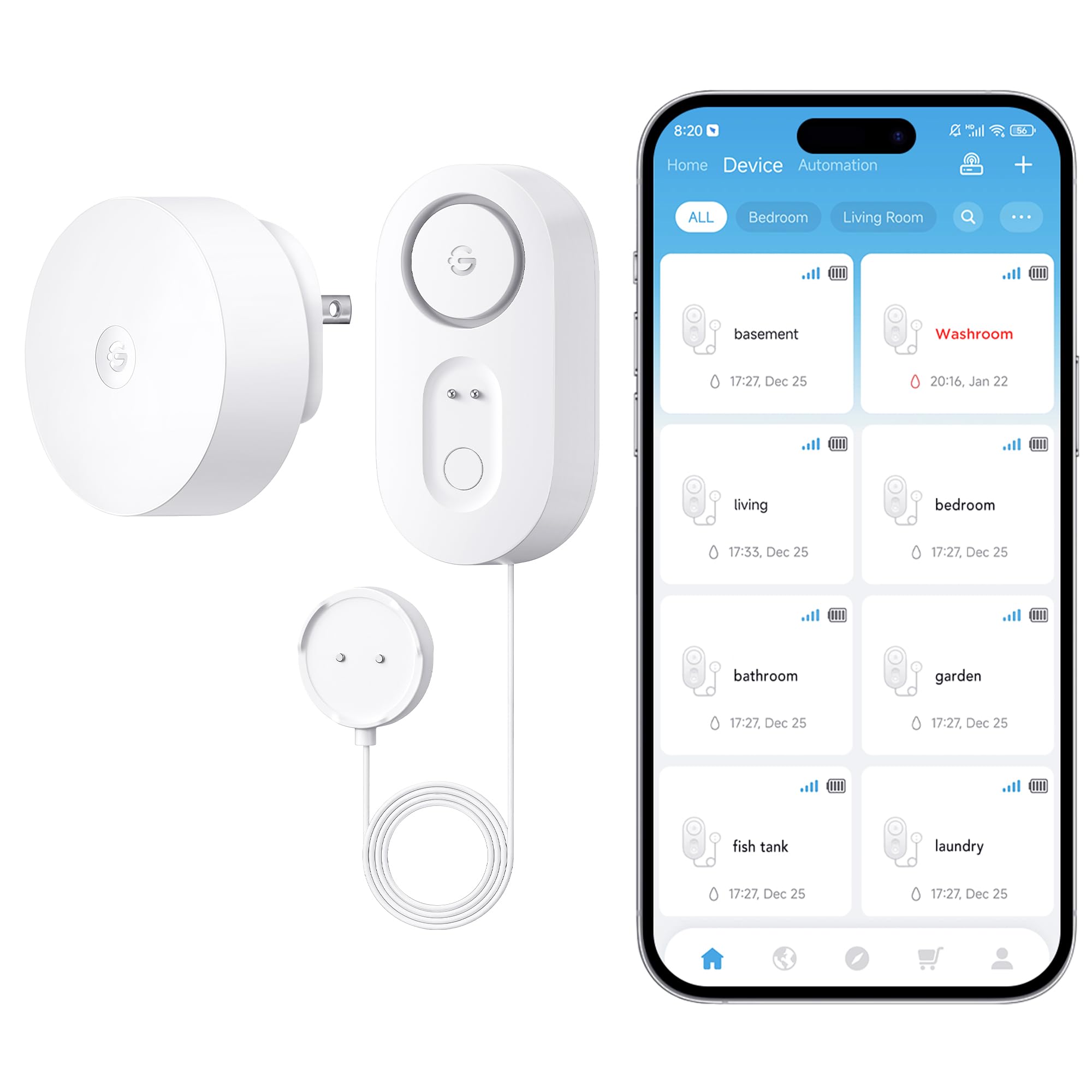
A cable that slides under the washing machine so you do not have to.
You can leave the unit body somewhere reachable and still sense a leak in a tight spot. Each unit has a flexible 4.92 ft cable with a compact probe on the end, so you push the sensing tip into a sump pit or behind a fridge. For appliances you cannot move, that cable is the main reason to pick this kit.
The gateway uses Sub-1G wireless to reach up to 1,804 feet — under the YoLink kit’s 2,034 feet, but comfortably past any Wi-Fi sensor. GoveeLife claims it holds signal through five dense walls, which is the scenario that matters in an old house with thick interior brick. Sirens run at 105 dB, and you get SMS, app, and email alerts, with SMS free at any volume. You can add several email addresses so family members get the same warning.
There is one design detail to know before you buy. The gateway only pairs with GoveeLife’s H5059 and H5830 water sensors, so it is not a universal hub. And while functionality and setup are what people praise most, connectivity is the mixed note — the long-range link works, but the gateway’s own 2.4 GHz Wi-Fi hookup to your router is where setups go sideways. Dry your probes and the IP67 units can be reused after a flooding event.
Why it earns a spot
- 4.92 ft cable reaches behind appliances and into sump pits where no sensor body fits
- Up to 1,804 feet of Sub-1G range through walls
- Free SMS alerts at unlimited volume, plus app and email push
- “Find Device” beeps misplaced sensors so you can track them down
The fine print
- The gateway pairs only with GoveeLife H5059 and H5830 sensors
- Gateway needs 2.4 GHz Wi-Fi to reach your phone
- 105 dB is the quieter siren in this lineup
Pick this for: tight cabinets, sump pits, and appliances you cannot shift to place a sensor under.
Pass if: you want a hub that accepts sensors from more than one brand.
5. Zircon Leak Alert WiFi

Names each sensor by room, then emails you straight to the source.
Zircon skips the app-first model. During setup you give each sensor a location name — “under the kitchen sink” — and when it trips, the email tells you exactly which one to check. That is an appealing design if you already live in your inbox and do not want another phone app on your home screen. There is no hub, and you can run an unlimited number of these side by side.
When water is detected, a 105 dB siren fires along with a flashing SOS light, and the alarm sounds for up to 8 hours — long enough that even a late arrival still hears it. When Wi-Fi is down entirely, the local alarm still works. The unit runs on a single 3V lithium CR123A battery with a low-battery chirp, like a smoke detector.
Here is the honest catch, and it is significant: battery life. The rechargeable-style CR123A setup drains fast in real use, and a set can be spent in about two months, so plan on a replacement supply. Connectivity to Wi-Fi is the other variable — it works for plenty of people and fights others. Email alerts are also not the same as an instant push notification, so expect a short relay delay instead of a live ring.
what separates it: email alerts that name the location, plus an 8-hour alarm that keeps sounding through a Wi-Fi outage.
The real cost of ownership: short battery life on a CR123A cell you will be swapping every couple of months.
Worth choosing when: you want room-by-room email warnings and no app dependency.
Skip the idea if: replacing a battery every other month is a chore you know you will skip.
6. Shelly Flood Gen4
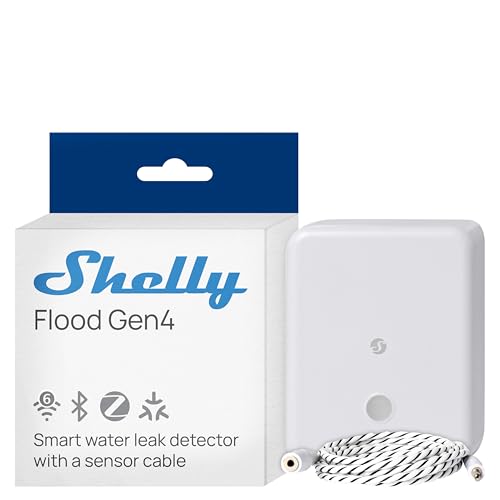
A leak sensor that speaks four smart-home languages at once.
Most detectors only know one app. This one connects over Wi-Fi, Bluetooth, Zigbee, and Matter, and it works with Alexa, SmartThings, Google Home, and Apple HomeKit. If your lights already react to a door sensor, you can have this sensor cut power, flash lamps, or trigger a scene when water appears. That kind of cross-device automation is where the Shelly earns its place.
The 6.56 ft sensor cable extends detection past the body of the unit, so you can sweep a wider area under a sink or along a pipe run. It weighs 91 g and mounts on the floor. Settings include an “Economic Alarm Mode” that reduces power use in a seasonal cabin or holiday property when nobody is there to respond. The manufacturer backs it with a 3-year warranty.
The honest note that decides whether this suits you: the IP44 rating. That covers splashes and dust but is not built for extended submersion, so do not drop this in a sump pit the way an IP67 unit handles it. Connectivity is also the most contested point in the reviews — set up can be finicky, and the strength of the automation payoff depends on your home network. This is a pick for someone who wants a smart-home piece, not a plug-and-forget sensor.
What it does best
- Four radios and Matter support — truly open to Alexa, Google, HomeKit, and SmartThings
- 6.56 ft sensor cable broadens the detection area beyond the housing
- Economic Alarm Mode suits an unattended cabin
- 3-year warranty
Know before buying
- IP44 is the lowest rating in this lineup — splashes yes, submersion no
- Setup and connectivity need more work than plug-and-play kits
For the smart-home tinkerer: someone who will wire this into automations and appreciates a 6.56 ft cable.
Not your pick if: the leak spot is a low pit or a spot that could sit underwater.
7. Stechro Water Sensor Alarm
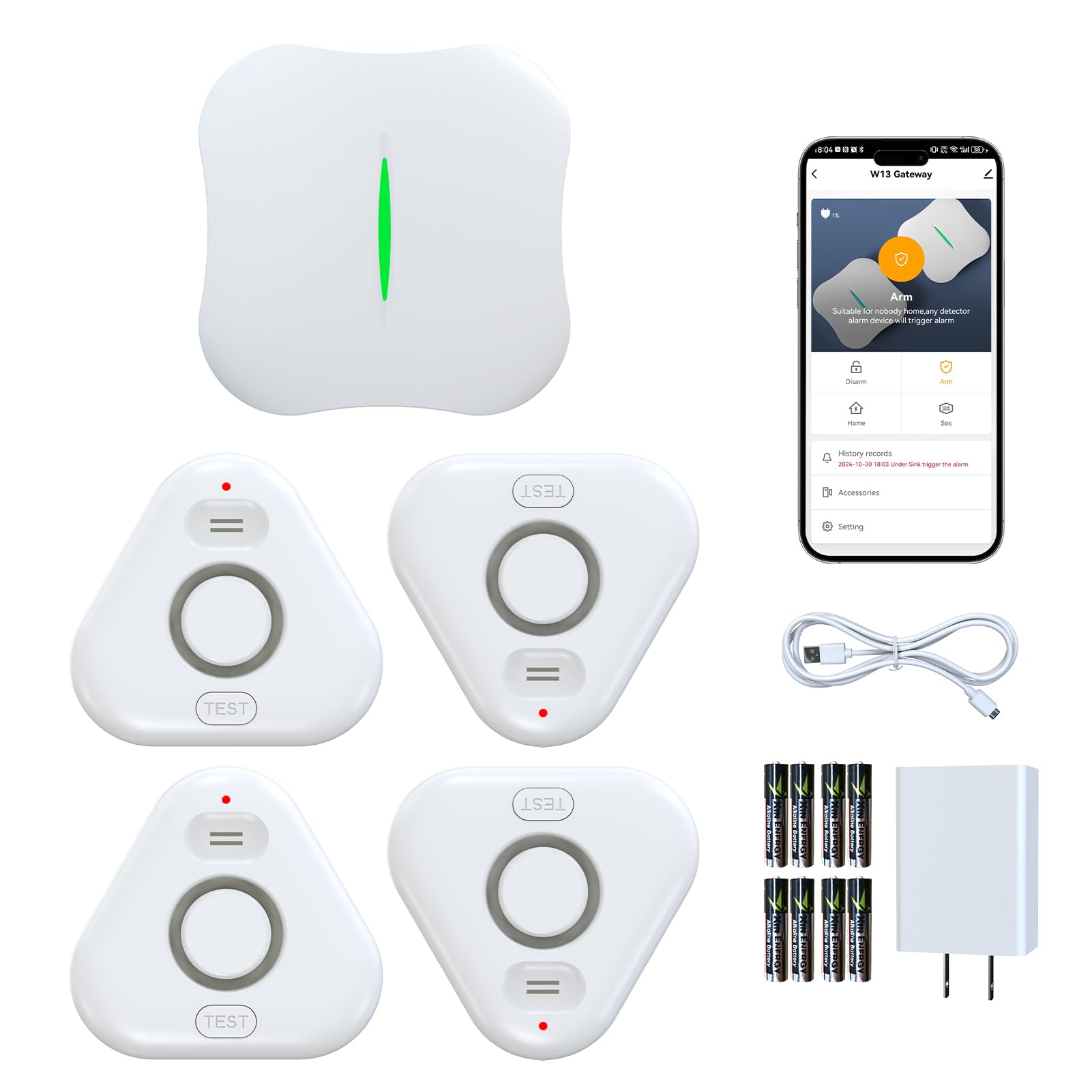
Four sensors, one gateway, and room to add twenty more.
The gateway here handles up to 24 sensors, and the kit ships with four WD77 units, so you can expand without changing hardware. Each sensor carries four bottom probes for floor flooding plus one top probe for drips. You place them in the kitchen, the bathroom, the laundry, the basement — anywhere water collects — and the app tells you which one tripped by name.
Sound is adjustable from 0 to 120 dB across four levels, and after an alert you can mute it with one tap in the app or the button on the sensor. The app also offers 32 ringtones, which is more customisation than most people will ever use but nice if you want a distinct tone per room. Sensors run on low-power AAA batteries with up to 3 years of life, and the whole kit is IP66 rated — protected against spray and humidity, not rated for full immersion. Stechro owners praise its reliability around washing machines, hot water tanks, and old pipes.
The catch that should decide your purchase is the gateway’s compatibility. It pairs only with the WD77 model (the one in this listing), not the older WD76. If you already own WD76 sensors, they will not connect. Also, SMS, phone, and email alerts require a paid subscription while app push stays free — and the gateway is 2.4 GHz-only.
Where it stands out: a 24-sensor gateway, four included sensors, and up to 3-year battery life on AAA cells.
Compatibility check first: only the WD77 sensor model pairs with this gateway, and paid plans cover SMS and email.
Make it yours if: you want four rooms covered now and a clean path to expand later.
Hold off if: you already own older Stechro sensors that will not pair with this hub.
8. Winees WiFi Water Leak Detector 3 Pack

A hub that keeps talking to its sensors through a basement wall.
The hub-to-sensor link here reaches 200 meters, according to the maker — that is the number to note if your basement is the worry. Sensors come pre-paired, and once the hub joins Wi-Fi the sensors are already connected, so there is no pairing dance. That thin 1.8 mm sensor body slides into hidden corners others cannot reach.
You get alerts three ways: app push, email, and SMS (text message) — more than most kits in this lineup. The alarm is 100 dB (about as loud as a power lawn mower) with three volume steps (high, medium, low). A trigger-duration setting lets you choose always ringing, 10 minutes, 1 minute, or 30 seconds. You mute it instantly with one of three buttons on the hub or in the app. It is IP66 rated (sealed against dust and strong water jets) and built for long immersion in humid spots. The system also works with IFTTT (a free service that links apps and devices).
Winees owners praise reliability first and setup second. Where it gets mixed is connectivity: from a router that keeps dropping clients, the hub disconnects and alerts stall. There is also a 2.4 GHz-only Wi-Fi limit here, like the others.
Why it holds up
- 200 m hub-to-sensor range — versus 1,804 feet on the GoveeLife, so watch the units when comparing
- Three alert channels: app, email, and SMS
- 1.8 mm sensor thickness fits into hidden corners
- Adjustable 100 dB alarm with a trigger-duration setting
- IFTTT-compatible for automation-minded setups
What to expect
- Hub disconnects on weak Wi-Fi, stalling alerts
- 100 dB is the lowest siren volume in this lineup
- 2.4 GHz Wi-Fi only, no 5 GHz support
Suits you if: you want app, email, and SMS alerting from a three-sensor kit with genuinely long hub reach.
Check first if: your router drops clients often — the hub relies on a steady Wi-Fi connection.
9. Honeywell CHW3610W1001 Wi-Fi Water Leak And Freeze Detector

Watches water and the room’s temperature in the same small puck.
Honeywell builds this as a leak-and-freeze detector, so it does double duty. Alongside moisture detection, it gives daily temperature and humidity readings, which is useful in a basement or garage where you want to know the room is drifting toward freezing. Setup is described as easy, and the app does the reporting.
It is a small single unit — one pack, no hub — with a tabletop mount and a 20-meter maximum range. That range figure is the lowest on this list, so it belongs near your router rather than in a far shed.
Honesty matters here. Functionality and Wi-Fi connectivity are the mixed points in owner feedback, with setup going smoothly for many but some units refusing to connect properly. It is the longest-running model here, and the app experience is not as polished as the newer kits. As a look-and-learn climate monitor it works; as your only line of defence on a burst pipe, weigh that against the more alert-focused picks.
Where it fits: daily temperature and humidity reporting alongside leak detection, in one compact unit.
Where it stumbles: a 20-meter range and mixed Wi-Fi connectivity mean it needs to sit close to your router.
Reach for it if: freeze risk and room climate matter as much as water.
Look past it if: you need the alert to fire reliably from a far corner of the property.
Know the Specs
Range: feet vs meters — read the unit
Range figures describe how far a signal travels between the sensor and its hub. Some makers quote feet, others meters. The YoLink system quotes up to 2,034 feet, the GoveeLife gateway up to 1,804 feet, and the Winees hub 200 meters. Those are different units, so line them up before you compare. When a sensor sits just behind a washing machine, none of this matters much. When it sits in a detached garage, it matters more than the siren.
Alarm volume in decibels (dB)
A decibel is a measure of sound loudness. A 105 dB siren behaves like a smoke detector at close range, while a 120 dB unit is loud enough to carry through a floor. Anything from 100 dB up will get your attention in a quiet house. What matters more than the peak number is whether you can adjust it — 120 dB at full tilt is unpleasant in a bedroom, and adjustable volume across several levels lets you set it sensibly.
IP ratings explained
The two digits after “IP” describe protection against solid objects and water. IP44 keeps out splashes and small particles, which is fine for a humidity-prone laundry corner. IP66 handles powerful water jets but is not built for long soaking. IP67 tolerates short immersion, so a unit sitting in a puddle survives. If your leak risk is a burst pipe that floods the floor, aim for the higher number.
Wi-Fi bands and hub dependency
2.4 GHz is an older, slower Wi-Fi band that reaches farther and through walls better than 5 GHz. Every detector in this guide uses 2.4 GHz — none supports 5 GHz. So a router broadcasting only on 5 GHz will leave your sensor offline. Hub-based systems (YoLink, GoveeLife, Winees, Stechro) add a relay step: the sensor talks to the hub, and the hub needs its own Wi-Fi link to reach your phone.
Common Questions
Will a Wi-Fi water leak detector work with my 5 GHz router?
Do I need a hub or can I use the sensor on its own?
How far can the sensor be from the hub?
Do the app alerts cost money?
How often do I have to change the batteries?
What does IP67 actually protect against?
Will a false alarm go off in a steamy bathroom?
Can I use these sensors with Apple HomeKit or Alexa?
Do these detect dripping pipes or only standing water?
What happens if my Wi-Fi goes down mid-leak?
The Bottom Line
For most people shopping a wi-fi water leak detector, the safest buy is the YoLink 3-Pack + SpeakerHub. It costs more than the budget kits, but its 2,034-foot LoRa range, IP67 housings, freeze warnings, and multi-year AAA batteries keep it reporting from a basement at 3 AM. If full-house coverage on a tight budget matters more, the TECKNET 5-sensor kit puts a sensor beside every water source in one box. And for the leak you cannot physically reach, the GoveeLife kit with its 4.92 ft probe cable is the tool that fits.
Whichever you pick, the real decision is hub or hubless. Hubless sensors skip the extra box but must each reach your router; hub-based kits trade that box for far longer sensor range. Pick hub or hubless to match your sensor distances, and the rest of the decision gets much easier.
How we choose
We do not accept paid placement. Every pick is matched to a real buyer and a real use-case; we do not hands-on test units.
Sources
Specifications: manufacturer listings and product documentation. Review insights: verified customer reviews, as of November 2026. Pricing: not shown on this page (it changes often); check the current price via the retailer link.
As an Amazon Associate, Tactical Gear Guy earns from qualifying purchases. This does not affect which products we feature.