Specs are compiled from manufacturer listings and verified buyer reviews and can change over time — please confirm the key details on the product page before buying.
Your floor space is gone and the demo room sound you wanted never showed up. A wall mounted speaker fixes both problems at once — it hangs flat against the wall, aims where you sit, and leaves the furniture alone. The trick is knowing which ones actually belong on a bracket and which ones just tolerate one.
This guide is built by comparing the manufacturers’ published specifications and the patterns across verified customer reviews, so you get each pick’s real strengths and trade-offs instead of marketing spin.
Impressive sound doesn’t demand floor space or a bulky cabinet, and this lineup proves it with clear options for every room and budget. The picks below are the best wall mounted speaker options you can hang with confidence.
Top Picks


How To Choose The Best Wall Mounted Speaker
Every speaker here is passive — meaning it has no amplifier inside and needs a receiver or amp to make sound. That single fact decides most of your buying: check that your amp can drive the speaker’s impedance, then check that the bracket suits your wall.
Start with your amplifier, not the speaker
Passive speakers are rated by impedance, measured in ohms — a lower number means the speaker pulls harder on your amplifier. The Pyle runs at 6 ohm, while the Polk Monitor XT90 is listed as compatible with both 4- and 8-Ohm amplifiers and receivers. Match the speaker to whatever your receiver is rated to handle before anything else.
Match the mount to the wall you own
Some speakers ship with a bracket; others rely on keyhole slots cut into the back of the cabinet. The Polk XT90 uses built-in keyhole slots, the Rockville has a built-in bracket, and the Yamaha includes adjustable brackets that let you hang the speaker vertically or horizontally. A swivel U-bracket, like the Herdio’s, lets you aim the sound at the seating area instead of straight ahead.
Indoor or outdoor changes everything
An IP44 rating (a weatherproofing score for water spray and dust) keeps a speaker working on a covered deck or beside a pool. Buy a speaker with no outdoor rating for a patio and you will be replacing it. If the speaker stays under the eaves or inside a garage, a sealed cabinet with a rust-proof grille buys you a lot of confidence.
Decide what the speaker is for
A surround system needs matching speakers at the front, sides, and rear, so look at the driver size and whether the maker offers a matching center and towers. A dedicated height speaker, by contrast, is built to throw sound at the ceiling for overhead effects. Adding a standard bookshelf to an Atmos receiver will not give you that vertical layer.
Side-by-Side Comparison
| Model | Best For | Woofer Size | Power Handling | Mounting | Amazon |
|---|---|---|---|---|---|
| Polk Audio T15★ Best Overall | First home theater build | 5.25 inches | 100 Watt | Wall-mountable bookshelf | Amazon |
| Rockville RockSlimSlimmest Fit | Flat against the wall | 5.25 inches | 40W RMS per speaker | Built-in bracket, 1.38″ profile | Amazon |
| Yamaha NS-AW190WHBest Outdoors | Patio and deck duty | 5 inches | — | Included adjustable brackets | Amazon |
| Pyle 5.25″ Bookshelf Pair | Living room stereo | 5.25 inches | 50W RMS each / 200W peak | Built-in wall mount brackets | Amazon |
| Herdio 6.5 Inch Outdoor | Pool and covered deck | 6.5 inches | 400W | Locking swivel U-bracket | Amazon |
| Polk Monitor XT90 | Dolby Atmos height layer | 4 inches | — | Built-in keyhole slots | Amazon |
| ELAC Debut 2.0 OW4.2 | Surround on a tight wall | 4 inches | — | On-wall design | Amazon |
| SVS Prime Satellite | Small room, big impact | 4.5 inches | — | Wall or ceiling mount | Amazon |
Detailed Reviews
1. Polk Audio T15 Bookshelf Speakers
Our pick — 4.5+★ from 11,000+ verified ratings; the strongest balance of quality and price.
The safe first buy for anyone building a surround system from scratch.
The 5.25-inch Dynamic Balance driver and 0.75-inch tweeter are the core of this pair, and they are deliberately easy to live with. Polk tunes them to stay clear and balanced even when you are not pushing volume — late-night viewing without waking the house. At 100 Watt power handling you have room to grow into a bigger receiver later.
What makes this the overall pick is the upgrade path. Polk publishes a matching plan: add T50 towers, a T30 center channel, and a subwoofer to move from a pair to a full 5.1 setup. Most budget speakers leave you guessing what matches; this pair is the entry step of a named system. Setup is just speaker wire into your AV receiver, no calibration gymnastics.
It carries 4.5+ stars across 11,000+ ratings, the largest owner base in this lineup. The honest catch is bass: a 5.25-inch driver in a compact cabinet gives you a solid mid-bass foundation, not the low rumble of a floor-stander, so plan on a subwoofer for movie-night thump. Mounting is the other thing to square away — they are rated wall-mountable, but the bracket hardware is not bundled, so you will source that separately.
Where the T15 earns its keep
- 100 Watt handling leaves headroom for a bigger receiver later
- Clear, balanced tuning at low volume for late-night listening
- Named upgrade path to a full 5.1 system with T50, T30 and a sub
- Simplest setup here: wire to the AV receiver and go
What to square away first
- Bracket hardware is not included, so budgeting for mounts is on you
- Compact 5.25-inch driver needs a subwoofer for deep bass
Go with these: first-time home theater builders who want a system they can expand in stages.
Look elsewhere if: you want everything in the box, brackets included, for a single-wall install.
2. Rockville RockSlim Wall Mount Speakers
A 1.38-inch cabinet that hangs like a picture frame and disappears beside a TV.
Depth is the whole story here. The RockSlim cabinet measures 1.38 inches deep, which means it sits nearly flush against drywall instead of jutting into the room. Owners consistently describe how snug it fits against the wall, the low-profile look you want beside a wall-mounted TV.
Inside, a 5.25-inch woofer and a 0.5-inch Mylar dome tweeter cover a 100Hz-20kHz frequency response, exactly what you want for dialogue and music without a sub. Power is 40W RMS per speaker, or 80W per pair, with 120W peak per speaker. That is modest compared with the Polk T15’s 100 Watt rating, so pair these with a small-to-mid receiver rather than a monster amp.
The install details are where Rockville thought it through. Molded wire grooves hide the cable run, spring-loaded terminals take bare wire quickly, and the brackets are built into the cabinet. The ABS cabinet and shielded grill hold up against dust and knocks in a kitchen or living room. If you are chasing overhead Atmos effects, this is not that speaker — it is a clean, flat surround and stereo option.
The real draw: very few wall speakers hang this close to the wall, and the hidden wire groove keeps the finished look neat instead of trailing cables.
Worth knowing: at 40W RMS per speaker it rewards a modest amp, not a high-power flagship receiver.
Made for this: anyone mounting a speaker beside a flat TV or in a tight kitchen where depth is the enemy.
Pass on it: if you need heavy power handling or a dedicated Atmos height channel.
3. YAMAHA NS-AW190WH Speakers
The deck speaker that ships with the brackets you actually need.
Yamaha includes adjustable mounting brackets in the box, and those brackets let you mount the speaker vertically or horizontally. That flexibility is the difference between fitting under an eave and not fitting at all. Hang them on deck posts, in garages, or over a workshop bench without buying extra hardware.
Sound is where these carry the day. Buyers report good lows and highs, an easy hook-up, and a natural fit on a patio. A 5-inch dynamic driver handles stereo output, and the white finish blends into siding rather than fighting it. They work indoors too, so one pair can move from a sunroom to a porch without going to waste.
Durability draws mixed reactions among owners, which is fair for an outdoor speaker that lives in sun and rain year-round. The 4.5+ star score across 500+ ratings is solid, but these are built for covered outdoor use and everyday weather, not years of direct punishment. If your install spot is fully exposed, that is the one thing to think through.
Why it stands out: shipped brackets that rotate between vertical and horizontal mounting are rare, and they save you a trip to the hardware store.
The honest caveat: durability splits opinion outdoors — covered spots under eaves or a deck roof suit them best.
Reach for this if: your speaker goes under eaves, on deck posts, or in a garage where a bracket-included pair makes life simple.
Think twice if: the speaker will sit in fully exposed weather with no roof or overhang.
4. Pyle 5.25” Bookshelf Speakers
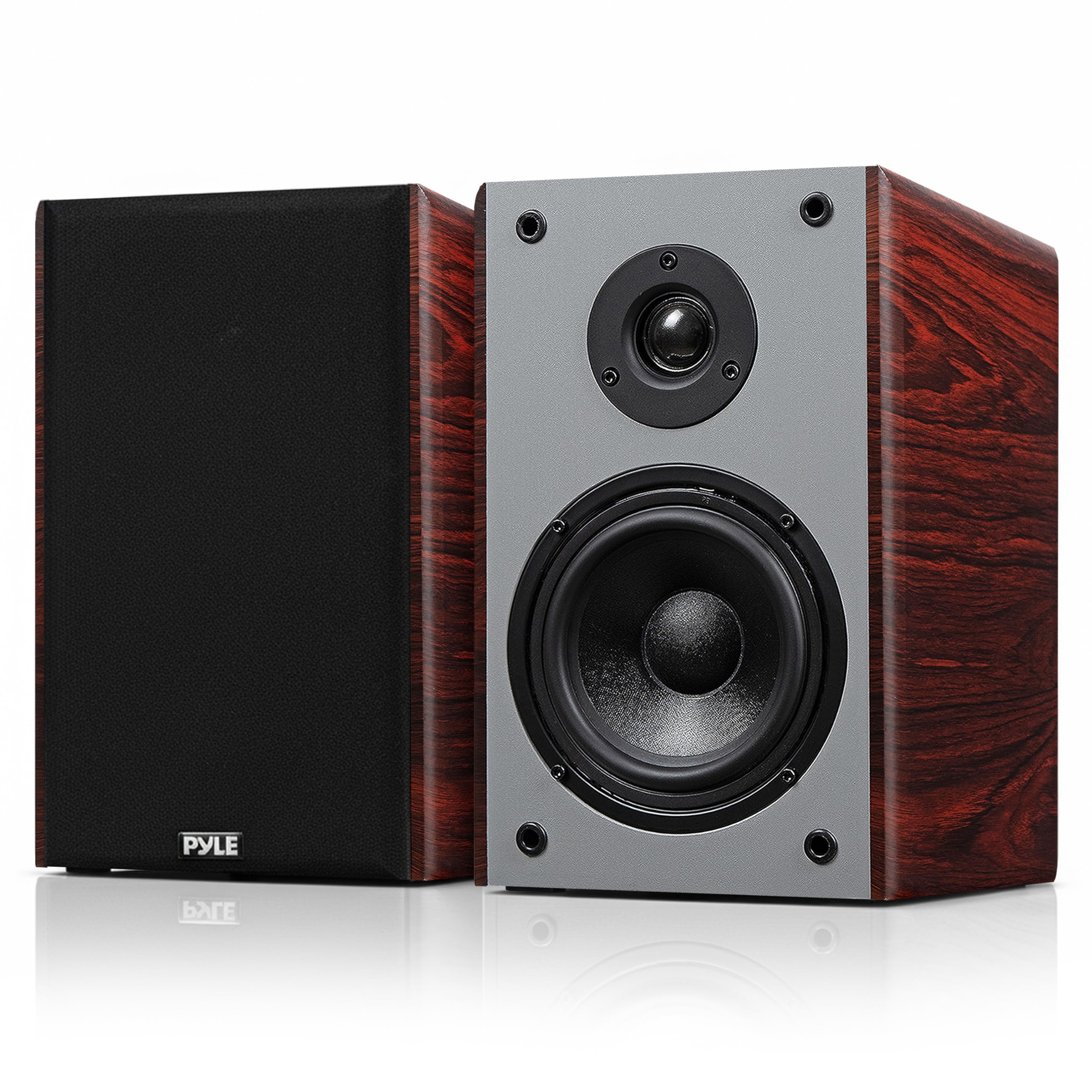
Cherry-grain cabinets that look like furniture and mount like a fixture.
Here is a pair that solves the living-room problem: nobody wants black boxes in a room with wood furniture. The cabinets are built from 12mm MDF with a cherry wood grain finish, and the detachable magnetic grilles let you run them clean or exposed. Built-in wall mount brackets mean they go up without extra parts, and speaker wire is included.
Each speaker delivers 50W RMS, 100W per pair, and up to 200W peak, with a 12dB crossover splitting a 65Hz-20kHz frequency range. The 0.75-inch silk dome tweeter handles highs while the 5.25-inch woven glass fiber woofer covers the lower end. Owners describe the sound as crisp and credit the 12mm MDF cabinet for the solid build.
Connection flexibility is a genuine plus — gold-plated 5-way binding posts take banana plugs, spade terminals, or bare wire, so almost any amp or receiver hooks up without adapters. At 6 ohm impedance, confirm your amplifier is rated for it before you buy. The finish and the wiring options are the story; this is not a speaker for overhead effects or a pool deck.
What wins people over: the cherry MDF cabinet and magnetic grille turn a technical purchase into a piece of furniture that fits a normal room.
Check before you buy: 6 ohm impedance is not universal — your receiver needs to be rated for it.
Best match for: a living room or media center where appearance matters as much as the spec sheet.
Not the pick for: outdoor mounting or an amplifier that is not rated for a 6 ohm load.
5. Herdio 6.5 Inch Outdoor Speakers

A 6.5-inch woofer built to take rain, dust, and a poolside splash.
Sound carries across a whole yard because this is the biggest driver in the lineup, at 6.5 inches versus the 4 inches on the Polk XT90 — noticeably more surface area pushing air. A 2.3-inch dome tweeter (the small cone that handles high notes) sits above it, and the pair is rated at 400W (watts, the power it can handle).
The IP44 rating means the speakers resist water spray and dust, so a covered deck, a garage, or a spot near the pool works without a cover. The rust-proof mesh grille has a water-resistant painted finish that keeps it corrosion-free, and Herdio calls the construction marine grade. Quick-connect terminals make the wiring side simple, and the capacitor crossover separates the two channels.
The locking swivel U-brackets are the underrated feature: you mount the bracket, aim the speaker at the seating area, then fasten it with a click. Aiming matters outdoors, where the listener is not always dead ahead. Owners call them loud, clear, and easy to install, with poolside use the most common setup. The honest note is size — some buyers find them bigger than expected, so check the footprint against your wall before ordering. Durability opinions split too, so covered placement is still the smart call.
The defining number: a 6.5-inch aluminum injection cone woofer with 400W behind it is the most output on this list for patio and deck listening.
Size it first: the cabinet is larger than some buyers picture, so measure the wall space before you commit.
Pick these for: a pool, covered deck, garage, or boat where weather resistance and volume both matter.
Skip the Herdio if: you are mounting in a tight indoor corner where a compact cabinet is the priority.
6. Polk Audio Monitor XT90 Height Speaker

The pair that adds the overhead layer your surround system is missing.
Most wall speakers fire straight at you. This one is engineered to add height — a 4-inch Dynamically Balanced Woofer built for Dolby Atmos content, so rain, helicopters, and overhead dialogue come from above rather than from the screen. If your receiver is 7-channel or more and supports Dolby Atmos, DTS:X, or DTS Virtual:X, this is how you use that capability.
Placement is genuinely flexible. You can sit them on top of MXT20 bookshelf speakers or the MXT60 and MXT70 floor-standers, or wall mount them using the built-in keyhole slots. Polk timbre-matches the range, so these blend with the MXT30 center and MXT12 sub in a unified system. They are also rated compatible with both 4- and 8-Ohm amplifiers and receivers, which makes them easy to drop into existing gear.
The Atmos effect is what owners keep coming back to — that sense of vertical immersion above the seating area. Performance holds up across mixed systems, and the drivers are only 4 inches, so do not expect this pair to carry bass; it is a supplement to your mains, not a replacement. Bring the right receiver and the payoff is immediate.
The Atmos argument
- Purpose-built height channel for Dolby Atmos, DTS:X and DTS Virtual:X content
- Compatible with both 4- and 8-Ohm amplifiers and receivers
- Mounts on bookshelves, towers, or the wall via keyhole slots
- Timbre-matched to the rest of the Monitor XT family
Before you commit
- Needs a 7-channel-or-higher Atmos receiver to do its job
- 4-inch drivers add height, not bass — pair with a subwoofer
Right call for: anyone with an Atmos-capable receiver who wants overhead effects without cutting holes in the ceiling.
Wrong call if: your receiver is a basic stereo or 5-channel unit, or you need this pair to deliver low-end punch.
7. ELAC Debut 2.0 OW4.2 On-Wall Speakers

Built from scratch to hang on a wall, not adapted to it.
This is a true on-wall speaker, and that changes the physics. The compact proportions are made for side or rear wall placement when floor space is limited, and the MDF cabinets are larger and internally braced to cut cabinet vibration. That bracing is the quiet reason on-wall speakers either sound clean or sound hollow.
The driver package is serious. A 1-inch cloth dome tweeter with a wide-roll surround takes response up to 35,000 Hz, and a waveguide controls directivity to reduce diffraction. The 4-inch aramid fiber woofer is stiffer and better damped than polypropylene or paper, which lets ELAC tune a longer, smoother low end. This is a 2-way bass reflex design and, notably, is not marked waterproof — indoor surround duty only.
Owners mention nice sound and strong value, with installation drawing mixed reactions — several find wall mounting easy, while others wrestle with it. That tracks for an on-wall cabinet that wants solid anchoring. The 4.5+ star score across 100+ ratings is small but clean, and the aramid woofer and braced cabinet are where the money goes. For a rear-channel or side-wall position in a performance-focused room, this earns its spot.
Where the money goes: internally braced MDF and an aramid fiber cone are the sort of build choices you normally find higher up the range.
Set-up reality: installation splits opinion, so plan a solid anchor point and give yourself time for the mount.
Choose ELAC for: side and rear surround positions where a purpose-built on-wall cabinet and clean high frequencies matter most.
Rule it out if: you need weather resistance or a quick peel-and-stick style install.
8. SVS Prime Satellite Speakers – Pair (Piano Gloss Black)

Small enough to tuck into a corner, built like a much larger speaker.
SVS takes technology from its reference Ultra Series and shrinks it. A 1-inch aluminum dome tweeter with an FEA-tune diffuser handles the highs, and a 4.5-inch woofer with an aluminum shorting ring and vented voice coil former handles the mid and low end. The cast ABS-fiberglass composite basket keeps the components aligned precisely, and the SoundMatch 2-way crossover is tuned for smooth handoff between drivers.
The cabinet can be wall or ceiling mounted, which opens up placement options the other picks here do not offer. Beyond front duty, these can serve as surround or height channels depending on your room layout. Build quality is a recurring theme among owners — they describe the speakers as solid and heavy, and the wide soundstage and clean reproduction get called out. The makers also match them to the full SVS Prime and Ultra Series, so they slot into a bigger system later.
The piano gloss finish is a look, not just a colour. That cabinet is the most premium build here, and it shows why these are priced where they are. The honest trade-off is presence: a 4.5-inch woofer in a compact cabinet gives you punch and imaging but not deep bass, so pair with a subwoofer for full-range sound. An industry review singled these out for performance and value at the audiophile end.
The audiophile angle: a 1-inch aluminum dome tweeter plus a SoundMatch crossover delivers imaging and a wide stage that punch above the compact cabinet.
Plan the bass: a 4.5-inch woofer cannot carry low-end weight alone, so a subwoofer completes the picture.
Worth it for: a compact room or multi-role setup where you want clean detail and the flexibility to mount on wall or ceiling.
Not the best fit if: you want a full-range speaker without adding a subwoofer.
Know the Specs
Impedance and Power Handling
Impedance, measured in ohms, is how hard a speaker pulls on your amplifier — lower numbers demand more current. Power handling, in watts, is the ceiling the speaker can take, shown as RMS for continuous power and peak for short bursts. The Pyle runs at 6 ohm with 50W RMS each and 200W peak, while the Polk XT90 works with both 4- and 8-Ohm amplifiers and receivers. Match impedance first; power handling is a ceiling, not a requirement.
Weather Rating and Mount Type
An IP44 rating (a weatherproofing score for water spray and dust) keeps a speaker safe on a covered deck or beside a pool, but not underwater. Mount type decides how you install: built-in keyhole slots on the Polk XT90 sit the cabinet flush to the wall, a locking swivel U-bracket on the Herdio lets you aim it, and included adjustable brackets on the Yamaha let you hang the speaker vertically or horizontally. A slim cabinet like the Rockville’s 1.38-inch depth keeps the install out of the way.
Common Questions
Do wall mounted speakers need a separate amplifier?
Will these speakers work with any AV receiver?
What does IP44 mean on an outdoor speaker?
Can I mount these speakers on drywall?
How much bass can I expect from a wall mounted speaker?
Is a height speaker better than a bookshelf speaker for a wall?
Can I use these speakers outdoors year-round?
Do I need a center channel if I use wall speakers for fronts?
How far from the wall should I mount the speakers?
Can I use a wall mounted speaker as a rear surround?
The Bottom Line
For most rooms, the wall mounted speaker winner is the Polk Audio T15 because it is the easiest starting point for a surround system — 100 Watt handling, a clear sound at low volume, and a named upgrade path to a full 5.1 setup (five speakers plus a subwoofer). If depth is your enemy, the Rockville RockSlim hangs at 1.38 inches and hides its wiring. And for a patio or pool, the Herdio 6.5 Inch Outdoor brings the IP44 rating and the biggest driver here — the one to reach for when the speaker is going outside.
How we choose
We do not accept paid placement. Every pick is matched to a real buyer and a real use-case; we do not hands-on test units.
Sources
Specifications: manufacturer listings and product documentation. Review insights: verified customer reviews, as of July 2026. Pricing: not shown on this page (it changes often); check the current price via the retailer link.
As an Amazon Associate, Tactical Gear Guy earns from qualifying purchases. This does not affect which products we feature.