Specs are compiled from manufacturer listings and verified buyer reviews and can change over time — please confirm the key details on the product page before buying.
The pads below all carry real insulation — foam layers, reflective film, or synthetic fill — rather than being a bare air bladder that turns into a fridge by midnight. Pick the right one and the ground stops draining your body heat by midnight.
This guide is built by comparing the manufacturers’ published specifications and the patterns across verified customer reviews, so you get each pick’s real strengths and trade-offs instead of marketing spin.
The spec that decides everything is R-value, a plain number that rates how well a pad blocks ground chill. Higher means warmer. Every pick here is rated for genuine cold-weather use, and the list below sorts them by what each one does best — pack weight, thickness, inflation speed, or pure warmth — so you can match a pad to your own trip. This is the shortlist for the Best Warm Sleeping Pad, ranked by R-value, insulation type, and packed weight.
Top Picks

How To Choose The Best Warm Sleeping Pad
You are buying warmth, and warmth on a pad comes from two things: the insulation material and how well it keeps your body heat from leaking into the ground. Everything else — packed size, weight, inflation method — is a trade-off against that warmth. Here is how to read the choices.
Start With R-Value, Not Thickness
R-value is the number that tells you how much ground chill a pad blocks. A pad rated around 2 is a light three-season option, while ratings of 4 and above are built for cold nights and shoulder-season trips. The NYECHTO pad rated 9.5, for instance, is aimed at four-season use, while the NEMO Switchback sits at 2 for milder conditions. Thickness affects comfort, but R-value is the real warmth signal.
Foam Versus Air Chambers
Closed-cell foam pads like the NEMO Switchback and the THINTON never go flat because there is no air to leak out — you just unfold them. Self-inflating and air-chamber pads pack smaller and sleep softer but rely on valves holding their seal. If you hate the idea of waking up on the ground at 2 a.m., foam is the simplest insurance.
Match the Pad to How You Travel
Backpackers count ounces and pack space, so a foam mat weighing 396 grams or a pad rolling to the size of a water bottle wins. Car campers and tent campers can carry a thicker, heavier pad with a built-in pump and pillow. Decide between backpacking and car camping before you compare specs, because a warm pad you resent carrying stays home.
Side-by-Side Comparison
| Model | Best For | R-Value | Thickness | Weight | Amazon |
|---|---|---|---|---|---|
| NEMO Switchback Foam Sleeping Pad★ Best Overall | Ultralight backpacking, no-fail warmth | 2 | 5.5 in folded | 0.42 kg | Amazon |
| THINTON Foam Camping Pads (2-Pack)Budget Champion | Budget two-pack for thru-hiking | 2.1 | 0.7 in | 396 g each | Amazon |
| NYECHTO Self Inflating Pad with Electric PumpWarmest Spec | Four-season car and tent camping | 9.5 | 3.14 in | 5.95 lb | Amazon |
| Elegear CumbreX 4″ Pad | Cold-weather backpacking with real cushion | 9 | 4 in | 2.2 lb | Amazon |
| Sea to Summit Camp Plus SI | All-season rectangular comfort | 4.3 | 2.6 in | 3.2 lb | Amazon |
| KLYMIT Insulated Static V Lite | Warmth-to-weight for backpackers | 4.4 | 2.5 in | 20 oz | Amazon |
| Big Agnes Divide Insulated | Three-season wide-regular comfort | 4.0 | 3.25 in | 30 oz | Amazon |
| Therm-a-Rest BaseCamp Self-Inflating | Frontcountry camping luxury | 6 | 2 in | 3 lb 6 oz | Amazon |
| Therm-a-Rest NeoAir Xlite NXT | Ultralight year-round warmth | 4.5 | 3 in | 13 oz | Amazon |
Detailed Reviews
1. NEMO Equipment Switchback Foam Sleeping Pad
Our pick — 4.5+★ from 650+ verified ratings; the strongest balance of quality and price.
The fold-out foam mat that shrugs off tree branches and never deflates at 3 a.m.
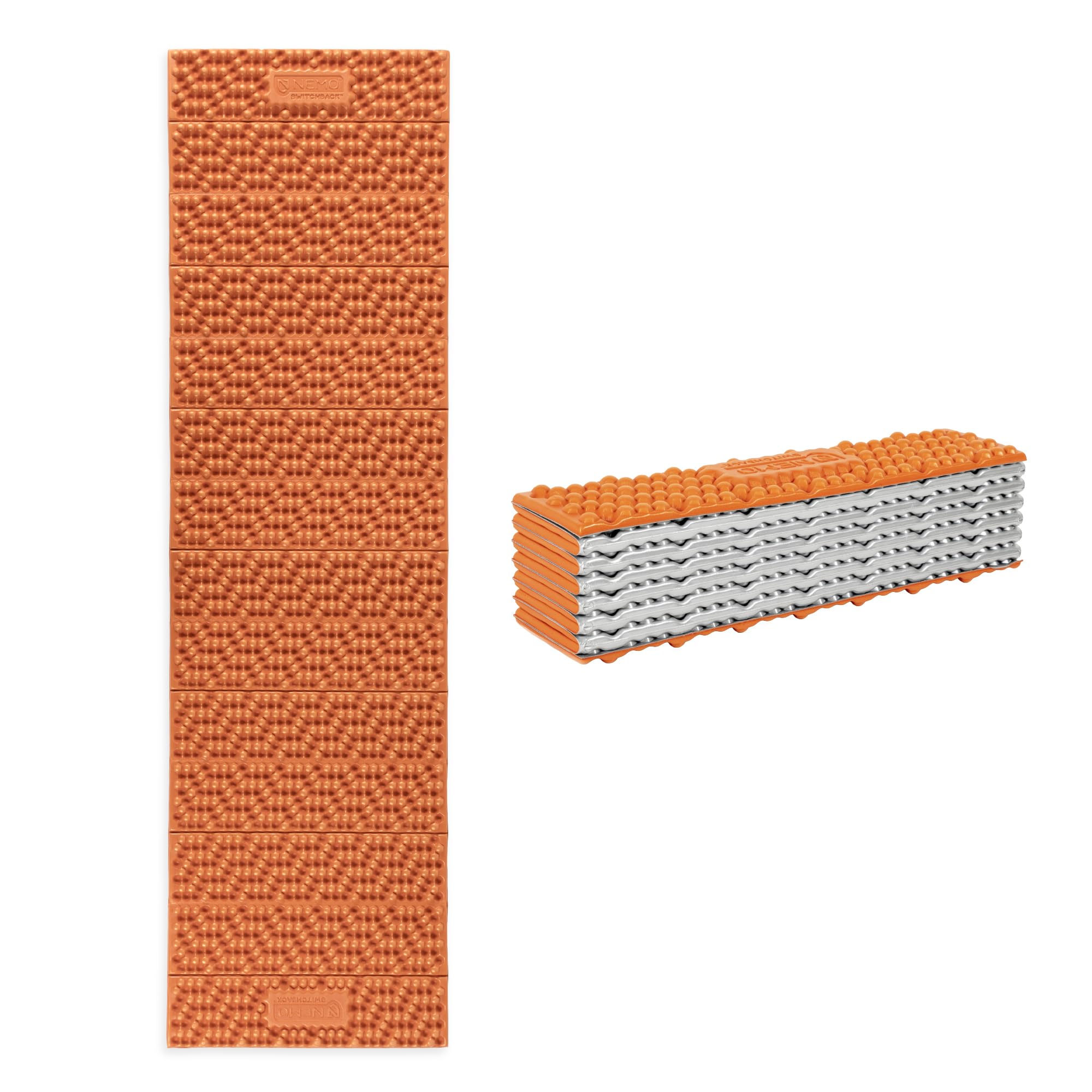
The first thing to know is that this is a closed-cell foam pad, meaning there is no air chamber to puncture and no valve to fail. You unfold it, lie down, and it holds you — that no-valve reliability earns it 4.5+ stars across 600+ ratings. It carries an R-value of 2, which handles three-season ground, and the hexagonal nesting pattern builds taller nodes so your sleeping bag’s insulation stays uncompressed and keeps trapping warmth.
What wins people over is the construction quality, and the durability stories back it up — the foam survives branches and rough ground that would wreck an inflatable. A metallized reflective film bounces your own body heat back at you, protected by a durable outer layer so it does not flake away. It weighs 0.42 kg, light enough to strap to the outside of a pack without a second thought.
Here is the honest trade-off: this is a minimalist mat, not a plush bed. Comfort comes up as the most-debated point, and the folded size runs large enough that it may not slide inside a smaller pack — plan to lash it outside. If you want deep cushioning under your hip, look at a thick air pad instead.
What Earns Its Keep
- Closed-cell foam means no punctures and no deflation failures.
- R-value of 2 covers spring, summer, and fall ground.
- Metallized film reflects body heat back to you.
- 0.42 kg packs light for backpacking and mountaineering.
Where It Asks Patience
- Thin by design — not a cushioned air-bed feel.
- Folded size can be too bulky to fit inside a small pack.
- R-value of 2 is not built for deep winter snow camping.
Go for it if: you backpack, climb, or just refuse to gamble on air valves holding all night.
Think twice if: you want a soft, thick surface and pack space is tight.
2. THINTON Foam Camping Pads for Sleeping (2-Pack)
Two ultralight foam mats for the price of a single fancy pad — and they fold flat.
Two pads come in the box, each opening to 72.8 by 23.6 inches at 0.7 inches thick, so you can outfit a partner or keep one as a spare. That 0.7-inch profile is the whole story — this is a thin closed-cell mat, not a cushioned bed. What it does have is an insulation rating of 2.0+, delivered by polyethylene foam paired with a heat-reflective aluminum film on the back that captures body heat and circulates warmth under you.
The build is where this one punches above its class. Quality is the single most-praised trait in owner feedback, and it holds up as a waterproof, moisture-proof layer that keeps ground damp off your bag. At 396 grams it disappears into a thru-hiking pack, and setup in the evening and pack-up in the morning take seconds — no inflation, no valves, no fuss.
Be clear-eyed about the thinness. Thickness is the most-discussed weakness here, and if you roll onto a root or a rock you will feel it — add a second layer or pair it with a cushioned pad if you are a side sleeper. As a budget two-pack for fast-and-light trips, though, it is hard to argue with.
The value math: two insulated closed-cell mats in one purchase, each under 400 grams, each rated 2.1 for warmth.
The honest weight: 0.7 inches of foam is a barrier against cold and damp, not a cushion against lumps.
Right call for: thru-hikers and budget campers who want light, warm, no-maintenance ground cover for two.
Look elsewhere if: you need padding over rocky, uneven ground.
3. NYECHTO Self Inflating Sleeping Pad with Electric Pump
The four-season heavyweight that inflates itself in 30 seconds and out-warms everything else here.
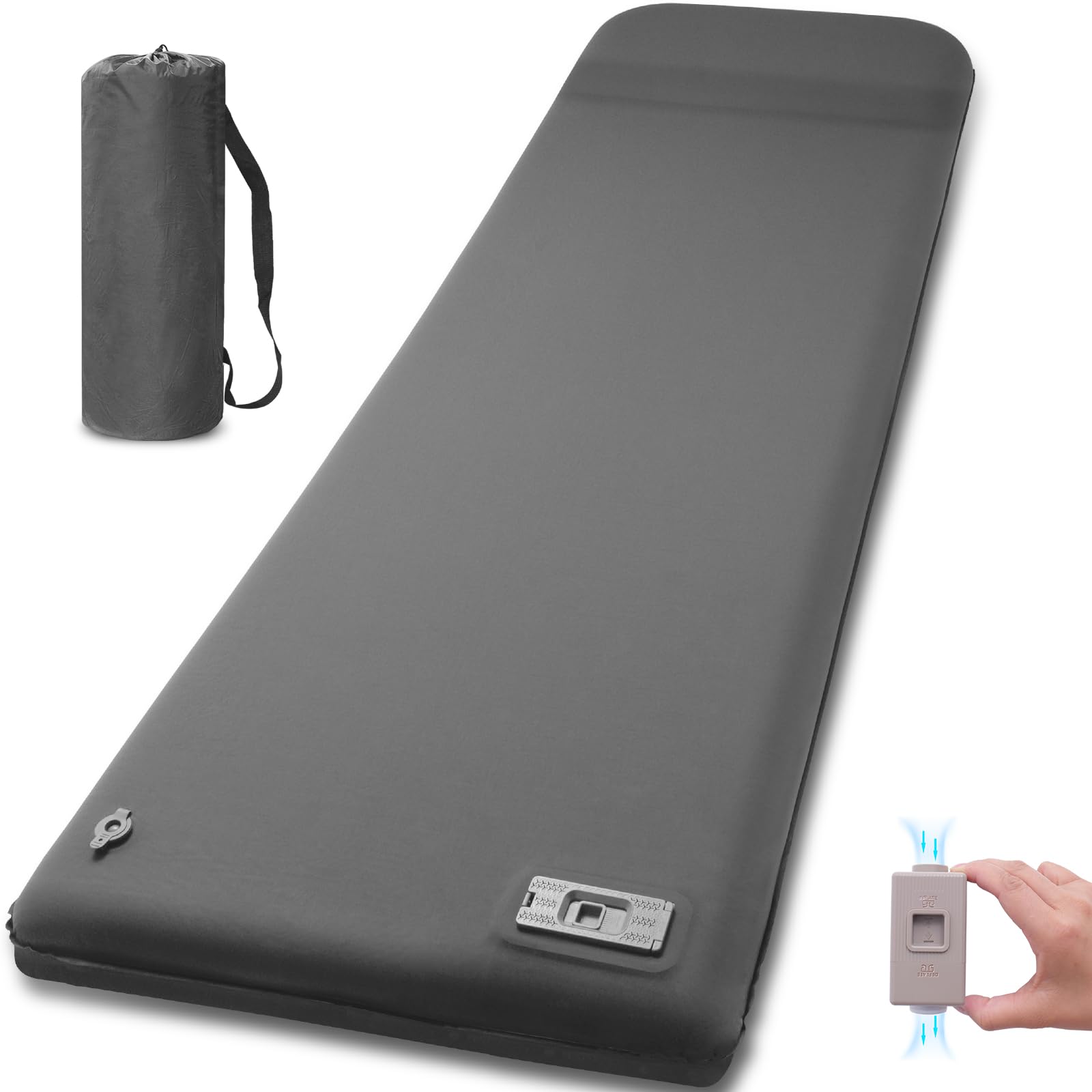
By the numbers, no pad on this list comes close for cold. This one rates an R-value of 9.5, versus the NEMO Switchback’s 2, and that is why it is the pick for genuine winter and four-season camping. The 3.14-inch memory foam body measures 3.14 inches versus the THINTON’s 0.7 inches, so you get real cushion instead of a thin barrier. It holds up to 665 pounds and comes with a built-in pillow.
The convenience is the draw. A built-in rechargeable pump inflates the whole mat in about 30 seconds with one touch, and deflates it back down to 0.7 inches for storage. A full charge takes 2-3 hours and covers roughly 7 inflations. The 50D elastic knit surface is quiet and moisture-wicking, and warmth stays in even on cold nights.
The catch is the charging system — that is the mixed spot in owner feedback, so treat the pump battery with care and keep the two-layer valve clicked shut. It also weighs 5.95 pounds, which is fine for a car or tent but not a backpacking mat. If you camp from a vehicle and want maximum warmth, this is the one.
The headline: an R-value of 9.5 and 3.14 inches of memory foam make this the warmest and thickest pick on the list.
Watch the pump: the rechargeable air system is the part to keep an eye on, and 5.95 pounds keeps it off the trail.
Made for: car campers and tent campers chasing four-season warmth with a self-inflating setup.
Not your mat if: you are counting ounces for a backpacking trip.
4. Elegear 4″ Thick Sleeping Pad with 9 R-Value
A 9 R-value pad that still packs down to 2.2 pounds — rare warmth at backpacking weight.
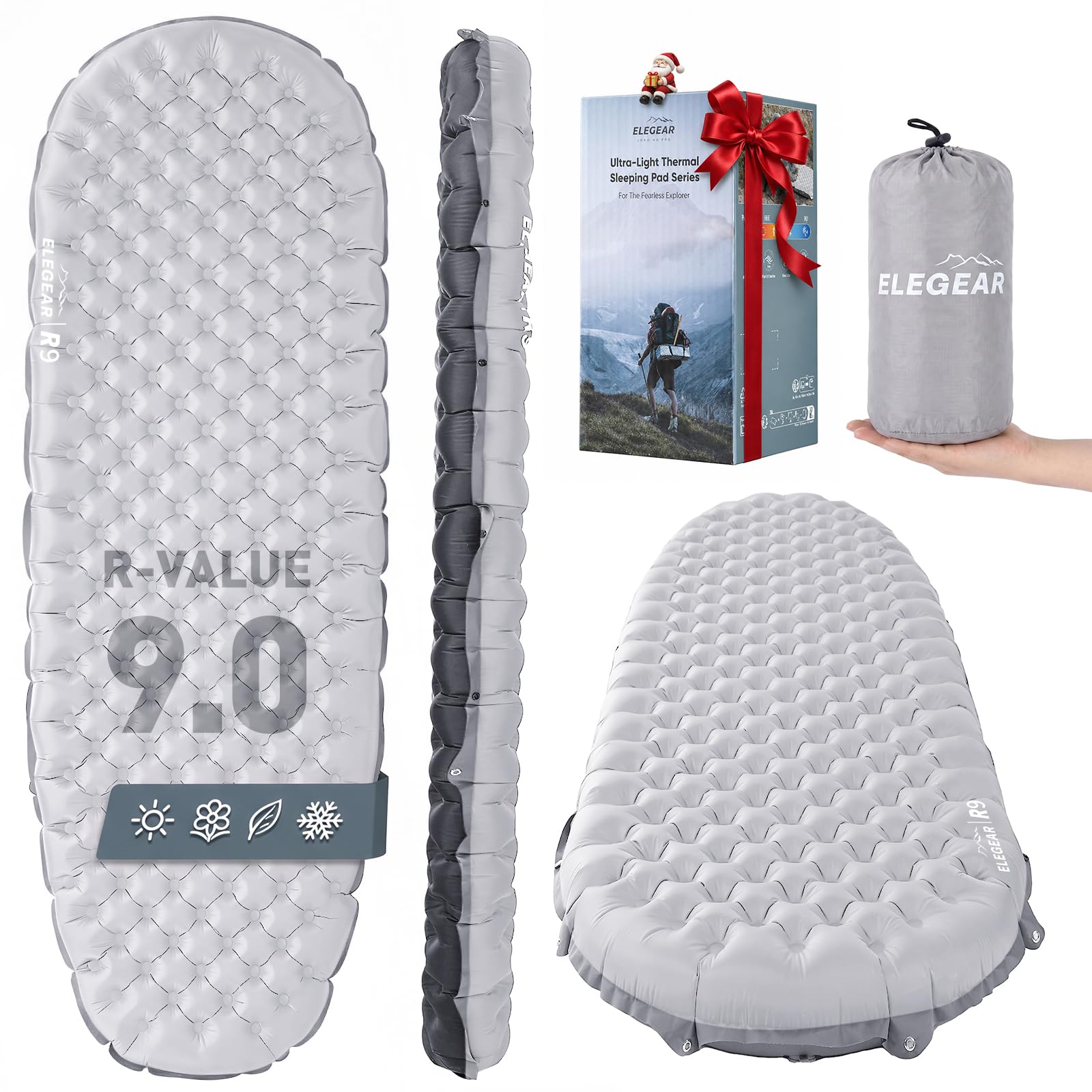
This is the pad for the backpacker who refuses to freeze. A 9-layer insulation system delivers an R-value of 9, independently SGS tested and ASTM F3340-22 certified, and the maker rates it for extreme environments down to -40°C. At 2.2 pounds it stays light enough for long hikes, which is the trick most high-R pads cannot pull off.
The 4-inch thickness is thicker than most standard 3.2-inch camping mats, and a mummy shape with densely distributed support cells spreads your weight so head, back, hips, and legs stay off uneven ground. A pump sack inflates it in 4 to 6 pumps — no built-in motor to drain a battery. Comfort and warmth are the two things owners highlight most, and it holds air for days at a stretch.
The trade-off: this is an inflatable, so it depends on the shell and valve holding, and the weight draws mixed feelings — some find it heavier in hand than expected for a 2.2-pound spec. The 20D ripstop nylon with a reinforced TPU layer resists punctures, but bring the included repair patch on rough trips.
Why It Stands Out
- R-value of 9 with 9-layer insulation for serious cold.
- 4 inches thick for cushion that resists bottoming out.
- 2.2 lb keeps high warmth at backpacking weight.
- Pump sack inflates in 4 to 6 pumps, no battery needed.
The Fair Warning
- Inflatable, so it relies on the valve and shell staying intact.
- Some find it heavier in hand than the 2.2 lb figure suggests.
- Mummy shape trims room compared to a rectangular mat.
Pick this when: you hike and camp in cold, and want high R-value without a heavy load.
Reconsider if: you want zero risk of a puncture ruining the night.
5. Sea to Summit Camp Plus SI Sleeping Mat

A self-inflating rectangular mat built for stretch-out room and honest four-season warmth.
A 4.3 R-value keeps this pad insulating all but the coldest ground, and a 2.6-inch latex foam body gives it a firmer, more supported feel than an air-only mat. The rectangular cut measures 72 by 25.2 inches, so you get corner-to-corner room to sprawl instead of a tapered mummy shape. The reversable valve inflates fast, deflates one-way for quick packing, and lets you fine-tune firmness.
What people value most in this pad is the warmth-per-dollar, and the coring technique is why — body-mapped air zones insulate where you touch the pad and cut bulk where you do not. A durable 75D polyester face fabric stands up to seasons of use, and it ships with a stuff sack, a field repair kit, and PillowLock patches to hold a pillow in place.
Portability is the honest sticking point. This is a car-camping and basecamp pad, not a trail mat — at 3.2 pounds and a 13 by 7.5-inch packed size, several owners find it too big and heavy for backpacking. If your camp is near the vehicle, that weight buys you genuine comfort.
Where it shines: 4.3 R-value and 2.6 inches of foam make it a warm, supportive basecamp mat with room to stretch.
The trade-off: 3.2 pounds and a bulky packed size make it a poor fit for long carries.
Best suited to: basecamp and car campers who want all-season warmth and rectangular room.
Keep looking if: the pad has to ride on your back for miles.
6. KLYMIT Insulated Static V Lite Inflatable Sleeping Pad

Synthetic insulation tucked into V-shaped chambers for warmth that travels light.
This pad’s party piece is its V-Chamber design, a body-mapping layout that cradles you and limits how much air sloshes around under your weight. The chambers are stuffed with Klymalite synthetic insulation and rated to a 4.4 R-value, so you get a genuine four-season pad at 20 ounces packed. It holds up to 350 pounds and inflates with 10 to 15 breath blows, then deflates by just opening the valve.
The material is a rugged 30D polyester that is waterproof, and dynamic side rails gently keep you centered so you are not sliding off at night. Owners consistently rate the easy inflate-and-deflate and the compact packed size — 8 by 3 inches — as the reasons it earns a spot in a pack. Side, back, and stomach sleepers all get a workable surface here.
The honest limit is capacity and width. At 23 inches wide with a 350-pound ceiling, larger or very restless sleepers may want more room, and 2.5 inches is moderate cushioning rather than plush. For a backpacker who wants warmth without bulk, it is a smart middle ground.
The case for it: a 4.4 R-value in a 20-ounce package with synthetic fill that does not rely on a separate layer.
Size up your fit: 23-inch width and a 350-pound capacity suit most, but broad-shouldered sleepers may want wider.
Built for: backpackers who want four-season warmth and a compact 8 by 3-inch packed size.
Not for you if: you need a wide mat or thick plush cushioning.
7. Big Agnes Divide Insulated Sleeping Pad, Wide Regular

Larger outer chambers that keep you centered, wrapped around a 4.0 R-value core.
The defining spec here is the shape. An I-Beam construction builds the mat 3.25 inches thick with 3.5-inch larger outer chambers, so the edges rise up and cradle you in the middle instead of letting you roll toward the floor. A 4.0 R-value handles three-season trips, and THERMOLITE insulation paired with a heat-reflective film traps your body heat and bounces it back as temperatures fall.
The wide-regular size runs 25 by 72 inches at just 30 ounces and packs to 5.5 by 8 inches. High-volume valves with micro-adjustments let you dial in firmness, and an included inflation sack saves your breath. Buyers report comfortable nights down to 30°F, and it is built from recycled nylon ripstop with aviation-grade TPU lamination for strong, dependable welds. A lifetime warranty covers manufacturing defects.
The one real question is footprint — some owners find the wide-regular bigger than they need, so check your tent floor if space is tight. This is the pick for comfort-focused three-season campers who want to stay put all night.
Why it earns a spot: the raised 3.5-inch outer chambers cradle you, and the 4.0 R-value keeps a three-season night warm.
The thing to check: the wide-regular footprint is generous, so confirm it fits your tent before committing.
Ideal for: three-season campers who roll around and want a mat that keeps them centered and warm.
Pass if: you are squeezing into a small one-person tent.
8. Therm-a-Rest BaseCamp Self-Inflating Sleeping Pad

A self-inflating pad with an R-value of 6, built to feel like a real bed under the stars.
Six is a serious R-value for year-round insulation, and the BaseCamp backs it with thick thermal foam that turns a tent floor into a warm, comfy surface. The WingLock valve is the convenience hero — it inflates three times faster than a classic valve and deflates in a flash. A PFAS-free DWR coating on the stuff sack keeps your gear dry without the older chemical finish.
The large size measures 77 by 25 by 2 inches, rolls to 26 by 7.5 inches, and weighs 3 pounds 6 ounces. Comfort is the standout, with the firm foam giving a stable surface some describe as sleeping on a real bed. It is made in the USA, and the maker recommends inflating it fully and letting it sit 2 to 4 hours before the first use so the foam can fully expand.
This is not a backpacking pad, and the size feedback says as much — the large dimensions that make it comfortable are the same ones that make it too bulky to carry far. For frontcountry trips where the car is close, that trades away weight for real sleep quality.
The Strong Hand
- R-value of 6 insulates year-round.
- WingLock valve inflates 3x faster than a classic valve.
- Thick thermal foam for a stable, bed-like surface.
- PFAS-free DWR-coated stuff sack included.
The Honest Costs
- 3 pounds 6 ounces and a bulky roll make it car-camping only.
- Self-inflation can use a few breaths of top-off air.
- 2 inches of thickness is firm rather than plush.
Choose this for: frontcountry camping where warmth and bed-like comfort matter most.
Leave it home if: you plan to carry your pad any real distance.
9. Therm-a-Rest NeoAir Xlite NXT Sleeping Pad

Thirteen ounces of backpacking pad that traps radiant heat with reflective film instead of foam.
Warmth without foam is the trick here. Reflective ThermaCapture technology bounces radiant body heat back at you, while a Triangular Core Matrix construction cuts convective heat loss, together delivering a 4.5 R-value that is warm enough for year-round trips. All of it packs into a 13-ounce body that rolls up as small as a conventional 1-liter bottle — the lightest mat on this list by a wide margin.
The 3-inch thick profile and baffled internal structure give you stability and support that a thin mat cannot, and the WingLock valve makes inflation easy and deflation instant. Quality is what stands out most in owner experience, and the warmth-to-weight is the reason backpackers gravitate to it. A pump sack, stuff sack, and patch kit are all included.
The trade-off is that this is premium gear, and value-for-money draws mixed feelings — you pay for the engineering. Some find the regular 20 by 72-inch size a touch narrow or wish it came smaller. If you measure everything in grams and still want a warm pad, this is the benchmark.
The headline: a 4.5 R-value at just 13 ounces, using reflective film rather than foam to hold heat.
The honest cost: it commands a premium, and the regular width is snug for some sleepers.
For you if: you backpack ultralight and still want a pad warm enough for year-round nights.
Skip if: you want a wide, roomy surface or a foam-filled feel.
Know the Specs
R-Value Explained
R-value measures how well a pad resists heat loss into the ground — higher means warmer. A rating around 2 handles mild three-season nights, while 4 and above are built for cold ground and shoulder-season camping. The NYECHTO pad’s 9.5 and the Elegear’s 9 sit at the extreme warm end, while the NEMO Switchback’s 2 suits milder trips. Read this number before anything else if you camp cold.
Insulation Type
Closed-cell foam traps warmth with its material itself and never deflates. Inflatable and self-inflating pads add air chambers, sometimes with synthetic fill like Klymalite or THERMOLITE or a reflective film like ThermaCapture. Foam tends to be heavier per warmth but bombproof; air chambers pack smaller and sleep softer but depend on their valves and shell holding the seal all night.
Common Questions
What R-value do I need for three-season camping?
Is a foam pad warmer than an air pad?
How much does pad weight matter for backpacking?
Can I use a three-season warm pad in winter?
Why does my sleeping pad feel cold underneath me?
How do I stop air from leaking out of my pad overnight?
Does a thicker pad mean a warmer pad?
Which pad is best for side sleepers?
How should I store and clean a warm sleeping pad?
Are two thin foam pads warmer than one thick pad?
The Bottom Line
For most campers the winner in the warm sleeping pad shortlist is the NEMO Switchback because its closed-cell foam cannot deflate, it packs light at 0.42 kg, and it handles three-season ground without a valve to fail. If you want maximum warmth and a self-inflating setup, the NYECHTO pad brings an R-value of 9.5 and 3.14 inches of memory foam for four-season camping. And for cold backpacking at low weight, the Elegear CumbreX pairs an R-value of 9 with a 2.2-pound pack weight. Match your R-value to your coldest expected night, then seal the valve and let the insulation do the work.
How we choose
We do not accept paid placement. Every pick is matched to a real buyer and a real use-case; we do not hands-on test units.
Sources
Specifications: manufacturer listings and product documentation. Review insights: verified customer reviews, as of November 2026. Pricing: not shown on this page (it changes often); check the current price via the retailer link.
As an Amazon Associate, Tactical Gear Guy earns from qualifying purchases. This does not affect which products we feature.