Specs are compiled from manufacturer listings and verified buyer reviews and can change over time — please confirm the key details on the product page before buying.
If you just want a mic that pairs to your iPhone and sounds good on the first try, the BONAOK G50 is the safest starting point for most people. One thing to know before the picks: this list counts any iPhone connection that works — Lightning, USB-C, or Bluetooth pairing — so not every option has the exact connector you searched for. Each one, though, is a real wireless handheld mic built for phone recording. If you are filming a street interview rather than a singalong, the COMICA Revo S may suit you better; the two do very different jobs.
This guide is built by comparing the manufacturers’ published specifications and the patterns across verified customer reviews, so you get each pick’s real strengths and trade-offs instead of marketing spin.
Sort these by one question first: do you need vocals for music, or clean speech for video? Those two jobs want different designs. The rundown below of the best wireless handheld microphone for iPhone covers both, so pick your lane first and your model second.
Top Picks

How To Choose The Best Wireless Handheld Microphone for iPhone
The biggest beginner mistake is assuming every wireless mic pairs the same way with an iPhone. It does not. Some connect over Bluetooth for karaoke, some come with a USB-C dongle for recording, and some are UHF wireless systems that need a receiver. Decide how you plan to hold the mic and what you are recording before you shop.
Match the connection to your iPhone port
An older iPhone with a Lightning port needs either a Lightning adapter or a mic that includes one. Newer iPhones use USB-C, which some handheld mics plug straight into with a receiver dongle. Bluetooth mics sidestep the port entirely. Check your own phone’s port first — it decides which of these mics you can use on day one.
Think about vocals versus speech
A karaoke mic built around a loud stereo speaker wants to fill a room with music and your voice. A reporter-style mic with a cardioid polar pattern (a pickup shape that favors sound directly in front and rejects the sides) is built to isolate one speaker. If you are interviewing people on the street, the speech-first design gives you cleaner audio.
Battery and wireless range
Rechargeable mics save you from hunting down AA cells every session. A UHF wireless system typically offers more roaming distance than a Bluetooth connection, which helps when you set the phone on a tripod and step away. Match the range to where you actually record — a tight room needs far less than an outdoor shoot.
Side-by-Side Comparison
| Model | Best For | Connectivity | Connector | Signature Spec | Amazon |
|---|---|---|---|---|---|
| BONAOK G50 Karaoke Mic★ Best Overall | Singing and parties | Bluetooth | 3.5 mm Jack, USB Type-C | 26W speakers | Amazon |
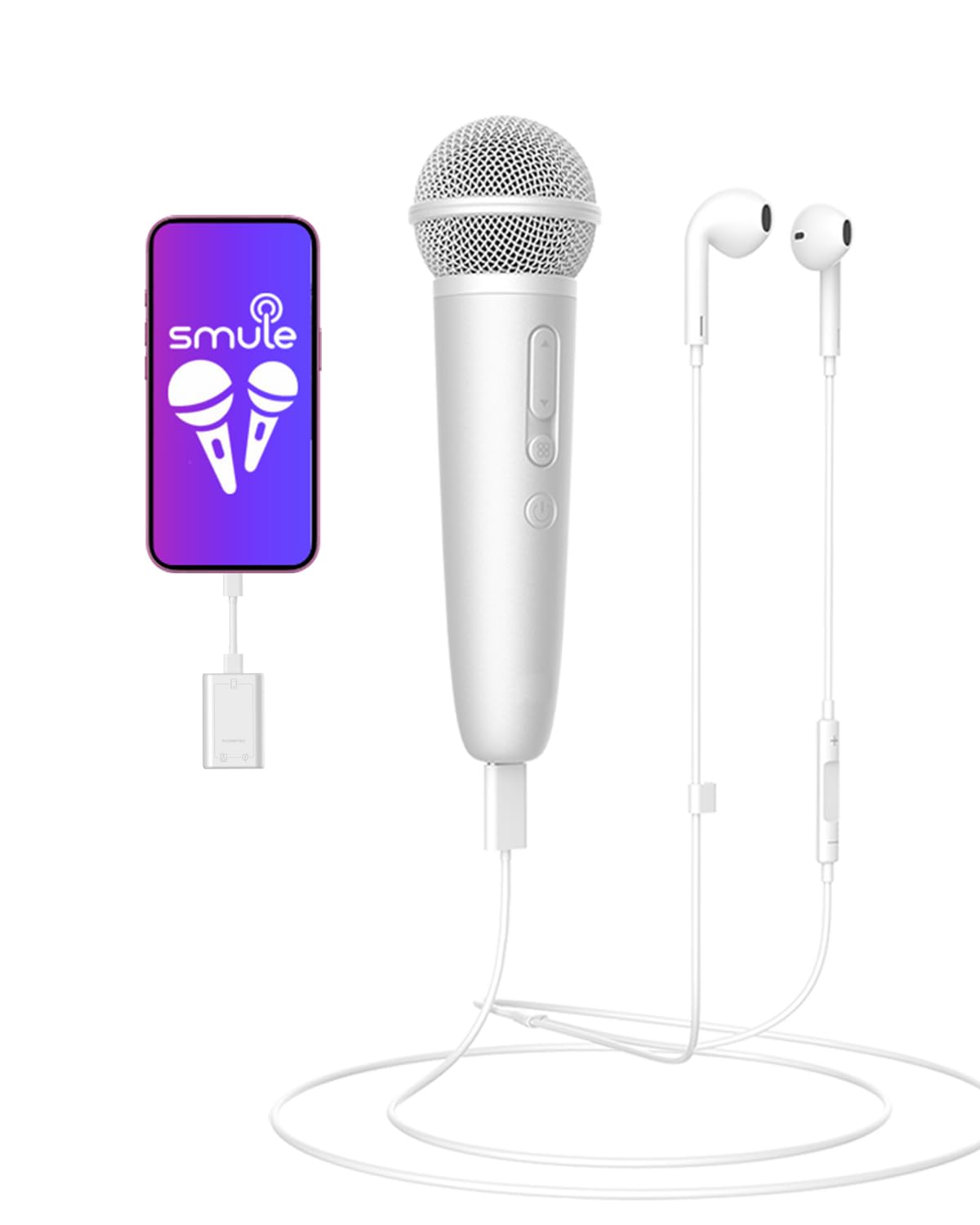
| PUREMIC Singing Mic + EarphoneBest for Beginners | Shy singers and beginners | UHF | USB Type-C | Monitor earphone | Amazon |
| COMICA Revo S | Interviews and vlogging | USB | USB Type-C | 14mm condenser capsule | Amazon |
| Alvoxcon USB Wireless Mic | Recording and streaming | USB | USB | 7-hour battery | Amazon |
| COMICA CVM-WS50(H) | Mobile interviews | UHF | 3.5 mm Jack | 197ft range | Amazon |
| JBL EasySing Mic Mini | Karaoke with vocal removal | Bluetooth, USB, Auxiliary | USB-C dongle | AI vocal removal | Amazon |
Detailed Reviews
1. BONAOK Karaoke Microphone G50
Our pick — 4.5+★ from 900+ verified ratings; the strongest balance of quality and price.
The all-in-one party mic that turns your phone into a karaoke machine without a single cable
This is the mic you grab when the fun is the point, not studio-grade audio. It pairs over Bluetooth to your iPhone, so there is no dongle to lose and no port to worry about. The handle holds 26W speakers (the wattage tells you how loudly it can push sound into a room), so music and your voice come out of the mic itself — no separate speaker needed. That is why it tops this list for most casual buyers, with a 4.5+ star rating from buyers.
What wins people over is how complete the experience feels out of the gate. The EQ chip and DSP (digital signal processing — the electronics that tune the sound) auto-adjust treble and bass, and there are professional, karaoke, and master modes for different settings. You can also strip vocals out of a backing track so you can sing lead. On a road trip, the FM tuner lets it play through your car stereo, which is more useful than it sounds when everyone is bored on a long drive.
The duet feature only works if both mics are from the same version year, because the Bluetooth chip changed between generations. Buy two of the current model together and you are fine; mix an older one with a newer one and the pairing simply will not complete. For everyone else, this is the most versatile pick here — and by a wide margin on built-in features. Note that its sensitivity rating of 115 db is far higher than the 40 db on the Alvoxcon, a sign of how hot this mic’s output runs.
Where the G50 Delivers
- 26W speakers put music and vocals in one handheld device
- Bluetooth pairing means no adapter for your iPhone
- Multiple EQ modes plus vocal removal for karaoke tracks
- FM tuner plays through your car stereo on road trips
What to Know First
- Duet singing needs two mics from the same version year
- It is a fun speaker-mic, not a studio recording tool
Buy it for movie nights and road trips: anyone who wants instant karaoke with zero setup hassle.
Think twice if: you plan to duet and cannot confirm both mics are the same version — or if clean interview audio is your real goal.
2. PUREMIC Singing Microphone
An earphone in the box so you hear yourself before your audience does
The included earphone is this mic’s whole argument. It lets you monitor your own voice in real time while you stream or record — you hear what your listeners hear and can adjust volume before a clunky note goes out live. For shy singers especially, that private feedback loop is the difference between belting it out and whispering into the mic.
Setup is genuinely one-step: plug the dongle into your iPhone, turn on the mic and receiver, and record. The mute button keeps you covered between songs, and the mute LED reminds you when the mic is live. A vocal cancel button flips to the original karaoke track in one press. It runs on UHF (ultra-high-frequency wireless — a signal type less prone to the dropouts Bluetooth sometimes suffers), and the sound quality earns the most praise across the review pages, with easy use close behind.
Value is the one split note: some find it worth the money, others feel it is not. Weigh that against the earphone, mute LED, and vocal cancel all being in the box — features you would otherwise piece together. The 75 db audible noise spec also runs a touch higher than the Alvoxcon USB mic at 80 db, so expect a touch more background hiss in very quiet rooms. Beginner-friendly, and priced like it.
The real draw: a complete starter kit — microphone, USB-C dongle, Lightning adapter, and monitor earphone — so nothing else needs buying to start singing or podcasting on your iPhone.
One thing to weigh: the sound is the star, but value opinions split, so go in expecting a solid everyday mic rather than a flagship recording tool.
Reach for it if: you want to hear yourself live and start recording in seconds without assembling gear.
Look elsewhere if: you need pro-grade isolation for outdoor interviews — a reporter-style cardioid mic serves that better.
3. COMICA Revo S Wireless Handheld Microphone

Built for street interviews: a cardioid capsule that captures your subject and tunes out the crowd
If your iPhone is for reporting, vlogging, or shooting a podcast, this is the pick that reads the room correctly. The 14mm condenser capsule (a condenser is a sensitive mic element, and larger capsules generally capture more detail) uses a cardioid polar pattern to lock onto whoever is speaking into the front. That means less traffic noise and chattering strangers in the background of a man-on-the-street clip.
The numbers back the speech-first focus. Recording runs at 48kHz/24bit (a sample rate and bit depth that preserve fine vocal detail), and the one-key CalMix denoise strips background hum in a single press. Three levels of gain adjustment let you boost sensitivity when a quiet speaker steps up. Best of all, it is among the most compact mics here: item dimensions of 13.3 x 4.7 x 3.1 inches make it easy to pack, versus the Alvoxcon USB mic at 2.15 x 8.8 x 3.11 inches. That packability and the quality overall are what people call out most.
Here is the catch worth knowing. The box ships with a USB-C receiver, which plugs straight into newer iPhones. On an older Lightning-port iPhone, though, you need a USB-C-to-Lightning adapter that supports OTG (a mode that lets the phone read the receiver as an accessory) or it will not connect at all. Check your port before ordering, and this becomes a professional little speech mic that punches well above its size.
Why It Stands Out
- 14mm condenser capsule with a cardioid pattern for clean speech
- 48kHz/24bit recording plus one-key noise reduction
- Three adjustable gain levels for different voices and rooms
- Compact metal-and-plastic body that packs easily
Before You Order
- Older Lightning-port iPhones need a separate OTG-capable adapter
- It is a speech/interview mic, not a musical karaoke machine
Built for: creators shooting interviews, vlogs, and podcasts who want natural speech and a tidy footprint.
Skip if: your iPhone still uses Lightning and you would rather not buy an OTG adapter.
4. Alvoxcon USB Wireless Microphone

A do-everything wireless set with rechargeable batteries in both the mic and the receiver
Both ends of this system carry a rechargeable lithium battery, each rated for 7 hours of working time, and both charge over USB power. Download-free plug-and-play over the USB receiver makes it compatible with PC, Mac, iPhone, and Android.
The wireless side is a UHF digital system (ultra-high-frequency — a signal chosen to resist Bluetooth and Wi-Fi interference) that reaches up to 60ft. A high-sensitivity dynamic moving-coil capsule does the pickup work, and there are 20 selectable frequencies with automatic pairing to dodge interference when several wireless devices share a room. It earns solid marks for effectiveness and, right behind, sound quality.
The trade-offs are specific, so check them against your setup. Functionality comes back mixed — a share of people report the mic randomly shutting off mid-use — and compatibility is likewise split, with several noting it will not work with Samsung’s Galaxy S10 Plus specifically. It also carries an 80 db audible noise figure and a 40 db sensitivity spec, so it is the least sensitive of the wired-connection mics here by a wide stretch versus the BONAOK at 115 db. A steady 4.0+ star rating across a big pile of ratings tells you most people get on fine with it — just check your phone model against the known issues first.
Where it shines: a rechargeable, 60ft-range wireless set with a USB receiver and automatic frequency pairing — generous utility for the middle of the market.
Check before buying: the Galaxy S10 Plus compatibility complaints and the reports of random shut-offs are the specifics to test against your own phone early.
Good match for: teachers, streamers, and podcasters who want a rechargeable wireless mic that pairs with plenty of devices.
Not ideal if: you own a Galaxy S10 Plus or need guaranteed uninterrupted long takes.
5. COMICA CVM-WS50(H) Handheld Microphone for iPhone & Android

Roam nearly 200 feet from your phone and still get the shot
This one is all about distance. Over UHF wireless (a radio band that carries the signal from mic to receiver) it transmits up to 197ft (60m) with nothing in the way, and up to 98ft (30m) when something blocks it. Film a presentation from the back of a room, or step away from a phone clamped to a tripod, and that range changes where you can stand and still record clean audio.
The details are tuned for mobile creators. A built-in LCD screen shows channel, audio status, and battery level at a glance so you are never guessing mid-shoot. Six selectable channels let you hop frequencies when another wireless device causes interference. The included adjustable metal phone clamp fits phones from 2.5 to 3.5 inches wide, and the integrated handheld grip steadies your filming. Real-time audio monitoring lets you hear the recording as it happens.
Two caveats matter here. Sound pickup is the most-debated point in the feedback — plenty hear the mic clearly, others run into pickup issues, so test it on your first shoot. And on an iPhone with a USB-C connection, you need a separate COMICA 3.5mm-to-USB-C cable that is not in the box. Go in knowing both and this becomes a long-range interview workhorse — the quality impression overall is the strongest thing about it.
Best used by: journalists and vloggers who need to film from a distance and want an LCD readout plus a phone grip in one kit.
Worth a second thought if: you want cables included from the start or need consistent, predictable pickup on the first take.
6. JBL EasySing Mic Mini – Real-Time Vocal Removal
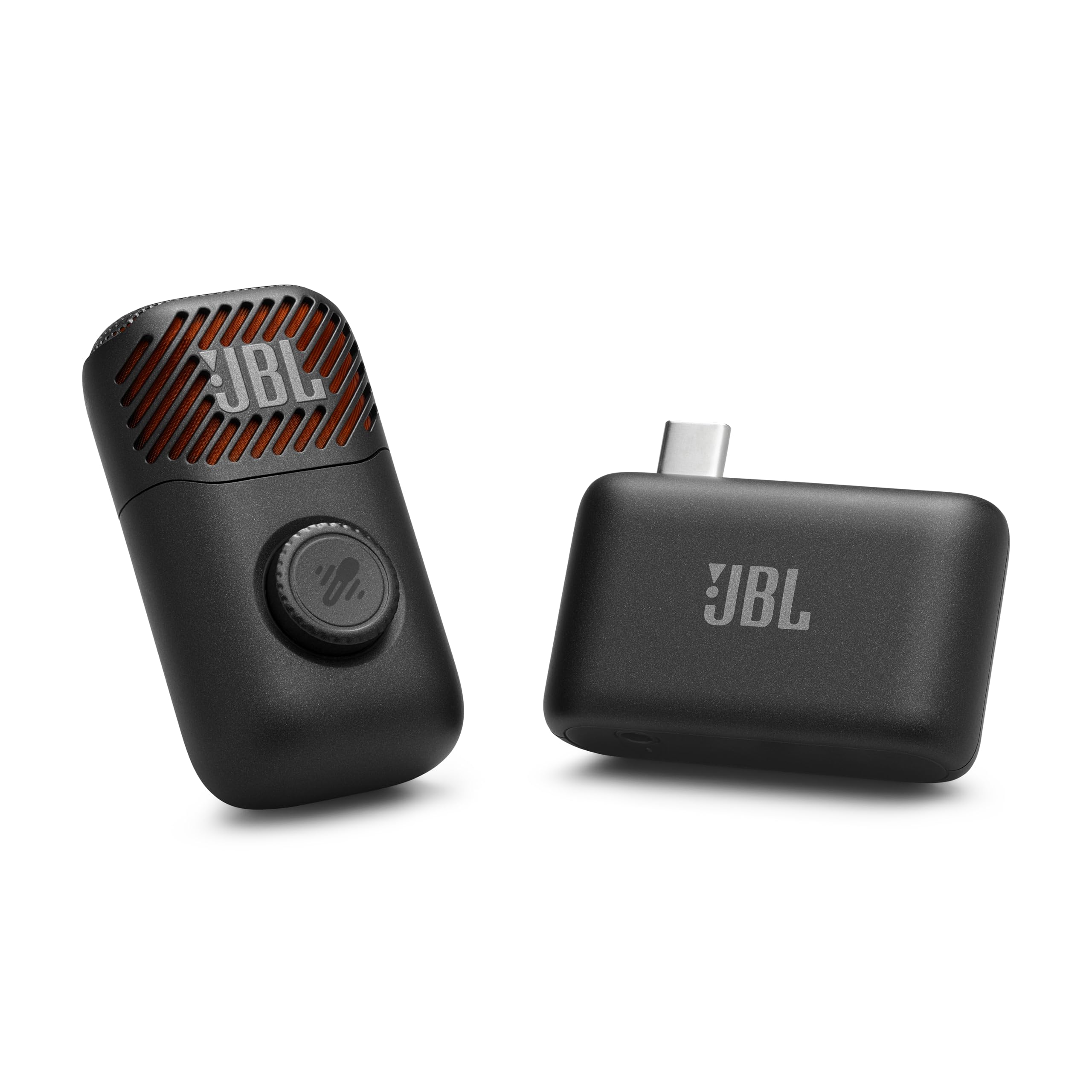
Dial the original singer down 25, 50, or 100 percent and take over the track live
JBL puts an unusual control in your hand: AI vocal removal you can adjust in real time from the mic or the JBL One app, dropping the original vocals by 25%, 50%, or 100%. Keep the chorus with the track and step out front on the solo, or cut the voice out entirely. Voice boost adds a lift when a song climbs into higher notes, so the key change does not leave you scrambling.
The connection is flexible. Bluetooth, USB-C dongle, and Aux out are all supported for speakers, phones, and laptops, over a stable 2.4GHz wireless link that keeps working as you move further from the speaker. The built-in battery runs up to 6 hours of playtime. It pairs readily with JBL portable and PartyBox speakers, and the mic and dongle charge together in a pocket-sized case with no extra cables.
The trade-off is range versus vocal control. Bluetooth range tops out at 10 meters, which is fine around a room but not for a large outdoor space — and it is a karaoke and casual-recording mic first, so treat studio-grade capture as someone else’s job. The vocal-removal powers are the reason to buy it. If singing along with control over the backing track is the goal, this is the most playful option on the list.
The headline feature: real-time AI vocal removal at 25%, 50%, or 100%, adjustable mid-song from the mic itself or the JBL One app.
The trade-off: a 10-meter Bluetooth range suits a room, not a field — and it leans karaoke rather than interview.
Made for: home karaoke fans who want to strip vocals out of any track and toggle it live.
Not for: creators who need long-range recording or precise speech isolation at a distance.
Know the Specs
Pickup pattern and capsule size
A condenser is a sensitive mic element, and the cardioid polar pattern favors sound directly in front while pushing down the sides. On a handheld mic this decides whether your subject comes through clean or the room bleeds in. For interviews and vlogging, a cardioid capsule like the 14mm one here isolates the speaker; for a singalong, that same directionality can feel fussy.
Wireless type: UHF, Bluetooth, or 2.4GHz
UHF (ultra-high-frequency wireless) tends to resist interference and roam further, which is why interview systems lean on it. Bluetooth is the easiest to pair with an iPhone but shorter in range. A 2.4GHz link sits between them, stable over moderate distances. Choose by where you stand: close to your phone, or across a room.
Battery and charging
Rechargeable mics with a USB-charged battery spare you from swapping cells. Pairing the mic’s charge time with how long a session runs — a livestream, a party set, a full interview day — is the practical check. A mic rated for hours of use that charges together with its dongle means fewer cables and less downtime.
Noise reduction and gain
One-key denoise and adjustable gain levels let you clean up background hum and boost quiet speakers without editing software. They help most in busy rooms or outdoor shoots where you cannot control the sound around you. Think of them as damage control: they reduce noise, they do not add clarity that was not captured.
Common Questions
Will these wireless handheld mics work with my iPhone’s port?
What is the difference between a UHF mic and a Bluetooth mic?
Do I need a separate speaker for karaoke, or does the mic make sound itself?
How far can I stand from my iPhone while recording?
Can I use these mics to record a podcast or interview rather than sing?
How long do the rechargeable batteries last?
What does one-key denoise actually do on a handheld mic?
Can I duet-sing with two of the same mic?
What is real-time vocal removal and who is it for?
Do I need an adapter or extra cable I might not expect?
The Bottom Line
Want one wireless handheld mic for your iPhone that covers singing, parties, and casual recording with almost no setup? The BONAOK G50 is the pick to beat — it bundles 26W speakers, Bluetooth pairing, and vocal removal in one device. Shoot interviews instead and the COMICA Revo S wins on clean, directional speech with its 14mm cardioid capsule (a pickup pattern that favors sound in front of the mic). If live karaoke with control over the backing track is the whole point, the JBL EasySing Mic Mini gives you real-time vocal removal you can adjust mid-song. Pick by the job — singalong, speech, or stage — and any of these turns your iPhone into a genuine recording tool.
How we choose
We do not accept paid placement. Every pick is matched to a real buyer and a real use-case; we do not hands-on test units.
Sources
Specifications: manufacturer listings and product documentation. Review insights: verified customer reviews, as of November 2026. Pricing: not shown on this page (it changes often); check the current price via the retailer link.
As an Amazon Associate, Tactical Gear Guy earns from qualifying purchases. This does not affect which products we feature.