Specs are compiled from manufacturer listings and verified buyer reviews and can change over time — please confirm the key details on the product page before buying.
Most point-and-shoot cameras die the same way: a wave, a splash, or a pocketful of sand. Every camera here has a sealed body rated to a real depth in meters, not a vague splash label. Depth rating, drop protection, and underwater lens sharpness separate the good ones from the frustrating ones.
This guide is built by comparing the manufacturers’ published specifications and the patterns across verified customer reviews, so you get each pick’s real strengths and trade-offs instead of marketing spin.
You will see depth ratings from 16 feet to 50 feet, shock ratings, and macro systems that get you within a centimeter of a subject. Below is how each one behaves in the water, on the trail, and in a pocket.
Top Picks


How To Choose The Best Water Resistant Point and Shoot Camera
Most buyers assume “waterproof” is a single standard. It is not. A camera rated to 16 feet and one rated to 50 feet are both sold as waterproof, but only one of them belongs on a snorkel trip. Start with the depth number, then work backward to how you actually plan to use it.
Match the depth rating to your water
A depth rating is the maximum depth the sealed body is built to withstand before water pressure wins. Pool splashing and shallow beach wading demand very little of that seal. Snorkeling and free diving push it harder. If most of your shooting happens within a few feet of the surface, a modest rating is plenty. If you plan to dive, look for a camera rated well beyond the depth you expect to reach.
Look past megapixels at the sensor and lens
Megapixel counts on rugged cameras are not the whole story, and on a compact sensor cramming more pixels can work against you. A bright lens — the aperture figure, like F2.0 — matters more in murky or low-light water. A back-illuminated sensor helps too, because it gathers more light in dim conditions. Aperture and sensor light-gathering decide whether underwater shots look clear or muddy.
Decide if you need macro
Macro is where rugged compacts beat a phone. Ring lights around the lens barrel and dedicated macro modes let you get within a centimeter of a subject and still light it evenly. If you shoot reef life, shells, or small trail finds, this feature is worth paying for. If you mostly shoot wide landscape shots above the surface, it matters far less.
Side-by-Side Comparison
| Model | Best For | Water Rating | Sensor | Optical Zoom | Amazon |
|---|---|---|---|---|---|
| Kodak PIXPRO WPZ2★ Best Overall | All-around adventure bundle | 15 m (49 ft) | 16 MP | 4x | Amazon |
| KODAK PIXPRO P1Best Value | Selfies and vlogging | 16 ft | 13 MP | — | Amazon |
| PENTAX WG-1000Most Modes | Casual outdoor shooting | 15 m (1 hr) | — | 4x | Amazon |
| Ricoh WG-80 | Close-up macro work | 14 m (2 hrs) | 16 MP | 5x | Amazon |
| PENTAX WG-90 | Cold-weather and macro | 14 m (2 hrs) | 16 MP | 5x | Amazon |
| Olympus Tough TG-6 | Underwater photography | 15 m (50 ft) | — | 8x | Amazon |
| PENTAX WG-8 | Deep dives and GPS | 20 m (2 hrs) | 20 MP | 5x | Amazon |
| OM SYSTEM TG-7 | Serious underwater shooting | 15 m (50 ft) | 12 MP | 4x | Amazon |
Detailed Reviews
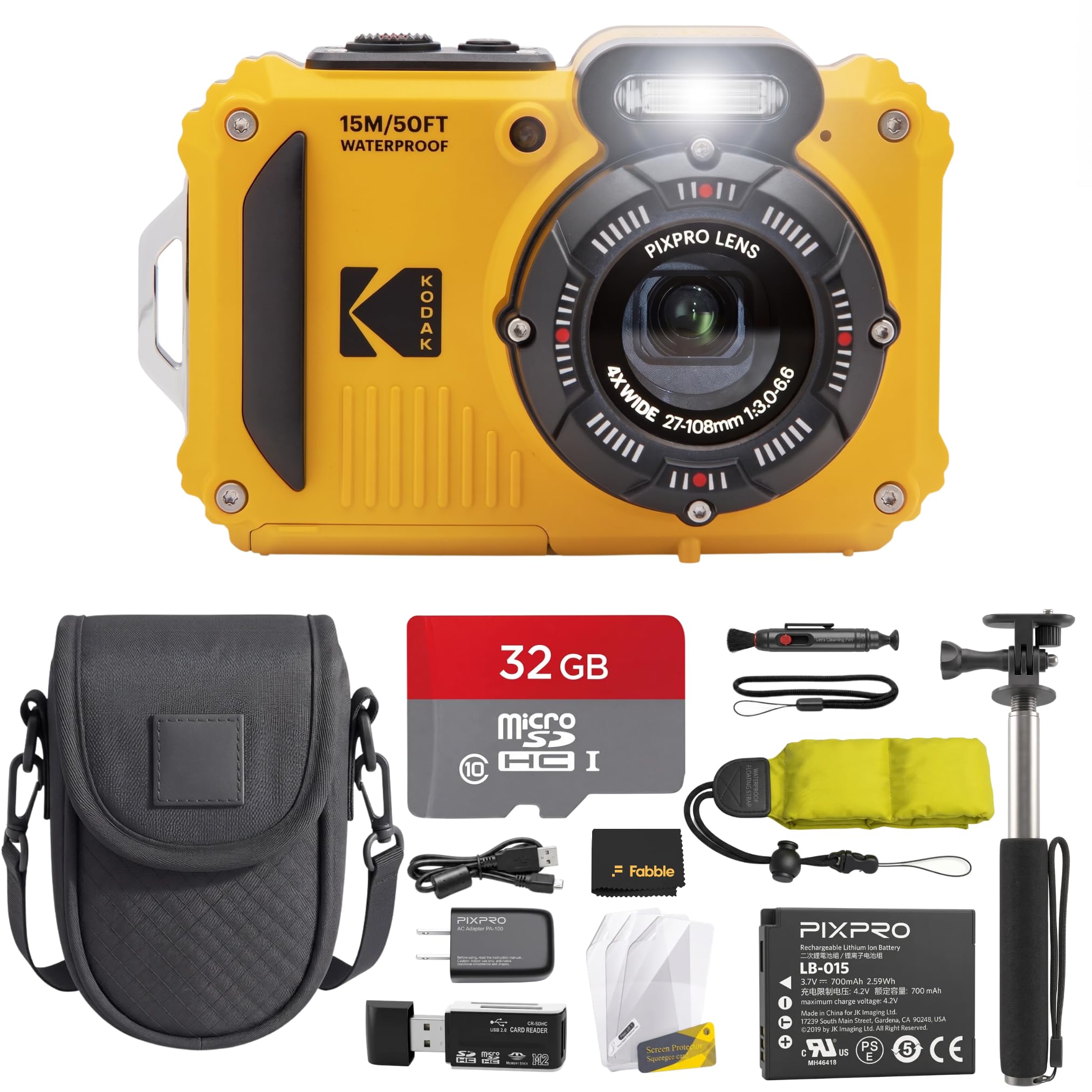
1. Kodak PIXPRO WPZ2 Digital Camera
Our pick — 4.0+★ from 300+ verified ratings; the strongest balance of quality and price.
The adventure camera that arrives with everything already in the box so you can shoot the moment you unzip it.
This is the crowd favorite of the group — 4.0+ stars across 340+ owners — and the reason is simple: it goes to 15 meters (49 feet) underwater and survives a 2-meter (6.56 feet) drop. For a beach trip or a snorkeling day that means you can hand it to a friend without a lecture. The 16-megapixel sensor (the chip that turns light into your photo) captures clean detail, and the 4x optical zoom (real lens zoom, not cropped digital enlargement) gets you close to the action without wading into the impact zone.
What wins people over is the build and the picture quality together — it feels heavy-duty rather than toy-like, and your shots come out sharp underwater and on the sand. The 7-item bundle covers the basics: a point-and-shoot case, floating strap, lens pen, monopod, USB card reader, screen protector, cleaning cloth, and a 32GB SD card with adapter. A floating strap is worth calling out because it means a dropped camera bobs instead of sinks. Continuous shooting runs at 6 frames per second, and the gap between shots is 0.17 seconds, so you can fire off a short burst when a wave breaks.
Why It Earns The Top Spot
- 15 m (49 ft) waterproof rating handles real snorkeling depth
- 2 m (6.56 ft) shockproof body takes trail and boat knocks
- 16 MP sensor with 4x optical zoom for genuine close-ups
- Floating strap means a dropped camera floats, not sinks
- 7-item bundle means no extra purchases before your trip
Where It Asks For Care
- Reliability reports split — some units keep working, some stop
- Wi-Fi connectivity feedback is mixed, so plan on the USB card reader
Reach for this if: you want one box that covers beach, pool, and shallow snorkel without buying accessories separately, and you value the strongest overall package here.
Think twice if: you need a camera rated for deep diving — 15 m is plenty for most surface work, but serious divers will want a higher rating.
2. KODAK PIXPRO P1 13MP Waterproof Digital Camera
The one built for facing the camera instead of standing behind it.
Most rugged cameras are designed for shooting outward. This one tilts its 2.8-inch LCD screen 180 degrees, so you flip it around, see yourself, and frame a selfie without guessing. Pair that with the built-in 3-color fill light — warm, white, and cool tones — and low-light group shots stop looking like silhouettes. It is the only camera here with that flip-screen design, which makes it the obvious pick if your photos are mostly of you and your friends.
The 13-megapixel BSI CMOS sensor (a back-illuminated chip that grabs more light) sits behind a bright f/2.0 fixed wide-angle lens at 26mm, so you fit more scene in each frame. The water rating is 16 feet with 3 feet of shockproofing and dustproofing — that covers pool, beach, splash, and everyday knocks, but not deep diving. Video records at 1080p and a fast 60 frames per second, which keeps fast motion smooth. Continuous shooting fires at 60 frames per second versus the WPZ2’s 6 frames per second, so it is built for capturing a burst of action.
There is no optical zoom here, only 4x digital zoom, which crops into the frame rather than moving the lens — so treat it as a wide shooter and walk closer instead. Charging runs over USB-C, and the lithium-ion battery is built in. As the most budget-friendly pick on this list, it trades zoom range and depth rating for the flip screen and fill light, and for a social-first shooter that is a fair trade.
The selfie math: you can finally see yourself while shooting. A 180-degree tilting screen (it flips all the way around to face you) plus a three-tone ring light is a combination no other camera here offers. That directly solves the worst problem with waterproof cameras — you cannot see what you are shooting when you hold them out at arm’s length.
Suits: vloggers, families, and anyone whose camera roll is mostly people.
The limit to accept: 16 feet of water protection and digital-only zoom mean this is a surface and splash camera, not a dive rig.
3. PENTAX WG-1000 Gray Waterproof Digital Compact Camera
A tough little camera that can be wiped down with disinfectant — a rare trick in this category.
Start with the detail nobody else offers: you can properly disinfect this body. It can be sterilized with solutions containing ethanol, sodium hypochlorite, or chlorine dioxide. That is why the maker pitches it for medical facilities and worksites, where a camera gets shared and needs cleaning. For the rest of us it simply means the shell tolerates a proper wipe-down. The water rating is 15 meters for up to one hour of continuous operation, so a snorkel session stays covered. It is also shockproof against a fall from 2 meters — matching the 2 m figure on the WPZ2 and beating the WG-90’s 1.6 m.
Where it stands out is autofocus: 25 autofocus points versus the Ricoh WG-80’s single point, which translates into far more reliable focus on a moving subject. The 4x optical zoom with 27mm wide-angle coverage handles scenery, and sensitivity runs to ISO 3200 for dim conditions. You also get seven capture modes including Auto, Manual, Underwater, and Scene, plus 20 color modes from Sepia to Sketch. The included O-CC180 protector jacket and O-ST180 carabiner strap make it easy to clip onto a backpack.
The honest catch is feedback on video — recording quality is the recurring weak point, so plan on this as a stills camera. Overall satisfaction splits too, which makes it a better fit for someone drawn to the mode variety and the washable body than for a buyer who wants the safest all-round bet.
Stills-first bargain: 25 autofocus points and 20 color modes give you creative range that most rugged compacts skip entirely, and the carabiner strap is genuinely useful on a trail. Buy it for photographs, not for footage.
Pick it for: stills, shared use, and any setting where the camera gets handled by lots of people.
Look elsewhere if: video matters to you — that is the part of this camera that draws the most criticism.
4. Ricoh WG-80 Orange Waterproof Digital Camera

Six LED lights ring the lens so the tiny stuff gets lit evenly, even 14 meters down.
Macro shooting is where this camera makes its case. Six LED Macro Lights sit around the circumference of the lens barrel, throwing bright, uniform light on a subject inches away. That solves the classic close-up problem — your own camera shadowing the thing you are trying to photograph. The body is rated to 14 meters for up to two hours, and it is shockproof, freezeproof, and crushproof. Underwater and Underwater Movie modes are tuned to correct color and contrast based on images actually captured beneath the surface, which helps with the blue-green cast that ruins underwater shots.
Inside sits a back-illuminated 16-megapixel CMOS sensor, and the lens runs a 5x optical zoom covering 5 to 25mm (28 to 140mm in 35mm terms). That 5x beats the Kodak WPZ2’s 4x and matches the WG-90, giving you more reach for wildlife and distant scenery. Aperture adjusts from f/3.5 to f/5.5. One spec to know before you buy: there is no image stabilization, so brace yourself or use a steady hand for long shots.
The trade-off worth flagging is focus speed — one autofocus point means the camera can hunt when your subject moves. Aim it at reef life, shells, plants, or details on a trail and it rewards you. Point it at a running dog and it will frustrate you.
Best for: underwater close-ups and detail hunters who want even lighting on small subjects.
Skip if: you shoot fast-moving subjects — single-point autofocus is the weak link here.
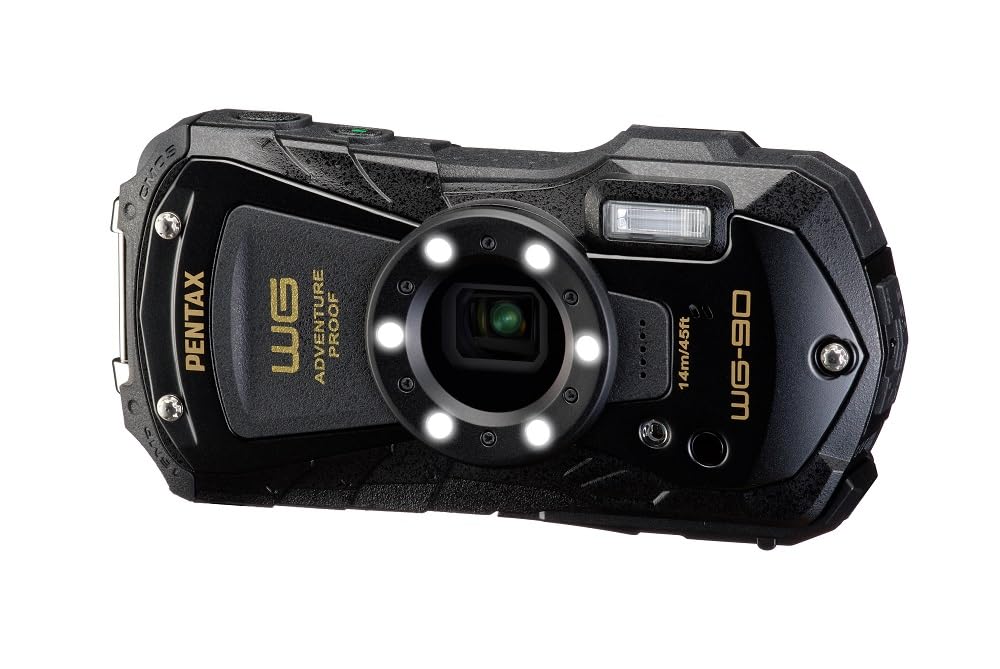
5. PENTAX WG-90 Black Waterproof Camera
Built for the trip where the water is cold enough to freeze your hands.
Freezeproof to -10 degrees Celsius is a spec most rugged cameras here do not carry, and it is the reason to look at this one. Cold-water surfing, winter hikes, snowy climbs — the WG-90 keeps working where the beach cameras stay home. Water protection runs to 14 meters for up to two hours, shockproofing handles a 1.6-meter fall, and the body is dustproof. A 16-megapixel back-illuminated CMOS sensor with sensitivity up to ISO 6400 handles dim conditions, and hybrid autofocus with 99 autofocus points gives it far more focusing intelligence than the single-point WG-80.
Close-up work gets serious attention: six LED Macro Lights ring the lens barrel, so tiny subjects get their own light. There is a PENTAX Digital Microscope mode for details too fine for the naked eye, and the included Macro Stand holds a 1cm focusing distance (about the width of your fingernail) during long observation shoots. The 5x optical zoom covers 28mm wide-angle scenery, so a whole beach fits in frame. The 2.7-inch LCD has an anti-reflection coating with an Outdoor View Setting for bright days, so the screen stays readable in sun. Full HD movies record in H.264 (a common video format that plays almost anywhere).
The catch, and it is a real one, is photo quality — it draws divided reactions, with sharpness at the frame edges and auto settings among the noted weak spots. The screen also scratches easily, so a protector is worth fitting on day one. The 2-hour battery life figure keeps a limited shooting window in mind for longer dives.
The cold-weather case: -10°C freeze-proofing plus 99 autofocus points and a macro stand is a package aimed at field work, not just vacation snapshots. If your adventures trend toward snow and cold water, this earns its place ahead of warmer-weather competitors.
Worth it for: cold-climate and macro-focused shooters who need the camera to survive freezing conditions.
Be aware: image sharpness and auto settings draw fair criticism, and the LCD wants a screen protector from day one.
6. Olympus Tough TG-6 Waterproof Digital Camera (Renewed)

A renewed tough camera that can take 100kgf of crush force and still shoot underwater.
Crushproof to 100kgf is a number that matters if your camera lives in a pack, a boat locker, or under a car seat. That rating means it survives being squashed by a heavy load, on top of 50 feet (15 meters) waterproofing, 7 feet (2.1 meters) of shockproofing, freeze-proofing to -10 degrees Celsius, and anti-fog construction.
The lens is a bright F2.0 with a maximum 8x zoom — more reach than anything else on this list — and the sensor is a back-illuminated CMOS paired with the TruePic VIII processor. Macro is a full system: four macro shooting modes with magnified shooting up to 1 centimeter from the end of the lens. There are five underwater shooting modes including underwater microscope, plus three underwater white balance modes to fight that blue cast. Video covers 4K plus Full HD at 120 frames per second for slow motion.
Battery figures: roughly 340 images on CIPA testing, around 50 minutes under standard JEITA testing, and up to 110 minutes when zoom and other functions stay idle. Note this is a renewed unit, so inspect the seals and the body on arrival. For the diver who wants the deepest feature set without paying the newest-model tier, it is a considered way in.
The underwater toolkit: five underwater modes, three underwater white balance settings, and 1cm macro focusing add up to a camera set up specifically for submerged photography rather than adapted to it.
Ideal for: divers and snorkelers who want temperature compensation, crush resistance, and real underwater color control.
One caution: renewed stock means you should check the door seals and body condition the moment it arrives.
7. PENTAX WG-8 Green All-Weather Adventure Camera

Twenty meters of depth, 4K footage, and a GPS that tags where every shot was taken.
Twenty meters for up to two hours is the deepest water rating in this group — deeper than the 15 m seals on the Kodak and the TG-7, and ahead of the 14 m on both the WG-80 and WG-90. If your diving runs deep, that headroom is the reason to pick it. Around 20 effective megapixels sit behind a 5x optical zoom with 28mm wide-angle coverage, so wide reef shots and zoomed-in details both work. 4K-resolution movie recording (four times the pixels of Full HD) handles the video side. Advanced GPS functions and a built-in digital compass mean every shot carries its location — useful on trail maps and dive logs alike.
For close work there is a high-power, variable-brightness six-bulb LED Ring Light and a Digital Microscope mode for subjects too small for the naked eye. A 3.0-inch wide-frame LCD with Outdoor View Setting keeps the screen readable in changing light. There is also a webcam function for live-streaming, which is an unusual extra in a rugged body. Autofocus is hybrid with 8 autofocus points.
What buyers report is strong, reliable performance in the field, with underwater photography called out as a strength. The divided notes land on image quality — some find photos excellent, some say they are not better than a phone — so set expectations around adventure documentation rather than competing with a dedicated camera. What wins people over is the build and the dependability.
Best for: divers who want the maximum depth rating here plus GPS tagging and 4K video in one body.
Second thought: the 8-bit depth and smaller autofocus count trail the field, so treat it as an adventure recorder, not a precision instrument.
8. OM SYSTEM Olympus Tough TG-7 Red Underwater Camera

The one built for the person who plans their whole trip around what lives under the surface.
This is the fullest rugged spec sheet in the group: waterproof to 50 feet (15 meters), shockproof to 7 feet (2.1 meters), crushproof to 220 lbf (100kgf, a measure of crushing force), freezeproof to 14 degrees Fahrenheit (-10°C), and dustproof with anti-fog dual-pane lens glass (two glass layers that stop condensation). The 12-megapixel back-illuminated CMOS sensor (a light sensor that gathers more light from behind) works with the TruePic VIII processor, behind a bright F2.0 lens covering 25-100mm equivalent with 4x optical zoom. F2.0 is the number that matters in murky water: a wider aperture (the lens opening) lets in more light, so your shots stay usable when the sun is low or the water is clouded.
The macro system is where this camera earns its keep. Four dedicated modes — Microscope, Microscope Control, Focus Bracketing, and Focus Stacking — let you focus as close as 1 centimeter from the front of the lens. Five underwater shooting modes (Underwater Snapshot, Wide, Macro, Microscope, and HDR) cover everything from broad reef shots to tiny subjects. Video records 4K at up to 30 frames per second, or Full HD at 120 frames per second for slow motion, and vertical video recording handles social content without a separate setup.
The most-praised part of this camera is the quality and the functionality — it is the busiest camera in this group by owner attention, with 438+ ratings at 4.0+ stars. The recurring split is image quality: some call the photos excellent while others find them short of their expectations, and the same caution runs through durability and value notes. Size it for what it is — a rugged, macro-capable adventure camera rather than a replacement for a larger sensor body.
What Keeps It In The Conversation
- Variable Macro System with 1cm close focusing across four modes
- F2.0 lens gathers light in dim or murky water
- Five dedicated underwater modes plus underwater white balance options
- 4K at 30fps and Full HD slow motion at 120fps
- Anti-fog dual-pane glass stops lens fogging on transition
The Honest Scorecard
- Image quality draws mixed reactions versus phone cameras
- Rated 4.2 against the top pick’s 4.3 — the WPZ2 edges it on score
The pick for: underwater photographers who need real macro reach and 4K footage without a housing case.
Note the gap: this one tops the ratings count in this group but sits just under the WPZ2 on score, so choose it for the macro system, not for a higher number.
Know the Specs
Depth Rating
A depth rating is the maximum water depth the sealed body is designed to withstand — the figure in meters or feet, sometimes with a time limit attached. A 14-meter rating with a two-hour limit is not the same as an unlimited 15-meter rating, so read both numbers. Match the depth to how you shoot: splash and pool work needs very little, while snorkeling and diving need real headroom. Dry the seals and keep the battery door free of sand before every immersion.
Aperture
Aperture is the size of the opening that lets light through the lens, written as an F-number — F2.0 is wider than F3.5. A wider aperture pulls in more light, which keeps underwater and low-light shots usable without a flash. On a small rugged sensor that brightness matters more than the megapixel count. If you shoot murky water or dusk, favor the lower F-number.
Macro and Ring Lights
Macro means shooting very close — a centimeter or two from the lens. The challenge is light, because the camera body casts a shadow on the subject. Ring lights built around the lens barrel solve that by lighting from all sides at once. A dedicated macro mode adds focusing that holds at close range. This is the difference between a blurry smudge and a clear shot of reef life or a shell.
Shock, Crush, and Freeze Ratings
Shockproofing is measured in drop height, like 2 meters. Crushproofing is measured in force, like 100kgf. Freezeproofing is a temperature, like -10 degrees Celsius. Each covers a different way a camera fails in the field — a fall, a heavy load, or extreme cold. Buyers heading into cold water or winter trails should prioritize the freeze rating, while pack-and-boat users get more from the crush figure.
Common Questions
What does a 15-meter waterproof rating actually mean for snorkeling?
Can I take these cameras scuba diving or only snorkeling?
Do I need a separate underwater housing case for these cameras?
What is the difference between optical and digital zoom on a waterproof camera?
How do I stop the lens from fogging when I go from cold air to warm water?
Is a freezeproof camera worth it if I mostly shoot in warm water?
Do these cameras record good video underwater?
How long does the battery last on a rugged compact?
Should I buy a renewed waterproof camera to save money?
What memory card do these cameras use?
The Bottom Line
For most people, the water resistant point and shoot camera winner is the Kodak PIXPRO WPZ2 because it combines a 15-meter depth rating, a 2-meter shock rating, and a 7-item bundle that covers the accessories you would otherwise buy separately. If you plan your trips around what lives under the surface, the OM SYSTEM TG-7 is the one to reach for, with its four-mode macro system and 1cm close focusing. And for cold water and snow, the PENTAX WG-90 brings freeze-proofing to -10°C and 99 autofocus points. Any of the three is worth the trip it is packed for — check the depth number, then buy for the water you actually shoot.
How we choose
We do not accept paid placement. Every pick is matched to a real buyer and a real use-case; we do not hands-on test units.
Sources
Specifications: manufacturer listings and product documentation. Review insights: verified customer reviews, as of November 2026. Pricing: not shown on this page (it changes often); check the current price via the retailer link.
As an Amazon Associate, Tactical Gear Guy earns from qualifying purchases. This does not affect which products we feature.