Specs are compiled from manufacturer listings and verified buyer reviews and can change over time — please confirm the key details on the product page before buying.
Here is the short answer: pick an antenna by the honest distance it can pull in, not the flashy number on the box. A window is the best real estate in your home for free TV signals, and the right antenna stuck to that glass can bring in local news, sports and network shows without a monthly bill. Most returns happen because a shopper bought a “long range” claim that never matched their distance to the broadcast tower.
This guide is built by comparing the manufacturers’ published specifications and the patterns across verified customer reviews, so you get each pick’s real strengths and trade-offs instead of marketing spin.
Below you will find nine window-mountable antennas ranked by what they actually deliver on glass, from budget pads to amplified panels with switchable boost modes. Every pick here can hang on a window, and each one is matched to a specific kind of home. My breakdown of the window mount antenna options explains real range, cable length, and mounting honestly.
Top Picks

How To Choose The Best Window Mount Antenna
Buying a window antenna is really about two numbers and one surface. The numbers are your distance to the broadcast towers and the antenna’s realistic range; the surface is the glass you plan to stick it to. Get those three aligned and the rest — picture quality, channel count, setup time — tends to fall into place.
Read the range claim like a skeptic
A “mile” rating is the best-case distance under open skies with nothing in the way. Walls, trees, hills and even your own window glass cut into that. That is why a modest, honestly rated antenna often beats a screaming claim: the Channel Master FLATenna states a 35-mile range, while one rival lists 180 miles on the box. For a city or suburban home, 35 realistic miles is a serious number. For a rural spot far from towers, you want the amplifier and a higher gain rating instead.
Amplified or passive — and where the power comes from
A passive antenna just receives; an amplified one adds a small booster circuit to lift weak signals. If you live close to towers, a passive unit is fine and simpler. If you are on the edge of coverage, the boost helps — the XVARYNIQ lists a 28dB inline amplifier with a two-mode switch, and the SHERRIVA powers its amplifier straight from your TV’s USB port. Check that you have a free USB port or an adapter, because an amplifier with no power is just a passive antenna.
Cable length decides whether it reaches the window
This is the spec shoppers overlook and then regret. Your TV sits on one wall; your best window may be across the room. A 12 ft coax run is tight in a small apartment but short in a living room. A 16 ft or 18 ft cable gives you slack to climb to a high window or reach around a corner. Measure the path from your TV’s antenna input to the glass before you buy, then add a couple of feet of slack.
Side-by-Side Comparison
| Model | Best For | Stated Range | Cable Length | Power / Amplifier | Amazon |
|---|---|---|---|---|---|
| NEOSIGN TV Antenna for Local Channels★ Best Overall | Best all-round window pad | 180 miles | 13 ft | Passive | Amazon |
| Trisonic TS-1599DTVBest Value | Cheapest suction-cup mount | 10 feet | — | Passive | Amazon |
| Mohu LeafBest for Design | Paintable, low-profile design | — | 12 ft | Passive | Amazon |
| Channel Master FLATenna | Honest urban reception | 35 miles | 12 ft | Passive | Amazon |
| SHERRIVA Amplified Indoor Antenna | USB-powered amplification | 65 miles | 16 ft | USB amplifier | Amazon |
| Five Star Ultra-Thin Amplified | Foldable fabric design | 60 miles | — | Amplified | Amazon |
| JM NEXLOV Indoor TV Antenna | Long cable, easy setup | — | 18 ft | Built-in booster | Amazon |
| Rymafxi Digital TV Antenna | Magnetic base flexibility | — | 18 ft | Signal booster | Amazon |
| XVARYNIQ Amplified TV Antenna | Dual-mode gain control | — | — | 28dB inline amplifier | Amazon |
Detailed Reviews
1. NEOSIGN TV Antenna
Our pick — 4.5+★ from 14,000+ verified ratings; the strongest balance of quality and price.
A flat window pad with 360° reception, so you hang it and scan instead of aiming at a tower.
Most people want one thing from a window antenna: hang it, scan, watch TV. This NEOSIGN pad delivers exactly that. Its defining spec is a 360° reception design — meaning it pulls signals from all directions at once rather than forcing you to point it at a tower. Combined with the 180-mile stated range on the box, it is built for the buyer who does not want to study a signal map before sticking something to the glass. Support for 4K and 1080p is listed too, so it fits modern smart TVs and older sets alike.
The 13 ft coaxial cable is the practical hero here. That is enough slack to climb from a low TV stand up to a window ledge or around a bookshelf, and the thick sheath is described as built for strength. Compared with the Mohu Leaf’s 12 ft run, you get an extra foot of reach to work with. Installation is genuinely simple: connect to the TV’s antenna input, place the pad on a desktop, wall or window, switch the set to “Air” mode, and run a channel search. The maker is honest about one thing — this is a passive receiver, so what you get depends on local signal coverage, and you should rescan any time you move it.
Where it earns its spot
- 360° reception removes the aiming guesswork that trips up first-time cord-cutters
- 13 ft coax gives real slack to reach a high or distant window
- Designed for both indoor and outdoor placement, and the maker says it holds up through storms
What to weigh first
- Passive design relies on good local coverage — check your area before buying
- The 180-mile figure is a best-case box number, not a promise for hilly terrain
Grab this one if: you want a set-and-scan antenna with no aiming, no amplifier wiring and enough cable to reach a real window.
Look elsewhere if: you sit far from the towers and need an amplified unit to lift weak signals.
2. Trisonic TS-1599DTV Razor Thin HD Digital Indoor TV Antenna
A 2.4 oz suction-cup pad that sticks to glass and lifts off without adhesive residue.
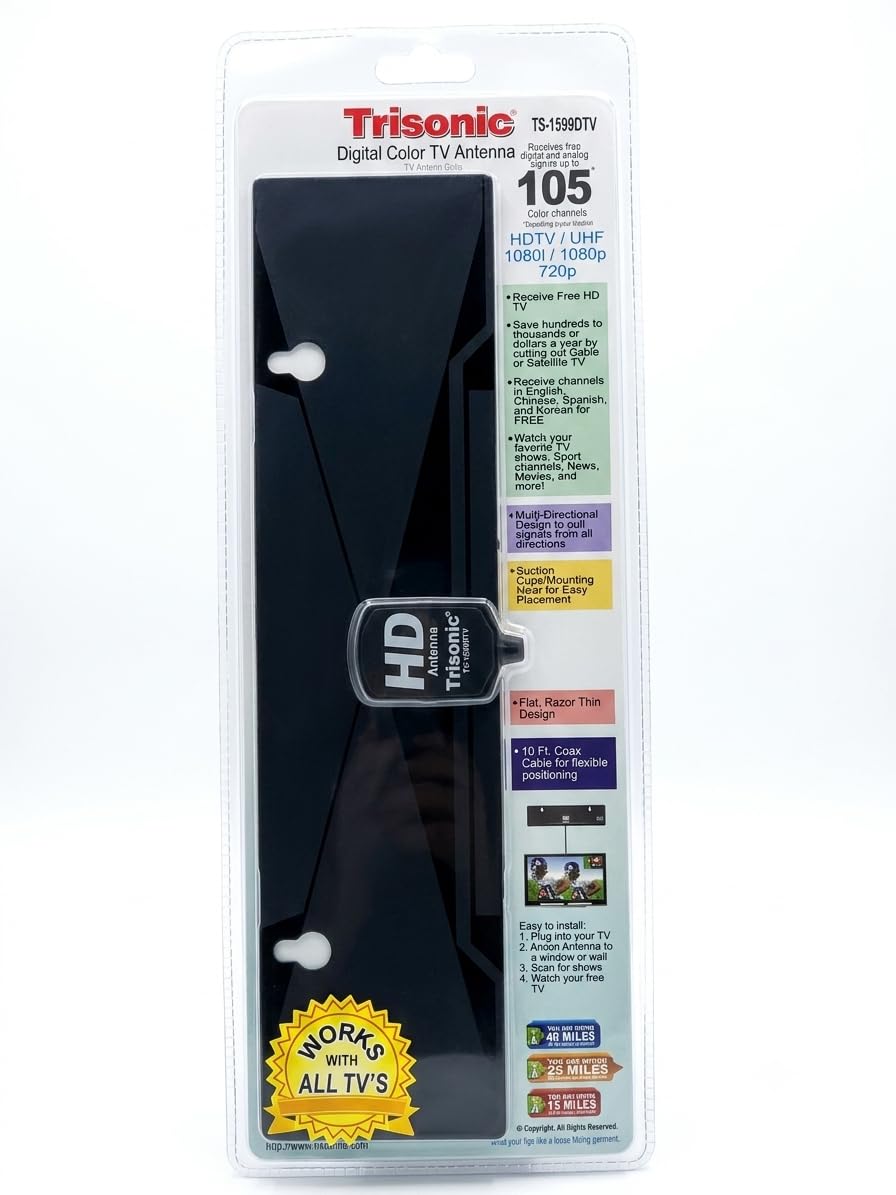
This Trisonic is the only pick in this group that mounts with suction cups — the maker designed it specifically to stick to a window for maximum exposure. It weighs just 2.4 ounces, which is the lightest here. Compare that with the SHERRIVA’s 7.68 ounces and you can see why a suction cup can hold it: less mass means less pull on the glass. Its multi-directional design means you do not have to aim it precisely, and the maker rates it for up to 100 channels.
The honest catch is the range figure. The listed range is 10 feet — a short-antenna spec, not a distance-to-tower number. Treat this as a close-to-towers pick for an apartment where the broadcast signals are already strong. Setup is genuinely one-step: connect the cable to the TV and you are done. If you live in a dense city with local towers nearby, this is a low-risk way to test free TV before spending more. If you are in a fringe area, it will struggle and you should look at the amplified picks higher up this list.
Why renters like it: suction cups mean no adhesive residue on a rental window, and 2.4 ounces is light enough to hang without extra support.
Set your expectations: the range is genuinely short, so this is a city pick, not a farmhouse pick.
Best fit: apartment dwellers with towers close by who want a removable window mount.
Skip this: rural homes far from transmitters that need real range and amplification.
3. Mohu Leaf Indoor TV Antenna, Ultra-Thin, Warm Grey
A 0.04-inch paintable pad with front-and-back elements that hides on a colored wall.
The Leaf is the one you buy when you refuse to put a piece of plastic in your nice window. It measures just 0.04 inches thick — thin enough that a coat of paint makes it vanish against a colored wall. That design flex is the real draw: the maker says it can be painted to match your room, and it hangs on a wall or window with the included hook-and-loop tabs and push pins. A 12 ft high-performance coaxial cable comes in the box, plus a one-year manufacturer warranty.
Buyers report the build quality holds up well for a low-profile pad, and they like the value for a free-TV setup. Under good coverage, the picture comes in clear and cable-like. The mixed part is channels and reception: this is a passive unit (it has no amplifier, so it does not boost the signal), and whether you pull 25 or 17 local stations depends on where you sit relative to the towers and what the building blocks. It is a UHF and Hi-VHF design (UHF and Hi-VHF are the two TV frequency bands), so it handles both bands. Set it up safely and it does its job; the variability comes from the airwaves, not the sheet itself.
Why it stands out
- Paintable, ultra-thin (0.04″) design hides in plain sight on a wall or window
- Front-and-back multi-directional elements mean you are not locked to one aim
- 12 ft coax, mounting tabs and pins included — a complete kit
The real limits
- Passive only — reception varies by building and terrain
- Channel count is never guaranteed; scan results depend on coverage
Pick the Leaf if: design matters and you want an antenna that vanishes on a painted wall.
Consider otherwise if: you need a guaranteed high channel count in a weak-signal area.
4. Channel Master FLATenna – Indoor Digital HDTV Antenna
A 35-mile flat antenna with RG6 coax and ATSC 3.0 support from a long-established brand.
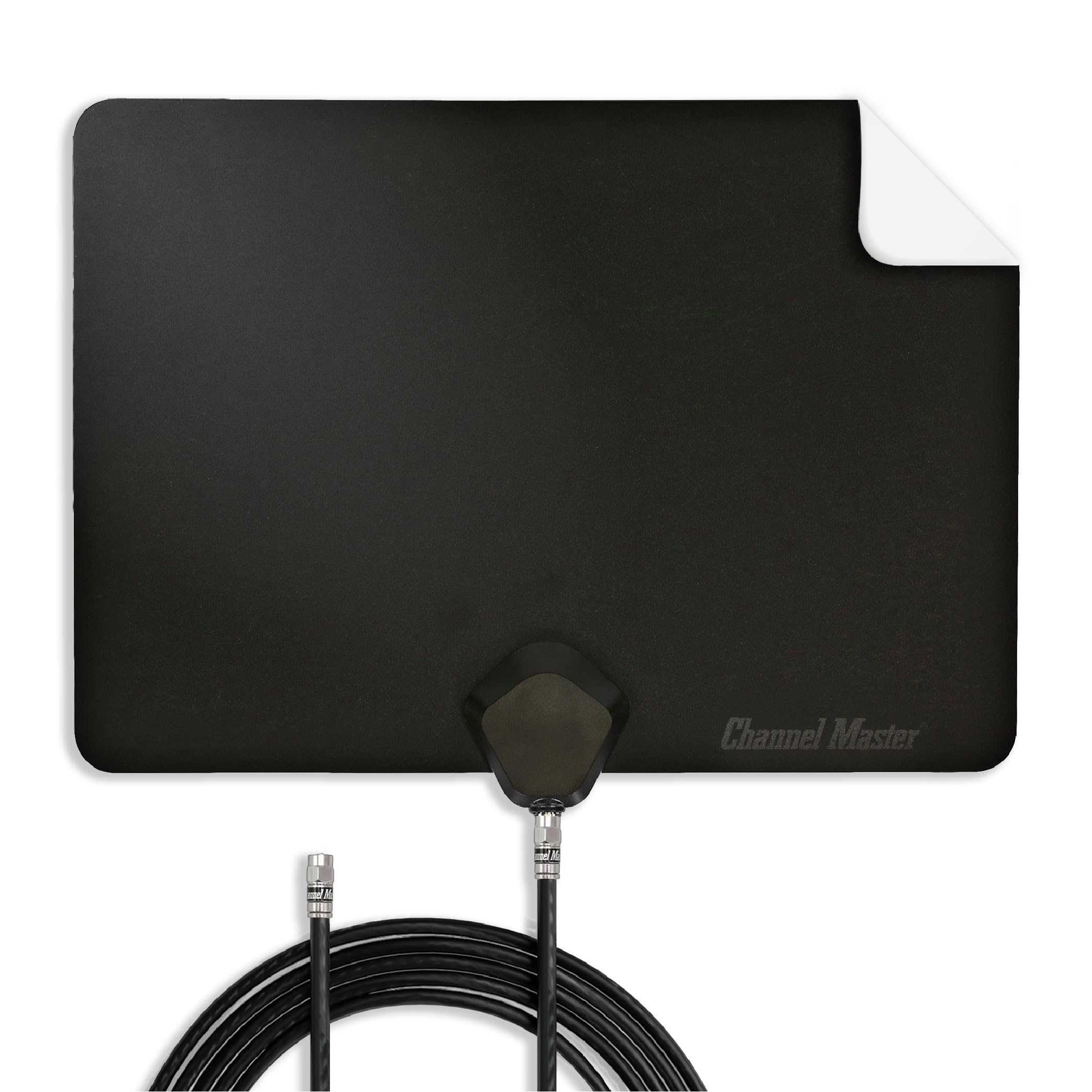
This is the most striking head-to-head in this guide. The FLATenna states a 35-mile range. The NEOSIGN above says 180 miles. That 180-vs-35 gap tells you how to read this pick: Channel Master is selling realistic range that accounts for obstructions and interference, not a fantasy number. For an urban or suburban home, 35 believable miles should out-pull a 180-mile claim from a no-name brand. It supports ATSC 3.0 NextGen TV (the newer broadcast standard) and 4K broadcasts. It also includes a 12 ft professional-grade RG6 coaxial cable (RG6 is a thicker cable type) with better shielding, so the signal stays steadier.
The reception performance is where this one shines. It works especially well on UHF band channels, which covers most modern local stations. The picture quality matches what people remember from cable, and it pulls in local channels and keeps a strong signal. The build is reversible — black on one side, white on the other — so it fits either decor style. The recurring gripe is the mounting adhesive: the sticky pieces do not always hold firmly to glass, so plan on a push pin or a frame mount if your window is the target.
Where it wins: realistic 35-mile range and RG6 shielding make it the safe bet for city and suburban reception.
The one flaw to plan around: the adhesive that must hold it to glass is the weak link in the kit.
Reach for this if: you want a known name, honest range and solid UHF performance.
Look elsewhere if: you need factory adhesive that will stick to a window without help.
5. SHERRIVA Indoor TV Antenna

A 65-mile amplified panel that draws its boost from your TV’s USB port instead of a wall adapter.
Plug an amplifier straight into the TV’s own USB port and you get boost without a separate power adapter cluttering the shelf. That is the smart trick here, and it pairs with a stated 65-mile range and a dual-stage, low-noise amplifier. The 16 ft coax runs across a room with room to spare — compared with the Mohu Leaf’s 12 ft, that is roughly 33% more slack to climb up to a high window. Setup is genuinely plug-and-play: connect, scan, done in minutes. It handles up to 4K on a smart TV or traditional set with a coaxial input.
This one occupies a useful middle ground. It amplifies weakly for stronger reception than a passive pad, but you must have a free USB port or an adapter, or the booster is just a passive antenna. At 7.68 ounces it is heavier than the 2.4-ounce Trisonic, so use the adhesive backing on a solid surface rather than a suction cup on glass. It is a sensible choice for a suburban home where signals are decent but not perfect and you want an extra lift.
The smart buy for: homes with a free USB port that want amplified reception without a wall adapter.
Check before you click: confirm a USB port or buy an adapter, or the amplifier never turns on.
6. Five Star Ultra-Thin Amplified HD TV Indoor Antenna

A foldable fabric panel with a 60-mile amplifier that packs flat for an RV or a move.
The element that makes this one different is the foldable fabric cover. Most indoor antennas are rigid plastic planes that bounce around in a moving box; this one bends and stows flat, which is nice for an RV, a dorm, or a serial apartment mover. Inside sits a high-gain smart amplifier rated for 60-mile reception, with 4K and 1080p output and support for NextGen TV ATSC 3.0. The maker rates it for up to 100 channels, and it works with any HDTV, digital tuner or converter box.
The build is deliberately slim and compact, so it can go wall-mounted, on a shelf, or hidden behind the set. That flexibility matters if your best signal spot is not your prettiest spot — you can shift it around without a bracket. It carries a one-year manufacturer warranty. The honest note is that a fabric shell at 0.02 inches thin is best treated gently; it is not a rugged piece of kit, and the amplifier still depends on decent local coverage to earn its 60-mile number.
The clever bit: folding flat makes it the easiest pick to pack and move, unlike a rigid flat panel.
The catch: ultra-thin fabric needs careful handling, and amplified reception still depends on local signals.
It suits: RV owners, renters and travel setups that need an antenna that packs flat.
Not ideal for: buyers who want a rugged, rigid unit and lots of local channels in a weak zone.
7. JM NEXLOV Indoor TV Antenna
An 18 ft coax run plus a high-gain amplifier and smart IC chip for cleaner VHF/UHF reception.
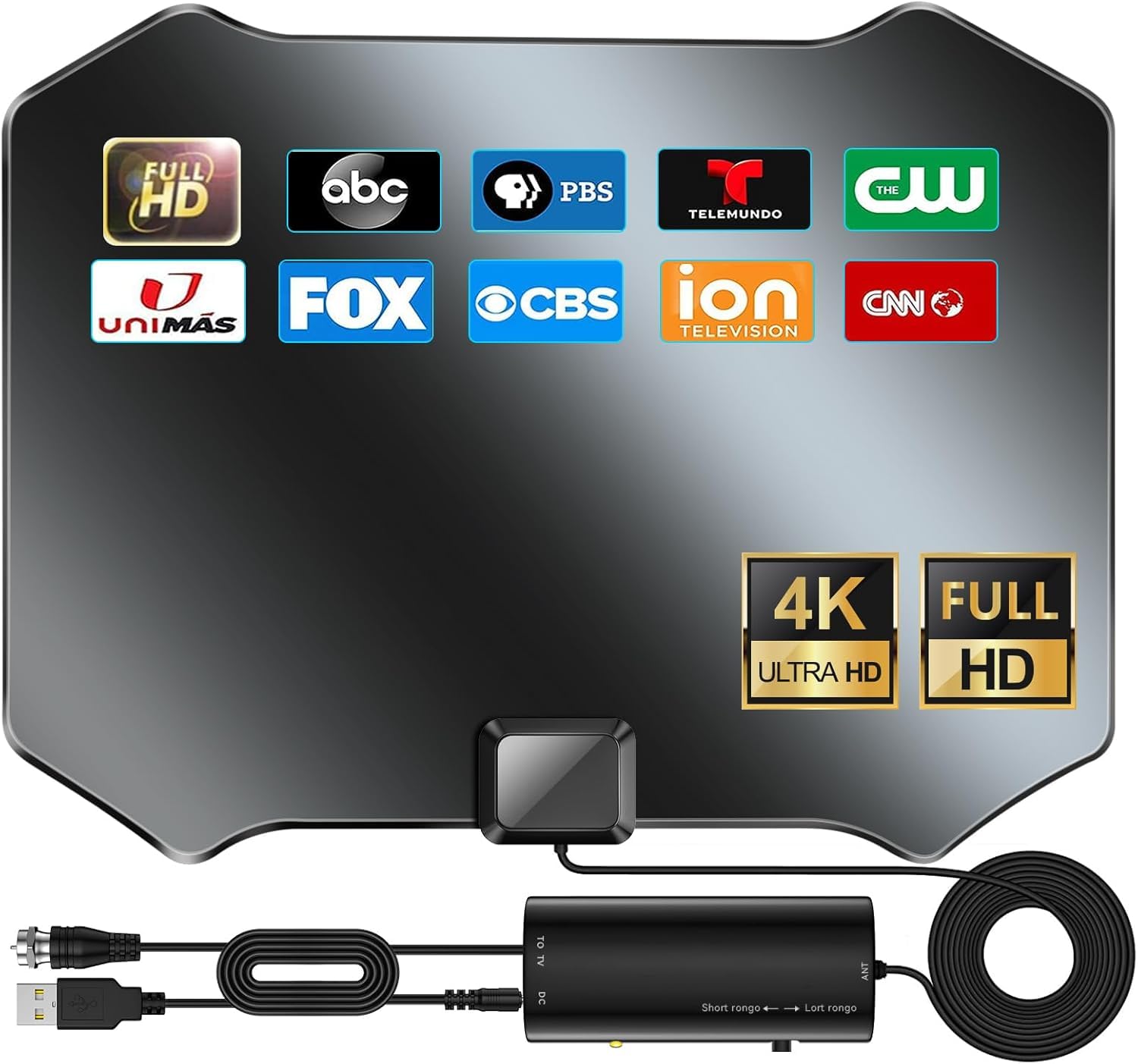
Shoppers underestimate the run from TV to window, and this JM NEXLOV hands you 18 ft of coaxial cable — the most of any pick here alongside the Rymafxi. That length often clinches the deal in a big living room, because you can chase the balance at the top of the window without a coax extension. The built-in high-gain amplifier and upgraded smart IC chip (a chip that filters signal noise) work to cut RF interference, the noise that breaks a picture up on weak stations. Support for 4K, 1080p and HDR (HDR adds more contrast and color) keeps modern sets happy. It fits RVs, campers and dorm rooms as well as a living room.
What wins people over is how cleanly it does the basics. Owners mention crisp, interference-free HD and often a full slate of local channels, with setup that takes just a few minutes. The antenna design and slim profile get consistent praise, and the flat panel is light enough (4.64 ounces) to conceal and shift around. The one caveat the maker states plainly: reception is affected by location, terrain and weather, so rescan after every repositioning.
What earns the praise
- 18 ft coax gives the most positional freedom of the flat picks here
- Smart IC chip plus high-gain amplifier work to tame RF interference
- 4.64 oz slim panel sits flush on a window or hides on a wall
Worth knowing
- Performance still swings with location, terrain and weather, as the maker notes
- Rescanning is required every time you move it for the best result
This one is for: big rooms and RV setups where a long coax run and strong booster matter most.
Think twice if: your heart is set on a self-adhesive mount that never needs repositioning.
8. Rymafxi Digital TV Antenna
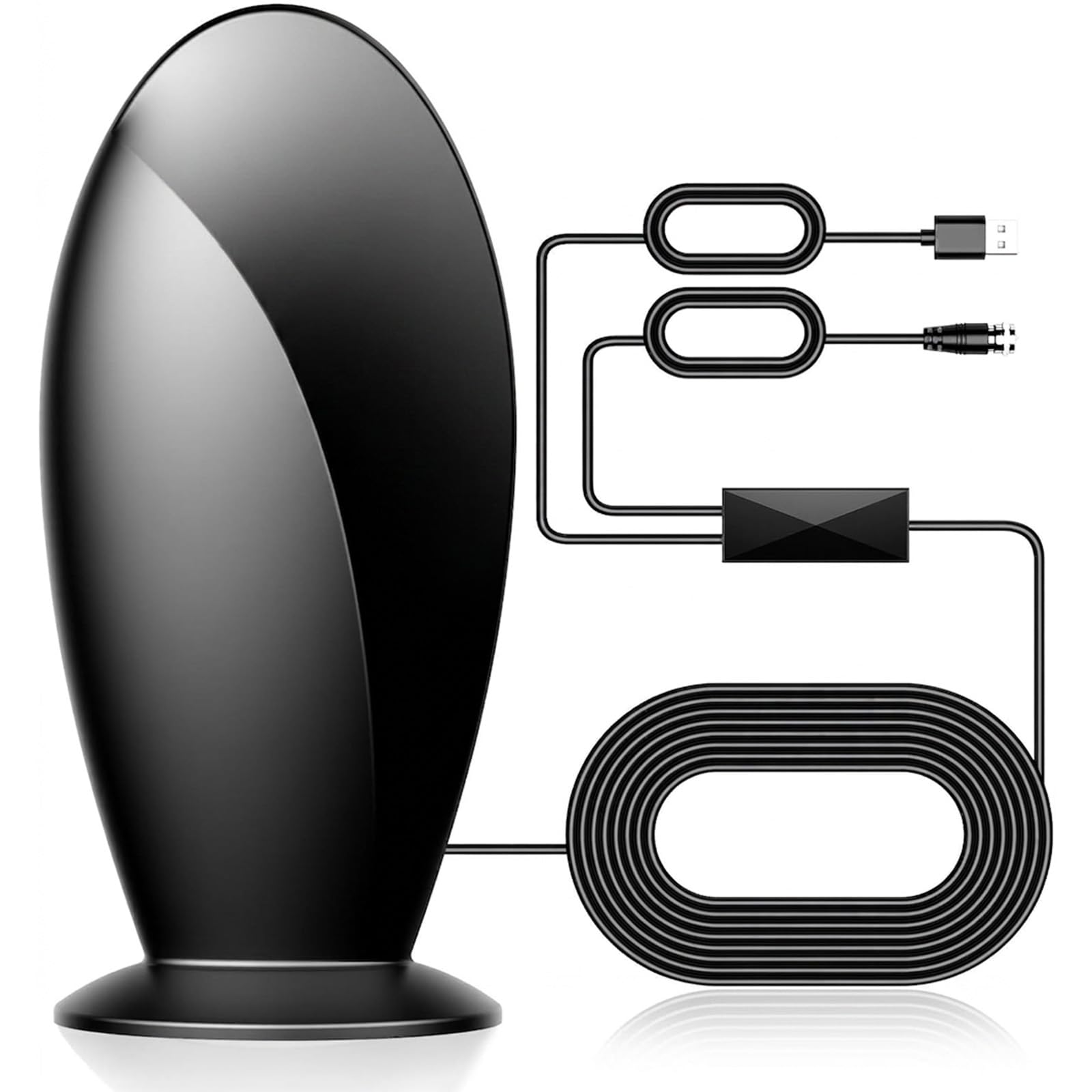
A magnetic-base panel with 18 ft of coax and adhesive strips, so it mounts on metal or glass and hides behind the TV.
A magnetic base is a feature almost no other indoor antenna offers. It lets this Rymafxi snap onto a metal surface — a filing cabinet, a metal frame, or the back of some TVs — while high-strength foam double-sided tape handles the window or wall. The “invisible design” goal is that you hide it behind the set or up on the frame and never look at it. The boosted transmission runs over an 18 ft coaxial cable to your 4K smart TV, with an amplifier that keeps performance consistent for 1080p and 4K content.
The 18 ft run is what gives you options. It matches the JM NEXLOV’s length and lets you climb from a corner TV to a high window in a single reach. Everything for setup is in the box: the coaxial cable, adhesive strips, and cable clips to keep the run tidy, plus the magnetic base for a tool-free install. No technician, no drilling. What the data does not promise is a specific mile range, so treat it as a flexible amplifier panel rather than a fringe-area long-range unit. It suits the buyer with good-to-decent coverage who wants a clean install.
The flex factor: magnetic base plus tape plus 18 ft coax gives more placement choices than a rigid sticky pad.
The honest limitation: no stated range or channel count is published, so it is not the pick for a fringe signal area.
Good match for: tidy, hidden installs on metal frames and window walls with strong local coverage.
Better choice exists if: you need a published mile rating to guarantee fringe reception.
9. XVARYNIQ Amplified TV Antenna
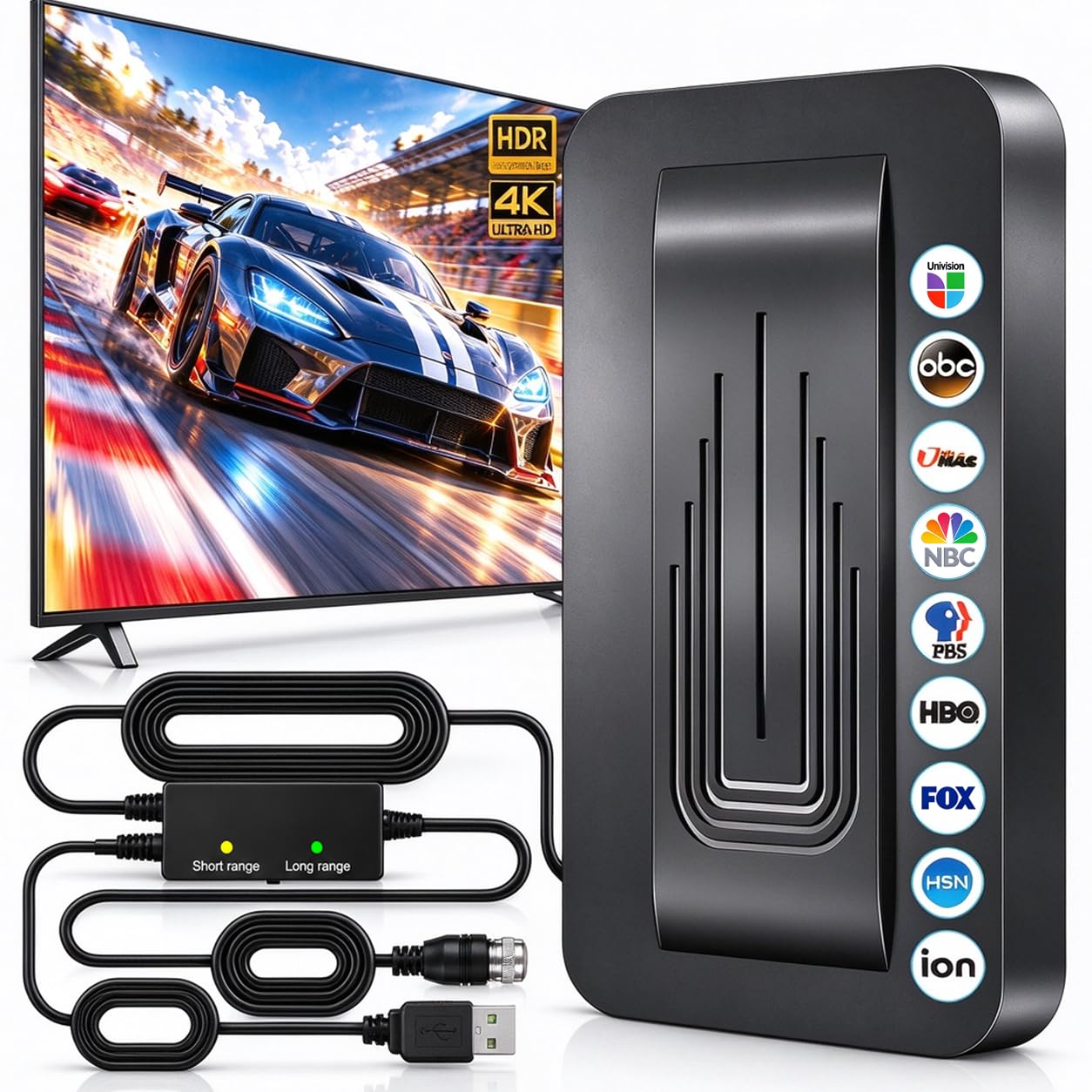
The only pick with a physical gain switch — yellow for close towers, green for far ones.
The detail that sets this one apart is the switchable amplifier. An inline amplifier with a rated 28dB gain carries an LED indicator: a yellow light for short range near towers, green for long range. You flip the mode, then rescan, and the tuner fine-tunes for more stations. That is a genuinely practical control for a fringe-area home where you want to dial in weak signals. It covers both bands — VHF 170-240MHz for many local stations and UHF 470-860MHz for the rest — and works with 4K and 1080p smart TVs that have a built-in digital tuner.
Three mounting methods come in the kit: screws and anchors for a wall, double-sided tape for a wall or window, and cable ties for an outdoor shelf. That is more optionality than the stick-on pads, and the advisor notes tell you to place it near a window or as high as possible, away from large appliances, hairdryers and microwaves. Power is USB 5V, drawn from the TV’s port or a 100-240V adapter (not included). Older TVs without a tuner need a separate converter box, also not included. The two-year warranty is the longest listed here. Give it a USB source and it is the most adjustable antenna in the group.
The one to grab: buyers on the edge of coverage who want to switch gain modes and pull in fringe stations.
Plan for this: you supply the USB power and, on an older TV, a converter box, or the boost never applies.
Know the Specs
Stated Range in Miles
This is the best-case distance under open sky in which the antenna can pull in signals. Real walls, hills and trees cut into it, so a conservative 35-mile figure often beats an optimistic 180-mile one. Use range as a rough guide and check a signal map for towers near you before buying.
Passive vs Amplified
A passive antenna just receives. An amplified one adds a booster — measured in gain like the 28dB on the XVARYNIQ — to lift weak signals. Amplified helps on the edge of coverage; passive is simpler close to towers. An amplifier needs power, usually USB 5V, so confirm you have a port or adapter.
Coaxial Cable Length
This is the run from the antenna to the TV’s antenna input, and it decides whether the antenna can reach your best window. Twelve feet is tight in a large room; 16 to 18 feet gives real slack to climb to a high window or reach around a corner. Measure the path, then add slack.
VHF vs UHF Bands
Most local stations broadcast on UHF, while some use VHF. A model covering both bands, like the XVARYNIQ at VHF 170-240MHz and UHF 470-860MHz, picks up more of what is on air. If you mostly watch UHF channels, a UHF-focused antenna can do fine.
Common Questions
Will a window mount antenna really pick up free local channels?
How far can an indoor antenna actually reach?
Do I need an amplifier, or is a passive antenna enough?
How much coaxial cable do I need between the window and my TV?
Why do some antennas have a range button and others do not?
Is an amplified antenna better than a passive one for a weak signal?
How do I mount an antenna on glass without the adhesive failing?
Will a window antenna work with an older TV that has no digital tuner?
Why do I lose channels after moving my antenna even a little?
Can I paint a window mount antenna to match my room?
The Bottom Line
For most homes, the window mount antenna winner is the NEOSIGN TV Antenna for Local Channels — 360° reception means no aiming, and 13 ft of coax gives you real slack to reach the glass. That combination makes it the safest set-and-scan pick. If your signals are on the edge and you need a boost, grab the XVARYNIQ Amplified TV Antenna with its switchable 28dB amplifier. And for a rural or hillside home fed up with inflated range claims, the honest 35-mile Channel Master FLATenna is the one to reach for. One small nudge: the NEOSIGN is the most-reviewed pick in this group, which is your sign to start there and move up only if you need amplification.
How we choose
We do not accept paid placement. Every pick is matched to a real buyer and a real use-case; we do not hands-on test units.
Sources
Specifications: manufacturer listings and product documentation. Review insights: verified customer reviews, as of November 2026. Pricing: not shown on this page (it changes often); check the current price via the retailer link.
As an Amazon Associate, Tactical Gear Guy earns from qualifying purchases. This does not affect which products we feature.