Specs are compiled from manufacturer listings and verified buyer reviews and can change over time — please confirm the key details on the product page before buying.
A white road saddle is a commitment. It has to look right against a white frame, but it also has to keep you comfortable through hour three of a long ride, and most riders get burned by picking on looks alone. The short answer: match the saddle’s shape and padding to how you actually sit on the bike, then worry about the colour. This guide separates white saddles with real cutouts and matched widths from ones that only photograph well.
This guide is built by comparing the manufacturers’ published specifications and the patterns across verified customer reviews, so you get each pick’s real strengths and trade-offs instead of marketing spin.
Rear width, cutout design, and rail material decide how a saddle feels after the first hour, not the colour. Below you’ll find what separates a saddle you forget about from one you fight — the plain-English rundown of the best white road bike saddle.
Top Picks

How To Choose The Best White Road Bike Saddle
The mistake most riders make is buying a saddle by its shelf profile instead of measuring their sit bones and riding position first. A road saddle carries roughly a third of your body weight through two small contact points, so a few millimetres of width or a slightly different nose angle changes everything. Work through the four points below before you commit to a white colourway.
Start with the cutout, not the cushion
A center cutout is a channel or full slot running down the middle of the saddle. It removes material where your soft tissue would otherwise press against the shell. Saddles with a full nose-to-mid cutaway, like the Terry Cite, take that further than a simple hole. If you ride drop bars with a low front end, a cutout is the single feature that decides whether hour two is pleasant or painful.
Match saddle width to your sit bones
Sit bone width is the distance between the two bony points at the base of your pelvis. Saddles here run from 140 mm up to 150 mm across the rear, and a wider rear supports a more upright posture while a narrow rear suits a stretched-out racing position. Go too narrow and your sit bones hang off the edges; go too wide and the saddle edges rub your inner thighs through the pedal stroke.
Decide how much padding your rides actually need
More foam is not automatically better: thick padding can compress and press where you don’t want it on a four-hour ride. Thick memory foam soaks up road buzz on short commutes, but deeply padded saddles can compress and put pressure where you don’t want it on a four-hour ride. Gel adds a layer of shock absorption without bulk. Racers often prefer a firmer, flatter profile; recreational riders usually want the softer build.
Check the colour and the rail before you pay
“White” is a broad term on bike saddles. Some white colourways read closer to cream or light grey in daylight, and a few listings pair a white top with black side panels. Look at the actual colour name in the spec list. On the hardware side, steel rails bolt into standard seatpost clamps, while alloy rails shave grams and flex slightly more.
Side-by-Side Comparison
| Model | Best For | Rated Weight | Rear Width | Rail / Shell | Amazon |
|---|---|---|---|---|---|
| GORIX GX-C19★ Best Overall | All-day comfort on a budget | 0.35 kg | 5.9 in (150 mm) | Steel rails / foam | Amazon |
| Charge SpoonRace Ready | Road racing and XC | 9.12 ounces | — | Chromoly rails | Amazon |
| Terry Cite Y Gel | Upright recreational riders | 6.08 ounces | — | Steel rails / vinyl cover | Amazon |
| Selle SMP Extra | Long-distance pressure relief | 395 grams | 140 mm | Steel rails / nylon-carbon shell | Amazon |
| Fizik Arione R1 | Flexible racers | 6.56 ounces | — | K:ium rails / composite glass shell | Amazon |
| Unistrengh Hollow Out Spider | Ventilated short rides | 0.41 lb (185 g) | 5.51 in | Chrome-plated steel / plastic | Amazon |
Detailed Reviews
1. GORIX GX-C19 Memory Foam Padded Bicycle Saddle
Our pick — 4.5+★ from 4,500+ verified ratings; the strongest balance of quality and price.
The white-with-black saddle that turns thousands of first rides into comfortable ones.
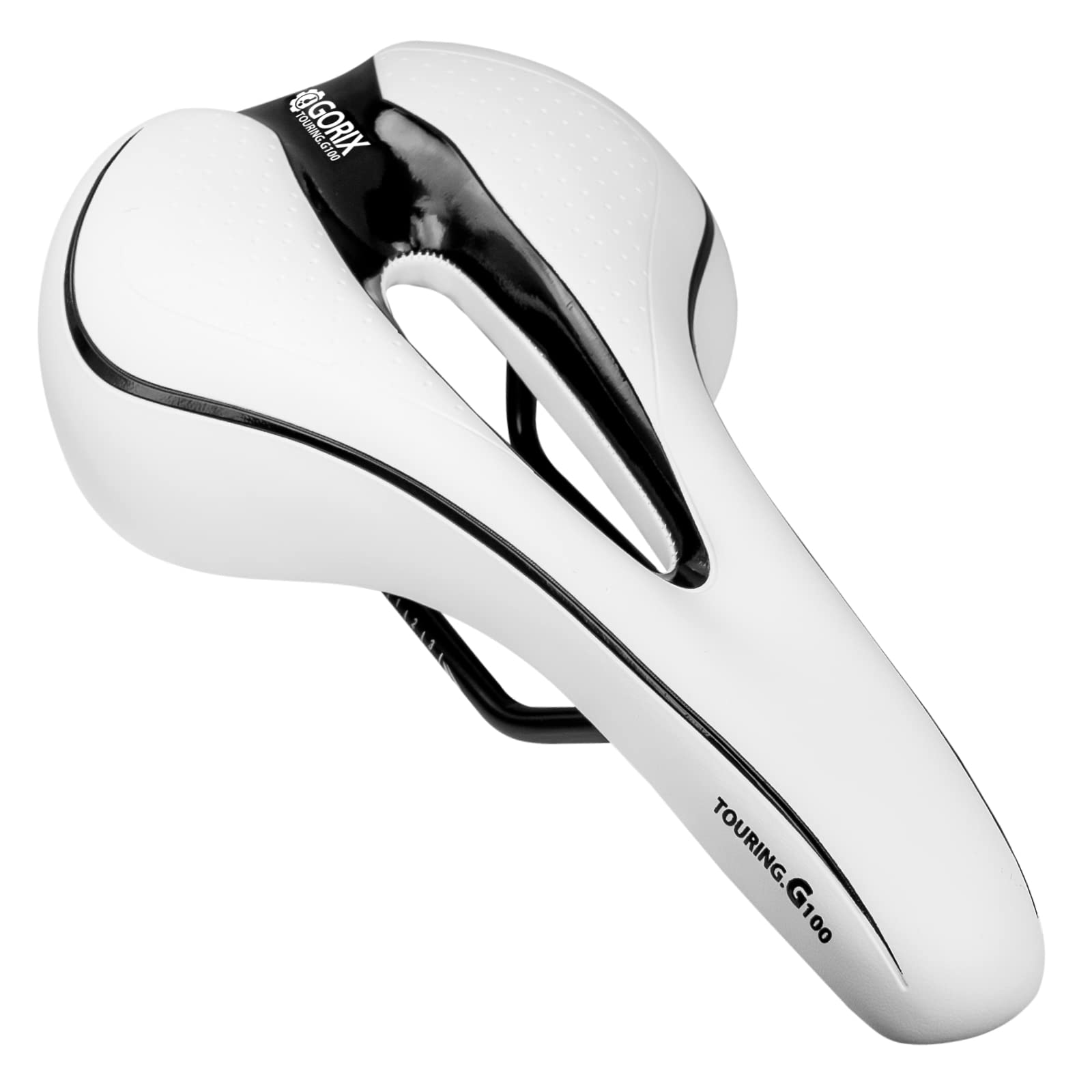
If you ride a hybrid or a road bike in a fairly upright position, start with this saddle. It measures 5.9 inches (150 mm) across the rear, giving your sit bones (the two bony contact points at the base of your pelvis) a broad platform. That means you are not balancing on an edge through the pedal stroke. The center cutout runs down the middle to take pressure off soft tissue and let air flow through on warm days.
Soft, thick foam sits under a PU leather and polyester cover that shrugs off road vibration rather than passing it straight up your spine. That comfort is what riders bring up far more than any other quality. It weighs 0.35 kg, which you feel on the climbs but barely notice on the flat. Setup is straightforward: the steel rails carry position markings, so you can nudge the saddle fore and aft to find the same spot again after a stem change.
The catch is the colour. The listed colourway is White×Black, and a run of riders find the white runs lighter or greyer than the photos suggest, so expect a two-tone look rather than a pure white top. That said, this is the crowd favourite — 4.5+ stars across 4,900+ ratings — and for the money it is the safest first saddle you can fit. Steel rails bolt into a standard seatpost clamp, and the vinyl-style cover wipes clean after a wet ride.
Why Riders Keep It
- 150 mm rear width gives broad sit-bone support
- Soft memory foam soaks up road buzz on long rides
- Center cutout relieves pressure and moves air through
- Marked rails make fore-aft setup repeatable
What To Expect
- White×Black colourway reads lighter than the photos
- 0.35 kg steel rail build is heavier than racy picks
- Thick foam softens pedalling feedback on hard efforts
The everyday pick: Ideal for commuters, hybrid riders, and anyone building a white bike on a sensible budget who wants comfort first.
Hold off if: You want a pure white top or a featherweight race saddle — this is a two-tone, foam-heavy build.
2. Charge Spoon Saddle
A race-shaped white saddle that punches well above its build for cross-country and road.
The Spoon is built for XC, enduro, and road racing, and that shows in the profile. It uses an anatomic shape — narrower and contoured so the saddle follows your body rather than sitting under it flat — with extra cushioning packed in to take the sting out of rough tarmac. At 9.12 ounces it sits firmly in the middle of the weight range, which is manageable whether you are racing on Sunday or training through the week.
what separates it from the GORIX is the rail material. Chromoly (a chrome-molybdenum steel alloy) rails are stiffer and tougher than basic steel, and they hold up to repeated clamp tightening without denting. The cover is a waterproof pad, so a surprise rain shower on the commute won’t soak through and leave you on a wet saddle the next morning — a real consideration for anyone running this saddle year-round.
The honest note is documentation: there are no published customer reviews on this listing, so you are buying on the spec sheet and the Charge name rather than a track record you can verify. That’s not a red flag on the saddle itself — the build is sound — but it means you should check the return window and see it fitted before committing to a full season of racing on it.
Profile that works: The anatomic, race-oriented shape and chromoly rails make it a natural choice for riders who are at home in a low, aggressive position.
Weigh up before ordering: With no review history posted, the Spoon asks for a bit more faith than the saddles above it — check the return policy first.
Reach for this if: You race XC or road and want a genuinely race-shaped white saddle with tough chromoly rails.
Look elsewhere if: You want published owner feedback to lean on before you spend.
3. Terry Cite Y Gel Bike Saddle
The saddle for riders who sit up and take in the view rather than tuck in and sprint.
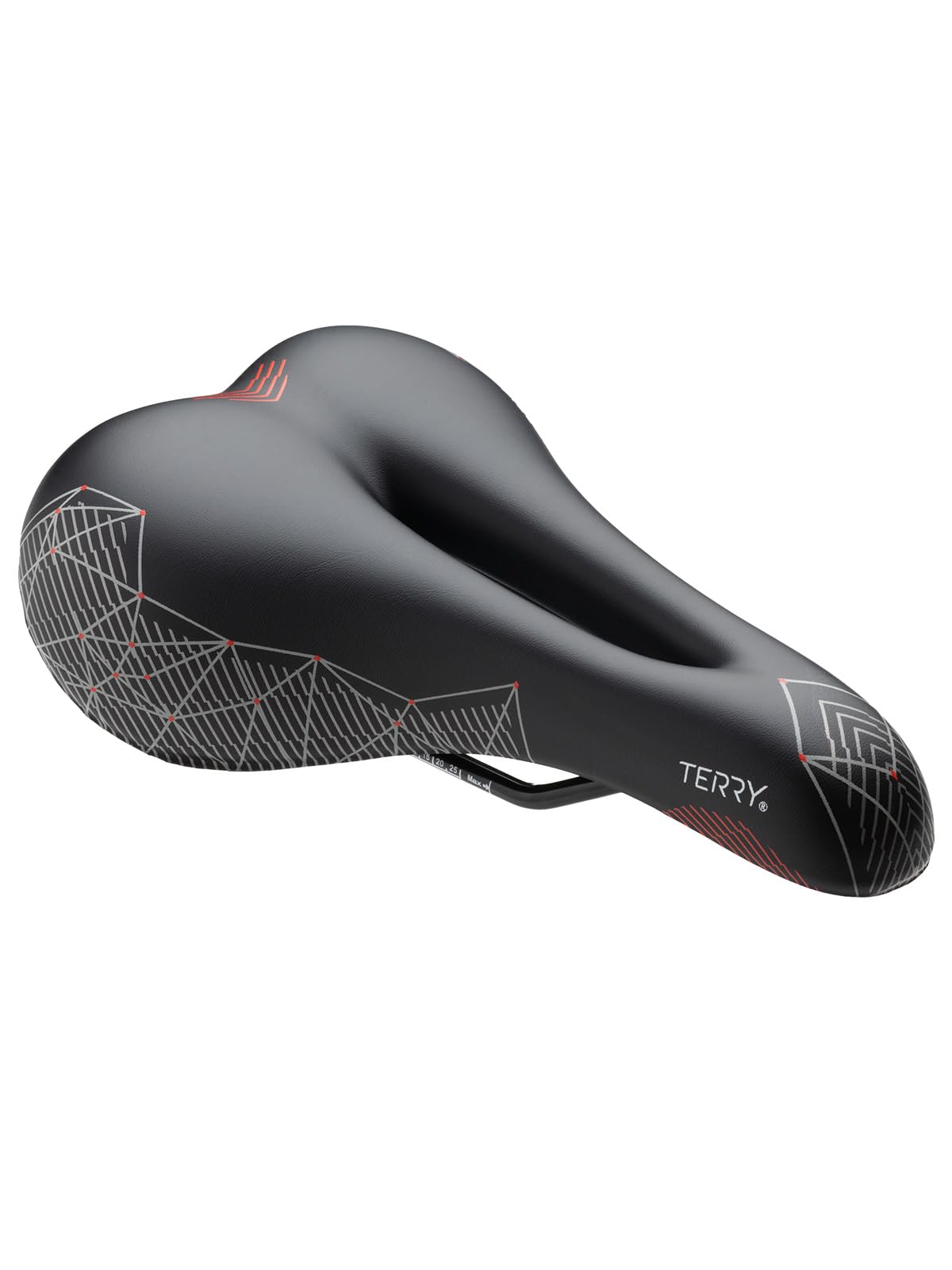
Terry cut this saddle completely away through the nose and mid-section, so there is no shell material pressing on soft tissue as you turn the pedals. The rear is wider than the brand’s other saddles, built for riders who are in a more upright riding position — the sort of posture you’d hold on a relaxed road bike or a half-day recreational ride rather than a race tuck.
The construction is a foam base with an added gel layer for shock absorption, wrapped in a synthetic vinyl cover with a screen-printed graphic treatment. Vinyl is easy to wipe down, and the build is designed to look new for years rather than fade into a grey mess. At 6.08 ounces it is lighter than the Charge Spoon’s 9.12 ounces — a meaningful difference in the sort of saddle that mostly sits under you rather than turning with your effort.
The trade-off is firmness. Several riders find it harder under the sit bones than they expected from a gel saddle, so if you want deep pillow-soft cushioning this is not it. Bear in mind too that the listed colourway is Prism Red, so if a true white top is a hard requirement, confirm the exact colour you are ordering before you fit it.
Comfort where it counts: The full-length cutaway and gel layer handle the pressure-relief job that matters on half-day recreational rides.
Firmness warning: It reads firmer than a gel label implies, and you should check the colour name before a white build.
Best suited to: Recreational riders who spend a half day or less in the saddle and want the cutaway to do the pressure work.
Think twice if: You want a soft, deeply padded perch or a guaranteed pure white top.
4. Selle SMP Extra Cycling Saddle

A white road saddle built for riders who put in the long miles and feel every pressure point.
The Extra is a proper road saddle — steel rails, soft polyurethane padding, and a shell made from nylon 12 filled with carbon fiber. That shell construction is the interesting part: adding carbon fiber to nylon gives a stiffer, lighter platform than plain plastic, so the saddle flexes predictably rather than squirming under you on a hard effort. It measures 275 x 140 mm (length x width) at 395 grams, and the rear width is a touch narrower than the GORIX’s 150 mm, which suits a more forward-leaning road position.
Where it separates itself is pressure control. The anatomic central cutout is designed to relieve pressure on the sensitive areas, and comfort is far and away the quality riders bring up — a saddle you can ride all day on without the numbness that sends most people saddle-shopping in the first place. The cover is an SVT synthetic (SMP’s own vacuum-bonded finish), and the steel rails fit most standard seatposts without a special clamp.
Two small footnotes. Adjustment gets mixed reviews — there’s a balance for fore-aft position that some riders take a few rides to find — and durability is generally fine but not unanimous. Neither is a reason to walk away; it’s a reason to spend ten minutes dialling in the setup properly rather than bolting it on and riding.
What Makes It A Long-Ride Saddle
- Central cutout built around pressure relief
- Carbon-fiber-filled nylon shell gives a stiff, stable platform
- 275 x 140 mm footprint suits a road riding position
- Steel rails fit most seatpost clamps without extras
Worth Knowing Up Front
- Fore-aft adjustment takes some patience to dial in
- Durability feedback is mixed rather than unanimous
- 395 grams is heavier than the race-focused picks
Choose this when: You do serious road mileage and want the central cutout and stiff shell working for you on long efforts.
The one catch: Plan on spending time dialling in the fore-aft position before the saddle feels right.
5. Fizik Arione R1 Saddle

A featherweight racing saddle designed for riders who can fold forward and hold it.
Fizik builds this one specifically for the Snake — the flexible rider who stays low and stretched out, rather than sitting upright. The flat, long profile supports that aggressive position, and it weighs 6.56 ounces, lighter than the Charge Spoon’s 9.12 ounces, so a full-season racer gets a real weight saving under the saddle. The cover is thermo-welded black Microtex, and the colourway of the version here is white.
Two construction details do the real work. Wing Flex technology engineers flexibility along the saddle edges where your inner thighs contact the surface, so your legs can move through the full pedal stroke without rubbing against a rigid edge. The shell is a high-strength composite glass with co-injected nylon, which keeps it stiff without the weight of an all-steel build. K:ium rails, a particular metal alloy, hold the whole thing to your seatpost.
The obvious caveat: this saddle bends you forward, so if your bars are high and your back is upright, the flat race profile will feel like sitting on a plank. Fizik designs for flexibility, and this one assumes it. It’s the kind of saddle that rewards a rider who has already found their position — a rider still adjusting shouldn’t start here.
Built for the low position: Wing Flex edges and the composite glass shell let the thighs move freely while keeping the platform stiff, and 6.56 ounces keeps it light.
Not for upright riders: The flat race profile wants a flexible back and a low bar position, or it feels hard and wrong.
Made for: Flexible road racers who hold a stretched-out position and want a light white saddle with flex at the edges.
Steer clear if: You ride upright or have not settled your fit yet — this shape assumes an aggressive posture.
6. Unistrengh Hollow Out Spider Seat Cushion
A breathable white saddle where airflow and low weight are the whole point.
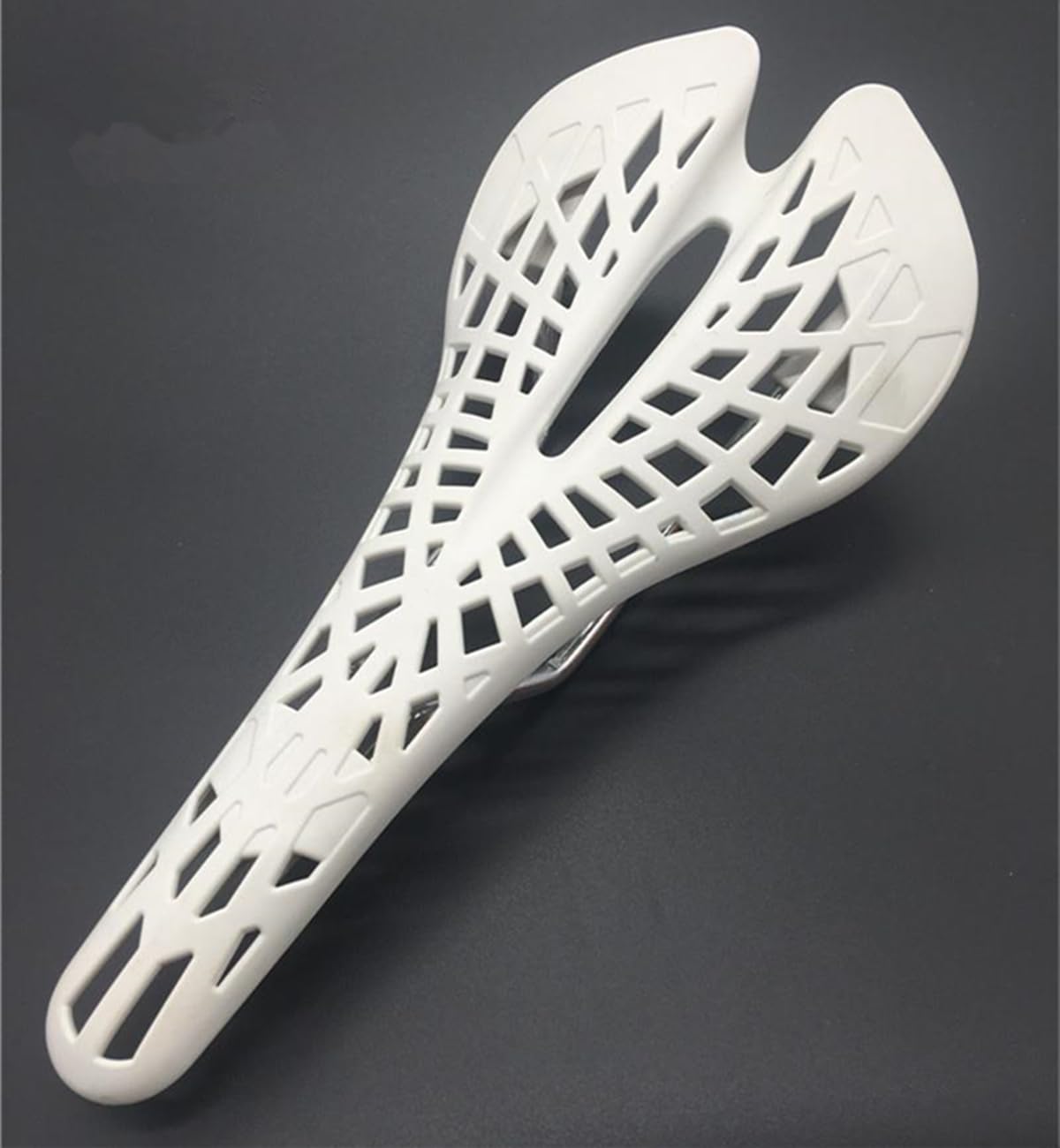
The twin-tail spider-web design runs 69 ventilation holes across the surface, so air moves through the saddle rather than trapping heat between you and the shell. The nose angles downward at 24 degrees to keep you forward on the saddle as you pedal. At 0.41 lb (185 g) it is the lightest build on this list, and that lightness is what riders notice first — the weight saving is real.
The material mix is modified plastic with chrome-plated steel bow rails, and the manufacturer claims the modified plastic improves flame retardancy, strength, and impact resistance. The overall footprint is 10.83 x 5.51 inches (27.5 x 14 cm) — slightly narrower than the GORIX’s 5.9 inches across the rear, and a touch longer at 10.83 inches versus 10.8. It’s built for mountain, road, and long-distance riding, and the super-cool look earns its own share of attention on a white bike.
Buyers will want to know the one significant thing: durability is the most-discussed issue on this saddle, and a number of buyers report it failing after a single ride. That’s a real caution for anyone planning daily use. There’s also no padded surface — this is a hard, breathable pad-free platform, so it is best treated as a short-ride or airflow-first choice rather than an all-day comfort saddle.
Airflow and low weight: 69 holes and 185 g make this the saddle for riders who overheat and want the lightest fit available here.
The honest catch: Durability is the recurring concern on this one, and the surface is unpadded, so it suits short and airflow-focused rides better than daily long miles.
Reach for this if: Airflow and a very low 185 g weight matter more to you than padding, and your rides are short to moderate.
Go elsewhere if: You want padding under your sit bones or need a saddle that can take daily punishment.
Know the Specs
Rear width and sit bone support
Rear width — the measurement across the widest part of the saddle — is the number that decides whether your sit bones land on the saddle or hang off it. The GORIX runs 150 mm and the Selle SMP runs 140 mm, and the difference tells you a lot: the wider saddle suits a more upright posture, the narrower one a more stretched-out road position. Measure your sit bones at a bike shop before choosing between the two.
Center cutout and pressure relief
A central cutout is the channel or full slot down the middle of the saddle that removes material from the pressure-sensitive zone. A simple hole relieves pressure at the contact point; a full nose-to-mid cutaway, like the one on the Terry Cite, goes further and lets more airflow through. If numbness is why you are saddle-shopping, this is the feature to prioritise over padding thickness every time.
Rail material and weight
Saddle rails are the two metal bars that clamp into your seatpost. Steel rails are durable and cheap; chromoly rails are tougher and stiffer; K:ium is a lighter alloy used on race saddles. Rail material is where most of the weight difference comes from, and lighter rails are not automatically better — they flex more and cost more. Match the rail to whether you race or commute.
Padding density versus firmness
Padding is foam, gel, or both, layered under the cover to absorb vibration. Thick memory foam softens the ride on short trips but compresses on long ones, while a firmer gel-and-foam build like the Terry holds its shape better across a half-day ride. A firmer gel-and-foam build like the Terry holds its shape better past the first hour, once your sit bones settle in.
Common Questions
Will a white road bike saddle fit my existing seatpost?
Is a center cutout better than a padded saddle for numbness?
How do I measure my sit bones for a road saddle?
Why does the “white” saddle arrive looking cream or grey?
Is a lighter saddle actually worth it on a road bike?
Can I use a road saddle on a mountain bike?
How long should a white saddle cover last?
Do I need gel padding on a road saddle?
Why does my new saddle feel hard at first?
The Bottom Line
For most riders, the white road bike saddle winner is the GORIX GX-C19 because it pairs a 150 mm rear width and a center cutout with memory foam that takes the sting out of long tarmac — the sort of build that suits commuters and hybrid riders without asking for a race fit. If you want a genuinely race-shaped saddle with chromoly rails, grab the Charge Spoon. And for long road miles where pressure relief matters most, the Selle SMP Extra is the one to reach for.
If you are still undecided, start with the rear width and cutout that match your riding position, not the one that looks best on the shelf. A saddle only works if its rear width matches your sit bones; the white top is the easy part.
How we choose
We do not accept paid placement. Every pick is matched to a real buyer and a real use-case; we do not hands-on test units.
Sources
Specifications: manufacturer listings and product documentation. Review insights: verified customer reviews, as of November 2026. Pricing: not shown on this page (it changes often); check the current price via the retailer link.
As an Amazon Associate, Tactical Gear Guy earns from qualifying purchases. This does not affect which products we feature.