Specs are compiled from manufacturer listings and verified buyer reviews and can change over time — please confirm the key details on the product page before buying.
You can buy a well-built ramp and still fight it every single day, because a van ramp lives or dies on one thing: whether its length matches your step height. Get that wrong and the incline turns steep enough that loading a chair becomes a two-person job. Get it right and a chair rolls up with almost no effort. The quieter trap is width and weight — a ramp wide enough for a chair often turns out to be a piece you cannot lift into the back of the van by yourself. One honest note before you read on: this list uses flexible matching around the capacity standard that matters here, which for a wheelchair plus its occupant is 600 lb or higher. Not every pick is the exact number or size you typed into the search bar. The nearest same-type ramp that serves the same job earns its place instead.
This guide is built by comparing the manufacturers’ published specifications and the patterns across verified customer reviews, so you get each pick’s real strengths and trade-offs instead of marketing spin.
What follows separates the folding workhorses from the telescoping travel pieces, with the real length, weight and load numbers laid out side by side so you can match one to your own van.
Two numbers decide whether a wheelchair ramp for van works for you: the ramp length that matches your step height, and the folded weight you can actually lift. Check both before you buy.
Top Picks


How To Choose The Best Wheelchair Ramp for Van
Most van ramp mistakes are made before anyone touches the wheelchair. You measure the wrong height, or you never measure at all, and then the ramp arrives and the angle is wrong. Start with the number the manufacturer of your van actually expects you to use.
Measure the rise, not the step
The number that matters is the total height the ramp has to climb from the ground to the van floor or tailgate. Measure that vertical drop with the van parked on level ground. If your van sits on a sloped driveway, measure where you will really be loading.
Then check the ramp’s own length guidance against that figure. FACHNUO’s 8FT ramp, for example, is built for rises of 8 to 24 inches, and the maker advises against any ramp shorter than four times your step height. That ratio is why a longer ramp feels easier: the same rise spread over more length gives you a gentler slope, so a chair needs less push to get up it.
The trade-off is space and weight. A longer ramp is harder to store and heavier to carry into the van, so the real skill is finding the shortest ramp that still clears your rise comfortably.
Decide how the ramp will live in your van
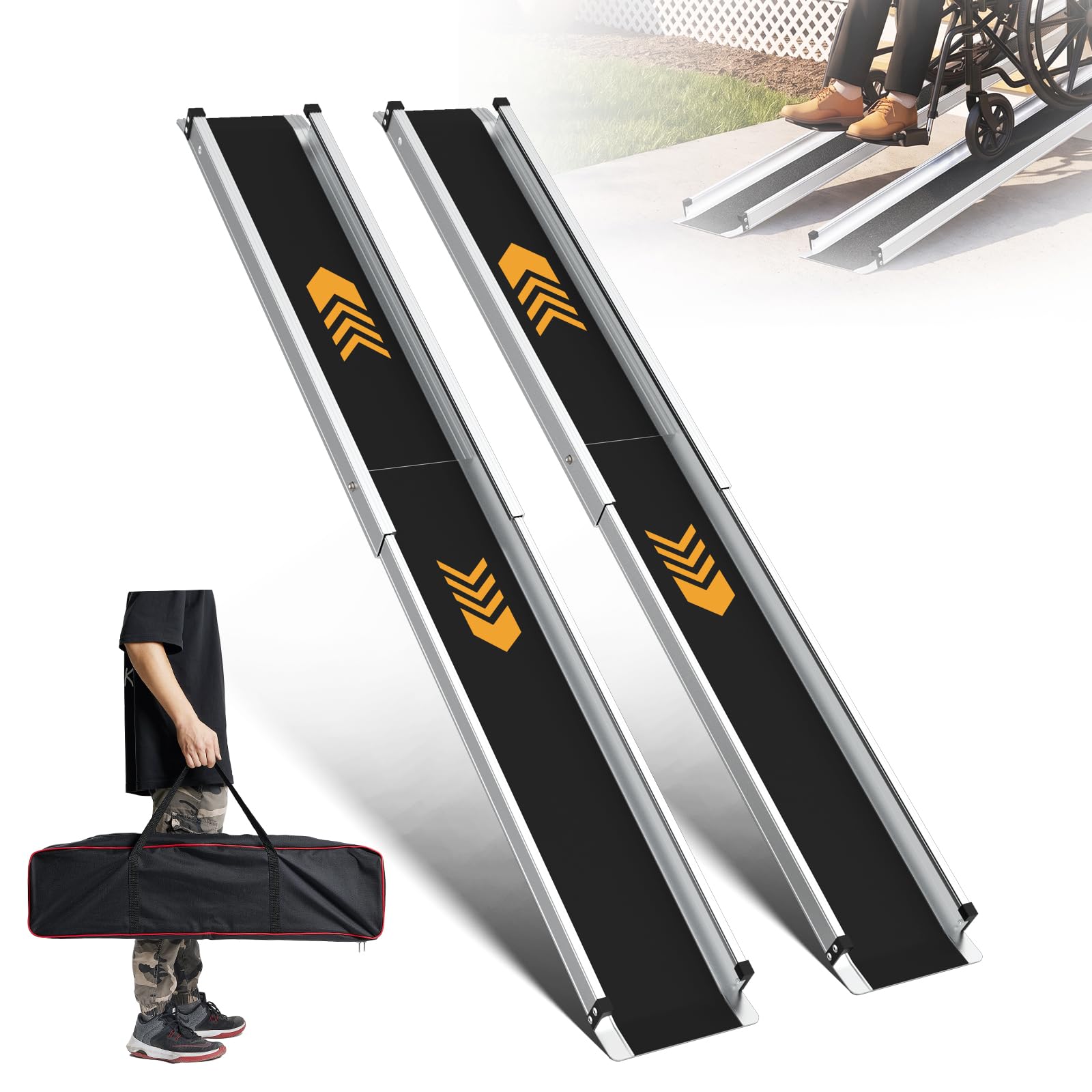
A ramp you load into the back of the van every trip needs a different design than a ramp that stays parked at your front door. Telescoping ramps collapse down like a collapsing ladder and come with a carry bag, which suits a ramp that rides in the back of the van daily. Foldable ramps fold once or twice and carry by a handle like a suitcase, which suits a ramp that gets moved between the house and the vehicle.
Trifold designs fold into three panels and can split into two lighter halves, which is worth knowing when the ramp has to be lifted into a minivan or SUV without help.
Check weight capacity and the ramp’s own weight together
Capacity is the load the ramp carries — the wheelchair plus the person in it. Ramps for a wheelchair and occupant start at 600 lb in this category, and some go to 800 lb. That number is the safety floor; do not go under it for an occupied chair.
The second number is how much the ramp itself weighs. A heavy ramp feels stable but is a chore to position every morning. A light ramp is easy to move but may flex under load, which is normal for aluminum and is noted as such on several of these listings.
Look at the edges and the surface
Side rails or baffles keep the wheels from rolling off the edge, and raised rails matter more on a ramp you use in bad light. A slip-resistant deck — usually a textured or punched-hole surface — gives the tires grip in the rain. Reflective strips and transition plates that sit flat against the ground are small touches that make the entry and exit less abrupt.
Side-by-Side Comparison
| Model | Best For | Length | Load Capacity | Weight | Amazon |
|---|---|---|---|---|---|
| FACHNUO 8FT Portable Wheelchair Ramp with Support Legs★ Best Overall | Best overall daily van and stair access | 96″ | 800 pounds | 52 pounds | Amazon |
| KOLOTOOL 5FT Telescoping Aluminum Ramp with BagBest for Travel | Travel and quick vehicle loading | Extends from 35″ to 60″ | 600 pounds | 16 lbs (2-pack) | Amazon |
| Gardhom 7FT Telescoping Wheelchair RampLightest Folding Pick | Light, storable telescoping option | 7 feet | 600 pounds | 17.6 pounds | Amazon |
| Titan Ramps 4′ to 7′ Telescoping Ramp with Bag | Adjustable reach for recumbent trikes | Extends from 4 feet to 7 feet | 600 pounds | 20 pounds | Amazon |
| Mkbve Portable Aluminum Ramp 6FT | High-capacity bifold van entry | 72″ | 800 pounds | — | Amazon |
| Ruedamann 10FT Telescopic Wheelchair Ramp | Long gentle incline for higher steps | 120″ | 600 pounds | 36.8 pounds | Amazon |
| TRIBLE SIX 10FT Foldable Aluminum Ramp | Folding 10-footer for home entrances | 120″ | 600 pounds | 66 pounds | Amazon |
| Prairie View Multifold Reach Ramp | Wide-platform multifold for vehicles | 120″ (folds to 50 3/4″) | 800 lb | 52 pounds | Amazon |
| EZ-ACCESS SUITCASE Trifold Ramp 8-Ft | Power chair and scooter van loading | 96″ | 800 pounds | 62 pounds | Amazon |
| MAASTERS Aluminum Wheelchair Ramp 12 Feet | Longest foldable reach for high vehicles | 146.46″ | 600 pounds | 93.3 pounds | Amazon |
Detailed Reviews
1. FACHNUO 8FT Portable Wheelchair Ramp
Our pick — 4.5+★ from 1,500+ verified ratings; the strongest balance of quality and price.
The eight-footer that carries more load than almost anything here — and tells you exactly what rise it clears.
Start with the number that settles most van-ramp arguments: this one holds up to 800 pounds, which is the load the ramp carries — chair plus person. That puts it above the 600-pound rating that two big names here, the Gardhom 7FT and the Ruedamann 10FT, both stop at. It measures 96 inches long when unfolded, so it spans a rise the maker lists at 8 to 24 inches. The brand’s own sizing guidance is worth repeating: do not pick a ramp shorter than four times the height of your step. Spread an 11.25-inch rise across this length and the chair goes up without a hard shove — buyers report it working well at exactly that height.
The folding is where it earns its keep day to day. It collapses to a 48″ x 14.5″ x 6.3″ bundle with a handle like a suitcase, so it drops into the back of the van and comes out with one hand. Both sides carry baffles (raised side walls that stop a wheel sliding off the edge) plus reflective strips, which matter for an evening return. The top and bottom edges have extended guide rails so the deck sits flush with the ground instead of kicking up.
The honest catch is the 52-pound weight. You lift 52 pounds of aluminum, and that is not a one-handed job for everyone. For van use, that means this is a ramp you set up and leave in place, not one you throw in and out at every stop. The surface is a double non-slip deck with a pleated pattern, so wheels and feet keep their grip in wet weather. The maker notes that a long ramp can sink slightly during use and rebound right after — that is normal for aluminum, not a defect.
Where it pulls ahead
- 800-pound capacity beats the 600-pound rating on the Gardhom and Ruedamann picks
- 96-inch deck with a stated 8-to-24-inch rise range answers the sizing question up front
- Reflective strips and side baffles make it usable after dark
- Suitcase handle and 48-inch fold make van storage simple
The daily reality
- 52 pounds is real lifting weight — plan on a semi-permanent spot for it
- Long aluminum decks flex a little under load, which is normal and springs back
Go this way if: you want one ramp that handles a van tailgate and a set of home steps with capacity to spare.
Think twice if: you need to stow the ramp inside the van on every single trip — a telescoping pick will serve that better.
2. 5FT Telescoping Aluminum Portable Wheelchair Ramp
It shrinks to a bundle light enough to sling in the back of the van and forget about.
This ramp is built to stretch out and collapse back down. It runs from 35 inches out to 60 inches, so it covers short rises and longer ones. At 16 lbs for the pair, you can carry it in one hand while steering a chair with the other. The load rating is 600 pounds, enough for a heavy manual chair plus a rider. One thing KOLOTOOL states plainly: this ramp is for manual wheelchairs, not power chairs or scooters. That single detail decides who should buy it as much as any spec.
For van duty, the practical win is storage. Owners mention it slipping into the back of a van with room to spare, and the included bag keeps the wet deck away from your cargo. The setup needs no tools — press the lock, extend the sections, and it is ready. The surface is a triple anti-skid deck with a waterproof, rustproof finish, so a rainy loading is not a slip risk.
Where it needs care is stability on uneven ground. Some owners find the telescoping sections want to shift on soft or sloped surfaces, so set both pieces square before the chair goes up. The clean verdict: light, compact and genuinely portable, provided your van floor is at the lower end of the rise range and your chair is a manual.
The van-fit read: 60 inches of maximum reach pairs naturally with a low-rise van floor or a curb-height entrance, not a tall step van.
Capacity ceiling: 600 pounds and manual chairs only — a power chair needs a sturdier, longer frame than this.
The right buyer: someone loading a manual chair into a vehicle who wants the ramp to live in the trunk without a second thought.
Look elsewhere if: you drive a power chair or need to span a tall step — the 600-pound rating and 60-inch reach will not suit either.
3. 7FT Telescoping Portable Wheelchair Ramp with Carrying Case
Four extra feet of telescoping reach than the KOLOTOOL, and still light enough to carry alone.
Here is the clearest weight-versus-length trade in the whole category. This Gardhom ramp is 17.6 pounds; the FACHNUO 8FT is 52 pounds. That is a 3.0x gap in carry weight, and it is the difference between a ramp that can be moved between vehicles and one that stays put. The length advantage over the KOLOTOOL is real too: 7 feet of telescoping reach instead of 60 inches maximum. Capacity stays at 600 pounds, so the weight saving does not drop you below the standard that matters for a chair and occupant.
For van use the adjustment is the point. The telescoping sections let you dial in the exact slope for a tailgate or a set of steps, and the black matte surface is anti-slip while also being rust-proof and water-resistant for damp loading areas. No assembly, no drilling — press the latch and it extends. The storage bag swallows it for the ride home.
As with any telescoping ramp, keep it to manual wheelchairs; powers chairs and scooters are not in its job description. Its overall rating is modest compared with the top pick, so treat it as a specialized travel tool rather than a permanent fixture you load on forever.
Pick it when: the ramp needs to travel — between two vehicles, or between the house and whoever is driving today.
Pass if: you want a ramp that stays anchored in one spot and never needs to be folded or extended again.
4. Titan Ramps 4′ to 7′ Telescoping Aluminum Wheelchair Ramp
A ramp that changes length for the job, so one purchase covers several loading points.
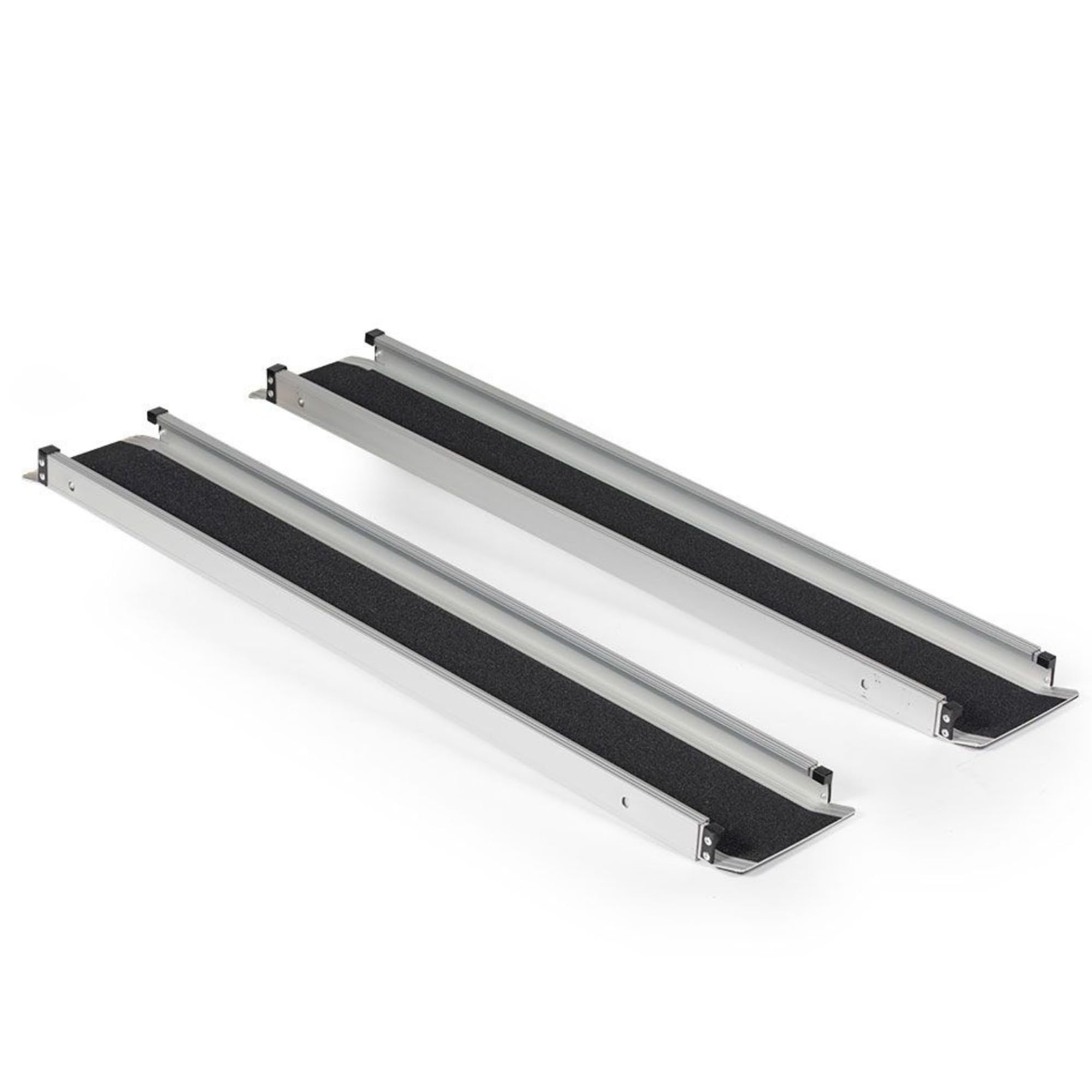
The spec worth knowing here is the adjustment range: it swings from 4 feet to 7 feet, and it does so without tools. The manufacturer markets that adjustability for rises and different environments, and the practicality is that a single ramp can handle a low van tailgate on one day and a taller set of steps the next. The load rating is 600 pounds, from a durable aluminum frame, and it folds into the included carrying bag.
The reviews back up the transport angle. Recumbent trike users get on with it well, and the folding-plus-bag setup is called out as good for storage and travel. It weighs 20 pounds — lighter than the FACHNUO by a wide margin, and light enough that lifting it into place is described as doable without much effort. The high-traction surface gives a firm grip going up and down in wet weather.
The nub of it is that telescoping adjustability comes with looser tolerances. Because it is built to telescope, some buyers find the track width a little narrower than they would like and want the deck to feel a touch more planted. It still holds its 600 pounds throughout, but if you load a wide power chair, give the width a hard look before committing.
Value in one line: 4′ to 7′ of reach, 600 pounds, a bag and a 1-year warranty — a practical middle rung on the ladder.
Worth it for: households with more than one loading spot, where the ramp has to adapt rather than sit in one place.
Skip if: your chair is unusually wide — the track wants accurate alignment at every setup.
5. Portable Aluminum Wheelchair Ramp 6FT
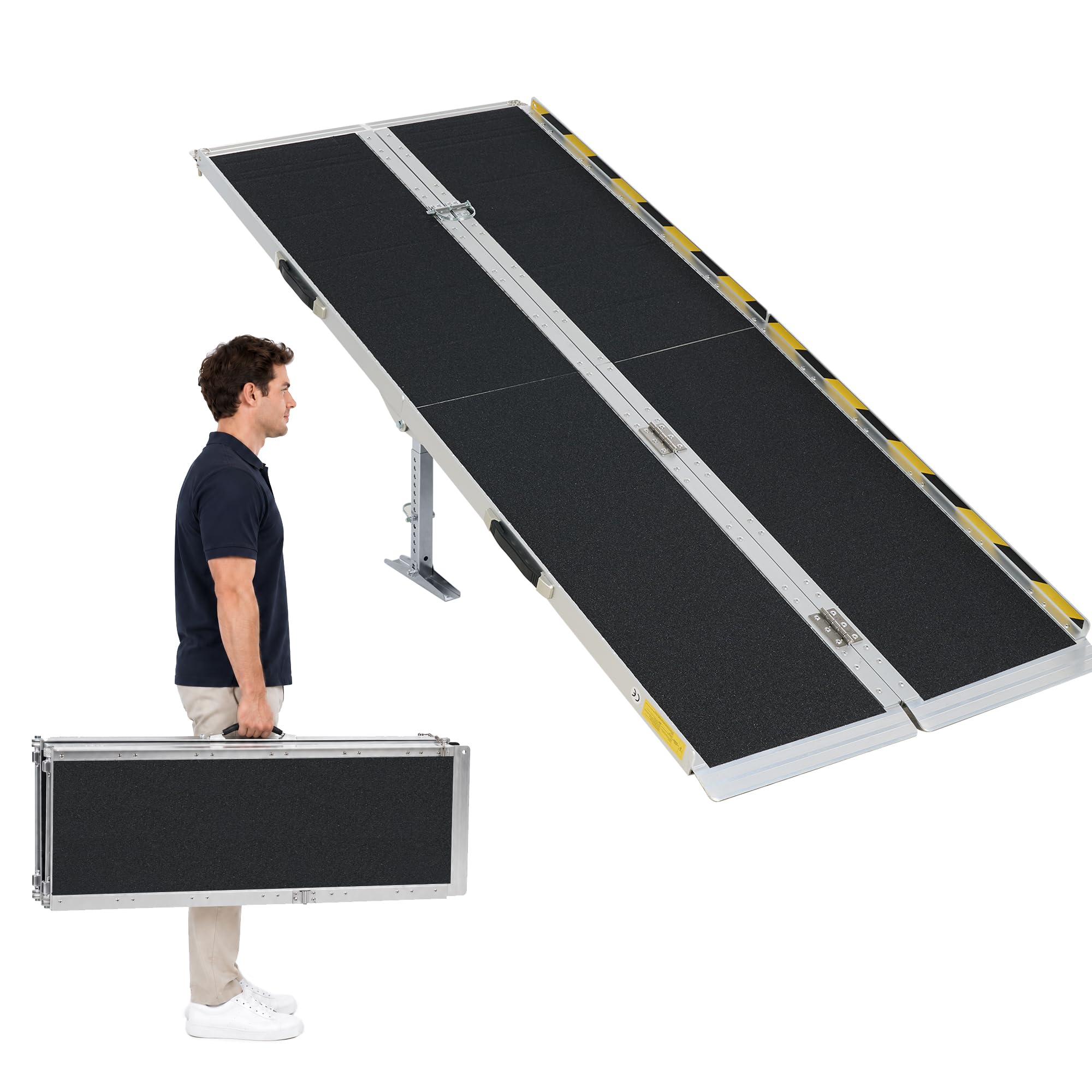
A bifold that folds like a book, carries 800 pounds, and can level itself on uneven ground.
The standout is the load rating: this Mkbve ramp holds 800 pounds, matching the FACHNUO and EZ-ACCESS and sitting above the 600-pound Titan and Gardhom designs. The construction is a premium aluminum alloy frame with reinforced rivets built to resist bending — not a casual claim at that rating. It measures 72 inches long, giving you a 6-foot deck to cover a van floor or a low set of steps.
Where it differs is the support leg. That adjustable leg (a strut you extend to prop up the ramp) stabilizes the deck on uneven surfaces and higher steps, so it does not sag or wobble over a threshold or curb. The deck itself has a non-skid textured surface for wet days, and yellow-and-black warning strips make the edges visible. Curved smooth edges let a wheel roll on and off without a bump.
The bifold design is genuinely easy to live with — it folds shut with a built-in handle, and a safety lock pin keeps it closed while it sits in the van. It is a newer listing with a modest review base, so you are buying on spec rather than a long track record. For a power chair, that 800-pound ceiling is the reassurance worth paying for.
The case for it: 800 pounds, an adjustable support leg and a compact bifold, all without tools or assembly.
The honest limit: a small review history means less owner feedback to gauge long-term wear.
Best matched to: power chair or heavier-user setups where that 800-pound ceiling and adjustable leg matter most.
Consider otherwise: if you want hundreds of reviews behind a choice, a longer-tracked pick gives you that comfort.
6. Ruedamann 10FT Telescopic Wheelchair Ramp

Ten feet of treadmill-flat incline for the van and the porch, split into two lifting halves.
This is the ramp for a rise that a shorter unit can only climb at an uncomfortably steep angle. At 120 inches long and 8.9 inches wide, it clears heights up to 30 inches, per the maker. It holds 600 pounds. The extra length is what flattens the slope — a long 10-foot run lets a chair go up on an easy angle instead of a hard one.
The safety details are stacked. The deck has a punched-hole surface (holes stamped through the aluminum) for traction and for draining rain, rubber pads to keep it from sliding, and 2-inch raised side rails that help keep a wheel from rolling off. Rounded edge caps protect hands and wheels. The three telescoping sections let you adjust length, and pins are included so you can fix it permanently after drilling into the floor.
The catch sits in the adjustability. Owners say the sections can be stubborn — some report pieces getting stuck while sliding — so give the joints a careful extension and keep the rails aligned before each use. Weighing 36.8 pounds, it is also a two-hands lift, even though it folds to 51 inches for transport. Set up well, it is one of the smoothest ramps for a van with a high floor.
Made for: a van or porch with a high step, where a longer, gentler incline genuinely changes the daily load.
Heads-up: the sliding sections need patience — extend them smoothly and check the lock points every time.
7. 10FT Foldable Aluminum Wheelchair Ramp

A single-piece 10-footer built for the steps outside your door, with a rise range spelled out for you.
TRIBLE SIX pitches this at steps 10 to 30 inches high, and it is best treated as a home-and-van hybrid. It measures 120 inches long and 28.3 inches wide unfolded, and folds down to 60″ x 14.28″ x 9.5″ with handles for moving. The rating is 600 pounds. The maker’s instruction to measure the cumulative height of the highest step — not a single step — is the detail that stops most sizing errors.
Functionality is what owners commend most consistently, and the foldable nature makes it easy to put away between uses. Both sides carry baffles and reflective warning stickers, and the deck has a non-skid layer over a folded aluminum surface for double grip. Transition plates at the top and bottom help the ramp sit flush on the ground so the chair rolls on without a jolt.
There is a hard boundary you should know: the listing says it is not for three-wheel equipment, so a three-wheel scooter needs a different ramp. At 66 pounds it is also a heavier piece, and a few customers note it feels like a two-person lift rather than a carry-in-one-hand setup. Used as a fixed home entrance ramp with the occasional van trip, it earns its keep.
Spec that decides it: 120 inches long and 28.3 inches wide with a stated 10-to-30-inch rise range and 600 pounds of capacity.
The one real limit: not suitable for three-wheel equipment, and 66 pounds wants careful lifting.
Suits: a front-entrance setup where the ramp leaves the house only occasionally for the van.
skip it if: your equipment has three wheels, which this ramp does not support.
8. Portable Multifold Reach Wheelchair Ramp, 52 Pound

A full 30-inch platform built for loading a chair into the back of a vehicle.
This Prairie View ramp is engineered around one job: getting an occupied chair or scooter into the rear of a vehicle. The load rating is 800 pounds, the deck is a full 30 inches wide for support and stability, and it folds down to 50 3/4″ x 16″ for storage. It separates into two sections to make each half easier to carry — that is likely where the 52-pound figure partly goes.
The rise figures are stated separately, which is unusually precise. For an occupied chair it is rated for 8 to 16 inches of rise; for unoccupied loading and unloading it is rated up to 24 inches. A patented center hinge removes a major pinch point, and the extended lip (the leading edge that rests on the vehicle) is designed to clear a bumper during loading. It is also listed as UL safety-tested for its capacity rating and carries a limited lifetime warranty.
Sturdiness is the quality buyers single out most. The recurring caveat is handling — it is a substantial piece, and setting it up can feel awkward compared with a telescoping unit. Treated as a dedicated vehicle-loading ramp, its width and bumper-clearing lip make van entry a one-person routine far more often.
What earns the platform
- 30-inch wide deck supports chair plus occupant with room to align
- Extended lip clears a bumper during rear loading
- Separates into two sections to ease carrying
- Limited lifetime warranty
Where you feel the trade
- 50 3/4-inch folded length is still bulky in tight vans
- Setup can feel awkward compared with a telescoping ramp
Reach for it if: you load a chair into a van or SUV tailgate and want a wide, bumper-clearing platform for it.
Look elsewhere if: your van has tight storage and a long folding piece will not fit — a telescoping design packs smaller.
9. EZ-ACCESS SUITCASE TRIFOLD Wheelchair Ramp

The trifold that folds up like a suitcase, splits in two, and carries 800 pounds for power chairs.
EZ-ACCESS leans hard into the travel piece. This 8-foot ramp folds into a suitcase-style bundle with built-in handles, and the trifold design splits into two lighter halves that fit into the back of most SUVs and minivans. It measures 96 inches long and 24 inches wide, and the aircraft-grade aluminum frame holds 800 pounds through repeated power chair and scooter traffic. That capacity ceiling matches the FACHNUO and Mkbve, well above the 600-pound Titan and Gardhom units.
The finer touches are what make it feel considered. An applied slip-resistant surface keeps grip in rain and snow, and the self-adjusting bottom transition plates conform to the ground so there is no gap at the base. It needs no tools or drilling to deploy, which suits a temporary install for guests as much as a permanent home entrance.
The honest cost here is the 62-pound handling weight. Owners agree the build is quality, and it is genuinely stable for a power chair, but it is a heavy piece to lift and maneuver — the weight is the recurring gripe. As a ramp that stays in the van for loading, its split-in-two design is what makes that weight manageable.
What makes it premium: 800 pounds, a split trifold and self-adjusting plates — details you buy for a power chair that gets loaded daily.
The pick for: a power chair or scooter that needs a broad, stable ramp you can break into two hauls.
Weigh the weight: at 62 pounds, this ramp rewards a plan — split it before you lift it, every time.
10. Aluminum Wheelchair Ramp 12 Feet – Loading Capacity 600 lbs
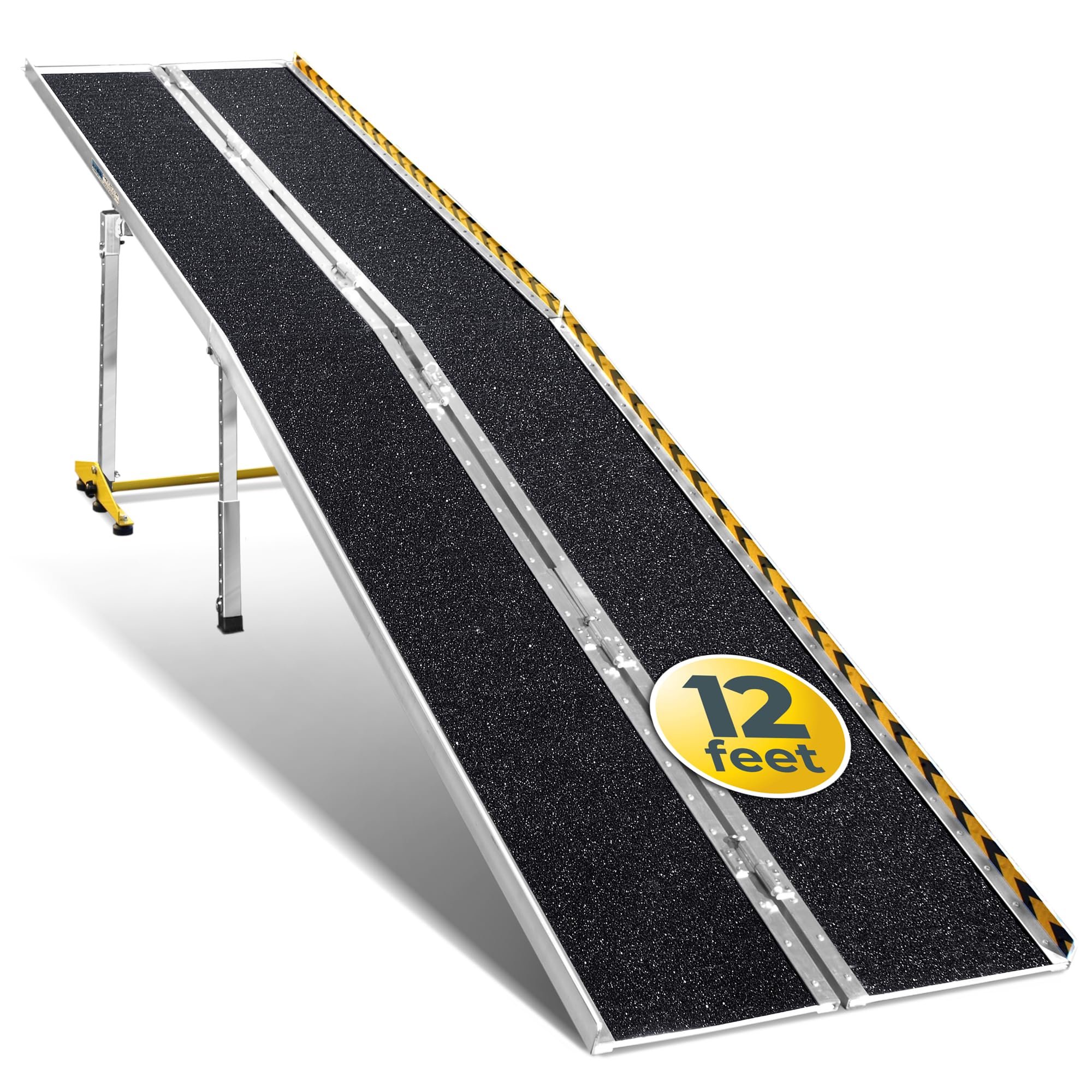
Twelve feet of gentle grade for the steepest van floor anyone has to conquer.
When the rise is tall and the deck has to stay nearly flat, length is the answer and this MAASTERS unit delivers the most of it here. It runs 146.46 inches long and 28.34 inches wide, and it is billed as ADA compliant to fit all wheelchairs, power chairs and mobility scooters. The rating is 600 pounds. A ramp the longest of the group spreads the same rise over more distance, which is what keeps a heavy chair rolling comfortably up the grade.
Safety gear is present and accounted for: anti-slip rubber, reflective warning strips, a non-skid surface, adjustable support legs and security pins. It breaks into 2 pieces with carrying handles for storage and transport. Ease of assembly is what owners praise most, and the makers also point to the pair of support legs that add stability under the heaviest devices.
Two limits are worth weighing honestly. It weighs 93.3 pounds, making it the heaviest pick here — this is a two-person or split-carry setup, not a one-hand load. And a few reviewers point out sturdiness falling short over time, so treat assembly and the support legs with care. As a fixed home or high-van access solution with the legs properly set, its length does the work that shorter ramps cannot.
Longest reach in the group: 146.46 inches for a near-flat climb, with an adjustable support leg to steady it.
Heaviest of the list: 93.3 pounds and some long-term durability reports make a steady install matter.
Choose it when: a short ramp makes the incline too steep and you can dedicate a long fixed run for home or high-van access.
Don’t choose it for: casual in-and-out of the van — the 93.3-pound weight is a serious lift for one person.
Know the Specs
Length and rise: the pairing that decides how hard the load feels
Ramp length is measured end to end, and rise is the vertical height the ramp must climb — the ground to the van floor or tailgate. The two have to be chosen together, because a long climb on a short ramp means a steep angle and more push to get up. That is why one maker advises against any ramp shorter than four times your step height. A 10-foot ramp like the Ruedamann is built to clear heights up to 30 inches, and the Prairie View unit states different rise ceilings for a loaded chair and for empty loading. Measure the total height first, then pick the length that keeps the slope gentle.
Load capacity versus the ramp’s own weight
Load capacity is the amount of weight the ramp is rated to hold — the wheelchair plus the person in it. Ramps for occupied chairs start at 600 pounds in this category, and several here go to 800. The ramp’s own weight is a separate number and it is what you feel every time you move it. A 17.6-pound telescoping pick and a 93.3-pound twelve-footer both carry the same purpose, yet they live very differently in your van. Match the capacity floor to your chair and occupant, then choose the lightest ramp you are comfortable handling — knowing that a heavier, wider ramp generally sits more solidly under load.
Common Questions
Will a wheelchair ramp fit my van if I don’t know the exact step height?
Is a 600 lb capacity enough for a wheelchair and its occupant?
Can I use a telescoping ramp for a power wheelchair or scooter?
How much does a van ramp weigh, and does a lighter ramp mean less capacity?
Can a folding ramp stay set up in the van, or does it have to be removed?
Will a three-wheel scooter work with these ramps?
Do the ramps have grip for wet or snowy weather?
Will a long aluminum ramp bend under load?
How do I keep a telescoping ramp from slipping or jamming?
Is a wider ramp better for loading a chair into a van?
The Bottom Line
The wheelchair ramp for van that gets the most people home safely is the FACHNUO 8FT Portable Wheelchair Ramp. It earns that spot on two numbers: 800 pounds of capacity and a 96-inch deck rated for an 8-to-24-inch rise. Those are the specs that decide whether a chair rolls up easily or fights you. It also folds to 48 inches with a suitcase handle, so it stores in the van without becoming a permanent fixture. If you need the ramp to live in the back of the van and shrink down between trips, the Gardhom 7FT Telescoping Ramp at 17.6 pounds is the travel-minded alternative. And for loading a power chair into a van tailgate, the Prairie View Multifold Reach Ramp gives you a 30-inch platform and a bumper-clearing lip built for exactly that job. Whichever you choose, start with the height you are actually climbing — a ramp that matches your rise turns loading from a chore into a routine.
How we choose
We do not accept paid placement. Every pick is matched to a real buyer and a real use-case; we do not hands-on test units.
Sources
Specifications: manufacturer listings and product documentation. Review insights: verified customer reviews, as of November 2026. Pricing: not shown on this page (it changes often); check the current price via the retailer link.
As an Amazon Associate, Tactical Gear Guy earns from qualifying purchases. This does not affect which products we feature.