Specs are compiled from manufacturer listings and verified buyer reviews and can change over time — please confirm the key details on the product page before buying.
If your games stutter and your downloads crawl while you pay for a fast plan, the cable between your router and your device is the cheapest fix you can make. A Cat 6 cable carries a full gigabit over 50 feet without dropping, while an underspecced cord caps your router at a fraction of what you pay for. Below are nine real cables sorted by what they actually deliver — from thin patch cords for a crowded rack to braided heavy-duty runs for a gaming desk.
This guide is built by comparing the manufacturers’ published specifications and the patterns across verified customer reviews, so you get each pick’s real strengths and trade-offs instead of marketing spin.
The category labels sound technical, but each one tells you something simple about speed and shielding. Keep reading and you will know exactly which wire for internet fits your setup.
Top Picks

How To Choose The Best Wire for Internet
You do not need the fanciest cable on the shelf. You need one whose speed rating clears your internet plan, whose length reaches your device cleanly, and whose shape fits where it has to go. Here is how the three main choices work in practice.
Match the category to your internet plan, not the marketing
The “Cat” number (short for Category, a rating system for cable construction) tells you the fastest signal the cable is built to carry. A Cat 6 cable moves data at up to 1,000 Mbps (1 Gigabit per second), which covers most home broadband plans with room to spare. A Cat 8 cable is built for 40 Gbps (40 Gigabits per second) over short runs, so it suits servers, data centers, and anything moving huge files between machines. If your plan tops out well below a gigabit, a Cat 6 will not slow you down.
Shielding: what the foil actually does
Shielded cable wraps the internal wires in metal foil or braid to block electromagnetic interference (EMI — stray electrical noise from nearby power lines and appliances). In an office with motors, fluorescent banks, or a bundle of cables running together, that shielding keeps your connection steady. In a quiet bedroom, an unshielded cable usually performs identically. Match the shielding to the environment, not to the spec sheet.
Length, shape, and gauge
Long runs lose a little signal, so buy the length you need and no more slack. Flat cables slide under carpets and along baseboards, while slim round cables bend easily into racks. The gauge number (AWG, written as a number like 28 AWG or 24 AWG) describes wire thickness — a lower number means thicker copper, and a higher number means a thinner, more flexible cable. Thin cables suit short patch runs; thicker copper holds signal better over longer distances.
Side-by-Side Comparison
| Model | Best For | Category | Speed Rating | Length | Amazon |
|---|---|---|---|---|---|
| Cable Matters 10Gbps Snagless Cat 6★ Best Overall | Everyday home and office runs | Cat 6 | 550 MHz | 50 ft | Amazon |
| TuokaJu Cat6A Shielded SlimSlim Shielded Pick | Tight conduit and behind-wall runs | Cat 6a | 10 Gbps / 550 MHz | 50 ft | Amazon |
| Sokqovt Cat6a Slim 24 PackCabinet Organizer | Neat patch-panel cabinets | Cat 6a | 10 Gbps / 550 MHz | 1 ft | Amazon |
| Papkolwe Cat 8 Flat | Outdoor and under-carpet routing | Cat 8 | 40 Gbps / 2000 MHz | 50 ft | Amazon |
| Amazon Basics RJ45 Cat-6 | Budget hookup for any room | Cat 6 | 1,000 Mbps / 250 MHz | 50 ft | Amazon |
| Lysymixs Cat6a Slim 24 Pack | Rack airflow in dense installs | Cat 6a | 10 Gbps | 1 ft | Amazon |
| Kxable Cat 7 SFTP | Gaming and 4K streaming setups | Cat 7 | 10 Gbps / 600 MHz | 50 ft | Amazon |
| Jadaol Cat6 Flat with Clips | Hiding cable against walls | Cat 6 | 10 Gbps / 250 MHz | 100 ft | Amazon |
| UGREEN Cat 8 Braided | Heavy-duty long gaming runs | Cat 8 | 40 Gbps / 2000 MHz | 50 ft | Amazon |
Detailed Reviews
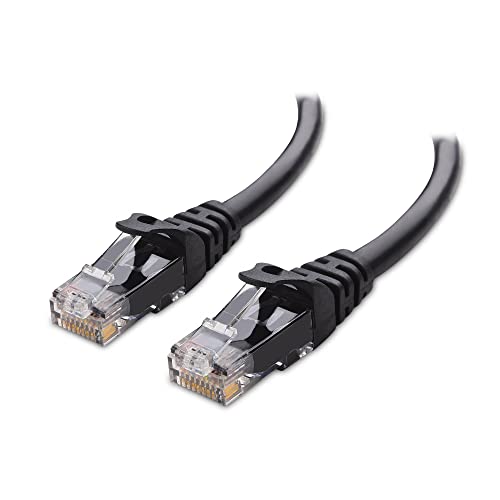
1. Cable Matters Cat 6 Ethernet Cable 50ft
Our pick — 4.5+★ from 19,000+ verified ratings; the strongest balance of quality and price.
Solid copper and strain relief for the run that has to survive daily plugging and unplugging.
The cable that wins people over is the build — 24 AWG bare copper conductors inside a round jacket, which is the thicker wire that holds signal strength across the full 50 feet. That matters when the cable disappears behind a cabinet and never gets touched again: you want the conductor to be copper, not an aluminium stand-in, because copper carries data with less resistance.
What you get on paper is 550 MHz of bandwidth and Cat 6 performance to the TIA/EIA 568-C.2 standard. In everyday terms this is more headroom than a typical home plan needs, so a 1-gigabit connection moves without the cable being the bottleneck. The gold-plated RJ45 contacts (the metal pins inside the plug) resist corrosion, and the strain-relief boots keep the connector from flexing where the wire meets the plug.
The honest catch is the round 6-ounce jacket — it is not a flat cable you can tuck against a baseboard in a thin sliver of space. If you need to run it under a carpet or through a tight door gap, a flat design serves you better. For a straight wall-to-desk run or a server closet, this one does the job without complaint. Buy the right gauge once and you never think about this cable again.
What earns its keep
- 24 AWG bare copper holds signal over the full 50 ft run
- 550 MHz bandwidth leaves headroom over gigabit home plans
- Gold-plated RJ45 contacts and strain-relief boots resist wear
- PoE, PoE+, and PoE++ support for cameras and access points
Where it asks a little patience
- Round 6-ounce jacket is bulkier to hide than a flat cable
- Overkill if your plan is far below gigabit speed
Go for this if: you want one dependable long cable for a desk, console, or server closet and you do not need to flatten it against a wall.
Look elsewhere if: your route needs to slip under a carpet or a narrow door gap, where a flat design is easier.
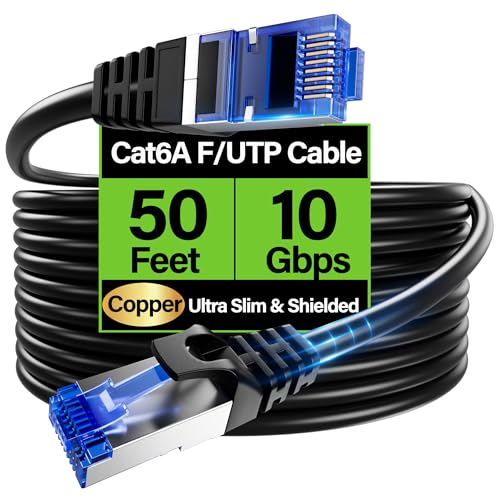
2. TuokaJu Cat6A Shielded 10Gbps 50 ft Slim Ethernet Cable
A 4.5mm diameter cable that bends where thick Cat6a will not go.
Here is the number that decides it: 4.5mm diameter. That is the outer thickness of this cable, and it lets you push it behind a wall, under a rug, or through a crowded conduit where a standard round Cat6a simply jams. The foil wrapping (F/UTP, meaning each pair is shielded from outside electrical noise) keeps the signal steady next to power lines and industrial gear.
Set this beside the Cable Matters up top and the trade-off is clear. The Cat 6a here is rated for 10 Gbps against the Cable Matters’ gigabit ceiling, and its 550 MHz matches the same frequency ceiling. The thinner 28 AWG wire is what makes it flexible at 50% more bendable than standard Cat6a. On a 50 ft run feeding a home office or a wifi 6 router, buyers report it “supports full 10Gbps speeds without issues” and praise the thin profile behind racks.
The thing to know is that thin 28 AWG wire is not built for the longest possible runs — it is a patch cable, and the shielding only earns its keep in noisy surroundings. In a spotless home office, an unshielded cable delivers the same result. Pure copper conductors do mean it supports PoE and PoE++ power for cameras and access points, so a single run feeds device and power together. Think of this as the cable you buy when the route is the hard part.
Fit over brute force: the slim jacket and snagless plug suit dense racks and tight wall cavities where a beefy round cable fights you every inch of the way.
The trade-off: thin is the whole point, so treat it as a patch run and let thicker copper handle marathon lengths.
Reach for this if: your run has to squeeze through a narrow space or sit beside electrical noise and you want 10 Gbps to reach the other end.
Pass on it if: you have a clean, open 50-foot route and could use a thicker conductor instead.
3. Sokqovt Cat6a Slim 1ft Patch Cables (24 Pack)
Twenty-four one-foot patch cords that turn a tangled network cabinet into something you can actually trace.
This is not a cable for reaching across a room — it is a cabinet refit. You get 24 identical 1 ft Cat6a patch cords in black, aimed at the short hop from patch panel to switch or from switch to server. Slim 28 AWG pure copper makes the 10 Gbps runs and supports PoE, and the tight, uniform length means your rack stops looking like a bird’s nest.
You can unplug it one-handed, even in a crowded rack. The easy-release tab (a clear plastic clip you press down) disconnects without a fight, which matters where your fingers barely fit. The clear ends pick up the green glow of the switch ports, so you can see which port a cable lands in from across the room. Its 28 AWG (the wire thickness) matches the TuokaJu’s gauge; by contrast, the Cable Matters runs a thicker 24 AWG for longer open runs. Different tools, different jobs.
Why rack builders like it: matching color and length across 24 cords makes a cabinet look deliberate, and the release tabs save real time during changes.
Where it stops: one foot is one foot, so these will not bridge a gap to a distant room or a router across the desk.
Built for: anyone wiring a patch panel, home lab, or small office cabinet who wants neat short runs in bulk.
Not your pick if: you need a single long cable to a desk or TV — buy one long cord instead.
4. Papkolwe Cat 8 Ethernet Cable 50 ft Flat
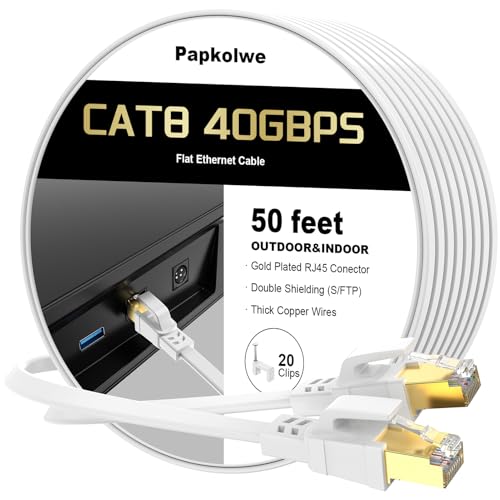
The flat outdoor-capable cable that takes full 40 Gbps where a round cord would snag.
Compare the speed spec here against the TuokaJu and the gap is wide: 40 Gbps and 2000 MHz from this Cat 8 against 10 Gbps and 550 MHz on the Cat 6a. That headroom suits someone moving big files between machines, running a NAS, or future-proofing a data run. The four shielded twisted pairs (S/FTP) and 24K gold-plated RJ45 plugs tamp down electromagnetic and radio interference, so the signal arrives clean.
The reason to choose it over a round cable is the flat jacket. It sits against a wall, slides under a carpet, and threads through a door gap without a bulge — so the cable disappears from view. The PVC cover is built to take direct sun, cold, and humidity, and it is rated for indoor and outdoor use. Free cable clips in the box help you pin the run down as you go.
The frank caveat is that Cat 8 speed only pays off on gear that can use it. A standard home router with a gigabit port will send the same signal through this as through a cheaper Cat 6. If you want the widest wire and the tidiest route, this delivers both.
Top of the stack for: outdoor runs, under-carpet routing, and anyone who wants maximum headroom in a cable that stays flat and out of sight.
Money better spent elsewhere if: your router tops out at gigabit — a Cat 6 cable of the same length moves your data just as fast.
5. Amazon Basics RJ45 Cat-6 Ethernet Patch Cable, 50 ft

The no-drama cable for the room that just needs a solid wired hookup.
You get steady speed without paying for a headline number. This Cat 6 carries data at up to 1,000 Mbps (1 Gigabit per second) over 50 feet, which is 10x faster than a Cat-5 cable at 100 Mbps — the same speed upgrade your router gives you over wifi. The difference is the delivery: wire holds the signal steady when the walls are thick and the wifi keeps flickering.
The gold-plated RJ45 connectors resist corrosion so the pins stay clean across the years, and the universal plug end fits routers, laptops, consoles, and printers alike. Owners mention the full 1,000 Mbps holding across the entire 50-foot run.
The reason it sells: the 250 MHz frequency and 1 Gbps ceiling cover the vast majority of home plans, and the build is plain and dependable.
What to expect: it is a standard round Cat 6, so it will not bend as tightly as a slim cord — plan your route with a little slack.
Pick this when: you want a straightforward cable for a bedroom, office, or living-room hookup and value reliability over exotic specs.
skip it if: you are wiring a 10 Gbps backbone or a data center — you want a higher-category cable for that.
6. Lysymixs Cat6a Slim Ethernet Patch Cable 24 Pack

Blue, slim, and built to let cool air move through a packed rack.
Twenty-four one-foot Cat6a patch cords in blue, each a 28 AWG bare-copper slim build. The headline claim is airflow: thin patch cables crowd the space in front of rack ports far less than fat ones, so the exhaust side of a dense switch breathes. Each cable is rated for applications up to 10 Gbps and meets the Fluke pass and ANSI TIA 568.2 D standards, which are the testing marks network pros look for.
Compare it with the Sokqovt pack and the shape is similar — both slim 28 AWG, both 1 ft, both tuned for short rack hops. Where this one leans in is the snagless clear plug with a strain-relief boot, plus the PoE support at 30 watt and 60 watt with a bundle of up to 12 cables. The clear boot lets you spot a lit PoE port through the plug, handy when tracing power on a camera feed.
One thing the listing is honest about: 28 AWG patch cables should not exceed 15 meters. That is a technical limit of the thin wire, so keep these for the cabinet and leave long runs to a thicker cord. Buyers describe them as half the thickness of a normal cable, and as working cleanly between switches and patch panels. This is the pick for someone who cares about a tidy, well-ventilated rack.
Best fit for: a dense switch or patch panel where slim cords keep ports visible and airflow clear.
Know before you buy: the 28 AWG wire has a 15-meter practical ceiling, so these are cabinet cables, not room-spanning ones.
7. Kxable Cat 7 Ethernet Cable 50FT, SFTP 10Gbps
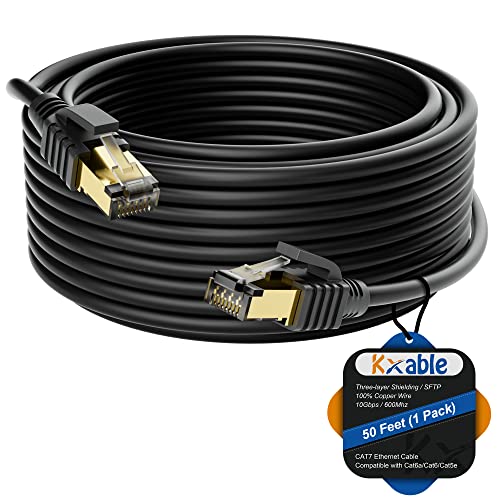
Triple shielding and 600 MHz for the gamer who wants every millisecond on their side.
The 600 MHz bandwidth is the standout figure here, sitting above the 550 MHz on the Cable Matters and TuokaJu Cat cables. Ten Gbps data moves at that frequency, and SFTP triple shielding wraps each pair in foil plus an overall foil and braided layer to push interference out of the signal. If your desk sits next to a powered speaker, a monitor, or a bundle of power cords, that extra barrier keeps the line clean.
The 26 AWG solid bare copper is the in-between option — thicker than the slim 28 AWG patch cords, thinner than the heaviest 24 AWG runs. That makes it supple enough to route and solid enough to protect the signal over 50 feet. Gold-plated FTP RJ45 plugs resist corrosion, and PoE, PoE+, and PoE++ support runs power to cameras and access points over the same cord. The manufacturer states the cable has been tested to the ANSI/TIA 568.2 standard with a DSX-8000 CableAnalyzer, and backs it with a one-year warranty.
The trade-off is weight and stiffness. A triple-shielded round cable is a touch heavier and less willing to turn a sharp corner than a slim cord. Customers note it fully supports 10 GB internet and holds up over time. For a high-performance gaming desk or a smart-home hub with a lot of nearby gear, that shielding earns its keep. Drop the shielding and you lose the 600 MHz rating that justifies a Cat 7 over a plain Cat 6.
The shielding angle: the 600 MHz rating and SFTP build are the point — buy it for a noisy, gadget-packed area, not a bare corner.
The trade-off: all that shielding makes the round cable a little heavier and firmer to route than a slim cord.
Choose it for: a gaming desk or media hub packed with electronics where clean signal matters most.
Overkill for: a quiet room with a single router, where a plain Cat 6 cable does the same job for less fuss.
8. Jadaol Cat6 Flat Ethernet Cable with Clips, 100 ft, White

The longest flat run in the lineup, designed to vanish against a wall.
You can wire a whole house with one run at 100 feet — from a router in one corner to a TV or gaming console across the way. The 250 MHz frequency (how much signal the cable can carry) supports up to 10 Gbps over Cat 6 UTP construction (unshielded twisted pairs), so a 4K stream and a game download run at once. The 30 AWG bare copper is the thinnest wire here, which is exactly what lets the flat jacket sit flush and slide under a carpet. Included clips let you pin the run in place.
The flat shape is why people reach for this one — it hides against a white wall and follows baseboards and corners without a bulge. Owners describe it as easy to conceal and easy to route, and the length is generous enough to reach across a house without splicing. Snagless RJ45 gold-plated plugs cover laptops, PCs, routers, and consoles. This cable slots neatly into an existing Cat 6 network, so it plays well with whatever gear you already own.
Two honest limits. First, 30 AWG is very thin wire, so over that full 100 feet it is happiest on a standard home plan rather than a 10 Gbps backbone. Second, a flat cable is less stiff than a round one, so avoid sharp kinks as you route it. If you need reach and neatness more than raw ceiling, this is the tidy long-run answer.
Go for it when: you need to reach across a home and want the cable to disappear along the wall, clips included.
Consider another cord if: you plan to push 10 Gbps over the full 100 feet — thin 30 AWG favors standard home speeds here.
9. UGREEN Cat 8 Ethernet Cable 50FT, Braided 40Gbps 2000MHz
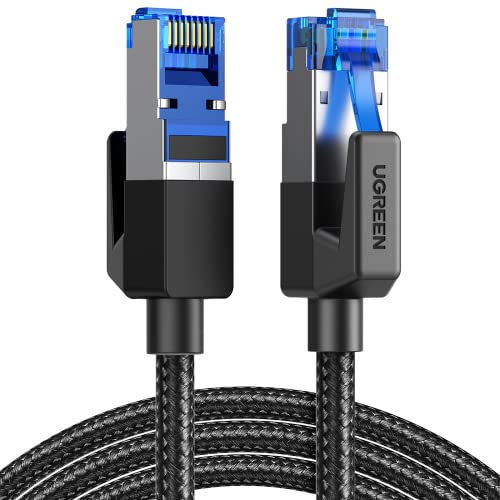
A cotton-braided Cat 8 cord built to survive being pulled, bent, and tugged.
Where the Papkolwe goes flat, this one goes armored. The cotton braided jacket makes the Lan cable stronger and more durable, and the manufacturer states it can be bent at least 10,000 times without breaking — a spec that matters if you game on a laptop and reposition cables constantly. Under the braid sit four shielded foiled twisted pairs (F/FTP, foil around each pair to block interference) and a pure copper core. Gold-plated RJ45 plugs (the standard internet connector) hold the signal clean at 40 Gbps and 2000 MHz.
Compare it to the thinner day-to-day cables and the 40 Gbps ceiling here is the top of the range, matched only by the Papkolwe on speed. The difference is the jacket and the fact that reviewers point out internet speeds improving from 120 Mbps to 320 Mbps once they switched to wire. That gain comes from swapping a weak wifi link for a direct copper run.
The catch is honest: 65 ft is called out in the listing as the exception to PoE support across the lengths, so if you plan to power a camera over this cord, check the length carefully. The braided jacket is also firmer than a slim cord and a little harder to fold into tight corners. Skimp on it and you get a flimsier cable; this is the buy for a long run that takes daily abuse.
The durability case: the braided cotton jacket and 10,000-bend rating make this the cable for a run that gets pulled and repositioned, not just plugged in once.
Worth a look: PoE works across most lengths but the 65 ft option is the stated exception, so confirm your length if powering a camera.
Reach for this if: you want a top-speed long cable that can handle being moved around and prefer a braided jacket over bare PVC.
Not the obvious call if: you want a flat cable to hide against a wall, where a slim or flat profile scores over toughness.
Know the Specs
Category rating (Cat 6, Cat 6a, Cat 7, Cat 8)
The Cat number is a certified construction standard that sets how fast a cable can carry data. Cat 6 is built to 1,000 Mbps at 250 MHz and suits most home plans. Cat 6a doubles the ceiling to 10 Gbps and often lists 550 MHz. Cat 7 pushes frequency to 600 MHz with heavier shielding, and Cat 8 leads the field at 40 Gbps and 2000 MHz on short runs. Higher is not automatically better for you — a faster category only helps if your router and devices can use it.
Wire gauge (AWG)
AWG stands for American Wire Gauge, and the number runs smaller as the copper gets thicker. A 24 AWG cable has a meatier conductor that holds signal better over long distances. A 28 AWG or 30 AWG cable is thin and flexible, ideal for crowded racks, tight corners, and patch runs — but thin wire has a practical distance cap, so keep it short where it counts.
Shielding (UTP, F/UTP, SFTP, F/FTP)
Unshielded twisted pair (UTP) has no metal barrier and is fine in a clean home. The shielded codes wrap those pairs in foil or braid to block interference from nearby electronics. F/UTP, SFTP, and F/FTP all add extra layers, and they pay off next to power lines, in data centers, or in a room packed with devices. In a quiet space, shielded cable works but the shielding goes unnoticed.
Frequency and speed together
Bandwidth in MHz is the width of the road, and the Gbps figure is the traffic that can flow down it. A 550 MHz cable rated at 10 Gbps carries high-speed data across the standard run. The two numbers should travel together in the listing — if one is missing, treat the speed claim with care. For a home plan under a gigabit, the frequency headroom matters less than the solid copper and good connectors.
Common Questions
Do I need a Cat 8 cable if my internet plan is gigabit?
Will a Cat 7 or Cat 8 cable work with an older Cat 5e router?
What does the AWG number mean on a network cable?
Does a shielded cable matter in a normal home?
Can I power a security camera over an Ethernet cable?
How long can a Cat 6a slim patch cable run?
Is flat cable as good as round cable for speed?
Why does a wired connection beat wifi for gaming?
Should I buy a 24 pack of short patch cables or one long one?
What does F/UTP or SFTP mean on a cable listing?
The Bottom Line
For most people, the strongest wire for internet pick is the Cable Matters 10Gbps Cat 6. Its 24 AWG copper and 550 MHz bandwidth hold a full signal over 50 feet, and the connectors are built to survive years of plugging. If your run has to squeeze through a tight wall or sit near electrical noise, reach for the shielded TuokaJu Cat6a Slim. And if you want to hide a long run against a wall with cable clips in the box, the flat Jadaol Cat6 100 ft is the tidy answer. Any of these three will outperform the wifi link you are fighting with right now.
How we choose
We do not accept paid placement. Every pick is matched to a real buyer and a real use-case; we do not hands-on test units.
Sources
Specifications: manufacturer listings and product documentation. Review insights: verified customer reviews, as of November 2026. Pricing: not shown on this page (it changes often); check the current price via the retailer link.
As an Amazon Associate, Tactical Gear Guy earns from qualifying purchases. This does not affect which products we feature.