Specs are compiled from manufacturer listings and verified buyer reviews and can change over time — please confirm the key details on the product page before buying.
You do not need a new water heater — you need it to stop reheating a full tank at 2 a.m. when nobody is awake. A timer switch sits between the breaker and the heater and cuts power during the hours your household never draws hot water, then restores it before the first shower. The picks below split into two families: mechanical and digital switches you wire in yourself on a 240-volt heater circuit, and smart controllers that install without any plumbing work at all. Which one you want depends on one thing — whether you are comfortable opening a breaker panel.
This guide is built by comparing the manufacturers’ published specifications and the patterns across verified customer reviews, so you get each pick’s real strengths and trade-offs instead of marketing spin.
Below you will find the honest ranking of the best water heater timer options, from simple dials to app-controlled units.
Top Picks


How To Choose The Best Water Heater Timer
The first decision has nothing to do with features. It is whether you are comfortable switching off a 240-volt breaker, testing the wires dead, and connecting a switch box. If yes, a hardwired timer is the cheaper and more direct route. If no, an app-controlled retrofit that clamps around the heater’s wiring or plugs into its control path is the only safe option, and you should have an electrician fit it.
Match the amp rating to your heater, never the other way round
A water heater timer is rated by how many amps it can carry continuously. A 30-amp heater on a 25-amp switch is a fire risk, while a 40-amp switch on a 20-amp heater is simply oversized and fine. Check the data plate on your heater’s side for its wattage and amperage before you buy anything. If your heater draws close to the switch’s limit, go up a tier rather than shaving the margin.
Decide how many on/off windows your day actually needs
Most households run two hot-water windows: a morning block and an evening block. A mechanical dial with a limited tab count can usually cover that. A digital programmer with dozens of events per week lets you skip weekends, handle shift work, or set a different Sunday schedule — but more programming means more to reset after an outage, so weigh that against how irregular your routine really is.
Ask what happens after a power cut
Blackouts wipe the clock on any timer without a backup. A unit with a rechargeable or replaceable backup keeps its schedule and resumes on its own; one without it needs a manual reset, which is the most common reason people quietly stop using a timer they installed. This single feature often decides whether a switch is still doing its job a year later.
Check the enclosure if the box lives outdoors or in a damp garage
A garage, utility closet, or exterior wall exposes the switch to humidity and temperature swings. Look for a metal casing, a lockable or raintight cover, and a stated operating range that covers your winters. A plastic housing with a loose lid will fog up and corrode its contacts faster than a sealed metal box.
Side-by-Side Comparison
| Model | Best For | Max Load | Programs | Voltage Range | Amazon |
|---|---|---|---|---|---|
| Intermatic WH21★ Best Overall | Straight swap for a failing dial timer | 25 amps / 6,250 W | Daily dial, single pole | 208–277V | Amazon |
| Intermatic EH10Premium Pick | Week-long scheduling with an override | Not stated | 42 ON/OFF events per week | 120V | Amazon |
| Aquanta Smart Water Heater TimerMost Connected | No-wiring retrofit on a storage heater | Not stated | Auto-scheduling, app driven | Not stated | Amazon |
| SURAIELEC 7-Day Digital Pool Timer | Budget 7-day scheduling outdoors | 40 amps | 7 ON/OFF settings | 120–277V | Amazon |
| BN-LINK Smart Wi-Fi Timer Box | Voice control from the couch | 40 amps | 30 settings | 120–277V | Amazon |
| DEWENWILS WiFi Smart Timer Box | Remote control with the strongest owner record | 40 amps / 2HP | 15 ON/OFF settings | 120–277V | Amazon |
| DEWENWILS 24-Hour Mechanical Switch | Set-and-forget simplicity | 40 amps / 2HP | 2 programs daily | 120V | Amazon |
| TORK TU40 | Fine 15-minute scheduling indoors or out | 40 amps | Multiple tabs, 15-min intervals | 120–277V | Amazon |
Detailed Reviews
1. Intermatic WH21 Electric Water Heater Timer
Our pick — 4.0+★ from 400+ verified ratings; the strongest balance of quality and price.
A single-pole steel-box switch rated 25 amps at 6,250 watts, built as a direct replacement for a standard heater dial timer.
If your old heater dial gave up and you want the same thing again, this is that part. The WH21 is a single-pole, single-throw switch — one set of contacts that makes or breaks the live wire to the heating element — rated for 25 amps at 6,250 watts on 208 to 277 volts. In plain terms, it fits the standard residential electric heater circuit and lets you program hot water for your high-use hours and shut it off for the quiet ones. The steel housing measures 5.25 inches wide and 6.75 inches high, so it slots onto the same knockout footprint many heaters already have.
What wins people over is the build. Quality is the most-praised theme by a wide margin, with around 90 mentions, and the second-largest theme is the drop in the power bill after scheduling. The practical translation is that the switch does exactly what a switch should: it respects the schedule and stops the element from cycling through the night. Durability splits: some units run for decades, others quit inside two years, and the warranty covers only one year. The warranty is one year.
The honest catch is the 25-amp ceiling. Compared with the 40-amp boxes elsewhere on this list, that headroom is narrower — so check your heater’s data plate first and do not assume the WH21 covers a larger element just because it is a known name. Compared with the SURAIELEC digital timer below, this one carries the same job with far less programming flexibility and no battery-backed clock, which is exactly why it is cheaper to own.
Where It Earns Its Keep
- 25 amps at 6,250 watts suits a standard residential electric element on 208–277V
- Steel housing at 5.25″ x 6.75″ fits a familiar wall footprint
- Quality is the most-praised theme by a wide margin, and the bill savings show up fast
- No app, no Wi-Fi, no pairing — it simply switches
Where It Asks Patience
- Longevity is mixed; some units last decades and others fail inside two years
- 25 amps is the lowest ceiling in this lineup, so verify your heater’s draw
- Single-pole design only switches one leg of the circuit
Reach for this if: you want a direct steel-box replacement on a standard electric heater and value simplicity over app control.
Look elsewhere if: your element draws more than 25 amps, in which case a 40-amp box is the safer fit.
2. Intermatic EH10 Electric Water Heater Time Switch
Program forty-two on/off events a week and never touch the dial again.
The number that matters here is 42. That is how many on/off events the EH10 can hold per week — a full seven-day schedule, each event timed to the minute, which is a completely different level of control from a dial that only knows “on at 6, off at 9.” If your household has a weekday rhythm and a weekend rhythm that look nothing alike, this is the switch that lets you express both. There is also an external override switch on the face, so when someone wants hot water outside the schedule they flick it instead of reprogramming anything.
Reliability is the theme that carries this unit — it is the most consistently praised trait, with installation close behind. Owners describe it as a workhorse, which matches a device designed to toil in a utility closet for years. The LED load indicator is a small but genuinely useful touch: a glance tells you whether the heater is drawing power right now, which saves a trip outside with a flashlight when the water runs cold.
Two things to know before you commit. First, this is a 120-volt unit, so if you are replacing a switch on a 240-volt heater circuit you need to confirm fitment rather than assume. Second, timer accuracy and programming both come in for mixed feedback — some find the schedule simple to set, others find it confusing, and there is a recurring note about settings drifting after power loss. Set it once, write your program down, and you will be fine.
Scheduling muscle: 42 events per week at to-the-minute accuracy is the finest control in this lineup, and the external override keeps it livable.
The thing to plan around: a 120-volt rating and settings that can slip after a blackout — document your program before you close the box.
Built for tinkerers: households with two distinct weekly routines that want every window spelled out.
Not for the impatient: if you would rather push tabs than key in times, the simpler options below will suit you better.
3. Aquanta Smart Water Heater Timer
It takes over the heater’s control path and schedules around your household’s hot-water use, so you never touch a switch.
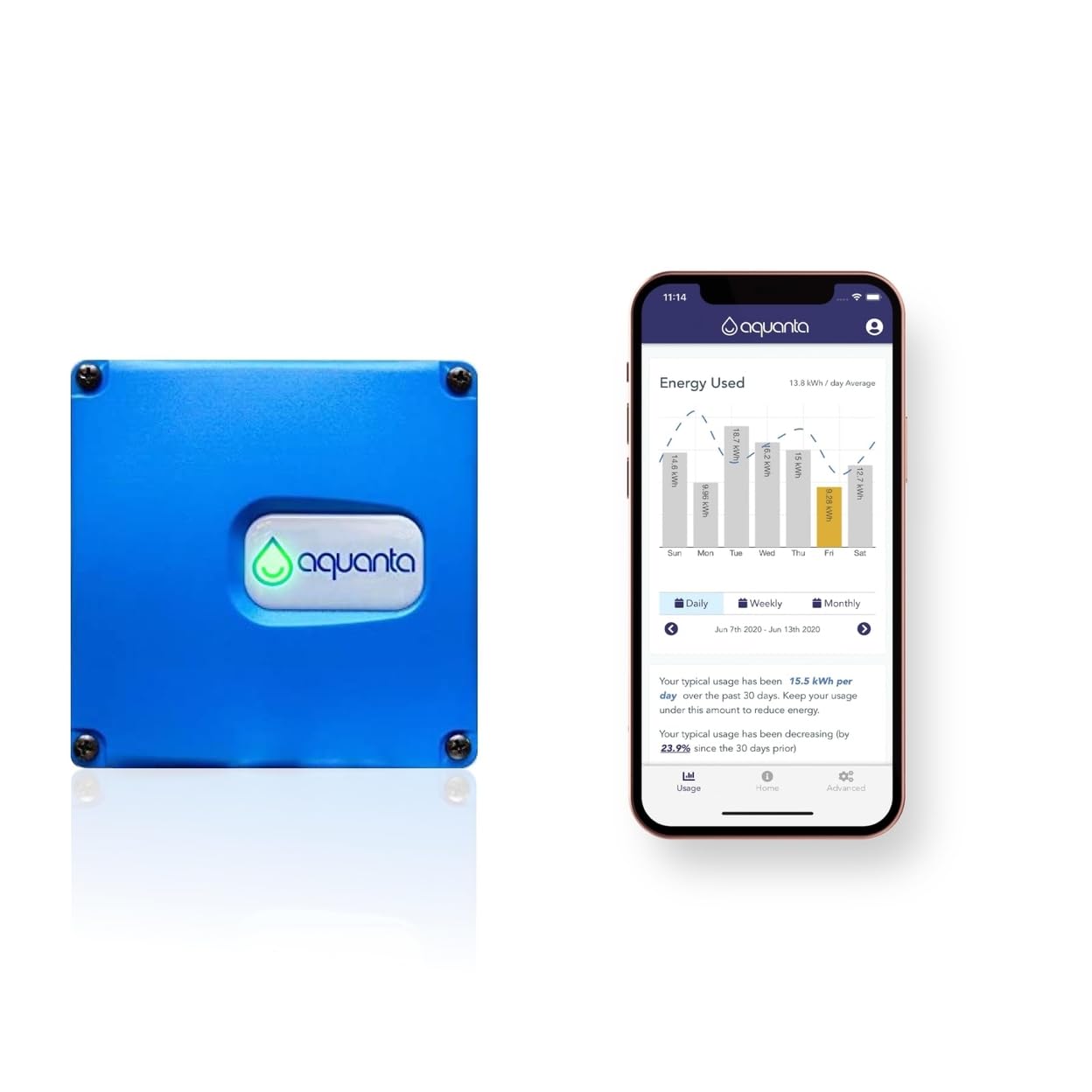
Every other pick on this page is a switch you wire into the heater’s power line. This one is not — it installs without any plumbing work, is UL safety certified, and works with most models of storage-style water heaters. That distinction matters enormously if you are not comfortable inside a breaker panel, because there is no 240-volt load passing through this device. Instead it takes over the heater’s control path and schedules from there, with the actual heating current handled by the heater’s own wiring.
What you get on top of scheduling is information. Hot water availability metering and tank temperature reporting tell you how much hot water is actually sitting in the tank right now, and daily, weekly, and monthly usage tracking shows the pattern behind your bill. Maintenance alerts round it out, including leak detection if you add the separate leak sensor. It talks to Alexa and IFTTT, so a voice command or an automation can nudge the schedule without opening an app.
The gap between the hardware and the software is where you should set expectations. Energy efficiency is the clear strength — buyers report bill cuts of 20 to 25 percent — but reliability and the app draw mixed reviews, with some units failing inside seven months. Buy it for the schedule and the metering, treat the app as a bonus, and register it properly the day it arrives.
The Case For Going Smart
- Installs without plumbing work on most storage-style water heaters
- Meters hot water availability and reports tank temperature
- Daily, weekly and monthly usage tracking turns guesswork into a pattern
- Works with Alexa and IFTTT; optional leak sensor adds alerts
The Honest Counterweight
- App quality is middling — expect basic rather than polished
- Leak detection requires the optional sensor, sold separately
- Depends on a live network connection for remote control
Right answer for renters and non-wiring types: you get real scheduling and real data with zero high-voltage work.
Wrong answer for: anyone expecting a flawless app — the savings are proven, the software is merely adequate.
4. DEWENWILS Heavy Duty Pool Timer, WiFi Smart Timer Box

Fifteen schedules, a sealed outdoor cover, and your phone doing the walking.
Here is the one that best balances price against capability. It carries 40 amps and 2HP across 120 to 277 volts, so it will happily switch a water heater, pool pump, or spa, and the sealed cover with waterproof pad plus an operating range of -40°F to 140°F means it belongs outdoors as much as in a utility closet. Inside, you get up to 15 ON/OFF settings across programmable, random, and countdown modes. That random mode is worth knowing about: it varies the switch time slightly so your heater’s cycling is not perfectly predictable.
Control is the selling point. The Smart Life app, Alexa, and Google Assistant all reach it over a 2.4 GHz Wi-Fi network, so you can kill the heater from the office when plans change, or just ask out loud. No hub is required. The package also ships two updated jumper wires and a hanging mount point at the top, which shortens a job that usually involves swearing at a small metal box.
Compare it honestly with the mechanical DEWENWILS further down: this one costs more and gives you 15 settings versus that unit’s two, and it trades a dial for a phone. The trade-off is connection reliability — connectivity is a mixed theme here, with dual-band router setups causing trouble because only 2.4 GHz is supported. Energy savings also split, with some owners reporting to a month off and others seeing no change at all, which usually traces back to a schedule that does not fit the household.
Why it wins the middle: 40 amps, 15 settings, -40°F to 140°F operating range, plus Alexa and Google Assistant without a hub.
Set your expectations here: 2.4 GHz Wi-Fi only — if your router pushes a single merged band, split it out before you start pairing.
Reach for this if: you want app and voice control on a 40-amp outdoor box without paying the premium tier.
Look elsewhere if: your Wi-Fi is a single merged 5 GHz network — the pairing will fight you.
5. DEWENWILS 24-Hour Mechanical Timer Switch

A metal box with two tabs and no app at all — and that is the point.
Two on/off programs per 24-hour cycle. A mechanical dial. Once you set the tabs, it repeats daily forever, with no pairing, no firmware, and no phone. It handles a max of 40 amps at 120 volts and 2HP motors, so it drives a water heater comfortably. The DEWENWILS capacity reading is 40 amps, and against the 25 amps of the Intermatic WH21 at the top of this page, that is meaningfully more headroom for larger elements. If the wiring is what has stopped you before, note the improved internal layout: it ditches the confusing jumper wires and labels the terminals by load type, which is the single most common complaint about outdoor timer boxes solved in one move.
The enclosure does serious work here. A rugged NEMA-3R metal body, flame-retardant resin core, and IP44 waterproof protection put it at -40°F to 140°F with a lockable cover that keeps weather and fingers out. On the user side, ease of use is the trait that comes up most — people who describe themselves as first-time installers get it wired and set without a call to an electrician.
The one weakness is timekeeping. Battery life feedback is split, with some reporting a month of retention and at least one clear note that it stopped holding time. Since there is no digital backup to lean on, a dead internal cell means reprogramming by hand. Budget for replacing that cell as routine maintenance, and this becomes a very quiet, very reliable switch.
The Simple Pleasure
- 40 amps and 2HP in a 120V mechanical switch — more headroom than the WH21’s 25 amps
- No jumper wires, terminals labelled by load type
- NEMA-3R metal body with IP44 protection and a lockable cover
- Two daily programs that repeat without any app involvement
The Maintenance Note
- Battery feedback is mixed, and losing time means resetting by hand
- Only two programs a day — no weekday/weekend split
- 120V rated, so verify your heater circuit
Best for the once-and-done crowd: pick your two windows, push the tabs, and forget the box exists.
Skip the shortcut: if your hot-water routine changes week to week, two programs will not keep up.
6. TORK TU40 Indoor/Outdoor Mechanical Appliance Timer

Push the tabs down for on, pull them up for off, and get 15-minute precision.
The TORK approach to scheduling is physical and immediate: each captive tab represents a slice of time, pushed down for ON and pulled up for OFF, with intervals as short as 15 minutes. You rotate the dial clockwise to align your start time with the arrow, set the slide switch to center, and the program repeats daily. Because it uses automatic voltage detection, it works across 120 to 277 volts and carries 40 amps, with the full rating sheet covering 28-volt DC at 20 amps resistive and 30 amps inductive at 120 volts. That breadth is why it shows up on water heaters, air conditioners, pumps, signs, fans, and lamps in the same product listing.
There is also a real-time clock face and multiple on/off settings, and the tab design means you can see your whole day at a glance without scrolling a menu. What people value most is simply that it works — functionality is the dominant theme, with ease of setting and changing the program right behind it.
The plastic housing is where feedback splits. Owners describe it as sturdy on one hand and note cracking on the other, so mount it somewhere it will not take a knock, and treat the wiring instructions as a starting point rather than gospel — some find them misleading. The tab design has a long track record, but the plastic housing can crack and the wiring diagram can mislead, so check each conductor at install.
Precision without a screen: 15-minute tab intervals across 120–277V and 40 amps, with automatic voltage detection doing the thinking.
Care at install: the plastic housing has a split reputation and the wiring diagram can mislead — double-check each conductor before you energize.
Made for visual schedulers: anyone who would rather push a physical tab than key in a time window.
Not for: tight mounting spots where the box might get bumped — the housing prefers a quiet wall.
7. BN-LINK Pool Pump Timer, Smart Wi-Fi Timer Box

Thirty settings, a polycarbonate shell, and voice control on the cheap.
Count the settings and this becomes interesting. The BN-LINK holds 30 — against the 7 in the SURAIELEC digital box below, that is a 4.3x gap, and it is the most programmable switch in this lineup. It carries 40 amps resistive across 120 to 277 VAC with 1HP to 2HP motor compatibility, so a heater, pool pump, fan, or spa all qualify.
Control runs through the Smart Life app with Alexa and Google Assistant on top, so voice commands work, and settings can be shared with family members on their own phones. There is a reset button that doubles as a manual ON/OFF switch with an indicator light — a small thing that matters when you are standing in front of the box in the dark. Countdown, random, and repeat modes cover the usual patterns, and the included manual walks through wiring for the various load types.
Be deliberate about the network: this needs a secured 2.4 GHz Wi-Fi connection and does not support 5.0 GHz networks, so old routers and merged-band setups are the usual source of frustration. Reliability across the schedule is also a mixed report, with some units running their settings perfectly and others drifting off program. At this price with this many settings, the smart play is to buy it for a simple, repeatable two-window schedule rather than a complex weekly maze.
The value equation: 30 settings, 40 amps, app and voice control, and a 12-month warranty — the most programmable option here by a wide margin.
The network caveat: 2.4 GHz only — a 5 GHz or merged-band router will not connect no matter how many times you retry.
Choose this if: you want smart control and maximum scheduling options without moving up a tier.
Pass if: your network is 5 GHz-only or you need the schedule to hold through a power cut — there is no battery backup listed.
8. SURAIELEC 7-Day 24-Hour Digital Pool Pump Timer

Three months of clock retention is the reason this one earns its spot.
Power outages are what quietly kill a timer’s usefulness, and this box has an answer. Its rechargeable backup battery holds the settings and the current time for up to three months when fully charged — so after a winter storm rolls through, the schedule is still there and nothing needs resetting by hand. That alone puts it ahead of several units on this page that lose their program the moment the grid blinks. It is also the lightest thing here at 1.2 pounds, against 2 pounds for the Intermatic WH21.
On capability, it delivers 7 ON/OFF program settings with 15-day combinations, single-day 24-hour settings, a Daylight Saving Time adjustment for the twice-yearly shift, and a Random function that varies the switching so the pattern is not perfectly mechanical. It handles 1HP at 120 volts and 2HP at 240 volts, spans 120 to 277 VAC, and carries 40 amps resistive, with ETL listing and conformance to UL STD.60730-1. The metal casing is lockable, raintight, and rust-proof, resisting abrasion, moisture, and direct sunlight.
Installation and programming are the strengths — owners consistently describe getting it set and mounted without drama, and it eliminates the manual walk-out to flip a switch. Durability is the split verdict, with some calling it sturdy and others reporting a short life. Programming quality lands on the good side of the ledger, so the risk here is longevity rather than usability.
The outage-proof angle: a rechargeable backup that holds time and settings for up to three months, in a lockable raintight metal box rated to 40 amps.
The fair warning: durability stories vary — some units run and run, others quit early, so keep the receipt and the ETL listing on file.
Pick this if: your power flickers often and you refuse to reprogram a timer after every storm.
Think twice if: you want a decade-long service life guaranteed — this one asks for a little luck on longevity.
Know the Specs
Amp rating and why 25 versus 40 matters
The amp rating is how much current a switch can carry continuously. A 25-amp unit like the Intermatic WH21 suits a standard residential electric element at 6,250 watts, while a 40-amp box has more headroom for larger loads or for a pump running alongside. Never install a switch rated below what your heater’s data plate says. Going higher is safe; going lower is not.
Single-pole versus double-pole switching
A single-pole switch breaks one wire in the circuit; a double-pole switch breaks both legs of a 240-volt feed. Single-pole designs like the WH21 are common on heater timers because the heater’s own controls and breaker still isolate the circuit. If your local code or your heater’s manual calls for both legs switched, check before you buy.
Program count and scheduling depth
A mechanical dial with two tabs handles a morning and an evening window. A digital programmer with 7, 15, 30, or 42 events lets you carve out different weekday and weekend patterns, a random mode, or a countdown for short bursts. More events is not automatically better — each one is something to reset if the clock is lost.
Clock retention after a power cut
Timers without a backup lose time and program when the power drops. A rechargeable cell that holds settings for months, as on the SURAIELEC box, keeps your schedule intact. A mechanical dial may use a small replaceable battery that needs periodic renewal. Ask this question before buying — it decides whether the timer stays useful.
Wi-Fi band and app compatibility
Smart timer boxes typically connect only on 2.4 GHz Wi-Fi, which travels further through walls than 5 GHz. If your router combines both bands under one name, split them apart before pairing. App ecosystems vary too — Smart Life, Alexa, Google Assistant, and IFTTT are not interchangeable, so check which one you already use.
Enclosure ratings for outdoor and damp locations
A NEMA-3R metal enclosure resists rain and sleet; IP44 protection covers splashing water. Plastic housings are lighter and cheaper but can crack, and metal boxes resist abrasion and sunlight better. If your timer lives in a garage, on an exterior wall, or beside a pool, pay attention to the operating temperature range as well.
Common Questions
Will a water heater timer actually lower my electric bill?
Can I install a water heater timer myself?
What is the difference between 25 amp and 40 amp timer boxes?
Does a timer keep its schedule after a power outage?
Will a Wi-Fi timer work with a water heater?
Do I need to split my router’s bands for a smart timer box?
How many on/off programs should a water heater timer have?
Can a pool pump timer be used on an electric water heater?
Is a digital timer more accurate than a mechanical dial?
What enclosure should a timer have in a garage or outdoors?
The Bottom Line
For most homes, the winner is the Intermatic WH21 — a steel-box switch at 25 amps and 6,250 watts that owners rate as quality-built and credit with a smaller power bill. If a 25-amp ceiling is too tight for your element, the DEWENWILS WiFi Smart Timer Box gives you 40 amps, 15 settings, and voice control without a hub. And if you would rather never open a breaker panel, the Aquanta schedules your storage heater with no plumbing work at all. One last nudge: check your heater’s data plate before you order anything — the amp figure there is the number that decides which of these eight you can safely use.
How we choose
We do not accept paid placement. Every pick is matched to a real buyer and a real use-case; we do not hands-on test units.
Sources
Specifications: manufacturer listings and product documentation. Review insights: verified customer reviews, as of November 2026. Pricing: not shown on this page (it changes often); check the current price via the retailer link.
As an Amazon Associate, Tactical Gear Guy earns from qualifying purchases. This does not affect which products we feature.