Specs are compiled from manufacturer listings and verified buyer reviews and can change over time — please confirm the key details on the product page before buying.
If you want a leather boot where your heel and toes sit at exactly the same height, the short answer is this: the Jim Green Barefoot African Ranger is the strongest all-round buy, the Xero Tari II is the sleek women’s pick, and the Vivobarefoot Tracker Leather AT II is the tough trail option. Each one puts your foot flat on the ground instead of tipping you forward on a raised heel. That flat stance (called zero drop) is the whole point — it levels your ankle, loads your calves differently, and lets a thin sole pass ground feel straight up to your foot.
This guide is built by comparing the manufacturers’ published specifications and the patterns across verified customer reviews, so you get each pick’s real strengths and trade-offs instead of marketing spin.
Below you get the three worth your attention, sorted by what each one actually does for your feet, plus a plain-English explainer on the specs that separate them in zero drop leather boots.
Top Picks

How To Choose The Best Zero Drop Leather Boots
The mistake most first-timers make is assuming “barefoot” is a marketing word. It is a measurement. A true zero drop boot has the heel and the ball of your foot sitting at the same height off the ground — no raised heel wedge tipping your weight forward. If a boot has any heel lift at all, it is not zero drop, no matter how soft the leather feels.
Check the drop before anything else
Drop is the height difference between the heel and the toe, and zero is the number you are hunting for. A level platform lets your ankle sit in a neutral position instead of being propped up. That is the change your calves and Achilles notice first when you switch over from a conventional hiking boot.
Leather type and how it is put together
Full-grain leather is the top layer of the hide, and it is the material that takes a beating and keeps its shape. Look for construction details alongside it — a reinforced rand (the strip of material wrapping the base of the boot) and double stitching at the stress points both tell you where the maker expects wear to happen first.
Toe box room and sole thickness
A wide toe box (extra room at the front of the boot) lets your toes splay out flat rather than bunching together. Thin soles are the other half of the barefoot equation — they let you feel roots and rocks instead of numbing the ground under a slab of foam. Neither is automatically better; it depends on if you want trail feedback or cushioning under a heavy pack.
Side-by-Side Comparison
| Model | Best For | Upper | Sole Profile | Build Detail | Amazon |
|---|---|---|---|---|---|
| Jim Green Barefoot African Ranger★ Best Overall | Everyday work and hiking | Full grain leather | Thin, flexible, level heel-to-toe | Lace-up, water resistant | Amazon |
| Xero Shoes Tari II Chelsea | Women’s everyday style | Leather | Barefoot, level heel-to-toe | Chelsea slip-on | Amazon |
| Vivobarefoot Tracker Leather AT II | All-terrain hiking | Leather | Full barefoot feeling, level heel-to-toe | Reinforced leather rand, double stitching | Amazon |
Detailed Reviews
1. Jim Green Men’s Barefoot African Ranger Boots
Our pick — 4.5+★ from 300+ verified ratings; the strongest balance of quality and price.
The work boot that lets your toes spread out and your arch do its own job.
This is the pick for a man who spends his day on his feet — a job site, a trail, or both — and wants a leather boot with no heel lift tipping him forward. The full grain leather upper gives you a boot that holds its shape, and the lace-up build lets you dial in the hold across the top of your foot. It is the one that best bridges full grain work-boot construction and a thin, flexible barefoot sole.
The sole is where the character lives. It is thin and flexible, so it bends and twists with your foot rather than fighting it, and you get real ground feel through it — you notice what you are standing on. There is generous room up front in the toe area, so your big toe and your pinky toe spread out instead of pressing against the sides. There is no built-in arch support or spring in the toe, by design: the boot lets your foot move the way a foot naturally moves.
What owners settle into is the leather and the build — beautiful leather, sturdy construction, and a ground feel that genuinely reads as walking barefoot. That leather-and-ground-feel combination is why it holds the top spot here. The honest side of the deal is that a thin sole and a flexible upper trade away the stiff underfoot platform a conventional heavy work boot gives you, so if you want a rock-solid, unyielding base underfoot, this flat and flexible design will feel like a different animal. It also asks more of your feet and calves while you adapt to a level stride.
What earns it first place
- Full grain leather upper that holds up to work and hiking use
- Thin, flexible sole with real ground feel and a level heel-to-toe profile
- Wide toe area lets your toes spread without side pressure
- Lace-up fit you can tune across the whole foot
Where it asks something of you
- No arch support or toe spring — your foot does the work
- Thin, flexible sole gives up the stiff platform a conventional work boot provides
- Men’s sizing only
Go for it if: you want one leather boot for work and trail that keeps your foot flat and lets your toes spread.
Think twice if: you rely on a firm, supportive underfoot platform or a raised heel to feel stable.
2. Xero Shoes Women’s Tari II Chelsea Boot
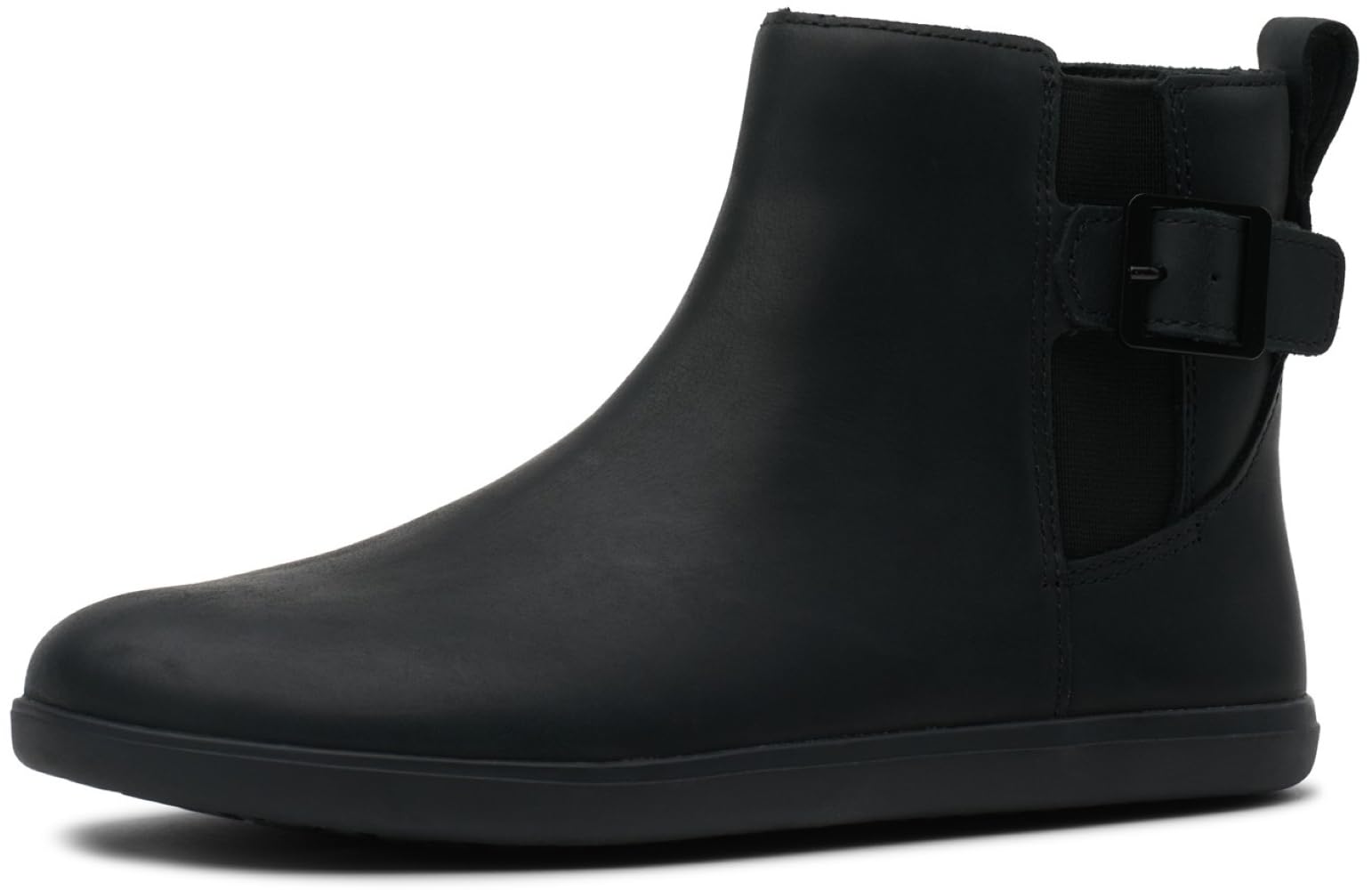
A pull-on leather Chelsea that keeps the barefoot platform without looking like a trail shoe.
Most barefoot boots are built for the trail and look it. The Tari II goes the other way — it is a women’s Chelsea boot, so it slides on with no laces and pairs with tights and a skirt or jeans and a sweater. If you want the flat, level stance of a zero drop boot but you need it to pass as normal everyday footwear, this is the one in this group designed for exactly that.
Xero Shoes built this updated version of its best-selling women’s leather boot with one of the barefoot movement’s biggest advocates, and the aim is stated plainly: barefoot comfort without compromising style. The two things that carry it are the way it looks and how comfortable it feels on — those are the qualities that come through strongest. It is a distinctly different proposition from the Jim Green, which leans on rugged work-boot construction; this one leans on looking polished enough for a normal day out.
Here is the catch you need to know before you pick a size. Fit is where the feedback splits — some find the size right on, while others find them too narrow. That is a width story, not a quality story, so the sensible move is to size with your foot’s width in mind rather than just its length. It has less of a review track record than the Jim Green — not a lesser boot, just a thinner one.
Why it earns a slot: the looks and the on-foot comfort are the two things that land, and a no-lace Chelsea in leather is a genuinely different wear from the lace-up work boots here.
The width question: fit is the split point — some find it spot on, others find it too narrow, so treat your foot width as the deciding factor at checkout.
The right call for: a woman who wants a flat, barefoot-feel leather boot she can actually wear with a skirt or jeans.
Look elsewhere if: you have a wider foot and want laces to fine-tune the hold — the Jim Green’s lace-up lets you adjust, this slip-on does not.
3. Vivobarefoot Tracker Leather All Terrain II

The trail boot built to take a beating at the stress points and still let you feel the ground.
This is the one for a woman who hikes rough ground and wants a leather boot that will hold together where boots usually wear out first. Vivobarefoot upgraded the leather rand — the strip wrapping the base of the boot where rocks and roots chew at it — and added reinforced double stitching at the key stress points. Put simply: the places that fail on a normal hiking boot are exactly where this one is reinforced.
It is a breathable, membrane-free design that still delivers reliable wet-weather protection, which matters when you are splashing through a stream crossing or walking in damp grass. And it keeps full barefoot feeling, so the ground comes through underfoot instead of being buried under a thick slab. That is a different balance from the Jim Green: this one is purpose-built for all-terrain hiking, where the Jim Green is a work-hiker hybrid. If the trail is the main event, this is the more dedicated tool.
What you give up is choice. It is the highest-rated of the three here, but it is also the newest listing with the least review history behind it, so its reinforced rand and double stitching carry more of the durability case than a long trail record does. It is also women’s sizing only, and the reinforced, membrane-free construction (no waterproof liner) is aimed squarely at hikers — if you want a boot that doubles as a knockabout work boot, the Jim Green covers more ground.
The build that matters: reinforced leather rand and double stitching at stress points are targeted at the wear zones a trail boot hits hardest — that is the durability story in one line.
The trade-off to weigh: wet-weather protection without a membrane, paired with full ground feel, comes with the thinnest amount of real-world trail history of the three picks.
Buy this one if: hiking is the job and you want reinforced, all-terrain leather that still lets your feet feel the trail.
Pass if: you need one boot that also handles everyday work duty or you want a longer review track record to lean on.
Know the Specs
Zero Drop (Heel-to-Toe Offset)
Drop is the height difference between the heel and the toe of a boot. Zero drop means they sit at the same height, so your foot is level instead of tipped forward. The benefit is a neutral ankle position and a stride where your whole foot lands flat — it is the single spec that defines this category.
Ground Feel and Sole Thickness
A thin, flexible sole is what makes a boot feel barefoot — you read roots, rocks, and pavement through it instead of hovering on a slab of foam. Flexible means the sole bends with your foot. The trade-off is less cushioning, so you feel more of the terrain, for better and worse.
Leather Rand and Stitching
A rand is the strip of material wrapping the base of the boot, right where rocks and roots strike. Reinforced double stitching means the seams at high-wear points get an extra line of thread. Both are durability details — they tell you where the maker expects the boot to take punishment, and that it is braced for it.
Toe Box Width
The toe box is the front section of the boot where your toes live. A wide toe box lets your toes splay out naturally rather than bunching up. Combined with a level platform, it is what makes a barefoot boot feel like walking without shoes — and it is the fit spec most worth checking against your own foot width.
Common Questions
How do I confirm a leather boot is really zero drop?
Are zero drop leather boots good for hiking?
Will a thin-soled barefoot boot hurt my feet on long walks?
What is the difference between the Jim Green and the Vivobarefoot Tracker Leather AT II?
Do the Xero Tari II Chelsea boots run narrow?
Can I wear leather barefoot boots for work as well as hiking?
How should zero drop leather boots fit in the toe box?
Are these boots available in men’s and women’s sizes?
Do these leather boots keep my feet dry in wet weather?
Which of these has the strongest durability story?
The Bottom Line
For most people hunting zero drop leather boots, the Jim Green Barefoot African Ranger is the pick to beat — full grain leather, a thin flexible sole, a wide toe area, and a build that covers both work and trail. If you want a flat, barefoot-feel leather boot you can wear with a skirt or jeans, the Xero Tari II Chelsea is the everyday women’s answer, just size with your foot width in mind. And for dedicated all-terrain hiking with reinforced leather at the stress points, the Vivobarefoot Tracker Leather AT II is the trail tool to reach for. Whichever you choose, confirm the level heel-to-toe platform and the toe box width before you commit — those two specs decide whether a barefoot boot feels natural or cramped on day one.
How we choose
We do not accept paid placement. Every pick is matched to a real buyer and a real use-case; we do not hands-on test units.
Sources
Specifications: manufacturer listings and product documentation. Review insights: verified customer reviews, as of November 2026. Pricing: not shown on this page (it changes often); check the current price via the retailer link.
As an Amazon Associate, Tactical Gear Guy earns from qualifying purchases. This does not affect which products we feature.