Specs are compiled from manufacturer listings and verified buyer reviews and can change over time — please confirm the key details on the product page before buying.
A yellow coat for men is not really about colour at all — it is about whether you stay visible, dry and warm on the days the weather has other plans. The short answer: a hi-vis yellow shell with reflective striping belongs in the truck or the boot room, and on your back whenever you head into low light. Below you get nine coats that all pass the same basic test — genuinely yellow, genuinely built for wet and cold work — sorted by what each one is actually good at.
This guide is built by comparing the manufacturers’ published specifications and the patterns across verified customer reviews, so you get each pick’s real strengths and trade-offs instead of marketing spin.
Not every bright jacket is a safety jacket, and not every waterproof coat glows when a car is coming, so the picks below are split by how hard they work and in what weather. Read this first and you can tell a genuine hi-vis work coat from a yellow jacket that only looks the part.
Top Picks


How To Choose The Best Yellow Coat for Men
You are buying a yellow coat for one of two reasons: you want to be seen, or you want to stay dry in weather that stops everyone else. Some of these coats do both, and a few lean much harder on one than the other. Here is what separates them in the field.
Waterproofing: read the millimetre number, not the label
Waterproofing is measured in millimetres of rain the fabric can hold back before it soaks through. A 3,000 mm shell handles heavy rain for a short spell, while a 30,000 mm shell is built for hours of driving rain. That is why one coat stands up to an all-day downpour and another leaves you damp after an hour — the millimetre rating tells you the outcome before you try it on.
Insulation: fleece, synthetic fill, or shell only
Think about the coldest shift you actually work or walk in before you pick. Fleece-lined bombers hold warmth close to your body, while synthetic fill works like a sleeping bag around your torso and stays warm even when wet. A plain shell is a raincoat first — it fits over a hoodie and does nothing for you in a frost.
Reflective stripes and where the yellow ends
Reflective striping is the part that actually gets you noticed after dark, when fluorescent yellow turns grey like everything else. Look for stripe coverage across the chest, arms and back rather than a single band. Black bottoms and cuffs also hide oil and road dirt, which keeps the coat looking sharp through a hard week.
Fit and sizing: assume it runs big
Most men’s hi-vis work coats are cut loose so you can layer underneath, and that means your normal size can hang slack. A few models in this list genuinely run large, so read the sizing notes in each review instead of trusting your usual letter size. A coat that gaps at the cuffs or reaches mid-thigh is the most common regret in this category.
Side-by-Side Comparison
| Model | Best For | Waterproofing | Warmth | Visibility | Amazon |
|---|---|---|---|---|---|
| TICONN Hi Vis Safety Bomber Jacket★ Best Overall | All-round workhorse | Waterproof shell | Fleece-lined | ANSI Class 3 | Amazon |
| toolant 100% Waterproof Safety JacketCold Shift Pick | Freezing work days | 3,000 mm | 180 g insulation | Type R Class 3 | Amazon |
| TCCFCCT Hi Vis Waterproof JacketPocket Master | Pockets and tool storage | Coated PU Oxford | Medium weight | 2-inch reflective stripes | Amazon |
| Hi Vis Rain Jacket with Black Bottom | Torrential rain | 30,000 mm | Unlined shell | 600 m reflective range | Amazon |
| FATONE Hi Vis Rain Jacket | Big-guys sizing | 5,000 mm | Lightweight shell | 300 m visibility | Amazon |
| Wuple Men’s Hi Vis Rain Jacket | Light packable rain cover | Waterproof shell | Lightweight | Reflective yellow | Amazon |
| VENDACE Hi Vis Fleece Bomber | Frigid outdoor shifts | PU-coated 300D Oxford | Polar fleece lining | ANSI Class 3, H-back stripes | Amazon |
| Helly Hansen Alta Hi Vis Shell | Professional-grade shell | Waterproof shell | Shell only | Hi vis workwear | Amazon |
| The North Face Thermoball Jacket | City-to-trail warmth | Water resistant | 118 g synthetic fill | Pigment yellow shell | Amazon |
Detailed Reviews
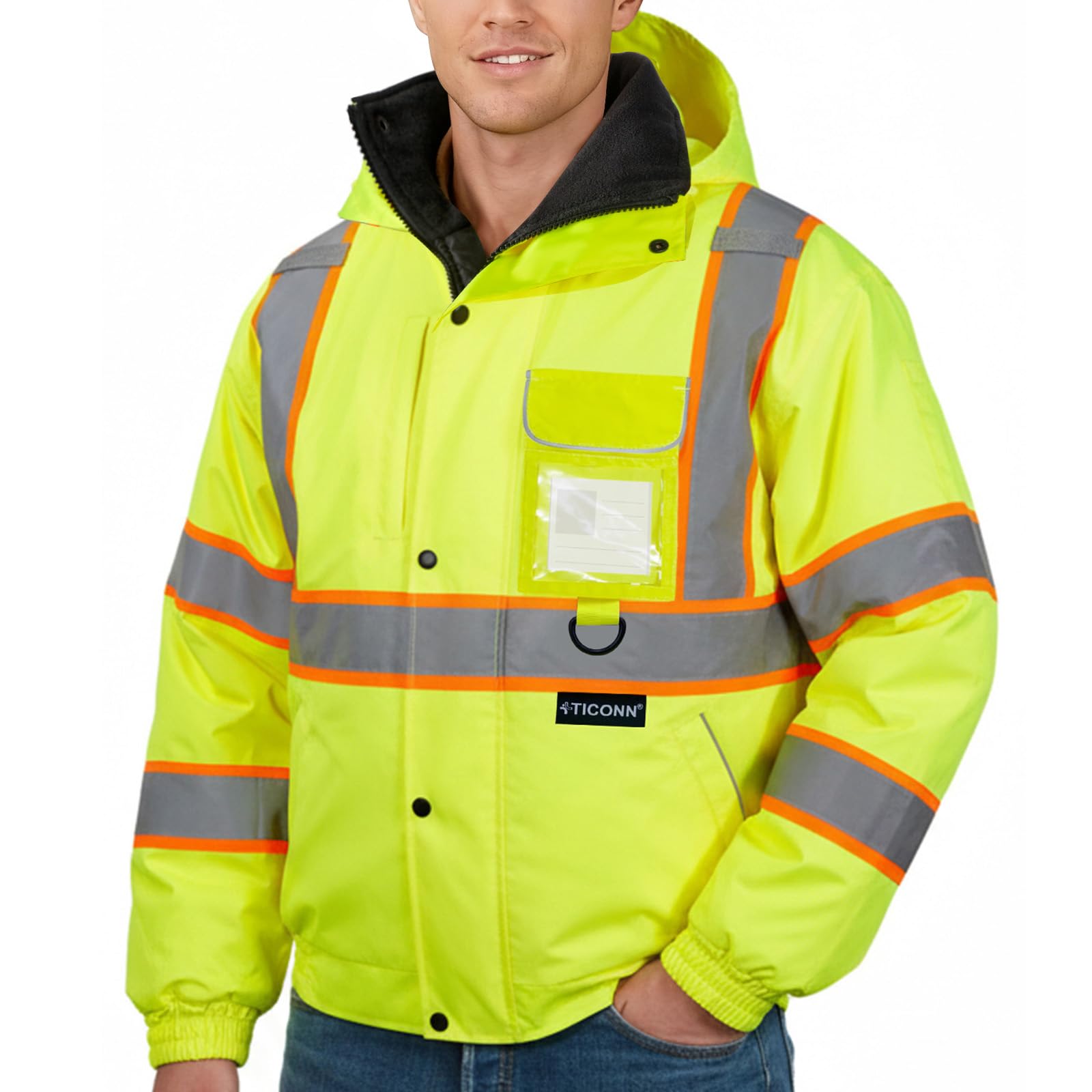
1. TICONN Hi Vis Safety Bomber Jacket
Our pick — 4.5+★ from 600+ verified ratings; the strongest balance of quality and price.
The fleece-lined bomber that balances warmth, rain protection and daytime visibility without asking you to pick one.
If you want one yellow coat that covers most of the year, this is the one to start with. It is a full fleece-lined bomber built to ANSI Class 3 (the visibility standard that says a garment is fit for roadside and work-site duty), so the shell is waterproof and the yellow reads bright from a distance. For someone who shovels the drive, walks the dog before sunrise, or works a site where the truck traffic never stops, that combination is exactly what the job asks for.
Owners keep circling back to the same thing: it fits like it was cut for them. It is also widely seen as strong value for the money, and the visibility and water resistance earn steady praise for real rain. The features list is practical rather than showy — a stowable hood you can tuck away, a mic strap for a radio clip, a retractable hem so you can cinch out the draft, and a windproof zipper with a snap storm flap. This is the coat that ends the yellow-coat search without a compromise on warmth or visibility.
What earns it top spot
- Fleece lining gives warmth on cold mornings without needing a second layer
- ANSI Class 3 visibility, so the yellow works in daylight and low light
- Stowable hood, mic strap, retractable hem and a windproof zip — genuinely useful work details
- Consistently praised for fit and value
What to plan around
- Sizing is the recurring sticking point — some find it oversized, others tight, so check the size guide carefully
- Designed as a work bomber, not a slim fashion cut
Reach for this if: you want one waterproof hi-vis bomber to cover commuting, shoveling and worksite shifts through the colder months.
Look elsewhere if: you need a lighter summer shell — the fleece lining is built for cold, not heat.
2. toolant Waterproof Safety Jackets
Insulation first: a hi-vis shell that keeps you warm without turning you into a walk-in duvet.
The headline here is the 180 g insulation (the fill weight that determines how much warmth the coat traps), and it is the reason this one holds its ground when the temperature drops. The shell carries a 3,000 mm waterproof rating, which means it handles heavy rain for the haul between the truck and the site. One honest note on the rainsheet question: the Hi Vis Rain Jacket with the black bottom is rated to 30,000 mm against this jacket’s 3,000 mm, so if you work in relentless long-duration downpours, that shell has more headroom. For cold, breezy shifts with wet spells, though, the insulation is the smarter trade.
Getting seen is handled by Type R Class 3 ANSI certification, with reflective strips that the maker says hold visibility after 25 washes — a claim note because reflective tape that greys out is the usual failure point on cheap hi-vis. Practical details read like someone who does the job wrote them: extended rigid hood brim, exterior pockets, radio mic tabs, an interior pocket, windproof placket, adjustable velcro cuffs and ribbing on the cuffs. What wins people over most is overall build quality, with warmth a close second. The recurring gripe is the zipper — a handful find it flimsy, so treat it gently and zip it fully aligned from the bottom.
Best use case: cold-weather site work, farm shifts and storage-yard jobs where you are standing in wind for hours and a thin rain shell would leave you shivering.
One thing to note: the zipper is the known soft spot, so this is a coat to look after rather than yank shut in a hurry.
Who it beats: any unlined rainshell on a freezing morning — the 180 g fill is real warmth you can work in.
Who it doesn’t: anyone chasing outright monsoon-grade water protection, where the higher-rated rain jackets win.
3. TCCFCCT Hi Vis Safety Jacket XL
Built for the worker who carries everything: ID badge, phone, wallet and radio, all with a coat that shrugs off the weather.
The outer shell is 300D coated PU Oxford (a tough, tightly woven polyester with a waterproof polyurethane coating), and it is rated as Level 3 PPE for work sites that require it. The yellow is a vibrant neon, and the black cuffs and hem add contrast plus hide road grime. Reflective striping runs two inches wide, which is the part that keeps you visible once daylight goes.
Where this coat makes its case is storage. There is a vertical zip pocket on the right chest, an ID holder on the left, dual buckles on the shoulders, large zippered pockets on both sides and an inner pocket. Some find the fit runs big, so if you sit between two sizes, take the smaller one. Quality is the thing owners are most confident about, with warmth close behind. On the honest side, a couple of long-term wearers have seen the fabric give up after a few weeks of hard use — this is a coat for regular work, not for someone who treats it rough, and it is cut with a loose fit for layering over a hoodie.
Storage that earns its place: an ID holder, a chest zip pocket, dual shoulder buckles and big waist pockets turn this into a mobile toolbox you wear.
The caveat: it runs big and a few hard-use owners saw fabric wear early, so keep it to regular site wear and check the size chart.
Pick this when: your job means carrying gear on your person — badge, radio, wallet, tools — all day in wet, cold weather.
Pass if: you want a close fit from the start; this is cut loose by design.
4. Hi Vis Rain Jacket
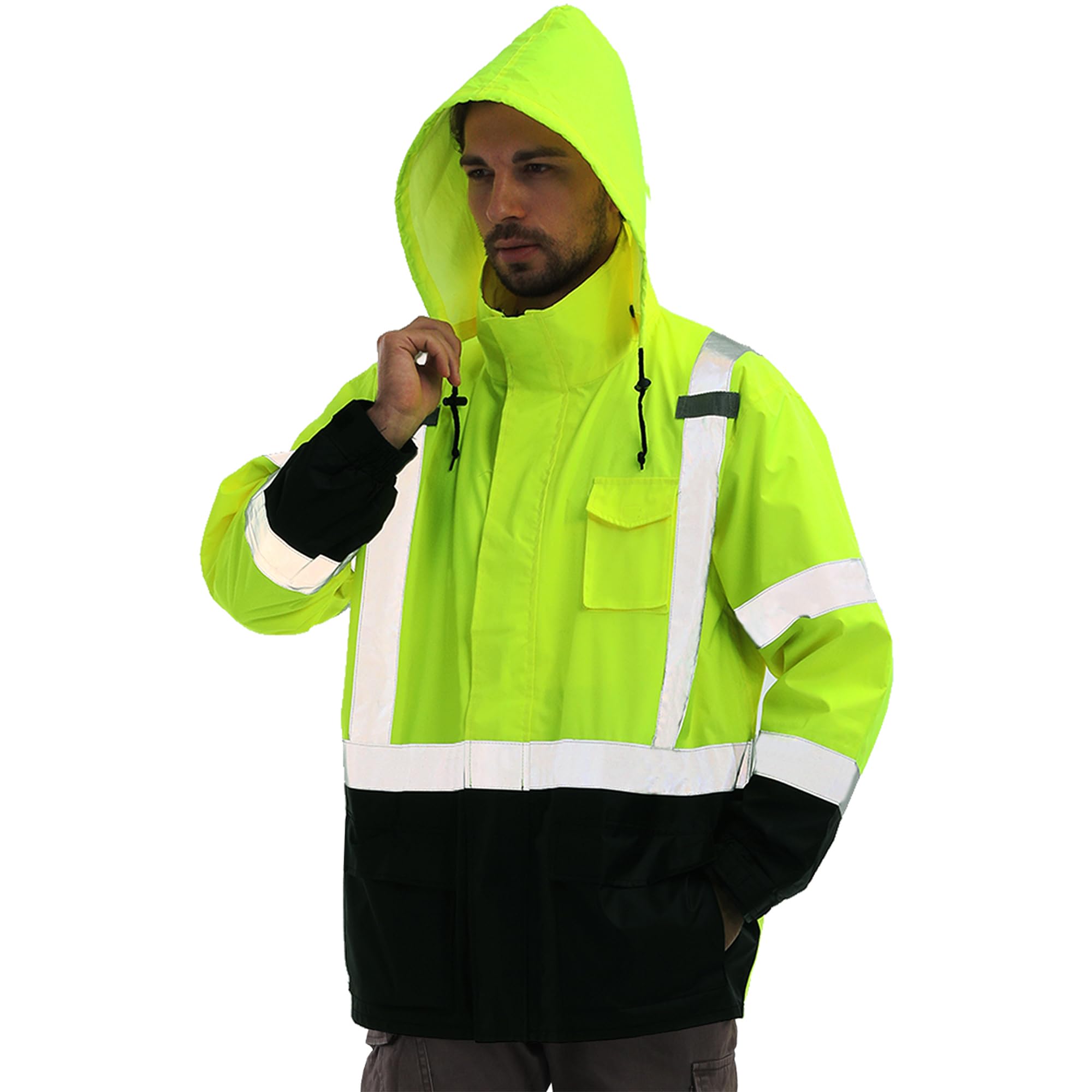
A 30,000 mm waterproof shell built for the days when the sky does not let up — and visibility that reaches 600 metres.
This is the shell for the wettest shift of the year. The shell carries a 30,000 mm waterproof rating, which is the stand-out number in this whole list — the toolant jacket is rated at 3,000 mm by comparison. That gap matters when you are standing in a downpour for hours rather than minutes. The fabric is 100% polyester Oxford with a PU coating and is rated to survive stretching and rubbing 20,000 times.
Night work gets serious attention here, with 3M reflective material giving 600 metres of visible range. Storage is generous — a clear chest pocket for ID cards, an inside left chest pocket for a phone and wallet, big waist pockets for large tools, plus side hand pockets. The trade-off is the sizing and pants fit: some find the trousers too tight for a 2x, and the size chart is not always accurate, so measure rather than assume. One or two report the pants ripping early. For a dedicated rain-suit shell, though, the waterproofing is the reason it is here.
Waterproofing that leads the field: the 30,000 mm shell versus 3,000 mm on the toolant means genuinely more headroom in sustained rain.
Fit to watch: the size chart and the pants fit are the recurring complaints, so confirm your measurements before you commit.
Made for: the outdoor worker who stands in real rain for hours and needs a shell that will not soak through by lunchtime.
skip it if: you want a close-fitting trouser cut — the pants run tight and small, so measure first.
5. FATONE Hi Vis Rain Jacket
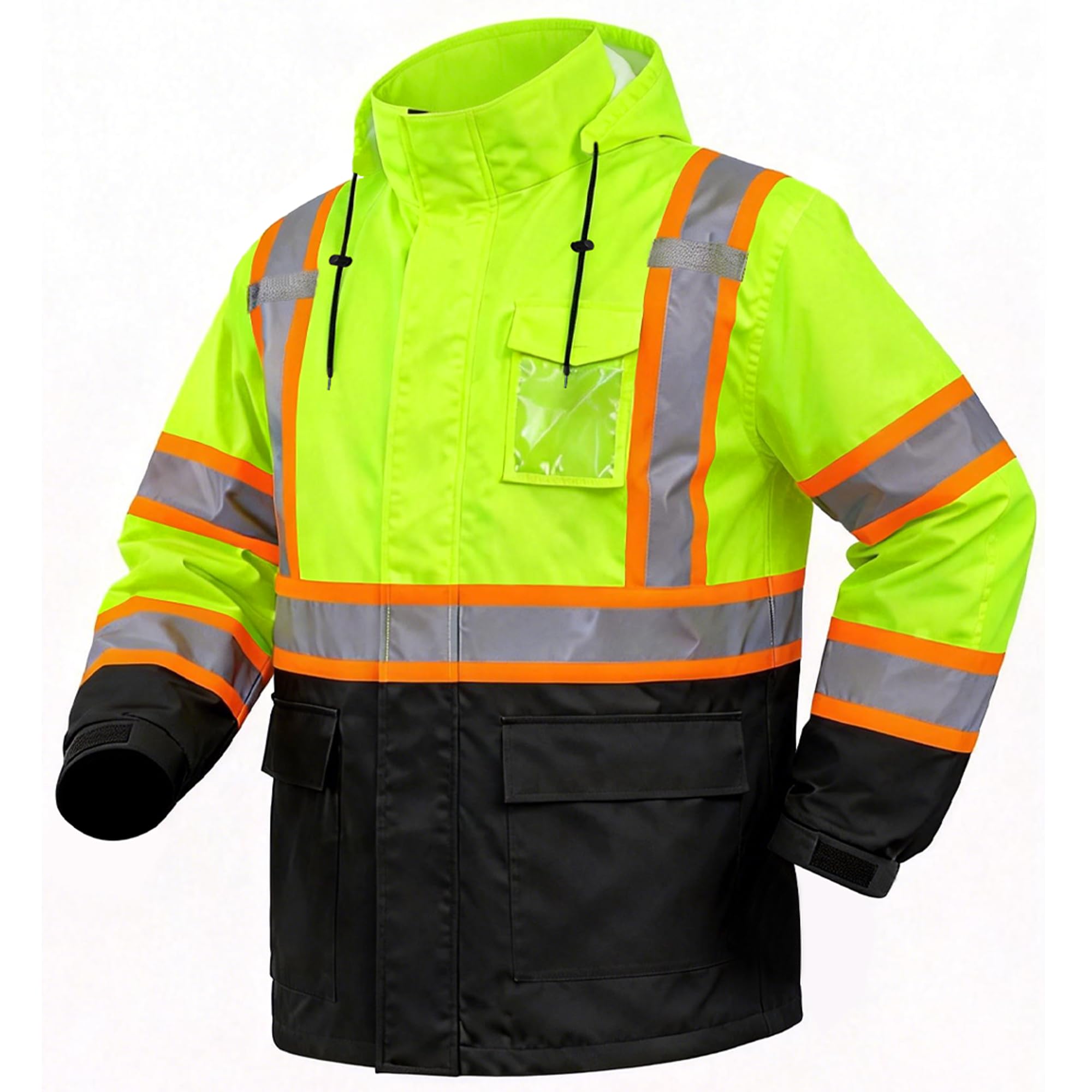
A lightweight rainshell that shows up at the biggest end of the size range, with a hood that genuinely covers your head.
The outer shell is coated with polyurethane waterproofing and the seams are heat-pressed and sealed — a detail that keeps water from sneaking through the stitching, and it handles 5,000 mm of precipitation. It meets ANSI/ISEA 107-2020 Type R Level 3 reflective standard, with strips across the chest, waist, arms and back giving 300 metres of visible range. The fluorescent yellow and orange body keeps you seen in daylight too. Best of all, the size range reaches 4XL/5XL, so if you have struggled to find hi-vis in your size, this cut is aimed at you.
Breathability gets real thought, with two vent shafts on the back and a mesh lining inside that stops clothes sticking to your skin. The hood tucks away into the collar, adjustable velcro elastic cuffs seal the wind out, and there is a clear PVC ID pocket on the chest plus two big waist pockets. Sizing is the catch — several find it runs big, so be ready to size down if you want a snugger fit. The overall build and water resistance are the parts owners trust most.
The reason to buy: the generous cut and big size range make this a genuine option when standard hi-vis tops out mid-size.
The honest limit: it runs large by consensus, so order a size down unless you plan to layer underneath.
The fit-first pick: if you wear a larger size and struggle to find hi-vis that actually covers you, this is built with you in mind.
Think twice if: you want a trim silhouette — this is a loose rainshell by design.
6. Men’s Hi Vis Rain Jacket

A lightweight, windproof rain shell for mild weather — the jacket to keep in the car so sudden rain stops being a problem.
This is the one to keep on the back seat for sudden rain. It is a lightweight polyester rainshell that is both waterproof and windproof, with the reflective yellow body giving you daytime presence and a hood for head coverage. It is built for mild weather rather than a deep freeze, so it performs as a throw-it-on layer over a hoodie when the day turns wet. A lightweight shell blocks wind as well as rain, so a wet, windy day feels far more manageable once you have one on.
Owners keep coming back to the quality and value, with the keep-you-dry performance being the thing they rely on. The fit is mixed — some find it a clean fit, others say it comes up much too large — so if you want a snugger result, size down. On the honest side, this is a shell, not an insulated winter coat, so it will not keep you warm on a freezing morning without layers beneath it.
Where it belongs: the boot of the car or the bottom of a bag, ready for the day the sky opens without warning.
What to expect: it runs large on some builds, so check sizing and treat it as a mild-weather outer layer.
Ideal for: commuters, roadside repairs and anyone who wants a lightweight yellow rain shell that takes up almost no space.
Not for: sub-zero shifts where insulation is what keeps you going.
7. VENDACE High Visibility Safety Jacket 2XL

A fleece-lined safety bomber for the coldest shifts, in a cut that feels more winter coat than workwear.
The warmth here is the point. A 100% polyester 300D Oxford outer shell with a PU coating resists wind and water while still breathing, and a polar fleece lining provides enough warmth for working in frigid conditions. That combination — a waterproof shell and a fleece inner — is what makes this one of the few coats here that works on a frozen morning without a second layer. It is fully compliant with ANSI/ISEA 107-2020 Class 3/Level 3, the visibility standard that lets the coat do duty on roadsides and work sites.
Visibility comes from 2-inch silver reflective stripes laid out in an H-back pattern, keeping you visible in extreme weather and low light. It sits somewhere between a bomber and a hoodie, with a full front zip, hand-warmer front pockets and a classic hood, plus a half-black bottom for stain resistance. It wears to size for most buyers, so the sizing note is quieter here than on the looser shells. Warmth and quality are the two things that keep coming up, and the price-to-warmth read is one of the best in the list — this is the cold-weather coat for the money.
Why it earns its warmth label
- Polar fleece lining is genuinely warm under a waterproof shell
- ANSI/ISEA 107-2020 Class 3 for road and site visibility
- 2-inch H-back reflective stripes for low-light work
- Wears true to size for most
Where it may not suit
- The fleece makes it too warm for mild weather
- Cut for cold workwear rather than a slim fashion line
Best for: frigid outdoor shifts — forestry, roadside, loading dock — where the lining is the reason you stay out.
Also worth knowing: you are paying for warmth, so a summer shell this is not.
8. Helly Hansen Men’s Alta Hi Vis Waterproof Shell Work Jacket
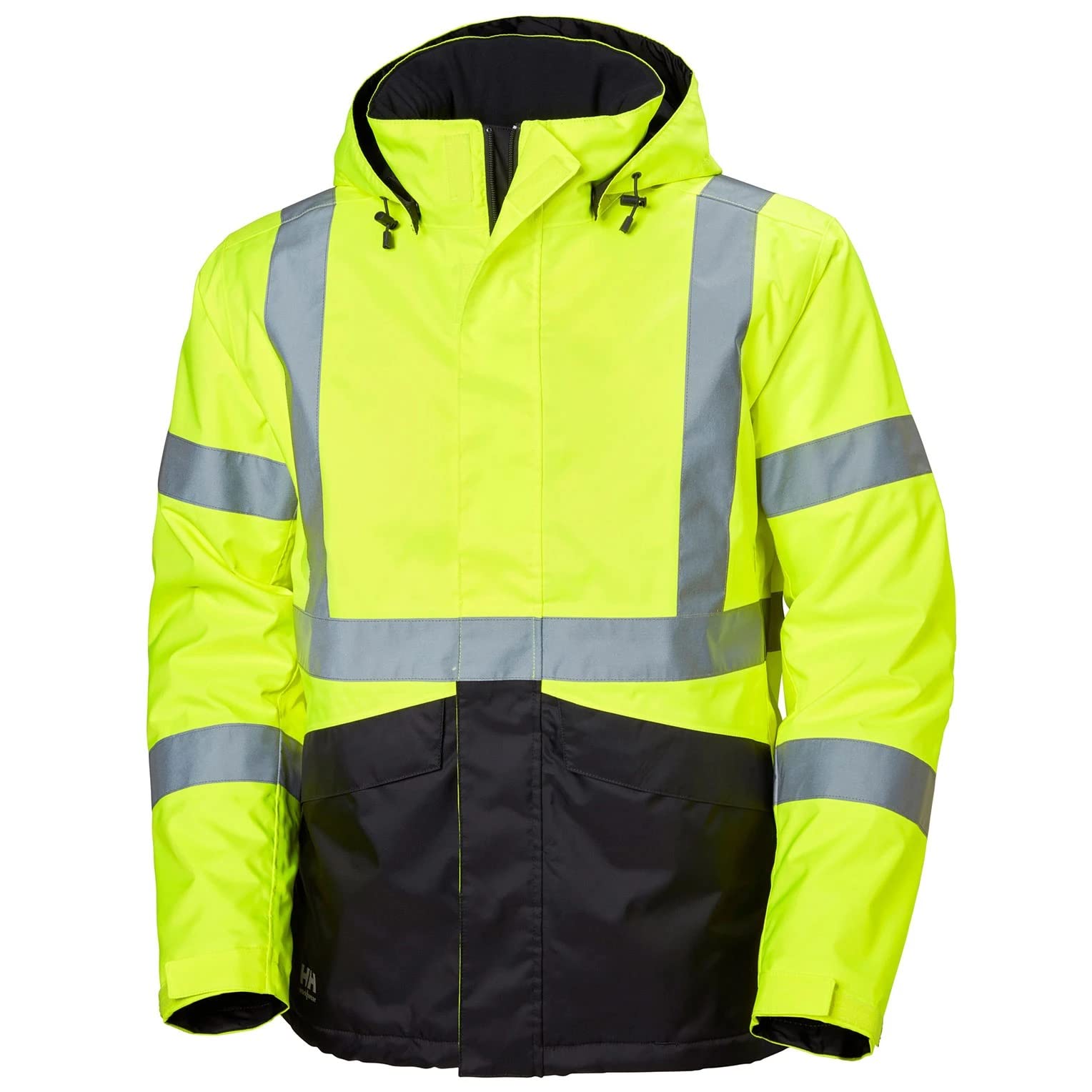
The professional’s rainshell: unlined, waterproof, and built to take a weather beating that turns other coats inside out.
This is the shell the serious trades reach for. Helly Hansen has been making waterproof workwear since 1877, and the Alta Hi Vis is its waterproof work shell — a layer meant to go over what you already wear rather than wrap you in insulation. The fit gets specific praise, including a hood big enough to actually cover your head in a storm. It holds up across wind, rain and snow, which is exactly what you want from a shell that lives on the job site.
Wear it over a fleece on cold days and it becomes a whole system. It is unlined by design, so the warmth has to come from what you put underneath — a fair trade for a coat that stays light and does not cook you when the weather warms up. Value for money gets mixed feedback, and durability is a point owners split on, with a few worrying about how many seasons it lasts under heavy use. That is worth weighing against the fact this is a dedicated workwear layer built for professionals rather than a weekend rain jacket.
What you are really buying: a professional waterproof shell you can layer under, with a hood cut big enough to do the job in real weather.
The trade-off: it is unlined and priced as pro gear, so layer up on cold days and go in expecting to look after it.
For the pro: tradespeople who want a single waterproof shell that can take a season of hard weather and be layered for any temperature.
Not the pick if: you want warmth built in — this is a shell, so a fleece goes under it.
9. The North Face Thermoball Insulated Jacket
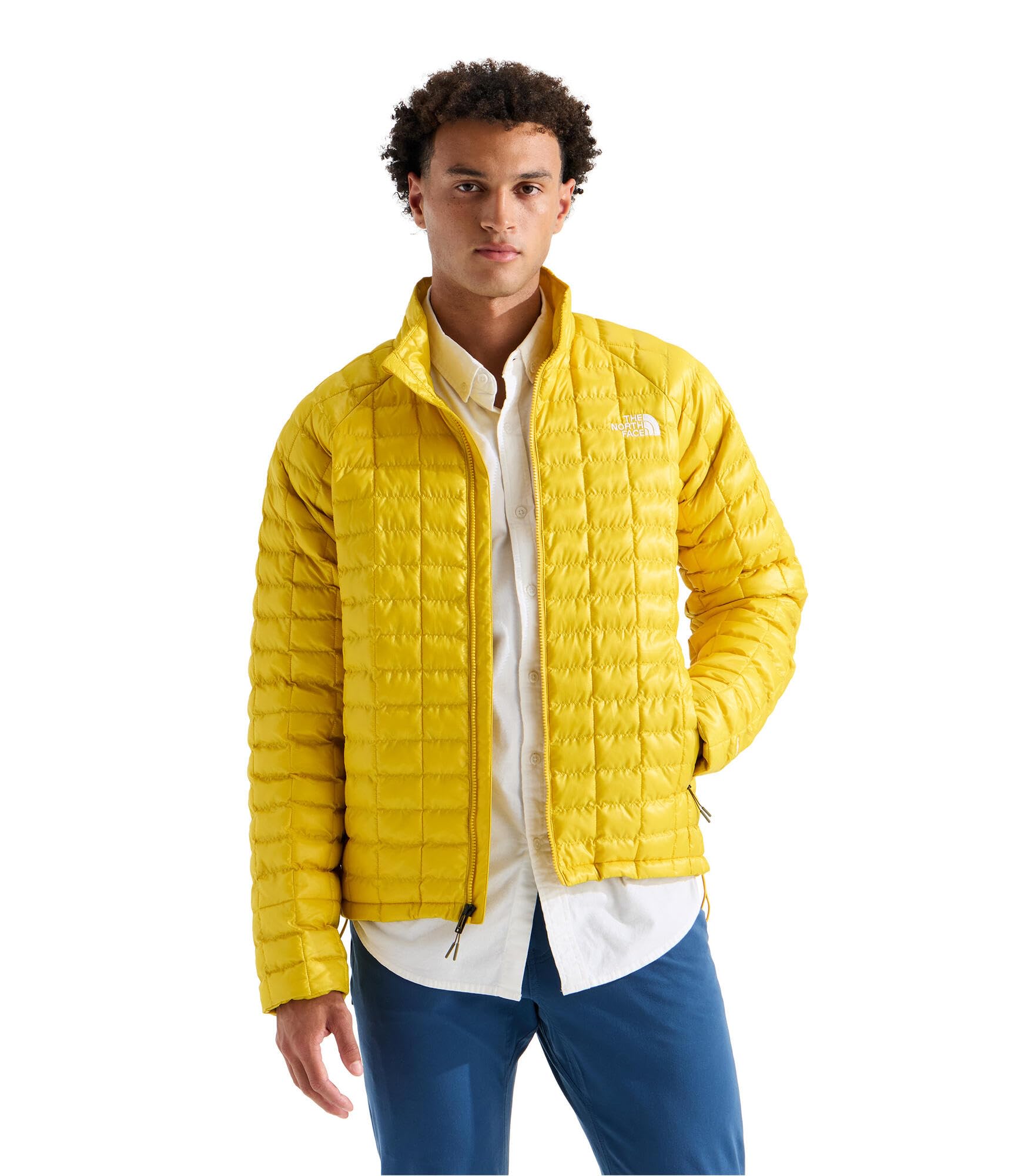
Not a work site jacket at all — a yellow insulated puffer for the commute, the trail and everything between.
This is the coat you wear when the yellow is for style and the warmth is for you. The 118 g synthetic insulation is 100% recycled, and the fabric is 100% recycled WINDWALL with a non-PFC DWR finish (a water-repellent coating that sheds light moisture without certain fluorinated chemicals). The updated quilting pattern is designed to reduce cold spots. It stays warm even when wet, which is the key reason synthetic fill beats down on a damp hike. Note the honest limit: unlike the waterproof work shells here, this one is water resistant rather than waterproof, so it handles drizzle and light rain but not hours of heavy downpour.
Fit is the thing to check. The regular cut fits true to size for most, with room through the chest and shoulders and an internal hem cinch-cord to pull it in. Details include an internal draft flap, a zipper chin guard to stop neck irritation, secure-zip hand pockets, and it packs down into its own right-hand pocket for travel. Warmth and quality are what owners count on. The mixed note is sizing — some find it runs a bit large — so if you sit between sizes, try the smaller one.
Why it fits a city-to-trail life
- 118 g synthetic fill stays warm even when wet
- Packs into its own pocket for travel
- Internal draft flap and zipper chin guard for real cold snags
- Regular fit with hem cinch-cord for tuneable shape
What holds it back
- Water resistant, not waterproof — not the coat for hours of rain
- Some find it runs a bit large
Suited to: commuters, walkers and light hikers who want a warm packable yellow puffer that doubles as everyday wear.
Wrong tool for: roadside work in sustained rain — that is a job for the waterproof shells above.
Know the Specs
Waterproof rating (mm)
This is how much rain a fabric can hold back before it starts to soak. A 3,000 mm shell suits heavy rain for a short stretch, while a 30,000 mm shell is built for hours of sustained downpour. Match the number to your actual exposure — a commute between the car and the building rarely needs the top end, but a full shift outdoors does.
Insulation weight (g)
A fill weight in grams tells you how much warmth is packed into the coat. A 180 g synthetic fill traps noticeably more heat than a light shell, and synthetic fill stays warm even when it gets wet — unlike down. That is why insulated hi-vis bombers suit a freezing morning while plain shells are best layered over a fleece.
Hi-vis class and reflective striping
Class 3 is a high-visibility standard built for workers who need to be seen from a real distance before they are spotted by a driver. Reflective striping is the part that matters in the dark, when fluorescent yellow loses its glow. Look for stripes across the chest, arms and back rather than a single band — coverage is what keeps you seen from all angles.
Fluorescent yellow vs plain yellow
Fluorescent yellow is designed to stay vivid in daylight and is the colour work sites specify. A plain yellow shell, like a puffer or bomber, is styled for everyday wear and reads as fashion rather than safety. Both keep you visible while the sun is up, but only the fluorescent hi-vis versions are rated to keep a road crew or site worker seen.
Common Questions
Does a hi-vis yellow coat actually make you safer after dark?
What waterproof rating do I need for all-day rain work?
Is a fleece-lined bomber or a plain shell better for cold weather work?
Why do hi-vis coats run so large, and how do I size one?
Can I wear a yellow work coat as an everyday winter jacket?
How long should the reflective stripes last on a hi-vis coat?
What does ANSI Class 3 mean on a safety jacket?
Is water-resistant good enough, or do I need fully waterproof?
Do yellow safety coats have pockets for phone, ID and tools?
Can I wash a hi-vis waterproof coat in a machine?
The Bottom Line
If you want one yellow coat to see you through most of the year, the TICONN Hi Vis Safety Bomber is the one to beat — a fleece-lined, waterproof, ANSI Class 3 shell that handles commuting, shoveling and site work without asking you to choose between warmth and visibility. On freezing shifts where warmth comes first, grab the VENDACE fleece bomber for its polar fleece lining. And if you work in relentless rain, the 30,000 mm Hi Vis Rain Jacket gives you the most headroom against a sustained downpour.
If you are on the fence, start with the one that fits how much time you spend outside — the TICONN bomber is the safest all-round starting point for most men who need a yellow coat that works as hard as they do.
How we choose
We do not accept paid placement. Every pick is matched to a real buyer and a real use-case; we do not hands-on test units.
Sources
Specifications: manufacturer listings and product documentation. Review insights: verified customer reviews, as of November 2026. Pricing: not shown on this page (it changes often); check the current price via the retailer link.
As an Amazon Associate, Tactical Gear Guy earns from qualifying purchases. This does not affect which products we feature.