Specs are compiled from manufacturer listings and verified buyer reviews and can change over time — please confirm the key details on the product page before buying.
You want a heart rate number you can actually believe mid-run, not a reading that spikes when you shift your arm. The short answer: the Apple Watch Series 12 is the strongest all-round wrist heart rate sensor here, and the Xiaomi Mi Smart Band 10 is the one to grab if you want 21 days of tracking on a modest budget. Everything else on this list wins on a specific strength — the Forerunner 970 on training depth, the Scanwatch 2 on a classic face that hides its sensors.
This guide is built by comparing the manufacturers’ published specifications and the patterns across verified customer reviews, so you get each pick’s real strengths and trade-offs instead of marketing spin.
Below you’ll find how each of these nine handles that problem, plus what to check before you buy a wrist heart rate sensor.
Top Picks


How To Choose The Best Wrist Heart Rate Sensor
A wrist heart rate sensor works by shining light into your skin and watching how blood flow changes that light — an optical method, as opposed to the electrical signal a chest strap picks up. That difference is why an optical watch and a chest strap can disagree on the same run.
Fit beats almost everything else
A sensor sitting loose, or sliding over your wrist bone, will drift and spike no matter how good the hardware is. Look for a band you can tighten one notch past comfortable and still wear for hours. The Withings Scanwatch 2 uses a 12mm band and the Garmin vívoactive 5 uses a 20mm band, while several picks here use 22mm — a wider strap spreads pressure and tends to sit steadier.
Check what the sensor does with the reading
What separates these devices is what they build on top of it: heart rate zones, HRV (heart rate variability, a measure of the gap between beats that hints at recovery), stress scores, and readiness ratings. The Apple Watch Series 12 takes background heart rate readings every five seconds, and the Fitbit Charge 6 pairs real-time heart rate with linked gym equipment.
Brightness vs battery is the real daily trade
An always-on bright screen is lovely outdoors and halves your battery life — the Garmin vívoactive 5 drops from 11 days to 5 with it on. The Xiaomi Mi Smart Band 10 runs 21 days between charges on a 200 mAh battery, while the Fitpolo packs a 350 mAh cell for 7 days.
Side-by-Side Comparison
| Model | Best For | Battery Life | Battery Capacity | Heart Rate Feature | Amazon |
|---|---|---|---|---|---|
| Apple Watch Series 12 GPS 42mm★ Best Overall | Best overall heart rate sensing | Up to 24 hours | — | HRV every 5 minutes | Amazon |
| Xiaomi Mi Smart Band 10Battery Champion | Longest battery on a budget | 21 days | 200 mAh | Heart rate monitor | Amazon |
| Fitpolo Smart Watch (2 Bands)Big-Screen Value | Big display, low cost | 7 days | 350 mAh | Real-time heart rate, SpO2 | Amazon |
| Google Fitbit Inspire 3 | Simple all-day tracking | 10 days | — | 24/7 heart rate | Amazon |
| Google Fitbit Charge 6 | Gym machine heart rate link | 7 days | 0.25 | 24/7 heart rate, ECG | Amazon |
| Garmin vívoactive 5 | Balanced health tracking | 11 days | — | Wrist-based heart rate, HRV | Amazon |
| Fitbit Sense 2 | Stress and sleep focus | 6+ days | — | 24/7 heart rate, cEDA stress | Amazon |
| WITHINGS Scanwatch 2 | Classic look, hidden sensors | 35 days | 0.12 | Continuous heart rate, AFib detection | Amazon |
| Garmin Forerunner 970 | Serious training and racing | 15 days | 560 mAh | Wrist-based running power, HRV status | Amazon |
Detailed Reviews
1. Apple Watch Series 12 GPS 42mm Smartwatch
Our pick — 4.5+★ from 450+ verified ratings; the strongest balance of quality and price.
The sensor that checks in on your heart every five seconds, not just when you ask.
Most wrist sensors only work hard during a workout. The Series 12 keeps reading your heart rate in the background every five seconds, all day and night. It also measures HRV (heart rate variability — the natural gap between beats that hints at stress and recovery) as often as every five minutes. That pace is what turns a wrist device into something closer to a continuous monitor.
It pairs that data with the Vitals app for overnight metrics, a daily sleep score, and a readiness reading that weighs your recent activity, vitals, and sleep. On the fitness side you get heart rate zones and Pacer, plus a 42mm case and up to 24 hours of normal use. A 15-minute fast-charge buys up to 12 hours, which covers a missed overnight charge without drama.
What wins people over is the look — the appearance draws the most praise by a wide margin, with the aluminum case now wearing Ceramic Shield 2 glass. Value for money and battery life both land as clear positives too. The honest catch is the screen: the 42mm size splits opinion, with some finding it exactly right and others saying it runs smaller than they pictured. The build is light on the wrist, so try a band size before you commit.
Why This Takes The Top Slot
- HRV readings as often as every five minutes — deeper recovery insight than most wrist sensors offer.
- Background heart rate every five seconds, so your all-day picture is continuous, not spot-checked.
- Fifteen-minute fast-charge for up to 12 hours of use when you forget to plug in overnight.
- Vitals, sleep score, and readiness pull the heart data into one daily read.
Where It Asks More Of You
- Up to 24 hours per charge means a near-daily charging habit.
- The 42mm display leaves some buyers wanting more screen real estate.
- You need an iPhone nearby to get the most out of it.
Reach for this if: you want the most complete heart picture on a wrist and don’t mind charging nightly.
Think twice if: a 42mm face will feel cramped on your wrist or you’re not in the Apple ecosystem.
2. Xiaomi Mi Smart Band 10 (2025) Global Version
Twenty-one days of heart tracking between charges, on a slim band that barely registers.
This is the pick for anyone who resents charging a wearable. The 21-day battery life versus the 7 days on the Fitpolo lets you leave the charger at home for weeks. And it’s doing that on a modest 200 mAh cell, where the Fitpolo carries 350 mAh for its shorter run. That’s efficiency through a lean design, not a big battery.
The 1.72-inch AMOLED screen — a bright, color panel with 2.0mm bezels — reaches 1500 nits HBM brightness, which keeps messages readable in direct sunlight. You get a high-precision electronic compass for swim direction, detailed workout analysis, and enhanced sleep stage tracking. Running HyperOS 2 keeps the interface smooth, and an hour of charging refills the whole thing.
Buyers report stretches of around 20 days between recharges and rate it high quality for the money, with some comparing it favorably to far pricier watches. One practical snag: the Xiaomi Fit app only supports the metric system, so if you think in pounds and inches you’ll need to route data through a third-party app like Google Fit. The 22mm fluoroelastomer band tucks in neatly once you size it right.
The value read: You get a bright 1500-nit AMOLED panel, swim-ready compass tracking, and three weeks of heart monitoring for entry-level money — that combination is hard to match here.
The fit note: Metric-only in the native app is a real friction point for US buyers, so plan on the Google Fit workaround before you buy.
Pick it for: budget-minded buyers who want heart rate and sleep data without a charging ritual.
Not for you if: you want imperial units without linking a second app.
3. Fitpolo Smart Watches for Men/Women (2 Bands)
A large 1.85-inch screen paired with a 350 mAh battery and Bluetooth calls.
If your eyes want a bigger screen, this is the one. The 1.85-inch HD touchscreen runs at 60Hz, and a built-in DSP chip — a processor that cleans up audio — powers Bluetooth 5.3 calling so you can answer from your wrist. Heart rate and SpO2 (blood oxygen estimate) tracking run in real time, alongside sleep broken into deep, light, and awake stages.
Its 350 mAh battery is the biggest on this list at that tier, though it’s rated for 7 days — the Xiaomi stretches far longer from a smaller 200 mAh cell. A 2-hour charge tops it off, and the package ships with two bands (silicone sport + braided casual) plus a magnetic charging cable. IP68 water resistance means rain and pool splash are covered.
What earns it attention is the look — appearance is the most-praised trait here, followed by value for money — and buyers read it as cute and easy to set up. The catch is functionality, which splits opinion: it works well for some and hits connectivity snags on iPhone for others. Android owners will have the smoother ride.
The screen-and-battery play: A 1.85-inch 60Hz display and a 350 mAh cell make this the roomiest, most power-cushioned option at its tier — 120+ sport modes come along for the ride.
What to know going in: Health tracking here is clearly marked non-medical, so treat the numbers as motivation, not diagnostics.
Best matched to: Android users who want a large screen and call handling without spending much.
Look elsewhere if: you’re on iPhone and need rock-solid connectivity reliability.
4. Google Fitbit Inspire 3
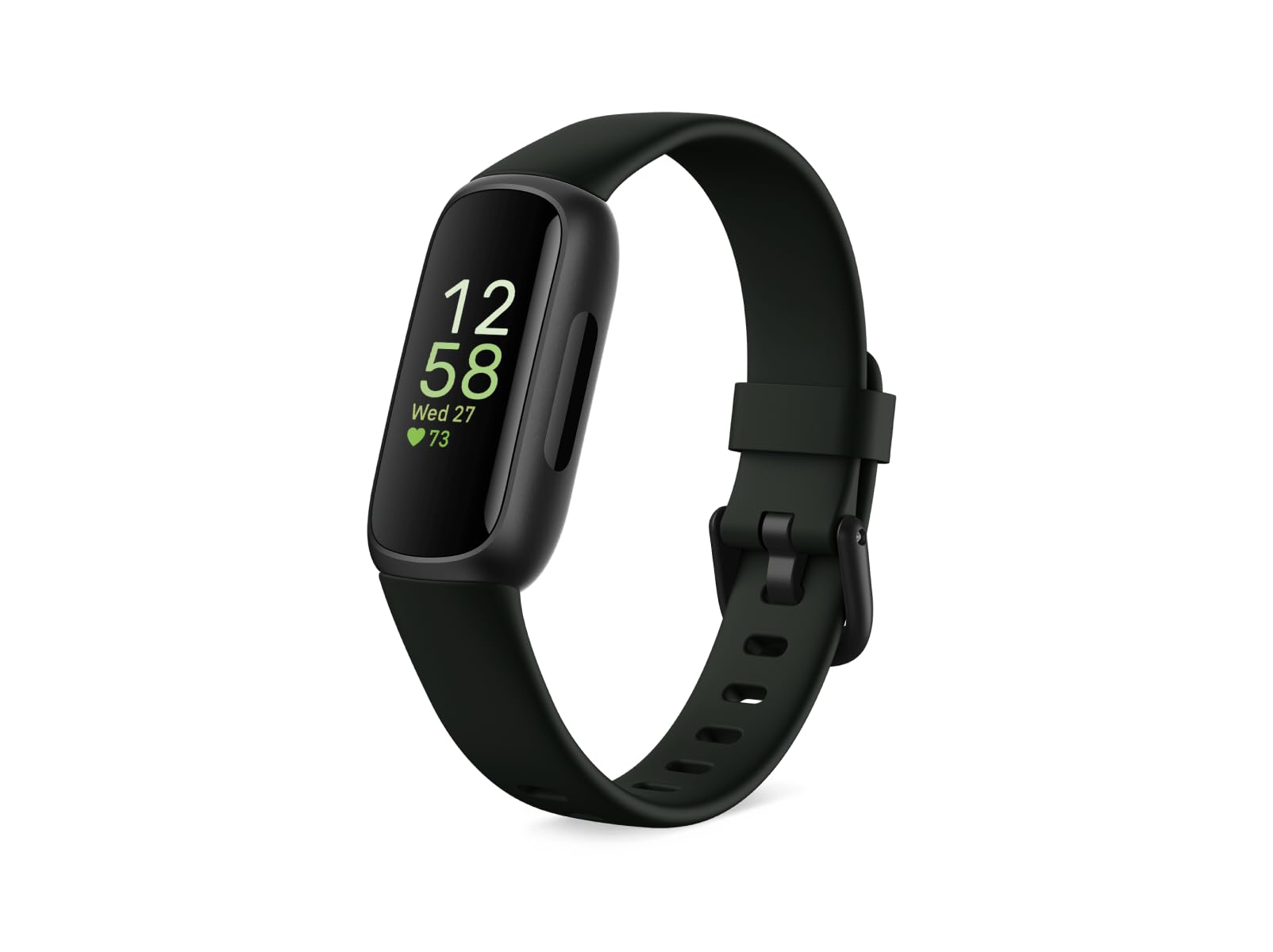
Ten days of continuous heart tracking in a tracker you forget you’re wearing.
You get more than a bare band but less bulk than a full smartwatch. Heart rate runs 24/7, and you get a Daily Readiness Score, Active Zone Minutes, and 40+ exercise modes that detect your workout automatically. It also tracks your resting heart rate and sends irregular heart rhythm notifications. SpO2 (blood oxygen) and a daily Stress Management Score pair with breathing sessions.
Sleep gets real attention here: automatic sleep tracking, a daily Sleep Score, a smart wake vibrating alarm, and a sleep mode. A 10-day battery on a 2-hour charge means you’re charging roughly once a week, and it works with iOS 16.4 or higher and Android 11.0 or higher.
Setup and use are the easy part — buyers consistently describe it as simple to get going and good at counting steps. The one honest caveat is longevity: while some find the battery excellent, a recurring theme is that charging can fail after a couple of months. Treat it as a light, comfortable everyday tracker rather than a training tool. The included small and large bands help you find a snug fit.
What It Quietly Does Well
- 24/7 heart rate plus resting heart rate and irregular rhythm notifications in one lightweight tracker.
- 10-day battery on a 2-hour charge, so it’s a once-a-week plug-in.
- Sleep Score, smart wake alarm, and Stress Management Score all in the base experience.
The Reasonable Hesitation
- Longevity is the question mark — charging failure after a couple of months shows up in the feedback.
- No built-in GPS, so outdoor routes are estimated rather than mapped.
Go here for: an unobtrusive all-day tracker with genuine sleep and stress insight.
Consider a step up if: you need GPS mapping or heavier training metrics.
5. Google Fitbit Charge 6

The tracker that beams your heart rate straight onto the treadmill’s own screen.
Here’s the feature that separates it from the Inspire 3: link the Charge 6 to compatible exercise machines, like treadmills and ellipticals, and your real-time heart rate shows on the machine’s display. Add built-in GPS, 40+ exercise modes, and 24/7 heart rate, and it covers both indoor and outdoor sessions well.
Round it out with a daily Stress Management Score, a nightly Sleep Score, and a Smart Wake alarm. Google essentials come baked in — turn-by-turn Google Maps directions during runs and Google Wallet tap-to-pay. Battery is rated 7 days with a 2-hour charge, and a 3-month Google Health Premium trial is included at no cost.
Two things to weigh honestly. Battery life lands 7 days here versus the 10 days on the Inspire 3, so you’ll charge more often. And like its sibling, long-term reliability is the loose thread — some units keep running fine while others stop working entirely, with durability after a couple of months being the recurring concern. It’s a strong training partner if you want the gym-machine link; it’s not the buy if you want to set it and never think about it.
Standout trick: Broadcasting live heart rate to gym equipment is genuinely useful — you watch effort on the treadmill rather than squinting at your wrist mid-stride.
Worth knowing: The Google Health Premium coaching relies on a separate paid membership after the trial, so the smarter coaching isn’t permanent.
Made for: gym-goers who split time between machines and outdoor runs and want one device for both.
Skip if: you want a device you can count on for years without worry.
6. Garmin vívoactive 5, 42mm, Ivory

Eleven days of smartwatch battery and a full health picture without an iPhone in the loop.
The vívoactive 5 runs up to 11 days in smartwatch mode, or 5 days with the AMOLED display always on. That leaves the Apple Watch’s 24 hours in the dust and means you’re charging roughly once a week and a half. Its wrist-based heart rate feeds a Body Battery energy score, a sleep score with personalized coaching, and an HRV status reading that helps you read your own recovery.
Over 30 built-in indoor and GPS sports apps cover walking, running, cycling, HIIT, swimming, and golf. There’s automatic nap detection, a morning report, fitness age, and menstrual cycle and pregnancy tracking. A Wheelchair mode counts pushes instead of steps — a genuinely thoughtful touch that’s rare on the shelf.
Quality is what buyers praise most — the most mentioned positive here — with the bright AMOLED display and interface earning high marks too. Battery life and sleep tracking are the split opinions: some call the battery outstanding while others see it drain within a day, and sleep accuracy draws both love and doubts. The 20mm silicone band and fiber-reinforced polymer case keep the 42mm case light. Music downloads and phone-free headphone listening round it out nicely.
The Garmin advantage: True 11-day smartwatch stamina plus HRV status and Body Battery give you a recovery view a 24-hour watch can’t sustain.
The honest caveat: Sleep tracking is where opinions divide — use it as a trend line, not gospel.
Pairs well with: anyone who wants serious health tracking and long battery in a light 42mm case.
Best to pass if: you lean heavily on sleep-stage accuracy as your main metric.
7. Fitbit Sense 2 Health and Fitness Smartwatch

Built around stress, with a sensor that reads skin response all day.
Most heart rate watches treat stress as a footnote. The Sense 2 makes it the headline: all-day stress detection with cEDA (a sensor that reads micro-changes in skin conductance), a daily Stress Management Score, and an ECG app for atrial fibrillation assessment. You also get irregular heart rhythm notifications, SpO2, and a health metrics dashboard — plus 24/7 heart rate tracking.
Sleep is a full feature set here: daily sleep stages, a Sleep Score, a smart wake alarm, and a do-not-disturb mode. Activity support runs to 40+ exercise modes with built-in GPS and a workout intensity map, and it’s water resistant to 50 meters. A 6+ day battery keeps you off the charger most of the week, and on-wrist Bluetooth calls, texts, Google Wallet, and Google Maps are all built in.
Buyers split on quality and reliability — some find it great, others hit problems. Battery life follows the same pattern: some see it stay charged, others get a single day. If stress and sleep insight is your priority, this brings a depth the simpler trackers don’t. If rock-solid predictability is the goal, the longer-running picks here feel safer.
Its whole reason to exist: The cEDA stress sensor plus an ECG app and a health metrics dashboard make it the most stress-aware watch on this list.
The trade-off: Battery reliability varies unit to unit, so it may not be the low-maintenance tracker you hoped for.
The right fit for: buyers who want to track stress and sleep physiology in more depth than a basic band offers.
Maybe not if: predictable week-long battery is non-negotiable for you.
8. WITHINGS Scanwatch 2 – Hybrid Smartwatch
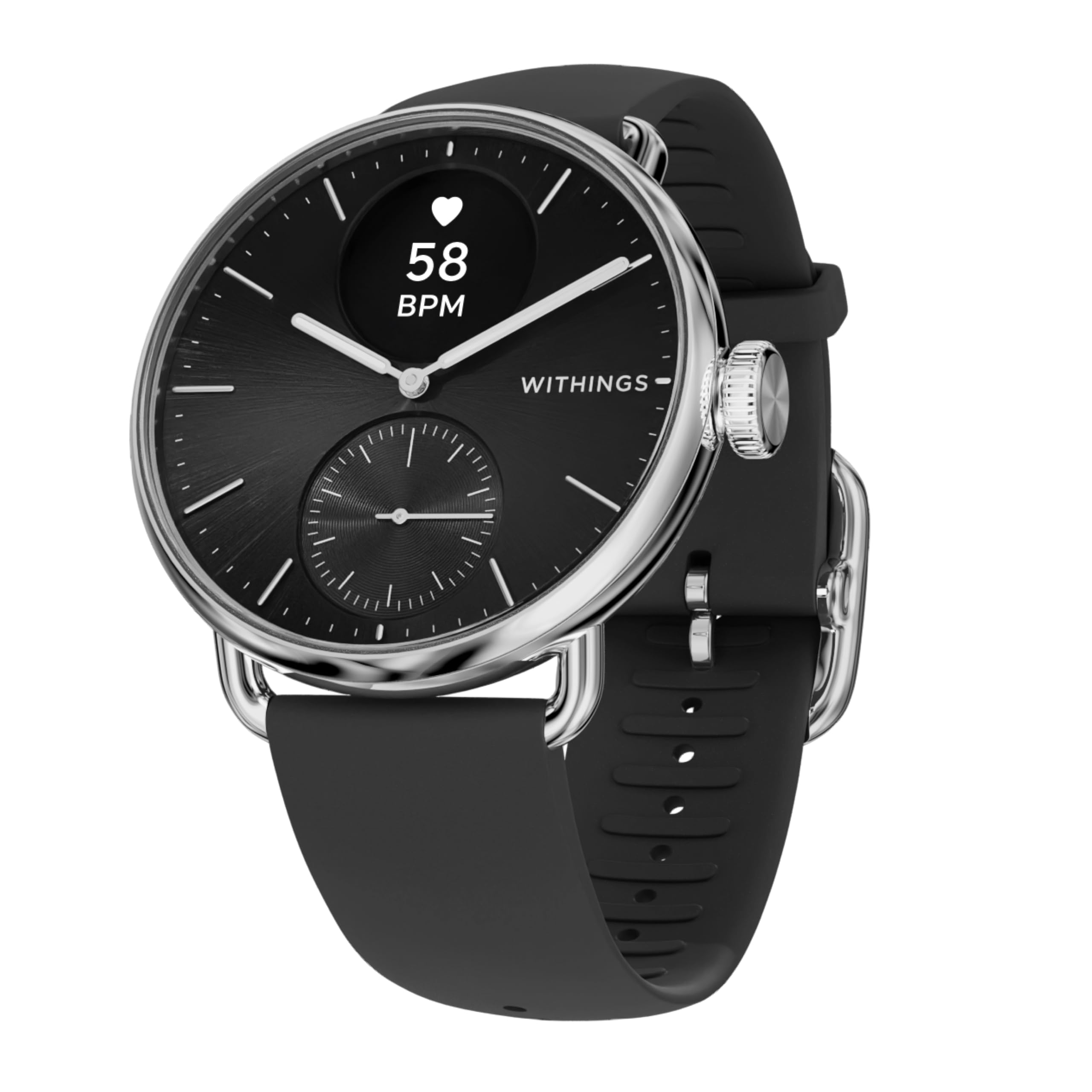
Analog hands, a sapphire crystal, and 35 days of hidden heart monitoring.
If you want a heart sensor that doesn’t look like a computer, this is it. The stainless steel case and sapphire glass read as a traditional watch, while continuous heart rate tracking and AFib detection (via the Withings ECG app) work quietly underneath. Its 30-second ECG and high-and-low heart rate notifications round out the health side.
The battery is the real eye-opener: up to 35 days of continuous use on a single charge, which leaves the 7-day picks and even the 11-day Garmin well behind. That’s longer tracking windows without the weekly charging habit. On top you get sleep stage and breathing tracking, 40+ sports with VO₂ max and heart rate zones, and a Vitality Score, all running through the HealthSense OS with on-device machine learning.
What people love is the look — appearance is the top positive trait here — and owners mention it doesn’t look like a computer on the wrist, with the software earning steady praise. Reliability, battery, and accuracy all sit as mixed notes, so treat the readings as a wellness guide rather than a lab measurement. The slim 12mm band and hook buckle keep it dressy, though the fit draws some split feedback.
Where it stands apart: A 30-second ECG and AFib detection inside a sapphire-crystal analog watch is a rare combination — you get monitoring without the gadget look.
What to keep in mind: Accuracy is a mixed theme, so this suits trend-watching rather than anyone who needs clinical precision.
The pick if: you want heart monitoring on a watch you’d wear with a suit.
Choose differently if: you want the tightest possible accuracy and a full color touchscreen.
9. Garmin Forerunner 970, 47mm

A training lab on the wrist, with running power straight from the sensor.
For anyone training toward a race, the Forerunner 970 goes deepest. Its wrist-based running dynamics cover cadence, stride length, and ground contact time, and wrist-based running power gives you a continuous read on how much force you’re putting into the ground — no extra foot pod needed. A training readiness score pulls from sleep, recovery, training load, and HRV status.
Specs back up the ambition: up to 15 days in smartwatch mode or 26 hours in GPS mode from a 560 mAh battery, the largest cell on this list. The AMOLED display is its brightest, paired with button controls, a titanium bezel, sapphire lens, and a built-in LED flashlight for late runs. Full-color built-in maps and multi-band GPS keep you on route, with dynamic round-trip routing when you break off the path. Multisport auto-transition handles swim, bike, and run splits on race day.
Design is clearly what buyers love most — the leading positive here — and the bright screen with its bezel and buttons gets steady praise. Battery life and tracking both register as wins. The catch is value, which splits opinion, so this is a tool you buy for its training depth rather than broad appeal. An ECG app records your heart rhythm where available, for people 22 years or older. Some advanced running metrics, like step speed loss, need the separate HRM 600 monitor.
Built for the start line: Wrist running power, HRV-based training readiness, and full-color maps put pro-level data on your arm without add-ons.
Know before you commit: A few deeper metrics require the sold-separately HRM 600 monitor, so budget for that if you chase every number.
Reserve it for: triathletes and runners chasing race-day performance who want running power and maps on the wrist.
Overkill if: you mainly want all-day heart tracking and the occasional workout log.
Know the Specs
Optical Heart Rate vs ECG
An optical sensor shines light into your skin and reads the pulsing blood flow back — it’s continuous and invisible, which is why wrist watches can track around the clock. An ECG is a different animal: it needs you to hold still and touch the watch for a short reading, and it records your heart’s rhythm for that moment. Devices like the Withings Scanwatch 2 and the Garmin Forerunner 970 include an ECG app, while most of this list relies on optical tracking alone.
What HRV and “Readiness” Actually Mean
HRV measures the tiny variation between heartbeats, which tends to move with how recovered or stressed you are. Watches turn that into a readiness or daily score that weighs recent activity and sleep. The Apple Watch Series 12 measures HRV as often as every five minutes. The Garmin vívoactive 5 folds HRV status into a Body Battery energy score — a useful trend, even if no wrist sensor reads it like a lab.
mAh, Days, and Real Battery Expectations
Battery capacity in mAh (milliamp-hours) tells you how much stored energy a device carries; battery life in days tells you how that plays out in practice. They don’t always line up: the Fitpolo packs 350 mAh for 7 days, while the Xiaomi Mi Smart Band 10 carries just 200 mAh yet runs 21 days. Display brightness and always-on features drain the difference. Read both numbers, then ask how often you want to charge.
Water Ratings And Fit
An IP68 rating means the device survives dust and water immersion to a specified depth — enough for rain, sweat, and pool splashes — while the Fitbit Sense 2 carries a 50-meter water resistance rating for swimming. Fit matters just as much to accuracy: a band that slips over your wrist bone will drift. Wider 22mm bands spread pressure more evenly, while slimmer 12mm and 20mm straps feel dressier. Tighten one notch past comfortable during workouts.
Common Questions
How accurate is a wrist heart rate sensor compared to a chest strap?
Why does my heart rate spike or drop when I’m not exercising?
Can I swim with these wrist heart rate devices?
Do I need an ECG to monitor my heart rhythm?
How long should a full charge take on these trackers?
Will a bigger battery always mean more days of tracking?
Do these watches track sleep automatically without pressing anything?
Which of these works without being tied to a specific phone?
Is a hybrid watch with analog hands as accurate as a full smartwatch?
How do I keep the heart readings consistent day to day?
The Bottom Line
For most people, the wrist heart rate sensor worth landing on is the Apple Watch Series 12. It reads HRV as often as every five minutes and background heart rate every five seconds — about as close to continuous as a wrist gets. Buyers back that up: 4.5+ stars across 400+ owners. If weeks of battery matter more than constant insight, the Xiaomi Mi Smart Band 10 gives you 21 days of tracking and a 1500-nit AMOLED (bright enough to read in sunlight) for far less. And for race-day data with wrist running power and maps, the Garmin Forerunner 970 is the one to reach for.
How we choose
We do not accept paid placement. Every pick is matched to a real buyer and a real use-case; we do not hands-on test units.
Sources
Specifications: manufacturer listings and product documentation. Review insights: verified customer reviews, as of November 2026. Pricing: not shown on this page (it changes often); check the current price via the retailer link.
As an Amazon Associate, Tactical Gear Guy earns from qualifying purchases. This does not affect which products we feature.