Specs are compiled from manufacturer listings and verified buyer reviews and can change over time — please confirm the key details on the product page before buying.
Most people shopping for a period jump boot get the height right and the build wrong. A tall black lace-up looks the part on a screen, but what you actually live with is the sole construction, the shank, and whether the leather is honest full-grain or a coated split. This guide sorts seven real options by exactly those things, so you end up with a boot that holds its shape through a full day on your feet, not just in a photo.
This guide is built by comparing the manufacturers’ published specifications and the patterns across verified customer reviews, so you get each pick’s real strengths and trade-offs instead of marketing spin.
The picks below run from affordable service boots to premium USA-made reproductions, and each one is judged on welt type, shank, and outsole rather than looks alone. Here is how the best ww2 para boots shake out once you weigh build against wear.
Top Picks


How To Choose The Best WW2 Para Boots
Paratrooper boots were built tall and stiff for a reason. The 10-inch or 11-inch shaft locks your ankle down, so you get support on uneven ground. The sole has to survive ground impact and rough terrain without folding. That is the design you are buying, if you want it for reenactment, uniform wear, or just the look.
The sole is the whole decision
A Goodyear welt is a stitched sole: thread runs through the upper, the welt, and the outsole instead of glue alone. It costs more to build, and it is the clearest sign of a boot you can resole instead of replace. An oil-resistant rubber outsole is the other half — it keeps grip on wet concrete and gravel.
What the shank does for your legs
A steel shank is a stiff strip buried under the arch of the foot. It keeps the boot from folding at the arch, which takes load off your heel and calf during long hours on your feet. You never see it, but you feel it in your arches by the end of a long shift.
Laces versus a side zipper
Twelve-eyelet lacing gives you the tightest, most adjustable fit — and the slowest way in and out. A side zipper gets you out of the boot in seconds, which matters on a shift change. The trade-off is that the zipper becomes the weak point on cheaper builds, so a zipper flap guard and a branded zipper are worth looking for.
Leather that takes a shine
Spit-shineable leather has a smooth, tight grain that takes polish and holds a mirror finish for inspection. Unlined interiors breathe better on long days but mold to your foot differently than lined ones, so pick before you size.
Side-by-Side Comparison
| Model | Best For | Shaft Height | Sole Construction | Weight | Amazon |
|---|---|---|---|---|---|
| Corcoran 10″ Original Unlined Jump Boot 1500★ Best Overall | Everyday wear and uniform use | 10 inch | Goodyear welt, oil-resistant rubber outsole | — | Amazon |
| ROCKY Tall Waterproof Insulated Paratrooper BootsAll-Weather Pick | Cold, wet public-service shifts | 10 inch | Goodyear welt, oil-resistant rubber outsole | 4.5 pounds | Amazon |
| Bates Men’s Enforcer 11 Inch Paratrooper BootFast On, Fast Off | Fast on and off at shift change | 11 inch | High-performance outsole | — | Amazon |
| Rothco Leather Jump Boots, 10 Inch | Reenactment and rugged outdoor use | 10 inch | Storm welt, oil-resistant beveled outsole | — | Amazon |
| Mil-Tec Men’s 18542000 Hiking Boots | Period-accurate US paratrooper reproduction | Calf high | Stitched sole, screwed heel | — | Amazon |
| Corcoran Men’s 10″ Jump Boot 975 | AR-670-1 army ASU wear | 10 inch | Goodyear welt, rubber outsole | 2 pounds | Amazon |
| Corcoran 985 Unlined Side Zipper Jump Boot | Long shifts with quick changes | 10 inch | Storm welt, 120+ oil-resistant lug outsole | 27 ounces per boot | Amazon |
Detailed Reviews
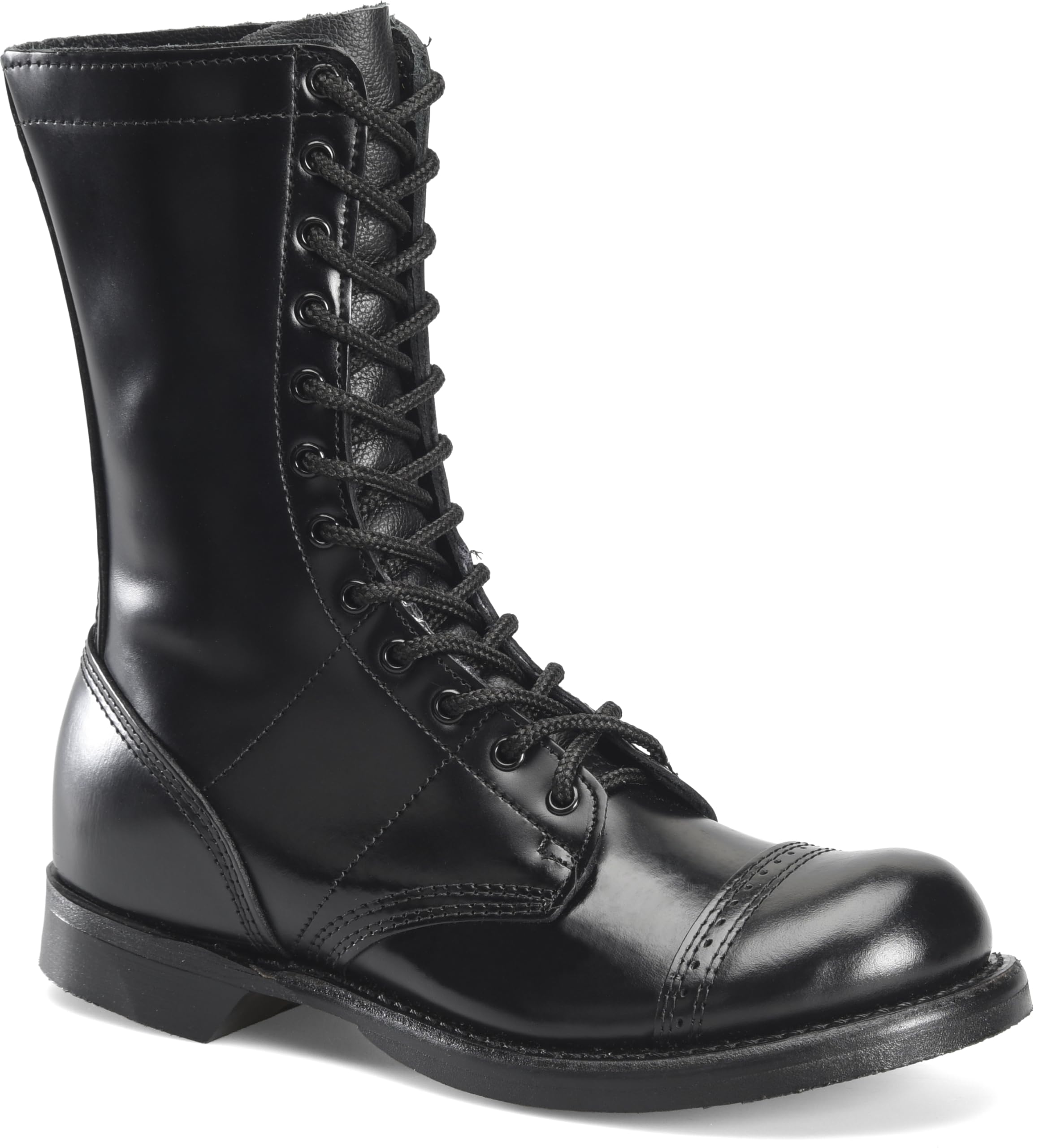
1. Men’s 10″ Original Unlined Jump Boot 1500
Our pick — 4.5+★ from 250+ verified ratings; the strongest balance of quality and price.
A stitched-sole, USA-made jump boot that keeps its shape long after the shine wears in.
What separates this Corcoran from a lot of tall black boots is the Goodyear welt — a stitched sole construction instead of glue — paired with an oil-resistant rubber outsole and a beveled heel. That combination means the upper is threaded to the sole rather than stuck to it, so the boot holds together under repeated ground impact. For a paratrooper-style boot, that is the part that matters most.
The unlined interior is the second half of the story. No lining means air moves through the boot better, and the cushioned insole plus soft toe cut down on the pinching that stiff leather usually causes in the first weeks. Ankle support is where this design earns its keep — the 10-inch shaft locks the joint down without a separate brace. The leather itself reads as the real thing, which is why build quality is the thing that wins people over here.
The honest catch is break-in. Stiff, honest leather takes time before it softens around your foot, and a 10-inch shaft gives you more leather to work through than a low boot does. Sizing is the other thing to watch — do not assume your sneaker size transfers over, especially if you plan to wear thicker socks.
Why This One Leads
- Goodyear welt construction stitches the upper to the sole for long-term durability
- Unlined interior breathes and softens into your foot over time
- Oil-resistant rubber outsole with a beveled heel for grip on varied surfaces
- Ankle support from the full 10-inch shaft, not an add-on brace
What To Expect
- Honest leather needs a real break-in period before it feels soft
- Size carefully — the fit does not map cleanly to everyday shoe sizing
Top of the list: the strongest all-round jump boot here for anyone who wants a stitched sole and a real leather upper for daily or uniform wear.
Think twice if: you want a boot that feels broken in on day one — this one asks for patience.
2. ROCKY Men’s Tall Waterproof Insulated Paratrooper Boots
The cold-weather jump boot that keeps water out and warmth in, at a real weight penalty.
This is the boot for wet pavement, slush, and cold morning roll calls. Rocky builds it with full-grain leather, a waterproof membrane, and 200 grams of Thinsulate insulation — the synthetic fill that traps warmth on cold days. A padded collar and fully gusseted tongue keep moisture, dirt, and debris from creeping down the shaft.
Here is the weight reality: this boot lands at 4.5 pounds, against 2 pounds for the Corcoran 975 further down this list. You feel that at the end of a long shift. The payoff is genuine weather protection and a contoured EVA footbed that cushions all day. Full-grain leather with a smooth toe cap and heel also takes a proper spit-shine when you need the polish.
The real sticking point is the side zipper. It is the fastest way in and out, but zipper failure is the recurring gripe on this model, and the fit runs small for a fair number of wearers. Order with room to spare, and treat the zip as a convenience rather than a daily crank.
Weather where it counts: waterproof construction and 200 grams of Thinsulate insulation make this the pick for cold, wet duty days. The smooth leather toe and heel are built to shine for inspection.
The honest trade: at 4.5 pounds versus 2 pounds for the Corcoran 975, and sizing leans small — the zipper is the other thing to keep an eye on.
Reach for this if: your boots see rain, sleet, and freezing mornings and you would rather carry extra weight than wet feet.
Look elsewhere if: you want a light, breathable boot for warm indoor work.
3. Bates Men’s Enforcer 11 Inch Paratrooper Boot
An 11-inch uniform boot built around a side zip, so you are out the door in seconds.
Bates has been making uniform footwear since 1885, and the Enforcer carries that lineage in its shape — a tall 11-inch shaft, durable leather, and a professional polishable toe that holds inspection shine. The side zipper is the headline feature: lace it once to your fit, then use the zip for every entry after that. The high-performance outsole keeps grip steady on hard floors and pavement.
Comfort is the surprise here. These are boots you can genuinely stay in — buyers report walking for three hours without discomfort, which for a stiff paratrooper silhouette is a serious claim. Quality is the thing people come back to praise, and it shows in the leather and the polishable finish.
The trade-offs are fit and longevity. Fit is genuinely mixed: some find it spacious, others find it narrow across the top of the foot, so try before you commit. On durability, the leather holds up well but sole separation shows up as the recurring wear point. That is the part to keep an eye on if you log heavy miles.
What Earns It A Place
- Side zipper makes the tall shaft manageable on a busy shift change
- Polishable toe keeps uniform standards easy to meet
- Long-wearing comfort for a stiff, tall boot
- High-performance outsole for steady footing
Where It Hesitates
- Fit runs wide for some feet and narrow across the top for others
- Sole separation is the wear point to watch over time
Suits you if: you wear a uniform boot every day and want a tall, polishable silhouette without wrestling twelve-eyelet laces each morning.
skip it if: your feet run narrow across the instep — that is the fit complaint to take seriously.
4. Rothco Leather Jump Boots, 10 Inch

Ten inches of brown leather with a steel shank, aimed squarely at period reenactment and hard ground.
Rothco goes after the WW2 look directly, and for buyers chasing a brown leather jump boot for reenactment this is one of the few options on the list that fits the part. The 10-inch shaft and 12-eyelet lacing lock your ankle down hard, and an internal steel shank runs under the arch to cut the strain your heel and calf would otherwise take.
The build details are solid on paper: a storm welt (a stitched sole construction that helps wick moisture) keeps your feet dry in mixed conditions. An oil-resistant beveled outsole handles rugged terrain, so you get grip on loose ground. A cushioned impact-absorbent insole softens the strike from jumping and hard landings, so your knees take less shock. You also get two pairs of laces — one leather, one nylon — so you can swap the look without hunting for replacements.
The catch is consistency. Check your pair carefully on arrival, and do not expect the leather to be supple from the start.
Period look, proper bones: steel shank, storm welt, and a 12-eyelet lace system make this the pick for reenactors who want the brown leather silhouette with real ankle lockdown.
Order with eyes open: quality varies between pairs, so inspect what arrives and treat the break-in as a real process.
Built for: WW2 reenactment and outdoor work where the brown leather look and a steel shank matter more than a broken-in feel on day one.
Not for: anyone who wants guaranteed consistency from pair to pair — check yours thoroughly.
5. Mil-Tec Men’s 18542000 Hiking Boots

A straight reproduction of the US Army paratrooper boot, right down to the stitched sole and screwed heel.
If your goal is to look like the reference photo and not just approximate it, this is the most literal option here. Mil-Tec built it as a reproduction of the US Army paratrooper boot that came into use in 1942 and replaced the M43 combat boot in 1944. That period detail is the whole point — you are buying a silhouette, not a modern hiking boot, despite the listing name.
The construction matches the era: 12-hole lacing up the shaft, a stitched sole rather than a glued one, a screwed heel, and tight seams throughout. That stitched sole is the durability feature to care about, since it is the same approach that lets a boot be rebuilt rather than binned. Owners come back on quality more than anything else, and the leather reads as thick and substantial.
Thick means stiff here. The leather is genuinely thick and firm, which is period-correct but not gentle on your feet at first. Fit is also a coin flip — some find it snug like a glove, others find it runs about half a size big. Check the sole too: the arch portion of the outsole is not leather, which matters if you were expecting an all-leather build.
The Reproduction Case
- Faithful 1942-pattern US Army paratrooper design
- Stitched sole and screwed heel for rebuildable longevity
- Tight seams and 12-hole lacing for a locked-in fit
What To Weigh First
- Thick, stiff leather takes real time to soften
- Sizing splits — some find it snug, others find it half a size big
- The arch section of the outsole is not leather
Right for history buffs: reenactors and collectors who want a period-correct US paratrooper reproduction with a stitched sole.
Wrong for comfort-first buyers: the thick, firm leather is authentic, not forgiving.
6. Men’s 10″ Jump Boot 975
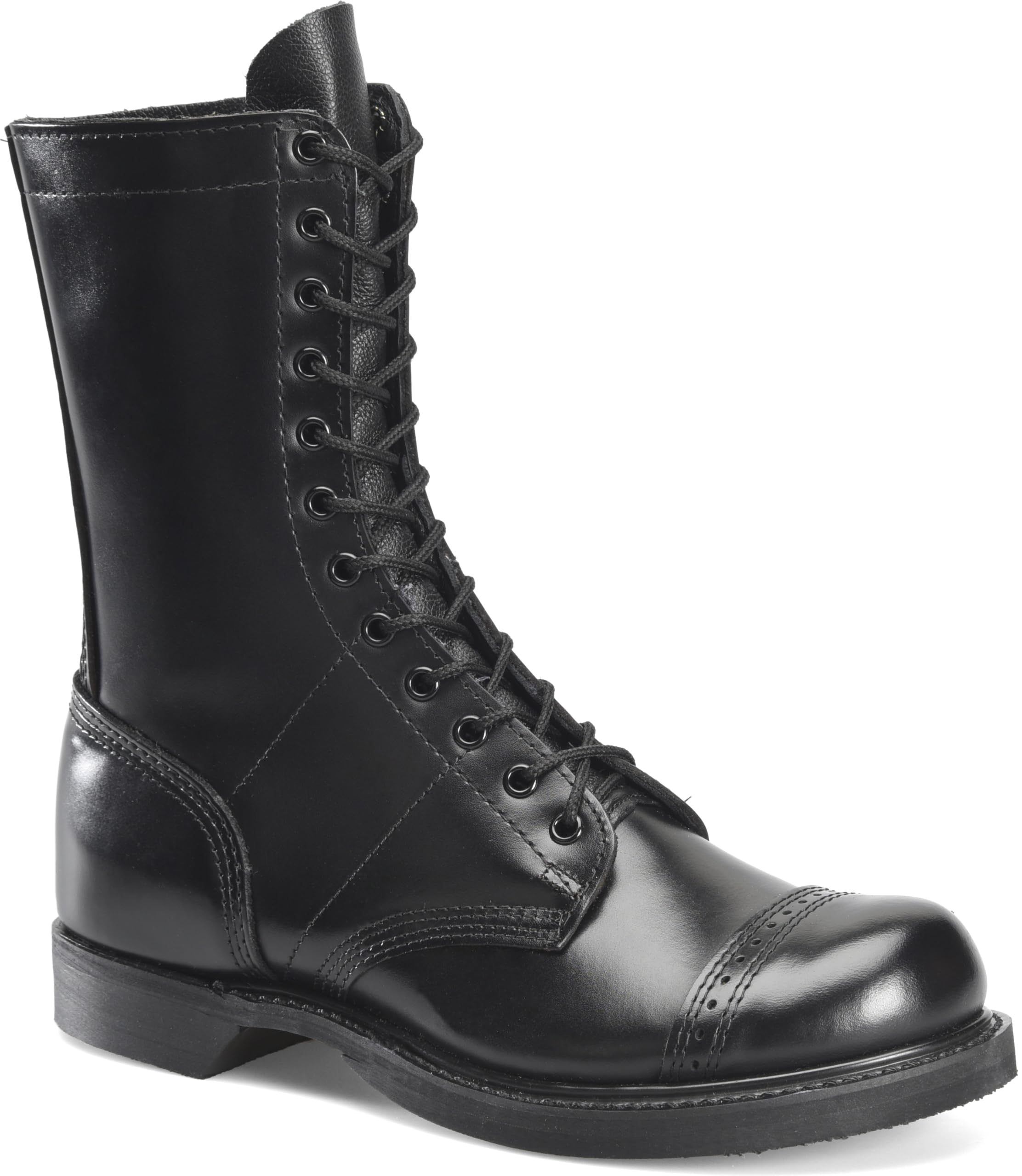
Two pounds of Goodyear-welted leather that meets uniform standards without dragging you down.
Weight is the argument here. At 2 pounds this Corcoran is the lightest boot on the list, against 4.5 pounds for the Rocky. For a tall 10-inch jump boot, that is a genuinely unusual number — most boots in this silhouette carry noticeably more mass.
You are not giving up construction to get there. The 975 pairs a premium leather upper with Goodyear welt stitching, a cushioned insole, and internal ankle support, plus a durable rubber outsole. It also carries the detail that uniform buyers need: it meets AR-670-1 standards for army ASU wear. Fit lands well, and the polished look is one of the things buyers come back to mention.
The honest caveat is surface wear. Scuffing shows up more than you might expect, so this is a boot you keep polished rather than one you treat rough. The leather is tougher than the finish suggests, but the easy-scuff trait is real.
Weight where it pays off: at 2 pounds it is the lightest boot here, giving you the tall jump-boot silhouette without the drag of the Rocky’s 4.5 pounds.
The finish needs care: scuffs show up readily, so plan on keeping the polish handy.
Best for lightness: uniform wearers and anyone who wants a Goodyear-welted jump boot that does not feel like a brick at day’s end.
Keep in mind: the surface scuffs easily, so it rewards a regular polish routine.
7. 985 Unlined Side Zipper Jump Boot

The premium zip boot: performance leather, a heavy-duty YKK zipper, and a lug outsole that grips.
Where the Bates keeps its zip simple, this Corcoran upgrades it. The 985 runs a heavy-duty YKK zipper with a zipper flap guard, so you get the fast on-and-off without trusting a cheap pull. The 10-inch upper is cut from performance “spit-shineable” leather that takes inspection polish, and the unlined interior keeps air moving through the boot on long hours.
Underfoot is where the money went. A DRYZ cushioned insole handles cushioning, a steel shank supports the arch, and storm welt construction plus a one-piece oil-resistant lug outsole give you traction on rough ground. Each boot stands about 10 inches high and weighs 27 ounces. The Garrison Army Munson last shapes the fit, and comfort is the thing buyers praise most about this model.
Two things to plan for. Sizing runs about half a size too big, so size down. And durability is uneven — most boots hold up for a long time, but the snap can fail early on a bad unit. That is a small share of the whole picture, but worth knowing going in.
Where The Money Went
- Heavy-duty YKK zipper with a flap guard for reliable daily use
- One-piece oil-resistant lug outsole with storm welt construction
- DRYZ cushioned insole over a steel shank for arch support
- Spit-shineable leather that passes inspection polish
Worth Knowing
- Sizing runs about half a size too big — order down
- The snap is the weak point on the occasional bad unit
The premium pick: buy this if you want a fast side zip without giving up a YKK zipper, spit-shine leather, and a lug outsole — and you accept sizing down half a size.
The one caveat: check the snap on arrival, since it is the only part that has failed early for anyone.
Know the Specs
Goodyear Welt vs Storm Welt
Both are stitched constructions, not glued. A Goodyear welt threads the upper to the sole so the boot can be repaired rather than thrown out when the outsole wears. A storm welt adds a raised lip that sheds moisture at the seam. Either way, a stitched sole is the single clearest sign of a boot built to last.
Steel Shank and Triple Rib Steel Shank
A steel shank is a stiff strip buried under the arch that keeps the boot from folding at the waist. It takes load off your heel and calf during long shifts on your feet. A triple rib steel shank adds ribbing to that strip for more rigidity, which suits heavier work.
Shaft Height and Ankle Lockdown
These boots run 10 or 11 inches at the shaft. A taller shaft braces your ankle without a separate brace, which is the point of a paratrooper silhouette. The trade-off is more leather to break in and a little less freedom to flex.
Insulation, Waterproofing, and Weight
200 grams of Thinsulate is synthetic fill that traps warmth on cold days, and waterproof construction keeps water out of the boot. Both add weight — one boot here comes in at 4.5 pounds while a lighter build is 2 pounds — so decide whether weather protection or light feet matter more.
Spit-Shineable Leather and Unlined Builds
Spit-shineable leather means a tight, smooth surface that accepts polish and holds a mirror finish for inspection. An unlined interior skips the inner fabric layer so air moves through better, which helps on long hours but changes how the boot breaks in.
Lacing and Zipper Systems
A 12-eyelet lace system gives you the tightest, most adjustable fit, and it is the slowest way in and out. A side zipper trades some of that precision for speed, so look for a zipper flap guard and a branded zipper to reduce the risk of early failure.
Common Questions
Are these the same boots US paratroopers actually wore in WW2?
Should I size up or down in a tall jump boot?
Is a side zipper weaker than laces on a jump boot?
What does a steel shank actually do in these boots?
How long does break-in take on a leather jump boot?
Can I wear these boots for work rather than reenactment?
Are these boots good for cold and wet weather?
Will a stitched sole really outlast a glued one?
What is the difference between unlined and lined jump boots?
How do I keep the polish looking sharp on a spit-shineable boot?
The Bottom Line
For most people the winning pick is the Corcoran 1500, because a Goodyear-welted sole and unlined leather give you a jump boot that holds up over years rather than seasons. If cold, wet shifts are your reality, the Rocky Paratrooper brings waterproof construction and 200 grams of Thinsulate at the cost of weight. And if you want the fastest way in and out with the best zipper hardware, the Corcoran 985 is the one to reach for. The ww2 para boots shortlist above covers the whole spread, so match the sole and the shaft to how you will actually wear them and you will not go wrong.
How we choose
We do not accept paid placement. Every pick is matched to a real buyer and a real use-case; we do not hands-on test units.
Sources
Specifications: manufacturer listings and product documentation. Review insights: verified customer reviews, as of November 2026. Pricing: not shown on this page (it changes often); check the current price via the retailer link.
As an Amazon Associate, Tactical Gear Guy earns from qualifying purchases. This does not affect which products we feature.