Specs are compiled from manufacturer listings and verified buyer reviews and can change over time — please confirm the key details on the product page before buying.
If you want the shortest possible answer: the Canon EOS R6 Mark II is the camera most creators should buy, because its autofocus locks onto your face and eye and holds it while you talk. The catch is that a camera body alone does not record a channel. Below you will find the pocket gimbals that shoot while you walk, the entry-level bodies that finally make sense of interchangeable lenses, and the cinema rigs built for people who colour-grade their own footage.
This guide is built by comparing the manufacturers’ published specifications and the patterns across verified customer reviews, so you get each pick’s real strengths and trade-offs instead of marketing spin.
A camera only earns its place here if it records 4K, tracks a moving subject, and survives a real filming session. That is the filter behind every pick in this youtube camera roundup.
Top Picks


How To Choose The Best YouTube Camera
Filming yourself is a different job from taking photographs. The camera has to hold focus on your face as you move, steady the frame when you walk, and take a microphone without an adapter. Get those three right and your footage looks professional at any price.
Autofocus that holds a face, not a wall
Face and eye detection is the single most useful feature for a talking-head channel. The camera finds your eyes and keeps them sharp even when you lean in or turn sideways. Phase detection autofocus (a system that measures distance quickly across the frame) is what makes this feel instant rather than hunting back and forth.
Sensor size and what it buys you
A 1-inch sensor gathers more light than a phone, so a dim room stays usable without extra lamps. A full-frame sensor goes further and gives you that soft blurred background behind your head. Bigger sensors also mean heavier lenses and rigs, so match the sensor to whether you film at a desk or on the move.
Stabilization for handheld work
A 3-axis gimbal (a motorized arm that counteracts your hand movement) lets you walk and talk without a tripod. In-body stabilization smooths small shakes but cannot fix a full walking stride. If you film while walking through a space, a gimbal steadies the shot more than any sensor upgrade.
Side-by-Side Comparison
| Model | Best For | Sensor | Top Video Spec | Screen | Amazon |
|---|---|---|---|---|---|
| Canon EOS R6 Mark II★ Best Overall | Talking-head and hybrid work | Full-frame 24.2MP | 4K 60fps, 180fps Full HD | 3.0-inch vari-angle | Amazon |
| Xtra MuseBest Value | Budget pocket vlogging | 1-inch CMOS | 4K 120fps | 2-inch touch | Amazon |
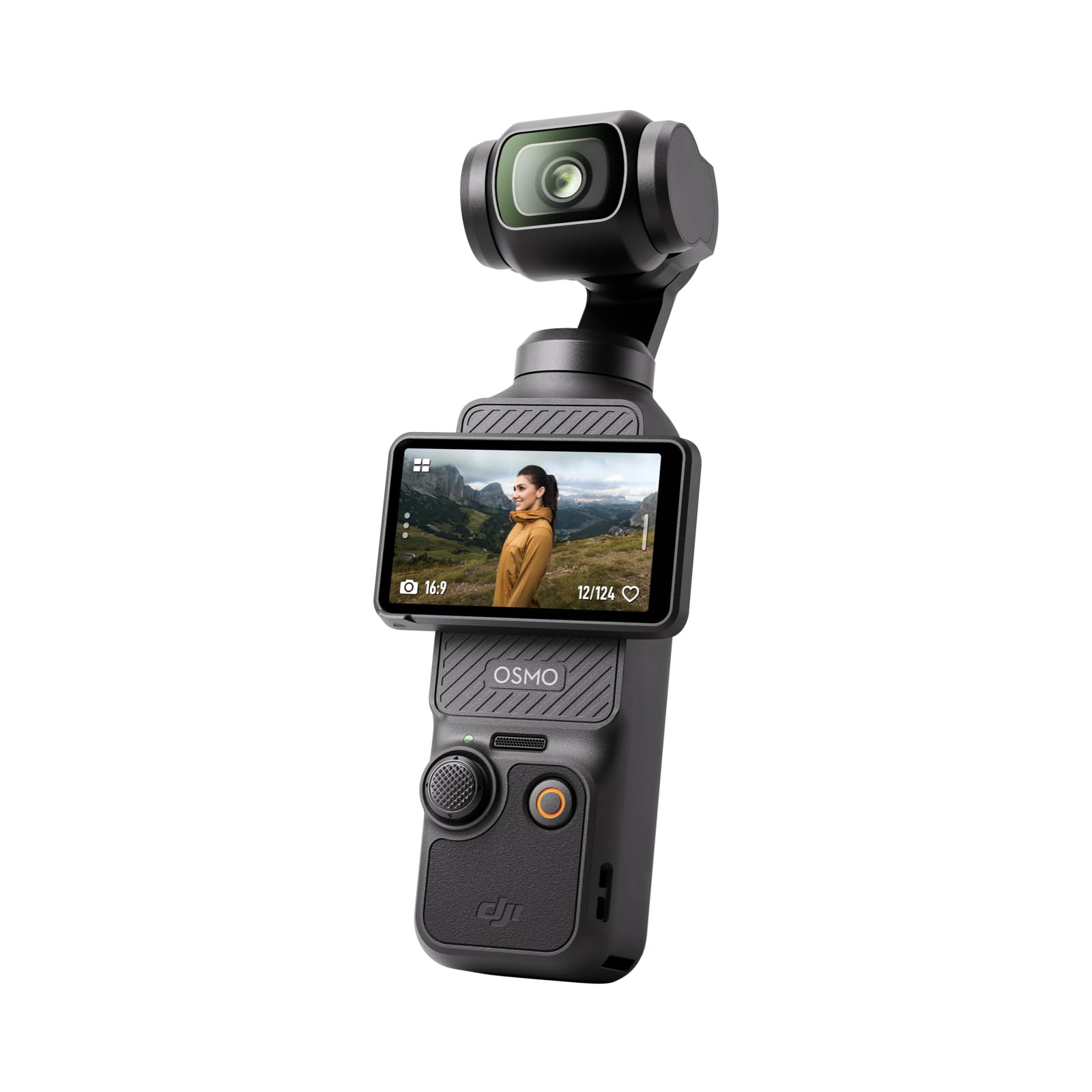
| DJI Osmo Pocket 3Most Portable | Travel and walking shots | 1-inch CMOS | 4K 120fps | 2-inch rotating touch | Amazon |
| Canon EOS R100 Kit | First interchangeable-lens body | APS-C 24.1MP | 4K 24fps | — | Amazon |
| Nikon Z 30 | Streaming and solo filming | APS-C | 4K 30p, Full HD 60p | Flip-out selfie monitor | Amazon |
| Insta360 Luna Pro | 8K detail and colour grading | 1-inch 8K | 8K 30fps, 4K 60fps | Detachable 2-inch OLED | Amazon |
| Sony ZV-E10 | Product and object close-ups | APS-C 24.2MP | 4K from 6K oversampling | — | Amazon |
| Blackmagic Pocket 4K Bundle | Raw recording on a budget | 4/3-inch, 4096 x 2160 | 4K ProRes and 12-bit RAW | 5-inch LCD | Amazon |
| Sony Alpha a6700 | Fast action and high frame rates | APS-C 26MP | 4K 120p | — | Amazon |
| Blackmagic Cinema 6K | Cinematic full-frame raw | Full-frame 6K, 6048 x 4032 | 6K 12-bit Blackmagic RAW | 5-inch HDR tilt | Amazon |
| Nikon Z6 III | Internal 6K raw and slow motion | Full-frame | 6K 60p N-RAW, 4K 120p | — | Amazon |
Detailed Reviews
1. Canon EOS R6 Mark II Mirrorless Camera (Body Only)
Our pick — 4.5+★ from 650+ verified ratings; the strongest balance of quality and price.
The one that keeps your eyes sharp while you talk with your hands.
This is the pick for the creator who films themselves at a desk and wants the camera to carry the focus work. Its full-frame 24.2 megapixel sensor (the light-gathering chip inside, bigger than the APS-C sensors further down this list) reads clean detail in a normal room. Canon’s head, face and eye detection locks onto a person’s left or right eye and tracks the whole body as you shift in your chair.
The video numbers are why it sits at the top. It records 6K-oversampled uncropped 4K at up to 60 fps, and Full HD at up to 180 fps without overheating — a high frame rate that lets you slow a hand gesture to a crawl in the edit. That Full HD figure is 180 fps versus the 60 fps the Canon EOS R100 kit below can manage. Add the 3.0-inch vari-angle touchscreen and you can flip the screen toward yourself and frame a shot from nearly any angle.
What wins people over is sheer quality — it is comfortably the most-praised thing about this body. The DIGIC X processor (Canon’s image brain) keeps noise low at high ISO, and built-in 5GHz Wi-Fi with Bluetooth 5 pushes files straight to the Canon Camera Connect app. The honest catch is the price tier: this is a premium body-only listing, so you still need a lens and the RF glass adds real cost. An occasional viewfinder or firmware gripe shows up in the reviews, but the weight of opinion sits firmly on the positive side.
Where it pulls ahead
- Full-frame 24.2MP sensor keeps low-light footage clean indoors.
- 4K at 60 fps and Full HD at 180 fps, uncropped and without overheating.
- Eye detection tracks people and animals automatically.
- 5GHz Wi-Fi and Bluetooth 5 for fast wireless transfers.
What to weigh first
- Body-only listing — budget for a lens on top.
- Premium tier pricing puts it out of reach for a first setup.
- Full-frame glass is heavier than the pocket options here.
Buy this one if: you film at a desk or in a studio and want the camera to hold focus without a second operator.
Keep looking if: you shoot on the move — a gimbal pocket camera below will serve you better for walking shots.
2. Xtra Muse Vlogging Camera with 1” CMOS & 4K/120fps
A gimbal pocket camera that undercuts the big names and still shoots 4K at 120 fps.
If you want the DJI-style pocket format without the flagship tier spend, this is the one to look at. The 1-inch CMOS sensor (a chip much larger than a phone’s) records 4K at 120 fps, and the 3-axis gimbal stabilizer smooths out dancing, running or hiking. A 2-inch touchscreen flips between horizontal and vertical shooting with a tap, which saves you re-framing for Shorts.
Its battery is rated at 161 minutes, which lands within a whisker of the DJI Osmo Pocket 3 at 166 minutes — close enough that the difference will not decide your day. You also get True 10-bit X-Log colour, which means the camera can record up to a billion colour shades and you can push the grade further when editing sunrises and sunsets. Master Follow keeps you centre-frame on a tripod while you jump or spin.
The bundle covers the extras that usually sting: carrying bag, wrist strap and a handle with a 1/4″ thread for standard tripod mounting. It takes Micro SD cards at V60 speed class, so buy a card rated that high or your 4K footage will stutter. The main trade-off is the app and accessory ecosystem — this is a newer brand, so the community of tutorials and add-on gear is thinner than what surrounds the DJI name.
Why it earns the value badge: you get the 1-inch sensor, 4K/120fps, and the same class of gimbal stabilization as the pocket flagship at a friendlier tier.
The practical note: match it with a V60 Micro SD card and a spare battery, and it will run a full vlog day.
Go here if: you want pocket-gimbal footage and 10-bit colour without flagship spend.
Think again if: you rely on a deep ecosystem of accessories and community presets built around a major brand.
3. DJI Osmo Pocket 3 Vlogging Camera
The pocket gimbal that made walking-and-talking footage a one-hand job.
Filming while you move is the whole point here. The 1-inch CMOS sensor records 4K at 120 fps, and the 3-axis mechanical stabilization keeps the frame level while you chase a pet or hike a trail. ActiveTrack 6.0 holds a subject centre-frame — set it on a tripod, jump, dance or spin, and it keeps you in shot.
Two features push it past the Xtra Muse above for travel creators. First, the 2-inch touchscreen rotates for horizontal and vertical shooting, so a Short and a full video come from the same take. Second, DJI OsmoAudio connects directly to two DJI Mic 2 or Mic Mini transmitters, which means clean wireless audio without a separate receiver box. Stereo recording is onboard as well, and D-Log M with 10-bit colour gives you the same billion-shade grading headroom.
Video quality is what the reviews circle back to — crisp 4K that slips into a small bag. The mixed signals land on battery life and long-term reliability, which is the fair question to ask before a big trip. Budget for a second battery if you film full days, and treat the folding mechanism with care. As owners sum it up, it is a camera that disappears into your pocket until you need it.
What creators keep coming back for
- 4K at 120 fps from a 1-inch sensor.
- Rotating screen switches horizontal to vertical instantly.
- Direct pairing with two DJI Mic 2 or Mic Mini transmitters.
- ActiveTrack 6.0 keeps a moving subject in frame.
Where it asks more of you
- Battery life draws mixed notes — carry a spare for long days.
- Long-term reliability is a recurring question in the reviews.
- Small gimbal arm wants gentle handling in a bag.
The ideal owner: a travel or on-the-move vlogger who wants one handheld device for stabilised 4K and wireless audio.
Not the fit for: anyone planning to shoot in the rain or rough conditions where a sealed body matters more than portability.
4. Canon EOS R100 Mirrorless Camera RF-S18-45mm Lens Kit

The cheapest real door into interchangeable lenses — and it comes with the glass.
This is the answer for a first-time creator who wants to learn what different lenses do without committing to a premium body. The 24.1 megapixel APS-C sensor (a smaller chip that still gives natural background blur) sits inside Canon’s smallest and lightest EOS R body. The kit includes the RF-S18-45mm F4.5-6.3 IS STM lens, whose optical stabilization corrects shake by up to 4 stops.
Where it holds you back is motion. It records 4K at up to 24 fps and Full HD at 60 fps — versus the 120 fps the DJI Osmo Pocket 3 can hit, so smooth slow-motion is not this camera’s strength. Dual Pixel CMOS AF covers up to 143 zones with human face and eye detection, which is genuinely useful for a talking-head shot. Continuous shooting reaches 6.5 frames per second in One-Shot AF, fine for thumbnails and stills.
The picture quality sells it — crisp, clear images from a body you can carry all day. One caveat worth knowing: a handful of reports describe units that stopped working, which is the kind of thing that can happen in any electronics batch. Buy from a seller with a clear return window and you cover yourself. For the money tier, this is the most sensible way to learn mirrorless shooting.
The beginner maths: a 24.1MP APS-C sensor plus a stabilised 18-45mm kit lens, all in Canon’s smallest and lightest R-series body.
The honest limit: 4K tops out at 24 fps, so it is a stills-first camera that also shoots video — not a slow-motion machine.
Reach for this if: you are buying your first interchangeable-lens camera and want a lens in the box.
Look elsewhere if: your videos lean on high frame rates for slow motion.
5. Nikon Z 30 with 16-50mm Wide-Angle Zoom Lens

Built from the ground up for the person filming alone in a bedroom.
Nikon aimed this one squarely at vloggers and streamers, and the details show it. A flip-out touchscreen works as a selfie monitor so you can see yourself while recording. There is a red REC light on the front, a built-in stereo microphone with adjustable sensitivity, and eye tracking for both people and pets. That is a lot of solo-shooting convenience in one APS-C body with the 16-50mm wide-angle zoom included.
The streaming side is the real differentiator against the Canon EOS R100 above. Plug it in and it works as a webcam, pushing smooth Full HD 60p over USB-C or 4K 30p over HDMI, with constant power over USB-C so a long stream does not drain the cell. Autofocus runs across 209 points with hybrid phase and contrast detection. It also mounts any NIKKOR Z lens, so the kit grows with you.
Two honest caveats. Image quality draws split opinions — some find it excellent, others see only small gains over what they had. Battery life is the bigger watch-out: it draws actual negative notes, with reports of trouble charging while plugged in. If you stream at a desk, the USB-C constant power solves that; if you roam, pack spares.
The solo-creator wins
- Flip-out selfie monitor and a front REC light.
- Plug-and-play webcam: Full HD 60p over USB-C, 4K 30p over HDMI.
- Built-in stereo mic with adjustable sensitivity.
- 209-point autofocus with eye tracking for people and pets.
Where you will feel friction
- Battery life is a genuine weak spot — mixed to negative in reviews.
- Image quality is a split verdict.
- Only USB-C constant power rescues all-day sessions.
The right match: a streamer or solo vlogger who wants selfie framing, a REC light, and webcam mode from the start.
The mismatch: a run-and-gun shooter who needs battery endurance away from a wall socket.
6. Insta360 Luna Pro 8K Vlogging Camera
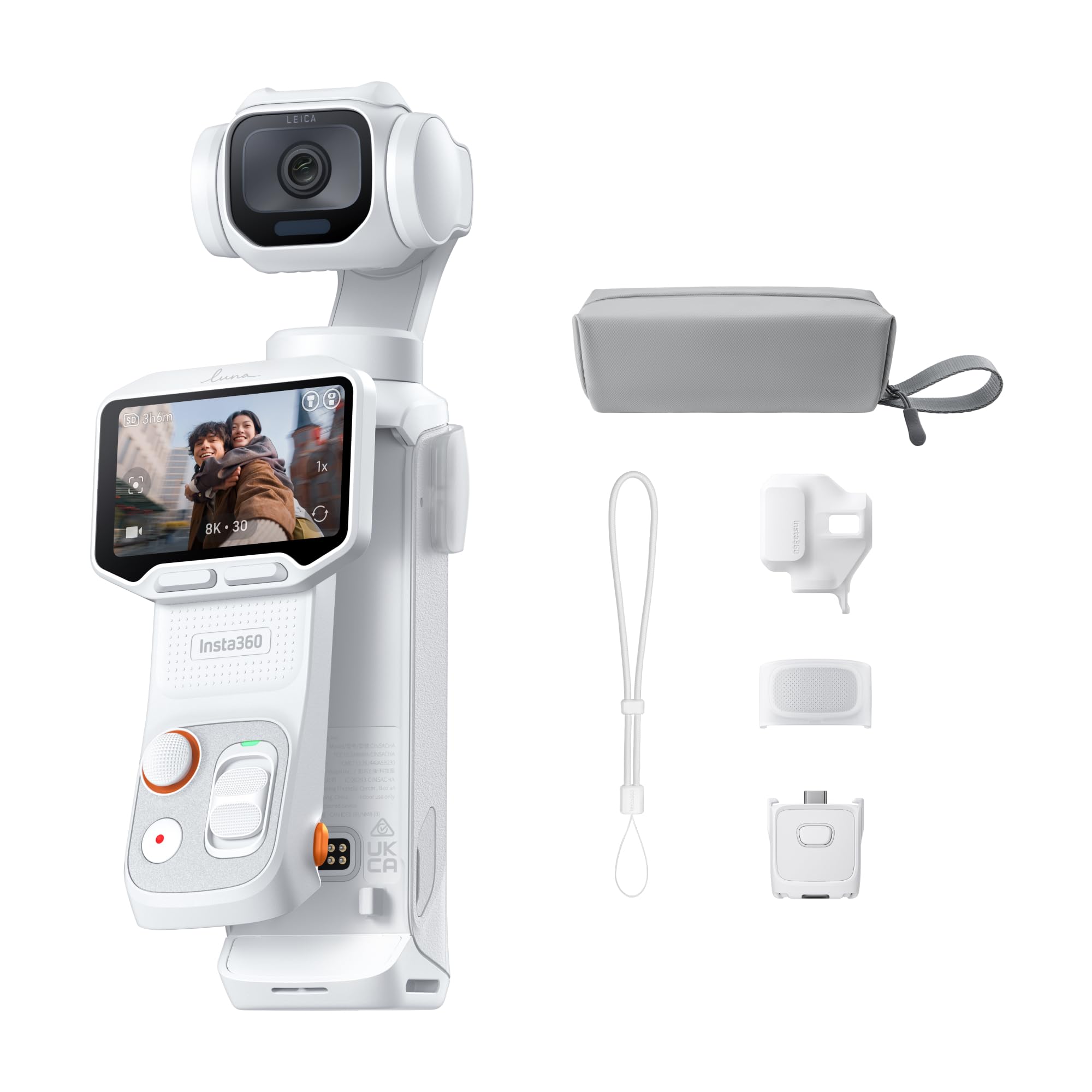
Eight-thousand-pixel footage from a gimbal you can hold in one hand.
The headline is 8K. A 1-inch 8K sensor shoots up to 8K at 30 fps with Dolby Vision, and that higher resolution means you can punch into a frame and still land on crisp 4K. Capture up to 14 stops of dynamic range (the spread between the brightest highlight and deepest shadow it holds) and you keep detail in a bright window and a dim corner at the same time. Leica colour profiles add a graded look straight out of the camera.
The detachable 2-inch OLED touchscreen is the feature that separates it from the pocket cameras above. Detach it and you get live preview and remote control up to 20m away — useful for group shots and solo setups where you cannot stand behind the camera. A twist of the screen switches to 4K at 30 fps vertical video for Shorts and Reels. Raw speed comes from 4× HighRes Zoom and 2× lossless zoom, with AI enhancement holding clarity.
On battery, Insta360 quotes up to 4 hours on a charge and fast charging to 80% in 23 minutes — that fast top-up is the difference between a dead camera and a second take. You also get 10-bit I-Log with support for ACES and DaVinci Resolve, and the Insta360 app uses AI to cut your best moments into a ready edit. The practical trade-off is storage: 8K files are enormous, so budget for large, fast Micro SD cards.
The resolution mic-drop: 8K at 30 fps with Dolby Vision from a 1-inch sensor, plus 14 stops of dynamic range and Leica colour science.
The realistic caveat: 8K eats card space fast, so plan your storage before a big shoot day.
The perfect fit: a creator who wants top-tier resolution, detachable monitoring, and cinematic colour in a pocket-able gimbal body.
Overkill for: someone who publishes at 1080p and never crops — a cheaper pocket option covers that.
7. Sony ZV-E10 APS-C Mirrorless Camera with 16-50mm Lens
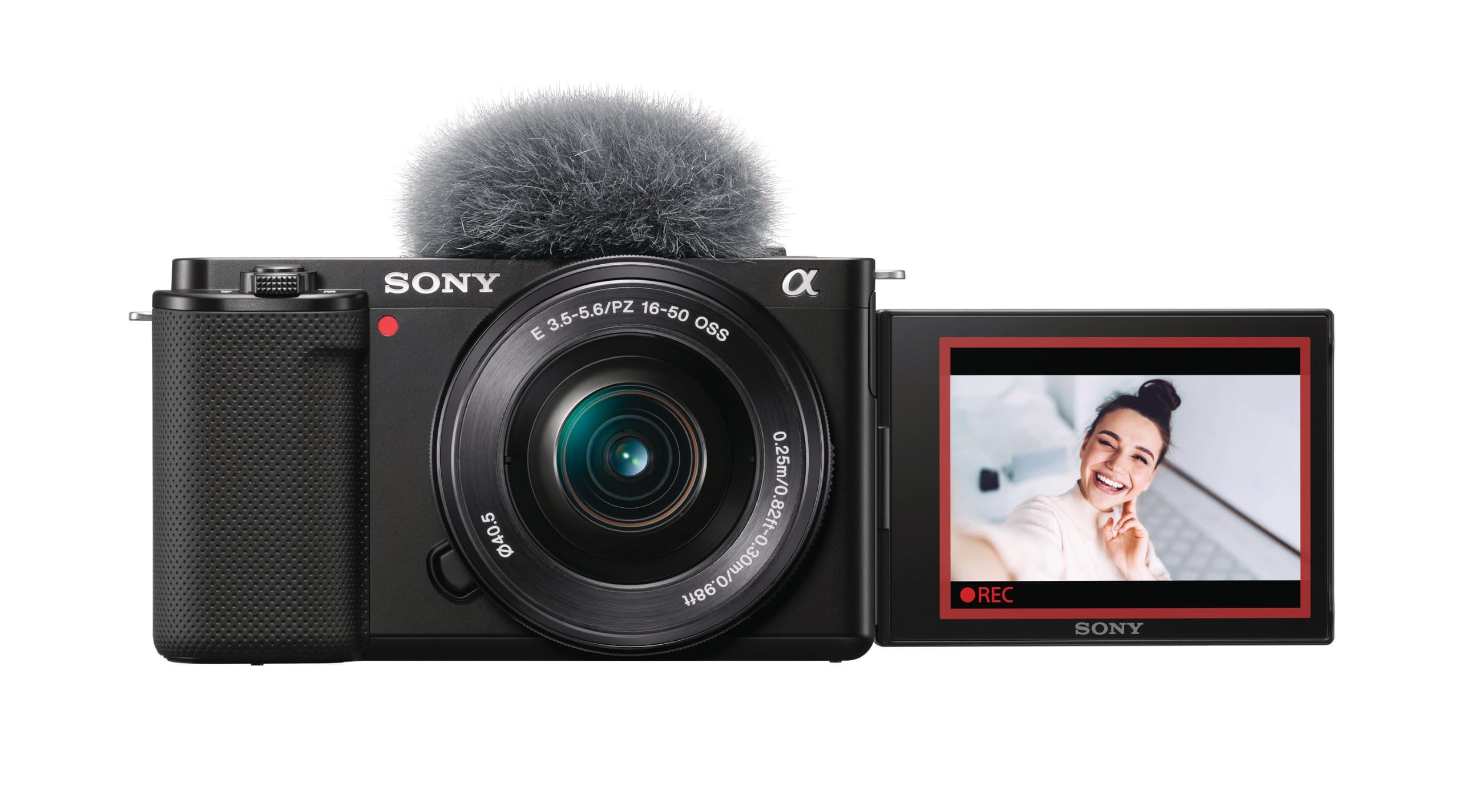
The camera that shifts focus from your face to the product in your hand.
If your channel is unboxings and hands-on reviews, this body was tuned for exactly that. The Product Showcase Setting moves focus from your face to an object you hold up in front of the lens, hands-free, without you reaching for the screen. A Background Defocus button toggles the blurred-background look on and off with one press. Both are direct answers to how review videos actually get filmed.
Underneath sits a 24.2MP APS-C Exmor CMOS sensor with Sony’s fast BIONZ X processor. It records 4K oversampled from 6K with full pixel readout and no pixel binning — a process that means every pixel in the final frame carries real captured detail rather than a guessed value. Autofocus spans 425 points with eye, face and hybrid phase detection. Live streaming runs over a single USB cable with no extra hardware.
Autofocus is the one place the reviews split, with some finding it excellent and a few reporting a failure. The rest of the consensus is warm: creators rate it highly for YouTube work and the interchangeable E-mount lens adds flexibility. The 16-50mm kit lens keeps the package light to start. If you want a camera that understands the mechanics of a review video, this is it.
Made for hands-on videos
- Product Showcase Setting switches focus between face and object.
- One-button Background Defocus for instant bokeh.
- 4K oversampled from 6K with full pixel readout.
- Single-cable live streaming with no extra hardware.
The fine print
- Autofocus reliability draws mixed reports.
- Locked to Sony E lenses if you expand later.
- Kit lens is bright enough only in good light.
Buy it for: product demos, unboxings, and any video where the subject moves from your face to an object.
Pass if: you want proven autofocus above all and prefer the certainty of a full-frame Canon system.
8. Blackmagic Design Pocket Cinema Camera 4K Power Bundle

A cinema camera in a coat pocket, with the editing suite thrown in.
This is the pick for the creator who has moved past point-and-shoot and wants to colour-grade their own footage. A 4/3-inch sensor records at a native 4096 x 2160 resolution with 13 stops of dynamic range, and dual gain ISO up to 25,600 keeps grain low when the light drops. The active MFT mount means you can fit a wide range of Micro Four Thirds lenses.
What you get for the tier is serious: Apple ProRes in all formats up to 4K and 12-bit Blackmagic RAW, recorded to SD/UHS-II, CFast 2.0, or an external SSD over USB-C. The body is carbon fiber polycarbonate composite with a multifunction handgrip, and a bright 5-inch LCD removes the need for a separate monitor. Audio goes in through mini XLR or 3.5mm jacks, with a built-in stereo mic as fallback.
This bundle is the sensible buy, because it adds two extra LP-E6 batteries and a dual charger on top of the body — enough to survive a shoot day on a power-hungry cinema camera. It also includes an activation key for DaVinci Resolve Studio, the editing and colour tool. The trade-off is that this is a dedicated video machine: no autofocus-carrying stills workflow, and you will need to learn the format.
What you are really buying: 12-bit Blackmagic RAW and ProRes up to 4K, 13 stops of dynamic range, and DaVinci Resolve Studio in one box.
The learning curve: this reward comes only after you learn to shoot for a grade — a stills-first creator will find it alien.
The right buyer: an experienced creator ready to grade their own footage and tired of compressed consumer codecs.
The wrong buyer: a beginner who wants the camera to pick focus for them.
9. Sony Alpha a6700 APS-C Mirrorless Camera Body

Slow motion and subject tracking that punch far above its sensor size.
For anyone filming fast action — sport, dance, a pet bolting across a room — this body leads the field here. It records 4K at up to 120p, which is a jump over the 60 fps ceiling on several bodies above. The 26.0MP APS-C Exmor R back-illuminated sensor (a design that catches more light than a standard front-lit chip) and BIONZ XR processor deliver clean images, and a dedicated AI Processor with Real-time Recognition handles accurate subject tracking.
Autofocus runs to 759 points with eye and face detection, and 4K at 60p is 6K-oversampled in 4:2:2 10-bit, with a choice of Long GOP or All Intra formats for editors who want them. The camera is compact, and the huge Sony E-mount lens ecosystem means you are never short of glass. It also reaches 11 frames per second continuous shooting for stills.
The mixed note in owner experience is reliability: some report the body turning off after 1.5 to 2 hours of use, which points to a heat or battery conversation rather than a defect story. Plan breaks and spare power for long sessions. On the whole this is a workhorse — fantastic image quality for both photos and video, with the lens range as its long-term advantage.
The spec that wins: 4K at 120p paired with 759-point autofocus and a 26MP back-illuminated sensor.
The honest caution: plan for shorter recording runs — some bodies shut down after a couple of hours of continuous use.
The match: action-heavy creators who need 4K 120p and deep autofocus, plus a vast lens ecosystem to grow into.
Look elsewhere if: you need marathon uninterrupted recording sessions.
10. Blackmagic Design Cinema Camera 6K Full Frame

Full-frame raw footage for the creator who wants a film set in one bag.
Full-frame and 6K is the combination here. The sensor records at a native 6048 x 4032 with 13 stops of dynamic range and dual gain ISO up to 25,600, and a built-in OLPF (an optical filter that reduces moiré and aliasing on fine detail) keeps textures clean. The Leica L mount opens up a broad lens selection, and the carbon fiber polycarbonate composite body with a multifunction handgrip keeps the controls within reach.
Recording flexibility is what separates this from the Pocket 4K bundle above: it captures 12-bit Blackmagic RAW and real-time H.264 proxies at the same time, writing to a CFexpress Type B card or an external SSD over USB-C. Audio comes in through mini XLR or 3.5mm, with a built-in stereo mic. The bright 1500 nit tilting 5-inch HDR LCD is called out as bright enough to skip an external monitor even in daylight.
DaVinci Resolve Studio is included, so the edit and colour suite comes with the camera. This is a specialist tool, not a run-and-gun body — it wants a tripod, considered light, and a shooter who understands raw workflows. If your channel is cinematic b-roll and narrative pieces rather than daily uploads, it delivers a look the pocket cameras cannot reach.
Why it looks like film
- Full-frame 6K sensor at 6048 x 4032 with 13 stops of range.
- 12-bit Blackmagic RAW plus real-time H.264 proxies.
- 1500 nit tilt HDR 5-inch LCD.
- DaVinci Resolve Studio activation included.
What it demands
- Raw workflow needs real editing knowledge.
- CFexpress Type B cards add to the setup cost.
- Better suited to planned shoots than spontaneous ones.
For the filmmaker: a creator making cinematic shorts who wants full-frame 6K raw and a bundled Resolve licence.
Not the pick for: a daily vlogger chasing convenience over the grade.
11. Nikon Z6 III Full-Frame Mirrorless Camera

Internal 6K raw and a viewfinder bright enough for a summer shoot.
If you shoot both stills and video and refuse to carry two bodies, this is the hybrid to weigh against the Canon EOS R6 Mark II. It records 6K at 60p internal N-RAW internally, plus oversampled 4K UHD, 4K at 120p and Full HD at 240p slow motion. Hi-Res Zoom reaches up to 2x digital during HD recording and 1.4x during 4K recording — a handy way to reframe without swapping lenses.
The viewfinder is the standout piece of hardware. It hits a max brightness of 4000 nits with 5760k-dot resolution and a 120 fps refresh rate, so the image stays vivid in bright conditions. The ISO range runs 100-64000, extendable to an equivalent of ISO 204800. Autofocus detects down to -10EV, aided by Deep Learning subject recognition, and tracks human faces as small as roughly 3% of the frame.
There is a caveat in the reviews around the electronic viewfinder occasionally glitching, and battery life draws negative notes — a normal tax on full-frame bodies with high frame rates. Pack spares and update firmware. What anchors the camera is build quality, which is the most-praised part, and the colour control via NX Studio Custom Picture Controls. It is the sort of tool you keep for years.
The headline spec: 6K/60p internal N-RAW recording with 4K/120p and Full HD/240p, plus a 4000-nit, 5760k-dot EVF.
The realistic note: battery life and an occasional viewfinder glitch are the two things to plan around.
The right owner: a hybrid shooter who wants internal 6K raw and a bright viewfinder in one body.
The wrong owner: a vlogger who needs a pocket-able gimbal camera for handheld days.
Know the Specs
Sensor size — 1-inch, APS-C, full-frame
Bigger chips gather more light and blur the background more. A 1-inch sensor fits in a pocket gimbal and still handles a dim room. An APS-C sensor (as in the Canon EOS R100 and Sony ZV-E10) gives sharper control over depth of field. A full-frame sensor (the Canon EOS R6 Mark II and Nikon Z6 III) gives the biggest low-light and bokeh advantage, at the cost of heavier glass.
Frame rate — fps and what it does
Frames per second decides how smooth a slow-motion shot can look. A camera that records 4K at 120fps can slow footage to a crawl; a body limited to 24fps in 4K (the Canon EOS R100) needs the Full HD mode for any real slow motion. Match the frame rate to your content — talking heads need little, action needs plenty.
Gimbal versus in-body stabilization
A 3-axis gimbal physically counteracts your hand with motors — the Xtra Muse, DJI Osmo Pocket 3 and Insta360 Luna Pro all use one. In-body stabilization smooths small shakes but cannot cancel a full walking stride. If you film while walking, a gimbal is the more effective tool.
Colour depth and log profiles
10-bit colour records more shades per channel, which gives you room to push a grade without breaking the image. Log profiles such as D-Log M, X-Log and I-Log flatten contrast so highlights and shadows keep detail. That extra headroom matters if you shoot a bright sky or a sunset and want to recover it in the edit.
Common Questions
Do I need a full-frame camera to start a YouTube channel?
Can I use the Sony ZV-E10 lens on a Canon body?
How long can the DJI Osmo Pocket 3 record on one battery?
Is 8K worth it over 4K for a vlog channel?
What does 10-bit colour actually change in my videos?
Can I plug these cameras straight into my computer for live streaming?
How do I get clean audio on a pocket gimbal camera?
Do I need DaVinci Resolve to edit Blackmagic footage?
Will a full-frame camera overheat during a long recording?
What memory card should I buy for 4K or 8K recording?
The Bottom Line
For most creators, the youtube camera to buy is the Canon EOS R6 Mark II, because its full-frame sensor and eye detection hold focus while you talk, and its 4K at 60 fps runs without overheating. If you film while walking, grab the DJI Osmo Pocket 3, whose 3-axis gimbal and rotating 2-inch screen handle vertical and horizontal in one take. And for a first lens-changing camera on a tighter tier, the Canon EOS R100 kit is the one to reach for. One honest nudge: the R6 Mark II is a body-only listing, so set aside part of your budget for glass before you commit.
How we choose
We do not accept paid placement. Every pick is matched to a real buyer and a real use-case; we do not hands-on test units.
Sources
Specifications: manufacturer listings and product documentation. Review insights: verified customer reviews, as of November 2026. Pricing: not shown on this page (it changes often); check the current price via the retailer link.
As an Amazon Associate, Tactical Gear Guy earns from qualifying purchases. This does not affect which products we feature.