Specs are compiled from manufacturer listings and verified buyer reviews and can change over time — please confirm the key details on the product page before buying.
Your Xbox Series S will happily run a racing sim, but a standard controller can only tell you so much about what the tires are doing. A wheel with real force feedback puts that information in your hands — the kick of a curb, the lightening of the front end as you push into a corner, the thump when you clip a barrier. The catch is that not every wheel sold as “Xbox compatible” gives you that feel, and the cheap ones often trade feedback quality for a low sticker. Below you’ll find the wheels that actually deliver on the Series S, sorted by what each one is genuinely good at.
This guide is built by comparing the manufacturers’ published specifications and the patterns across verified customer reviews, so you get each pick’s real strengths and trade-offs instead of marketing spin.
Some wheels here bolt to a desk with a clamp, others want a dedicated rig, and a couple bring a full three-pedal-and-shifter set in the box. The list below separates them by the job each does best, so you can pick the right xbox series s steering wheel without paying for hardware you will never use.
Top Picks
How To Choose The Best Xbox Series S Steering Wheel
The Series S is a small console that fits under a TV in a living room, and that single fact shapes most of these decisions. Your wheel has to survive being clamped to a coffee-table-height desk and unclamped again when the room goes back to normal. Before you compare numbers, work out where the wheel will live, because a direct-drive base bolted to a flimsy folding table will shake the table more than it shakes you.
Force feedback type: gear, belt, or direct drive
Force feedback is the motor system that pushes back against your steering input, letting you feel grip and weight through the rim. Gear-driven wheels use toothed cogs to transfer that force, which tends to feel notchy and can be heard across a quiet room. Belt-driven bases run a belt between the motor and the wheel shaft, so the feel is smoother and the noise drops. Direct drive skips both and connects the motor straight to the wheel shaft, which gives the quickest, cleanest response — and usually the heaviest, priciest base.
Rotation range in degrees
Rotation range is how far the wheel turns from lock to lock, measured in degrees. A 270-degree wheel turns roughly three-quarters of a full circle, which suits arcade racers and quick corrections. A 900-degree wheel matches the lock-to-lock travel of a real car, so long sweeping corners and truck sims feel natural. Some wheels here switch between the two, which lets you keep arcade fun and simulation accuracy in one unit.
Pedals and sensor type
Pedals are where a lot of buyers get caught out. A potentiometer is a contact-based sensor that wears over time; a Hall-effect sensor reads the pedal position magnetically with no physical contact, so the pedal stays consistent. Look at whether the brake pedal has a progressive spring — that is the resistance that makes a brake feel like a brake instead of a switch. If a listing includes a shifter, check whether it is a sequential-style paddle set on the rim or a separate H-pattern gear stick, because they are very different add-ons.
Mounting and desk space
Most wheels ship with a clamp that grips the edge of a desk or a rig plate. A clamp works fine on a solid wooden desk but can slip on thin glass or a hollow-core table. If you plan to move the wheel between rooms, weight matters as much as the clamp: a direct-drive base can weigh far more than a gear-driven one. Check the clamp depth against your desk thickness before you commit.
Side-by-Side Comparison
| Model | Best For | Wheel Type | Buttons | Weight | Amazon |
|---|---|---|---|---|---|
| Logitech G920★ Best Overall | First wheel, best all-rounder | Gear-driven FFB | 16 | 5 pounds | Amazon |
| HORI Racing Wheel OverdriveBudget Champion | Budget arcade racing | 270° turn radius | 13 | 7 pounds | Amazon |
| Thrustmaster TMXLong-Throw Pick | Long-range simulation steering | Belt-pulley FFB | 10 | — | Amazon |
| PXN V99 | Complete set on a mid budget | Dual-motor FFB, 270°/900° | — | 8.85 kg | Amazon |
| Turtle Beach VelocityOne Race KD3 | Direct-drive response | Direct drive, 3.2Nm | — | 14.4 pounds | Amazon |
| MOZA R3 Bundle | Entry direct drive with room to grow | Direct drive, 3.9Nm | 22 | 10000 g | Amazon |
| Thrustmaster T248 | Button-heavy sim racing | Force feedback | 24 | 7350 g | Amazon |
| Logitech G923 + Shifter | Manual gearbox immersion | TRUEFORCE FFB | 10 | — | Amazon |
Detailed Reviews
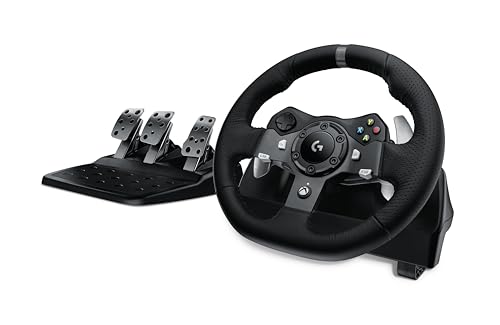
1. Logitech G920 Racing Wheel and Pedals
Our pick — 4.5+★ from 22,000+ verified ratings; the strongest balance of quality and price.
The leather-wrapped all-rounder that made force feedback mainstream and still earns the most trust.
Sixteen buttons on the rim, a hand-stitched leather cover under your palms, and a set of pressure-sensitive pedals in the box. That combination is why it is the safest first wheel for a Series S owner. The force feedback runs through helical gearing — a quiet, smooth gear train rather than a loud cog stack — so the feedback arrives as a steady push rather than a rattle. You feel the wheel load up as you turn into a corner and lighten as the front tires let go.
What keeps this at the top is the wheel itself. Owners consistently single out the rim feel and the gearing over everything else, and the ergonomics get the same warm reception — the leather grips well with sweaty hands and the shape sits naturally at nine and three. The pedals are the second piece of the story: the brake is pressure-sensitive and nonlinear, meaning it pushes back harder the further you press, and the pedal faces adjust so you can shift the brake and throttle into a comfortable position. Setup is a cable-and-go job rather than a driver hunt, and both the Xbox Series S and PC read it without fuss.
Here is the honest trade-off. The plastics in this wheel include 52% certified post-consumer recycled content, and while that is a good thing, the wheel body is not a metal-and-carbon piece. Some of the force feedback sharpness that belt and direct-drive bases deliver is softened by the gear train, and responsiveness and long-term durability draw a more divided response than the feel of the rim. If you race nightly for years, expect the gear-driven feel to be your ceiling. For everyone else, it is a remarkably complete package at five pounds — light enough to clamp to a desk and pack away, and 16 buttons give you more on-rim controls than the TMX’s 10.
Where it earns its keep
- Hand-stitched leather rim that stays grippy through long sessions
- Pressure-sensitive brake pedals with adjustable pedal faces
- Quiet helical gearing that keeps the noise down in a shared room
- 16 buttons on the rim for in-game menus and car settings
Where it asks patience
- Gear-driven feedback feels less crisp than belt or direct drive
- PC and Xbox only — it does not work with PlayStation consoles
- Housing is plastic with recycled content, not metal
The sensible first wheel: a Series S owner who wants a complete, quiet wheel-and-pedal set that works from the start and packs away after a session.
Think twice if: you already know you want razor-sharp feedback — the gearing here trades that crispness for smoothness and silence.
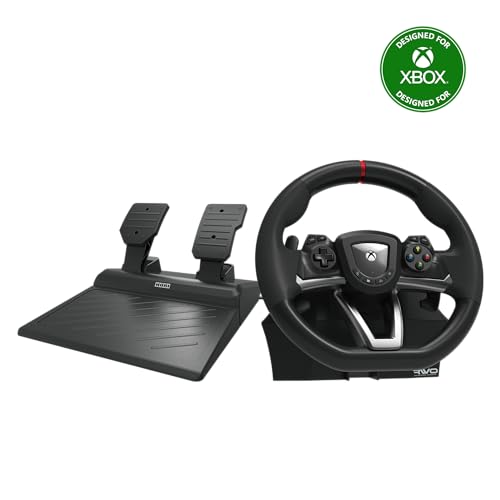
2. HORI Racing Wheel Overdrive
A full-size rim with an official Microsoft badge, built for Forza nights rather than lap-record hunting.
The headline here is the licensing. HORI built this wheel under official Microsoft licence, so the Xbox Series S treats it as a first-party device — no adapter, no workaround. The rim is full-size with a 270-degree turn radius, which is a shorter throw than the 900-degree wheels further down this list. That short throw is not a flaw: 270 degrees suits arcade racers and quick counter-steering, so the wheel snaps back and forth fast when you are trading paint in Forza.
What owners get excited about is the fun factor. Owners say the Overdrive transforms racing games, and Forza titles come up again and again as its natural home. Setup is a straightforward USB connection and it also works on Windows 10 if you want to move it to a PC. The clamp is sturdy, which matters at seven pounds — heavier than the G920’s five, so a light folding table will feel it. Thirteen buttons cover the essentials, and adjustable sensitivity lets you tune the steering ratio to your taste.
The trade-off is build consistency. Build quality draws a split verdict overall — some find it sturdy, others find it flimsy, so this is a wheel to treat with a little care rather than wrestle. It is also not the pick for someone chasing simulation fidelity: the shorter rotation and the general feel sit squarely in arcade territory. If you want realistic lock-to-lock travel for truck sims, the TMX below is the better fit. But as an entry point for a Series S owner who mostly races casually, this is the least fussy way in.
The case for it: official Microsoft licensing, a full-size rim, and a 270-degree throw make this the easiest wheel to hand to a casual player on a Series S — plug it in, load Forza, race.
Go for this if: your racing is Forza-first and you want the shortest path from box to track.
Not your wheel if: you plan on Assetto Corsa or truck sims where 900 degrees of travel matters — the short throw will frustrate you.
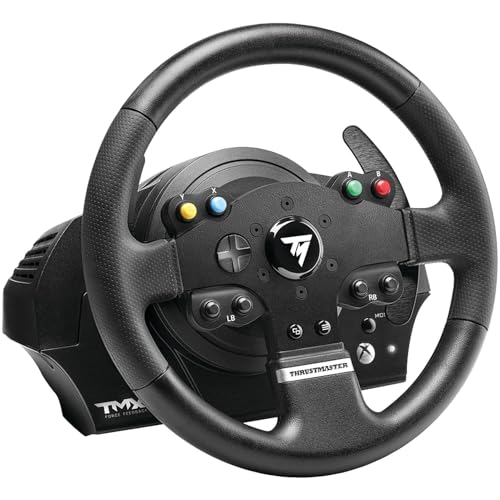
3. Thrustmaster TMX Force Feedback Racing Wheel & Pedals
Belt-driven feedback and 900 degrees of travel, for the driver who wants a real steering ratio.
Start with the number that separates this from the HORI above: 900 degrees of rotation. That is the full lock-to-lock sweep of a real car, so a long highway bend or a slow hairpin needs the same hand travel it would in the real thing. The rim itself measures 11 inches across — the same 28 cm diameter Thrustmaster quotes — and sits comfortably in the hand for long stints. The base uses a belt-pulley system rather than gears, which is why the feedback is described as responsive, precise, and quiet.
The optical reading is the second detail worth understanding. A 12-bit resolution reads 4,096 values across the steering axis, so tiny corrections register in-game instead of skipping from one position to the next. Owners describe this as a reliable, budget-friendly wheel with strong force feedback that makes driving games more enjoyable, which tracks with what the specs promise. It is also one of the wider wheels here at 12.99 x 11.81 x 13.11 inches, so clear a little more desk space than a compact base needs.
The honest catch is build consistency — solid construction gets praised and poor build quality gets reported in roughly equal measure, so inspect yours on arrival. Ten buttons is also the lowest on-rim count on this list, which matters if you like mapping a lot of car functions to the wheel instead of the pad. It does not have the G920’s leather rim or 16 buttons, but it beats the G920 on rotation range and quietness if smooth, long-throw steering is what you are after.
What the numbers buy you: 900 degrees and a belt drive are the two features that make a wheel feel like a car rather than a toy, and this is the most affordable way to get both on a Series S.
Reach for this if: you drive simulation-style — long corners, precise line-holding, and you want a quiet belt drive under the desk.
Look elsewhere if: arcade games and quick lock-to-lock flicks are your whole diet, where a 270-degree wheel feels more immediate.
4. PXN V99 Force Feedback Racing Wheel, with Pedals and Shifter

Three pedals, a six-speed shifter, and a detachable rim — the most hardware in one box here.
Most wheels on this list stop at wheel and pedals. The V99 keeps going: a three-pedal set with Hall magnetic sensors, a 6+1 gear shifter, and a detachable 11.8-inch wheel with four paddles on it. The Hall sensor detail matters because it reads pedal position magnetically with no contact to wear, so throttle and brake stay linear over time. The shifter gives you a real H-pattern feel with high and low gear switching, which is the piece you miss on every other budget wheel here.
The rim runs dual-motor force feedback at 3.2Nm, and the rotation switches between 270 and 900 degrees — so you can flip it to arcade-snap for a quick race and back to full travel for simulation work. The grip area is wrapped in TPR rubber, a soft-textured cover that resists sweat, and four paddles split into upper shifters and lower analog paddles for clutch or custom input. Two points stand out in the feedback: quality gets the most praise, and force feedback follows closely behind, with drivers describing the feel as close to a real car.
The catch sits in the connection. Compatibility is the most-discussed weak point on this wheel — some buyers report connectivity trouble, and the Xbox and PS4 pairing runs through the original controller rather than plugging straight in. It also weighs 8.85 kg, so this is a wheel you mount and leave mounted, not one you pack away weekly. Treat the initial pairing as a setup task, follow the manual, and the hardware underneath is a lot for a mid-range budget.
The full-set argument: if you add up buying a wheel, a three-pedal set, and a separate shifter, the V99 is the only pick here that puts all three in one box — and the Hall pedals are the kind of part usually reserved for pricier kits.
Built for: the driver who wants a manual gearbox and a clutch from day one and does not mind a longer first-time pairing.
Consider the alternative if: you want plug-and-play above all — the guided controller pairing is the part most likely to test your patience.
5. Turtle Beach VelocityOne Race KD3 Racing Wheel & Pedals
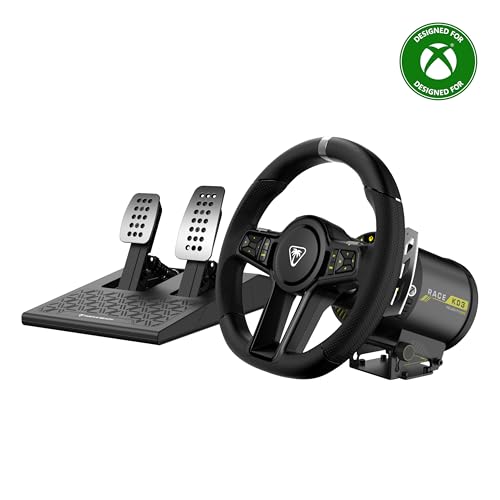
A direct-drive base with a tuning screen built in, but it wants a real rig under it.
Direct drive means the motor connects straight to the wheel shaft with no gears or belt in between, so the feedback reaches your hands with nothing softening it. The KD3 pairs that with a 3.2Nm Custom K: Drive motor — the same torque figure the PXN quotes, but delivered without the gear train. Add magnetic paddle shifters that click through gears cleanly and a Hall-effect throttle and brake pedal assembly, and the core hardware reads like a proper sim setup.
What makes it unusual is the Race Management Display — an on-wheel screen for tuning settings without diving into a menu on the console. A companion tuner app covers Xbox, PC, and mobile, and the modular design accepts other compatible VelocityOne accessories as you build out. Mounting gives you two routes: an included table clamp or integrated threaded inserts if you have a rig with bolt points. It is also the most compact of the big bases at 4.61 x 11.77 x 11.54 inches, so it clears desk space better than its weight suggests.
That weight is the catch. At 14.4 pounds it is the heaviest wheel here by a wide margin — nearly three times the G920’s five pounds — and a base that heavy will shake a lightweight desk and slip a thin clamp. It is also the newest design on this list, and this particular model has far less owner history to lean on than the Logitech or Thrustmaster picks. If you have a solid rig or a heavy desk and want the cleanest feedback this side of a premium direct-drive base, this is the one to look at.
The tuning angle: the Race Management Display and companion app put setup changes at your fingertips instead of in a console menu — a genuinely useful feature on a wheel you will adjust per car and per track.
Right for you if: you have a rig or a heavy desk and want direct-drive feedback with on-wheel tuning.
skip it if: your wheel lives on a folding table — 14.4 pounds and a direct-drive motor need something solid underneath.
6. MOZA R3 Racing Wheel and Pedals Bundle for Xbox & PC

The strongest feedback on this list, with 22 buttons and a quick-release rim that swaps out.
Of every wheel here, the R3 pushes hardest: a direct-drive base rated at 3.9Nm, the highest torque figure on this list and a step up from the Turtle Beach and PXN’s 3.2Nm. Direct drive plus ultra-low torque ripple — the smoothness of the motor’s output — means the feedback arrives instantly with no notchiness between positions. The rim is an 11-inch round wheel with ISF PU grips and an aluminum alloy rim, and the racing-level quick release lets you swap wheel rims without tools.
The hardware list is unusually complete for a first direct-drive kit: wheel base, rim, SR-P Lite dual pedals with Hall sensors, and an angle-adjustable desk clamp that fits various tables in the box. The pedal set uses high-strength steel with anti-slip surfaces, and both the pedal spacing and the out-curve adjust so you can tune the ergonomics. Twenty-two customizable buttons is the most on this list by a clear margin — 22 against the G920’s 16 and the TMX’s 10. The MOZA Pit House software and the cloud-based MOZA app let you save custom settings per game and launch into a title with one click.
Where it stumbles is the gas pedal — a small number of these arrive with the throttle not registering properly, and connectivity and ease of use draw a more divided response than the build quality does. If the throttle works, this is a superb entry point into direct drive. If it does not, you are dealing with support rather than driving. Worth checking the pedals thoroughly on day one, because the rest of the bundle is the most future-proof setup here.
Why it stands out: quality and value both land strongly in owner reports, and the quick-release rim plus Pit House software mean this base can grow with you instead of becoming a dead end.
The pick for planners: anyone who wants the most torque on this list and intends to add rims or pedals over time.
Test it first if: you are not comfortable troubleshooting a pedal from the start — that is the one reported weak spot.
7. Thrustmaster T248 Force Feedback Racing Wheel

Twenty-four buttons on the rim — the most controls, in a red-and-black shell built for sim menus.
The number to start with is 24. That is the button count on the T248’s rim, the highest here, and it changes how you drive: pit strategy, brake bias, engine maps, and traction settings can all live on the wheel instead of buried in the pad. It connects over USB to the Series S, Xbox One, and PC, and it ships as a single piece kit. At 7,350 grams it is a substantial unit, and its 17.91 x 14.17 x 12.2 inch footprint is the largest here — this wheel takes up real space.
The colour is note because it is the only wheel here that is not black or dark grey: red and black makes it easier to spot across a room and harder to lose against a black rig. That is a small thing, but it matters if your setup shares space with a living room. The extra buttons are the real argument, though. If you race championship-style with pit stops and car setup changes mid-race, having 24 controls on the wheel saves you constantly reaching for a controller.
That said, there is less owner feedback on this specific model than on the Logitech and Thrustmaster TMX picks, so the long-term durability picture is thinner. The larger footprint also means it wants a desk with depth, not a narrow shelf. And if you rarely touch car setup, those 24 buttons are dead weight — the G920 gives you 16 and a lighter body for less. Buy this one when the controls, not the wheel itself, are the thing you need.
The control argument: in a race with pit strategy and live setup tweaks, reaching for the pad on every stop is the immersion killer — 24 on-wheel buttons is the direct fix.
Made for: the sim racer who manages tires, fuel, and brake bias mid-race and wants all of it on the rim.
Probably overkill if: you race short arcade sessions — you would be paying for 24 buttons to use six of them.
8. Logitech G923 Racing Wheel and Pedals

The one that ships with a real gear stick and runs feedback straight from the game engine.
TRUEFORCE is the feature that separates this from the G920 above. Instead of the game sending broad canned effects to the motor, TRUEFORCE connects directly to in-game physics, so the feedback comes from what the tires and engine are actually doing frame by frame. That is a real difference in feel, not a spec-sheet flourish, though it only shines in supported titles. Everything on the rim, the shifter knob, and the shifter boot is wrapped in hand-stitched leather, and the gear shaft is solid steel with polished metal pedals underneath.
The shifter is the second half of the pitch. Most wheels here make you shift with paddles on the rim; this bundle adds a separate six-position H-pattern stick so a manual gearbox feels like a manual gearbox. A programmable dual clutch works as a launch-assist aid in supported games, and a built-in LED RPM indicator on the wheel shows you when to shift without looking at the dash. The 24-point selector and progressive brake spring keep your inputs adjustable from the rim. Owners describe it as solid mid-level gear that performs well in titles like Forza and Assetto.
The caveat is the brake pedal. The brake is deliberately stiff — that progressive spring is what makes it feel like a real brake, but it also means a firm foot, and grip feel overall is a divided note among drivers. If you want the manual gearbox experience with the cleanest feedback Logitech offers, this is the complete package.
What you gain over the G920
- TRUEFORCE feedback tied to in-game physics, not canned effects
- Manual H-pattern shifter included, with a steel gear shaft
- Hand-stitched leather across wheel, knob, and boot
- LED RPM indicator and programmable dual clutch for launch assist
What you give up
- Firm brake pedal needs a solid mount and a firm foot
- Only 10 buttons versus the G920’s 16
- TRUEFORCE needs supported titles to show its advantage
For the gear-shifter faithful: anyone who wants to row through gears by hand and feel feedback pulled from the game’s own physics.
Not the pick if: you drive automatic in every race — the shifter and dual clutch are a big part of what you would be paying for.
Know the Specs
Force Feedback Type
Force feedback is the motor system that pushes back on the rim so you can feel grip, weight, and bumps. Gear-driven bases run the force through toothed cogs — smooth enough but with a slight notch to the feel. Belt-driven bases run a belt between motor and shaft, giving a smoother, quieter response. Direct-drive bases connect the motor straight to the shaft for the quickest, cleanest feedback, at the cost of weight and price.
Rotation Range
Measured in degrees, this is how far the wheel turns from one lock to the other. A 270-degree wheel turns about three-quarters of a circle, which suits arcade racers and quick corrections. A 900-degree wheel matches a real car’s steering travel, so long corners and truck sims feel natural. Some wheels switch between the two so you can match the rotation to the game.
Pedal Sensors
A potentiometer is a contact-based sensor that reads pedal position and can wear over time. A Hall-effect sensor reads position magnetically with no contact, so the pedal stays consistent. A progressive brake spring adds resistance as you press harder, which is what makes a brake feel like a brake rather than an on-off switch.
Mounting and Weight
Most wheels clamp to the edge of a desk or rig plate, and some add threaded inserts for bolting down. Weight matters as much as the clamp: a light gear-driven wheel at 5 pounds stays put on a desk, while a direct-drive base at 14.4 pounds can shake a thin table and slip a light clamp. Check your desk thickness and sturdiness before committing.
Common Questions
Will any of these wheels work on both an Xbox Series S and a PC?
Does a 270-degree wheel feel worse than a 900-degree wheel?
What is the difference between gear, belt, and direct drive?
Do I need a rig, or can I clamp a wheel to a desk?
Is a Hall-effect pedal better than a standard pedal?
What does TRUEFORCE actually change?
How much desk space does a racing wheel take up?
Do I need a separate shifter, or are the paddle shifters enough?
How loud is a force feedback wheel, and will it disturb the room?
Is a direct-drive wheel worth it as a first wheel?
The Bottom Line
For most Series S owners, the xbox series s steering wheel winner is the Logitech G920 because it pairs a quiet helical gear train and a hand-stitched leather rim with pressure-sensitive pedals and 16 on-wheel buttons — the most complete, least fussy package here. If you want long-throw simulation steering, grab the Thrustmaster TMX for its 900-degree rotation and belt drive. And if you want the strongest feedback and a rim you can swap, the MOZA R3 leads on torque at 3.9Nm.
The one nudge worth making: if you are racing Forza tonight and nothing else, spend the difference on the arcade-fun side and race this weekend. But if you plan to grow into Assetto Corsa or truck sims, buy the wheel that already has the rotation range and feedback type you will want a year from now — the G920 and TMX both hold up better over that stretch than a short-throw arcade wheel will.
How we choose
We do not accept paid placement. Every pick is matched to a real buyer and a real use-case; we do not hands-on test units.
Sources
Specifications: manufacturer listings and product documentation. Review insights: verified customer reviews, as of November 2026. Pricing: not shown on this page (it changes often); check the current price via the retailer link.
As an Amazon Associate, Tactical Gear Guy earns from qualifying purchases. This does not affect which products we feature.