Specs are compiled from manufacturer listings and verified buyer reviews and can change over time — please confirm the key details on the product page before buying.
A worm gearbox trades motor speed for turning force, and the wrong flange or bore means it will not bolt to your motor at all. The short answer: match the flange and bore first (Nema23, Nema34, or 56C), then pick the ratio you actually need. This guide covers six real units, what each one bolts to, and where each one stops being the right tool.
This guide is built by comparing the manufacturers’ published specifications and the patterns across verified customer reviews, so you get each pick’s real strengths and trade-offs instead of marketing spin.
Most buyers get burned by assuming a higher ratio always means more usable power, when in practice it means less output speed. Here is how to line up a worm gearbox with your motor, your shaft, and your load before anything gets bolted down.
Top Picks

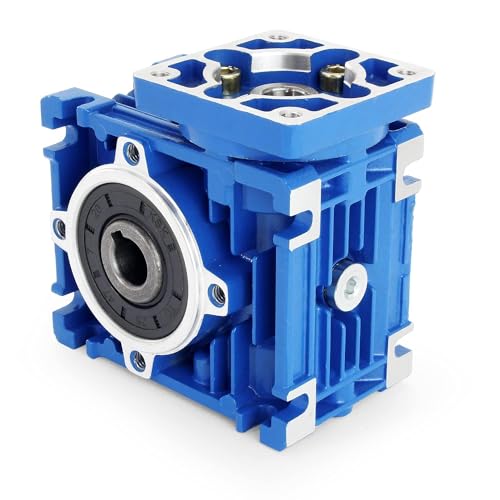
How To Choose The Best Worm Gearbox
Start with the motor you already own. A worm gearbox is a bolt-on part, so if the flange pattern and input bore do not line up with your motor, nothing else about the unit matters. Check the flange size, the motor mounting hole spacing, and the input bore diameter before you read a single word about torque.
Flange and bore: the fit that decides everything
A Nema23 motor takes a 60mm x 60mm flange with 47mm x 47mm mounting hole spacing. A Nema34 motor takes an 86mm x 86mm flange. A 56C motor is a different animal entirely and needs a 56C mounting flange. Get the flange pattern wrong and you are drilling adapter plates.
The input bore is the hole your motor shaft slides into — 11 mm and 14 mm are the two sizes that show up most in this group. The output shaft diameter is what your driven pulley, sprocket, or coupling grips, and it ranges from 8 mm on the small DIY box up to 1 inch on the big 56C unit.
Ratio: what 10:1 and 40:1 really mean
The ratio tells you how many turns the motor makes for one turn of the output shaft. A 10:1 box turns the output once for every ten motor turns, so you keep more speed and get moderate force multiplication. A 40:1 box slows the output right down and multiplies turning force sharply in exchange.
A higher ratio is not automatically better for your axis. It is better only when you need slow, strong motion — a rotary table or a winch drum. If you need a fast indexing axis, a 40:1 gearbox will feel painfully slow.
Gear lash and self-locking: the honest limits
Every standard worm gearbox has some gear lash — a small amount of rotational play between the gears. That is normal and fine for general load driving, but it is why these units are not intended for precision machining or high-accuracy positioning.
Most of the mid-range boxes here are reversible, meaning a back-drive load on the output can turn the input. That matters for anything that must hold position when power is cut, such as a vertical lift.
Side-by-Side Comparison
| Model | Best For | Speed Ratio | Flange / Mount | Output Shaft | Amazon |
|---|---|---|---|---|---|
| CNCTOPBAOS NMRV040 40:1 Nema34★ Best Overall | Slow, strong Nema34 builds | 40:1 | 86mm Nema34 | 18 mm | Amazon |
| CNCTOPBAOS NMRV030 40:1 Nema23Compact Pick | Compact Nema23 projects | 40:1 | 60mm Nema23 | 14 mm | Amazon |
| Jecoupoon NMRV040 10:1 Nema34 | Faster Nema34 motion | 10:1 | Nema34 | 18 mm | Amazon |
| PGFUN 20:1 Right Angle 8mm | Corner-turning DIY builds | 20:1 | 90° angle drive | 8 mm | Amazon |
| Lexar Industrial MRV040 10:1 56C | 1.16 hp 56C motors | 10:1 | 56C | 3/4 | Amazon |
| Lexar Industrial MRV050 10:1 56C | 2.06 hp 56C motors | 10:1 | 56C | 1 | Amazon |
Detailed Reviews
1. CNCTOPBAOS NMRV040 Worm Gear Reducer Gearbox
Our pick — 4.5+★ from 20+ verified ratings; the strongest balance of quality and price.
A big-ratio box for Nema34 builds that need slow, stubborn torque.
The 40:1 speed ratio is the headline, and it is four times the ratio of the Jecoupoon NMRV040 in this group — 40:1 versus 10:1. In plain terms, that means your Nema34 motor turns forty times for every single turn of the output shaft. You give up output speed and get turning force multiplication in return, which is exactly what a rotary table, a conveyor, or a packing line wants.
What makes it the strongest pick here is how completely it is specified. The 86mm x 86mm Nema34 flange, the 73mm spigot length, and the 95mm diagonal pitch are all published, so you can check the fit against your motor before ordering. The input bore is 14 mm (0.55 inch) and the output shaft is 18 mm (0.7 inch). It takes a 4.77-pound aluminum alloy housing with a hardened steel worm and a 94 copper worm gear inside, plus a KSK oil seal and high-grade bearings for heat dissipation and rigidity.
The catch you need to plan around: this unit is reversible, meaning it is non-self-locking. A back-drive load on the output will spin the input shaft. On a vertical lift or a hoist, that means you need a separate brake. And like every standard worm box, it carries normal gear lash, so it is not the tool for precision machining or tight positioning.
Where it earns the top spot
- 40:1 ratio delivers heavy torque amplification for Nema34 motor setups
- Full flange and shaft dimensions published, so fit is checkable up front
- Aluminum alloy body with hardened steel worm and a 94 copper worm gear
- Low operating noise and overheating resistance for continuous running
Plan around this before you order
- Reversible, so back-drive loads will turn the input — a brake is needed for lifting
- Gear lash makes it unsuitable for high-accuracy positioning work
- Slower output than a 10:1 box, which hurts fast indexing
Reach for this if: you run a Nema34 motor on a conveyor, rotary table, or packaging machine that needs slow turning force.
Look elsewhere if: your axis has to hold its position with the power off, because nothing in this housing stops a back-drive.
2. CNCTOPBAOS NMRV030 Worm Gear Reducer Gearbox
The Nema23 answer, with a smaller bore that saves a lot of bench space.
This NMRV030 fits a smaller motor shaft than the NMRV040 above, with an 11 mm input bore instead of 14 mm. That matters if your motor is the smaller Nema23 size, because a coupling will not cleanly fix an oversized bore. The 60mm x 60mm flange and 47mm x 47mm mounting hole spacing match the standard Nema23 pattern, so it bolts straight onto that motor. The output shaft comes out at 14 mm (0.55 inch).
The 40:1 ratio runs on a single-start worm design for maximum torque amplification and smooth output, which suits feeding devices, rotary tables, winching, and general automation lines. The die-cast aluminum alloy housing does the heat dissipation and corrosion resistance work, and the whole thing is pre-lubricated and debugged at the factory. That last point is the quiet win here — you bolt it up and run it, no grease gun required on day one.
Two honest notes. It is reversible and non-self-locking, same as its bigger sibling, so back-drive loads will turn the input. And the normal gear lash of a worm drive means student projects and CNC router auxiliary axes are its ceiling, not precision positioning.
What it saves you: a pre-lubricated unit that mounts straight to a Nema23 flange with no adapter plate and no first-day maintenance. For a DIY robotic arm or a small engraving machine, that is a fair chunk of build time back.
The trade-off: the compact 60mm flange and 11 mm bore are the whole point, but they also mean this box will not grow with a motor upgrade to Nema34 later.
Fits your bench if: a Nema23 stepper or servo is already sitting on your workbench and you want torque without a new mounting plate.
Think twice if: your build plan includes stepping up to a Nema34 motor down the road.
3. NMRV040 Worm Gear Reducer 10:1
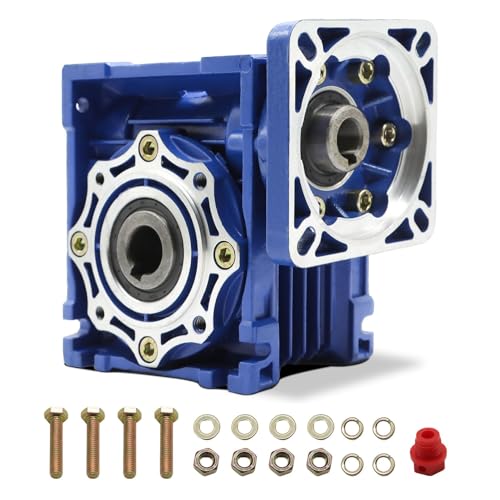
Same Nema34 footprint as the winner, but built to move faster.
If the 40:1 ratio on the top pick felt too slow for your axis, this is the direct swap. The 10:1 ratio gives you four times the output speed relative to that box, and you keep the same 18 mm output shaft diameter and the same 14 mm input clamp bore. So the couplings and pulleys you already bought will still fit.
The flange input hole with clamp shaft design is the practical detail here — you slide the motor shaft in and clamp it, rather than hunting for a keyed fit. The maker recommends the 71B5 installation form, and the housing is described as compact and lightweight with low noise and easy maintenance and repair. For a Nema34 servo setup where you want motion rather than raw grunt, the shorter ratio is the right call.
What you give up is force multiplication. A 10:1 box will not drag a heavy conveyor load the way a 40:1 will, and the same worm-drive caveats apply. This is a speed-first part, not a lifting part.
The fit advantage: an 18 mm output shaft matches the Best Overall pick exactly, so tooling swaps between the two boxes without new hardware.
Your pick when: you need a Nema34 axis that indexes quickly rather than one that drags a heavy load.
The limit to know: a 10:1 ratio will not carry the same load as the 40:1 box in this same Nema34 family.
4. PGFUN 20:1 Right Angle Worm Gearbox

Turns power around a corner when a straight-through box will not fit.
Every other gearbox on this list passes the shaft straight through. This PGFUN unit redirects it 90 degrees, with one input shaft driving one right-angle steering output shaft. On a tight DIY frame, a small robot, or a model where the motor has to sit beside the driven axle rather than behind it, that geometry is the whole reason you would buy it.
The 8 mm output shaft is the thinnest here — the Jecoupoon NMRV040 outputs through an 18 mm shaft, for comparison, so this is a small-scale part by design. The 20:1 ratio sits between the 10:1 and 40:1 boxes, and it is built from aluminum alloy and #45 steel across an 82 x 82 x 50 mm body with a 20-tooth gear. Motor drive connects through a coupling and belt pulley.
The maker is refreshingly blunt about the ceiling: it is a simple steering gear and cannot be used for high-torque or high-rotating-speed CNC applications. Believe that. It is a clever linkage part for light DIY work, not a transmission for a real machine tool.
Where it shines: the 90-degree output solves a layout problem no straight worm box can, and the 20:1 ratio gives useful speed reduction in a small package.
Be honest about the job: with an 8 mm shaft and an explicit warning against high torque and high speed, this belongs on hobby builds and simple mechanisms only.
Buy it for: a compact DIY mechanism where the motor and the driven shaft must sit at right angles.
Do not buy it for: a CNC axis or anything that needs real torque, because the maker rules that out directly.
5. MRV040 Worm Gear 10:1 56C Speed Reducer

The 56C bolt pattern for real industrial motors, not hobby steppers.
This is a different class of part. Instead of a Nema stepper flange, it carries a 56C mounting flange, which mates to the C-face motors used on pumps, conveyors, and mixers. The rated horsepower is 1.16 — that is the working ceiling for this box, and it is a figure you check against your motor nameplate before the order goes in.
The gearing is 10:1, so the output turns once per ten motor turns. The input shaft diameter is 5/8 inch and the output shaft is 3/4 inch — both standard imperial sizes that match common pulleys and couplings without an adapter. It has been in the catalog since 2015, which tells you it is a settled, stable part rather than a fresh listing with no track record.
Here is the practical caution. The 1.16 rated horsepower is the hard limit, and the MRV050 in this same line doubles that to 2.06 — so if your motor is anywhere near the top of this range, you are on the wrong box. Buy the one that matches your actual motor, not the one that looks like the safest margin.
Why it belongs on the shortlist
- 56C flange bolts to standard C-face industrial motors
- 10:1 ratio gives a moderate, usable speed reduction
- 5/8 inch input and 3/4 inch output are common imperial shaft sizes
The ceiling to respect
- 1.16 rated horsepower is well under the 2.06 of the larger MRV050
- No Nema pattern, so it will not fit hobby stepper or servo setups
- 10:1 will not deliver the slow, heavy torque of a 40:1 box
Right match for: a 56C motor in the 1.16 hp class driving a pump or conveyor that needs a moderate reduction.
Wrong match for: anyone running Nema steppers or servo motors, since the flange pattern will not line up at all.
6. MRV050 Worm Gear 10:1 56C Speed Reducer

The largest box here, rated for a 2.06 hp 56C motor and a full inch of shaft.
Two numbers separate this from the MRV040 above. The rated horsepower climbs to 2.06, and the output shaft grows from 3/4 inch to a full 1 inch. That inch of shaft matters because it lets you run a bigger pulley or sprocket without stepping up through an adapter sleeve, and it signals a box built to take a heavier radial load.
The rest of the spec sheet reads the same: 10:1 ratio, 56C mounting flange, 5/8 inch input shaft. The ratio and inlet are identical, so the real decision between this and the smaller unit is purely horsepower and shaft size. If your motor nameplate is above 1.16 hp, this is the box that matches it.
Ask yourself if you need the extra capacity at all. On a light conveyor or a small pump, the bigger housing is just heavier and costs more to mount for no gain. This is the right part for a demanding drive, not a default upgrade. If your load is light, the smaller NMRV030 above will do the job.
The upgrade that counts: a 2.06 rated horsepower ceiling and a 1 inch output shaft make this the only unit here sized for genuinely heavy 56C motor drives.
What it does not fix: the 10:1 ratio is the same as the smaller MRV040, so if your real problem is speed or slow-turning torque, the extra horsepower will not solve it.
The one to grab if: your 56C motor runs above 1.16 hp and you need the 1 inch output to carry a larger driven pulley.
Overkill if: a small pump or light conveyor is the job, where the smaller MRV040 does the same work in a lighter package.
Know the Specs
Speed Ratio (10:1, 20:1, 40:1)
The ratio is turns-in versus turns-out. A 10:1 box spins its output once for every ten motor turns, keeping more speed and giving modest force multiplication. A 40:1 box spins its output once for every forty motor turns, which slows everything down and multiplies turning force sharply. Pick the ratio that matches your driven part’s required output speed, not the largest number listed.
Input Bore and Output Shaft Diameter
The input bore is the hole that receives your motor shaft; the output shaft is what grips your pulley, sprocket, or coupling. If either measurement is off, the part will not install. Sizes here run from an 11 mm bore and 14 mm output on the Nema23 box up to a 5/8 inch input and 1 inch output on the largest 56C reducer. Measure your motor shaft and driven shaft before you order.
Motor Flange Pattern
The flange is the bolt circle that joins gearbox to motor. Nema23 uses a 60mm square with 47mm hole spacing, Nema34 uses an 86mm square, and 56C is its own industrial standard. A gearbox built for one pattern will not bolt to another, so the flange decides compatibility before any torque figure matters.
Gear Lash and Self-Locking
Gear lash is the small rotational play built into any worm drive, and it is normal for general load driving. It is the reason these units are not intended for precision machining. Self-locking is the separate question of whether a back-drive load can turn the input — most of the mid-range boxes here are reversible, meaning they are not, so a vertical lift needs its own brake.
Common Questions
Will a Nema23 gearbox bolt straight onto my Nema23 stepper motor?
Is a 40:1 worm gearbox better than a 10:1 gearbox?
What does non-self-locking or reversible mean on a worm gearbox?
Can I use a worm gearbox for CNC precision machining?
How do I size a 56C gearbox to my industrial motor?
What is the difference between the MRV040 and MRV050 speed reducers?
Do these gearboxes need lubrication or maintenance before first use?
Why is an 8mm output shaft too small for some projects?
Can I change the speed ratio on a worm gearbox after I buy it?
What does the 94 copper worm gear rating mean inside the CNCTOPBAOS NMRV040?
The Bottom Line
For most builders, the worm gearbox winner is the CNCTOPBAOS NMRV040 40:1 because it lists every dimension that decides fit: the 86mm Nema34 flange, the 14 mm input bore, and the 18 mm output shaft. You can check your motor against those numbers before you buy. Inside, a hardened steel worm and a 94 copper gear sit in an aluminum housing. If you want the same Nema34 footprint with faster output, grab the Jecoupoon NMRV040 10:1. Its 18 mm output matches the winner, so it swaps in without new tooling. And for a 56C industrial motor above 1.16 hp, the MRV050 10:1 is the one to reach for, with its 2.06 rating and 1 inch output shaft.
Before ordering, measure your motor shaft diameter and your flange bolt spacing. Ratio and horsepower get the attention, but bore diameter and bolt circle decide whether the box mounts or gets returned.
How we choose
We do not accept paid placement. Every pick is matched to a real buyer and a real use-case; we do not hands-on test units.
Sources
Specifications: manufacturer listings and product documentation. Review insights: verified customer reviews, as of November 2026. Pricing: not shown on this page (it changes often); check the current price via the retailer link.
As an Amazon Associate, Tactical Gear Guy earns from qualifying purchases. This does not affect which products we feature.