Specs are compiled from manufacturer listings and verified buyer reviews and can change over time — please confirm the key details on the product page before buying.
Buying a workout mat for outside is mostly about two things: whether it stays put on concrete or decking, and whether it survives being rolled out on a rough surface week after week. Thin yoga mats slide, curl and shred outdoors. The picks below are the ones built with denser foam, textured undersides and thicker cushioning so your jump rope, lunges and HIIT sessions actually work on a patio or garage floor.
This guide is built by comparing the manufacturers’ published specifications and the patterns across verified customer reviews, so you get each pick’s real strengths and trade-offs instead of marketing spin.
Outdoor sessions punish a mat in ways a living room never does, so the shortlist below weighs grip, thickness and surface toughness first. These are the workout mats for outside worth rolling out on concrete, decking or grass.
Top Picks


How To Choose The Best Workout Mats for Outside
An outdoor mat fails for one of three reasons: it slides, it is too thin for the surface underneath, or it falls apart at the edges. Fix those three and everything else is preference. Here is what actually matters when your training floor is concrete, decking or grass.
Grip on a hard, smooth surface
Concrete and composite decking offer almost no friction, so the mat’s underside does all the work. Look for a grooved, circle-pattern or tire-tread base — those shapes channel air out and bite into the surface. A double-sided textured mat gives you grip on top for hands and feet as well. If you plan to jump rope, weight matters here: a heavier mat resists dragging when the rope catches an edge.
Thickness versus stability
Thickness in millimetres is the number that decides knee comfort. A mat around 7mm gives real shock absorption on concrete while still feeling firm enough for balance work. Anything much thinner is mostly a barrier between you and the ground, not a cushion. Anything very thick and soft can feel unstable during lunges, so high-density foam beats plain soft foam outdoors.
Material and weather exposure
PVC and TPE are the two common outdoor-friendly materials. PVC tends to be denser and heavier, which helps it stay flat. TPE is lighter and rolls up smaller for carrying to a park. Neither one likes being left in direct sun for days at a time — roll it up and store it out of the weather when you are done. EVA foam tiles suit a covered patio or garage floor where they can stay put.
Size and portability trade-off
A larger mat gives you more room to move but adds weight to carry. A jump rope mat only has to be long enough that the rope lands on it, while a full-body mat needs room for lateral lunges and press-ups. Check whether a carry bag or straps are included — rolling a heavy mat without straps is the fastest way to hate it.
Side-by-Side Comparison
| Model | Best For | Thickness | Mat Size | Material | Amazon |
|---|---|---|---|---|---|
| GXMMAT Large Exercise Mat★ Best Overall | Full gym sessions in a garage | 0.28″ | 72″L x 72″W | PVC | Amazon |
| dofopo Jump Rope MatBest for Concrete | Rope work on concrete | 0.24″ | 71″L x 24″W | TPE | Amazon |
| HAPBEAR Large Yoga MatBest Wide Mat | Yoga and stretching outdoors | 0.25″ (6mm) | 72″L x 36″W | TPE | Amazon |
| Karma Fitness Large Workout Mat | Wide range of motion work | 0.39″ (10mm) | 72″L x 32″W | TPE | Amazon |
| Cheete Jump Rope Mat | Quiet rope work indoors and out | 0.19″ | 48″L x 36″W | Rubber | Amazon |
| FEECCO Jump Rope Mat | Shoe-on jumping on concrete | 0.28″ (7mm) | 53.94″L x 35.83″W | PVC | Amazon |
| AIRHOP Interlocking Gym Mats | Covering a patio or garage floor | 0.79″ | 24″L x 24″W per tile | EVA foam | Amazon |
| innhom Large Exercise Mat | Big footprint at home | 0.28″ (7mm) | 84″L x 60″W | PVC | Amazon |
| VEVOR Large Exercise Mat | Two or three people training together | 0.28″ (7mm) | 108″L x 72″W | PVC | Amazon |
Detailed Reviews
1. GXMMAT Large Exercise Mat for Home Gym, 6×6 ft
Our pick — 4.5+★ from 750+ verified ratings; the strongest balance of quality and price.
A six-foot square of dense foam that refuses to move under jump rope work.
Two numbers set this one apart for outdoor use: a 72″L x 72″W footprint, and 0.28″ of high-density micro-foam. That square spreads across a garage floor or patio slab and gives you room for lateral lunges, press-ups and jump rope without stepping off the edge. The foam is dense rather than squishy, so you get cushioning under your knees without the wobble you feel on soft mats.
What wins people over is build quality — it is the single thing the review pages dwell on, and the second is how little the mat budges once it is down. A grooved, matrix-circle underside grabs the floor while the subtly textured top stops hands and feet sliding out of position. It is also built to be used with or without shoes, which matters when you are training on concrete and do not want to unlace between sets.
The catch is the weight. At 9 kg this is a mat you unroll and leave in place, not one you sling over your shoulder — the HAPBEAR below weighs 1.2 kg by comparison. So if you carry a mat to a park every session, this is not that mat. The included pair of gloves, three Velcro straps and a carry bag keep storage manageable, but plan on it living near your training spot. At 4.5+ stars across 700+ ratings, most owners accept the heft in exchange for the stability.
What earns it first place
- 72″ x 72″ of usable surface — room for cardio, weights and stretching
- 0.28″ high-density foam cushions knees on hard floors
- Grooved underside locks onto smooth surfaces instead of creeping
- Works with or without shoes and shrugs off abrasion and scratches
Where it asks something back
- 9 kg makes it a stay-put mat, not a throw-it-in-the-car mat
- PVC construction needs rolling up and storing out of long sun exposure
Roll it out if: you train in a garage or on a patio and want one big surface that stays flat all session.
Carry-on-only: the 9 kg weight rules it out for anyone hauling a mat to a park each time.
2. dofopo Jump Rope Mat, 71″ x 24″
Seventy-one inches of rope runway, built for the slab in your driveway.
Jump rope on bare concrete and your rope frays, your knees complain and the neighbours learn your training schedule. This mat answers all three. At 71″L x 24″W it is long enough that the rope lands on the mat instead of the floor. The TPE material — a rubbery, flexible foam — is softer than a PVC mat, so it takes the sting out of each landing.
Compare it against the jump Rope Mat from Cheete in this list: that one measures 48″L x 36″W, while this stretches to 71″ in length with a narrower 24″ width. For rope work the extra length is the useful dimension, because the rope swings front to back. It rolls and travels easily too, and the free carry bag means it can go from garage to park without a fuss.
Here is the part to weigh up honestly. Grip on hard surfaces is the split verdict on this mat — it holds on some floors and skates on others, and the fix is usually to check the surface underneath before you commit. It is also thin at 0.24″, so it is a barrier-and-cushion mat rather than a deep shock absorber for heavy landing work. Owners broadly report it does its job well on hard ground. If your patio is smooth composite rather than grippy concrete, expect to test it before a full session.
Why it earns a slot: length and lightness together — 71 inches of rope coverage at a carryable weight, with a bag in the box.
The honest limit: the underside grip is inconsistent across floor types, so smooth decking may need a second look.
Right call for: rope work on a driveway, garage floor or concrete pad where length matters most.
Look past it if: your training surface is polished or you need deep cushioning for heavy landings.
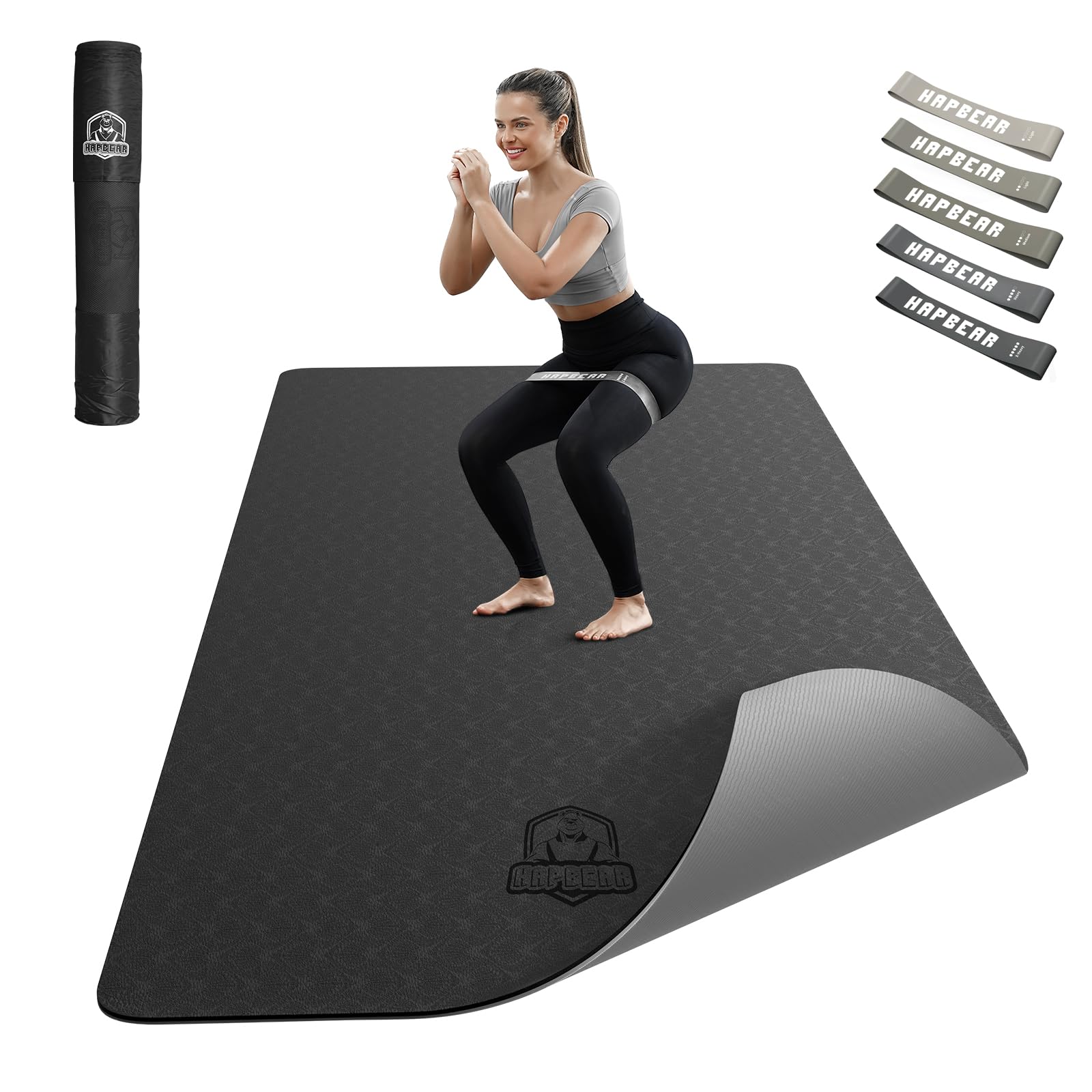
3. HAPBEAR Large Yoga Mat, 72″ x 36″ x 6mm
The one you can sling in a bag and still have 36 inches of width on the grass.
If your outdoor mat needs to travel, this is the one to look at. At 1.2 kg it weighs a fraction of the big PVC mats — the GXMMAT above is 9 kg — so it goes into the included carry bag and comes out in a park without a struggle. You still get a 72″L x 36″W surface, which the maker describes as 50% wider than a standard mat.
The TPE build gives you a 6mm cushion, which lands in the useful middle: enough under knees and wrists during holds, thin enough that you stay balanced in a lunge. Size and overall quality are the two things that stand out most in owner feedback, and the double-sided texture is designed to hold on smooth surfaces. A note from the maker worth taking seriously: it is not intended for use on carpet, so grass, decking and concrete are its territory.
Two things to plan around. Thickness and durability draw divided opinions — some find the 6mm just right, others expected more depth, so go in knowing this is a yoga-and-stretching mat rather than a heavy impact pad. There is also an initial scent out of the bag; the maker suggests one to two days of airing out before first use. Neither rules it out, but both mean it suits stretching and travel better than heavy impact work.
Where it shines: portability plus width — 1.2 kg and 36 inches across is a rare pairing for outdoor sessions away from home.
Go in expecting: a yoga-grade 6mm cushion rather than deep impact absorption, plus a couple of days of airing out.
Pack it up if: you stretch, hold poses or do Pilates outdoors and want width without weight.
Not the pick for: shoe-on HIIT on concrete, where you want more density underfoot.
4. Karma Fitness Large Workout Mat, 10mm

Ten millimetres of cushioning for anyone whose knees hate a concrete patio.
Start with the number that matters: 10mm, or 0.39″ in the listing, which is the thickest single-sheet mat in this list. On a hard outdoor surface that depth is the difference between finishing your set of lunges and stopping halfway. The 72″L x 32″W footprint is 33% wider than a standard 24-inch yoga mat, so your hands and feet stay on the mat during sumo squats and press-ups instead of drifting onto concrete.
The dual-layer TPE is denser than typical NBR foam, and the maker calls it waterproof and sweat-resistant — useful when you are training outside and the surface gets damp. Both sides carry a diamond texture for grip in multiple directions, which is what keeps a thick mat from feeling like a sponge under a lunge. It rolls up, and the carry bag has an adjustable shoulder strap for the walk to the park.
Softness cuts both ways. Owners describe it as very soft with generous cushioning, and at 10mm that is the trade you are making — it is built for comfort during stretching, Pilates and floor work, not for explosive lateral movement where you want firm ground feel. At 1.76 kg it is still light enough to carry. If your outdoor training is high-impact plyometrics, the firmer GXMMAT above will feel more planted.
Reasons this one earns its place
- 10mm thickness is the deepest cushion here for hard outdoor ground
- 72″ x 32″ gives extra width for squats and press-ups
- Waterproof, sweat-resistant TPE wipes clean after a session
- Diamond texture on both sides for grip in every direction
The trade you are making
- Deep cushion softens ground feel during fast, explosive moves
- Hand wash only, so no machine cleaning after muddy outdoor use
Made for: stretching, Pilates and strength work on a patio where knee comfort comes first.
Think twice if: your sessions are plyometric and you rely on a firm, responsive surface underfoot.
5. Cheete Jump Rope Mat, 48″ x 36″

A rubber mat wearing a fabric jacket, so rope strikes land dull instead of loud.
Most mats are a slab of one material. This one stacks three layers: a jersey fabric top for double wear resistance, a rubber middle for bounce and softness, and a tire-tread base for grip. The point of that build is noise — a jersey face deadens the slap of the rope, which is the whole reason a rope mat exists if you train on a balcony or in a shared courtyard.
Where it differs from the longer dofopo mat is the shape. This one is an oval at 48″L x 36″W and 0.19″ thick, and it weighs 2.59 kg — a denser, wider block rather than a long narrow runway. The rubber construction with that tire-tread underside is designed to hold its position and take a beating without tearing. It also doubles as a children’s play mat, pet mat or equipment mat when the rope is packed away.
Know the size trade-off before you buy. Length is 48 inches here, versus long-format rope mats that stretch past 70, and opinion on whether it is big enough splits accordingly — fine for controlled rope work, tight if you jump with a wide, sprawling style. Some also find it shifts on certain surfaces. Neither rules it out, but the 48-inch length and occasional shifting mean it suits compact rope work rather than every setup.
The standout: the layered jersey-over-rubber build is the sound-proofing trick here, and the wear layer sits on top where rope contact happens.
The size question: 48 inches of length suits compact rope work; wide, fast skipping styles will feel boxed in.
Best match for: apartment balconies and courtyards where rope noise is the real problem.
Look elsewhere if: you want a long runway for wide rope swings.
6. FEECCO Jump Rope Mat, 54″ x 36″

Built heavy on purpose so your rope mat does not wander mid-swing.
The design brief here is simple and it works: a mat that does not slide when a weighted rope catches the edge. It weighs 6.5 lbs and carries a non-slip backing, so heavy rope strikes do not drag it across the concrete. That is the exact failure mode that makes people give up on using a yoga mat for jumping, and this mat was built to fix it.
Cushioning comes from 7mm of high-density PVC — 0.28″ thick — with a texture the maker describes as softer than the rock-hard high-density mats of old. Jump on it with shoes and you get the full effect. It is sized 53.94″L x 35.83″W in a rounded shape, which trims weight without losing the width a broad-shouldered jumper needs. The same surface works for sit-ups and crunches between rope sets.
Outdoor use is where this one earns its keep. The maker lists concrete and grass as surfaces it handles — concrete stops your rope wearing out quickly, and grass lets the rope swing cleanly. It wipes down easily, so grit and dust from a patio are not a problem. If you mostly train indoors on carpet and only occasionally venture outside, the thicker Karma Fitness mat above gives you more cushion for floor work.
Why it holds its ground: 6.5 lbs of weight plus a non-slip back is the combination that stops rope work from turning into mat-chasing.
Worth knowing: it is a rope-and-floor-work mat first, so deep cushioning for long floor sessions is not its aim.
Choose this if: you jump rope outdoors with shoes on and want a mat that stays put through heavy swings.
Skip if: you need one mat to double as a plush floor pad for extended stretching sessions.
7. AIRHOP Interlocking Gym Mats, 12 Tiles

Twelve tiles that turn a bare patio slab into a padded training floor.
This is a different animal from a roll-up mat, and that is the point. Each tile is 24″L x 24″W x 0.79″ thick, and twelve of them cover 48 square feet across a 6x8FT area. Interlocking edges click together and 24 edging pieces finish the perimeter, so you can build a floor for a covered patio, garage or basement rather than unroll a single sheet.
The 0.79″ EVA foam — a firm, springy closed-cell material — is the thickest surface in this list by a wide margin, and it does two jobs a thin mat cannot. It cushions jumps and heavy equipment like benches and dumbbells, and it damps noise so a home gym stops sounding like a workshop. Cushioning and value are the two qualities that land best in owner feedback, and people like that the double-sided steel-pattern surface wipes clean and shrugs off pet hair.
What you give up is portability. These tiles do not roll up, so this is a floor you lay once and leave — great for a patio that stays covered, wrong for a mat you want to take to the park. The reversible black-and-gray sides let you flip the look, and the BPA-free, phthalate-free foam keeps it a sensible choice for a family space. If your patio or garage spot is fixed, twelve tiles cover 48 square feet and replace a stack of roll-up mats.
What makes it different
- 0.79″ thickness is the deepest cushioning in this lineup
- 48 square feet of coverage from twelve 24″ x 24″ tiles
- Interlocking edges assemble and break down without tools
- Waterproof, anti-slip surface is easy to wipe clean
The catch to plan for
- Does not roll or travel — it is a permanent floor, not a portable mat
- Loose tiles need a flat base to sit cleanly and evenly
Ideal when: your outdoor training area is fixed and you want a padded, quiet floor rather than a single mat.
Wrong fit if: you train in different places and need something that rolls up and travels.
8. innhom Large Exercise Mat, 7′ x 5′

Thirty-five square feet of PVC that swallows a garage floor whole.
At 84″L x 60″W this covers 35 square feet of floor, and it weighs 9.7 kg — heavier even than the GXMMAT above. That combination is deliberate. A mat this size with that much mass stays flat on a garage or basement slab, and the weight is what keeps it from rucking up at the corners when you move across it. If you want one 84″ x 60″ surface for cardio, weights and stretching without repositioning between moves, this delivers it.
Grip and toughness come from a textured top surface and a circle-pattern underside, which is the same idea as the GXMMAT but in a longer, narrower shape. The 7mm high-density PVC holds its resilience while cushioning your joints, and the closed-cell surface keeps sweat and moisture out so a damp wipe is enough to clean it. It ships with three straps and a carry bag for storage.
The wrinkle is the size itself. Owner feedback on dimensions is split, with some finding it great and some noting it falls about a foot shorter than the description suggests — so measure your space and check the listing’s stated 84 inches rather than assuming. Cushioning and thickness also draw mixed responses, which fits a 7mm mat: it is a supportive floor mat, not a soft cloud. At 4.5+ stars across 400+ ratings, most buyers are happy with what arrives.
The draw: 35 square feet and 9.7 kg of dense PVC make this a mat that lies flat and stays flat in a garage gym.
Measure first: reported lengths vary against the description, so confirm the footprint against your floor before ordering.
Worth it for: a dedicated garage or basement gym where a big, heavy sheet can lie flat permanently.
Not for you if: you need a mat that folds small or travels to a park.
9. VEVOR Large Exercise Mat, 9′ x 6′
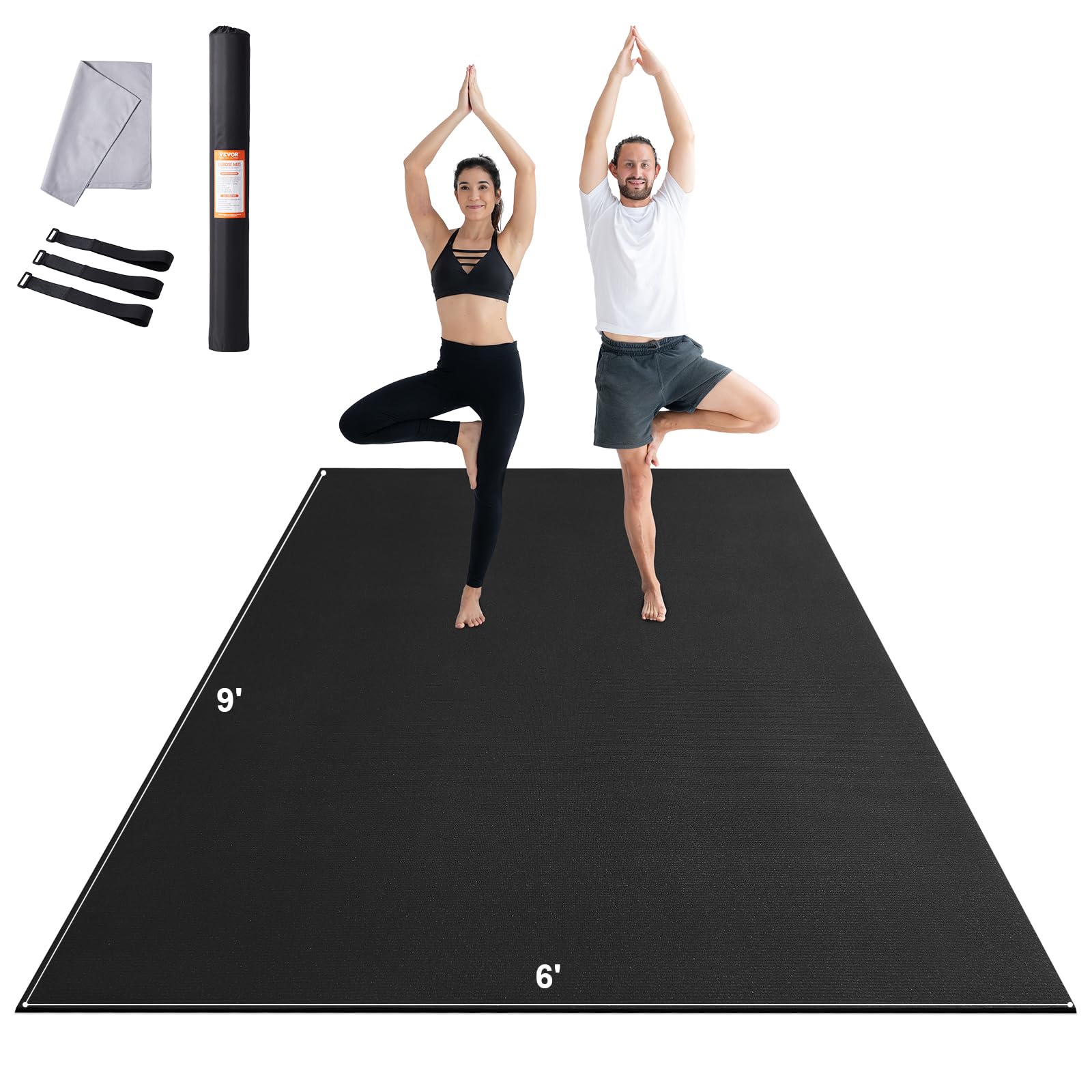
A nine-by-six sheet rated for two or three people training at once.
This is the biggest mat here: 108″L x 72″W, a 9x6ft surface the maker says suits two or three people at the same time. Set against the 84″ x 60″ innhom above, that extra length and width turns a solo workout mat into a shared training floor — enough room for a partner doing HIIT beside you without shuffle-stepping onto concrete.
The material spec is the other talking point: high-density PVC at 2800g/㎡, which is the maker’s measure of how much material goes into each square metre. That density is why it stays intact through prolonged use, and why the dense circular texture on the underside grips hard enough to stop the mat sliding underfoot. It protects carpet, hardwood and concrete floors from scratches, and the 0.28″ thickness gives cushioning that balances support with softness.
There are two things to hold in mind. Thickness divides opinion — some find it thick, others not very thick — so if you want deep padding this is a firm mat rather than a plush one. And at this size it is a floor mat, not something you carry casually, though it does arrive with a storage bag, three straps and a highly absorbent fiber towel. Owners latch onto the size and the grip, which for a shared outdoor setup are the two that count.
Where it pulls ahead
- 108″ x 72″ is the largest surface in this list — genuinely two-person
- 2800g/㎡ PVC density resists wear through long use
- Dense circular base texture grips without sliding
- Ships with storage bag, three straps and a fiber towel
What to accept going in
- Firm 0.28″ padding rather than deep, soft cushioning
- Huge footprint needs a big, flat spot and permanent storage space
Built for: couples or training partners who want one shared floor on a patio or in a garage.
Reconsider if: you want plush cushioning or need to roll it up and drive it somewhere weekly.
Know the Specs
Thickness in millimetres
Thickness is the number that decides how much shock your knees absorb on concrete. A mat around 7mm gives real cushioning while staying firm enough for balance work. Thinner mats in the 5mm to 6mm range suit yoga and stretching, where you want ground feel. Very thick foam tiles go far deeper and turn a hard floor into a padded surface, but they are not something you roll up and carry.
Material: PVC, TPE and EVA
PVC is dense and heavy, which helps a mat lie flat and grip. TPE is lighter and more flexible, so it rolls small and travels well. EVA foam is the springy material behind interlocking tiles and does the best job of damping noise. All three handle outdoor use, but none should be left in direct sun for days at a stretch — roll it up and store it out of the weather.
Size and the rope-landing zone
For jump rope, length is the dimension that matters: the mat needs to be long enough that the rope lands on it rather than the floor. For strength and stretching you want width so your hands and feet stay on the mat during lateral moves. A 6x6ft mat gives room for lunges and rope work but weighs around 9kg, so pick a size you can either leave in place or carry.
Grip and how it is measured
Grip depends on the underside pattern. Grooved, matrix-circle and tire-tread textures channel air out and bite into smooth surfaces, which is what stops a mat skating across a patio. A textured top surface adds traction for hands and feet. Heavier mats resist dragging better than light ones, which is why dense PVC tends to hold its place during rope work.
Common Questions
Can I use a regular yoga mat on concrete or a patio?
How thick should an outdoor workout mat be for jump rope?
Will a workout mat damage my wooden deck?
How do I stop my mat sliding on smooth concrete?
Can I leave an outdoor workout mat outside all the time?
Are interlocking foam tiles better than a roll-up mat outdoors?
Can I wear shoes on these mats?
How do I clean a mat after outdoor use?
Does a bigger mat always suit outdoor workouts?
What is the difference between TPE and PVC for an outdoor mat?
The Bottom Line
For most outdoor training setups, the GXMMAT Large Exercise Mat is the one to buy — a 72″ x 72″ surface with 0.28″ of dense foam and a grooved underside that holds its place on a hard floor. If your outdoor work is jump rope on concrete and you want something light to carry, the dofopo Jump Rope Mat gives you 71 inches of runway and a carry bag in the box. And for a fixed patio or garage floor you want padded once and for all, the AIRHOP Interlocking Gym Mats cover 48 square feet in tiles that click together and stay there.
How we choose
We do not accept paid placement. Every pick is matched to a real buyer and a real use-case; we do not hands-on test units.
Sources
Specifications: manufacturer listings and product documentation. Review insights: verified customer reviews, as of November 2026. Pricing: not shown on this page (it changes often); check the current price via the retailer link.
As an Amazon Associate, Tactical Gear Guy earns from qualifying purchases. This does not affect which products we feature.