Specs are compiled from manufacturer listings and verified buyer reviews and can change over time — please confirm the key details on the product page before buying.
If you have ever watched a loaded trailer or a tower section creep backward the second you let go of a crank, you already know why a worm gear winch matters. The worm gear mechanism locks the load in place the instant you stop turning, so you can reposition your hands, take a breather, or walk away without a separate brake step. This guide covers three Dutton-Lainson hand winches built in the USA on that exact principle, and explains which one fits your job site.
This guide is built by comparing the manufacturers’ published specifications and the patterns across verified customer reviews, so you get each pick’s real strengths and trade-offs instead of marketing spin.
You will see which model suits a drill-powered lift and which one keeps things purely manual, plus the gear ratio and reel capacity details that decide how much line you can spool and how hard you have to crank. Here is the honest read on the Best Worm Gear Winch for farm, dock, and garage lifting work.
Top Picks

How To Choose The Best Worm Gear Winch
The one thing that separates a worm gear winch from every other hand winch is what happens when you stop cranking. A spur-gear or friction winch can let the load drift back. A worm gear is self-locking — the screw thread physically resists the drum turning backward — so your load stays exactly where you left it. That single behavior is why these winches turn up on tower builds, dock lifts, and trailer ramps.
Decide between drill drive and pure hand crank
A hex drive winch accepts a socket on a standard cordless drill, so a power tool does the cranking on long lifts. That saves your arms on repeated pulls. A standard-drive model is manual only, which keeps the mechanism simpler and means one less battery to worry about in the field. Lift the same load dozens of times a day and the hex drive pays for itself; crank a few times a season and a plain handle is plenty.
Match the gear ratio to your load and your patience
A lower gear ratio — the 30:1 on the WG1500HEX, for example — multiplies your effort so heavy loads move in small, controlled increments. The trade-off is speed: more turns of the handle for every foot of cable. A higher ratio moves faster but asks more muscle. Pick the ratio for the weight on the line, not for the speed you wish you had.
Check reel capacity before you rig
Reel capacity tells you how much line the drum will hold, which caps how deep a lift you can rig. The WG1500HEX’s standard reel holds up to 43 ft of 1/4 in cable (cable not included). If your deepest pull needs more line than the drum holds, step up to a larger reel. Measure your deepest pull before you buy.
Plan for weather and mounting
These winches carry a black powder-coated steel body for rust resistance in outdoor service, and hardened all-steel gears inside. They mount in compatible fixed hoist or lifting setups without special hardware. On a dock or an exposed trailer, that powder coat is what keeps rust from locking up the drum and gears.
Side-by-Side Comparison
| Model | Best For | Drive Type | Weight | Body | Amazon |
|---|---|---|---|---|---|
| Dutton-Lainson WG2000HEX★ Best Overall | Drill-powered lifts | Hex drive + socket handle | 10.7 pounds | Black powder-coated steel | Amazon |
| Dutton-Lainson WG2000 | Pure manual cranking | Manual hand crank only | 10.55 pounds | Black powder-coated steel | Amazon |
| Dutton-Lainson WG1500HEX | Controlled heavy lifts | 5/8 in hex drive + socket handle | 10.38 pounds | Black powder-coated steel | Amazon |
Detailed Reviews
1. Dutton-Lainson WG2000HEX Worm Gear Winch
Our pick — 4.5+★ from 90+ verified ratings; the strongest balance of quality and price.
The drill-driven workhorse that does the cranking for you and holds the load the moment you let go.
For anyone lifting the same awkward load over and over — tower sections, dock hardware, a stubborn piece of farm equipment — this is the one to reach for. It pairs a hex drive with a standard cordless drill, so the power tool turns the drum while you keep both hands on the rigging. A removable socket handle is included, so when the battery dies you switch to hand cranking without hunting for a second tool. The dual-drive format is the whole reason it leads this list.
What wins people over is the sheer build quality — the well-welded gears and lubricated internals give a smooth, solid feel even under a heavy load. It is built for lowering and raising towers and antennas, where the worm gear’s slow, controlled take-up keeps the load from running away. Once you stop turning, the load stays put with no separate brake step, so positioning never gets away from you. All-steel hardened gears and a black powder-coated steel body round out a package that handles weather-exposed service on a dock or job site.
At 10.7 pounds it is a touch heavier than the WG1500HEX at 10.38 pounds, a gap you will barely notice lifting it onto a mount. It measures 6.9 x 6.8 x 9.5 inches, which mounts cleanly in a compatible fixed hoist setup without special hardware. The honest follow-up question is capacity: this is a heavy-duty hand winch built for controlled pulling and lifting, not for speeding through a lift. A higher gear ratio would raise loads faster, but each turn would take more muscle — this winch trades speed for a smooth, manageable crank.
What earns it the top spot
- Hex drive runs off a standard cordless drill, with a removable socket handle for manual cranking when power is gone.
- Self-locking worm gear holds the load the instant cranking stops — no brake step.
- Hardened all-steel gears and lubricated internals give a smooth, solid feel under load.
- Black powder-coated steel body adds rust resistance for dock and job site use.
Where it asks a little patience
- Built for controlled, slow lifting, not for racing a load up.
- At 10.7 pounds it carries a little more heft than the 1500 model when you are mounting it.
Reach for this if: you lift repeatedly and want a drill to take the cranking load off your arms, with a manual handle as backup.
Think twice if: you never plan to use a drill and would rather keep the mechanism as simple as possible.
2. Dutton-Lainson WG2000 Worm Gear Winch

One handle, no batteries, and a worm gear that refuses to let a load slip between pulls.
Sometimes the simplest rig wins. This WG2000 runs on a manual hand crank only, with no hex drive or drill compatibility, and that is the point. There is no battery to charge and no socket to lose in the truck bed. The ergonomic handle gives steady control for hand-crank operation in farm, shop, dock, or job site setups, and the self-locking worm gear holds the load the instant you stop turning. For a field tool that lives outside and gets cranked a few times a day, fewer moving parts is a feature.
Inside you get the same hardened all-steel gears and lubricated internals as the hex-drive models, so the smooth, solid feel under load carries over. The black powder-coated steel body resists rust through weather-exposed service, and the compact body mounts easily in a compatible fixed hoist or lifting setup without special hardware. At 10.55 pounds it sits right between the two hex models in heft, and it measures 9.5 x 6.9 x 6.9 inches so it fits a similar mounting footprint.
The case for manual: if your cranking is occasional rather than constant, the pure handle removes every power-related failure point and keeps the setup dead simple to deploy and store.
The trade-off to weigh: without a hex drive, every long lift is all arm — the same repetitive pulls the WG2000HEX hands off to a cordless drill. Crank dozens of lifts a day by hand and your shoulders will feel every one of them by afternoon.
Your fit if: you want one dependable manual winch that never asks for a charge and holds its position every time you stop.
Not your fit if: you regularly lift heavy loads all day and would rather a drill do the turning.
3. Dutton-Lainson WG1500HEX Worm Gear Winch
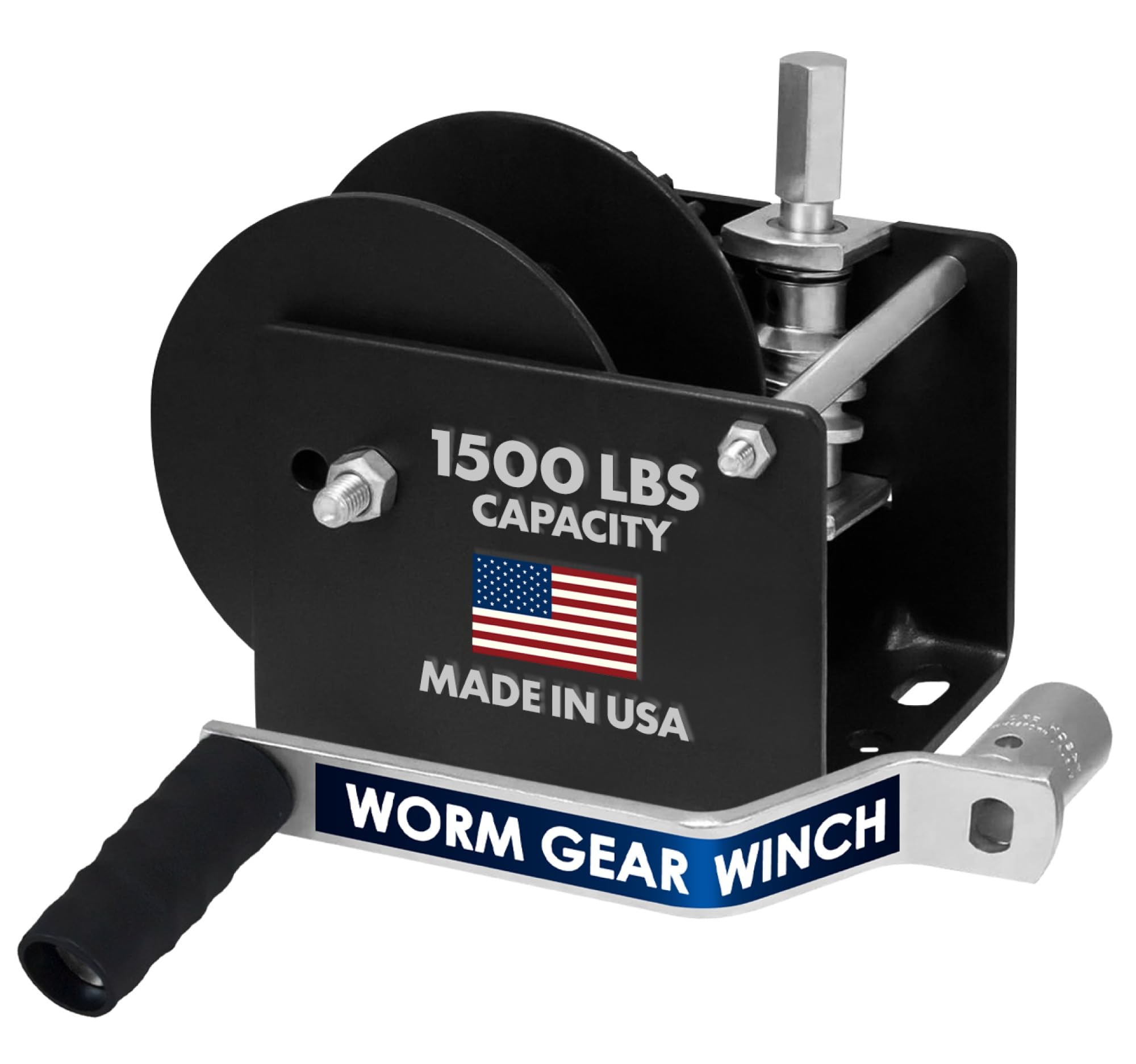
A 30:1 gear ratio that trades cranking speed for smooth, inch-by-inch control on heavy lifts.
Where the WG2000HEX hands you drill-driven power, this one adds a specific number that changes how it feels: a 30:1 gear ratio. That ratio is a multiplier on your effort, so heavy loads move in small, controlled increments instead of lurching. It is rated at 1,500 lb on the first layer of line, and for awkward positioning jobs around the shop or job site, that slow-and-steady control is what you want.
The drill drive is a 5/8 in hex, and it takes a standard cordless drill to cut down hand-crank effort on repeated pulls and long lifts. A removable socket handle is included so you can convert to a manual hand crank whenever power is not available. Durability is the thing that holds up over time here, with hardened all-steel gears and a self-braking worm gear that keeps the load locked the moment you stop. Buyers use it for lifts from tower sections to a 24 ft sun sail, and they keep praising how little effort the handle takes per turn.
Here is the spec that decides the rigging: the standard reel holds up to 43 ft of 1/4 in cable, which is not included. If your lift runs deeper than that, plan for a bigger drum. It is the lightest of the three at 10.38 pounds and measures 9.6 x 7 x 6.7 inches, so mounting it is no chore. The trade-off is the ratio itself — that 30:1 gearing means more turns of the handle per foot of cable, so it is built for control first and speed second.
Go with this when: you want drill-assisted cranking plus a low gear ratio that keeps a heavy load moving smoothly and safely in small steps.
Check the line first: confirm your lift stays within 43 ft of 1/4 in cable, because the standard drum will not hold more than that.
Know the Specs
Worm Gear Self-Locking
A worm gear is a screw-shaped gear that drives the drum through its thread, and that geometry resists turning backward when you stop cranking. In plain terms, the load stays put the instant you let go — no separate brake step. That is the whole reason to pick a worm gear winch over a come-along that can slip between pulls. It suits lifting and positioning where steady control matters more than raw speed.
Gear Ratio
Gear ratio is how many turns of the handle it takes to turn the drum once. A 30:1 ratio on the WG1500HEX means more turns per foot of cable, which multiplies your effort so heavy loads move in small, controlled steps. Lower ratio, more control and less speed; the ratio is a trade between muscle and pace, so match it to your load and your patience.
Hex Drive
A hex drive is a six-sided socket fitting that lets a standard cordless drill turn the drum instead of your arm. On the WG2000HEX and the 5/8 in hex of the WG1500HEX, the drill does the cranking on long lifts and repeated pulls. Both include a removable socket handle so you can switch to manual cranking whenever power is not available.
Reel Capacity
Reel capacity is how much line the drum will hold, which caps how deep a lift you can rig. The WG1500HEX’s standard reel holds up to 43 ft of 1/4 in cable, and the cable is not included. Measure your deepest pull before you buy so you do not run out of line mid-lift.
Common Questions
Does a worm gear winch really hold the load without a brake?
What is the difference between the WG2000HEX and the WG2000?
Can I use my cordless drill on the hex drive winches?
How much cable does the WG1500HEX hold?
What does a 30:1 gear ratio feel like in use?
Can these winches stay outside in the weather?
Is the Dutton-Lainson worm gear winch made in the USA?
Which model should a tower builder pick?
Do I need a separate brake or come-along with these?
The Bottom Line
For most lifting jobs, the worm gear winch winner is the Dutton-Lainson WG2000HEX because it gives you drill-powered cranking plus a manual socket handle backup, and it holds the load the instant you stop. If you want the lowest gear ratio for smooth, inch-by-inch control on heavy lifts, grab the WG1500HEX with its 30:1 ratio and 43 ft reel. And for a dead-simple field tool with no battery to charge, the manual-crank WG2000 is the one to reach for.
How we choose
We do not accept paid placement. Every pick is matched to a real buyer and a real use-case; we do not hands-on test units.
Sources
Specifications: manufacturer listings and product documentation. Review insights: verified customer reviews, as of November 2026. Pricing: not shown on this page (it changes often); check the current price via the retailer link.
As an Amazon Associate, Tactical Gear Guy earns from qualifying purchases. This does not affect which products we feature.