Specs are compiled from manufacturer listings and verified buyer reviews and can change over time — please confirm the key details on the product page before buying.
Buying yellow plastic chain sounds simple until you realize the cheap stuff fades to pale cream in one summer and snaps the first time a gust catches a long span. The one that matters most here is UV resistance and link thickness, because those two decide whether your barrier still looks like a barrier next season. This guide covers seven real options, from a 25-foot USA-made roll to a 124-foot bulk spool, so you can match the length and link size to the job instead of guessing.
This guide is built by comparing the manufacturers’ published specifications and the patterns across verified customer reviews, so you get each pick’s real strengths and trade-offs instead of marketing spin.
Some chain is built for a weekend event and some is built to sit outdoors for years. Below you’ll find honest notes on UV claims, link diameter, cut-to-length handling, and what owners actually report after real use. If you want the short answer before the details, the yellow plastic chain that holds up best outdoors is the SunShield roll, though a bigger spool wins on volume.
Top Picks

How To Choose The Best Yellow Plastic Chain
Plastic chain fails in three predictable ways: it bleaches pale in sunlight, it goes brittle and cracks, or it is simply too short for the span you need. Pick a roll that answers all three and you are done. Here is what to weigh before you buy.
UV resistance and color retention come first
Yellow is a warning color, so the whole point is that it stays yellow. A chain with a stated UV-resistance claim — like the SunShield technology on the US Weight roll, which the maker describes as holding up to 10 years of durability and color retention — is the difference between a barrier that still reads as “keep out” and one that fades into a pale smear by August. On bare outdoor spans in direct sun, treat any chain without a UV claim as a short-term buy.
Match link diameter to how far away it must be seen
Link diameter is the width of each individual loop, measured in inches. Bigger links catch more light and read from further away. Sizes here run from roughly 1.38 inches up to 2 inches, and a 2-inch link is the one to pick for parking-lot or roadside use where someone is looking from a distance. Smaller links are lighter and easier to handle for indoor queue lines and event décor.
Buy the length you’ll actually use, then cut
Every chain on this list can be trimmed with wire cutters, tin snips, garden shears, or on some models ordinary scissors. Buying slightly over your span is safer than coming up short, because a spliced barrier looks sloppy and a cut end is easy to tidy. Long spans between posts also sag more, so a 100-foot or 124-foot roll is the right call for driveways and fence lines rather than chaining several short rolls together.
Side-by-Side Comparison
| Model | Best For | Length | Link Diameter | Weight | Amazon |
|---|---|---|---|---|---|
| US Weight 2″ x 25′ SunSheild★ Best Overall | Long-term outdoor use | 25 ft | 2 in | 1 pounds | Amazon |
| PATIKIL Plastic Chain Links 30 FtBest For Events | Indoor crowd lines and events | 30 ft | 1.4 in | 12.6 ounces | Amazon |
| SEVSTATWK Yellow Plastic Chain 25ft | Fast setup with hardware included | 25 ft | 1.42 in | 1.08 pounds | Amazon |
| Mr. Chain 30002-25 | Commercial crowd control | 25 ft | — | 1.02 pounds | Amazon |
| Ahniiqo 60 Feet Barrier Chain | Long runs on a budget | 60 ft | 1.5 in | 2.94 pounds | Amazon |
| Stockroom Plus 100-Foot Roll | Driveway and parking barriers | 100 ft | 1.38 in | 3.9 pounds | Amazon |
| Houseables 124-Foot Spool | Bulk industrial spans | 124 ft | 2 in | 6.43 pounds | Amazon |
Detailed Reviews
1. US Weight 2″ x 25′ SunSheild Plastic Safety Chain – Yellow
Our pick — 4.5+★ from 1,500+ verified ratings; the strongest balance of quality and price.
The 2-inch link that holds its color through a decade of sun.
Two inches of link width is the number that matters here. That is 2 inches versus the 1.38-inch links on the Stockroom Plus roll, so each loop catches more light and reads as a hard yellow line from across a loading dock. For a parking barrier or a hazard boundary, that extra width is the whole reason you would pay a little more for a shorter roll.
The maker’s UV claim is the real headline: SunShield technology rated for up to 10 years of durability and color retention. Owners back that up in practice — the chain holds up in wind and rain, and the bright yellow is visible from a distance. It ships as a 25-foot length with two S-hooks included, so you can hang it on posts or walls without a separate hardware run. Made in the USA is stated plainly, too. And at 1 pound for the whole roll, winding it off and back is a one-hand job.
Cutting is simple with wire cutters or tin snips, and the color lineup means you can color-code zones if you run several. The trade-off is span: 25 feet is a short roll, so a long driveway or fence line will need more than one length. That is the honest case for stepping up to the 100-foot or 124-foot spools below if you are fencing distance rather than marking a doorway.
What earns the top spot
- 2-inch links stay visible from a real distance, not just arm’s length
- Stated UV resistance targets the fade problem directly
- Two S-hooks included so setup needs no extra parts
- At 1 pound, the whole roll handles easily
Where it runs short
- 25 feet covers a doorway or dock, not a long fence run
- Long spans between posts will need extra support to stay taut
Reach for this if: you need one visible, sun-resistant span across a gate, dock, or short property line and want it to still look yellow next year.
Look elsewhere if: your job is measuring out a driveway length — a 100-foot or 124-foot roll will serve you far better than several of these joined up.
2. PATIKIL Plastic Chain Links, 30 Feet Safety Chains, Yellow
A 30-foot roll light enough to carry to the next event.
If your chain lives in a van and comes out for a different venue every weekend, handling matters more than brute strength. This one weighs 12.6 ounces for the full 30 feet — light enough to carry on one shoulder along with the rest of your event kit. The links measure 1.4 x 0.8 x 0.2 inches each, a modest size that suits indoor crowd lines rather than roadside visibility.
The design is built for repeat use. You roll it onto a plastic reel after the event and it goes back to the next one without tangling, which owners confirm is how it behaves. Cutting to a shorter length takes wire cutters, tin snips, or even pruning shears. It attaches to posts and ground poles, and the plastic is described as not rusting or fading in rain or sun over long-term use.
One quirk worth knowing: the listing shows a product dimension entry that lists the single link’s measurements rather than the rolled-up package size, so don’t read it as a bulk item size. It works beautifully for small-space jobs — breakaway props, queue guides at a market stall, a bit of theatrical décor — and it is the lightest handling roll in this group.
Best for shuffling between venues: the reel-and-roll routine plus 12.6 ounces of carry weight makes this the one you throw in the boot without thinking about it.
The honest limit: 1.4-inch links and a shorter roll mean this is an indoor and event chain, not a roadside barrier — for that, the 2-inch links elsewhere do the job better.
Who this beats for: market traders, event crews, and anyone who sets up and packs down constantly and wants chain that avoids a tangle.
Where it bows out: exposed outdoor spans where a driver needs to spot the line from a distance — step up to a bigger link size for that.
3. Yellow Plastic Chain 25ft

Six hooks and a red end tab so you can hang it in minutes.
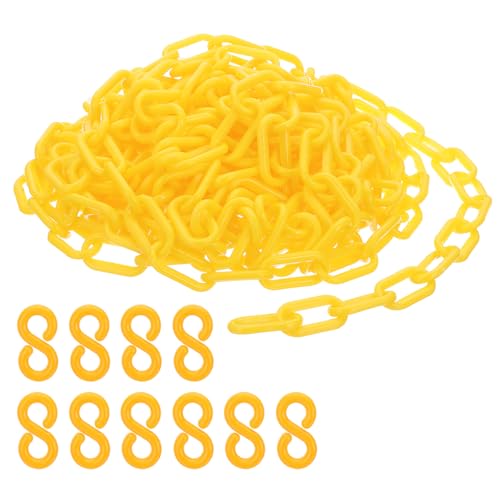
The package is what sells this one. You get a 25-foot chain with 1.42-inch links, plus six S-hooks and a red hook already attached to one end. That red tab is a small but genuinely useful touch — it makes the loose end easy to spot in a crowd so you can grab and clip it fast. If you have ever untangled a barrier while a queue waits, you will appreciate it.
Each link is 20 percent heavier than the standard for added strength, and the plastic resists fading, aging, and cracking. For a 25-foot span at 1.08 pounds total, that is a workable balance — stiff enough to hang properly, still light enough to set up solo. Trimming uses wire cutters or garden shears if you need a shorter run.
Where it fits best is indoor and controlled outdoor use: museums, event venues, horse arenas, warehouses, and parking zones. The listed package dimensions describe the box it arrives in, so expect a compact parcel. As a newer listing it has less of a track record behind it than the longer-established rolls, which is the one reason to look twice before choosing it for a hard-use industrial site.
Setup convenience: six S-hooks plus a pre-attached red end hook means fewer trips to the hardware drawer and a barrier that goes up in the time it takes to read this paragraph.
Fair caveat: it is a fresh product with a thinner history than the long-running rolls here, so heavy commercial duty is better served by a proven name.
Pick this when: included hardware and a clearly marked end saves you the fiddly part of barrier setup.
Pass if: your site is high-traffic, all-weather industrial and you want a roll with years of owner feedback behind it.
4. Mr. Chain 30002-25
The workhorse roll you buy for crowd lines that run all day.
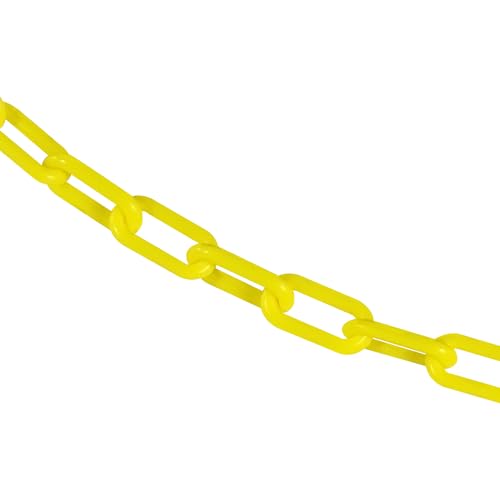
High-density polyethylene is the material spec to notice here, because it is the plastic that tends to stay tough instead of going brittle. The maker rates it UV-resistant and says it will not fade, rust, or become brittle. For a barrier that lives outdoors on a queue line, that trio of claims is exactly what you want on the label.
Fitting it to your site is the other strength. It is pitched as an alternative to caution tape, which matters if you have been taping off pews or walkways and want something reusable that looks tidier. The links are sized to read from over 30 feet away, and the whole roll weighs just 1.02 pounds. Trimming with wire cutters works, and the plastic is recyclable once you’re done with it.
Color is the one thing to size carefully. Bright yellow is the point for safety, but if you are buying for a decorative garden or event role where a softer shade suits, note that color carries a mixed reception in the review pages. For pure crowd control and access restriction, it stays firmly on mission.
What wins people over: the material. High-density polyethylene plus UV resistance is the combination that keeps plastic chain from cracking through a summer of sun, and the large links give it presence at a distance.
Worth knowing: it is a short 25-foot roll, so budget for more than one if you are marking out a long queue lane.
The right call for: churches, venues, and property managers who need reusable crowd-control barrier instead of throwaway caution tape.
Think twice if: you need a decorative accent rather than a safety line, or a single span longer than 25 feet.
5. 60 Feet Plastic Barrier Chain
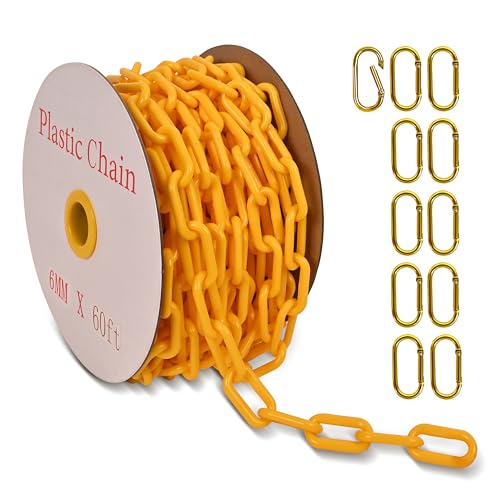
Sixty feet of chain with a carabiner so it clips and releases fast.
Length is the argument for this one. At 60 feet versus the short 25-foot rolls, you can mark a real queue lane or a long site boundary with one piece. Each link measures about 1.4 x 0.78 x 0.236 inches, and the whole run weighs 2.94 pounds — hefty enough to hang properly, still portable. That is 2.94 pounds versus the 1-pound US Weight roll, and you feel it once the span gets long.
The quick-release carabiner is the practical detail. It clips onto a post or fence and lets you pull the chain down in seconds. Trimming to length needs only ordinary scissors, no specialist tool, which is unusual and genuinely convenient. The plastic is described as non-conductive and safe for use around electrical repair or pool-area isolation, so it is a sensible choice where a metal chain would be the wrong call.
One honest note from the maker: they flag a possible measurement error of plus or minus 0.5 percent on link size, and say physical color may differ slightly from the screen. In practice that means treat the length as close rather than exact and don’t count on a perfect color match to a swatch. For general crowd control, that margin is fine.
Why this earns its place
- 60 feet covers a long lane without joining rolls
- Quick-release carabiner makes setup and pack-down fast
- Ordinary scissors can trim it, so no tool kit needed
- Non-conductive plastic suits pool areas and electrical zones
The fine print
- Maker notes up to 0.5 percent measurement variance on link size
- Screen colors may not match the physical yellow exactly
Go with this for: a long queue lane or site perimeter where one piece of chain is far neater than joining several short rolls.
Not the one for: a compact doorway or indoor accent job, where a lighter, shorter roll is easier to manage.
6. Yellow Plastic Chain 100-Foot

A hundred feet on one roll, priced for fencing off real distance.
This is the value answer to long-span barriers. One hundred feet versus the 25 feet on the US Weight roll is enough to line a driveway, a parking bay, or a market lot without splicing pieces together. Each link measures 1.38 x 0.75 x 0.2 inches, and the whole roll weighs 3.9 pounds, so it stays manageable in one hand.
The material is described as weatherproof and built to withstand varied conditions without rusting or fading. It cuts to length easily, which owners appreciate, and the chain is used for both barricades and props — it doubles as decorative chain for Halloween and event work. Set aside the mixed reception on durability, though. Some owners find it can break under real load, and there are reports of it behaving as though only as strong as its weakest link. For a visual line that directs people, that is workable. For a load-bearing tie-down, it is not.
So the honest framing is this: it is a visual barrier first, and a structural one never. Use it to close off a driveway, guide traffic, or mark zones, and it earns its keep. Ask it to hold anything back or bear real tension and you will be disappointed.
Volume for the job: 100 feet for driveway and parking-lot fencing is exactly the length most people actually need, and the weatherproof build suits a permanent outdoor setup.
The fair caution: reports of breaking under load mean this belongs where it warns and directs people, not where it has to hold weight or withstand force.
Made for: driveways, parking lots, and market bays that need a long, visible, weatherproof line in one piece.
Skip for: anything load-bearing or structural — if the chain has to actually restrain, choose a heavier-duty barrier than plastic.
7. Plastic Chain 124 Feet

The two-inch link at 124 feet — the biggest run and the widest loops here.
Two inches of link width across 124 feet is the most barrier you can buy in this group. Each link is 2 inches with a quarter-inch thickness, which is the size that reads at a distance — not at arm’s length. Against the 1.38-inch links on the 100-foot roll, the 2-inch width is the reason this chain suits industrial, roadside, and arena work where the barrier must be obvious.
The build is aimed at staying outdoors. It is UV protected and weatherproofed to sit under hot sun and wet weather without fading or rusting, which is the point they make about metal chain. It attaches to stanchions and ground poles and unrolls from a reel without tangling. Owners describe it as easy to move and visible from a distance, and it is used for church parking-lot events, so the everyday barrier role is well covered. The material is recyclable when you are done.
At 6.43 pounds this is the heaviest roll here, which is the honest trade-off. That weight is what gives it stability over a long span and keeps it from sagging, but it also means a solo setup takes both hands and a firm footing. Bring a helper for a full 124-foot run.
Strongest barrier in the group
- 2-inch links carry the most visual weight of any pick here
- 124 feet runs a full lot or arena line in one piece
- UV protected and weatherproof for permanent outdoor use
- Recyclable plastic when it finally retires
What to plan around
- At 6.43 pounds it is the heaviest roll to haul and set up
- A 124-foot run over uneven ground is easier with a second pair of hands
When it’s the right roll: industrial, arena, or roadside barriers that must be legible from far off and stay out in all weather.
When to look elsewhere: small indoor or event jobs, where the weight and bulk of a 124-foot spool is more than you need.
Know the Specs
Link Diameter (Inches)
Link diameter is the width of each individual loop in the chain, measured in inches. It decides how far away the barrier can be seen and how much weight the chain carries. A 2-inch link catches more light and reads at a distance, which suits parking lots and roadside marking. Smaller links around 1.38 to 1.5 inches are lighter and easier to handle for indoor queue lines and event décor. Match the size to who needs to see the line and from how far.
UV Resistance and Color Retention
UV resistance means the plastic is formulated to withstand sunlight without going brittle or bleaching. Yellow is a warning color, so when it fades the whole point of the barrier fades with it. Chains with a stated UV claim, or made from high-density polyethylene, are the ones to trust for permanent outdoor use. Without a UV claim, treat a chain as a short-term or covered-use product.
Cut-To-Length and Tools
Every plastic chain here can be trimmed, but the tools vary. Wire cutters, tin snips, garden shears, and on some models ordinary scissors all work. Buy slightly more length than your span so a cut end is the only trim you make. Long spans sag more between posts, so plan extra supports rather than stretching one piece tight.
Weight Per Roll
Roll weight tells you how portable the chain is over a long span. A 1-pound roll is a one-hand job, while the 6.43-pound bulk spool needs a second pair of hands. Heavier chain tends to hold up better across a long run, but lighter rolls are far easier to carry between events. Weigh how far the chain must reach against how often you will move it.
Common Questions
What does the inch number on plastic chain actually mean?
Will yellow plastic chain fade in the sun?
How do I cut plastic chain to the length I need?
Can plastic chain be used outdoors year-round?
Is plastic chain strong enough to block a parking space?
Does plastic chain rust or go brittle over time?
How much length do I need to span a driveway?
Can I reuse plastic chain at another event?
Is yellow plastic chain recyclable?
Can I use plastic chain around a pool or electrical work?
The Bottom Line
For most buyers, the best overall pick here is the US Weight SunSheild roll, because its 2-inch links and stated UV resistance cover the two things that decide if a barrier lasts. If you need a long span for a driveway or lot, grab the 100-foot Stockroom Plus roll, and if maximum visibility across a big site is the goal, the Houseables 124-foot spool is the one to reach for. One honest nudge: buy the roll that matches your span in the first place rather than joining several short lengths, since that is where most barrier setups lose their tidy look.
How we choose
We do not accept paid placement. Every pick is matched to a real buyer and a real use-case; we do not hands-on test units.
Sources
Specifications: manufacturer listings and product documentation. Review insights: verified customer reviews, as of November 2026. Pricing: not shown on this page (it changes often); check the current price via the retailer link.
As an Amazon Associate, Tactical Gear Guy earns from qualifying purchases. This does not affect which products we feature.