Specs are compiled from manufacturer listings and verified buyer reviews and can change over time — please confirm the key details on the product page before buying.
If your feet ache by lunch, the problem is usually the sole, not your work ethic. A wedge sole is one flat slab of rubber or crepe running heel to toe with no raised heel, so your weight spreads evenly instead of concentrating under the heel. This guide covers eleven boots built that way, ranked by how they actually hold up on concrete, ladders and asphalt — with the honest trade-offs each one carries.
This guide is built by comparing the manufacturers’ published specifications and the patterns across verified customer reviews, so you get each pick’s real strengths and trade-offs instead of marketing spin.
You will see which uppers are waterproof, which toes carry a safety rating, and which soles can be replaced once they wear flat. Every pick below is judged on the same handful of specs, giving you a straight answer on the work boots wedge sole that matches your job.
Top Picks

How To Choose The Best Work Boots Wedge Sole
Start with the sole, because that is the whole point of this category. A wedge sole is a single flat layer of rubber or crepe foam that runs from heel to toe with no defined heel block. It spreads your body weight across the whole foot, which is why roofers, concrete finishers and warehouse crews gravitate to it.
Sole material: rubber versus polyurethane versus crepe
Rubber outsoles resist oil and slips well and can be a little firmer underfoot. Polyurethane foam soles carry tiny air bubbles, which is what makes them light and shock-absorbing. Crepe-style soles grip smooth concrete but wear faster on rough asphalt. If you walk on finished floors all day, a foam or crepe wedge is the softer ride; if you are on oily shop floors, favor a rubber wedge with a slip rating.
Construction: welted versus cemented
Goodyear welt construction stitches the upper, lining and midsole together so the outsole can be replaced when it wears flat. Stitchdown construction, used on some American-made boots, stitches the upper directly to the midsole for extra stability underfoot. Both beat a glued-on sole if you plan to keep the boot for years rather than one season.
Toe protection and electrical rating
A soft toe keeps the boot lighter and more flexible but offers no impact protection. A steel or alloy safety toe adds a protective cap and usually bumps the weight. If your site requires it, look for an ASTM F2413-18 rating printed in the listing. Electrical hazard (EH) rated soles are built with non-conductive materials — worth knowing if you work near live circuits.
Side-by-Side Comparison
| Model | Best For | Shaft Height | Toe Style | Construction | Amazon |
|---|---|---|---|---|---|
| Georgia Boot Men’s Wedge Industrial Boot★ Best Overall | All-day comfort on concrete | — | Soft Toe | Goodyear Welt | Amazon |
| AZXPROT 6″ Soft Toe Wedge Sole WaterproofBest Value | Wet-weather site work | 6″ | Soft Toe | Goodyear Welt | Amazon |
| Golden Fox 6″ Plain Toe WedgeTop Performer | Ironworkers and carpenters | 6″ | Plain Toe | Goodyear Welt | Amazon |
| Wolverine Trade Wedge Waterproof Romeo | Pull-on convenience | — | Soft Toe | Wedge Outsole | Amazon |
| ROCKROOSTER Edgewood Moc Toe | Roofers and asphalt crews | 6″ | Steel Toe | Goodyear Welt | Amazon |
| Carhartt Men’s Chelsea Wedge Boot | Slip-on all-shift wear | — | Steel or Soft Toe | Goodyear Welt | Amazon |
| ARIAT Rebar Wedge Moc Toe 6″ | Waterproof premium comfort | 6″ | Moc Toe | — | Amazon |
| Timberland PRO Gridworks Wedge 6″ | Cold and oily terrain | 6″ | Alloy Safety Toe | — | Amazon |
| Danner 6″ Bull Run | USA-made stitchdown build | 6″ | Round Toe | Stitchdown | Amazon |
| Danner Bull Run 8″ Brown Cristy | Ankle support on ladders | 8″ | Round Toe | Stitchdown | Amazon |
| Thorogood American Heritage 8″ | Dirty jobs, no break-in | 8″ | Soft Toe | Goodyear Storm Welt | Amazon |
Detailed Reviews
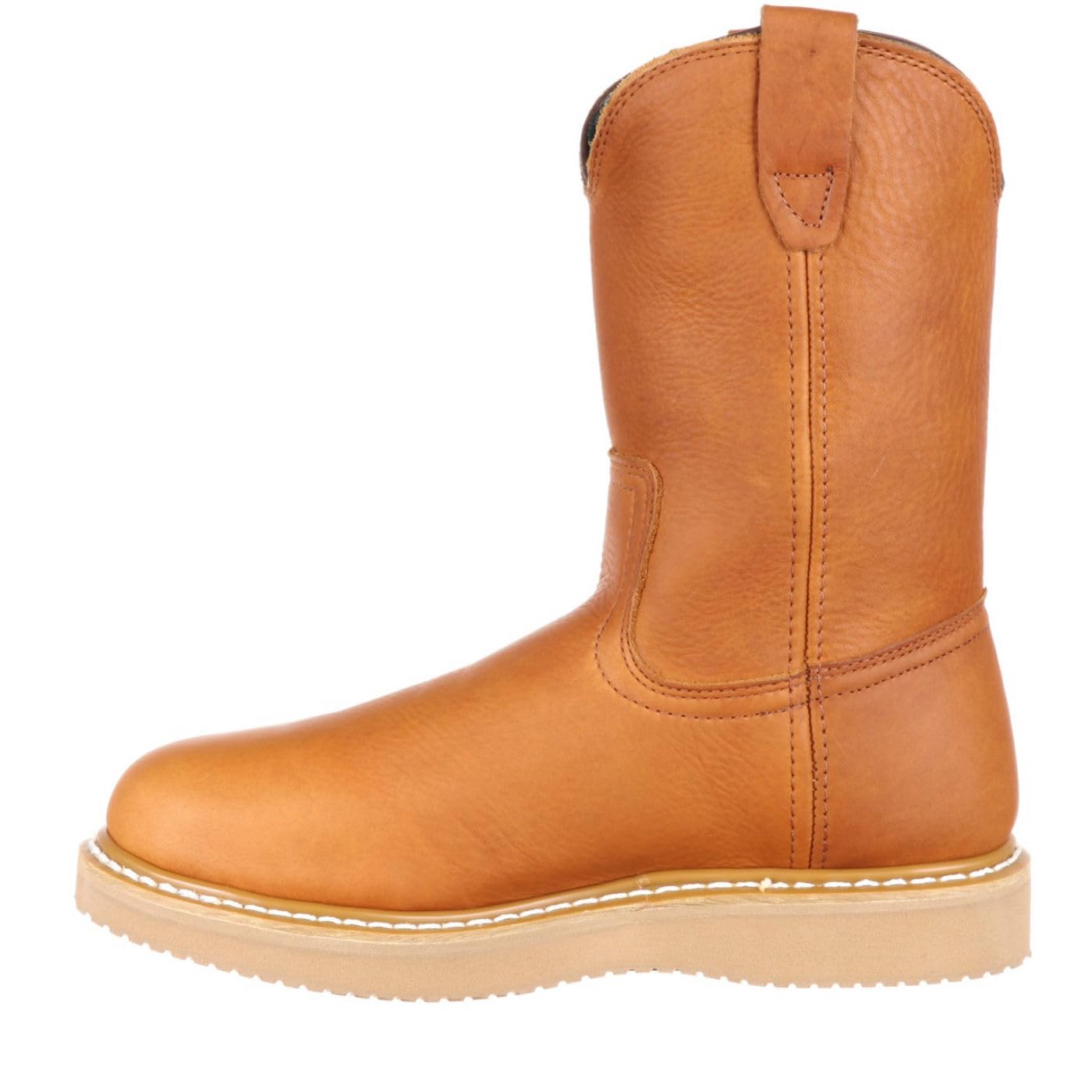
1. Georgia Boot Men’s Wedge Industrial Boot
Our pick — 4.5+★ from 850+ verified ratings; the strongest balance of quality and price.
The leather-and-welt wedge that wins on comfort without asking you to gamble.
Comfort is the reason this boot lands at the top. Owners describe a wedge that softens the ground underfoot through a full shift, and it sits on a flat crepe-style sole that spreads weight instead of concentrating it at the heel. The upper is real leather, and Georgia builds it with Goodyear welt construction — stitching that ties the upper, lining and midsole together so the outsole can be swapped once it wears flat.
A wedge sole is the part that dies first; if the boot is welted, a cobbler can fit a new sole and you keep a broken-in upper for years. This is where it beats the AZXPROT 6″ below — both use Goodyear welt construction, but the Georgia’s leather upper and 5.07-pound shipping weight point to a sturdier build you can service rather than replace.
The honest catch is sizing. Fit is the single most-talked-about topic on this boot, and it splits — some buyers report the size is spot on, others find it off and end up exchanging. Order with a returns plan in mind, and measure your foot against the size chart rather than assuming your sneaker size carries over.
What’s working in your favor
- Goodyear welt construction lets a cobbler replace the worn outsole instead of scrapping the boot
- Leather upper that owners mention looks sharp off the clock as well as on site
- Wedge sole spreads pressure evenly for long hours on hard floors
- Comfort is the standout in owner feedback by a wide margin
What to plan around
- Sizing runs inconsistent — some find their usual number perfect, others need a swap
- Soft toe, so no impact cap if your site requires one
- Durability reports are a mixed bag rather than universally glowing
Reach for this if: you want one wedge boot that cushions a long shift and can be resoled rather than thrown out.
Think twice if: your workplace mandates a safety toe cap or you want to order without checking the size chart.
2. AZXPROT 6″ Soft Toe Wedge Sole Waterproof Safety Boot
Budget-tier pricing with full-grain leather and a dual-density sole that absorbs shock.
Here is what the entry-level tier gets you: a 6-inch shaft, full-grain leather upper, Goodyear welt construction and a dual-density outsole that mixes rubber with PU foam. That foam layer is the part you feel — it cushions and rebounds underfoot so a concrete floor feels less like concrete. The upper leather is oil-tanned and described as water resistant rather than fully waterproof, so splashes and damp ground are fine, standing in a puddle is not.
Build quality is what buyers talk about most here, and comfort runs a close second. The leather is treated to resist hardening and cracking, which is the usual failure point on cheap work boots. Speed hooks make lacing quick at 5 a.m., and the padded tongue and soft collar keep the ankle from rubbing.
Weigh the durability picture honestly, though. There is real disagreement in the feedback — a stretch of customers note the boots coming apart within weeks, while the broader consensus calls the quality good. Treat this as a value pick for lighter duty or a second pair, not as the boot you bet a decade of hard concrete on.
Where it earns its place: full-grain leather, a dual-density shock-absorbing sole and Goodyear welt at the entry tier is a lot of boot for the money, and the slip- and oil-resistant tread handles shop floors.
The trade-off to know: water resistant is not waterproof, and the durability record is genuinely split rather than uniformly strong.
Best fit for: landscaping, warehouse or light construction crews who want a leather wedge boot without stretching the budget.
Look elsewhere if: you need a guaranteed waterproof membrane or a safety toe cap.
3. Golden Fox 6″ Plain Toe Wedge Boot
A foamed polyurethane wedge with air bubbles in it — light, springy and genuinely comfortable.
The sole is the story. Golden Fox builds this on a heavy-duty polyurethane wedge, a foamed material full of tiny air bubbles that keeps the boot light, flexible and shock-absorbing. Inside sits a steel shank, a stiff strip under the arch that forces the foot to bend at the ball rather than the middle — which is what takes pressure off your arch over a long day.
Construction is Goodyear welted, so the sole can be replaced and the premium oil-tanned leather upper keeps going. Triple stitching holds the panels together, and the leather develops a patina as it scuffs rather than looking beaten. Oil- and slip-resisting properties make it a fit for ironworkers, carpenters and general construction.
Comfort and value are the two things buyers bring up most, and the roomy toe box gets called out specifically. The one recurring note is stiffness — several say the leather starts firm and softens with wear, while a few find it stays stiff longer than they would like. Give it a gradual break-in rather than judging it on day one.
The real draw: a foamed polyurethane wedge with a steel shank under the arch is a combination that reads comfortable and light on paper and delivers it on concrete.
Set your expectations: the leather arrives firm. Break-in is real here, and the first week will not feel like the third.
Pick this one if: you want a resole-able welted wedge with a roomy toe box and a sole that stays springy all shift.
Wait on it if: you need a boot that feels broken in from the first hour.
4. WOLVERINE Trade Wedge Waterproof Romeo Boot

No laces, no fuss — a waterproof Romeo that slides on in seconds.
This is the boot for anyone who has had enough of lacing up in the dark. It is a Romeo-style slip-on, so you step in, and the smooth lining helps your foot slide down rather than catch on the way. The wedge outsole spreads pressure evenly across hard surfaces, and the waterproof build means a wet morning does not soak through before you reach the truck.
Owners are clear about what works: the quality feels solid, it looks sharp, and it is lighter than its bulk suggests. The trade-off is size. Fit runs very big here, and that is the most-discussed point about this boot by a wide margin. If you normally wear a 10, do not assume a 10 is your number — check the size guidance and size down if the chart points that way.
There is also a wear question on the sole. Most say the boot holds up well, but a minority find the bottom wears through faster than expected, which is worth knowing if you are on abrasive asphalt all day.
Why it earns a spot
- Slip-on design means you are out the door without lacing
- Waterproof build for wet commutes and damp sites
- Wedge sole spreads pressure across hard floors
- Smooth lining makes the foot easy to insert
Fit notes to weigh
- Sizing runs very big — the biggest complaint on this model
- Slip-on fit depends on your instep, so try the size chart carefully
- Some report the outsole wears quickly on rough ground
Belongs on your feet if: you want waterproof protection and a wedge sole without a single lace to tie.
Pass if: you want a locked-down laced fit or you cannot size down for a roomy last.
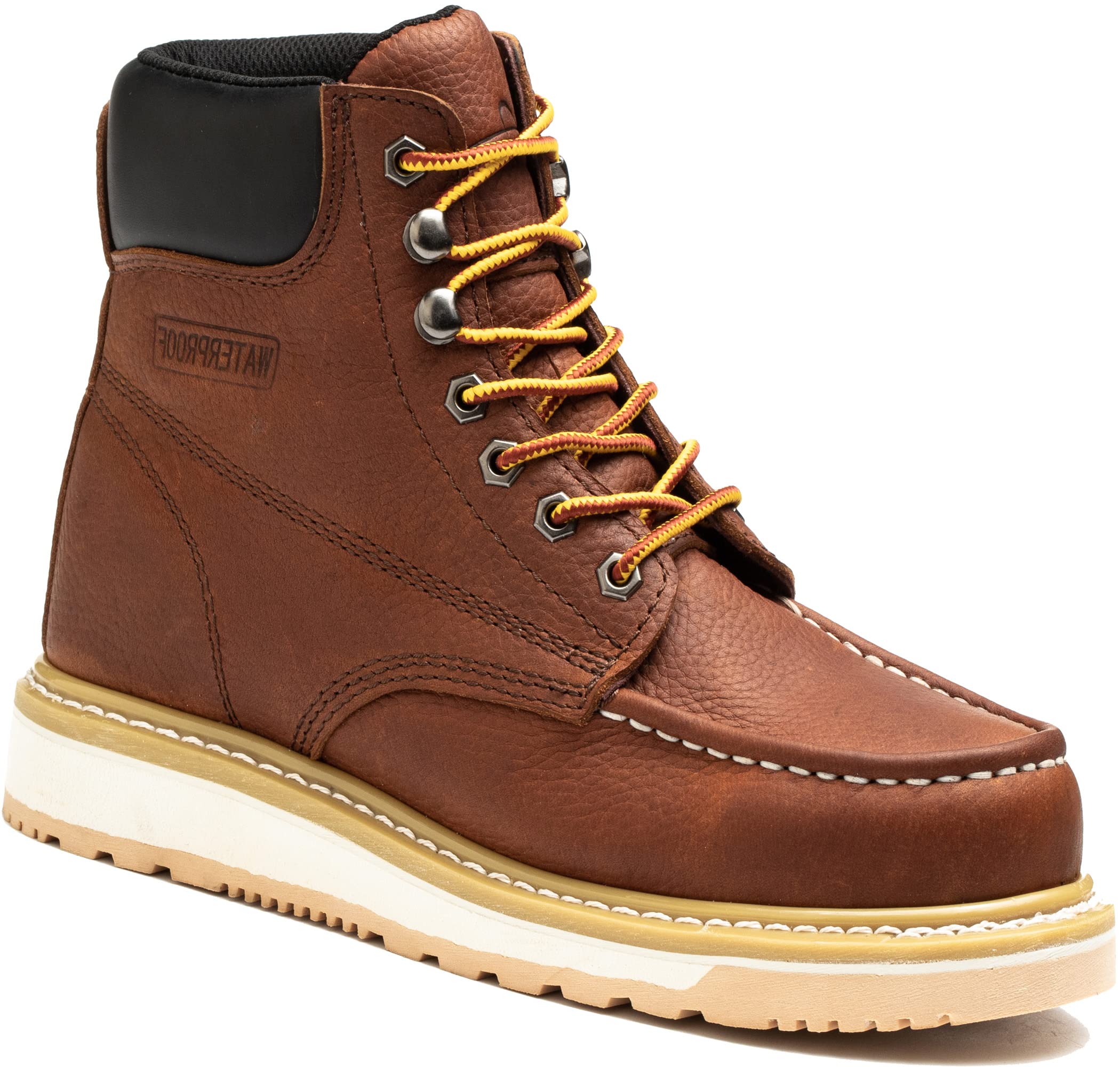
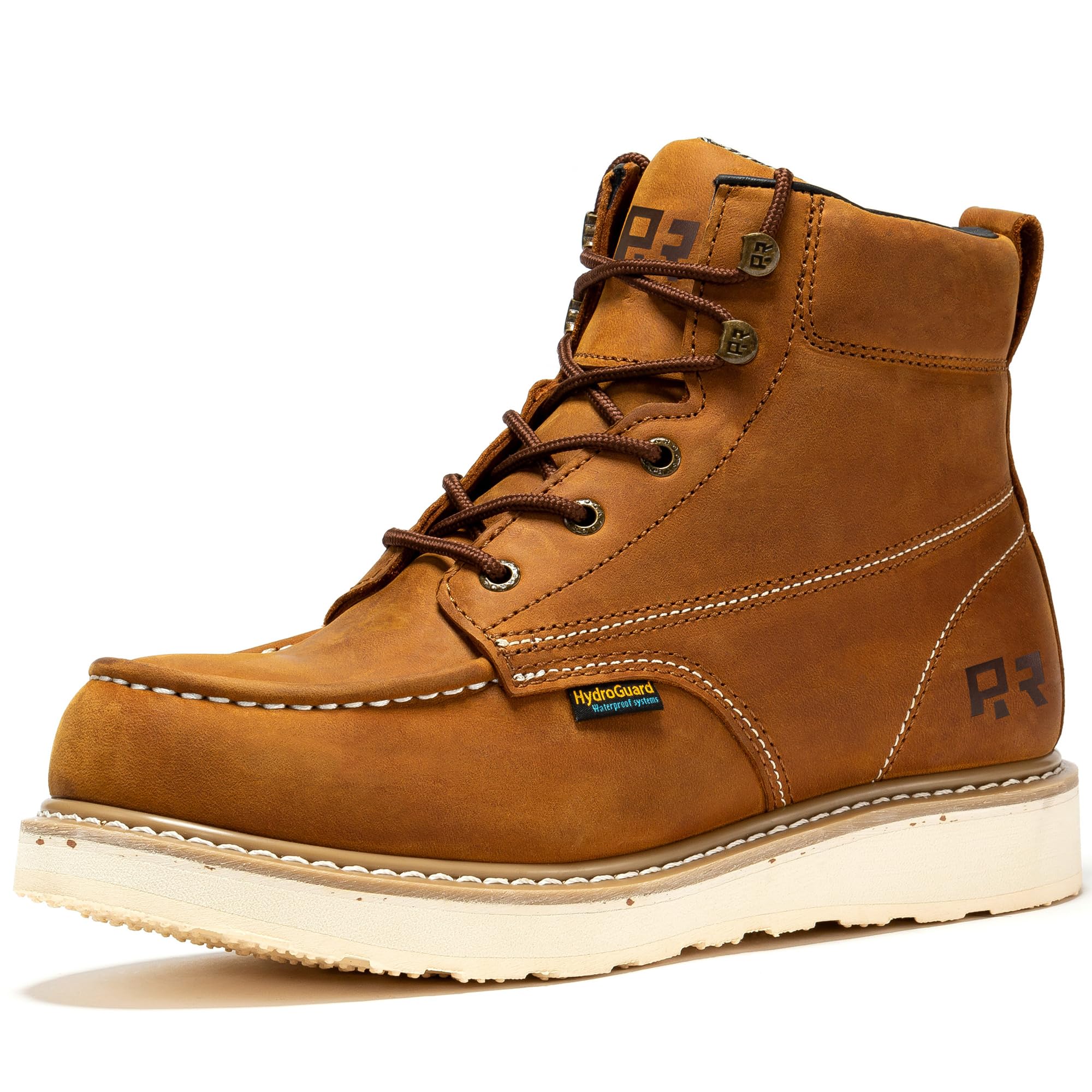
5. ROCKROOSTER Edgewood Waterproof Moc Toe Work Boot
The one on this list that carries a full ASTM safety rating and a steel toe cap.
For roofers and asphalt crews, this is the spec sheet that matters: steel toe, ASTM F2413-18 M/I/C, I/75 C/75, EH rated. In plain terms, that is a boot tested for impact and compression resistance plus electrical hazard protection — the standard a commercial site will ask you to prove. The upper is oiled crazy horse leather with a Hydroguard waterproof membrane, and the sole is oil-resistant, non-slip rubber.
Underfoot there is a PU midsole and a steel shank for arch support, and the moc-toe stitching gives it a look that works off the clock too. It is a 6-inch shaft, which keeps the boot flexible while still covering the ankle. Sizing runs 6 through 15 for men.
Quality is the theme in the feedback, with comfort right behind it, and buyers describe it as good value for heavy rain and light abrasion — the two conditions roofers actually face. The honest caveat is longevity. Some find it tough on concrete, some say it will not last, and the leather gets called fairly fragile by a few. This is a strong safety boot, not an heirloom.
What you are really buying: a certified ASTM F2413-18 steel-toe wedge with a waterproof membrane and a non-slip rubber outsole — real site compliance, not decorative safety language.
The honest limit: durability is the split point in the feedback, so this favors crews who rotate boots rather than wear one pair into the ground.
Built for: roofers, asphalt crews and anyone whose site requires a rated steel toe and EH protection.
Wrong pick if: you want a soft toe for flexibility or expect a decade out of one pair.
6. Carhartt Men’s Chelsea Wedge Boot

A pull-on Chelsea with twin gore panels that hug the ankle without a lace in sight.
Carhartt’s take on the wedge is a Chelsea silhouette — oil-tanned leather, twin gore panels on the sides that stretch to let the foot in, and a pull tab to get it started. It comes in both steel toe and soft toe versions, so you can match the safety spec to your site instead of settling.
The footbed is where the comfort lives. Insite technology delivers high-rebound cushioning with arch support, and a FastDry lining pulls moisture away so feet do not stew over a long shift. The outsole is a dual-density Carhartt rubber wedge with slip-resistant traction, and Goodyear welt construction means it can be resoled down the road.
Easy on and off is the third most-mentioned thing about this boot, right behind quality and comfort, and the gore panels are why. The mixed signals come from durability — a share of reviewers point out the soles separating — plus a sizeable group who find the fit off. Soft toe or steel toe and a break-in period both matter here, so try them on a job that does not punish a wrong call.
Standout spec: Insite footbeds and a FastDry lining under a dual-density slip-resistant rubber wedge is a comfort stack built for a full shift on your feet.
The catch: sole separation shows up in enough feedback to be a real question mark, and the fit runs inconsistent enough to try before you commit to a season.
Go for it if: you are on and off your feet all day and want a slip-on that still has a cushioned, supportive footbed.
Reconsider if: you need the most bulletproof sole on the list, or a locked fit with laces.
7. ARIAT Rebar Wedge Moc Toe 6″ Waterproof Work Boot

The premium wedge that buyers keep on their feet rather than in the closet.
Ariat’s Rebar wedge is a 6-inch waterproof moc-toe built for the guy who works in weather and does not want to think about his feet. It weighs 3.1 pounds — a light build for a waterproof leather boot — so a long shift on scaffolding or in a trench does not leave you dragging by three in the afternoon.
What buyers value most is how it handles actual work: it comes up repeatedly as work-friendly, with comfort close behind. That is the pair you want in a boot you wear daily rather than save for site inspections. Fit gets called out as accurate for most, so the sizing question is less of a gamble here than on the Carhartt.
Weight is the one honest split. Some owners call it light, others say it feels heavy on the foot — which usually depends on what you are comparing it against. If you are coming off a soft-toe canvas boot, expect a firmer, planted feel. For a waterproof leather boot at this tier, that is a fair trade.
The case for it
- Waterproof leather keeps feet dry through wet shifts
- 3.1-pound build stays light on the foot for a waterproof boot
- Work-friendly by reputation — buyers wear it full-time, not occasionally
- Fit runs accurate for most, so sizing is less of a coin flip
What you give up
- Weight opinions divide — some find it heavy compared with lighter soft-toe boots
- No safety toe listed, so it will not satisfy a site that mandates one
Your pick if: you want a waterproof leather wedge that is light enough to wear all day and accurate enough in size to order with confidence.
Keep looking if: your work requires a safety toe or you strongly prefer a heavier, more planted feel.
8. Timberland PRO Gridworks Wedge 6″ Alloy Safety Toe

Alloy toe protection with a cold-formula outsole built for freezing, oily ground.
The defining spec here is the alloy safety toe paired with an internal waterproof membrane. Alloy is lighter than steel for the same protection job, so you get a cap without the full steel-toe mass. The membrane keeps water out and adds blood-borne pathogen resistance — a detail that matters in industrial and medical-adjacent settings, not just wet weather.
Underfoot, Anti-Fatigue Technology footbeds absorb shock and push energy back into each step, and the lining is breathable ReBOTL material containing at least 50% recycled plastic with an antimicrobial treatment to keep odor down. The outsole is a lightweight cold-formula wedge built for traction on freezing and oily surfaces. Electrical hazard protection rounds out the safety spec.
Buyers in construction are the loudest fans, and comfort and fit both draw praise. Durability splits hard, though — some pairs last almost two years, others come apart within a month. Break-in time and weight divide opinion too, with a chunk of owners calling them chunky.
The deciding spec: an alloy toe plus a waterproof membrane, an antimicrobial ReBOTL lining and a cold-formula outsole is genuine protection for cold, wet, oily work.
Read this before you buy: durability is the least predictable part of the feedback — the experience ranges from nearly two years to a month, so treat this as the light-duty option in a rotation rather than a single pair for everything.
Fits the job if: you need an alloy toe, waterproofing and real traction on freezing or oily floors.
Think hard if: you want a boot that breaks in fast and stays light on the foot.
9. Danner 6″ Bull Run Work Boot
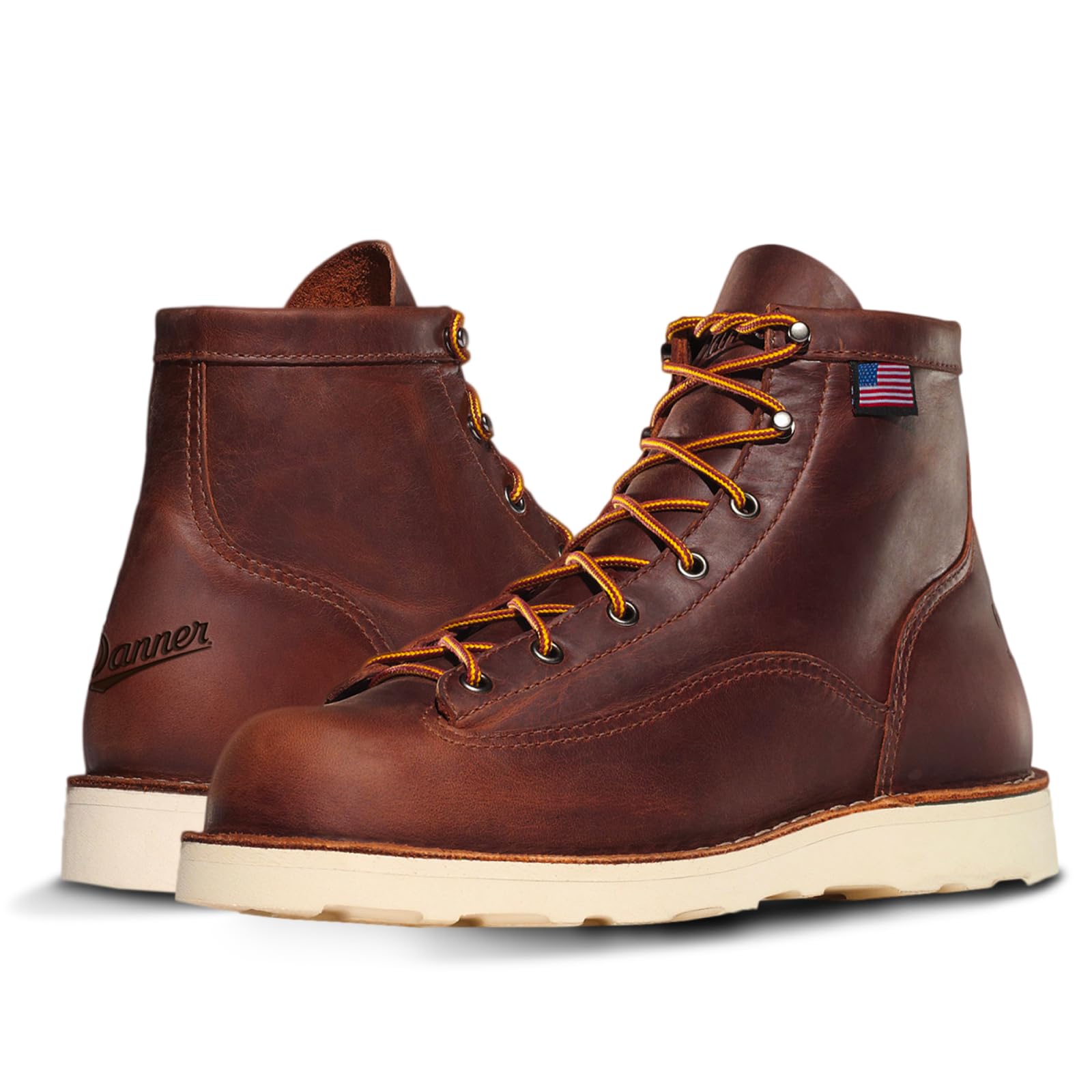
The heritage build: full-grain leather, a crepe-style wedge and stitchdown construction.
Danner’s Bull Run keeps it plain — a 6-inch round-toe boot on a sturdy Danner Wedge outsole, handcrafted with the brand’s stitchdown construction. That last part is the reason to look here. Stitchdown stitches the upper straight to the midsole for extra stability underfoot, and it is a construction that holds its shape far longer than a glued sole.
The full-grain leather upper is oiled for water resistance, and the footbed is a removable three-density OrthoLite insert — three layers of foam at different firmness so the heel takes more cushioning than the forefoot. Soles and heels use non-conductive shock-resistant materials for electrical hazard protection.
Appearance, leather quality and value all draw praise, and the leather takes a polish when you need it to. The downside is consistency on the sole: some pairs last a long stretch, others report the soles coming apart. That is a real split, and if you buy these, treat the leather well and plan on a resole rather than a replacement.
Where the money goes: USA-made stitchdown construction on a wedge outsole with a three-density OrthoLite footbed is the craftsmanship end of this category.
The catch to price in: some pairs see the soles separate earlier than you would expect — resole-able design cushions the blow, but you should expect to use it.
Made for the buyer who: wants an American-made stitchdown boot with a removable multi-density footbed.
Look elsewhere if: you need a consistent, trouble-free sole from the start.
10. Danner Bull Run 8″ Brown Cristy

An 8-inch shaft versus the 6-inch Bull Run above, for ankles that need bracing.
If you climb ladders or work on uneven ground, the 8-inch shaft is what separates this boot from the rest. It comes up above the ankle for a firmer hold, on the same sturdy slip-resistant Danner Wedge outsole and the same removable three-density OrthoLite footbed as the 6-inch version above. Full-grain leather upper, oiled for water resistance, and a 1.9-pound build that stays manageable for a taller boot.
The construction is the same stitchdown approach, and the soles and heels use non-conductive shock-resistant materials for electrical hazard protection. The round toe gives your toes room without a steel cap.
Value and appearance come up in the feedback most often, and the leather draws split opinions — some call it thick and substantial, one calls it just leather and a sole. Fit runs large for a portion of buyers. If your usual number feels loose at the heel, size down rather than accepting it and hoping it tightens.
Worth the extra height for
- 8-inch shaft gives firm upper-ankle support on uneven ground
- Removable three-density OrthoLite footbed for cushioning that lasts
- Slip-resistant Danner Wedge outsole with electrical hazard protection
- Full-grain leather that molds to your foot over time
Know before you order
- Fit runs large for some — verify the size before committing
- Leather quality reads unevenly across batches
- Not a lightweight boot compared with lower-shaft options
Worth it for: anyone who wants more ankle bracing without giving up a flat slip-resistant wedge sole.
Not the one for: buyers who want a forgiving true-to-size fit or a light, flexible boot.
11. Thorogood American Heritage 8″ Soft Toe

Oil-tanned leather, a storm welt and a fiberglass shank — the classic American wedge.
Thorogood’s American Heritage 8-inch is the boot a lot of trades eventually land on, and the build explains why. It is Goodyear storm welt construction, which stitches the upper to the midsole with a raised welt that seals moisture out and lets the sole be replaced. A fiberglass shank under the arch adds flex and strength, and the 8-inch shaft keeps the ankle supported up top.
The footbed is removable and shock absorbing on a Poron Comfort Cushion insole — dual-density foam with open cells that resist moisture, so sweat does not pool under your foot. Oil-tanned full-grain leather outside, and the sole is a slip-resistant MAXWear Wedge rated ASTM F2892-18 for electrical hazard resistance. Made in the USA from USA and globally sourced components.
Construction, origin and the leather quality are what buyers praise, and the leather is often compared to a broken-in baseball glove — supple from the start, with no real break-in period. The genuinely mixed signal is fit. That is the most-discussed point about this boot, and it splits: some find their size right, others need a different one or find the width off.
The build that wins people over: storm welt construction, a fiberglass shank and a Poron cushion insole is heritage footwear engineering at its most practical.
Order carefully: fit is the one recurring friction point on this model, and it is the reason to try before you rely on it daily.
Right for: brickies, fitters, mechanics and anyone who wants a resole-able American-made wedge with soft leather from day one.
Wrong call if: you need a safety toe or a fit you can order blind.
Know the Specs
What “wedge sole” actually means
A wedge sole is a single flat slab of rubber, crepe or polyurethane that runs heel to toe with no defined heel block. It puts more rubber under your foot, so weight spreads evenly on flat surfaces — the reason it suits concrete finishers, warehouse workers and anyone standing all shift. On a steep ladder or a roof pitch, the lack of a heel edge is the trade-off, and grip becomes the deciding spec instead.
Goodyear welt versus stitchdown
Both are stitched constructions, and both let a worn sole be replaced. Goodyear welt stitches the upper, lining and midsole together with a separate welt strip, so the outsole can be swapped without touching the upper. Stitchdown stitches the upper directly to the midsole for a firmer, more stable feel. Either beats a glued-on sole if you plan to keep the boot past one season — a resole costs far less than a new pair.
Safety toe ratings explained
An ASTM F2413-18 rating on a boot means the toe cap has been tested for impact and compression. The extra codes matter: M/I/C covers impact and compression, and EH means electrical hazard resistance. Steel caps are the traditional choice; alloy caps do the same protective job with less weight. Soft toe and plain toe boots skip the cap entirely, so they are lighter and more flexible — but they will not pass a site that requires rated protection.
Waterproof versus water resistant
Water resistant leather shrugs off splashes and damp ground; waterproof means a membrane is built in to keep water from passing through. The trade-off is breathability — a membrane traps moisture from the inside too, which is why some waterproof boots get hot. If you work in rain or standing water, pay for waterproof. If you work in dry heat, water resistant leather and a breathable lining like ReBOTL often keeps your feet drier overall.
Common Questions
Will a wedge sole work boot be comfortable on concrete all day?
Can a wedge sole work boot be resoled?
Is a steel toe or alloy toe better for a wedge sole boot?
How do I size a wedge sole work boot that runs large?
Do I need a waterproof wedge sole boot for outdoor work?
What does ASTM F2413-18 actually test on a work boot?
How long should a wedge sole last before needing replacement?
What is electrical hazard protection on a work boot?
Why do some wedge sole boots feel stiff at first?
Are slip-on wedge boots as safe as laced boots on a jobsite?
The Bottom Line
Want the safest bet? Start with the Georgia Boot Wedge Industrial Boot. It pairs a leather upper with a Goodyear welted build (a stitched construction that can be resoled) and a wedge that owners describe as comfortable through a full shift. For most people shopping work boots wedge sole, it is the best all-round answer.
If you need a certified safety toe for a commercial site, the ROCKROOSTER Edgewood carries the full ASTM F2413-18 rating with a steel cap and waterproof membrane. Want a slip-on instead? The Carhartt Chelsea gets you out the door with no laces and a cushioned Insite footbed. And for the heritage crowd who wants American-made stitchdown construction with a removable multi-density footbed, the Danner 6″ Bull Run is the one to reach for.
Whichever you pick, judge the leather and the construction, not the marketing — a flat wedge sole is only as good as the boot built around it. A welted or stitchdown boot you can resole will outlast a cemented one every time.
How we choose
We do not accept paid placement. Every pick is matched to a real buyer and a real use-case; we do not hands-on test units.
Sources
Specifications: manufacturer listings and product documentation. Review insights: verified customer reviews, as of November 2026. Pricing: not shown on this page (it changes often); check the current price via the retailer link.
As an Amazon Associate, Tactical Gear Guy earns from qualifying purchases. This does not affect which products we feature.