Specs are compiled from manufacturer listings and verified buyer reviews and can change over time — please confirm the key details on the product page before buying.
A hand plane is not a complicated tool to shop for once you know one thing: the sole has to be flat and the blade has to be sharp. Everything else — the wood, the colour, the marketing language — is secondary. The picks below are the ones that actually deliver both, sorted by what you plan to do with them: trimming a door edge, smoothing a tabletop, or flattening a slab.
This guide is built by comparing the manufacturers’ published specifications and the patterns across verified customer reviews, so you get each pick’s real strengths and trade-offs instead of marketing spin.
Some are meant to be gripped in one hand for quick trim work; others need two hands and a longer runway. Match the plane’s size and sole length to the cut you make most: a 1.38-inch block plane for door edges, a 2-inch smoother for tabletops, a 14-inch jack for flattening slabs.
Top Picks


How To Choose The Best Wood Plane Tool
Most people buying their first hand plane focus on the wrong thing. They look at the size of the tool or the finish on the handles, then get it home and find the sole is slightly dished or the blade needs an hour on a whetstone before it will cut. The three things that actually determine whether a plane works are the flatness of the sole, the quality of the blade steel, and how easy the blade is to adjust.
Sole Flatness Is The Foundation
The sole is the flat bottom of the plane that rides on the wood. If it is not flat, the blade will cut deeper in some spots than others and you will chase a wavy surface all afternoon. A precision-ground or lapped sole is worth paying for. Cast iron bodies are the standard because they stay flat under pressure, but ductile iron resists cracking better than standard cast iron if the tool gets dropped.
Blade Steel And Cutting Width
The blade — sometimes called the iron — does the actual cutting. O1 tool steel, high carbon steel, and laminated Japanese steel are the common options, and each holds an edge differently. Cutting width tells you how much wood you cover in one pass. A 1.38-inch block plane is nimble for trimming; a 2-inch bench plane covers more ground on a tabletop. A 1.38-inch block plane eases a door edge; a 2-inch or wider bench plane smooths a large panel in fewer passes.
Push Versus Pull Stroke
Western planes are pushed away from you. Japanese planes, called kanna, are pulled toward you, which many woodworkers find gives more control and less fatigue over a long session. The trade-off is that Japanese planes are tuned by tapping the blade with a hammer rather than turning a screw, so setup takes a different kind of patience. Pick pull-stroke if you want control and less fatigue; pick push-stroke if you want screw adjustment instead of hammer taps.
Side-by-Side Comparison
| Model | Best For | Cutting Width | Weight | Body Material | Amazon |
|---|---|---|---|---|---|
| JORGENSEN NO.60-1/2 6-1/4″★ Best Overall | All-round trimming and detail work | 1.38 inches | 1.5 pounds | Ductile iron | Amazon |
| KAKURI Japanese 42mmBest for Precision | Precision chamfering and edge work | 1.4 inches | 11.9 ounces | White oak | Amazon |
| STANLEY No. 4 (12-404)Budget Champion | Budget-friendly smoothing and trimming | 2 inches | 2.8 pounds | Cast iron | Amazon |
| Spear & Jackson CSP3 No. 3 | Cabinet work and general joinery | 1.75 inches | 1.5 kg | Cast iron | Amazon |
| KAKURI Japanese Large 60mm | Covering large surfaces in one pass | 50 mm (1.97″) | 2.2 pounds | White oak, oil finished | Amazon |
| SUIZAN Kanna 2.4″ | Wide surfaces with pull-stroke control | 50 mm (1.97″) | 0.88 kg | Oak | Amazon |
| Taytools 469614 #4 | Out-of-the-box flat sole | 2 inches | 4.1 pounds | Ductile cast iron | Amazon |
| Woodriver Low Angle Block | Trimming end grain and fine fit work | 1.63 inches | 2 pounds | Ductile iron | Amazon |
| Woodriver #5-1/2 Jack Plane | Flattening and long-run smoothing | 2-3/8 inches | 7.6 pounds | Ductile iron | Amazon |
Detailed Reviews
1. JORGENSEN NO.60-1/2 6-1/4″ Wood Planer
Our pick — 4.5+★ from 600+ verified ratings; the strongest balance of quality and price.
The small block plane that arrives sharp and ready for trim work
A 1.38-inch cutting width makes this the plane you reach for when you are easing a door edge, chamfering a tabletop, or trimming a drawer that has swollen shut. It weighs 1.5 pounds, so you can hold it one-handed all afternoon without your wrist complaining. That is noticeably lighter than the STANLEY No. 4 at 2.8 pounds — for a tool you grab for quick jobs, the difference matters.
The blade is O1 tool steel, a hard-wearing steel that holds an edge well and can be resharpened repeatedly rather than replaced. The body is ductile iron, a tougher cousin of standard cast iron that resists cracking if the tool gets knocked off a bench. A zinc-alloy lever cap and stainless steel parts round out the hardware. The cutting depth adjusts with a knob, and the mouth width is adjustable too.
What wins people over is the quality of the build — that is the thing owners talk about most by a wide margin. Sharpness right from the start runs second, so you can put it to wood without a lengthy tuning session first. The honest catch sits around the adjustability and sole flatness, where opinions are mixed rather than glowing. Expect to spend a little time checking the sole with a straightedge before your first serious cut.
Where it pulls ahead
- 1.38-inch cutting width handles trimming and chamfering without overhang
- O1 tool steel blade is finely sharpened and can be resharpened for long life
- Ductile iron body is drop-tested for durability
- 1.5 pounds keeps one-handed work comfortable
Where to set expectations
- Adjustability and sole flatness draw mixed feedback — check flatness on arrival
- Small body means it is not built for covering large panels quickly
Go for this if: you want one small plane for trimming, deburring and craft work that arrives sharp.
Think twice if: you need a long-soled plane for flattening wide boards.
2. KAKURI Japanese Hand Plane 42mm
A trim little kanna that pulls toward you for chamfering and fine detail
This is a Japanese plane, known as a kanna, and it cuts on the pull stroke instead of the push. That means the blade is drawn toward your body, which gives a more consistent, controlled cut with less effort. The 7-inch body sits easily in one hand — it is compact next to the STANLEY No. 4, which measures 10.7 inches long and 2.8 inches wide against this plane’s 2.1-inch width. If you are working on small parts or tight corners, that smaller footprint is the whole point.
The blade is Japanese high carbon steel laminated with soft iron. The lamination makes the blade more durable and easier to sharpen, and it comes hand-sharpened by craftsmen. A chipbreaker reduces splitting compared to single-blade planes. The body is natural Japanese white oak, and the cutting width is 1.4 inches with a 42 mm blade. An English instruction manual is included, which helps if this is your first pull-stroke plane.
The craftsmanship and the ease of use are what owners rate highest, with both drawing the same level of praise. Sharpness, cutting performance and value all follow closely behind. The adjustability, though, is genuinely mixed — some find it easy to dial in, others hit friction. Part of that comes with the territory: Japanese planes are tuned by tapping the blade with a hammer, so there is a learning curve before the setup feels natural.
The pull-stroke advantage: Drawing the plane toward you rather than pushing away is easier on the body over a long session, and the 1.4-inch cut handles chamfering and edge smoothing with precision.
Budget in setup time: The blade needs fine-tuning with a hammer before use — plan on an afternoon of learning before the first clean shaving.
This one earns its place if: you want an authentic Japanese tool for detailed chamfering and you are willing to learn the tap-adjust method.
Look elsewhere if: you want a screw-knob adjustment you can set in seconds.
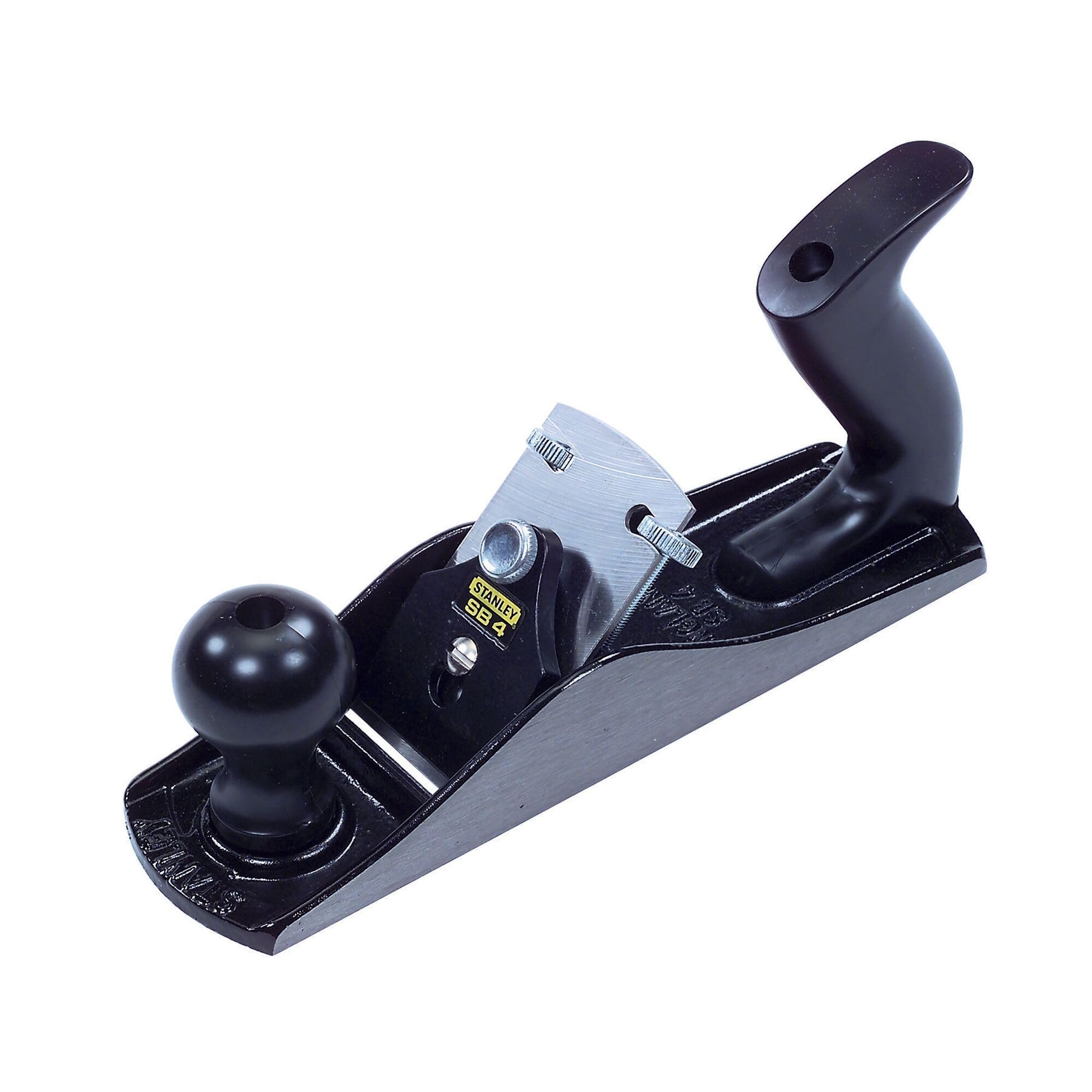
3. STANLEY No. 4 Adjustable Bench Plane (12-404)
The classic bench plane with a wide mouth and a long-tuning reputation
A 2-inch cutting width is the headline here — wider than the JORGENSEN’s 1.38 inches. That extra coverage means fewer passes when you are smoothing a panel or trimming a door. The cast-iron base has precision-ground sides and bottom for stable, accurate planing, and the hardened and tempered steel cutter is built to survive repeated use.
The quick-release cam-lock makes it easier to pull the iron out for adjustment or sharpening, and the high-impact polymer handles are contoured and polished for comfort. It wears a Limited Lifetime Warranty from STANLEY. At 2.8 pounds it has enough mass to carry through a cut without feeling like a workout.
Quality and value for money are the two things owners praise most, and by a large margin. But the blade adjustment draws the most negative attention of any aspect, and the ease of use is genuinely split — some find it simple to work with, others say setup can run to about an hour and a half. Buyers report the disagreement plainly: “some finding it easy to work with while others report it takes about an hour and a half to set up.” Blade sharpness and sole flatness also come in for mixed feedback. If you are prepared to tune it, it rewards you; if you want plug-and-play, know what you are signing up for.
The wide-mouth value play: A 2-inch cutter and precision-ground cast-iron base at an entry-level position make this the least expensive way to get a full-size bench plane in your shop.
The setup tax: The blade adjustment is the most-criticized aspect — expect to spend real time dialing it in and possibly flattening the sole before it cuts its best.
Reach for it if: you want a full 2-inch bench plane on a tight budget and do not mind tuning it yourself.
Pass if: you want a plane that cuts perfectly straight from the start with zero fettling.
4. Spear & Jackson CSP3 No. 3 Carpenters Smoothing Plane

A cabinet-maker’s smoother with a brass screw and a paper-thin shaving habit
The No. 3 size is aimed squarely at cabinet work and general joinery — the kind of smoothing where you want a controlled, fine cut on a finished face rather than rapid stock removal. The cast-iron body has a precision-milled base and faces, and the blade adjusts with a brass screw instead of a plastic knob. Cutting width is 1.75 inches, which sits between the STANLEY’s 2 inches and the JORGENSEN’s 1.38 inches — enough coverage for panel work without feeling unwieldy.
Functionality is the second most-praised trait after overall quality, and the shaving performance gets its own consistent nod. The plane does what it says: it takes a thin, clean shaving and leaves a surface that is ready for finish. It is also considered suitable for beginners, though the adjustability is the weak spot — that is the aspect that draws the most negative feedback.
Owners mention the plane “takes paper-thin shavings from pine,” which is the tell for a smoother that is set up correctly. The catch is the setup itself: some find it surprisingly easy to use, while others need significant work before it cuts cleanly. Durability feedback is mixed too. Treat this as a plane that rewards patience at the bench and punishes the assumption that it will be perfect on day one.
Why cabinet work suits it
- Precision-milled cast-iron base and faces for accurate smoothing
- Brass adjusting screw gives finer control than plastic knobs
- 1.75-inch cutter covers panels without overreach
- Known for taking paper-thin shavings from softwood
What to expect at the bench
- Adjustability is the most-criticized aspect — setup varies from easy to involved
- Durability feedback is mixed, so treat the tool with care
Suits you if: your work is cabinet and joinery smoothing and you value a brass-screw adjustment.
Not for you if: you need a plane for rough stock removal rather than fine finishing.
5. KAKURI Japanese Large Hand Plane 60mm

A two-handed kanna built to cover big surfaces in a single pass
At 10.2 inches long and 3 inches wide, this is the large sibling of the 42mm KAKURI — designed to be gripped firmly with both hands and pulled smoothly across a wide surface. The 60 mm blade gives a 50 mm (1.97-inch) cutting width. That is wider than the smaller KAKURI’s 1.4 inches, and it means fewer passes when you are smoothing a tabletop or a door panel.
The blade is laminated Japanese high carbon steel with a soft iron backing, hand-sharpened by craftsmen, and paired with a chipbreaker that reduces tear-out and improves shaving control. The body is Japanese white oak finished with oil, which provides better glide and helps minimise warping from moisture and humidity. It weighs 2.2 pounds — heavier than the small KAKURI at 11.9 ounces, but still balanced enough to pull with control.
Build quality is what owners praise most, followed by performance and sharpness. The cutting performance gets a specific nod for making “glassy smooth finish cuts with little effort.” The mixed signals show up in adjustability, setup and ergonomics — the same tap-with-a-hammer tuning that defines Japanese planes. Expect to spend time dialing the blade before the first pass feels right.
The big-surface pull: A 50 mm cutting width on a 10.2-inch oak body lets you smooth wide panels in fewer, more controlled passes than a small block plane allows.
Setup is not optional: The blade is set by tapping, not turning a screw — the 60 mm size is a joy once tuned, but tuning is part of ownership.
Worth it for: woodworkers who want a large Japanese smoother for wide panels and will invest the setup time.
skip it if: you want a screw-adjustable plane or you mostly work on small parts.
6. SUIZAN Kanna Japanese Wood Planer 2.4″ Double Blade

A hand-size kanna that glides on hard and soft wood alike
The body is oak, 10.24 inches long and 2.95 inches wide, and the whole plane weighs 31.0 oz (880 g). That is light enough to control with a pull stroke and long enough to flatten a wider board without tipping. The blade is Japanese steel, 2.36 inches (60 mm) wide, with a 1.97-inch (50 mm) cutting width. It is a two-blade set — one plane iron plus a metal chip breaker, which helps keep shavings under control.
There are no adjusting screws. You set the blade by tapping the top with a hammer to protrude it a little at a time, and tap the front of the body left and right in turn to retract it. That is the traditional kanna method — it feels odd at first and then becomes second nature. Sharpen the blade on a whetstone whenever the edge needs it. The plane does the same jobs as a small block plane, but it cuts on the pull stroke and gives good control.
What customers note most is that it comes super sharp and is easy to set up and use, and that it glides smoothly on hard and soft wood. It is described as leaving very smooth flat finishes. The main thing to accept is the tapping adjustment — there is no screw to turn, so precision comes from your hammer technique, not a dial.
What makes it glide
- 2-blade set with a chip breaker for cleaner cuts
- 60 mm Japanese steel blade with a 50 mm cutting width
- Oak body is light enough for controlled pull strokes
The trade-off to accept
- No adjusting screws — blade depth is set by tapping with a hammer
- Needs whetstone sharpening when the edge dulls
Pick it up if: you want a versatile kanna for both hard and soft wood and you are comfortable with tap tuning.
Leave it if: you want a screw-adjustable plane or you are not ready to sharpen on a whetstone.
7. Taytools 469614 Smoothing Bench Hand Plane #4

A #4 smoother that arrives flat enough to cut straight from the box
The sole is precision ground to within the British Standard of 0.003 inches over the entire length. That is the number that matters most here — it means the bottom is flat enough that the blade cuts evenly across the full 2-inch width rather than skipping over high spots. The body and frog are ductile cast iron, described as nearly indestructible, and the sole and sides are lapped. At 4.1 pounds it has real mass to push through a cut.
The iron is 0.120 inches thick and 2 inches wide, made from tool steel hardened and tempered to 55-60 on the hardness scale. The tote and knob are premium-grade oiled, hand-rubbed Sapele rather than plastic. The overall length is 9-3/4 inches and it is 2-1/2 inches wide.
Quality and sole flatness are what owners praise most, and value for money follows close behind — the plane is noted for working well and requiring minimal setup. The blade is the honest weak point: decently sharp from the start, but feedback says it does not sharpen well afterward, so plan for a replacement blade down the line. Durability and alignment also draw some negative notes. For a tool whose whole pitch is a flat sole, though, it delivers on that promise.
Flat where it counts: A sole ground to 0.003 inches across its length means fewer high spots and a cleaner cut on the first pass — the most important spec for a smoothing plane.
The blade caveat: The iron is sharp enough to start, but it is the part most owners would upgrade — sharpening it properly is a reported weak spot.
Choose it if: you want a #4 smoother with a lapped, flat sole and you are happy to swap the blade eventually.
Hold off if: you want a blade that sharpens easily over the long haul.
8. Woodriver Low Angle Block Plane

A low-angle block plane with a knuckle cap for trimming tricky end grain
The 12-degree bed angle is the defining spec. A low angle slices across end grain — the exposed cross-section of a board — with less tearing than a standard-angle plane, which is why this style is a favourite for trimming, fitting and fine detail. The blade is high carbon tool steel, 1-5/8 inches wide by 0.125 inches thick, with a 25-degree blade angle, in a 2-inch-wide by 7-inch-long body. Cutting width is 1.63 inches. It weighs 2 pounds.
The knuckle-style lever cap is one of the classic details. It is based on a longstanding design and features a cam locking action for blade depth. That cam action is one of the few adjustability features that gets specific praise — it holds depth firmly, which is the whole game on a block plane. The ductile iron body gives it stability without the heft of a full bench plane.
Quality is what owners praise most by a wide margin, with value for money second. Sharpness also gets a nod — it is noted for sharpening quickly. The mixed signals land on blade adjustment, durability, flatness and setup, so expect a bit of tuning and be ready to check the flatness of the sole. Sharpening quickly is reassuring; flatness is the one to verify.
Why end grain behaves
- 12-degree bed angle reduces tear-out on end grain
- Knuckle lever cap with cam locking holds blade depth
- High carbon tool steel blade sharpens quickly
- 2 pounds keeps it stable without bench-plane heft
What to check on arrival
- Flatness and setup draw mixed feedback — verify the sole with a straightedge
- Blade adjustment is the aspect that divides owners
Right tool for: end-grain trimming, fitting and fine detail where a low angle does the work.
Wrong tool for: flattening large panels — that is a jack plane’s job.
9. Woodriver #5-1/2 Jack Plane

The long-bodied jack plane built for flattening and long smoothing runs
At 2-7/8 inches wide and 14-15/16 inches long, with a 2-3/8-inch-wide blade, this is the largest and heaviest plane in the lineup. It weighs 7.6 pounds. That mass is the point: a long, heavy sole rides across a board and averages out the high and low spots, which is exactly what you want when flattening a slab or smoothing a long run. The 2-3/8-inch blade is wider than any other plane here, so each pass covers more ground.
It is modelled after the Bedrocks, which were Stanley’s top line, and features fine-grained ductile iron castings with fully machined frogs. The soles and sides are machined flat and square, and the maker says the tools require minimal tune-up before use. That last point matters — a jack plane that starts square saves you a weekend of lapping.
Quality is the trait owners praise most, with value for money second and performance third. It is described as achieving paper-thin shavings by the fourth or fifth pass, and it is called the best bang for your buck among planes in this size class. The tricky part is weight: 7.6 pounds is a lot to push through a long smoothing run, so this is not the tool for a quick touch-up.
Mass does the work: A 7.6-pound body and 2-3/8-inch blade let the plane average out variations across long boards — the thing a small block plane cannot do.
The honest weight: 7.6 pounds takes real effort over a long session; it is a bench tool, not a one-handed trimmer.
Buy it for: flattening and smoothing long boards where mass and a wide blade pay off.
Not for: quick one-handed trimming or small-detail work.
Know the Specs
Cutting Width
Cutting width is how much wood the blade covers in one pass. A narrow block plane around 1.38 inches is nimble for trimming and chamfering. A wider bench plane at 2 inches or more covers more ground on a tabletop or panel. A 1.38-inch blade eases an edge; a 2-inch or wider blade flattens a board in fewer passes.
Body Material
Cast iron is the standard for stability and flatness. Ductile iron is a tougher cousin that resists cracking if the tool gets dropped. Wooden bodies, like the oak used on Japanese kanna, are lighter and glide smoothly, and an oil finish helps them resist moisture and warping. Cast iron adds heft for flattening, while an oak kanna body keeps the plane light enough to pull one-handed.
Common Questions
What is the difference between a block plane and a bench plane?
Should I buy a Japanese pull-stroke plane or a Western push plane?
How do I know if the sole of a hand plane is flat?
What does the number on a plane (No. 3, No. 4, No. 5) mean?
Do I need to sharpen a new hand plane before first use?
What is a chip breaker and why does it matter?
How heavy should a hand plane be?
Can a hand plane replace sanding?
Why does the Woodriver #5-1/2 cost more than the STANLEY No. 4?
What should I check when a new plane arrives?
The Bottom Line
For most people, the wood plane tool winner is the JORGENSEN NO.60-1/2 because it pairs a sharp O1 steel blade and a ductile iron body in a 1.5-pound package that handles trimming and detail work without setup drama. If you want a full-size bench plane for cabinet work on a budget, grab the STANLEY No. 4. And for flattening long boards, the Woodriver #5-1/2 is the one to reach for.
One honest nudge: the JORGENSEN is the pick most likely to make you a hand-plane convert the first afternoon, because it arrives ready to cut rather than waiting for a tuning session. Buy for the cut you make most often and any of these will serve for years.
How we choose
We do not accept paid placement. Every pick is matched to a real buyer and a real use-case; we do not hands-on test units.
Sources
Specifications: manufacturer listings and product documentation. Review insights: verified customer reviews, as of November 2026. Pricing: not shown on this page (it changes often); check the current price via the retailer link.
As an Amazon Associate, Tactical Gear Guy earns from qualifying purchases. This does not affect which products we feature.