Specs are compiled from manufacturer listings and verified buyer reviews and can change over time — please confirm the key details on the product page before buying.
Most watches sold as “WWII style” are costume jewelry with a dial printed to look old. The ones worth your wrist are the handful that copy a real wartime spec — the A-11 field watch, the Flieger pilot’s watch — and then back it with parts that survive daily wear. This guide covers nine of them, from a stone-washed Flieger homage to a double-domed sapphire automatic, and tells you plainly which case size, crystal, and movement you are actually paying for.
This guide is built by comparing the manufacturers’ published specifications and the patterns across verified customer reviews, so you get each pick’s real strengths and trade-offs instead of marketing spin.
Some of these run on a battery and some you wind or shake to keep alive, and that one difference changes how you live with the watch. Here is how each of these World War 2 Watches holds up once the honeymoon period ends — and which trade-offs you will actually live with.
Top Picks

How To Choose The Best World War 2 Watches
A period-correct military watch is judged on four things: what it copies, what protects the dial, what powers it, and what it can survive. Get those four right and the watch performs, whatever name is printed on the dial.
Which wartime watch is it actually copying
Two designs dominate. The A-11 was the general-issue American field watch, and it means a plain, high-legibility dial with nothing on it you do not need. The Flieger was the German pilot’s watch, which is why the Mil-Tec carries a 43mm case and a simple three-hander.
Know which one you want before you shop. A 32mm A-11 tribute and a 43mm Flieger read completely differently on the same wrist, and buying the wrong one is the usual reason people send a watch back.
Crystal, crown and water resistance
The crystal is the window over the dial. Mineral crystal is the budget standard and scratches with time; sapphire crystal is far harder to mark, which is why the Bulova 96A245 and the Vaer both use it. A screw-down crown threads into the case like a jar lid, sealing the opening you pull out to set the time.
Water resistance is rated in ATM, where 1 ATM equals roughly the pressure of standing 10 meters underwater. A 3 ATM watch handles rain and handwashing. A 10 ATM watch is the one you can swim in.
Battery, wind, or shake-to-run
Quartz means a battery pushes the hands, so it keeps time and asks nothing of you until the cell dies. Mechanical means gears and a spring do the work. Automatic adds a spinning weight that winds the spring as you move; manual-wind means you turn the crown yourself.
Side-by-Side Comparison
| Model | Best For | Case Width | Movement | Water Resistance | Amazon |
|---|---|---|---|---|---|
| Bulova Archive Series 96A245★ Best Overall | Collector-grade heritage | 42mm | Automatic | 30M | Amazon |
| Bulova Military Heritage Hack 96A246Best Everyday Wear | Everyday field wear | — | 21-jewel automatic | 30M | Amazon |
| PRAESIDUS A-11 Service AutomaticMost Authentic | Authentic A-11 feel | 38mm / 42mm | TMI NH35 automatic | 100M | Amazon |
| PRAESIDUS A-11 Spec 2 | Small-wrist A-11 replica | 32mm / 40mm | Ameriquartz quartz | 100M | Amazon |
| SEAKOSS 1963 Pilot Chronograph | Pilot-chronograph fans | — | Seagull ST1901 manual wind | — | Amazon |
| Vaer A-11 Field Watch | Swim-and-trail durability | — | Quartz | — | Amazon |
| WARTIME WW2 USAAF | 1940s replica look | — | Swiss quartz | 10 ATM | Amazon |
| VOSTOK Komandirskie 811171 | Soviet military character | — | Mechanical | — | Amazon |
| Mil-Tec Vintage Aviator Flieger | Budget pilot-watch look | 43mm | Miyota quartz | 3 ATM | Amazon |
Detailed Reviews
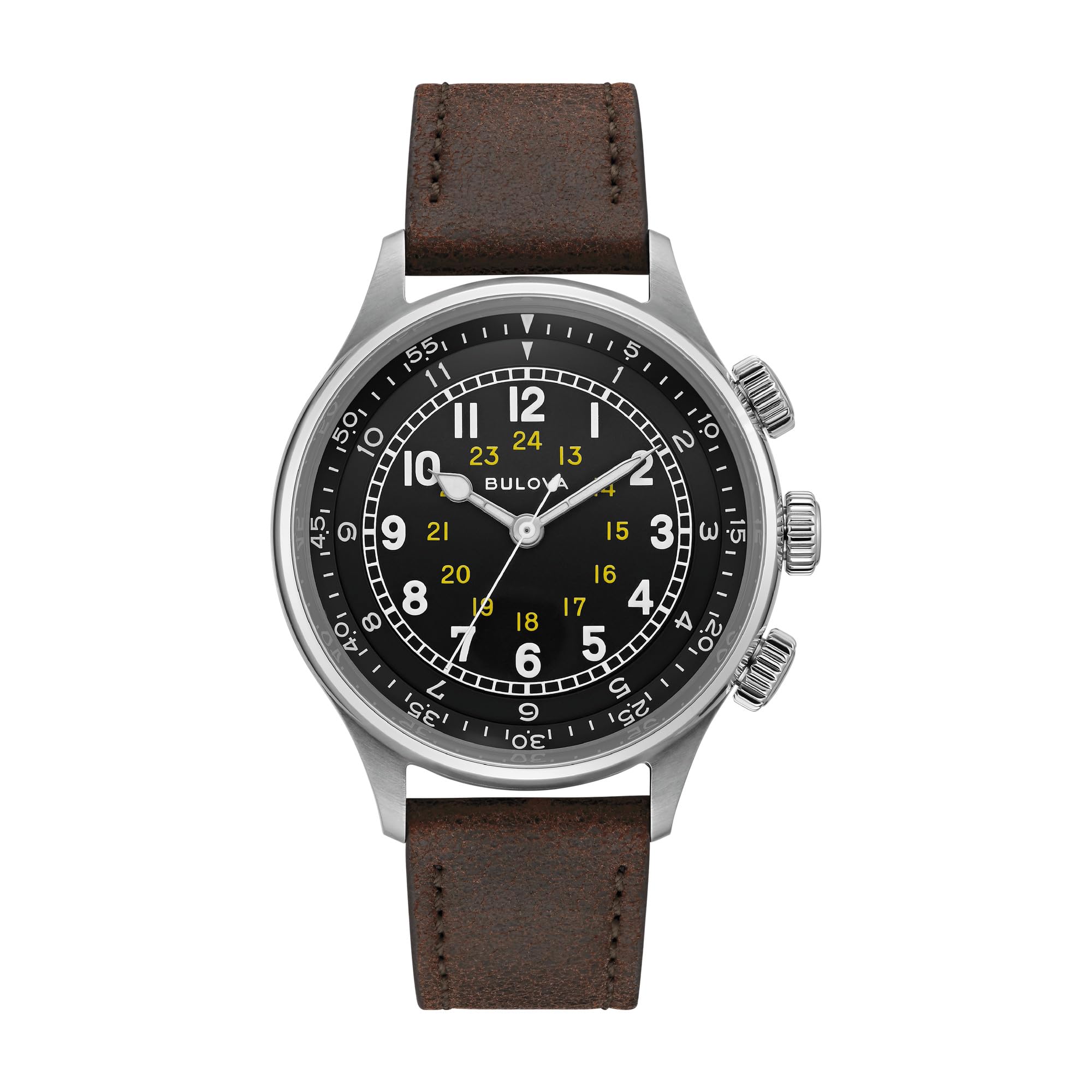
1. Bulova Archive Series: Military – 96A245
Our pick — 4.5+★ from 250+ verified ratings; the strongest balance of quality and price.
An automatic field watch with two rotating inner rings — aviation hardware dressed in military grey.
The dial is where this one wins. It carries white and yellow accents over a black face, and the two rotating elapsed hour and minute rings let you track a second time zone without a single extra button. At 42mm across a stainless steel case, it sits firmly in modern field-watch territory — big enough to read at a glance, small enough to slide under a shirt cuff. The double domed sapphire crystal over the dial is the hard, scratch-resistant glass, so a knock against a doorframe does not leave a scar.
What pulls people in is the period styling — the vintage look is comfortably the most-praised trait here, with the brown leather strap and the luminous hands and markers drawing steady approval. Worth knowing: this is a heavier piece than its rivals. At 3.46 ounces it is less than half the weight of the 8.15-ounce Vaer A-11 further down this list, so if a featherweight wrist is your priority, the Vaer is the better call.
The honest catch is the running gear. The automatic movement is mechanical — a spinning weight inside winds the mainspring as you move, so you never fit a battery. That also means the timekeeping draws split opinions, and some owners find theirs runs fast. The bezels are another sore point, with a few finding them looser than they would like. Neither is a deal-breaker for a watch you wear for its looks, but neither should surprise you either.
Where It Shines
- Double domed sapphire crystal resists scratching far better than mineral glass
- Two rotating rings track elapsed time hands-free
- Luminous hands and markers stay readable in low light
- Automatic movement needs no battery changes
The Honest Trade-Offs
- Timekeeping is inconsistent — some run fast
- Bezels can feel loose from the start
- 30M water resistance is rain-and-handwashing only
Buy it if: you want an automatic heritage piece with sapphire glass and a dial that rewards a second look.
Think twice if: you need a watch you can swim in, since 30M will not cover that.
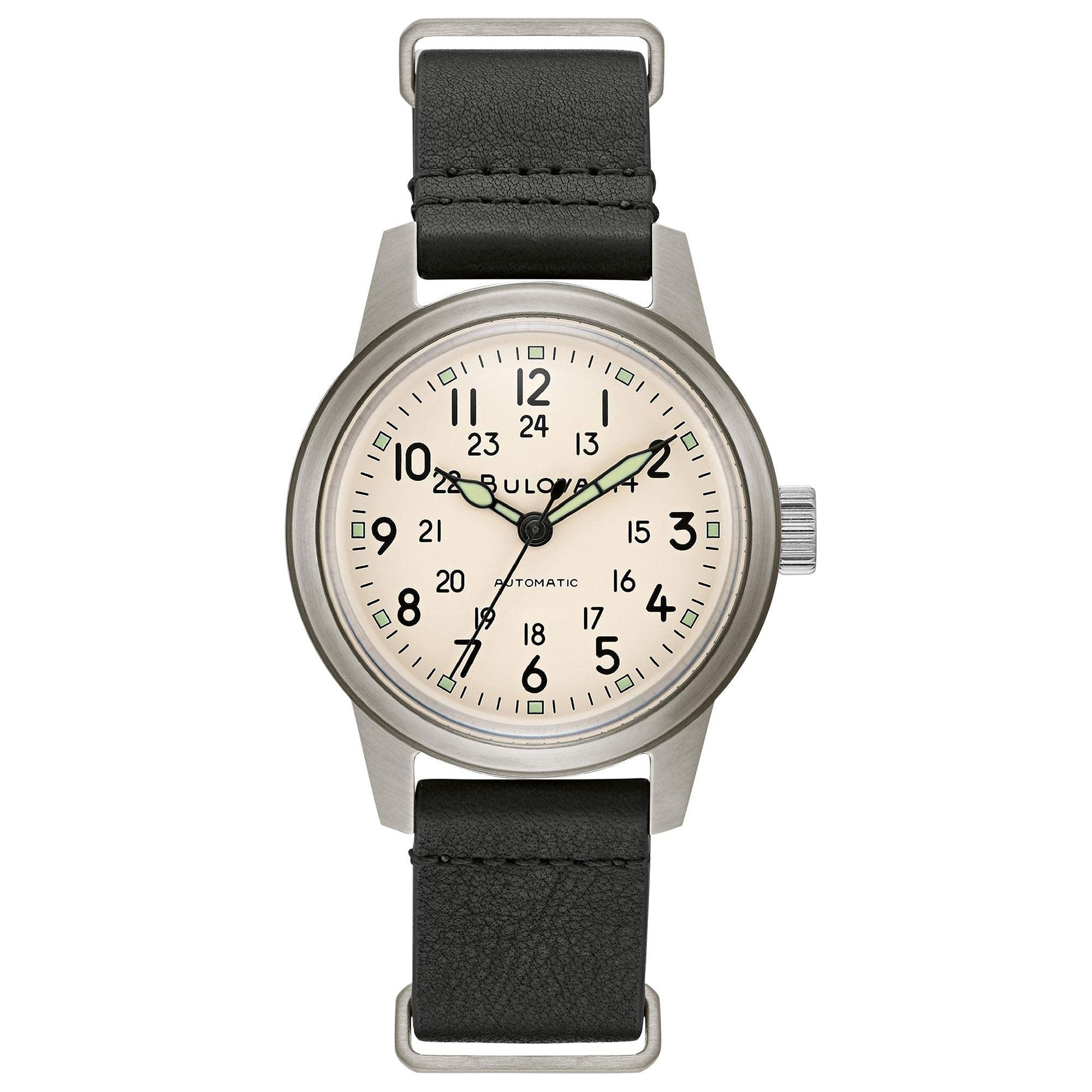
2. Bulova Men’s Military Heritage Hack Automatic Watch
The ivory-dialed Hack watch that looks like it walked off a 1940s supply crate.
Bulova’s Hack Watch borrows the field-watch ingredients that made the originals work, then wraps them in an ivory dial with a center track that displays 24-hour time. That inner scale means you can read evening hours without mentally converting them — a small thing you will notice every afternoon. The three-hand movement is automatic and built with 21 jewels (jewel bearings inside the mechanism, which cut friction and wear), and it holds a 42-hour power reserve, so a watch you take off on Friday night is still ticking Sunday afternoon.
The retro military look is exactly why people keep reaching for it over sleeker modern pieces, and the soft leather NATO strap and comfortable feel get their share of love. Size draws approval too — noticeably slimmer than a chunkier dive watch. Accuracy is broadly reasonable for a mechanical piece, though not clockwork. The domed mineral crystal over the dial is softer than sapphire, so treat it with a little respect, and 30M water resistance means rain is fine but swimming is not.
Why it earns its slot: that 42-hour reserve is the spec that quietly matters most — it turns an automatic from a watch you babysit into one you simply wear on Monday.
Reach for this if: you like a warm ivory face, a genuinely soft strap, and an automatic you can leave in a drawer for a weekend.
Look elsewhere if: you want a dial you can swim with — this one stops at 30M.
3. PRAESIDUS A-11 Military Watch Automatic WW2 Field Watch
A-11 styling with a real automatic inside and the water rating to back it up.
Two things set this one apart: the movement and the depth rating. Under the dial sits a TMI NH35 automatic, a widely used Japanese-made mechanical movement that winds itself as you move. Around the case, 100M water resistance means you can wear it swimming rather than hiding it under a cuff when it rains. That combination of a watch that runs without a battery and one you can wear in the water is rarer than it sounds.
The case comes in two widths — 38mm or 42mm — so both smaller and larger wrists have a version that fits rather than forces. The overall look is what draws the most appreciation; the fit gets its share of the praise too. Timekeeping is respected here, with a well-behaved NH35 keeping close time in real use. Luminous indexes are on hand for low light, though brightness feedback is a mixed bag — some wish they glowed harder.
Value for money is the one area that splits opinion. The build and the movement justify it for people who care about provenance, while others feel the price tag asks a lot for a quartz-cased field watch silhouette. Whether the price is fair depends on how much you value the NH35 movement and 100M rating. There is also a mild reliability question mark that shows up in the reviews, so do not assume it will run flawlessly forever — just that it is built to be serviced.
The Spec Sheet Wins
- TMI NH35 automatic — no battery, no winding
- 100M water resistance covers a swim, not just a rainstorm
- Comes in 38mm and 42mm so wrists of different sizes fit properly
- Luminous indexes aid low-light reading
Know Before You Buy
- Value for money reads differently depending on your budget
- Luminous brightness is modest
- Reliability reports are not uniform across owners
The clean verdict: the A-11 Service is the closest thing here to a true dual-purpose WWII tribute — automatic and genuinely water-ready.
But note: if you want a flawless out-of-box reputation, the Bulova Hack runs a simpler, steadier line.
4. PRAESIDUS A-11 Spec 2 Military Watch
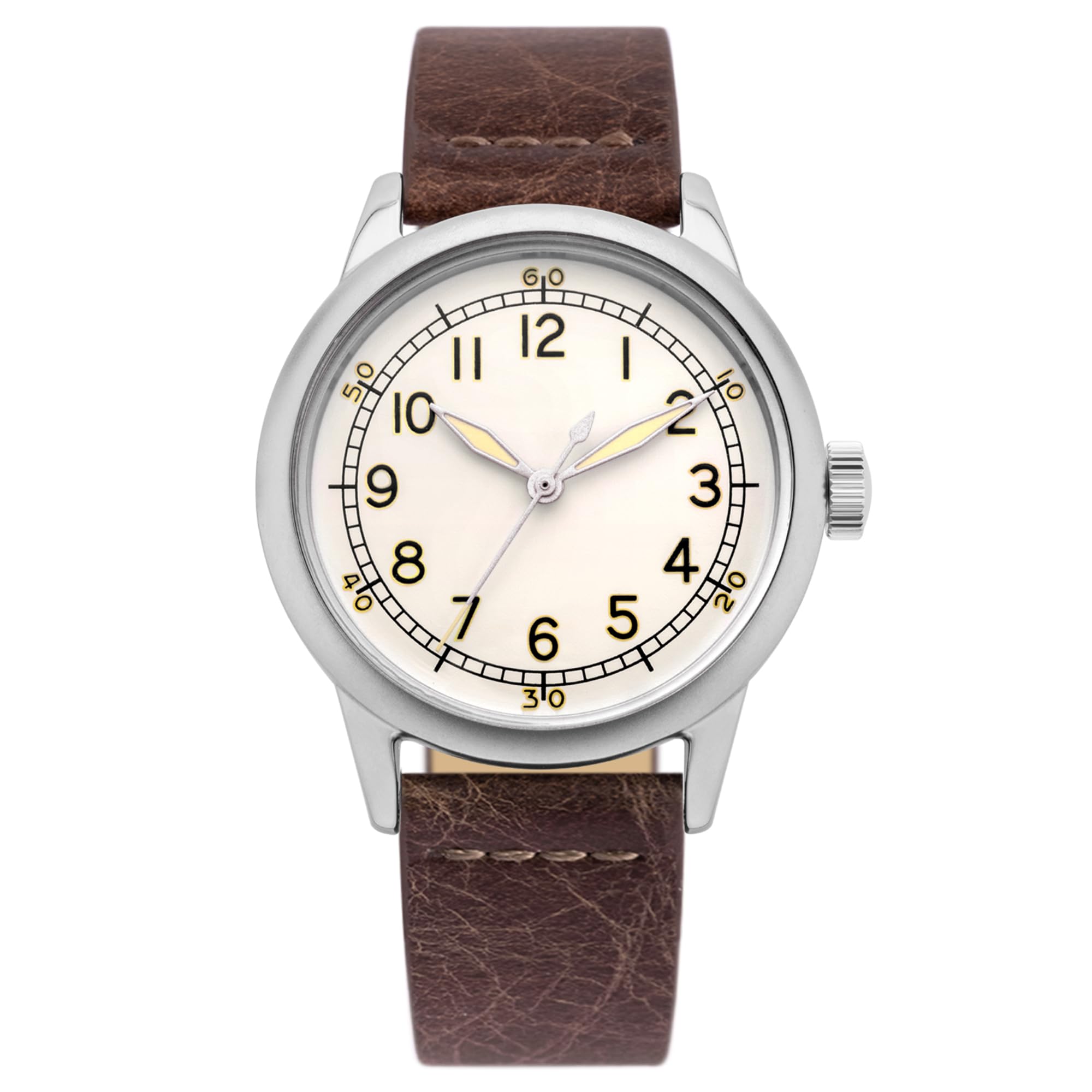
A 32mm A-11 for small wrists, or a 40mm version if you prefer modern presence.
Small-wristed buyers, listen up. The Spec 2 is offered in a compact 32mm case, and that is genuinely uncommon in WWII tributes — most cluster at 40mm and up. It also has a 40mm option, so you are picking a fit rather than accepting one. The dial is covered by scratch-resistant sapphire crystal, the same hard glass the pricier Bulova 96A245 uses, and 100M water resistance means rain, sweat and swimming are all fine.
The movement is an Ameriquartz quartz — a battery-driven movement, which means it keeps time without winding and only asks for a fresh cell now and then. The A-11 design is a straight-forward, high-legibility field dial with nothing extra to distract. It comes on leather, canvas or nylon depending on the build. This one is assembled in the USA and backed by a 1-year warranty.
Now the honest part: the feedback here is thinner and more uneven than the more established picks. Some owners love the vintage recreation and the movement inside, while a portion find the overall refinement a step behind a Bulova. Read the Spec 2 as a niche fit — the small-case option — rather than an all-rounder. If you want the most proven A-11 replica in the lineup, that is the Service Watch at number three.
The size argument: a 32mm case is the single spec that makes this one worth considering — it is the closest this list gets to a true-to-era small field watch.
Runner-level pair: the Spec 2 suits smaller wrists and buyers who want sapphire glass and water resistance without the automatic price.
Caveat emptor: the spec sheet promises a lot; the feedback is not as consistently glowing as the Service Watch above it.
5. SEAKOSS 1963 Pilot Chronograph Watch
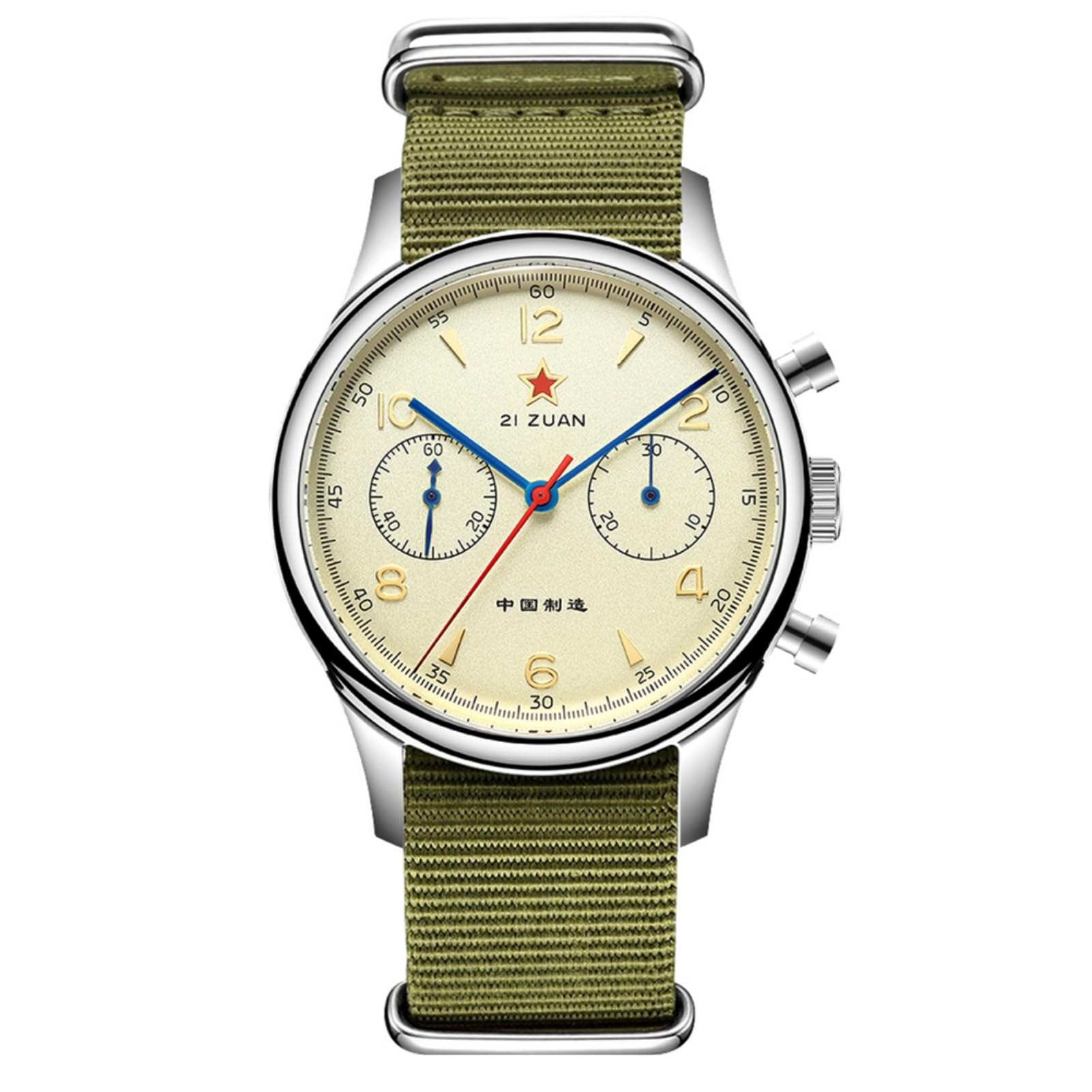
A Chinese Air Force pilot chronograph reissue built around a real mechanical column-wheel movement.
The story behind the name is the pitch: the 1963 Chinese Aviation Chronograph traces back to Project 304, launched by the Tianjin Watch Factory in 1961 to build a watch for Chinese Air Force pilots. Five prototypes came first, then 32 trial watches in 1963, and in 1966 some 3,000 were produced for pilots — a deliberate step away from imported timepieces. This watch is the modern commemoration of that.
Under the dial is a Seagull ST1901, a manual-wind mechanical chronograph. That means you turn the crown to build power — no battery — and the stopwatch function runs through a column wheel (a small toothed wheel that coordinates the chronograph’s start, stop and reset). It operates at 21,600 vibrations per hour and carries 21 jewels. The blue protective film on the pushers is a shipping coating — peel it off with tape.
There are two real ownership rules. Never force the crown when you feel firm resistance, and stop the chronograph before you hit reset — resetting while it runs damages the mechanism. That said, what owners respond to most is how the watch looks, followed by how it is put together. Value is the third leg. If you want a set-and-forget daily, a mechanical chronograph is not that. If you want a genuine mechanical complication with history behind it, this is the one that delivers it.
The take: for anyone who wants a real column-wheel chronograph and Air Force provenance on the wrist, the 1963 is the most interesting object in this lineup.
Small print: manual-wind and chronograph care are real commitments — it will not run unattended.
6. Vaer Men’s Field Watch — A-11 Replica
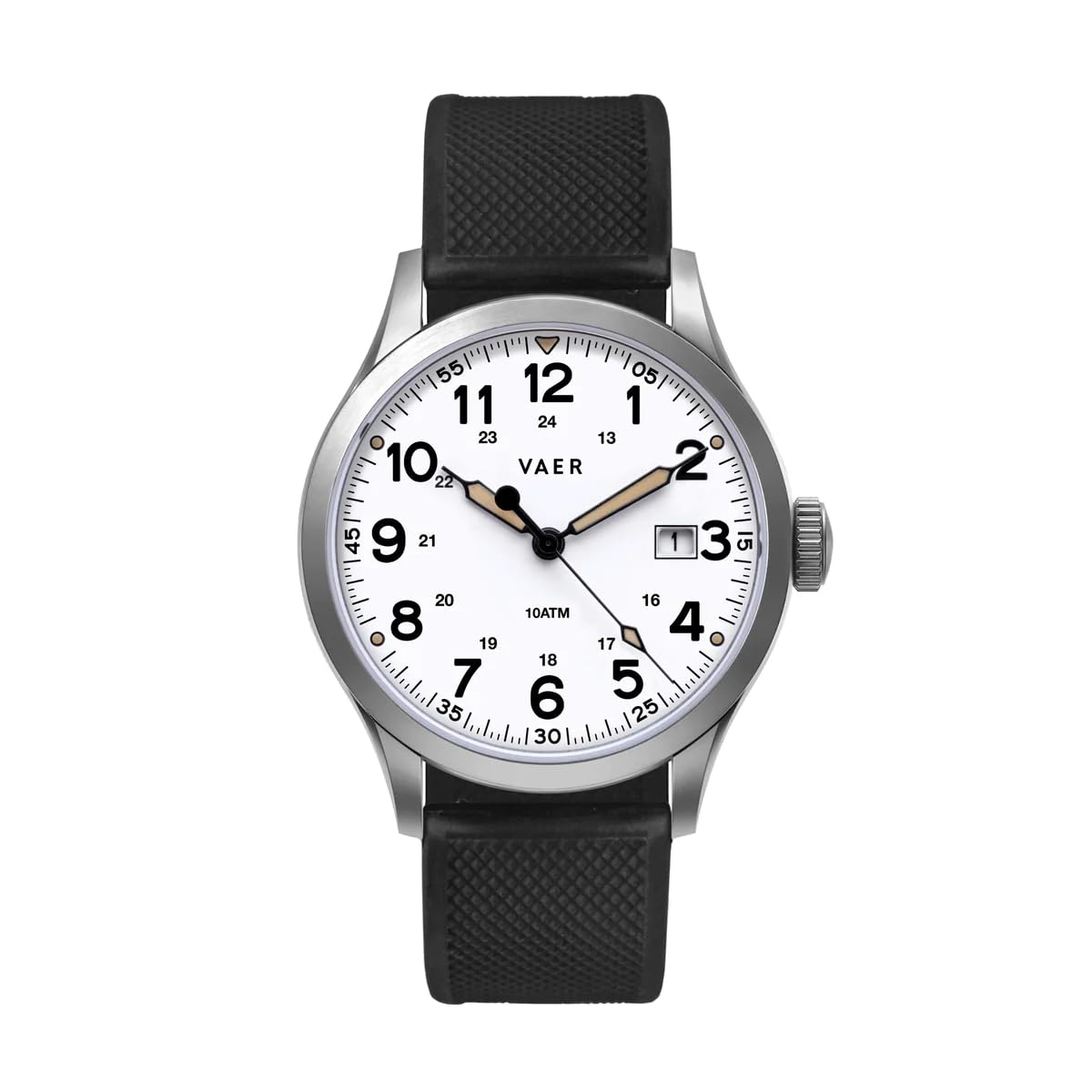
The A-11 reissue that brings a screw-down crown and sapphire glass to a quartz field watch.
Where the WWII original relied on a simple push-pull crown, the Vaer upgrades that weak point with a locking screw-down crown — it threads into the case like a jar lid, sealing the opening that otherwise lets water in. Scratch-resistant sapphire crystal protects the dial on the front. The movement is quartz, which means a battery keeps it accurate and you never wind it. This is the piece you take on a trail, into the sea, and back to the office without thinking twice.
It is also the heavyweight of the field-watch crowd. At 8.15 ounces, the Vaer is more than twice the weight of the 3.46-ounce Bulova 96A245, so you feel it on the wrist — a solid, present kind of weight rather than a feather-light one. Legibility earns consistent praise; the A-11 dial is plain enough to read at a glance, and durability feedback is strong, with the sapphire crystal reported to stay scratch-free over time. Value for money follows closely behind.
The one wrinkle: it is a quartz watch, and if you specifically want a mechanical movement on your wrist, it will not satisfy that. Everything else about it is engineered for use. The screw-down crown and the sapphire crystal are exactly the kind of upgrades a 1940s field watch would have wanted if the technology had existed then.
Build-first design: the screw-down crown is the detail that makes this the most water-confident field watch in the lineup.
Rounds out the shortlist: the Vaer suits hands-on wear — trail, swim, daily beat-up — without the fragility anxiety of a mechanical.
Reconsider if: your heart is set on an automatic; the quart movement is the one thing it cannot give you.
7. WARTIME WW2 Military Watch USAAF

A canvas-and-leather USAAF-style watch that reads like it came out of a 1940s footlocker.
The visual pitch here is simple and specific: it looks like a genuine 1940s timepiece. The dial, the canvas strap with a leather lining, and the USAAF framing all aim at that feel. The movement is Swiss quartz, which means a battery keeps it accurate and you never wind it. Water resistance is rated to 10 ATM — 10 times the pressure of the surface, which translates to swimming and snorkeling rather than deep dives.
That 10 ATM rating is the strongest on this list outside the two Praesidus models, and it makes this one of the more weather-proof replicas in the group. Where the data divides is on the build. Some find it nicely made; others feel the quality does not quite match the period look. Timekeeping splits the same way — many report great time, while a small number had one stop working inside the first month.
So treat the WARTIME as a look-first purchase. If you want the USAAF aesthetic and genuine water resistance to back it, it delivers. If you want a watch whose reliability reputation is bulletproof, the Bulova Hack or the Praesidus Service Watch are the safer picks — this one earns its place on appearance and on that 10 ATM number, not on a glowing performance record.
The case for it: the WARTIME nails the 1940s silhouette and backs it with 10 ATM water resistance — rare for a replica-first watch.
The counterpoint: build and timekeeping do not get the same consistent confidence, so buy it for the look.
8. VOSTOK Komandirskie 811171

The Soviet-issued Commander watch — a mechanical piece with a military pedigree no replica can claim.
This is not a tribute; it is the real lineage. Vostok’s factory was evacuated from Moscow to Chistopol on the Kama River in 1942 and produced only defense equipment during the war years. In 1965 the company was appointed an official supplier of watches for the Defense Department of the Soviet Union — and the Komandirskie (Commander) was created that year. The watch you buy today traces directly back to that. That is a different kind of heritage from a styled copy of an American A-11.
It is a mechanical watch, so a mainspring drives the hands and you keep it running by winding. The functional, clear-cut military design is what owners prize most — the dial reads like it belongs on a soldier’s wrist rather than a showroom. Build quality follows in the approval. Timekeeping is the split issue: many keep great time, some run fast. Ease of use is the recurring gripe — the two-crown setting system takes a few minutes to understand, and a portion of buyers find it fiddly at first.
The two-crown system is a quirk of the design, not a defect, and it becomes second nature after a few wears. Once you have it, the watch is straightforward. The leather band completes the look. The package is heavier than the spec descriptions of slimmer watches suggest — a solid, chunky presence rather than a delicate one. If you want a genuine piece of Cold War-era military watchmaking rather than a Western replica, the Komandirskie is in a category of its own.
The heritage factor: this is the only watch here issued under a real defense-department contract — the authenticity is not a styling exercise.
Pick this one if: provenance matters to you and you are happy to learn a two-crown mechanical setting routine.
Pass if: you want a watch you can set without a shrug of confusion — this one has a learning curve.
9. Mil-Tec Vintage Aviator Watch Flieger

The pilot-watch entry point: a 43mm Flieger dial with a Japanese movement and a stone-washed steel case.
At 43mm across, this is the widest case on the list — and that is the point of a Flieger. The German pilot-watch formula calls for a big, legible dial, and the Mil-Tec delivers with a simple black face, luminous hands and hour markers, and a silver steel case with a stone-washed finish that mutes the shine. The movement is a Japanese Miyota quartz, so a battery keeps time and you never wind. On the wrist it is light — the watch itself runs 80 grams, and the leather band is 20mm wide and cut to fit wrists up to 8.8 inches in circumference.
What owners respond to most is the overall quality for the money, with the replica look and the authenticity of the design earning steady approval. Where it splits is on the long-term side: some report well-constructed wear, while a minority hit durability trouble — the worst case being a crown that snapped off early. The second hand is also black on a black dial, which makes it genuinely hard to spot. It is a deliberate period-styling choice, but budget for the extra second it takes to find the second hand.
Water resistance is 3 ATM. Treat that as splash-and-handwashing, not swimming — the 32mm-to-43mm Flieger form is built for a cockpit, not a beach. The 14mm case height gives it a confident, tool-watch thickness. At its budget-friendly price, this is the least-expensive way into a real Flieger silhouette — with the understanding that it is a light-duty pilot watch, not a daily-beater durability champion.
Why It Makes the List
- 43mm Flieger case — the widest on this list, and the most period-correct pilot size
- Miyota quartz keeps accurate time with no winding
- 20mm leather strap fits wrists up to 8.8 inches
- Luminous hands and markers for low light
Watch Out For
- 3 ATM means no swimming
- Crown construction is a reported weak point
- Black second hand is hard to spot against the dial
Best for entry: the Mil-Tec is the most affordable way to wear a genuine Flieger silhouette today.
Mind the limits: light-duty build and 3 ATM mean it is a fair-weather watch, not a beach companion.
Know the Specs
Case Width and Case Height
Case width is the number you measure across the face, and it decides how the watch sits on your wrist. A 32mm A-11 reads as a small, classic field watch; a 43mm Flieger dominates the wrist. Case height — the thickness from front to back — tells you how much it stands off your arm. The Mil-Tec’s 14mm height gives it a chunky, tool-watch profile, while slim dress-watch shapes often sit much flatter. Match width to wrist size and height to how much bulk you actually want.
Movements: Quartz, Automatic, Manual
A quartz movement uses a battery and a vibrating crystal to keep time — reliable, low-effort, and typically more accurate. An automatic movement has a weight that spins as you move, winding a mainspring; the Bulova Hack’s 21-jewel automatic holds a 42-hour power reserve as a result. A manual-wind movement asks you to turn the crown yourself, as with the Seagull ST1901 chronograph. Quartz is the set-and-forget choice; mechanical is the one that gives a watch its character.
Water Resistance: 3 ATM vs 10 ATM
Water resistance is measured in ATM, and treat 1 ATM as roughly the pressure of standing 10 meters under water. A 3 ATM watch — the Bulova 96A245 and the Mil-Tec, for example — shrugs off rain and hand-washing but is not meant for a swim. A 10 ATM watch, like the WARTIME or the Praesidus models rated 100M, is built for swimming and light water activity. It is the single spec most likely to matter on a trip.
Crystal Glass and Crown Seals
The crystal is the clear cover over the dial. Mineral crystal (used on the Bulova Hack and Mil-Tec) is the standard glass and can pick up scratches over time. Sapphire crystal (on the Bulova 96A245, Vaer and Praesidus Spec 2) is far harder to scratch and stays clear longer. The crown is the knob you pull to set the time — a screw-down crown, like the Vaer’s, locks in place and seals much more securely than a simple push-pull design.
Common Questions
What is the A-11 watch and why is it called the watch that won the war?
Can I swim with a 3 ATM military watch?
Is an automatic watch better than a quartz watch for a field watch?
What is the difference between the Mil-Tec Flieger and an A-11 field watch?
How do I properly wind a manual watch like the Seagull ST1901?
Can a 43mm watch fit a small wrist?
What is a screw-down crown and why does it matter?
Do wartime-style watches need servicing and how often?
What is the difference between sapphire and mineral crystal?
What is the A-11 replica difference between the Praesidus Spec 2 and the Vaer?
The Bottom Line
The world war 2 watches pick that gets the balance right is the Bulova Archive Series 96A245 — a double domed sapphire crystal, two rotating dial rings, and a vintage-inspired automatic that earns its place on looks and build. If you want period looks with the softest daily wear and a 42-hour reserve, the Bulova Hack is the one to reach for. And if you actually plan to swim in your field watch, the Praesidus A-11 Service Watch with 100M resistance is the safest company.
How we choose
We do not accept paid placement. Every pick is matched to a real buyer and a real use-case; we do not hands-on test units.
Sources
Specifications: manufacturer listings and product documentation. Review insights: verified customer reviews, as of November 2026. Pricing: not shown on this page (it changes often); check the current price via the retailer link.
As an Amazon Associate, Tactical Gear Guy earns from qualifying purchases. This does not affect which products we feature.