Specs are compiled from manufacturer listings and verified buyer reviews and can change over time — please confirm the key details on the product page before buying.
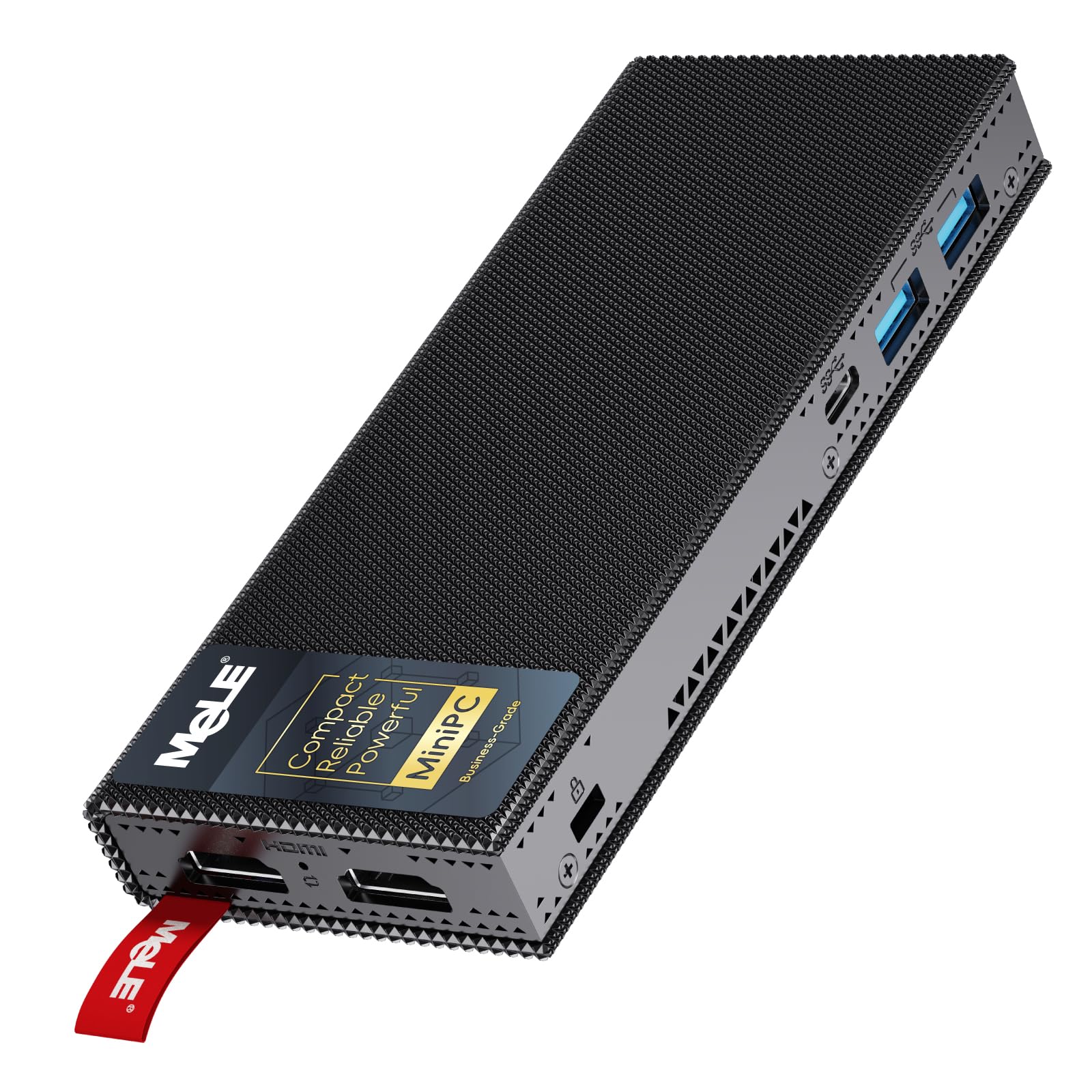
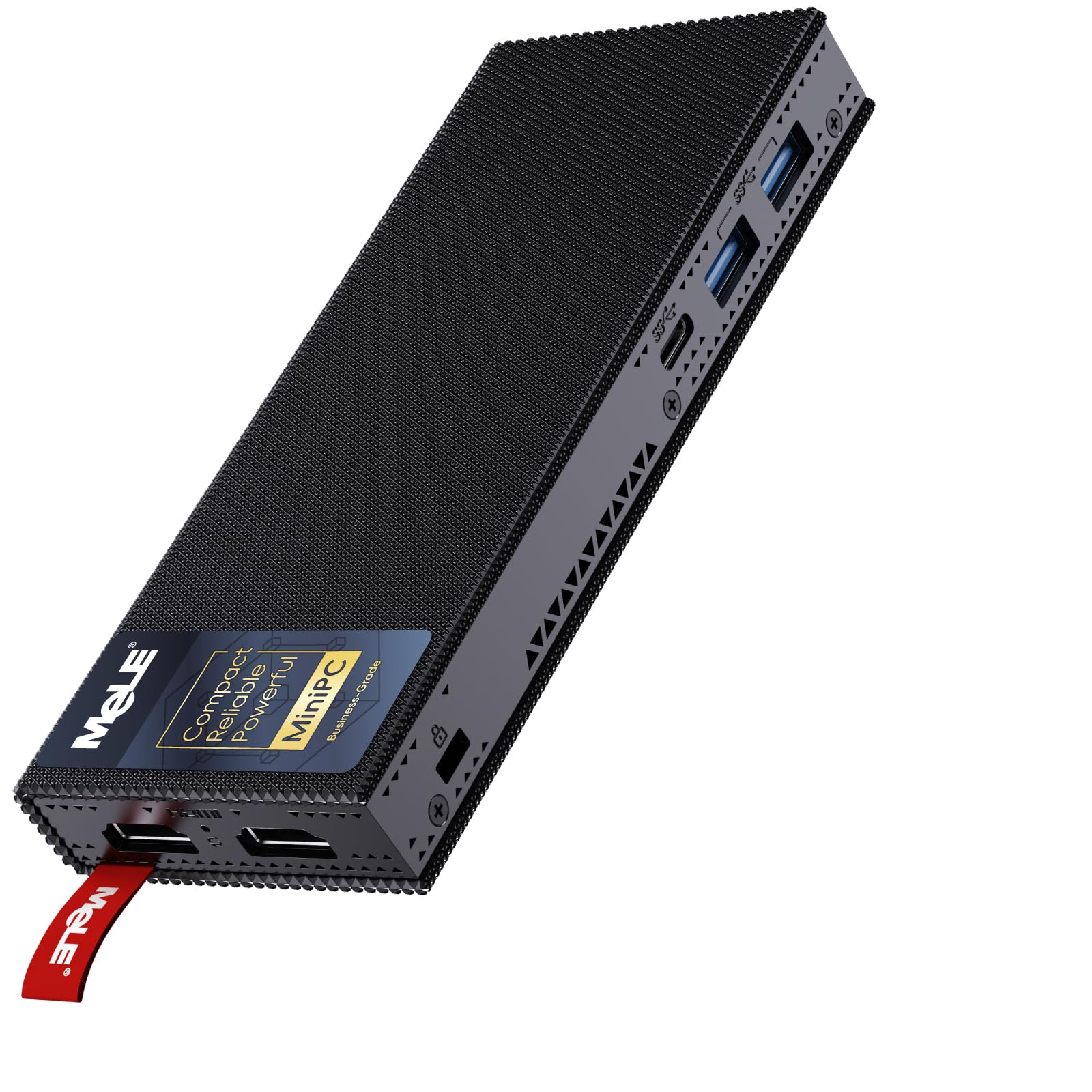
If you want a full computer that disappears into a pocket instead of sitting under a desk, the MeLE PCG02 Pro N100 is the strongest overall pick here. It packs a 12th-gen Intel N100 chip (a low-power processor built for everyday tasks) into a fanless stick you can carry anywhere. The trick with this category is that tiny size always forces a trade-off. You get portability, but you also get slower chips, less expansion room, and cases that run warm to the touch. The nine picks below sort out which stick PC, palm-sized box, or touchscreen micro computer actually earns its place on your desk.
This guide is built by comparing the manufacturers’ published specifications and the patterns across verified customer reviews, so you get each pick’s real strengths and trade-offs instead of marketing spin.
A mini PC shrinks the whole computer into something the size of a deck of cards, and the specs decide whether it feels useful or sluggish. This breakdown of the world smallest pc options shows which tiny machines handle real work and which ones cut too many corners.
Top Picks

How To Choose The Best World Smallest PC
The smaller the computer, the more every decision counts. A stick PC has no room for a big processor or a graphics card, so you are really choosing which compromises you can live with. Start with the job you need it to do, then match the chip, memory, and ports to that job.
The processor sets the ceiling
Low-power chips like the Celeron N5100 or the N100 handle browsing, documents, and streaming without trouble. They are built to sip electricity, which is why they fit in a fanless case. If you plan to run virtual machines, Docker containers, or lots of background services, look for a chip with more cores. The Intel Pentium N3700 runs on four cores and four threads (four parallel work lanes), which suits that homelab role better than a basic two-core part.
Memory and storage decide how it ages
8GB of RAM is the comfortable floor for Windows 11 with several browser tabs open. A 128GB drive fills up fast once you add updates and photos, so a 256GB model gives you more breathing room. Watch the expansion path too. Some sticks take a Micro SD card for extra space, while others reserve a real M.2 slot for a proper SSD upgrade.
Cooling, ports, and power
Fanless designs run silent because there is no spinning fan, and the case itself acts as the heatsink. That means the surface gets warm during long sessions, so placement matters. Count your ports before you buy. Two HDMI outputs let you drive two screens, and a USB PD port (Power Delivery, a charging standard) lets a power bank with enough output run the machine away from a wall socket.
Side-by-Side Comparison
| Model | Best For | Processor | Memory & Storage | Key Port / Feature | Amazon |
|---|---|---|---|---|---|
| MeLE PCG02 Pro N5100★ Best Overall | Budget stick PC | Celeron N5100, up to 2.9 GHz | 8GB / 256GB | Dual HDMI, fanless | Amazon |
| MeLE PCG02 Pro N100Also Great | Everyday all-rounder | Intel N100, up to 3.4 GHz | 8GB / 256GB | Dual HDMI, USB PD3.0 | Amazon |
| Khadas Mind 2Top Performer | Power users on the move | Intel Core Ultra 7 155H, up to 4.8 GHz | 32GB / 1TB SSD | Thunderbolt 4, 435 g | Amazon |
| MINIX NEO Z300-0dB | Silent 24/7 operation | Intel i3-N300 octa-core | 16GB / 512GB SSD | Fanless, M.2 2280 slot | Amazon |
| HiGOLE 5.5″ Touchscreen (16GB) | Touchscreen workstation | Celeron N5095, up to 2.8 GHz | 16GB / 256GB | 5.5″ IPS touchscreen, USB-C | Amazon |
| HiGOLE 5.5″ Touchscreen (8GB) | Portable field unit | Celeron N5095, up to 2.9 GHz | 8GB / 128GB | 5.5″ touchscreen, 2500mAh battery | Amazon |
| Intel Compute Stick CS125 | Simple plug-and-play | Intel Atom x5-Z8300 | 2GB / 32GB | One USB 3.0, 802.11ac | Amazon |
| OuuOee Mini PC Stick J4105 | Business & media stick | Celeron J4105, up to 2.5 GHz | 8GB / 128GB | Gigabit LAN, 4K 60Hz HDMI | Amazon |
| Binxarn Pentium N3700 Mini PC | Homelab & NAS duty | Pentium N3700, up to 2.4 GHz | 8GB / 128GB SSD | 6 USB ports, Gigabit RJ45 | Amazon |
Detailed Reviews
1. MeLE Fanless Mini PC Stick PCG02 Pro N5100 8GB 256GB
Our pick — 4.0+★ from 100+ verified ratings; the strongest balance of quality and price.
The stick that proved a whole desktop can ride in a shirt pocket.
Here is the older sibling of the top pick, and it still holds its own. The quad-core Celeron N5100 bursts up to 2.8 GHz, with 8GB of 2933MHz DDR4 memory and 256GB of eMMC storage. Buyers report it cheerfully running WhatsApp, Deepl, Sonos, OpenShot, Audacity, and VLC at the same time. That is a lot of everyday software for a machine this small.
MeLE shipped this as the first PC stick with USB PD3.0, and that is the feature worth understanding. It means a power bank, a power station, or any source above 12V and 24W can drive the computer. Plug it into a TV at a hotel and your pocket becomes an office. Dual HDMI 2.0 ports also let it push two displays at once, which the single-HDMI sticks here cannot do.
Reliability is the thing buyers mention most, which makes sense for a fanless box you leave running. What wins people over is that it stays quiet and stable day to day. A handful of owners noting heat trouble out of a large review pool is a fit concern, not a reason to write it off.
Why it earns a spot: dual HDMI and USB PD3.0 power in a fanless stick that handles a full workday of light software.
Keep in mind: eMMC storage is slower than an SSD, and the passive case runs noticeably warm.
Reach for this if: you want the proven stick formula at the entry level and value the twin HDMI outputs.
Pass if: you need fast SSD-level storage for large files and constant heavy writes.
2. MeLE Fanless Mini PC Stick PCG02 Pro N100 8GB 256GB
The fanless stick with the newest chip in the room.
The N100 processor is the headliner here, and it earns the top spot. It runs up to 3.4 GHz on Intel’s 10nm process (a smaller manufacturing node that tends to run cooler and more efficiently). That is the quickest clock speed of any fanless stick in this list. It makes office apps, web browsing, and media playback feel responsive rather than sluggish.
Memory is where it pulls away from the older sticks. You get 8GB of LPDDR4 running at 4266MHz, paired with 256GB of storage. Compare that to the Intel Compute Stick’s 2GB of RAM and you see the gap immediately: this machine holds four times the memory, so several browser tabs and a video call run side by side without choking. A Micro SD slot adds room for up to 2TB more if you need it.
The connectivity leans practical. Two USB 5Gbps ports, two USB-C ports, a Micro SD slot, dual HDMI, and a Gigabit Ethernet jack cover most desks. The USB-C port carries USB PD3.0, which means a power bank rated 24W or higher at 12V to 23V can run the whole computer. That turns a hotel TV into a workstation in seconds. The fanless case runs silent and stays dust-resistant, though MeLE notes the surface can reach 55°C to 70°C under load. That is normal for passive cooling, and the design meets the IEC62368-1:2018 safety standard.
Where this stick earns its keep
- Fastest clock of the fanless sticks here at 3.4 GHz with the N100
- 8GB LPDDR4 memory and 256GB storage give you room to work
- Dual HDMI plus USB PD3.0 means dual screens or power-bank operation
- Silent, dust-resistant passive cooling rated for 24/7 running
What to know before you buy
- The case warms to a real, noticeable temperature under heavy load
- Micro SD is the only storage expansion; there is no SSD slot
Reach for this if: you want one tiny machine that handles office work, streaming, and dual monitors without a fan whirring.
Look elsewhere if: you need to open the case and swap in a bigger internal drive later.
3. Khadas Mind 2 Mini PC — Intel Core Ultra 7 155H, 32GB, 1TB
A pocket desktop that carries serious muscle and a built-in battery.
This is the pick for anyone tired of tiny computers that behave like toys. The Intel Core Ultra 7 155H runs 16 cores and 22 threads up to 4.8GHz, with a three-in-one architecture that splits work between the CPU, GPU, and NPU (a dedicated chip for AI tasks). Drop that beside the Celeron chips on this list and the difference is not subtle. It handles creative projects and daily tasks without the waiting.
It is genuinely pocketable at 435 grams and just 2 cm thick, wrapped in a CNC unibody aluminum case. You get 32GB of LPDDR5 memory and a 1TB PCIe 4.0 SSD, which dwarfs the 8GB sticks around it. Thunderbolt 4 and USB4 push 40Gbps transfers, and the HDMI 2.1 port handles an 18Gbps signal. The Arc graphics clock up to 2.25GHz, and the AI Boost NPU adds 34 TOPS of combined computing power for AI work.
The detail that changes daily use is the built-in 5.55Wh battery. Unplug it and it slips into sleep without losing your work, with up to 25 hours of standby and a 2-second wake. Adding storage is a magnetic cover press away on the M.2 2230 slot. The catch is the tier: this is the priciest machine here, and its NVIDIA-free Arc graphics suit creative work and AI tasks rather than hardcore gaming.
Where it wins: real desktop-class power — 16 cores, 32GB of memory, 1TB of fast storage — in a 435-gram shell you can pocket.
The trade-off: it sits at the top of the value ladder, and the graphics lean on integrated Arc rather than a dedicated card.
The verdict: if you travel with real work to do — editing, code, AI tools — and want no compromise on speed, this is the one.
Think twice if: your tasks fit a cheaper stick and you would rather keep the spend modest.
4. MINIX NEO Z300-0dB Fanless Mini PC — i3-N300, 16GB, 512GB

Built to run in the background without a sound for days on end.
Some people want a tiny PC they never think about again. That is where this MINIX fits. It uses the Intel Alder Lake-N N300 octa-core processor (eight cores working in parallel), backed by Intel UHD Graphics across 32 execution units. That core count makes it a strong pick for running many small jobs at once rather than one demanding one.
The memory and storage headline the value story: 16GB of DDR4 RAM upgradeable to 32GB, plus a 512GB M.2 NVMe SSD. There is an M.2 2280 PCIe slot that supports expansion up to 4TB. Compare that to the Binxarn N3700’s 128GB SSD and you see who planned for the long haul. The 6MB cache and 3.39 GHz speed keep office work and browsing moving briskly.
It runs fully fanless, drawing only what it needs to stay silent in a quiet room. The design is rated for continuous 24/7 operation and built with an anti-static layer that guards against electromagnetic interference. Honest note: if you run it hard, the top cover can get warm — MINIX suggests keeping it out of children’s reach. Set it on a shelf or behind a monitor and that warmth stops mattering.
Built for uptime: an 8-core chip, 16GB of expandable memory, and a 512GB NVMe drive in a case with no moving parts to fail.
The honest caveat: the fanless cover heats under sustained load, so give it open air rather than a sealed cabinet.
Pick this for: a always-on office box, media server, or shop-floor computer where silence and stability matter more than raw clock speed.
Better suited elsewhere if: you want a battery-powered pocket machine you carry between rooms.
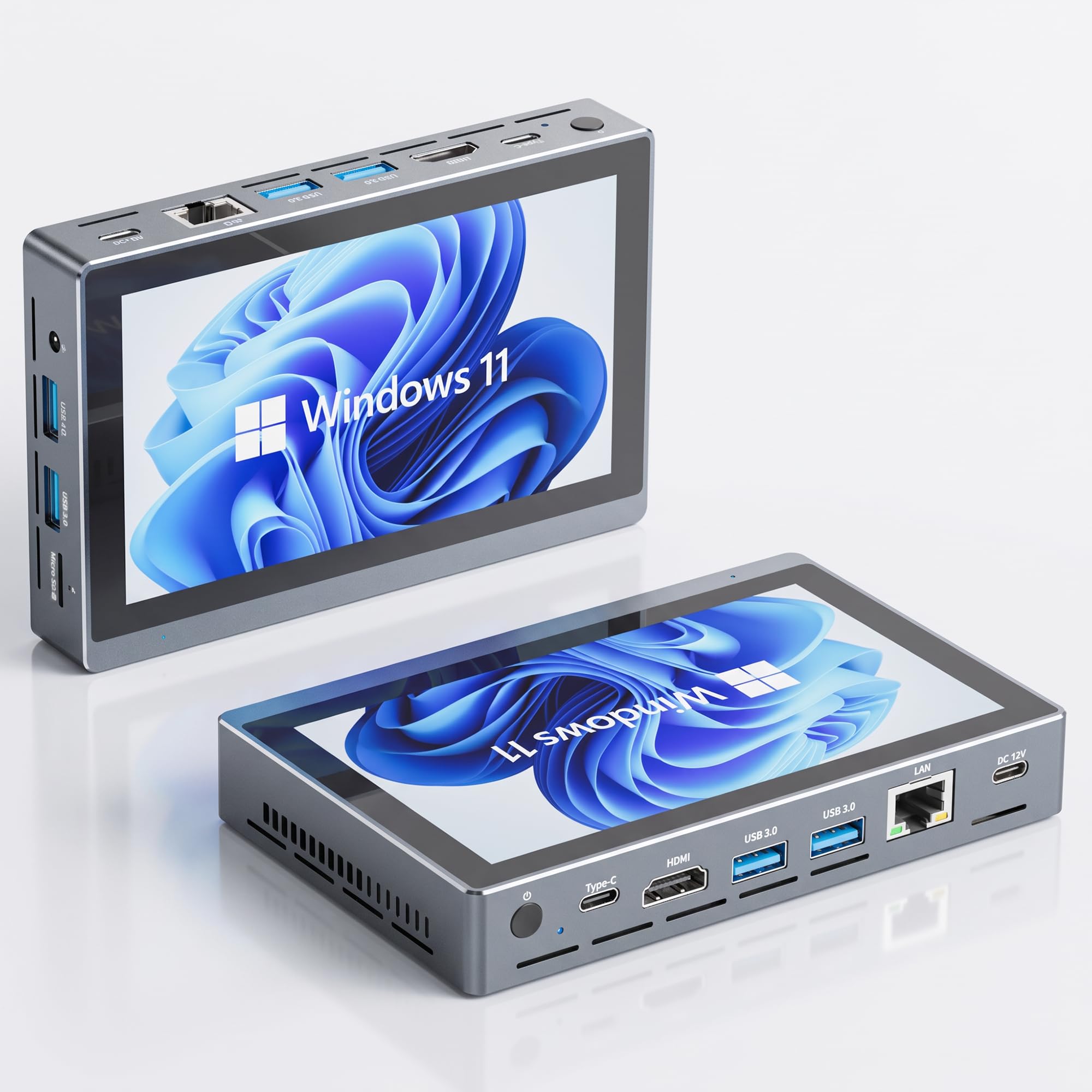
5. HiGOLE 5.5″ TouchScreen Mini PC — N5095, 16GB RAM, 256GB
A computer with its own screen, so you never hunt for a monitor.
This is the fully-loaded version of HiGOLE’s touchscreen micro PC, and the 16GB of RAM is the reason to pick it. Paired with 256GB of eMMC storage and the quad-core Celeron N5095 up to 2.8GHz, it runs apps at a clip owners compare to a tablet or laptop. The 5.5-inch IPS touchscreen (a wide-viewing panel) shows 720×1280, and a G-Sensor rotates the image as you turn the unit.
Because the screen is built in, it works with nothing but a power cable — handy for a POS till, a kiosk, or a smart-home control panel. Windows 11 Pro comes pre-installed and it is Linux-ready. You also get full USB-C, dual-display output through HDMI at 4K@30Hz, Gigabit Ethernet, four USB 3.0 ports, a TF card slot, and a PD charging port. The 2500mAh battery gives up to 4.5 hours away from the wall, and the whole thing weighs 0.32 kg.
Owners tend to like how it performs and appreciate the compact footprint. Two honest notes surface in the data. It can get warm during long sessions, and the case is uncomfortable to hold when it does — so treat it as a desk unit, not a handheld. The touch panel itself works well for some and not at all for others, so test yours early.
The draw: double the memory and storage of its sibling, plus a built-in screen, a 4.5-hour battery, and a full port set.
The catch: it runs warm in extended use, and the 5.5-inch panel is a companion display rather than a roomy main screen.
Suits you if: you want a self-contained micro computer for kiosks, control panels, or desk work where 16GB keeps things smooth.
Not your pick if: you need a big monitor or plan to hold the device in your hand for hours.
6. HiGOLE 5.5″ TouchScreen Mini PC — N5095, 8GB RAM, 128GB

The go-anywhere touchscreen box for field checks and pop-up desks.
Where the 16GB version is a desk unit, this one is built to leave the desk. The same 5.5-inch IPS touchscreen, the same quad-core Celeron N5095 up to 2.9GHz, but here with 8GB of RAM and 128GB of storage. The built-in 2500mAh battery delivers up to 4.5 hours of runtime, and at 0.32 kg it slips into a bag. Compare the carry weight to the Binxarn’s 0.28 kg mini box and the two are close — but only this one has its own screen and battery.
That combination is the point. You can walk to a rack, plug in over Wi-Fi 5 or a cable, and check settings with no monitor in sight. Windows 11 Pro and Linux readiness make it flexible for field debugging, equipment inspections, and on-site tasks. Dual-display output through HDMI reaches 4K@30Hz, and Type-C video out, Gigabit Ethernet, four USB 3.0 ports, a TF slot, and a PD charging port round out the connections.
Quality is what the reviews praise most, and people describe it running fast enough for everyday jobs. The part to weigh honestly: reliability reads mixed across the data, and heat plus charging compatibility draw their fair share of gripes. Some units have stopped working early. That makes this a good second or field machine rather than the sole computer you depend on for everything.
What makes it portable
- Built-in 720×1280 touchscreen means no separate monitor needed
- 2500mAh battery gives up to 4.5 hours untethered
- Weighs just 0.32 kg for easy carrying between jobs
- Full port set including Gigabit Ethernet and Type-C video
Things to weigh
- Reliability reports are mixed, with some early failures noted
- Heat and charging quirks show up in the feedback
Best served: technicians and field crews who need a screen and computer in one small, cordless unit.
Consider the 16GB sibling instead: if this is your main computer and you want the extra memory to spare.
7. Intel Compute Stick CS125 — Atom x5, 2GB RAM, Windows 10

The original pocket PC, now a simple way to turn a TV smart.
This is the stick that started the whole category. The quad-core Intel Atom x5-Z8300 sits at its heart, with 2GB of DDR3L memory and 32GB of storage. That is the smallest memory and storage on this list by a wide margin — remember the MeLE N5100 runs 8GB — so set expectations to match. It runs Windows 10 in 32-bit form with Intel HD graphics, and that is enough for browsing and media.
Setup is where it shines, and it is the aspect praised most in the data. Plug it into an HDMI port, power it up, and it is running. Compatibility is the second thing owners value. Integrated 802.11ac wireless keeps the network link quick, and there is one USB 3.0 and one USB 2.0 port plus Bluetooth 4.0 for a keyboard and mouse. It drives a display up to 3840×2160, so a 4K TV is within reach.
The trade-off is speed and reliability. Performance reads mixed, with some owners finding it quick for media apps and others seeing it restart on its own. Value is the trump card — it remains the most accessible way into a stick PC by a clear margin, and the high owner count shows a lot of people getting real use from it.
The promise kept: near-instant setup, working 802.11ac Wi-Fi, and a 3840×2160 display ceiling for turning any HDMI screen into a basic computer.
The reality check: 2GB of RAM and 32GB of storage are tight, so it suits streaming and light browsing, not multi-tab work.
You’ll get on with this if: you want the easiest, most budget-friendly route to a TV that browses the web and streams.
Keep looking if: your day involves several apps open at once and you need it to never stall.
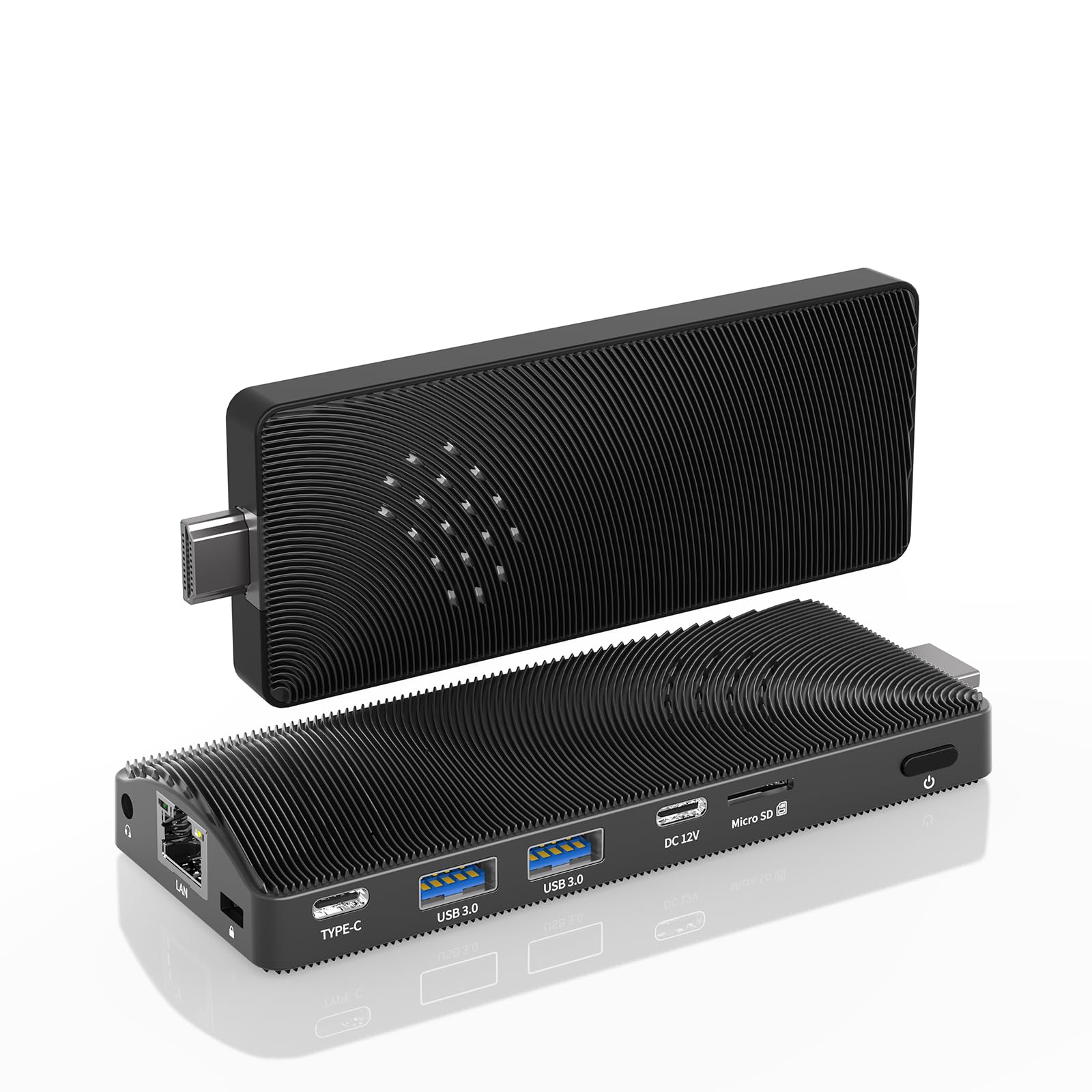
8. OuuOee Mini PC Stick — Celeron J4105, 8GB RAM, 128GB
A wired-friendly stick for desks that need a steady network cable.
The standout on this stick is the Gigabit LAN port. Most pocket PCs here rely on Wi-Fi alone, but the OuuOee adds a real Ethernet jack for a stable wired connection — useful for an industrial panel, a small server, or any spot where Wi-Fi drops out. The Celeron J4105 runs up to 2.5GHz, backed by 8GB of DDR4 RAM and 128GB of storage. A Micro SD slot adds up to 1TB more if you need it.
Video is a genuine highlight. The HDMI 2.0 port with Intel UHD 600 graphics (a small integrated graphics engine) pushes 4K at 60Hz, so motion looks smooth rather than choppy. Owners pushing a display to a projector or a TV get that full frame rate, which cheaper sticks cannot always manage. Bluetooth 5.0 and dual-band 2.4/5GHz Wi-Fi handle wireless accessories and connections.
It runs Windows 11 Pro and works with Ubuntu or Linux, which widens its uses to business, office, and media setups. The fanless design keeps it quiet and rated for 7/24 operation. The trade: performance is balanced rather than quick, so heavy multitasking will feel the stretch. It is a sensible second machine for a dedicated job, not a speed demon.
The differentiator: a Gigabit LAN port plus 4K 60Hz HDMI in a fanless stick, with 8GB of RAM and Linux support.
Set your sights: the J4105 is a modest chip, so it shines on steady single tasks more than heavy multitasking.
Built for: offices, industrial panels, and media corners that want a wired connection and smooth 4K 60Hz output.
Look to the N100 pick instead: if raw speed on a wireless-only setup matters more to you than the LAN jack.
9. Binxarn Mini PC — Intel Pentium N3700, 8GB RAM, 128GB SSD
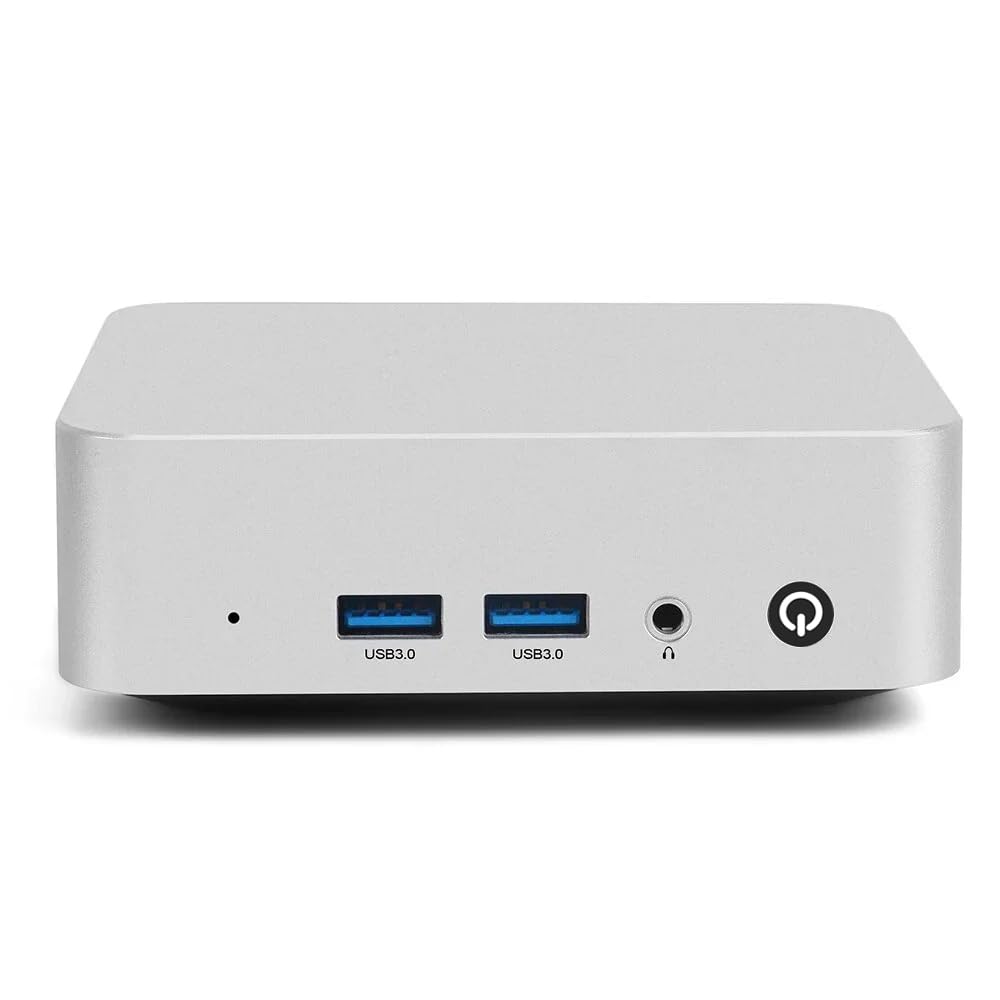
The little silver box made for running services around the clock.
This mini PC is aimed at a different job than the pocket sticks. The Intel Pentium N3700 brings four cores and four threads up to 2.4GHz, which Binxarn says handles virtual machines, NAS setups, Docker, and multiple background services with less stuttering than two-core machines. If you plan to run things, not watch things, that core count is the reason to look here.
It holds a real 6W TDP (thermal design power, a measure of how much heat the chip makes), paired with a copper heat sink and a quiet fan. That means it runs nearly silent over long hours without the warm-to-the-touch surface a fanless case develops. The 700MHz Intel HD Graphics decodes H.264 and H.265 video in hardware. Storage is a 128GB SSD with support for up to 2TB expansion, and 8GB of RAM keeps services fed.
The port spread is the widest of the pocket boxes here: two Type-C, two HDMI, two USB3.1, two USB2.0, Gigabit RJ45 LAN, and a 3.5mm audio jack. It weighs 0.28 kg and measures 11.2×11.2×3.7cm, small enough to VESA-mount behind a monitor. The honest limit is its score and small review pool, plus the older chip’s modest pace for daily desktop work.
Made for services: four cores, a 6W thermal rating, and copper-plus-fan cooling built to stay quiet under a long-running load.
Weigh the fit: it favors tucked-away server duty over snappy desktop use, and it has fewer owner reviews than the leaders.
The task it fits: a homelab or NAS node that runs quietly behind a screen around the clock.
Skip it for: everyday desktop speed — the N100 pick is quicker for that.
Know the Specs
Processor and Clock Speed
The chip is the biggest limit on what a tiny PC can do. Celeron and Atom chips sip power and stay cool, which is why they fit in fanless sticks — good for browsing, documents, and video. Higher clocks like the N100’s 3.4 GHz or the Core Ultra 7’s 4.8GHz mean faster single tasks. More cores, like the N300’s eight, matter when you run several programs or services at once.
RAM and Storage
Memory is the number of things your PC can hold open at once, and 8GB is the comfortable floor for Windows 11. Storage is where files and programs live; 32GB fills quickly and 256GB or more gives you room. Watch the type too — an M.2 NVMe SSD moves data far faster than eMMC, and a Micro SD or M.2 slot decides how far you can grow.
Cooling Method
Fanless designs run silent and resist dust, but the case itself becomes the heatsink, so the surface gets warm during long work. A fan-cooled box like the MINIX or Binxarn can stay cooler under load at the cost of a moving part and a little noise. Neither is better — one suits a quiet room, the other a machine that works hard.
Ports and Power Delivery
Count the ports against your gear. Dual HDMI runs two monitors, and Gigabit Ethernet guarantees a steady wired link. A USB PD port that accepts enough voltage lets a power bank run the whole computer away from a socket. Match the port to the job before you commit.
Common Questions
Can a pocket-sized PC really replace a full desktop?
Why does a fanless mini PC case feel hot?
Can I run a mini PC stick from a power bank?
How much RAM do I need in a tiny PC for Windows 11?
Is eMMC storage slower than an SSD?
Can these mini PCs run two monitors at once?
Do I get Windows 11 on these tiny computers?
Can I expand the storage on a mini PC stick?
Which mini PC suits a homelab or NAS setup?
Can I mount a small mini PC behind a monitor or TV?
The Bottom Line
The strongest all-rounder for most people is the MeLE PCG02 Pro N100, because its Intel N100 chip clocks higher than the older fanless sticks and its 8GB of RAM and 256GB drive keep everyday work smooth. For creative or AI-heavy tasks on the move, the Khadas Mind 2 delivers desktop-class cores in a 435-gram shell with a built-in battery. And if a built-in touchscreen is what you need, the HiGOLE 16GB touchscreen model puts a full Windows 11 Pro computer and its own IPS screen in one handheld unit.
What makes the top pick worth choosing is its mix of a newer chip, expandable storage, dual HDMI, and USB PD3.0 power that keeps it useful whether it sits on a desk or runs from a power bank.
How we choose
We do not accept paid placement. Every pick is matched to a real buyer and a real use-case; we do not hands-on test units.
Sources
Specifications: manufacturer listings and product documentation. Review insights: verified customer reviews, as of November 2026. Pricing: not shown on this page (it changes often); check the current price via the retailer link.
As an Amazon Associate, Tactical Gear Guy earns from qualifying purchases. This does not affect which products we feature.