Specs are compiled from manufacturer listings and verified buyer reviews and can change over time — please confirm the key details on the product page before buying.
The quick answer: for most wood floors you want an orbital buffer, not a high-speed rotary, because the orbital head moves in a random pattern that scuffs and buffs without the swirl marks a spinning disc can leave behind. Anything in the mid to premium tier with a 13-inch or wider pad, a heavy motor and a long cord will handle a whole room without you chasing outlets or kneeling on a pad by hand. Every pick below is a corded orbital or rotary machine that sands, waxes and buffs hardwood.
This guide is built by comparing the manufacturers’ published specifications and the patterns across verified customer reviews, so you get each pick’s real strengths and trade-offs instead of marketing spin.
You will see which machine earns its spot on hardwood and which one is really a carpet tool in disguise, how pad size changes how fast a room goes by, and why motor speed matters more than motor noise. A random-orbital buffer turns a dull, cloudy hardwood hallway into a walk-behind job you can finish in an afternoon.
Top Picks


How To Choose The Best Wood Floor Polishing Machine
First-time buyers often assume every floor buffer works the same on hardwood, and that is where swirl marks come from. On hardwood, the head type decides everything. A random orbital head moves the pad in overlapping circles, so it lifts grime and works wax in without cutting a visible track. A straight rotary disc spins in one direction and can burn a swirl pattern into a soft finish if you linger in one spot. Match the head to the job before you look at anything else.
Orbital versus rotary heads on hardwood
Orbital machines glide and are far more forgiving for a homeowner doing a hallway or a living room for the first time. Rotary buffers are the classic commercial tool and they cut faster, but they ask for a steadier hand. If your floor is a factory finish you want to protect, an orbital head is the safer starting point.
Pad size and how long a room takes
A 13-inch cleaning path covers less ground per pass than a 17-inch deck, which makes 13-inch models easier to steer around furniture and tighter rooms. A 17-inch machine eats a big open floor faster but is heavier to push and harder to fit between cabinets. Think about your largest open room and your tightest corner, then pick the size that survives both.
Motor speed, weight and cord length
Speed is listed in RPM — revolutions per minute, how many times the pad turns each minute. Low-speed buffers around 150 to 175 RPM are the standard for buffing, waxing and scrubbing because they work the product in rather than flinging it. Weight matters too, since a heavier head presses down for you on deep cleaning. And a long cord means fewer outlet swaps mid-room.
Side-by-Side Comparison
| Model | Best For | Pad / Deck Size | Speed | Weight | Amazon |
|---|---|---|---|---|---|
| Oreck Commercial Orbiter★ Best Overall | All-round hardwood buffing | 13.6 in wide head | Random orbital | 33 lb | Amazon |
| Oreck Orbiter ORB600MWEasiest to Steer | One-hand control | Random orbital head | Random orbital | — | Amazon |
| HHQ Commercial Scrubber with PadsBest Kit Value | Kit value on tile and wood | 13 in wide deck | Orbital | 39 lb | Amazon |
| HHQ 13″ Buffer and Polisher | Big areas, brush variety | 13 in deck | 1.5 hp motor | 40 lb | Amazon |
| Prolux Core 13″ | Small homes and tight rooms | 13 in cleaning path | 150 RPM | 28 lb | Amazon |
| Farag Janitorial 17″ Buffer | Large commercial floors | 17 in base plate | 175 RPM | 106 lb | Amazon |
| Dapper Supply 17″ Buffer | Solution tank scrubbing | 17 in cleaning path | 175 RPM | — | Amazon |
| Viper VN2015 Venom | Wide-deck commercial buffing | 20 in deck | 175 RPM | 109 lb | Amazon |
| Clarke CFP Pro 17HD | All-metal heavy use | 17 in deck | 1.5 hp motor | — | Amazon |
Detailed Reviews
1. Oreck Commercial Orbiter Hard Floor Cleaner
Our pick — 4.5+★ from 4,500+ verified ratings; the strongest balance of quality and price.
The random-orbit workhorse that buffs hardwood without carving swirls into it.
What makes this one the pick for a hardwood floor is the brush head itself: it rotates in a random orbital pattern, which is the wandering, non-repeating motion that glides over boards instead of grinding a track into them. That random orbit is what keeps the finish even when you slow down in a corner. The head measures 13.6 inches wide and the whole machine weighs 33 pounds, so it presses down for you on deep cleaning without being a fight to push.
This is a genuine all-floorer, not a one-trick hardwood tool. It sands, refinishes, strips, scrubs, waxes and polishes, and it dry-cleans carpets without leaving the soapy residue that attracts fresh dirt. It also squeezes into bathrooms and under sinks where a wide commercial buffer simply will not fit. Oreck has been building this model since 2006, and that long production run shows in the maturity of the design.
What keeps people loyal is build quality — it is the single most-praised trait of this machine, far and away ahead of everything else owners talk about. Cleaning performance and how easy it is to load brushes and pads follow close behind, and the shine it leaves on hardwood is the payoff everybody describes. Weight and long-term durability draw the most split opinions — it is 33 pounds, so hauling it up stairs is a two-hand job, and a few long-term owners treat the moving parts as something to keep an eye on. The included accessory set is the other recurring gripe: plan on buying your pad assortment separately.
What wins people over
- Random orbital head prevents brush marks, swirls and gouges on hardwood
- One machine sands, strips, scrubs, waxes, polishes and dry-cleans carpets
- 13.6-inch head and 33-pound body press down for deep cleaning
- Fits bathrooms and under-sink spaces a full commercial buffer cannot reach
Where it asks you to compromise
- Pads and brushes are largely a separate purchase
- 33 pounds is heavy to carry between floors
- Weight and durability draw the most split opinions
Made for: whole-home hardwood upkeep where you want one machine to sand, wax and buff without swirl risk.
Think twice if: you need to carry it up and down stairs regularly, or you expect a full pad set in the box.
2. Oreck Orbiter Hard Floor Cleaner ORB600MW
A buffer light enough to steer with one hand and quiet enough to run while the house sleeps.
Where the first Oreck gives you headroom on capacity, this ORB600MW is the one to pick if the job is a smaller home and you want control above all else. The brush head uses the same random orbital motion, so you get the no-swirl, no-gouge glide over your boards, but the machine is balanced for fingertip steering. It steers with one hand like a shop tool, and the long cord lets you move room to room without hunting for an outlet.
Terrazzo and travertine owners tend to love this one just as much as hardwood households, because the same orbital action lifts years of dull film without cutting too deep. Buyers report floors looking fresh again rather than merely swept, and it holds its own against bigger commercial units on hardwood and stone.
The one-hand factor: fingertip control is the headline here — you guide it rather than wrestle it, which matters on long buffing passes across a living room. The quiet motor also means you can work in the evening without the whole street knowing.
What to weigh: it offers a narrower range of jobs than the top Oreck, and because it is lighter it presses down less on heavy stripping. If your floor needs aggressive sanding, the heavier machines below earn their keep.
Reach for this if: you want a hardwood and stone buffer you can run one-handed in tight rooms.
Look elsewhere if: your priority is heavy-duty stripping rather than routine polishing.
3. HHQ Commercial Floor Scrubber Machine with Brushes and Pads
The machine that shows up with the whole pad drawer already in the box.
Buying a buffer usually means buying the buffer, then buying pads, then buying brushes. This HHQ flips that: it arrives with two polishing and stripping pads, three scrub brushes, a microfiber carpet bonnet and a pad holder all in one kit. For a household tackling hardwood, tile and a carpeted den with a single tool, that bundle removes the most annoying part of ownership — the second and third shopping trip. The deck is 13 inches wide and the body weighs 39 pounds.
Rubber wheels are the quiet hero here. The machine is built heavy on purpose so it deep cleans better, and the wheels let you roll it to the next room instead of carrying it. Fingertip control keeps it steerable once you are working. Here is a detail worth knowing if you already own Oreck gear: these pads and brushes are made to swap with an Oreck Orbiter, and Oreck pads fit this buffer in return, so you are not locked into one brand’s accessory shelf.
Value and build quality are what carry this machine with its owners — the money angle leads, with quality close behind. Durability and weight are the two split opinions: some find it stout and some find it less stout than hoped, and the weight reads as either manageable or a bit cumbersome depending on the room. Size it honestly against your own stairs and you will be happy.
Covered by a real warranty: the motor carries a 5-year manufacturer warranty and the rest of the components get 2 years, which is the sort of backing that turns a mid-priced tool into a safer bet.
Best matched to: a whole-house kit buyer who wants brushes and pads bundled and does not want to shop twice.
Worth a pause if: you want the lightest possible buffer to carry upstairs.
4. HHQ 13″ Commercial Floor Scrubber Machine

Three brush grades in one kit, built around a motor that keeps its cool on long jobs.
The number to notice is the motor: up to 1.5 hp, or 1100 watts, built as an ECM motor meant to run extended sessions without overheating or burning out. On a full day of buffing a big floor, that endurance is the difference between finishing the job and waiting for the tool to cool. It weighs 40 pounds.
Where the kit really flexes is brush choice. You get a heavy, medium and soft brush plus three cleaning pads, so you can go aggressive on a stripped floor and gentle on a fresh wax without hunting for add-ons. Fingertip control keeps the heavy frame steerable, and the rubber wheels make it easy to move from room to room between passes. A waterproof design with self-cleaning capability also means the cleanup after the cleanup does not become its own chore.
The people who own this one talk most about effectiveness — handling big areas is the recurring theme — and ease of use comes second. The variety of brushes is the third thing owners bring up, which tracks with a kit this complete.
The motor payoff: 1.5 hp drives the pad hard enough for real scrubbing, and the ECM design is aimed squarely at long sessions without a cooldown break.
One honest catch: at 40 pounds it is a two-hand tool to lift, so think of it as a floor-level machine you wheel rather than carry.
Suits you if: your job list runs from stripping to soft buffing and you want the brush for each step in one box.
skip it if: you only ever buff one clean hardwood floor at a time.
5. Prolux Core 13 inch Electric Floor Buffer

The 28-pounder built for home hallways, with a cord that reaches the whole floor.
This is the lightest full-size buffer in the group at 28 pounds, and that single fact changes who it is for. It weighs 28 pounds versus the 40-pound HHQ above, which matters every time you lift it over a threshold or carry it to another floor. The 13-inch cleaning path fits a home, office or restaurant scale, and its footprint is the most compact here at 15 inches deep by 10 inches wide by 31 inches high — easier to tuck into a closet than a 106-pound commercial deck.
Prolux also designed it to scrub and buff in both directions at once, which is the trick that keeps swirl marks off a finished hardwood floor. The motor is a low 150 RPM high-torque unit, so it presses product into the boards rather than flinging it, and it comes with five cleaning pads plus a 50-foot extension cord. That cord length is genuinely freeing — you can work a whole room without unplugging, and the telescoping T handle adjusts to your height.
Owners describe it as a household-grade machine that sets up in about 10 minutes, with a buffing brush most people master in less than ten minutes of practice. Quality and ease of use lead the praise, with the 13-inch disk coming in at the right size and the shine on hardwood as the payoff. Value and handle adjustability draw more mixed feelings, and the stability is the one honest wobble — set the T handle to your height and keep a steady push and it tracks fine. A 5-year motor guarantee backs it up.
The case for it
- 28 pounds versus the 40-pound HHQ buffer
- Bidirectional scrub and buff action to hold off swirl marks
- 50-foot cord and telescoping T handle reach a whole room
- 5 pads included and a 5-year motor guarantee
What to keep in mind
- Stability is the most-cited weak spot — press evenly
- Value and handle adjustability split opinion
- 150 RPM backs off heavy stripping compared to bigger decks
Built for: home and small-business floors where a light, tight machine with a long cord beats raw power.
Not the fit if: you are stripping a large commercial floor that wants a heavier head.
6. Farag Janitorial Industrial 17″ Floor Buffer Polisher
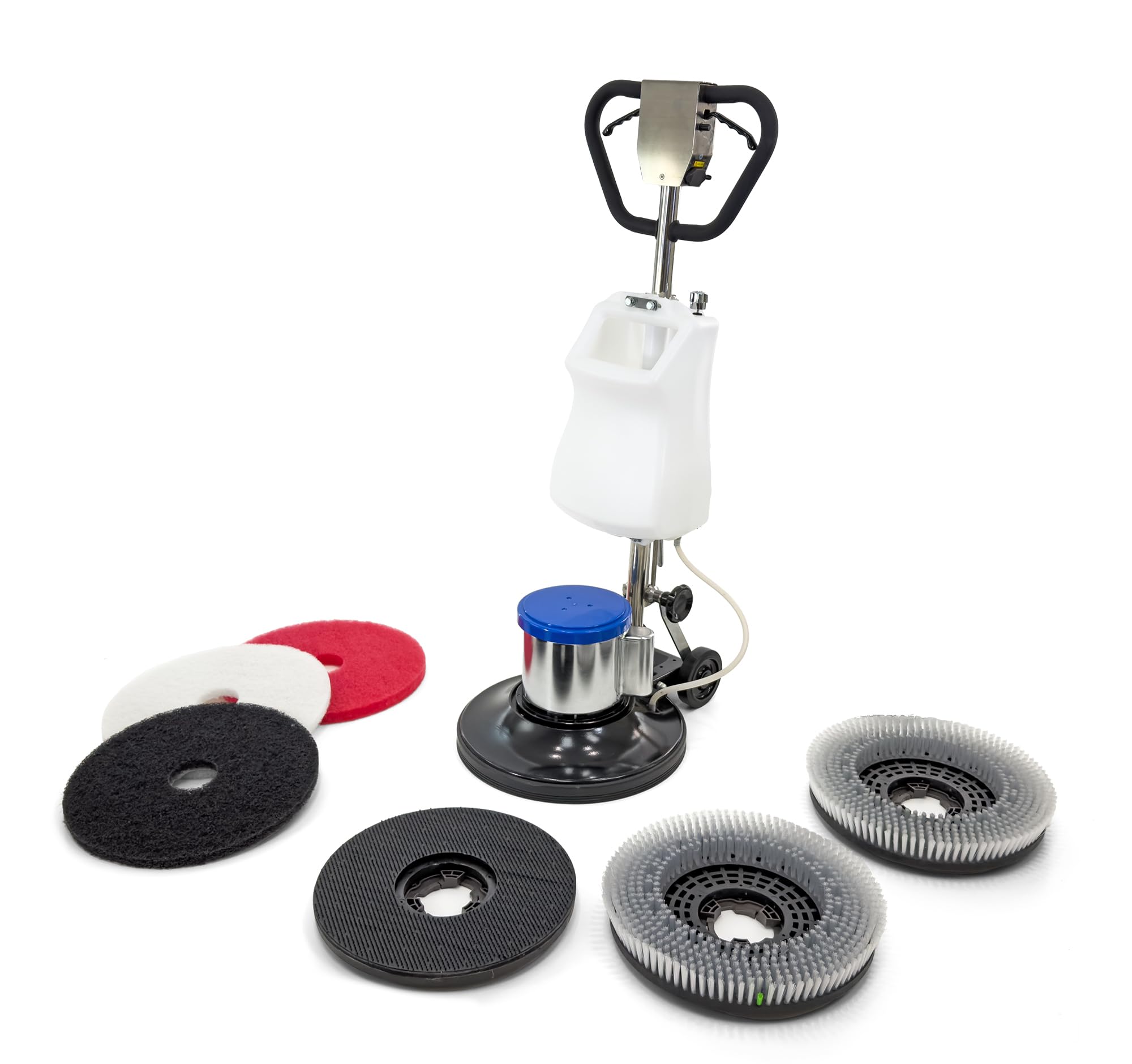
A 106-pound metal-bodied 17-inch deck for floors measured in square footage, not hallways.
The 17-inch base plate is the spec that decides this machine’s buyer. A wider deck covers far more floor per pass than a 13-inch unit, so a large open commercial room goes by quickly. But that deck sits inside a 106-pound metal body, and that weight is doing two jobs at once: it deep cleans by pressing down for you, and it makes hauling the machine upstairs a serious consideration. This is a floor-level tool on a 40-foot power line, not a portable one.
The power spec tells the same story. It runs a 1100 W motor at 175 RPM, the classic low-speed buffer setting for scrubbing, buffing and polishing hardwood and vinyl, and it draws 10 A from a corded supply. The metal construction and full attachment kit mean it is built for repeated commercial use rather than weekend touch-ups.
Where the money goes: into the metal frame and the 1100 W motor, which together give the 17-inch pad the mass it needs to cut through a dull commercial floor in one pass.
The trade-off: at 106 pounds, getting it to the second floor is a real project. If your floors are single-level and open, that weight is an asset rather than a burden.
Pairs well with: single-level commercial rooms and large open hardwood where a wide, heavy deck pays off.
Not your tool if: you need something you can carry from floor to floor.
7. Dapper Supply 17″ Multi-Functional Floor Buffer Polisher
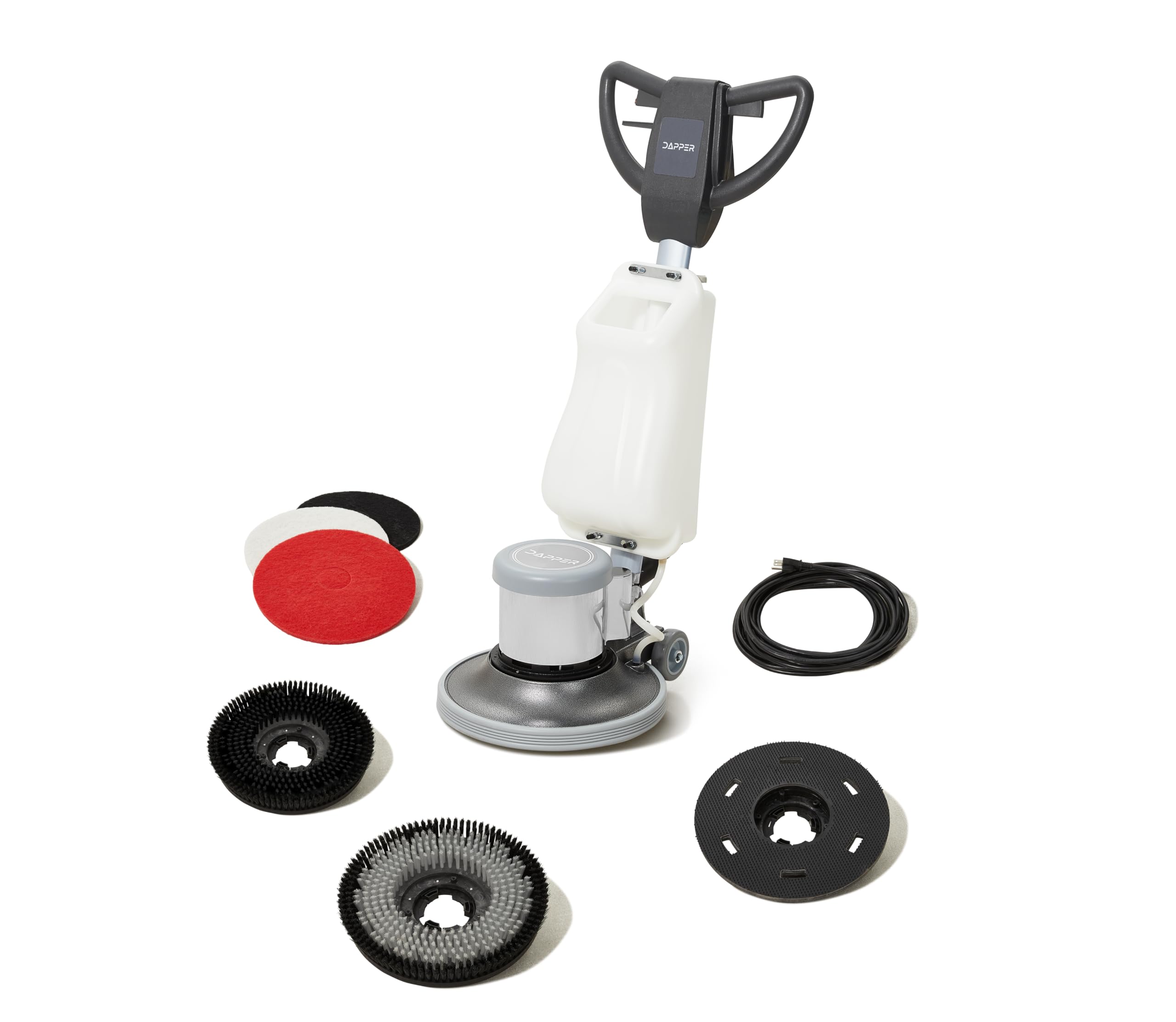
The buffer that carries its own cleaning solution so you scrub and buff in one pass.
The optional 3.5-gallon solution tank is the feature that sets this machine apart for deep cleaning. Instead of spraying the floor and then buffing it, you load the tank and let the buffer put down solution as it works. A 17-inch cleaning path and 175 RPM high-torque random orbit motor spread that work over a wide swath. The bidirectional cleaning mechanism is the same anti-swirl approach the other good orbitals use, so you avoid gouges, swirls and sanding marks on a finished floor.
The 39-foot cord stretches across a large room without outlet swaps, and the 1100 W pure copper motor is built for continuous use. Two small touches make it easier on the person pushing it: a lightweight aluminum main bracket cuts fatigue on long sessions, and an anti-collision rubber ring on the nose edge guards both the machine and the baseboards when you get close to a wall. A wet-and-dry pickup pan rounds out the kit.
Where it earns trust: that counterweighted head and wide 17-inch path are built for professional-style results on tile, grout and hardwood in one sweep.
The honest catch: the solution tank adds bulk and weight, so this is a deliberate floor-level tool rather than a grab-and-go buffer. If your job is routine dry buffing, you are carrying a tank you will not fill.
Meant for: deep scrub-and-buff sessions on tile, grout and hardwood where laying down solution is part of the job.
Rethink it if: you only need light maintenance buffing with no wet work.
8. Viper VN2015 Venom Series Low Speed Buffer
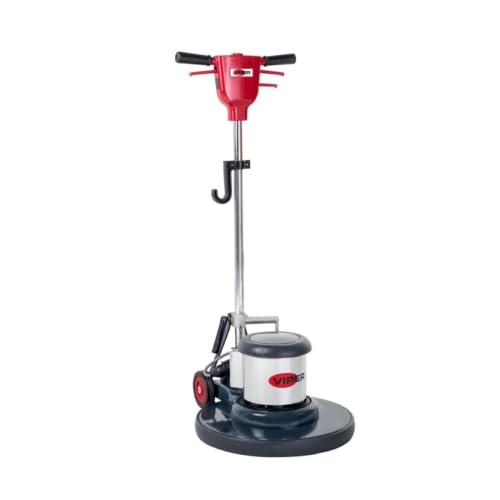
A 20-inch deck and a 50-foot cable for covering big floors in fewer passes.
Twenty inches is the widest deck on this list, and that number is the whole pitch: each pass covers more floor than a 13-inch machine or a 17-inch one, so a large commercial room gets done with fewer trips up and down. The low-speed motor runs at 175 RPM with 1.5 hp behind it, the standard setup for buffing and polishing a big hardwood floor evenly. It drives a 19-inch pad from a 110V corded supply.
The 50-foot power cable lets you work a long run of floor without repositioning, which is the kind of time-saver that matters on a commercial schedule. The 109-pound metal build sits in the same weight class as the other 17-inch commercial decks here — nothing about this machine is meant to be lifted casually.
What owners respond to most is the quality of the build; functionality opinion splits, with some reporting it worked great and others less so. Treat that as a nudge to check the specific pad setup for your floor rather than an indictment. If you are polishing a wide, flat commercial floor, the 20-inch deck is the reason to pick this over a 13-inch unit.
Deck math that matters: a 20-inch pad covers more floor per pass than any other pick here, and the 175 RPM low speed works a polish in evenly.
Right for: big commercial hardwood floors where fewer, wider passes save hours.
Wrong for: tight domestic rooms or anyone who needs to carry the buffer up a flight of stairs.
9. Clarke CFP Pro 17HD Polisher

A steel-bodied 17-inch polisher with a gearbox built to outlast the floor it sits on.
Clarke approaches the job the way heavy commercial gear does: all-steel construction, an all-steel triple planetary gear box, and a 1.5 hp motor behind a 17-inch deck. The gearbox is the part that usually wears first on a rotary buffer, so a triple planetary design is aimed at commercial duty. A safety lock-out switch and fingertip controls keep the operation simple, and the 50-foot safety yellow cord reaches a full commercial room.
The pad drive uses a universal clutch plate, which lets you swap pad types without a dedicated driver change — useful when you move from scrubbing to buffing on the same floor. Every surface that touches the floor or takes a knock is metal, which is the durability answer a buyer wants in something this size. Corner control and machine weight split some opinion, so test the balance once it arrives and work out your own push rhythm.
Built to be serviced: the all-metal frame and triple planetary gear box are the specs that make this a long-life machine rather than a season-long one, and that is why it earns a spot at the top of the premium tier.
The genuine catch: metal everywhere means weight, and the 1.5 hp rotary demands a steady hand. If you have never run a buffer, the orbital machines above are gentler teachers.
Pick this when: you want an all-metal rotary built for repeat professional use and you already know how to run one.
Step back if: you are new to buffing and want the swirl-mark forgiveness of an orbital head.
Know the Specs
Orbital versus rotary head
A random orbital head moves the pad in wandering circles, which keeps the abrasive or wax from cutting a repeatable track — that is what prevents swirls and gouges on a hardwood finish. A rotary head spins a single disc in one direction, which cuts faster and buffs glossier but can leave swirl marks if you dwell too long in one spot. If your floor has a factory finish you want to keep, an orbital machine is the safer choice.
Speed in RPM
RPM means revolutions per minute — how many times the pad turns each minute. Low-speed buffers sit in the 150 to 175 RPM range, which works polish and wax into the wood instead of flinging it across the room. Higher speeds are for stripping and spray buffing; low speed is the standard for hardwood polishing and buffing.
Pad and deck size
The pad diameter, or deck size, sets how much floor each pass covers. A 13-inch path fits tight rooms and halls; a 17-inch or 20-inch deck covers large commercial floors faster but is heavier to maneuver. Match the deck to your largest open room and your narrowest corner rather than buying the widest one.
Weight, wheels and cord length
Weight is a feature on a buffer: a heavier head presses down for deep cleaning so you do not have to. Rubber wheels let a heavy machine roll instead of being carried, and a long cord (40 to 50 feet on the commercial models) means you can finish a large room before needing a new outlet. All of these are corded electric machines, so the cord reaches the wall socket, not a battery pack.
Common Questions
Will a floor buffer actually polish hardwood or is it only for tile?
Do I need an orbital or rotary machine to avoid swirl marks?
What size pad or deck should I buy for a home?
Can these machines sand, wax and strip, or only buff?
How heavy is too heavy for lifting a floor buffer?
Do these buffers need a special pad or will any pad work?
Can I use these on carpets too?
What warranty should I expect on a floor polisher?
Do I need a 110V outlet, or can these run on battery?
The Bottom Line
If I had to point a first-time hardwood owner at one machine, it is the Oreck Commercial Orbiter. Its random orbital head prevents the swirl marks that scare people off rotary buffers, it dry-cleans and buffs in the same afternoon, and it is the crowd favorite — 4.5+ stars across 4,500+ owners — which tells you it holds up in real kitchens and living rooms. If you want the steadiest one-hand control and a quiet run, the Oreck Orbiter ORB600MW is the one to reach for. And if your floor work is on large open commercial areas, the Dapper Supply 17-inch buffer with its solution tank is the one to grab for combined scrub and buff sessions.
How we choose
We do not accept paid placement. Every pick is matched to a real buyer and a real use-case; we do not hands-on test units.
Sources
Specifications: manufacturer listings and product documentation. Review insights: verified customer reviews, as of November 2026. Pricing: not shown on this page (it changes often); check the current price via the retailer link.
As an Amazon Associate, Tactical Gear Guy earns from qualifying purchases. This does not affect which products we feature.