Specs are compiled from manufacturer listings and verified buyer reviews and can change over time — please confirm the key details on the product page before buying.
A router jig decides whether your router cuts a clean, repeatable circle, corner or hinge pocket or a wobbling mess you sand for an hour. Buy by cut shape — circle, corner, hinge, dado or rectangular recess — because no single template does all five well. Below you get nine honest picks sorted by the job they handle, each with the real specs and the real owner experience attached to it.
This guide is built by comparing the manufacturers’ published specifications and the patterns across verified customer reviews, so you get each pick’s real strengths and trade-offs instead of marketing spin.
A circle jig will not cut a hinge pocket, and the wrong template wastes both stock and an afternoon. Below are nine spec-checked router jigs, sorted by the cut each one handles.
Top Picks


How To Choose The Best Wood Router Jig
Buy the jig that matches your most repeated cut, not the one with the longest feature list. A speaker builder needs a circle jig and a cabinet installer needs a dado guide, and a jig that tries to do both usually does neither cleanly.
Match the template to the cut, not the router
A circle jig swings a fixed pivot pin at set distances, so it cuts round holes and discs in one pass. A radius template clamps over a corner and gives you a fixed curve to follow — good for photo frames and furniture edges. A hinge jig is a pocket cutter for door mortises, and a dado guide rides an edge to plough straight channels.
Check the fit before anything else
Most of these jigs mount to your router’s base plate with screws, pivot pins or a guide bushing. A circle jig sized for a compact or trim router will not fit a full-size plunge base, and a large dado plate is not built for a palm router. Measure your base plate and confirm the model list before ordering — a mismatch is the most common reason a good jig gets returned unused.
Look at the material and the hardware
Hardened acrylic and CNC-machined aluminum hold their accuracy better than thin plastic, and anodized surfaces resist wear. The small parts matter as much: pivot pins, edge stops, screws and centering discs are what keep a cut repeatable on the tenth pass, not just the first. Missing or flimsy hardware is the gripe that shows up most across these kits.
Side-by-Side Comparison
| Model | Best For | Cut Type | Range / Capacity | Material | Amazon |
|---|---|---|---|---|---|
| Jasper Model 200★ Best Overall | Speaker cutouts and round inlays | Circles | 2¼″ to 18 3/16″ | Acrylic | Amazon |
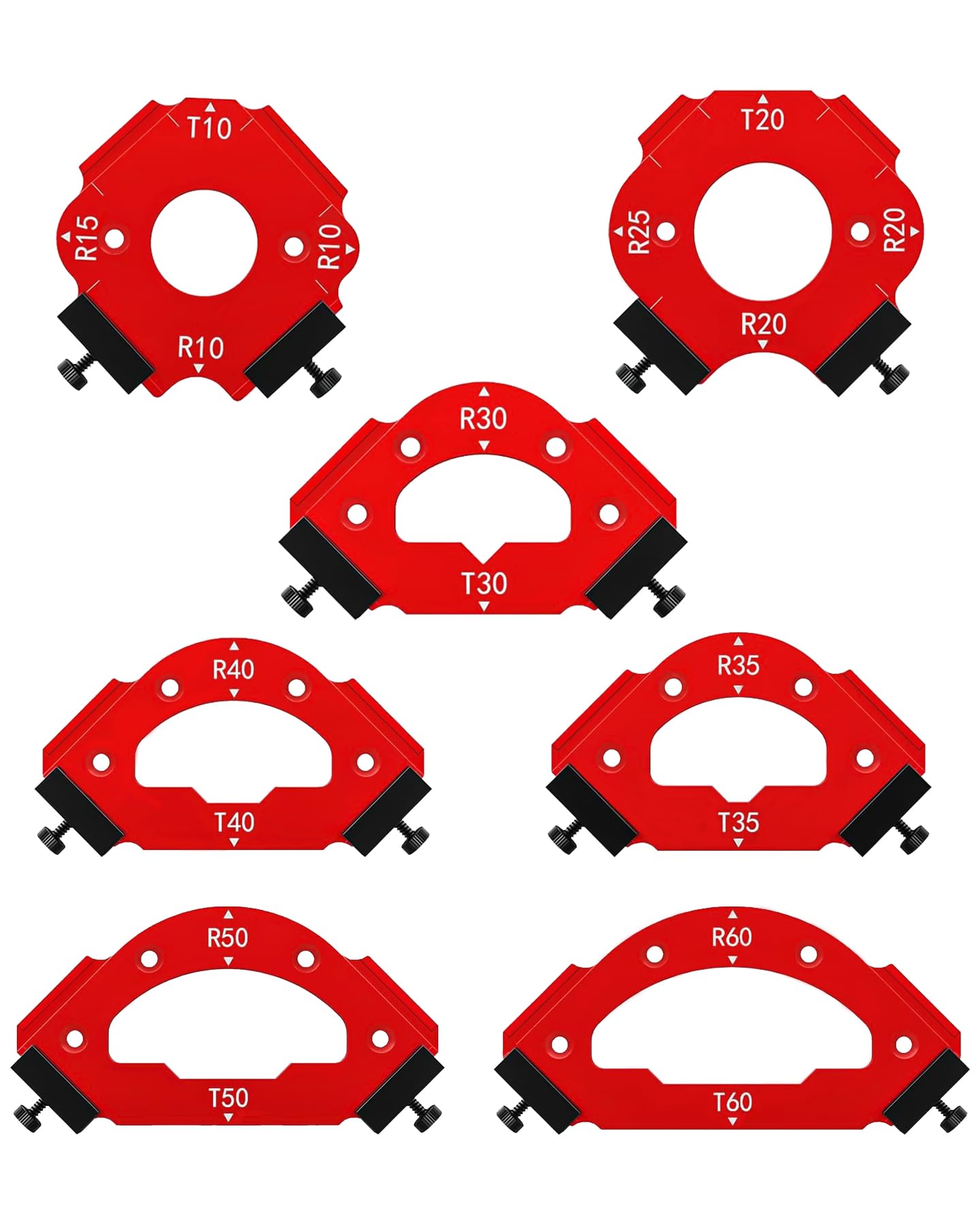
| TANYO 7pcs Radius TemplateMost Versatile | Rounded corners and edge profiles | Radius / fillet | 18 radii, R10–R60 | Aluminum | Amazon |
| Milescraft 1224Edge Work Pick | Edge work and mortises | Straight / mortise | Offset base included | — | Amazon |
| Door Hinge Jig (Gohelper) | Hinge mortises in doors | Hinge pocket | 2-1/2″ to 5″ hinges | 6061 aluminum | Amazon |
| Kreg PRS1000 | Chamfers and radius corners | Radius / chamfer | 5 radius, 3 chamfer sizes | Metal | Amazon |
| Jasper 290 | Trim and cordless routers | Circles | 1½″ to 18 3/16″ | Acrylic | Amazon |
| Jasper 300 XLC | Large tabletops and speaker cabs | Circles | 7″ to 52-3/4″ | Hardened acrylic | Amazon |
| Bora Router Dado Jig | Dados, rabbets and mortises | Straight channel | 1/4″, 1/2″, 3/4″ bits | Plastic | Amazon |
| Trend Varijig | Rectangular recesses and panel work | Square / rectangle | 23.6 x 23.6 inches | Metal | Amazon |
Detailed Reviews
1. Jasper Model 200 Circle Guide Kit
Our pick — 4.5+★ from 950+ verified ratings; the strongest balance of quality and price.
A circle jig that cuts 256 sizes without you resetting a single guess.
If your bench time goes into speaker cabinets, round inlays or decorative discs, this is the one that most often ends up mounted permanently to the router base. It swings out 256 different circle sizes from 2¼″ to 18 3/16″, stepping in 1/16″ increments — so the size you want is already a hole in the plate, not something you have to eyeball. That is the whole value: no layout, no trammel points, no trial disc in scrap first.
The kit is made from high-strength acrylic and ships with a centering calibration disc, pivot pins and all mounting hardware. That calibration disc is the quiet hero — it squares your router to the pivot point so the same setup cuts the same circle on the second pass. Owners work it with Bosch routers and plunge bases especially, and it takes a range of router sizes rather than locking you into one brand. For DIY speaker building and car audio installs, it has become close to the default choice.
Where it falls short is the small stuff, not the cutting. Value and durability both land in mixed territory in owner feedback, which for an acrylic plate is fair: treat it as a precision instrument, not a scrap-bin tool, and it holds. Also note that this is a plunge-router circle guide — a compact trim router belongs on the Jasper 290 instead. The comparisons across these picks stay strictly within each product’s own published specs. It sits at 4.5+ stars across 900+ ratings, and the crowd favorite status is earned on repeatable circle work rather than on bells and whistles.
What earns its keep
- 256 circle sizes from 2¼″ to 18 3/16″ in 1/16″ increments
- Centering calibration disc plus pivot pins for repeatable passes
- Fits Bosch and a range of plunge-router bases
Where it asks for care
- Acrylic plate wants careful storage, not rough handling
- Not built for compact trim routers
The fit: Speaker builders, inlay cutters and anyone who needs a round disc the exact size they drew.
Think twice if: Your router is a small trim or cordless model — measure the base plate first.
2. TANYO 7pcs Router Corner Radius Template
Seven plates, eighteen curves, and an end to freehand corner sanding.
Seven aluminum plates cover 18 radius angles — R10, R15, R20, R25, R30, R35, R40, R50 plus T10, T20, T30, T35, T40, T50 and T60. That matters because rounding a corner by hand means jigsaw, then sanding, then checking, then sanding again. Here you clamp the guide over the corner, tighten the screws, and run the router along the edge rail. Photo frames, table and chair edges and wood panel trimming all fall inside its range.
What buyers notice first is that it simply works, and second that setup is quick — the adjustable edge stops are the reason. The plates are CNC-machined from high-hardness aluminum alloy with an anodized surface, so wear resistance is baked in rather than painted on. This is a 7-piece set against the 1-piece single-template kits, which is the practical difference: you stop shopping for a second corner jig.
The honest catch is corner accuracy. Some cuts come off by a sixteenth of an inch on the flat sides — as buyers report, the corner accuracy gets mixed feedback, and that sixteenth will show up on a tight-fitting inlay. Check the plate is fully seated and the stops are tight before you cut. Functionality is what wins people over here, and for general woodworking the small tolerance rarely bites.
Best use of the set: Furniture edges and frame corners where you want a consistent curve on every piece without a shop-made template. The aluminum body also shrugs off the wear that softens plastic guides.
Reach for this if: You cut rounded corners on multiple sizes of stock and want one box to cover the job.
Look elsewhere if: Your work needs sub-millimeter corner joints — a fixed CNC template is the better call.
3. Milescraft 1224 Edge & Mortise Guide
One guide that rides an edge, cuts a mortise, and squeezes into narrow stock.
Mortises, rabbets, dados and edge finishing all need the router held tight against a reference face — that is exactly what this guide’s large edge surface gives you. It handles straight edges and curved ones, so radial cuts are on the menu too. The offset base is the sleeper feature: it lets you route edges and profiles on narrow boards where a full base plate would overhang and tip.
Two non-marring mortising pins come in the box, sized for cutting mortises in varying board thicknesses without marking the face you just planed. At 1.75 pounds it has enough mass to sit steady on the workpiece. Reliability is the thing owners lean on most, and the value reads well against the job it does.
Two honest notes. Setup splits opinion — some find it quick, others fight it — so read the instructions once before your first mortise. And the mounting system has drawn criticism for arriving without screws, so check the box contents before you start. The plastic body is durable enough for regular shop use, though treating the clamp faces gently will keep it flat.
Where it pays off: Any project that mixes edge work with joinery — cabinet runs, shelf dados, door frames — because you swap setup rather than swap tools. That offset base alone saves a second purchase for narrow-stock work.
Suits: Cabinet and furniture builders who cut along edges more than they cut circles.
Not for: Anyone expecting a screw-it-on-and-go install — inventory the hardware first.
4. Door Hinge Jig (Gohelper)
Hinge mortises in one pass, no chisel-and-prayer routine.
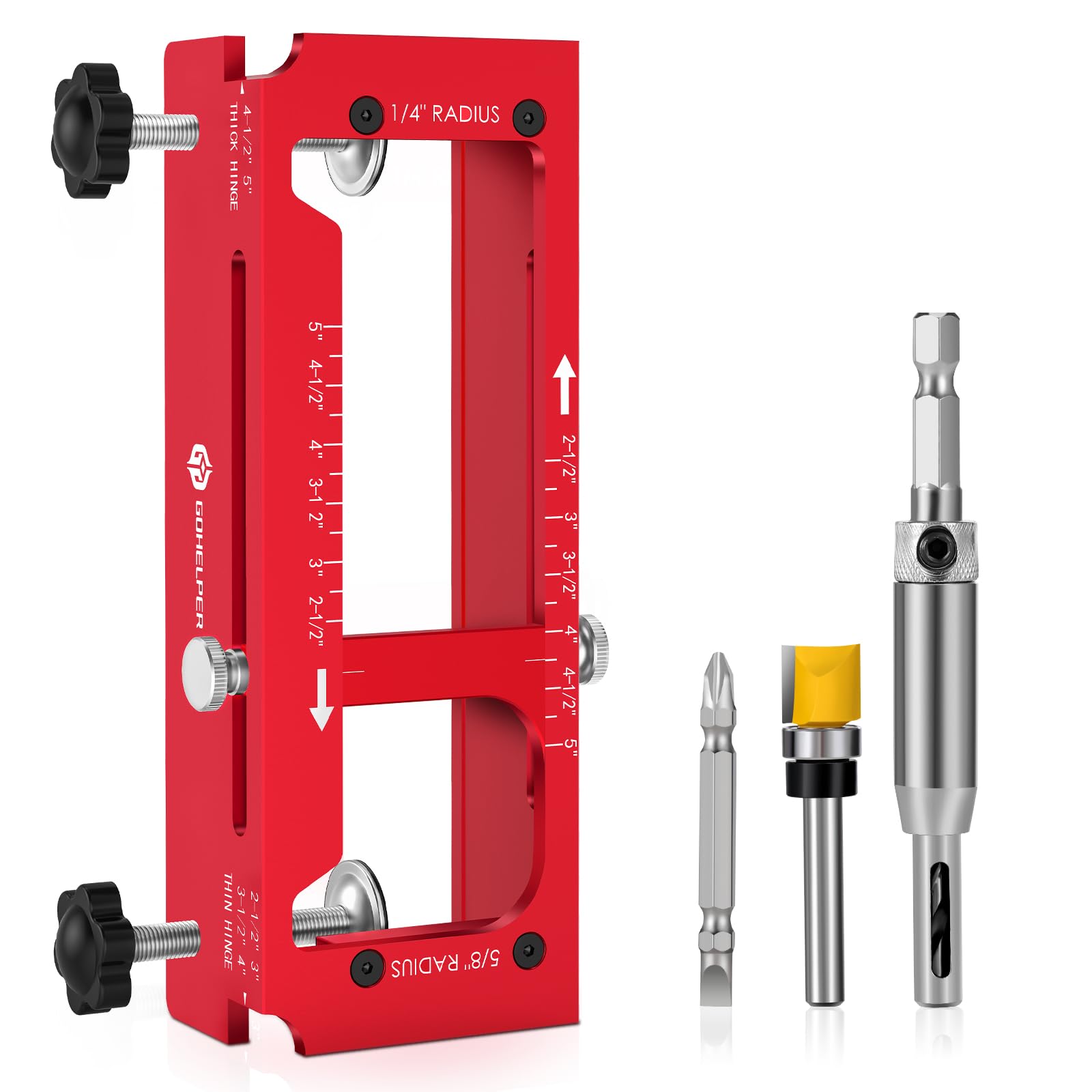
Hanging a door means cutting a hinge pocket that sits flush, and this jig clamps to the door and gives you the outline in one pass — no chiselling, no freehand routing. It takes round hinges at 1/4″ and 5/8″ radius plus square-corner hinges, and covers 2-1/2″ to 5″ hinge lengths. That spans the range you would meet on interior and exterior doors.
The build is precision-machined 6061 aluminum alloy with an anodized surface — a step up from the plastic templates that flex under a router bit. A built-in depth gauge handles thick (4-1/2″, 5″) and thin (2-1/2″, 3″, 3-1/2″, 4″) hinges, so you are not resetting depth by eye on every door. The package is complete out of the gate: the jig, a router bit, a self-centering hinge bit, a double-ended screwdriver bit and a manual.
One limit worth knowing before you order: it works on the door only, not the jamb, so a jamb-side pocket is still a separate job. It is a task-specific tool — a corner-radius jig or a circle guide is a better spend if you rarely hang doors. For DIYers and pros hanging multiple doors, the time saved per door adds up fast.
Task-specific value: Door hanging is a job most people do once or twice, so the kit completeness matters — you are not hunting for a router bit or a self-centering bit on a Saturday morning. Silicone anti-skid pads keep the jig from slipping on the door face.
Great for: Anyone hanging a run of doors or replacing a few and not owning a shop full of jigs.
Wrong buy if: You need the jamb side cut too — this covers the door only.
5. Kreg Corner Routing Guide Set, PRS1000

A corner guide built like a hand tool, with a grip that keeps the cut steady.
Corners and chamfers in one guide is the pitch here — five radius sizes and three chamfer sizes, so the shaping job is a matter of switching templates rather than switching tools. It locks to any trim router, handheld router or router table, which makes it a one-in, one-out purchase for a small shop. At 400 grams it has enough body to feel controlled on a climb cut.
Two design details earn their place. The adjustable edge stop posts sit against the workpiece edge and hold the guide square, and the GripMaxx surface bites into the stock so it does not creep during a pass. The large handle then lets you hold the guide confidently while the router does the work — that combination of grip and edge locking is why the setup stays repeatable.
What lets it down is alignment. Corner cutting draws mixed feedback and the alignment and template-alignment aspects are the recurring complaint — the guide can drift if the edge stop is not seated hard against the stock. Check that the stop posts are square before the first pass and the cut stays where you put it. It uses any trim or handheld router, so the fit range is not the issue here.
The strong side
- Five radius sizes and three chamfer sizes in one guide
- Adjustable edge stop posts hold the guide square
- GripMaxx surface stops the guide creeping mid-cut
The weak side
- Alignment can drift if the stop posts are not seated
- Corner cutting draws mixed owner feedback
Plays well with: A small shop that wants radius and chamfer work from one guide, on trim, handheld or table-mounted routers.
Pass if: You want a set-and-forget template with no alignment check before each pass.
6. Jasper 290 Circle Jig

Two hundred sixty-eight circle sizes that follow your trim router everywhere.
Most circle jigs assume a plunge base. This one is sized for the compact and cordless routers that live in a van or a small shop, with 268 circle sizes from 1½″ to 18 3/16″ in 1/16″ increments. That makes it the practical choice if you cut speaker rings or inlays with a trim router on a bench, a site, or in a cramped garage.
Two performance levels exist under the same precision. Standard uses hardened acrylic for everyday work, and PRO uses industrial-grade polycarbonate for strength and wear. Both share the same CNC-machined pivot holes and calibration disc, so the geometry is identical. The kit ships with a calibration disc, a ¼-inch centering pin, two 1/8-inch pivot pins and mounting screws — the small parts that make a jig accurate on the tenth cut, not just the first.
The compatibility check is where people get caught. It fits most compact, trim and cordless routers including Bosch Colt, DeWalt DCW600 and DWP611, Makita XTR01 and Milwaukee M18 FUEL, but it is not for full-size plunge routers. A full-size plunge user should look at the Jasper Model 200 instead. Check the compatibility chart before ordering — it is the one step that stops a return.
Why it holds up: The 290 covers the small-router owner well because it was designed around that base plate, not adapted to it. At 12.6 ounces it adds little weight to a trim router, so the whole setup stays light for overhead or cabinet work.
Fits best: Trim-router and cordless-router owners cutting speaker cutouts, rings and templates.
Check first: Verify your exact base plate against the compatibility chart — a full-size plunge router will not mount.
7. Jasper 300 XLC Circle Cutter Router Jig

For the tabletop and speaker-cab circles that other jigs cannot reach.
Once a circle gets past about eighteen inches, most jigs run out of arm. This one reaches 7″ all the way to 52-3/4″, in 1/4-inch increments, for 184 circle sizes. That covers round tabletops, big speaker cabinets and decorative discs that would otherwise be marked out with a shop-made trammel and a lot of nerve.
The plate is hardened acrylic with a built-in pivot system, and the kit ships with a precision calibration disc, pivot and centering pins, centering guides and mounting hardware. Rated Grade A and named a Top Tool Circle Routing Jig in its own product listing, it is designed to hold its accuracy once the calibration disc squares it up. Quality and ease of use are what owners lean on most here, and the circle cuts come out clean on the first pass.
The fit is the trade-off. Compatibility feedback is mixed, with some Bosch and DeWalt routers not mounting cleanly — check your base plate before ordering, because a mismatch here means an unused jig. Also weigh 1.37 pounds and a large plate: the long arm swings a wide arc, so a steady hand on a big tabletop matters. If your circles stay small, a smaller jig wins on handling.
The long-arm case: A 1.37-pound plate with an arm that reaches 52-3/4″ gives you the leverage to draw a full tabletop circle without a helper. For speaker builders who work large, this is the range that saves a shop-made template.
Right for: Round tabletops, large speaker cabinets and any circle past the reach of a compact jig.
Skip when: Your router base is not on the compatibility list, or your circles stay small.
8. Bora Router Dado Jig

Dados and rabbets cut straight, with one bushing and no drilling.
A dado is a straight channel cut across the grain, and getting it parallel to the edge by eye is how shelves end up crooked. This guide clamps to an edge and holds the router in a straight line, cutting dados, rabbets and mortises — the three joinery cuts that most build a cabinet. A 1″ standard guide bushing comes included so mounting needs no drilling or bolting.
Width settings let you cut wide dados with a 1/4″, 1/2″ or 3/4″ router bit, so one plate covers the common shelf and panel widths. The plate is 15″ by 10″ and weighs 9.6 ounces — a large surface that keeps the router steady while you guide it. It works with Bora WTX and NGX clamp edges, so it slides into that system if you already run it.
The clear limit is the router: this plate is not designed for palm routers. It is built for larger, more powerful hand-held models, so a compact trim router will not sit right. The plastic body is the other consideration — fine for the hobby cabinet, but not a lifetime metal tool.
Best fit for the bench: Cabinet and shelving builds where the dado is your most-used cut. The included bushing and the wide bit range mean you can cut a shelf dado and a narrow rabbet on the same setup.
Made for: Cabinet makers cutting shelves and panels who already run a full-size hand-held router.
Not the pick if: Your router is a palm or compact trim model — the plate will not seat properly.
9. Trend Varijig Adjustable Router Template System

A frame you adjust once, then reuse for square recesses and slot work.
Square and rectangular recesses are the awkward cut — not a circle, not a straight edge, and hard to keep tidy by hand. This adjustable frame handles them, with up to 23.6 x 23.6 inches of capacity for inlays, recesses, hinge mortises and panel routing. Once the frame is set, the dimensions hold, so the second recess matches the first.
The kit includes an anti-tilt shoe that keeps the router level as you work across edges and openings — that is what stops the bit tipping and leaving a stepped cut. Metal construction and a dual-scale guide make repeatable setups quick. The frame replaces shop-made templates for panel work and is at 4.7 pounds, heavy enough to sit stable on the bench.
Two real costs to plan for. The screws are tiny and fiddly to work with, and the clamps needed to hold the frame are sold separately. Some frames also need extra support to stay put through a long pass. Check the size of your recess against the capacity before you buy — a small hinge pocket does not need a 23.6-inch frame, and a smaller jig will set up faster.
Why pick the frame
- 23.6 x 23.6 inch capacity for panel work and large recesses
- Anti-tilt shoe keeps the router level across openings
- Dimensions hold once set for repeat recesses
Plan around these
- Tiny screws are fiddly to handle
- Clamps are not included with the frame
Comes into its own: Inlay, panel and rectangular-recess work where the same dimension repeats across a run.
Overkill for: One-off hinge pockets — a dedicated hinge jig sets up far faster.
Know the Specs
Circle range and increments
Circle jigs list a diameter range plus the step size between holes. The Jasper Model 200 runs 2¼″ to 18 3/16″ in 1/16″ increments, the Jasper 290 runs 1½″ to 18 3/16″, and the Jasper 300 XLC reaches 7″ to 52-3/4″ in 1/4-inch increments. A smaller step size means more hole choices, so the circle you cut matches the circle you drew.
Radius versus chamfer templates
Radius templates give you a fixed corner curve — the TANYO set covers 18 radii from R10 to R60 across 7 plates, and the Kreg PRS1000 covers five radius sizes plus three chamfer sizes. A chamfer is an angled cut rather than a curve, so a guide that offers both saves you buying a separate tool for each profile.
Fitting the base plate
Most jigs mount to the router base with screws, pivot pins or a guide bushing. A circle jig built for a trim router will not fit a full-size plunge base, and a large dado plate is not designed for a palm router. Check the model list against your exact base plate before ordering — the fit is the single biggest cause of an unused jig.
Material and hardware
Hardened acrylic, industrial-grade polycarbonate and CNC-machined aluminum hold accuracy better than thin plastic, and anodized surfaces resist wear. The small hardware matters as much as the plate: pivot pins, edge stops, centering discs and screws keep the cut repeatable past the first pass. A missing or flimsy part is the gripe that shows up most across kits.
Common Questions
Will the Jasper 290 circle jig fit my trim router?
How many circle sizes does a circle jig actually cut?
Can I cut hinge mortises with a radius template?
What is the difference between a radius and a chamfer?
Will a dado jig work with a palm router?
How large a recess can the Trend Varijig cut?
Do I need a different jig for each router?
Are acrylic circle jigs strong enough for regular shop use?
What is the biggest circle the Jasper 300 XLC can cut?
The Bottom Line
For most woodworkers the wood router jig winner is the Jasper Model 200 because 256 circle sizes from 2¼″ to 18 3/16″ in 1/16″ increments covers the round work that drives most buying decisions. If you cut rounded corners instead of circles, grab the TANYO 7pcs Radius Template. And for trim-router owners, the Jasper 290 is the one to reach for. If circle work is not your main cut, the right jig sits in the circle, corner, hinge or dado column — pick the column you actually use, and one jig handles it cleanly.
How we choose
We do not accept paid placement. Every pick is matched to a real buyer and a real use-case; we do not hands-on test units.
Sources
Specifications: manufacturer listings and product documentation. Review insights: verified customer reviews, as of November 2026. Pricing: not shown on this page (it changes often); check the current price via the retailer link.
As an Amazon Associate, Tactical Gear Guy earns from qualifying purchases. This does not affect which products we feature.