Specs are compiled from manufacturer listings and verified buyer reviews and can change over time — please confirm the key details on the product page before buying.
Stocking a studio means buying gear that survives back-to-back classes, holds its shape under a room full of bodies, and stays put when a student sweats through a balance pose. The picks below split into two jobs: mats you roll out for a class, and prop bundles that stock a whole shelf. Short answer: the Hatha large TPE mat is the strongest all-rounder for shared floor space, and the Manduka PROlite is the one to buy when you want a mat that simply will not wear out.
This guide is built by comparing the manufacturers’ published specifications and the patterns across verified customer reviews, so you get each pick’s real strengths and trade-offs instead of marketing spin.
Studio gear lives or dies on two things: whether the surface grips when damp, and whether the foam keeps its shape after a season of use. This breakdown covers both, with the sizes and materials spelled out so you can match props to your room. Here is the practical shortlist of yoga studio equipment worth stocking.
Top Picks


How To Choose The Best Yoga Studio Equipment
Studio buying is a numbers game before it is a taste game. Students per class set your piece count. How hard your floor is sets your mat thickness. How much sweat lands on the surface sets if you need a closed-cell mat (a mat with a sealed surface that sweat cannot soak into) or a textured one. Get those three right and the rest is preference.
Match the piece count to your class size, not your storage shelf
A 10-pack of mats covers ten students at once with nothing left over for the damaged one. A 15-piece block-and-strap set means every student in a fifteen-person class gets their own pairing. Bulk packs state their count plainly, so count your largest class and buy to that number. Extra pieces cost less per unit than reordering mid-term.
Thickness is about joints, not comfort marketing
A mat around 5mm of thickness gives most people enough cushioning on a hard floor without going wobbly in standing balances. Anything at 12 mm or half an inch is a different tool: it is for floor work, kneeling, and sitting, where the extra depth protects knees and hips. Studios usually want both a thin mat for flow and a thick one for restorative sessions.
Foam density tells you whether a block will sag under a heavier student
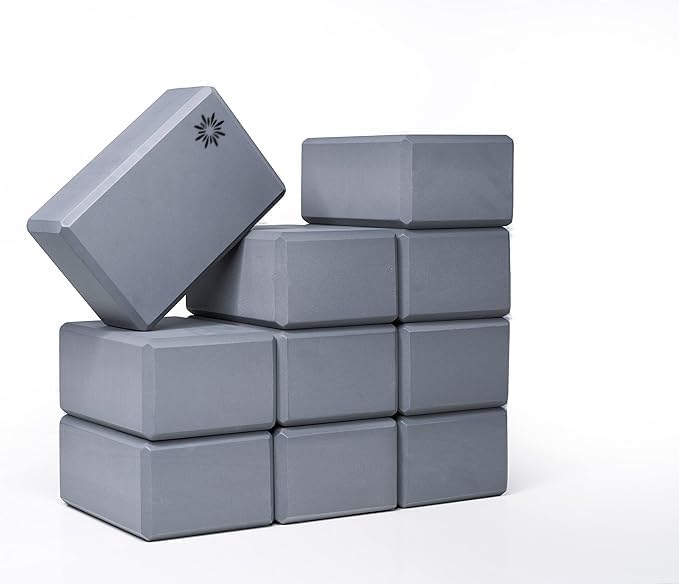
Blocks are rated by density, and higher density means the block resists squashing when someone leans their full weight on it. A firm block supports a pose. A soft one gives way and shifts the stretch. Look for a stated density rating rather than a promise that a block is “firm.”
Closed-cell versus open-cell surfaces decide your cleaning routine
A closed-cell mat has a sealed surface that blocks liquid from soaking in, so a wipe-down between classes actually works. Open-cell foam absorbs sweat and needs more attention. For a shared studio mat, sealed wins on hygiene and on how long the mat lasts before it starts to smell.
Side-by-Side Comparison
| Model | Best For | Thickness | Piece Count | Material | Amazon |
|---|---|---|---|---|---|
| Hatha Yoga Large TPE Mat★ Best Overall | Shared floor space in a small studio | 0.5″ (1/2 inch) | 1 Count | Thermoplastic Elastomers | Amazon |
| Meooeck 18 Pcs Blocks and Strap SetBest Prop Bundle | Outfitting a beginner class with blocks and straps | 4″ block depth (3″ block height) | 18 Count | 50% EVA foam, 50% cotton | Amazon |
| Sunshine Yoga Bulk 4in Foam Blocks, 10 PackHighest Rated | Straight block restock for a studio shelf | 4″ block depth | 10 Count | Ethylene Vinyl Acetate (EVA) | Amazon |
| Hugger Mugger Pranayama Bolster | Restorative and breathwork sessions | — | 1 Count | Upholstery-Grade Fabric | Amazon |
| STAASH Premium Yoga Set | A single complete mat kit for one practitioner | — | 4 Count | Polyurethane, Rubber | Amazon |
| Wettarn 15 Pack Blocks and Straps Set | Teachers running group classes and workshops | 3″ block height | 30 Count | EVA Foam | Amazon |
| Stakt The Original Foldable Yoga Mat | Teachers who travel between rooms | 12 mm laid flat | 1 Count | Ethylene Vinyl Acetate | Amazon |
| Manduka PROlite Yoga Mat | Daily studio practice that must not wear out | 4.7 mm | 1 Count | Polyvinyl Chloride | Amazon |
| Voyage 5mm Studio Yoga Mats, 10 Pack | Opening a new studio floor | 5 mm | 10 Count | 6P Free Polyvinyl | Amazon |
Detailed Reviews
1. Hatha Yoga Large TPE Yoga Mat
Our pick — 4.5+★ from 600+ verified ratings; the strongest balance of quality and price.
A six-foot by four-foot slab of cushioning that lets two people work side by side without touching elbows.
The 72″L x 48″W footprint is the headline spec. That is a mat four feet across — double the width of the roll most people own — so a student can take a wide stance or lie out full length without hanging a hand off the edge. Add the 0.5″ (half-inch) thickness and the floor stops being an issue. Knees, hips and elbows land on a high-density surface instead of tile, which is the whole reason studios keep a thick mat in the restorative corner.
Build quality is the most-praised attribute by a wide margin, drawing more than twice the mentions of the next topic. The double-sided non-slip texture does the work you need in a shared room: it grips the floor on the bottom and grips hands and feet on top, so the mat does not skate when someone steps onto it mid-flow. The material is TPE (thermoplastic elastomers — a rubbery plastic that is phthalate-free and fully recyclable), and the maker lists it as gentle on skin.
Long-term toughness is where it gives ground. Tear resistance earns mixed reports — some owners put it through heavy use with no trouble, others have found the surface scuffs or rips at a fold. A few also notice an initial smell that fades. Neither is a reason to walk away from a mat this size and this cushioned, but it is a reason to keep it out of direct sun and wipe it with cold water and mild detergent rather than scrubbing it. Store it on the two included bundling ribbons and it holds its roll instead of creasing.
What earns it the top slot
- 72″ x 48″ gives four feet of width — room for a wide stance or a partner stretch.
- Half-inch TPE padding takes pressure off joints during floor work and kneeling poses.
- Double-sided non-slip texture holds the mat to the floor as well as hands to the mat.
- 8.8 pounds stays put on the floor and rolls up onto its own two ribbons.
Where it asks for care
- Tear resistance gets mixed feedback — spot-clean and air-dry instead of scrubbing.
- Some notice a new-mat smell at first that fades with airing.
- Hand-wash only, and prolonged sun exposure is off the table.
Stock this if: you teach small-group or one-to-one sessions and want a single mat that covers a whole corner of the room.
Think twice if: you need ten mats for a large class — this is a one-count mat, and the Voyage 10-pack covers a full floor instead.
2. Meooeck 18 Pcs Yoga Blocks and Strap Set
Twelve blocks and six straps in one box — enough to hand a beginner class everything they need on day one.
Here is the useful math for a teacher: 12 EVA foam blocks plus 6 adjustable straps means six students can each have a block pairing and a strap, or twelve can share blocks with straps passed around. The blocks measure 9″ x 6″ x 3″, a standard support height that works for seated poses and under-the-hand support without being so tall it feels unstable. The straps run 8 ft with a metal D-ring buckle, so a student can lengthen the loop for a hamstring stretch and shorten it for shoulder work.
The surface is the quiet win for a shared set. EVA foam with a textured face grips skin and clothing, and the material is a 50/50 EVA foam and cotton blend that keeps the blocks light enough for one person to carry the whole carton. The 4.3-pound pack weight means a teacher can move the set between rooms without a trolley.
Where it earns its place: bundling blocks and straps together saves you the classic studio headache of ordering two separate SKUs and discovering they arrived on different weeks. One order, one count, one shelf.
The honest limit: with 60+ ratings, this is a newer addition to the prop shelf than the block-only bulk packs, so the long-term wear record is thinner. The firmness is designed for support rather than for deep squish, which some students who prefer a softer block will notice.
Pair it with your mats if: you run beginner and restorative classes where props come out every session.
Look elsewhere if: you only need blocks and already own a strap supply — the 10-pack of Sunshine Yoga blocks is the cleaner buy.
3. Sunshine Yoga Bulk 4in Foam Yoga Blocks, 10 Pack
The highest-scoring pick on this list, and the simplest: ten firm 4-inch blocks that stack and hold.
The 4-inch depth is the detail to notice. A 4″ block sits taller than a 3″ block, so it reaches the floor for a student whose hands do not comfortably land in a seated forward fold, and it works as a seat during restorative poses. The 31 Shore C density rating is the other number that matters — Shore C is a firmness scale for foam, and a higher number means the block resists squashing when weight lands on it. That is the difference between a block that supports a pose and a block that shifts out from under a student.
Beveled edges make it easier to hook a thumb around the block and to stack two together when someone needs extra height. There is no strap in this pack — it is blocks only, ten of them, individually shrink-wrapped, which is exactly what a studio wants when restocking a shelf rather than outfitting a whole class. Wipe with a dry cloth and it is ready for the next session.
Why it leads the block shelf: it holds the highest rating on this whole list, and the praise is concentrated on the two things that matter — build quality first, durability second. This is a block that arrives firm and stays firm.
What it does not do: no straps included, so if you are starting from zero props you will buy those separately. The 4-inch height is generous — a shorter student may prefer a 3-inch block for under-the-hand support.
The straightforward restock: buy this when your block shelf has gaps and you know exactly what height your students use.
Buy the Meooeck set instead if: you also need straps in the same order.
4. Hugger Mugger Pranayama Yoga Bolster

A firm, flat-topped bolster that turns a mat into a place to lie back and breathe instead of stretch.
Most studio props lift you up. This one is built to lie under the length of the spine or under the ankles, which is why the flat top and flat bottom matter — a rounded bolster rocks, and a rocking bolster under your back is a distraction. The fill is deliberately very firm, so it holds its shape under a body instead of collapsing into a pillow. Upholstery-grade fabric covers it — the durable, wipe-friendly category of cloth rather than a thin decorative weave — and the 2.7-pound weight makes it easy to move around the room one-handed.
Handles on both sides are a small thing that becomes obvious in a class: a student can reposition the bolster without getting up. The cover is machine washable, which for a shared prop in a room full of breathing bodies is not a luxury. It is handmade in the USA and comes in a plum finish that reads as a piece of furniture rather than gym gear.
What it does best: the fit is the thing that lands with owners — it suits a range of body lengths, including smaller frames that find most bolsters too tall or too wide. The flat top and firm fill hold the spine in a supported backbend instead of letting it sag like a folded blanket.
The firmness question: very firm is the point, and it is also the split in feedback — some find the support exactly right, others find it harder than they expected. If you want a soft prop to sink into, this is not that prop. Note the wash instruction says machine wash while the listing also lists it as a hand-care item, so follow the care label on the bolster itself.
Worth the shelf space if: you teach breathwork, yin or restorative sessions where students lie back for long holds.
Not your prop if: you want something cushy to sit on — the firm fill is a support tool, not a cushion.
5. STAASH Premium Yoga Set
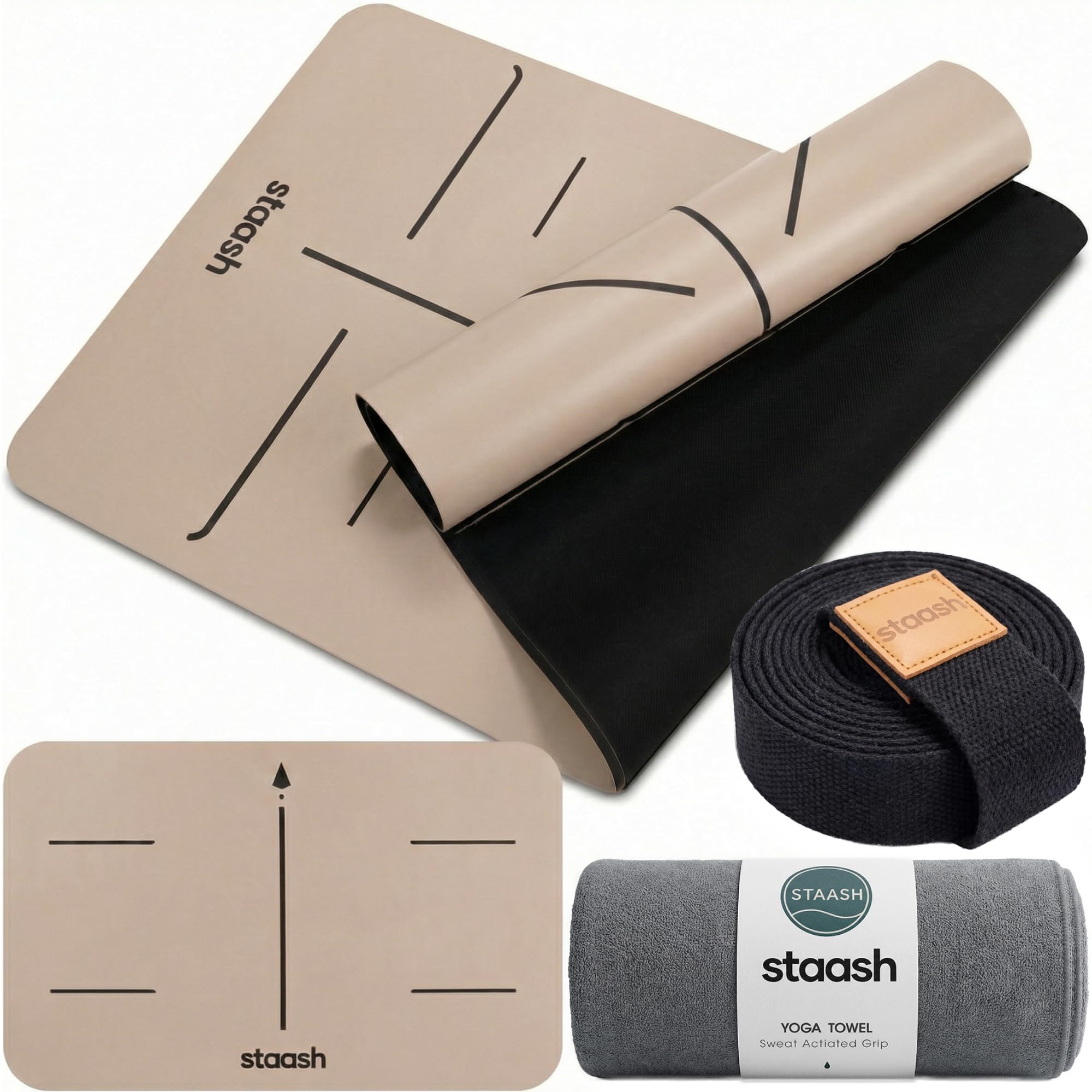
One box that covers a practitioner from mat to knee pad, with a polyurethane top that grips when hands get damp.
Polyurethane is the material worth understanding here. PU (polyurethane) is a synthetic surface that gets grippier as moisture lands on it, which is the opposite of how a plain rubber mat behaves. If your studio runs warm or your classes are vigorous, that is a real advantage over the TPE mat above — hands stay planted instead of creeping forward in a plank. The base is natural rubber, and the maker states it is free of PVC and harmful chemicals.
Four pieces arrive together: the mat, a microfiber towel, a strap and a knee pad. The knee pad is the add-on most mat buyers order later for kneeling poses, so bundling it saves a second shipment. It weighs 3.8 kg, which is heavy enough to sit flat on the floor and light enough to carry in and out of a class. The sand beige finish is a deliberate studio look rather than a gym-mat look.
The value read: buying a mat, towel, strap and knee pad one at a time costs more and arrives in four deliveries. This bundles them in one count of four and keeps the materials consistent across the set.
The catch: hand wash only, and the PU top rewards care — wipe it down rather than soaking it. At 3.8 kg it is a heavier carry than a thin travel mat, so it is best kept at the studio or at home rather than hauled on a commute.
Reach for this if: you want your own complete kit for a shared studio, ready to wipe down and roll out.
Skip the bundle if: you already own a strap and towel and only need the mat surface.
6. Wettarn 15 Pack Yoga Blocks and Straps Set for Stretching

Fifteen matched block-and-strap pairs in one carton — the set you buy once and stop thinking about.
The pairing is the logic of this pack. Each of the 15 EVA foam blocks (EVA is a lightweight, firm foam) comes with its own metal D-ring strap, so there is no scramble matching loose straps to loose blocks before a class. Every student gets a block at 9″ x 6″ x 3″ and a strap of about 6 ft — a shorter strap than the 8 ft ones in the Meooeck set, and easier for a beginner to manage without a tail of webbing on the floor. The D-ring buckle lets a student set the loop length and forget it.
This is the count that fits a real class. Thirty pieces total means a teacher running a fifteen-person session can hand out props at the door and collect them at the end without shorting anyone. The whole thing is built for sharing, storing and organizing — which is the unglamorous reason studios buy bulk in the first place.
The teacher’s angle: fifteen complete pairs remove the most common pre-class delay in a props-heavy session. Blocks and straps stay matched, and a missing piece is obvious at a glance.
Worth knowing: 30 items is a lot of storage volume, and at 3 inches these blocks sit lower than the Sunshine Yoga 4-inch depth — fine for under-the-hand support, less useful as a seat. Feedback on this pack is still building, so the wear record is shorter than the block-only bulk packs.
Built for: teachers and studio owners running group classes, workshops or school sessions who need props for a whole room.
Overkill if: you practice alone and only need one block and one strap.
7. Stakt The Original Foldable Yoga Mat
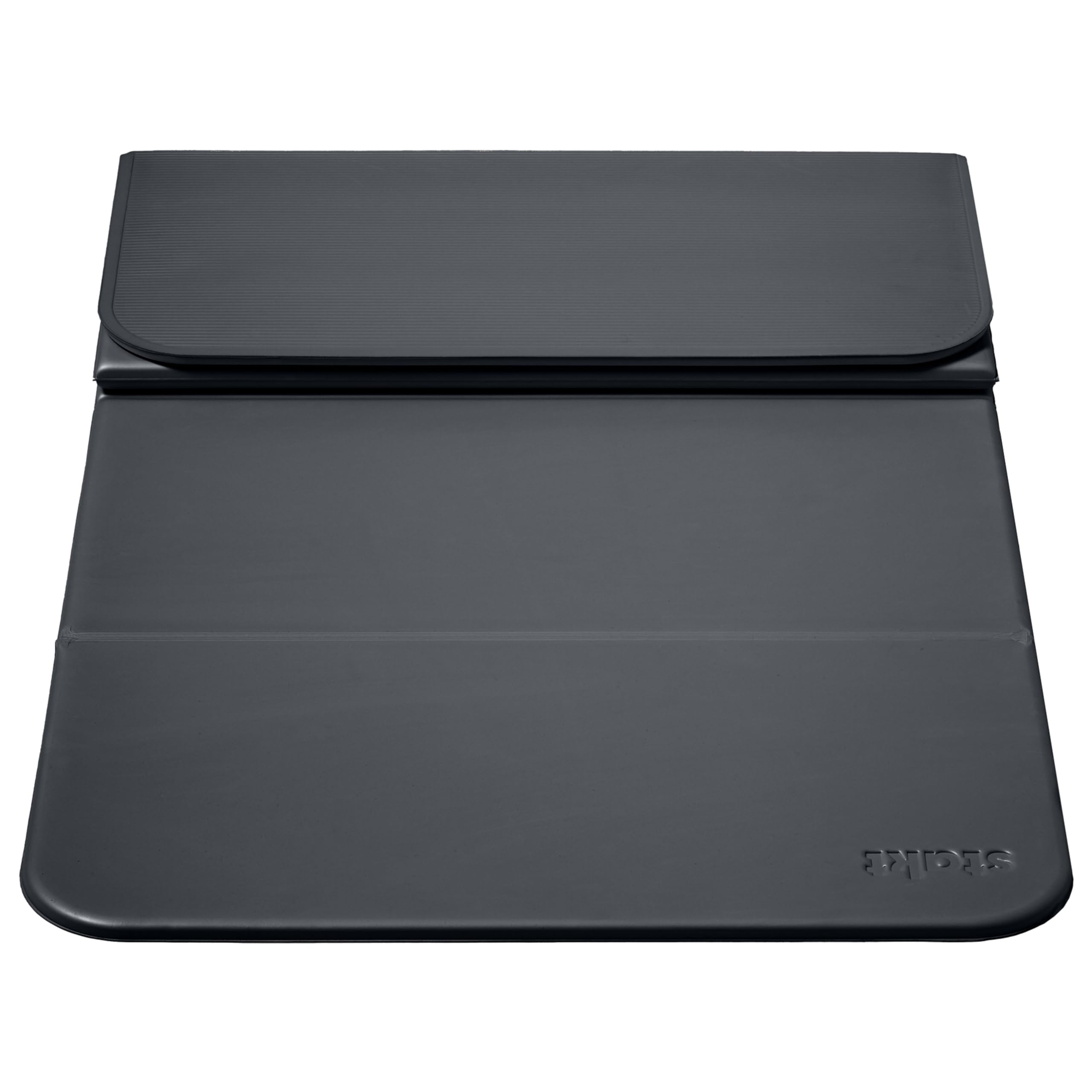
A mat that folds into its own block, so a teacher can walk into a room carrying one item instead of three.
Laid flat it is 69″ x 24″ at 12 mm of thickness — thick enough that kneeling work stops hurting, which is the reason people reach for it in the first place. Fold it and the layers stack into elevation, turning the mat into a block, a step or a meditation seat. For a teacher who moves between rooms, that replaces a mat plus a block plus a cushion with one 3-pound object that folds to 24″ x 3″ x 12″.
The folding design draws the second-most mentions after build quality — structured fold lines lay it flat instead of lumping, and it packs into a shelf gap. It is patented (Patent No. US D1,050,762 S), made from EVA and wiped clean with warm water and oil-free soap. The non-slip face keeps hands and feet from travelling during balance work.
The real win: portability without a thin, painful mat. You get 12 mm of cushioning and a block in one carry, which no other pick here does.
Where it splits opinion: durability and value both draw mixed feedback — the fold creases are the wear point over time, so store it flat or loosely folded rather than compressed. At 24 inches wide it is narrower than the 48-inch Hatha mat, so partner work is out.
Made for: travelling teachers and anyone who practices in borrowed rooms and wants props in a single bag.
Pass if: you want a wide, dedicated studio mat that stays in one place.
8. Manduka PROlite Yoga Mat 4.7mm

The mat a studio buys when it is tired of replacing mats — sealed surface, dense cushion, no-slip backing.
The specification that separates this from everything else on the list is the closed-cell surface. Closed-cell means the mat has a sealed skin rather than open pores, so sweat stays on top and a wipe actually cleans it instead of pushing moisture into the foam. In a shared studio that is the difference between a mat you can hand to the next student and one that needs a full wash. Add 4.7 mm of dense cushioning and the mat protects knees without sinking into mush under a standing pose.
The base carries a no-slip dot pattern that holds the mat to a wood or studio floor, so it does not creep during a flow. At 71″ x 24″ it is a streamlined size built for tight class settings where a wide mat would overlap your neighbor. At 4.6 pounds it is a reasonable carry to class. The material is OEKO-TEX certified PVC, latex-free, and made in an emissions-free German facility — OEKO-TEX being an independent testing standard for harmful substances in textiles.
Buyers report it takes a few sessions to break in, then grips better with use, and the wear record is the strongest argument for the spend — this is the mat people keep for years rather than seasons. The one thing to plan for is the cleaning rule: use the maker’s own mat wash, because other cleaners are not recommended for the sealed surface.
The case for buying it: it is the crowd favourite on this list by a wide margin, with thousands of owners behind the rating. For a studio replacing mats every season, the sealed surface and dense 4.7 mm cushion are what cut the rebuy cycle.
Where it falls short: 4.7 mm is thinner than the 12 mm Stakt and the half-inch Hatha, so it is a mat for practice, not for lounging on your knees. It is also the priciest mat here and it demands its own cleaner.
The long-game pick: buy this if your mats see daily classes and you want to stop rebuying.
Look elsewhere if: you need a thick, pillow-like mat for restorative floor work — the Hatha 1/2-inch gives you far more depth.
9. Voyage 5mm Studio Yoga Mats, 10 Pack

Ten mats in one carton — the fastest way to put a floor under a class that does not own a mat yet.
Opening a studio means buying mats by the room, not by the person, and this box delivers ten individually wrapped mats at 72″ x 24″ each. Taller students will thank you for the length: 72 inches means a six-foot practitioner can lie out without heels hanging off the end, and 24 inches of width keeps arms inside the mat in a wide stance. At 5 mm of thickness, the cushioning softens a hard floor during a held pose without making standing balances feel like standing on a sponge.
The construction is built for turnover. An interior fiber mesh layer runs through the mat to resist stretching and tearing, and the textured top gives grip during transitions. The closed-cell vinyl foam blocks liquid from soaking in, so a spray-and-wipe between classes is enough. The material is free from latex, lead, heavy metals and 6P phthalates. Colours vary across the pack, which owners actually like — a rack of mismatched mats looks deliberate rather than mismatched.
Quality draws the most praise, with value right behind it — ten usable mats cover a whole class in one order. The catch is weight: 36 pounds for the box means you will want a shelf and a plan for carrying them, not a single tote. The 0.2″ thickness listed in the dimensions is the compressed/rolled figure, so plan on the 5 mm stated cushioning when you are deciding, not the round-down in the spec table.
Start here if: you are opening a studio or running a rental-mats class and need a full floor this week.
Think twice if: you want a single mat for personal use with a premium grip — the Manduka PROlite is the better individual buy.
Know the Specs
Mat thickness in millimeters and inches
Thickness is the spec you feel first. A mat around 4.7 mm to 5 mm gives enough padding to protect knees and hips on a hard floor while staying stable for standing balance. A mat at 12 mm or half an inch behaves differently — it is built for floor work, kneeling and sitting, where depth protects joints. Thin and thick mats do different jobs, which is why studios keep both.
Shore C foam density on blocks
Shore C is a scale for how firm a foam is. A block with a stated density rating resists squashing when a student leans weight onto it, so it supports the pose instead of shifting. Blocks without a stated rating are a guess. Look for the number, and match block height — 3-inch and 4-inch are the two standard heights — to the students who will use them.
Closed-cell versus open-cell surfaces
Closed-cell means the mat or brick has a sealed outer skin, so liquid sits on the surface instead of soaking in. That makes a wipe-down between classes effective and keeps the mat usable far longer in shared settings. Open-cell foam absorbs moisture and needs more thorough cleaning. For a studio floor, sealed surfaces win on both hygiene and lifespan.
Piece count and pack weight
Bulk prop packs list a count and a total weight, and both matter. The count sets how many students one pack covers per session. The weight tells you whether one person can move the set between rooms. A 30-piece block-and-strap set and a 10-pack of mats both solve the same problem — outfitting a class — but they store and carry very differently.
Common Questions
How thick should a studio mat be for a class that includes kneeling poses?
Will a 4-inch yoga block be too tall for a shorter student?
How many blocks and straps do I need for a class of twelve?
What does closed-cell mean on a yoga mat and why does it matter in a studio?
Is a foldable yoga mat as stable as a flat mat for standing poses?
Can I use ordinary household cleaner on a sealed yoga mat?
Do bulk yoga mat packs come in mixed colors?
How firm should a yoga bolster be for breathwork?
What is the difference between a TPE mat and a PVC mat?
The Bottom Line
For most studios, the yoga studio equipment starting point is the Hatha large TPE mat, because 72″ x 48″ at a half inch gives you the widest, most cushioned floor space of any single mat here. If your priority is a mat that outlasts the lease, the Manduka PROlite brings a sealed closed-cell surface and 4.7 mm of dense cushioning that holds up to daily class use. And when you need to stock a room rather than a corner, the Voyage 10-pack puts ten 72-inch mats on the floor in one order.
Prop the shelf next: the Sunshine Yoga 4-inch block pack is the highest-rated pick on this entire list, and its 31 Shore C density (a hardness measure — higher holds firmer) is the reason it holds firm under weight. If you want a mat that lands in the middle of everything — grip, cushion, portability — the Stakt foldable replaces a mat, block and cushion with one 3-pound carry, which matters most if you teach in borrowed rooms.
How we choose
We do not accept paid placement. Every pick is matched to a real buyer and a real use-case; we do not hands-on test units.
Sources
Specifications: manufacturer listings and product documentation. Review insights: verified customer reviews, as of November 2026. Pricing: not shown on this page (it changes often); check the current price via the retailer link.
As an Amazon Associate, Tactical Gear Guy earns from qualifying purchases. This does not affect which products we feature.