Specs are compiled from manufacturer listings and verified buyer reviews and can change over time — please confirm the key details on the product page before buying.
You want crisp quilt seams without dragging out a full ironing board, and a wool pressing mat does exactly that. It soaks up heat from your iron and pushes it back up through the fabric, so one pass presses both sides at once. The trick is picking one thick enough to protect your table, big enough for your blocks, and honest about the wool inside it.
This guide is built by comparing the manufacturers’ published specifications and the patterns across verified customer reviews, so you get each pick’s real strengths and trade-offs instead of marketing spin.
Below you will find eight wool mats split by real jobs — travel, big blocks, appliqué, and full-table pressing. What matters is matching the mat to how you actually sew — block size, table space, and whether it travels.
Top Picks


How To Choose The Best Wool Ironing Mat
A wool pressing mat is a thick felted pad that turns any flat table into a pressing station. The wool grabs your fabric so it does not slide, and it holds the iron’s heat so your seams set flat. Buying the wrong one usually means a mat that is too small for your blocks or too thin to protect the table underneath.
Match the size to your blocks, not your shelf
An 17″ x 24″ mat handles most piecing and yardage work without repositioning. A 14″ x 14″ square sits beside the sewing machine and slips into a retreat bag. If you press long strips or full quilt widths, a 36″ x 18″ surface stops the mid-press shifting that ruins a seam line.
Look at the wool, then the thickness
New Zealand wool shows up again and again because its fibers felt into a dense, ridge-free surface. A half-inch thickness is the common benchmark — enough padding to iron on a table without scorching it. A mat with ridges or loose fibers will transfer texture into your fabric.
Decide if you need extras
Some mats arrive bare, and some ship with a travel bag, a cutting mat, an iron rest pad, or pins. If you press away from home, the bag and accessories matter as much as the wool. If the mat lives on your cutting table, spend your attention on surface size instead.
Side-by-Side Comparison
| Model | Best For | Surface Size | Thickness | Weight | Amazon |
|---|---|---|---|---|---|
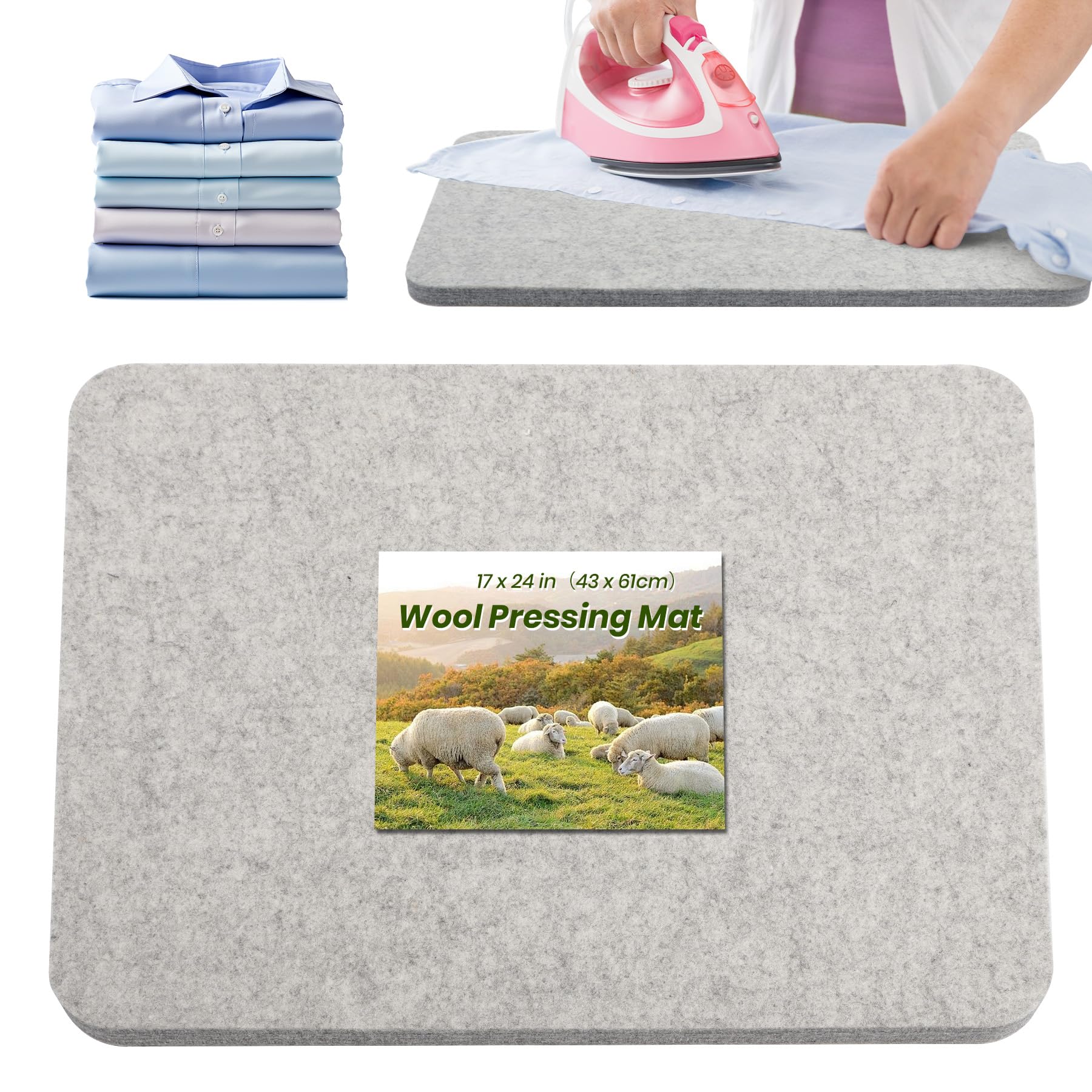
| Wool Pressing Mat Set (Deluxe 2 Pack)★ Best Overall | Two-mat setup for home and travel | 17″ x 24″ plus 10″ x 10″ | 1/2″ | 2.19 pounds | Amazon |
| oliso MultiMat Wool Pressing MatModular Pick | Building a modular pressing area | 14″ x 14″ | 13mm | 1.06 pounds | Amazon |
| BREENHILL Wool Pressing MatBest Value | Large surface on a modest budget | 17″ x 24″ | Approximately 1/2″ | 1.65 pounds | Amazon |
| Madam Sew Natural Wool Pressing Mat | Tabletop pressing at the machine | 17″ x 13.5″ | — | 1.34 pounds | Amazon |
| Rdutuok Wool Pressing Mat | Complete starter kit with accessories | 24″ x 17″ | 1/2″ | 2 pounds | Amazon |
| Applique Fusing Mat by Sewmadic | Fusible web and appliqué work | 17″ x 13 ½” | — | 1.48 pounds | Amazon |
| LMD Innovations Wool Pressing Mat | Quilt classes and travel | 17″ x 13.75″ | — | 2.8 pounds | Amazon |
| Needles Quilt Studio Wool Pressing Mat | Full-width yardage and big blocks | 36″ x 18″ | 1/2″ | 1.11 kg | Amazon |
Detailed Reviews
1. Wool Pressing Mat Set Deluxe 2 Pack
Our pick — 4.5+★ from 950+ verified ratings; the strongest balance of quality and price.
Two mats in one box: a full-size pressing surface and a small one that rides in your bag.
Two mats in one order cover both your cutting table and your travel kit, which is why this set is the crowd favorite at 4.5+ stars across 900+ ratings. You get an 17″ x 24″ wool mat for the cutting table and a 10″ x 10″ mat for retreats or a class. The 1/2″ density means you can iron directly on a bare table with no board underneath, so the wool takes that table off your setup list entirely.
What wins people over is the wool itself — pure New Zealand wool with dense fibers and a smooth, ridge-free surface, which is exactly what the largest share of buyers single out as the standout quality. The heat reflection is what you notice daily: the mat absorbs heat from the iron and radiates it back through the fabric, so seams press flat in fewer passes. On the mat set as a whole, you give up very little.
The 2.19-pound weight is not a featherweight, and against the oliso MultiMat at 1.06 pounds that difference is worth naming — the Deluxe set is the heavier of the two because you are getting two mats, not one. Fold it into the included pouch for storage, and it still fits a suitcase or tote. The occasional note about the wool’s natural smell fades; air it out before your first use.
Why this one earns the top spot
- Two surfaces in one purchase — a full 17″ x 24″ mat plus a 10″ x 10″ travel mat
- 1/2″ density lets you iron on any flat surface with no ironing board
- Heat retention presses both sides at once, cutting your passes down
- Smooth, ridge-free wool finish for a professional press
Where it asks a little of you
- At 2.19 pounds it is heavier than a single-mat purchase
- The natural wool scent needs a short air-out before first use
Grab this if: you want one purchase that covers both your cutting table and your travel kit.
Look elsewhere if: you only press at home and would rather not pay for the second small mat.
2. oliso MultiMat Wool Pressing Mat 14 in x 14 in
The mat that clicks together with its own kind, so your pressing area grows with each project.
Most wool mats are a single fixed size, but this one ships with four ProPress Links — heat-resistant silicone clips that join one MultiMat to another. You start at 14″ x 14″ beside your machine and link a second mat when a big block needs more room. Buyers call out that flexibility as the feature that sets the MultiMat apart.
At 1.06 pounds it is the lightest mat in this lineup, which makes it the easiest to carry to a retreat or stow next to a sewing machine. The 13mm wool is dense and firm, thick enough to take quilters pins straight into the surface, and the natural wool holds fabric steady so blocks do not shift or stretch while you press. It reflects heat back up for pressing both sides at once, with the crisp seams and smooth finishes you want.
One thing to plan for: each mat is sold separately, so a large pressing area means buying more than one. If you work mostly on small blocks at the machine, a single frame is plenty. If you press wide yardage, budget for a linked pair and treat it as one build-out.
The linking advantage: silicone ProPress Links join multiple mats into one slip-free surface, so the pressing area is whatever you decide it should be.
The real cost: a bigger surface is a bigger purchase — mats do not come bundled together.
Reach for this if: you press in stages and want a surface you can expand without buying a whole new mat.
Think twice if: you press long strips of yardage every week and would rather have one large mat from the start.
3. BREENHILL Wool Pressing Mat 17″x 24″
A full-size pressing surface at 1.65 pounds — easy to fold and carry to the next table.
If you want the big working area without the bulk of a heavier mat, this is the one to look at. The 17″ x 24″ surface handles most pressing tasks, and at 1.65 pounds it folds into a sewing tote or travel case without weighing you down. The wool is naturally pure and releases only the mild, earthy scent of real wool rather than a chemical smell.
The dense texture is doing the work here. It holds heat from your iron and spreads it evenly, so the fabric gets heat from both sides and you flip pieces less often. The firm felted surface takes pins, which is what you want when you are holding a tricky patchwork piece in place mid-press. For quilting, embroidery, and everyday fabric projects it is a straightforward fit.
The honest catch is the odour expectation. Wool naturally carries an earthy scent, and this mat leans into that rather than masking it. Air it out after unboxing and it settles. If you are sensitive to any wool smell at all, give it a day near an open window before the first pressing session.
Big surface, low carry weight: 17″ x 24″ at just 1.65 pounds makes this the easiest full-size mat here to pack up and move.
The scent note: pure wool means an earthy smell from the start, so give it a day to air out.
Best for: quilters who want a large pressing area they can also throw in a bag and take to class.
skip it if: any wool scent at all bothers you and you would rather have a mat that claims no smell.
4. Madam Sew Natural Wool Pressing Mat 17”x13.5”

Sized to sit right beside the machine and press blocks without dragging out a board.
This is a working mat for the sewer who presses as they piece. At 17″ x 13.5″ it fits next to a sewing machine without eating the whole table, and at 1.34 pounds it is light enough to shift around as your project changes shape. The wool absorbs the iron’s heat in its dense fibers, so the fabric gets heat from both sides and you get crisp, flat seams without scorching the table underneath.
What earns it a place here is the grip. The felted surface holds quilt blocks in place so fabric does not stretch or pucker, and it is naturally fire-resistant, which matters when you are pressing near delicate fabric. It cuts pressing time because the reflected heat sets a flat seam in fewer passes. Buyers repeatedly note that once they press blocks on this mat, setting up a full ironing board feels like extra work.
On the trade-off side, the wool smell comes up again — a mixed point rather than a fault. Give it a few days to air and it fades. If you want a larger pressing area for full-width yardage, this size runs short; it is built around blocks and piecing. For that job it is right-sized.
What makes it a tabletop staple
- 17″ x 13.5″ fits beside a sewing machine without taking over the table
- Dense wool holds blocks in place to stop stretching and puckering
- Naturally fire-resistant felt guards against scorching your fabric
- 1.34 pounds makes it easy to reposition between projects
The small print
- Wool scent is a mixed point — air it out before first use
- The 17″ x 13.5″ surface is too short for full-width yardage
Worth it for: piecing at the machine, where the block goes straight from needle to press.
Not the fit for: pressing whole widths of backing fabric, where you need the wider mats above.
5. Rdutuok Wool Pressing Mat 17″ x 24″

A 24″ x 17″ pressing mat that arrives with the tools to actually use it.
The mat itself is 100% New Zealand wool with no synthetic fillers, dense and firm, and the 24 x 17 x 0.5 inch surface gives you real room for larger fabric pieces. Where this one pulls ahead of a bare mat is the kit: a carrying bag, an iron rest pad, a measuring tape, scissors, 40 sewing pins, and a felt notions pouch. If you are starting fresh, that is most of a pressing station in one box.
The wool absorbs and holds the iron’s heat so both sides of the fabric get pressed at once, and you flip pieces far less. Pins go straight into the dense surface, which helps when you are holding appliqué or quilt pieces in position. The dimensions are the notable point against the oliso MultiMat: this mat’s 24 x 17 x 0.5 inch footprint is the more spacious of the two, and that extra working area is exactly what big blocks need.
Worth knowing before you commit: the accessory bundle is practical but basic, so if you already own good scissors and pins you are paying for duplicates. The wool smell is a mixed note here too, as it is on most pure mats. Size and quality are what most buyers focus on, and both hold up.
Choose this if: you want a large mat plus starter accessories in a single order.
Pass if: your sewing kit is already stocked and you only need the wool surface itself.
6. Applique Fusing Mat 17” x 13 ½”

Built for fusible web and hot glue, with a Teflon sheet to keep your iron clean.
Fusible web and HTV are where most pressing mats fear to tread. This set pairs a wool mat with a Teflon Applique Pressing Sheet, and the fusing mat surface is non-stick so fusible adhesives and hot glue lift away instead of bonding to the wool. Rounded corners add durability at the edges that take the wear. At 17″ x 13 ½” it is sized for portability and for block work.
The felted wool grips fabric so appliqué pieces stay put instead of slipping or distorting mid-press, and the reflected heat sets crisp iron lines. It works with a dry iron on most countertops or tables, and with a steam iron on heat- and water-resistant surfaces. Seam crispness is the thing buyers keep coming back to, and this mat delivers it.
The one limitation to weigh is surface size. At 17″ x 13 ½” this is a block and appliqué mat, not a yardage surface — if you need to press a full backing width, look at the larger mats on this list. And the Teflon sheet is a protective layer, so treat it as part of the routine rather than an optional extra.
Why it fits fusible work: a non-stick fusing mat plus a Teflon pressing sheet keeps your iron and your wool mat protected while adhesives set.
The size limit: 17″ x 13 ½” covers blocks and appliqué, not full-width yardage.
Made for: appliqué, raw-edge fusing, and anyone using fusible web or HTV on a regular basis.
Wrong tool for: pressing large quilt backings, where a wider mat saves you time.
7. 100% New Zealand Wool Pressing Mat Travel Bag

A pressing kit built around the quilt class — bag, cutting mat, and iron rest in the box.
You can carry your whole pressing setup to class, a show, or a local sewing club, and buyers name that portability as the second most-talked-about strength. The 17″ x 13.75″ wool mat, the travel bag with a zippered pocket, the cutting mat, the silicone iron rest, and two sewing tools all pack into one setup. At 2.8 pounds it is the heaviest mat here, but it is also carrying the most with it.
On the pressing side, the wool grips fabric and reflects heat upward so seams come out crisp and flat. The heat reflection also lets you run lower iron settings with little to no steam, which matters when you are working delicate appliqué pieces or small block seams away from home. It works on any flat surface — a desk, a table, or a counter top — with a mini project iron or a mini steam iron.
The honest catch is the weight. At 2.8 pounds it is noticeably heavier than the oliso MultiMat’s 1.06 pounds, so it is not the mat for someone who wants a single thin slab in their sewing bag. Cleanup is simple — warm water and hang dry. If you travel and press, the extras earn the weight back.
Packed for the road
- Travel bag, cutting mat, silicone iron rest, and two sewing tools included
- Wool grips fabric and reflects heat for crisp, flat seams
- Works on any flat surface with a mini project or steam iron
- Easy cleanup — warm water wash, hang dry
The trade-off to know
- At 2.8 pounds it is the heaviest mat on this list
- The kit is built for portability, so the mat surface is mid-sized
Pick this up if: your pressing happens away from your own sewing room and you want everything in one bag.
Leave it if: the mat stays on your table and weight is something you would rather not carry.
8. 36″ x 18″ Wool Pressing Mat

The long mat that ends the mid-press shuffle on large quilt blocks.
When a block is wider than your mat, you press part of it, slide it, and lose the seam you just set. This mat ends that. Its 36″ x 18″ surface is the widest on this list, so large blocks and big projects get pressed in one pass with no shifting mid-press. At half an inch thick, it rolls up for storage and still holds top-notch wool density for gripping blocks.
Two details set it apart from the rest. It is described as perfectly flat with no ridges, and the wool compacting technique means no stray fibers transfer onto your project — the small quality issues that ruin a clean press surface. Iron on the wool setting with steam and it holds up. It ships with a natural cotton storage bag that lets the wool breathe while keeping dust off the pressing surface.
What buyers respond to most is the quality of the wool itself, and the fit is the reason: it behaves like a better surface than a traditional ironing board for small seams. The catch is storage. Rolled up it still takes up shelf or closet space, and you need a table long enough to hold 36 inches. If you have the table length, its 36″ x 18″ surface presses a wide block in one pass without repositioning.
The wide-surface win: 36″ x 18″ means no more shifting large blocks halfway through a press.
The space cost: it rolls for storage but still needs a long table and closet shelf to live on.
The right pick when: your projects regularly run wider than a standard mat and you are tired of sliding fabric around.
Second-guess it when: counter space is tight and a compact square fits your sewing setup better.
Know the Specs
Wool density and thickness
Thickness is measured in fractions of an inch or in millimeters on the mat listings, and a half-inch felt is the common benchmark for pressing directly on a table. Density matters more than the number alone. Dense wool felt grips fabric and reflects heat; loose fibers shed onto your project and leave ridges that press into the seam. Look for phrasing like “smooth, ridge-free” and “no stray fibers” when you compare mats.
Heat reflection and both-side pressing
Wool holds the iron’s heat and radiates it back up through the fabric, which is what lets you press both sides of a piece in one pass. The practical result is fewer flips and fewer passes with the iron. On your table, this is what lets you skip the ironing board — the wool takes the heat and protects the surface under it, so the mat becomes the pressing station.
Surface size versus carry weight
The mat surface is written as length by width in inches. A 14″ x 14″ square suits the space beside a sewing machine. A 17″ x 24″ mat handles most piecing and yardage. A 36″ x 18″ mat covers large blocks without repositioning. Weight in pounds tracks how much mat you are carrying — under 1.5 pounds is easy to bag, while the heavier kits trade portability for accessories.
Accessories and the link system
Some mats ship bare, and some arrive with a travel bag, cutting mat, iron rest, pins, or a Teflon pressing sheet. A link system is the other accessory note — heat-resistant silicone clips that join multiple mats into one larger, slip-free pressing surface. If you press in stages, the link system is what lets the surface grow with your project instead of forcing a single-size purchase.
Common Questions
Do wool pressing mats really press both sides of the fabric at once?
Can I use a wool pressing mat on my regular wooden table?
Why does my wool pressing mat smell like sheep?
How long does a wool pressing mat last before it flattens out?
Can I pin directly into a wool pressing mat?
Is a wool pressing mat better than an ironing board for quilt seams?
What size wool pressing mat do I need for my quilting?
Can two wool pressing mats be joined into one larger surface?
How do I clean a wool pressing mat?
Can I use a steam iron on a wool pressing mat?
The Bottom Line
For most sewists, the strongest pick is the Wool Pressing Mat Set (Deluxe 2 Pack), because two mats in one order cover the cutting table and the travel kit — and its 4.5+ stars across 900+ ratings backs that up. If you press away from home and want it all in one bag, the LMD Innovations Wool Pressing Mat kit packs a travel bag and cutting mat with the wool. And for wide blocks that need one clean pass, reach for the Needles Quilt Studio 36″ x 18″ mat.
How we choose
We do not accept paid placement. Every pick is matched to a real buyer and a real use-case; we do not hands-on test units.
Sources
Specifications: manufacturer listings and product documentation. Review insights: verified customer reviews, as of November 2026. Pricing: not shown on this page (it changes often); check the current price via the retailer link.
As an Amazon Associate, Tactical Gear Guy earns from qualifying purchases. This does not affect which products we feature.