Specs are compiled from manufacturer listings and verified buyer reviews and can change over time — please confirm the key details on the product page before buying.
Here is the short answer: buy on navigation first, not on acreage claims. A robot mower that loses its positioning signal leaves you with an unmowed stripe down the middle of the lawn, and no amount of advertised coverage fixes that. The picks below split into two camps — satellite-guided units that shine on open ground, and camera-plus-lidar units that keep working under tree cover. Match the navigation type to your yard’s tree cover and the mowing takes care of itself.
This guide is built by comparing the manufacturers’ published specifications and the patterns across verified customer reviews, so you get each pick’s real strengths and trade-offs instead of marketing spin.
Slope rating, cutting height range, and whether the mower needs a perimeter wire decide more of your daily experience than the headline coverage figure ever will. Below you get the specs that matter, translated into what they mean on a Tuesday afternoon, so you can choose a yard robot mower that actually finishes the job.
Top Picks
How To Choose The Best Yard Robot Mower
The mistake almost every first-time buyer makes is shopping by acreage. Coverage is the least interesting number on the box, because a mower rated for a quarter acre will happily crawl your half acre over two days — it just does it in smaller bites. What you actually feel every week is whether the thing finds its way home, climbs your bank, and cuts to the length you like.
Navigation decides your whole experience
RTK means real-time kinematic satellite positioning — a fixed reference station plus satellites that pin the mower’s location to within centimeters. It works beautifully on open grass and struggles under dense canopy or along tall walls. LiDAR (a spinning laser that measures distance to nearby objects) and stereo cameras do not care about the sky at all. They read what is physically around the machine, which is why units carrying both systems cost more and wander less.
Cutting height range beats cutting width
Cutting width tells you how wide a stripe the deck lays down — a wider deck covers ground faster. Cutting height range tells you whether the machine can do the job at all. A mower that bottoms out at 1.6 inches will never give you a tight warm-season cut, and one that tops out at 2.7 inches leaves cool-season grass short in wet weeks. Check the range before the width.
Slope rating and obstacle clearance
A 45% slope rating means the mower can climb a bank that rises 45 units over every 100 units of run. Most suburban side yards sit well under that, but a drainage ditch or a steep front bank can exceed it. Look also for a stated obstacle clearance figure — that is the curb or root height the machine will step over instead of stopping and asking you for help.
Side-by-Side Comparison
| Model | Best For | Cutting Width | Cutting Height Range | Maximum Slope | Amazon |
|---|---|---|---|---|---|
| Mammotion LUBA mini 2 AWD 1500H★ Best Overall | All-round home lawns up to 0.37 acre | 7.9 in | 2.2–4 in | 80% | Amazon |
| ANTHBOT M5Easiest Start | First-time owners on small, simple yards | 7.9 in | 1.2–2.7 in | 45% | Amazon |
| Roborock RockNeo Q110HBest Under Trees | Tree-heavy yards that kill satellite signal | 8.7 in | 1.6–3.1 in | 45% | Amazon |
| Segway Navimow i105N | Reliability in a mixed-layout garden | 7.1 in | — | — | Amazon |
| Sunseeker X3 Plus | Edge cleanup along fences and walkways | 8 in | 1.6–3.2 in | — | Amazon |
| MOVA LiDAX Ultra 1000 | Two yards, front and back, from one machine | 8 in | 1.2–3.9 in | 45% | Amazon |
| Segway Navimow i210 AWD | Sloped quarter-acre with delicate turf | 7.1 in | 2–3.6 in | 45% | Amazon |
| Sunseeker X5 AWD | Half-acre lots with roots and uneven ground | 8.7 in | 1.6–3.2 in | 60% | Amazon |
| DREAME A3 AWD 2000 | Steep, hilly lots and fast recharge turnaround | 7.87 in | 1–4 in | 80% | Amazon |
| Mammotion LUBA 2 AWD 5000HX | Large properties with rough, thick grass | 15.7 in | 2.2–4 in | 80% | Amazon |
| YARBO Y40 Core Lawn Mower Pro | Acreage and four-season groundskeeping | 20 in | 0.8–4 in | 70% | Amazon |
Detailed Reviews
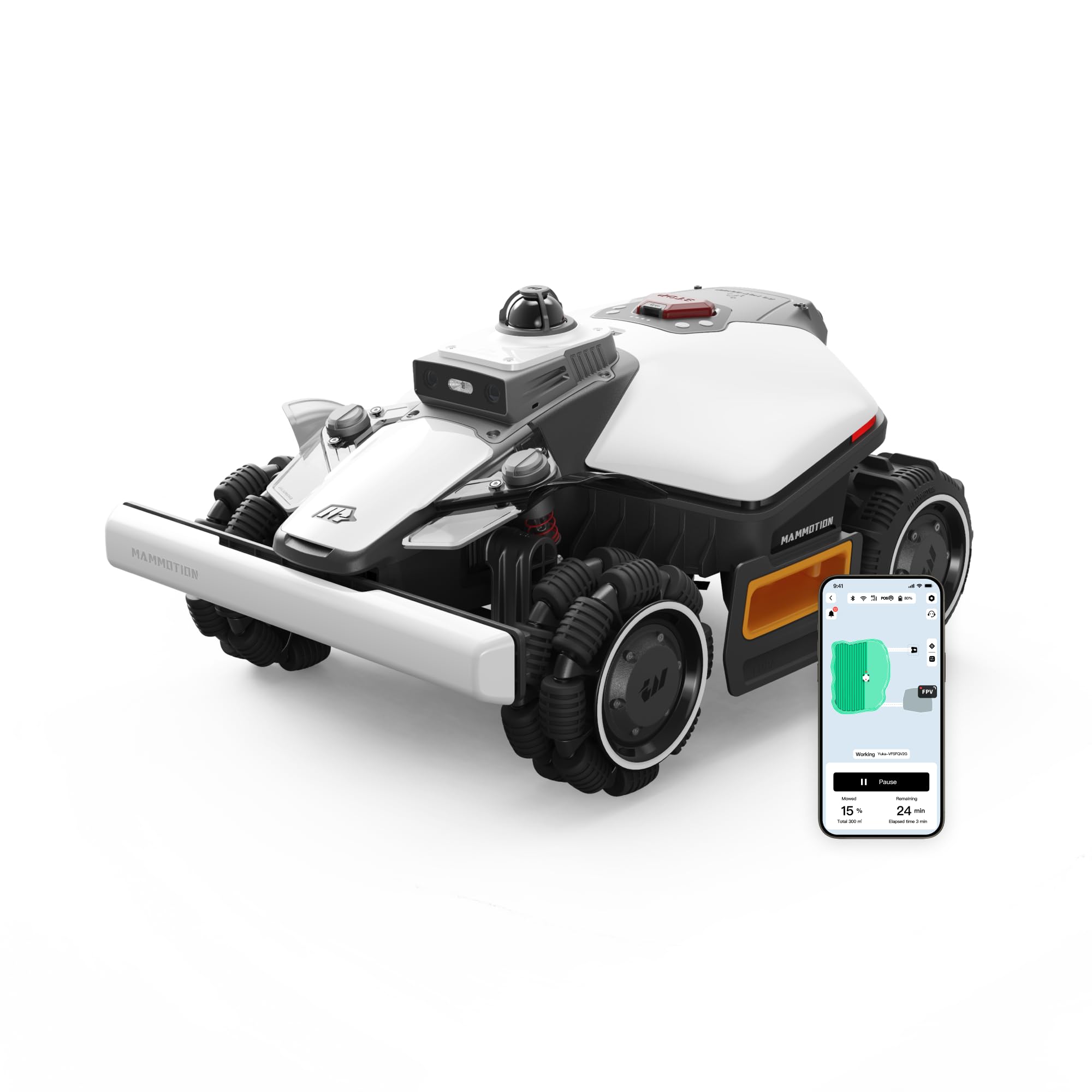
1. (2026 NEW) Mammotion LUBA mini 2 AWD 1500H Robot Lawn Mower
Our pick — 4.0+★ from 250+ verified ratings; the strongest balance of quality and price.
Climbs an 80% bank, then squeezes into a 7.9-inch edge stripe
This pick earns its spot on one number: it climbs an 80% slope gradient, driven by two independent 88W wheel motors. That is far steeper than any normal suburban lawn, and that headroom is the point — it will not stall on your one annoying bank. It also carries a 360° × 45° field of view (the full circle of vision around the deck, plus 45 degrees of vertical spread). So it spots a garden hose or a lawn chair earlier and reroutes instead of nosing into it.
Coverage is 0.37 acres across up to 20 separate mowing zones, and the mower manages them without you redrawing anything. DropMow mode is the clever bit for odd jobs: set the machine down, press the button based on the direction it happens to be facing, and it cuts that patch once without saving a map. The main cutting disc adjusts height from the app between 2.2 and 4 inches, while a dedicated side blade handles the strip where lawn meets driveway. Mammotion also lets you cap the charge level — hold it at 80% between jobs and top to 100% only before a scheduled cut — and shift charging into cheaper off-peak hours.
What wins people over is the money math: buyers report it paying for itself against monthly lawn-service bills, and setup draws the second-biggest share of praise. The honest wrinkle is stability and navigation, which read mixed rather than glowing — a small share of yards with tight geometry or tight signals give it trouble, and the app’s zone tools take a session to learn. At 4.0+ stars across 250+ ratings it is a safe bet, but it wants a mostly open lawn, not a maze of narrow passages.
What earns the top spot
- 80% slope rating is real headroom for banks most mowers refuse
- Steps over curbs, roots, and thresholds up to 45mm without stopping
- 7.9-inch cutting width with independent edge blade for clean borders
- 20 zones plus DropMow for one-off patches with no mapping
Where it asks for patience
- Stability and navigation come back mixed — complex layouts need tuning
- Top-end coverage stops at 0.37 acres, so big lots need a second pass plan
- 4-inch maximum cut height trims short for tall cool-season grass
Best fit: A yard with one genuinely steep bank, a fence line that needs a clean edge, and a few separate zones to keep straight.
Think twice: If your lawn is a jigsaw of narrow passages, expect to spend an evening tuning the zone map before it settles in.
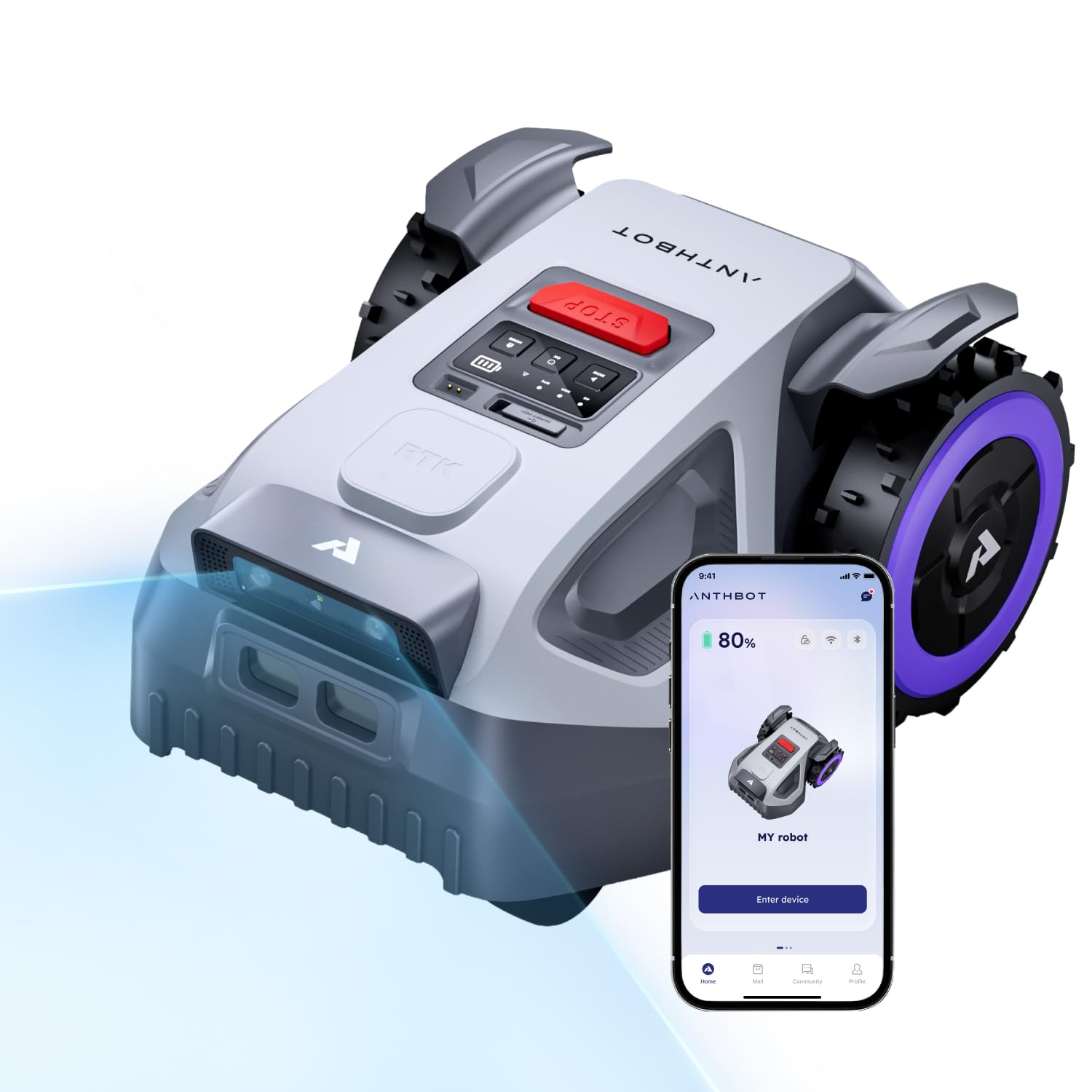
2. ANTHBOT M5 Robot Lawn Mower
Ten minutes of watching it drive itself, then the map exists
For a first robot mower, the barrier is never the cutting — it is the mapping. The M5 builds its own virtual map in the ANTHBOT app in about 10 minutes without you steering it around the property, which is the single biggest reason a nervous first-timer should start here. It recognizes more than 1,000 common garden objects through dual 150° HDR cameras (wide-angle sensors that see in high-contrast light), so toys and garden furniture get a detour rather than a collision.
Cutting height runs 1.2 to 2.7 inches — the lowest floor in this lineup, which makes it the pick for anyone chasing a tight warm-season cut. Against the LUBA mini 2 above, that range sits low at both ends: the Mammotion bottoms out at 2.2 inches and reaches 4 inches. If you keep fescue tall through summer, the M5 will leave you wanting.
Slope handling reaches 45% and coverage tops out at 0.15 acre, so this is a small-to-medium yard machine, full stop. It runs at ≤58 dB — about the level of a quiet conversation — and the self-charging cycle resumes work automatically after a top-up. The package ships in multiple boxes with the RTK reference station separate, so budget a second delivery day and read the setup steps in order before you start.
The beginner’s bargain: Unboxing-to-mowing in minutes, a low cutting floor, and quiet running make this the least intimidating entry point in the group. Setup quality is the theme that runs through owner feedback, and the cutting results get consistent approval on ordinary suburban grass.
Reach for this if: Your yard is a straightforward eighth of an acre and you want the machine to figure out the map for you.
Look elsewhere if: You need a tall summer cut — 2.7 inches is the ceiling here.
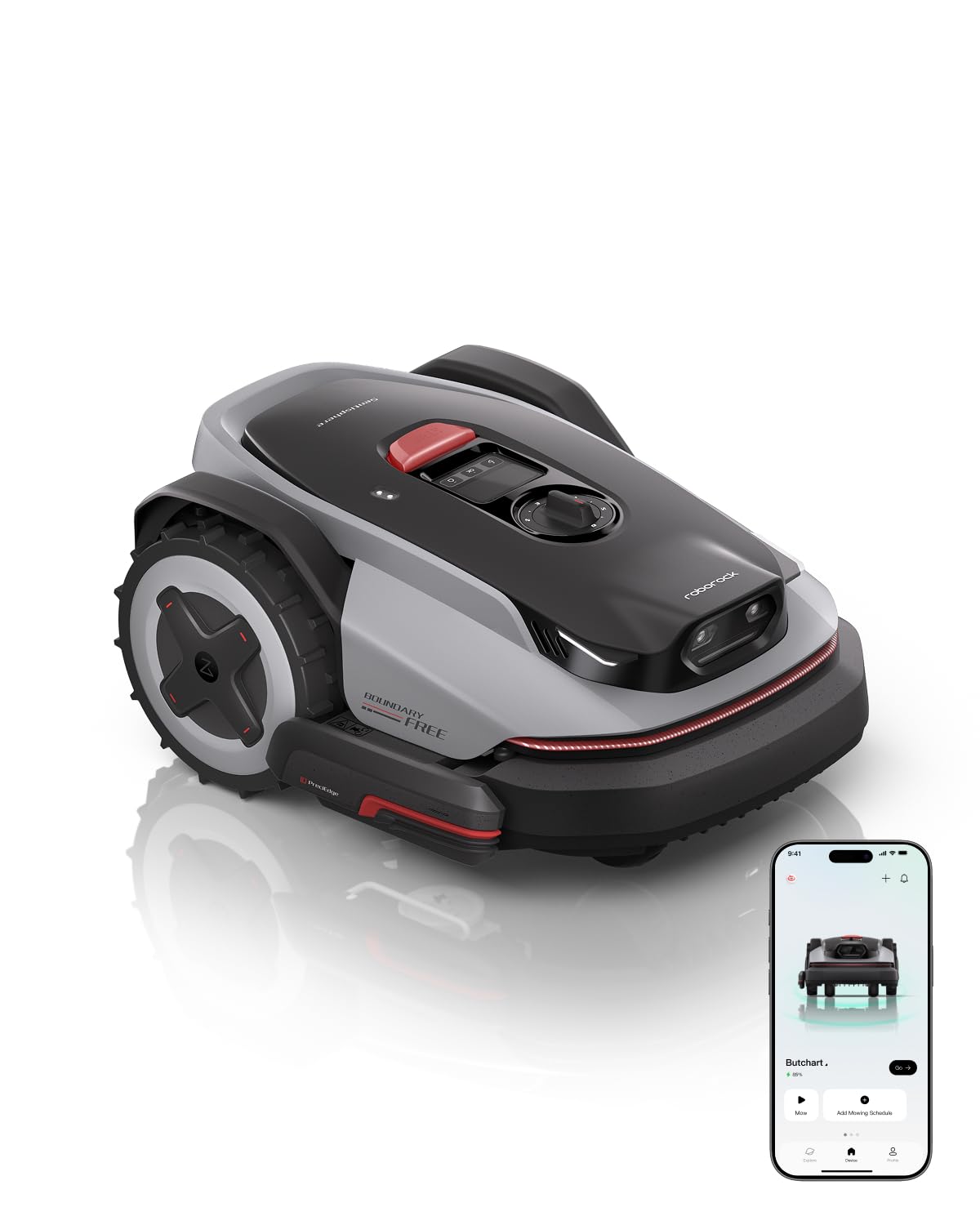
3. Roborock RockNeo Q110H Robot Lawn Mower
The widest deck in the lineup, built for yards that block the sky
Mature trees are the enemy of satellite navigation, and Roborock built around that problem directly. Full-band RTK pairs with VSLAM — visual simultaneous localization, which is the mower recognizing where it is by looking at landmarks around it — so positioning holds under canopy, alongside tall fences, and in shaded corners. It also threads passages as narrow as 2.3 ft, which is a real constraint on older properties with tight side yards.
This one lays down the widest stripe of the smaller units at 8.7 inches of cutting width. Compare that to the Mammotion LUBA mini 2 at 7.9 inches and you get a visibly faster pass over the same lawn. It is also the physically largest of the compact group, measuring 24.6 by 16.5 by 10.6 inches — worth checking against your storage shed door before ordering. Height adjusts between 1.6 and 3.1 inches, and a floating deck follows ground contours so dips do not get scalped.
Battery runs 130 minutes per cycle, and the mower handles 45% slopes plus 1.57-inch obstacles without calling for help. The honest caveat is functionality: a meaningful share of owners mention uneven results across different lawn types, so this rewards a yard that matches its design rather than one that fights it. A PIN lockout and high-decibel alarm come standard, with 4G tracking offered as a separate add-on.
Built for the hard yard: Tree cover, narrow gaps between fence and house, and shadowed corners are exactly what the RTK-plus-visual pairing is for.
The fair warning: Mixed functionality feedback in the reviews makes this the pick that most rewards an honest look at your own lawn shape before you commit.
Fits best: An established lot with heavy shade and a tight side passage where other mowers lose signal.
Not the one: For wide-open pasture-style grass, the extra navigation hardware is money spent on a problem you do not have.
4. Segway Navimow i105N Robot Lawn Mower

The track record pick: it just keeps showing up and doing the loop
Reliability is the thing owners talk about most with the i105N, and the numbers back the reputation — this is the most-reviewed machine in the whole group, at 4.0+ stars across 400+ ratings. Its EFLS 2.0 system blends RTK satellite positioning with visual correction, so a corridor between buildings or a patch under a tree still gets centimeter-level accuracy. A 140° field-of-view camera recognizes 150+ types of garden objects, and AI-assisted mapping fills in the clear edges of your lawn for you rather than making you trace every corner by hand.
Coverage is an eighth of an acre across up to 12 zones, with per-zone schedules and mowing directions so you can alternate the stripe pattern and cut down on track marks. The 7.1-inch cutting width is the narrowest here alongside the i210, so expect more passes than the 8.7-inch Sunseeker X5 — a fair trade for a machine that fits through tighter gates. A full 3-year warranty is the longest standard coverage in this lineup.
The genuine trade-off is stability: uneven ground is where this mower is most often described as struggling, and cutting performance reads mixed rather than raved about. On a flat, mostly rectangular lot it does the job unattended; on a yard with a grade or a rough patch, plan to watch the first few cycles before trusting it fully.
Why owners keep recommending it
- Most-reviewed pick in the group, with the reliability pattern to match
- Customers note it paying for itself within a single mowing season
- 3-year warranty, plus over-the-air updates for new features
- 12 zones with individual schedules and mowing directions
What to plan around
- Uneven terrain is the recurring weak point in owner feedback
- 7.1-inch width means more passes than the wider decks
- 4G anti-theft tracking is an optional add-on, not included
Good match: A flat suburban lot where dependability matters more than the fastest possible pass.
Look past it: If your yard rolls or dips, the stability feedback should send you toward an all-wheel-drive pick instead.
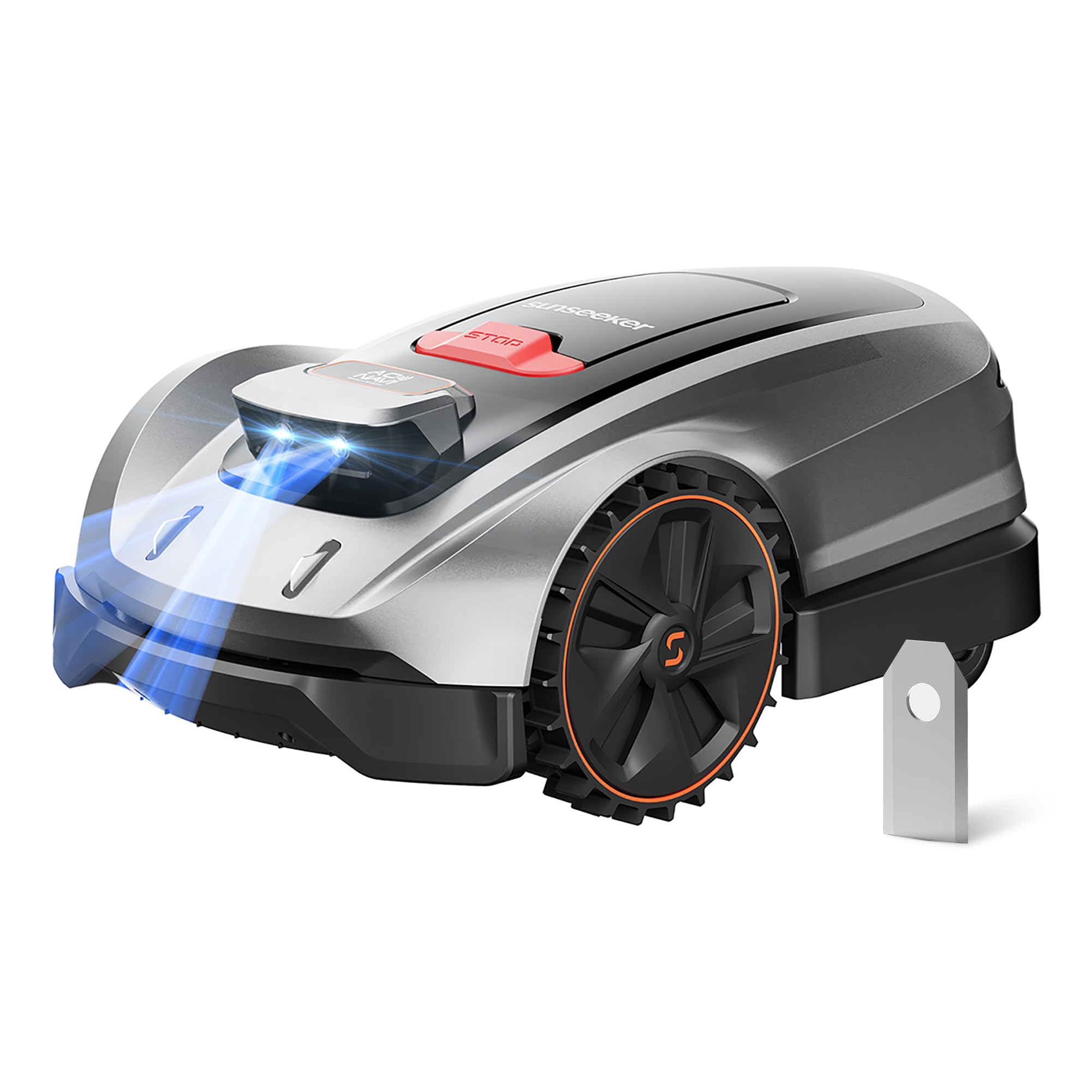
5. Sunseeker X3 Plus Robot Lawn Mower
The machine that saves you the string-trimmer lap afterward
Most robot mowers leave an unkempt fringe along fences and driveways, and you pay for that fringe every week with a trimmer. The X3 Plus uses an offset blade that rides closer to hardscape borders, so the follow-up trimming shrinks. Add 8 inches of cutting width and a height range from 1.6 to 3.2 inches and you have a deck that fits suburban front and back lawns without drama.
It covers 0.3 acre — more than twice the ANTHBOT M5’s 0.15 acre — so it suits a lot bigger than an eighth of an acre without stepping up to the pricier tiers. AONavi blends RTK positioning (satellite-based location accurate to the centimeter) with visual mapping. Camera plus ultrasonic sensing (sound-based detection) handles obstacles, so a stray hose gets a detour.
The 19.9-pound body is the lightest here, which matters more than you would think: hauling it out of a bed after winter, or lifting it over a curb to a second zone, stays manageable. Sunseeker backs it with a 2-year support window and US-based help. Mapping draws praise for being quick to establish, and traction over split zones is where the machine earns its keep.
Worth the badge: Edge-to-hardscape cutting plus a light body makes this the least tedious mower to live with weekly, even if it is not the flashiest on paper.
Buy it for: A fenced backyard and a street-facing front lawn where the border strip has always needed a second pass.
Pass on it: Very large lots — 0.3 acre is the ceiling and there is no AWD here for serious grades.
6. MOVA LiDAX Ultra 1000 Robot Lawn Mower

Two maps, no RTK station, and a cutting range that spans 1.2 to 3.9 inches
Two separate lawns, one mower: the LiDAX Ultra 1000 is the only pick here that stores two independent maps and manages up to 150 zones across them. That suits a house plus a second property, or a front and back yard you treat as separate lawns. It also drops the RTK reference station entirely. A 360° 3D LiDAR array (a spinning laser scanning the full space around the deck in three dimensions) builds the map itself with centimeter accuracy, in dim light or glare. No station to mount, no clear-sky requirement.
The cutting range is the story though: 1.2 inches at the floor, 3.9 inches at the ceiling. That spans both the short warm-season cut and the tall cool-season cut in one machine, adjustable from the MOVAhome app. UltraTrim brings the cut within 2 inches of walls and hedges, and a movable disc closes the gap on flush lawn-to-pavement edges. It handles 45% slopes and 1.6-inch obstacles on off-road wheels, and after auto-recharge it picks up exactly where it left off.
The trade-off is stability. Getting stuck occasionally and unreliable navigation show up as a genuine pattern in owner feedback, and mapping is mixed too. Treat the first week as a tuning period — walk the yard, set the no-go zones, and watch where it snags. A 3-year manufacturer warranty softens the risk considerably.
What stands out: Performance and setup both get consistent approval, and the RTK-free installation is a genuine simplification over satellite-station machines.
The catch: Stability is where this mower needs you — expect a few stuck moments before the zone map is dialed in.
Made for: Two separate lawns, or a seriously varied single yard that needs both short and tall cuts.
Wrong pick: A rough lot with lots of grade changes, where the stability feedback will bite quickly.
7. Segway Navimow i210 AWD Robot Lawn Mower

Zero-turn steering that will not scar the turf on every pivot
Here is the detail that separates the i210 from a generic all-wheel-drive mower: a concentric third wheel that lets it spin in place without scraping the grass. Most robots pivot on their drive wheels and leave swirl marks where they turn. This one does not. Automotive-grade electronic stability control — the same idea as traction control in a car, actively correcting the machine’s attitude — keeps it steady on the 45% (24°) slopes it is rated for.
You get a cut from 2 to 3.6 inches high across a 7.1-inch width — on the higher side of the compact group and matching the i105N’s narrow deck. The 5.1Ah battery covers up to 2,690 ft² per charge. An adaptive drive system feeds extra power only when the ground demands it, which stretches runtime on flat sections. Up to 20 zones get tune paths, and the mower resumes smoothly after auto-recharging.
EFLS Network RTK with one-tap auto mapping gets it deployed in minutes, and tri-frequency RTK plus vision holds centimeter-level accuracy. Real-time GPS alerts fire through the app if the machine is lifted or leaves its area. Mapping is the one place feedback splits — some setups come together instantly, others report GPS signal trouble — so site the RTK equipment carefully before you map.
Where it wins: Effectiveness is the theme in owner feedback, and the turf-friendly turning is a real daily benefit no spec sheet conveys.
Picks you right: A sloped quarter acre with turf you actually care about keeping blemish-free.
Second thoughts: If your signal environment is tricky — dense trees, tall buildings — the mapping feedback suggests a lidar-based pick instead.
8. Sunseeker X5 AWD Robot Lawn Mower

A half acre, roots and all, handled by tires built for the job
Half an acre is where compact mowers start to feel like a commute, and the X5 is built for exactly that scale — up to 21,780 sq. ft. on rugged tires with independent front suspension. The 8.7-inch floating cutting deck follows ground contours between 1.6 and 3.2 inches, so root bumps and dips get a cleaner pass than a rigid deck manages. Slope rating is 60%, and it threads passages as narrow as 31.5 inches.
RTK plus VSLAM plus Vision AI combine to keep coverage steady under trees, in shade, or wherever satellite signal weakens, and the system runs at night as well as in daylight. You get up to 5 maps with smart zones and no-go areas for flower beds and pools — all virtual, no trenching. At 60 dB it stays inside neighborhood-noise comfort, and a 2-year warranty with US-based support covers the machine.
Setup is where expectations need calibrating: quick mapping happens for plenty of owners, while others find the programming steep. Mowing performance itself, though, is the clear strength — the machine gets described as improving at reading its yard over successive runs. A 26-pound body is heavier than the X3 Plus, so plan where it lives between seasons.
What the half-acre buyer gets
- 0.5-acre coverage with 8.7-inch deck to cut the pass count down
- 60% slope rating plus independent front suspension for rough ground
- Up to 5 maps with no-go zones, all virtual
- Runs day or night at 60 dB
Set your expectations here
- Programming the zones is the steep part for some owners
- 26 pounds is a lift to move between properties or store overhead
- 3.2-inch max cut is short for tall summer grass
Right for you: A half-acre lot with roots, uneven turf, and a grade that stalls lesser mowers.
Reconsider: If you want zero learning curve on the app, the simpler compact picks ask less of you.
9. (Upgraded) DREAME A3 AWD 2000 LiDAR Robot Lawn Mower
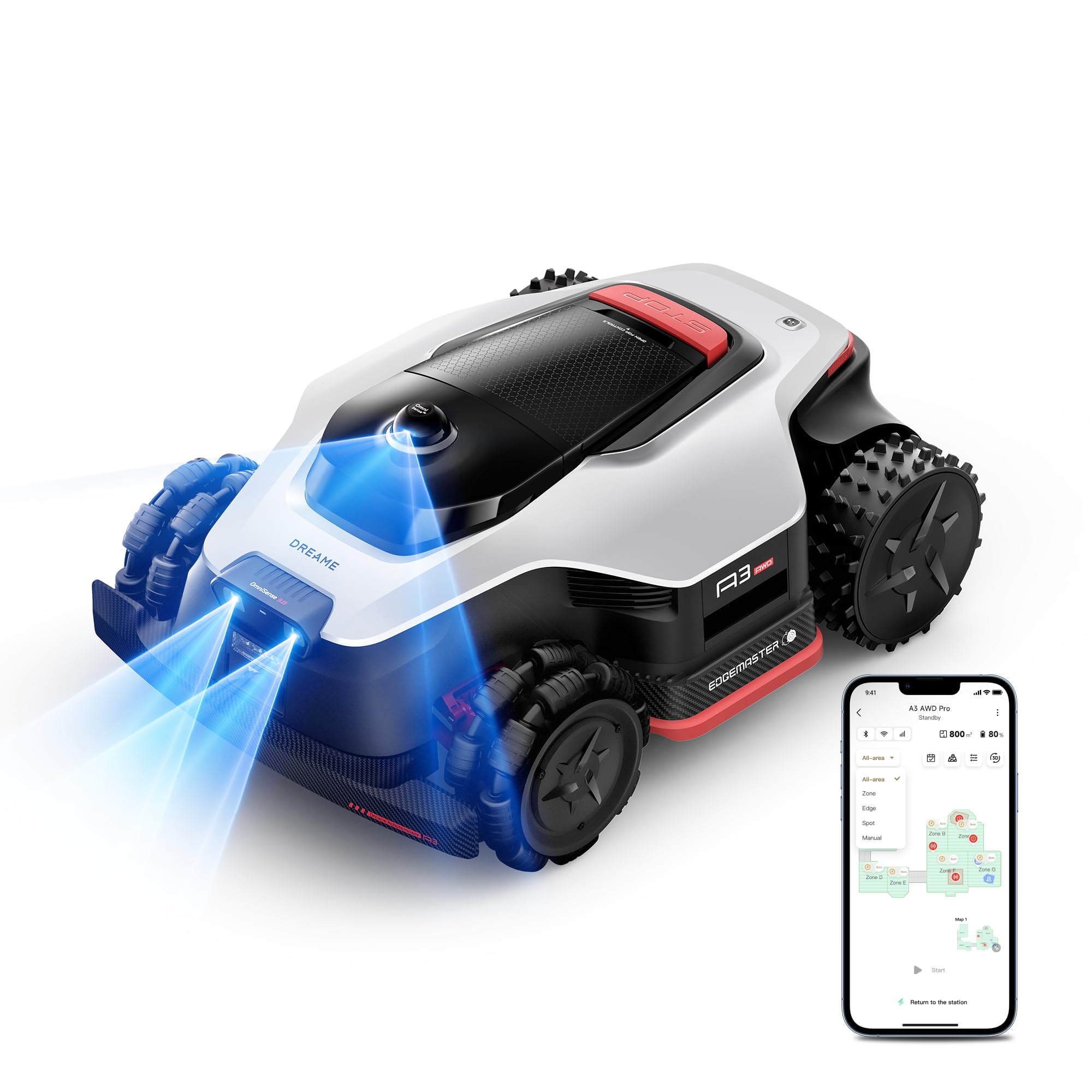
A 45-minute recharge turns a big lawn into a single-day job
The charging figure is the one that changes how you use this machine: a 5A adapter refills it in 45 minutes, which the maker rates 22% faster than the industry standard. On a 0.25-to-0.50-acre lawn that means the mower gets back to work quickly instead of sitting on the dock for hours, and the maker claims a full acre finishes in one day. Heavy-duty AWD hub motors take 80% (38.7°) inclines and step over 2.17-inch obstacles.
Navigation is RTK-free — 360° LiDAR plus binocular AI vision maps the yard in minutes and holds position under heavy tree cover or beside tall walls. It dodges more than 300 kinds of objects, from pets to garden hoses to kids’ toys. EdgeMaster 2.0 cuts within 1.97 inches of borders, and the optional trimmer module (sold separately) brings that gap under 1.18 inches. Cutting height spans 1 to 4 inches, the widest range in this lineup alongside its sibling Mammotion.
Build quality is a step up too: hard-anodized aluminum and stainless steel instead of the all-plastic shells most of these mowers use, at a hefty 53.6 pounds. A built-in 4G module and HDR camera provide real-time monitoring and theft protection, backed by a 3-year warranty and a year of free 4G service. It is the highest-rated machine in the group at 4.5+ stars, though it has the fewest ratings of any pick here — thinner proof than the long-running models, worth knowing before you lean on the score.
The recharge argument: On a large cut, fast turnaround matters more than raw battery capacity, and no other mower here refills in 45 minutes.
Worth knowing: The 4.5+ star score rests on the smallest review base in this lineup, so treat it as promising rather than settled.
Best for: A hilly half acre where the mower must get back to work fast to finish in one day.
Not the one: If you need battle-tested reliability over years of owners, the more-reviewed picks carry deeper evidence.
10. Mammotion LUBA 2 AWD 5000HX Robot Lawn Mower
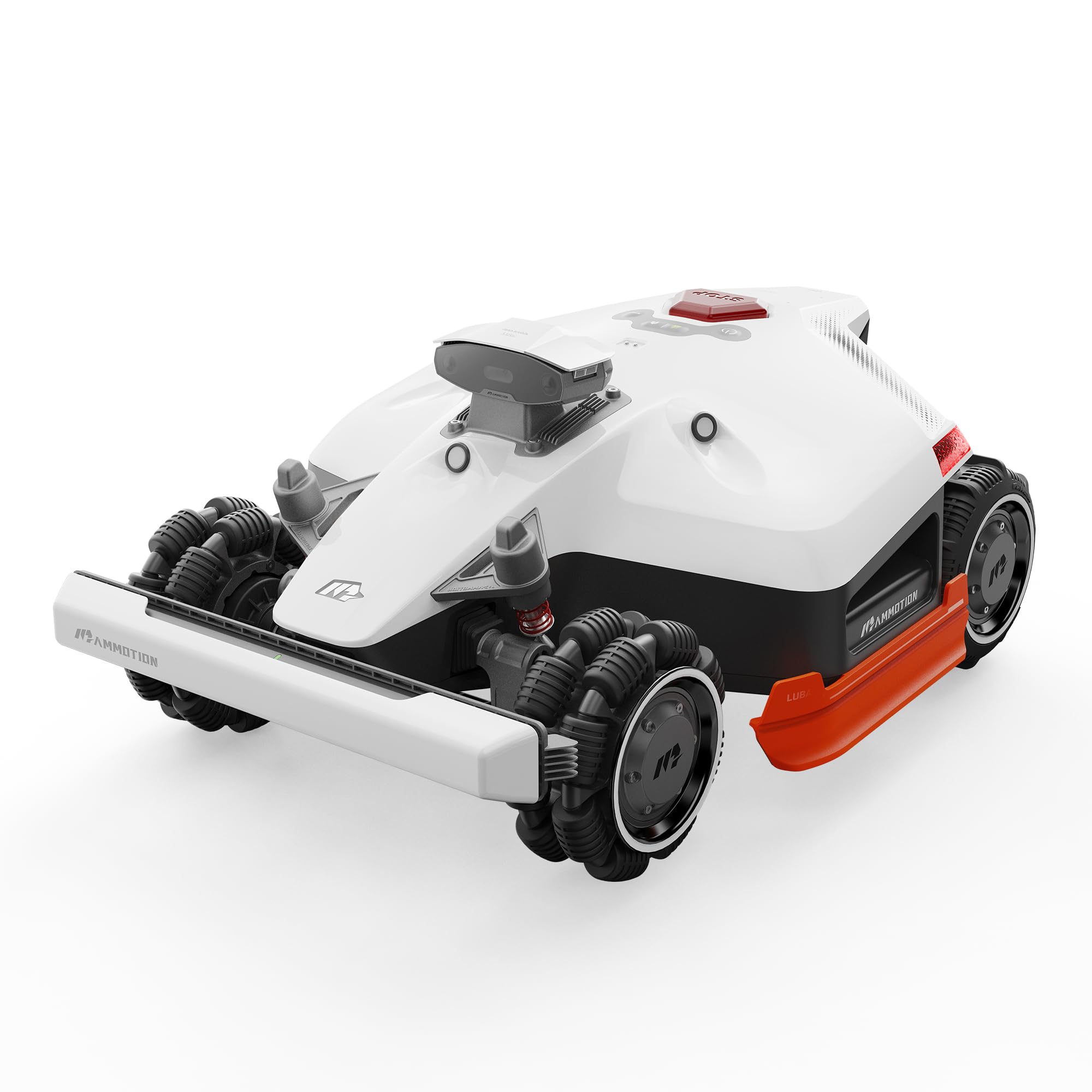
Fifteen-point-seven inches of deck and 165 watts of grip for rough ground
Cutting width is what makes a large property bearable, and the 5000HX lays down 15.7 inches per pass — double what the compact mowers manage. A 165W four-wheel motor system drives that deck across 80% (38°) slopes, potholes, and tall thick grass that stalls lighter machines. Coverage reaches 1.25 acres with a maximum of 1.48 acres, and it manages up to 50 separate mowing areas including road sides, pools, and flower beds.
Tree cover will not stop this one: UltraSense AI Vision pairs with RTK (satellite positioning) so the mower keeps working where the signal fades. It recognizes 200+ objects and picks an avoidance strategy for each. Riding-style zero-distance edge cutting trims right up to borders. Connectivity runs on 4G, Bluetooth, and WiFi, so you can check status from anywhere. The app supports mowing patterns — parallel, checkerboard, diamond grid — plus 3D lawn printing that adjusts route, height, and angle to draw shapes into the turf. Height adjusts between 2.2 and 4 inches across 18 positions.
Performance is the overwhelming strength in owner feedback, with setup the clear second; the machine simply mows whatever you point it at. Navigation and app usability are the mixed spots — the interface takes time to learn, and some yards behave better than others. GPS tracking and a “lost” mode that locks out unauthorized use handle theft protection. At 41 pounds, this is a two-person lift if you need to move it.
Why the big-property buyer picks it
- 15.7-inch cutting width halves the passes on large lawns
- 165W four-wheel drive handles 80% slopes and thick grass
- Up to 50 mowing zones across 1.25 acres
- 4G, Bluetooth, and WiFi connectivity for remote status
Know before you order
- App usability takes real time to learn
- Navigation is mixed — complex layouts need tuning
- 41 pounds is not a one-person carry
Built for: An acre-plus property with thick grass and grades, where deck width saves hours every week.
Overkill for: A small suburban lawn, where you would carry the weight without using the coverage.
11. YARBO Y40 Core Robot Lawn Mower Pro
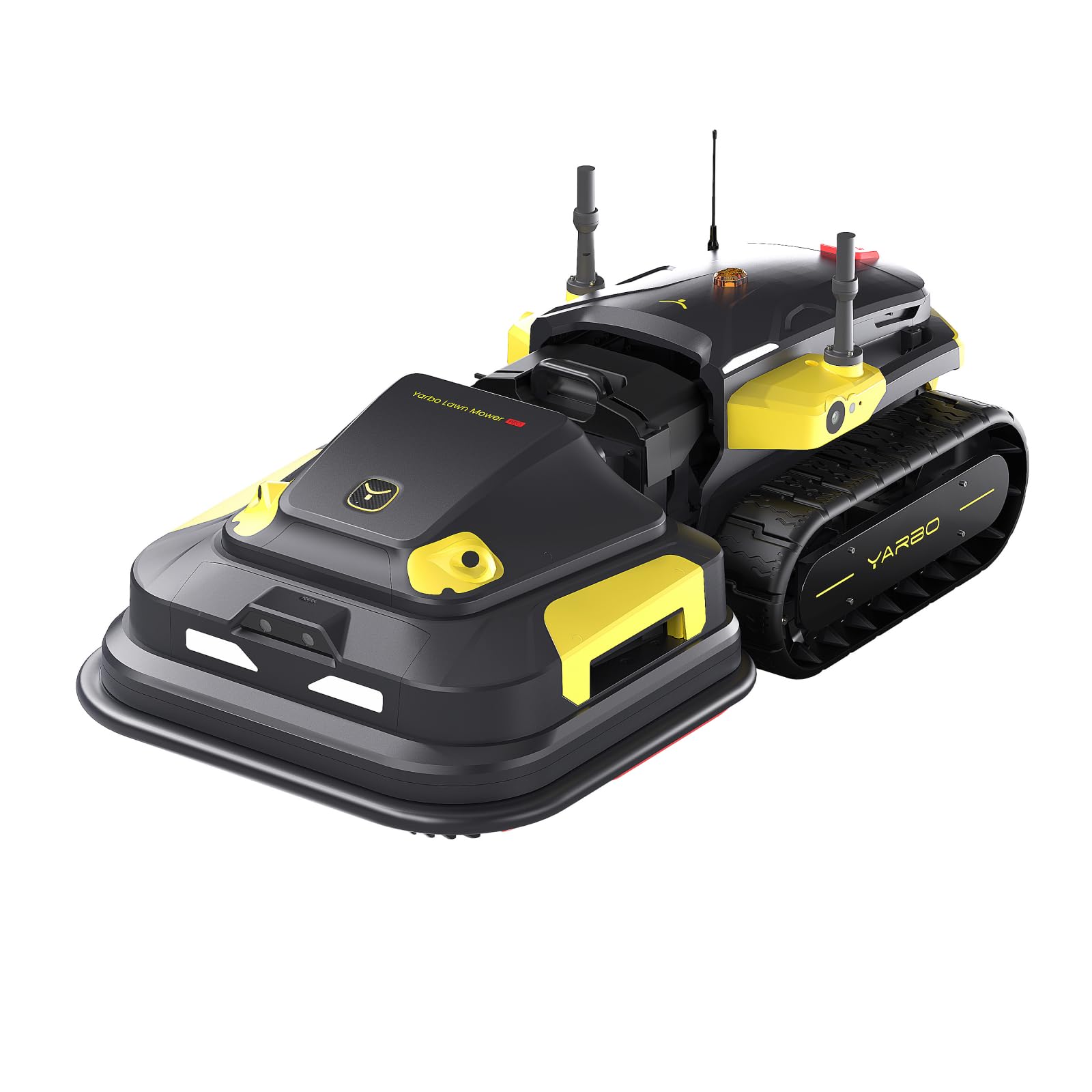
A 20-inch deck and tracks built for six acres, not six hundred square feet
This is not a lawn mower in the same sense as the rest of this list — it is groundskeeping equipment. The 20-inch cutting width is the widest here by a clear margin, and dual 300W motors drive a high-efficiency grass ejection design that keeps clippings from building up and stopping the work. Adjustable cutting height runs from 0.8 to 4 inches, the lowest floor and the tallest ceiling on the whole list, so it can scalp warm-season grass short or leave cool-season turf long in the same season.
Two blade sets come in the box — razor blades and straight blades — so cool-season grass and damp, thick warm-season grass each get the right edge. Triple-fusion navigation combines RTK-GPS with binocular vision and multi-sensor PPVS to hold position, and the binocular cameras plus ultrasonic sensors catch suspended obstacles other mowers miss entirely. Patented multi-terrain tracks and all-steel skid shoes carry it across muddy, stony, uneven ground at up to 70% (35°) climbing gradient.
Scale is the honest caveat, and it arrives in three parts. The machine weighs roughly 210 lbs and ships in four separate boxes, so two adults should plan the assembly. Installation also needs a clear 120° view of the sky for the Data Center Set, which limits where on a wooded property you can place it. Owners describe it mowing a yard across one to two days and handling hills well, though some report it stopping mid-operation. A 2-year warranty covers it, and a remote control is sold separately.
The scale story: Six acres of coverage, 20 inches of cut per pass, and a cutting range from 0.8 to 4 inches put this in a different class from every other pick.
Plan the install: Four boxes, two adults, roughly 210 lbs, and a sky view requirement — this is a project, not a same-day setup.
Right for: Large properties, turf farms, or grounds where a single machine must cover serious acreage across seasons.
Not for: A normal residential lot — the weight, the assembly, and the sky-view requirement all become friction you do not need.
Know the Specs
Navigation: RTK Versus LiDAR
RTK is satellite positioning with a fixed ground reference station, accurate to centimeters on open ground and prone to dropouts under dense canopy or beside tall walls. LiDAR is a spinning laser that measures distance to physical objects around the mower, so it does not need the sky at all. Many premium units run both — satellite for the open lawn, laser and cameras for the shaded corners. The clue to which matters for your yard is simple: count the trees and the walls.
Cutting height range in inches
The low end decides whether you can get a tight warm-season cut; the high end decides whether tall cool-season grass stays healthy through a wet stretch. A range like 1.2 to 3.9 inches covers most residential lawns. A range like 2.2 to 4 inches suits taller grass and will not scalp. Match the range to the grass you actually grow before anything else on the spec sheet.
Slope rating and climbing ability
A slope percentage describes rise over run across 100 units of horizontal distance — 45% is a noticeable bank, 80% is steep enough to feel like a hill. All-wheel-drive machines with independent motors climb higher gradients than two-wheel-drive units. If your yardhas a ditch or a side bank, match the rating to that specific slope, not to the flat sections.
Cutting width and pass count
A wider deck covers more ground per pass but needs more room to turn and stores larger. Narrow decks fit through tight gates and around complex borders. Width does not change whether the mower can do the job — only how long it takes. Balance it against your gate openings and storage space.
Wire-free setup and virtual boundaries
Burying perimeter wire is the old way; virtual boundaries drawn in an app are the current standard. Wire-free means faster installation and easier changes when you rearrange a flower bed, but it depends entirely on the navigation system holding its position. A wire-free mower that loses signal mid-lawn is worse than a wired one that never does.
Multi-zone mapping and no-go areas
Zone count tells you how many separate patches the mower can treat on its own schedule — front lawn, back lawn, side strip, a neighbor’s shared strip. No-go areas carve out flower beds, pools, and play sets so the machine never enters. If your property is split by a driveway or a fence, check the zone count before you buy.
Common Questions
Do I still need to bury perimeter wire with these mowers?
Will a robot mower work under heavy tree cover?
What slope can a robot lawn mower actually climb?
How short can these mowers cut my grass?
Does a robot mower handle thick, overgrown grass?
How many separate zones can one mower manage?
Is a robot mower quieter than a gas mower?
What happens when the battery runs down mid-lawn?
Can I move the mower to a second property or a different yard?
Do these mowers come with theft protection?
The Bottom Line
For most yards, the winner among the yard robot mower field is the Mammotion LUBA mini 2 AWD 1500H. It combines an 80% slope rating, a 7.9-inch deck with a dedicated edge blade, and 20 managed zones in one machine that handles a genuinely varied lawn. If trees dominate your property and satellite positioning keeps dropping, grab the Roborock RockNeo Q110H — its RTK-plus-VSLAM pairing (satellite plus camera-based mapping) holds position where the others stumble. And for acreage that demands a serious deck, the Mammotion LUBA 2 AWD 5000HX lays down 15.7 inches per pass with the motor headroom to keep going.
One honest note before you commit: the highest-rated machine here, the DREAME A3 AWD 2000, sits on a much smaller body of owner evidence than the long-running Mammotion and Segway models. Weigh the depth of the track record, not just the star score. Whichever you choose, match it to your trees, slope, and grass length, and the weekly mowing chore genuinely disappears.
How we choose
We do not accept paid placement. Every pick is matched to a real buyer and a real use-case; we do not hands-on test units.
Sources
Specifications: manufacturer listings and product documentation. Review insights: verified customer reviews, as of November 2026. Pricing: not shown on this page (it changes often); check the current price via the retailer link.
As an Amazon Associate, Tactical Gear Guy earns from qualifying purchases. This does not affect which products we feature.